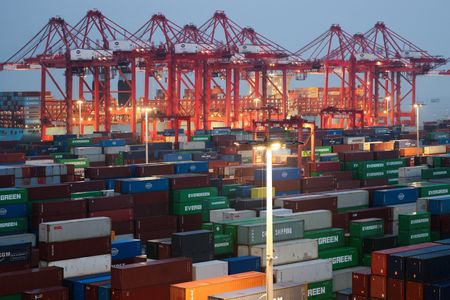

Chinese manufacturing exports experienced a dramatic acceleration in April as production facilities worked overtime to fulfill surging demand from artificial intelligence sectors and businesses stockpiling materials due to concerns that Middle East conflicts could drive global supply costs higher.
The robust export performance has expanded China’s trade surplus with the United States to $87.7 billion for the year, creating a key talking point for President Donald Trump’s upcoming Beijing visit next week for a leadership summit aimed at continuing last year’s trade ceasefire.
Although Chinese manufacturers have managed to navigate challenges from the Middle East crisis so far, economic experts caution that prolonged warfare and rising energy costs could eventually reduce international demand, leaving weak domestic spending unable to compensate for the shortfall.
Currently, economists are monitoring the speed of the artificial intelligence manufacturing surge and whether related equipment shipments can sustain China’s export momentum.
“The conflict in the Middle East pushed up demand for global manufacturing inventory replenishment, and under the upward cycle of semiconductors, imports and exports maintained a boom,” said Xing Zhaopeng, senior China strategist at ANZ.
“There is still room for expansion in this round of manufacturing cycle driven by AI, and it is expected that the annual export growth rate will be about 10%.”
Saturday’s customs data revealed exports jumped 14.1% compared to the previous year in dollar terms, significantly exceeding March’s 2.5% increase and surpassing economist predictions of 7.9% growth.
Separate manufacturing activity reports from last month indicated new export orders reached their peak level in two years during April.
Import activity also remained robust, increasing 25.3% compared to March’s 27.8% rise. Economic forecasters had anticipated 15.2% growth.
These figures pushed China’s monthly trade surplus to $84.8 billion in April, up from March’s $51.13 billion.
China’s broader economic performance showed strength in the opening quarter, with GDP expansion reaching 5% annually, matching the government’s yearly target ceiling and reducing pressure for immediate economic stimulus measures.
However, even China, frequently criticized by international partners for subsidy-supported low-cost production, faces challenges from reduced buyer spending power as fuel and shipping expenses climb.
Manufacturing data released last month indicated input costs stayed high, especially for processed goods and petroleum, coal, and chemical products.
Jobless rates also increased slightly while retail sales, measuring consumer spending, continued lagging behind industrial production.
Trump plans to meet with Chinese President Xi Jinping during his May 14-15 Beijing trip, as both nations work to stabilize relations strained by disputes over trade, Taiwan, and the Iran conflict.
Trump will likely seek trade concessions from Beijing before November’s U.S. midterm elections, though business leaders and analysts don’t anticipate major agreements.
When confronted with U.S. tariffs that temporarily reached triple-digit levels, Chinese exporters pursued alternative markets including South America by reducing prices. China concluded 2025 with a record $1.2 trillion trade surplus.