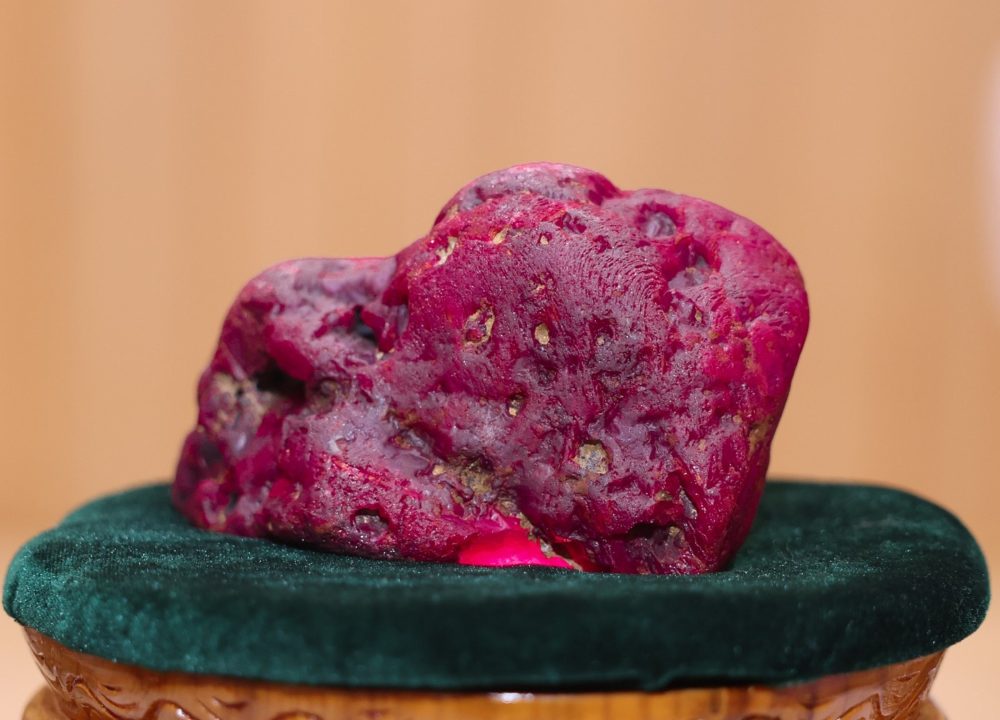

BANGKOK (AP) — Gem workers in Myanmar have uncovered an exceptionally large ruby that experts believe ranks as the second-heaviest ever discovered in the war-torn Southeast Asian country, according to state media reports released Friday.
The precious stone weighs 11,000 carats (equivalent to 2.2 kilograms or 4.8 pounds) and was found close to Mogok town in the upper Mandalay region, which serves as the center of the nation’s profitable gem extraction operations. This area has recently seen heavy combat as part of Myanmar’s ongoing civil war.
State-run Global New Light of Myanmar reported that workers found the uncut ruby during mid-April, shortly following the country’s traditional New Year celebrations.
Though the gemstone weighs approximately half as much as a 21,450-carat (4.29 kilogram or 9.45 pound) specimen discovered in 1996, experts consider this latest find more precious because of its exceptional color and clarity. The stone displays a purplish-red coloration with yellow highlights, premium color grading, moderate see-through qualities, and a surface that reflects light exceptionally well.
The nation of Myanmar supplies approximately 90% of global ruby production, with most stones coming from the Mogok and Mong Hsu regions. Both legally traded and illegally smuggled precious stones represent a significant income source for Myanmar. Human rights advocates and organizations like the British-based Global Witness research group have called on jewelry companies to boycott gems from Myanmar, arguing that the industry has provided crucial funding to the country’s military leadership for many years.
A supposedly civilian administration took power this year following elections that human rights organizations and opposition groups condemned as fraudulent. The voting restored President Min Aung Hlaing to office, the military commander who orchestrated the latest coup in 2021. He and his cabinet members recently inspected the enormous ruby during a visit to his office in Naypyitaw, the nation’s capital.
Revenue from gemstone extraction also provides essential financing for ethnic rebel groups seeking independence, which has contributed to Myanmar’s decades-long internal warfare.
Safety conditions in these mining areas continue to be unstable. The Ta’ang National Liberation Army, known as TNLA, a rebel organization representing the Palaung ethnic community, seized control of Mogok in July 2024. While the TNLA managed the mining operations after taking over, Myanmar’s military eventually regained authority through a peace agreement negotiated by China that was finalized in late 2024.