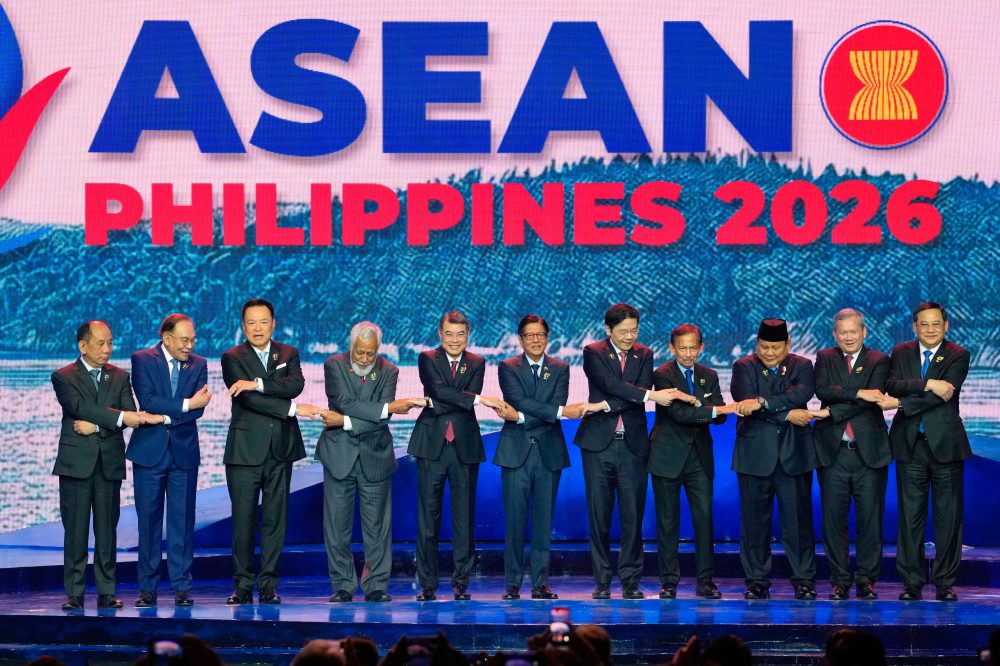

CEBU, Philippines — Government leaders from across Southeast Asia convened for their yearly conference on Friday, facing mounting concerns about how Middle East hostilities could affect their nations’ economies and populations. Thailand’s foreign minister characterized the Iran conflict as something that “should not have occurred in the first place.”
The urgency felt by Association of Southeast Asian Nations officials became evident through their decision to prioritize emergency preparedness discussions, particularly focusing on securing reliable energy and food resources for their rapidly developing region that depends heavily on Middle Eastern oil and gas imports.
The gathering took place on Cebu island in the Philippines, where President Ferdinand Marcos Jr. directed organizers to eliminate customary ceremonial elements due to global economic uncertainties.
A major concern confronting ASEAN officials involves potential mass evacuations from Middle Eastern countries, where over one million Southeast Asian workers currently reside, should conflicts escalate significantly.
Multiple Southeast Asian nationals have lost their lives following military actions launched by the United States and Israel against Iran on February 28. Intermittent fighting has persisted despite a ceasefire agreement established a month ago, particularly around the crucial Strait of Hormuz.
According to a preliminary joint statement reviewed by The Associated Press, the emergency strategy urges the organization’s 11 member countries to coordinate information sharing and strengthen partnerships with global organizations “to ensure the safety and welfare of ASEAN nationals in affected areas.”
While ASEAN representatives typically employ measured diplomatic language, Thailand’s foreign minister Sihasak Phuangketkeow spoke more directly, advocating for an indefinite extension of the current U.S.-Iran ceasefire and guaranteed safe maritime passage through the Strait of Hormuz.
“This war should not have occurred in the first place,” Sihasak stated during a brief AP interview, emphasizing that all ASEAN nations share these concerns. “We don’t know what the objectives are right?”
“The peace talks seem to be moving but we want the war to end,” Sihasak added.
The regional emergency strategy encompasses several initiatives, including potentially approving an emergency fuel-sharing agreement this year, developing an interconnected power network, expanding crude oil supplier diversity, encouraging electric vehicle adoption, and exploring emerging technologies such as civilian nuclear power.
While Middle Eastern concerns dominated the abbreviated summit designed to reduce expenses, leaders also addressed ongoing regional tensions, including South China Sea territorial disagreements with Beijing, Myanmar’s five-year internal conflict, and recent border disputes between Thailand and Cambodia.
In a forthcoming maritime policy statement, leaders committed to “endeavour to conclude the negotiation of an effective and substantive Code of Conduct in the South China Sea.”
Discussions regarding this proposed non-aggression agreement between ASEAN and China have continued for over ten years amid escalating confrontations, particularly between Chinese and Philippine maritime forces.
These prolonged negotiations have fueled criticism of ASEAN as an ineffective forum where officials gather annually in traditional attire for symbolic unity photographs despite underlying disagreements.
Four ASEAN members—Brunei, Malaysia, Vietnam, and the Philippines—are directly involved in the longstanding South China Sea disputes. The remaining regional partners include Cambodia, East Timor, Indonesia, Laos, Myanmar, Singapore, and Thailand.