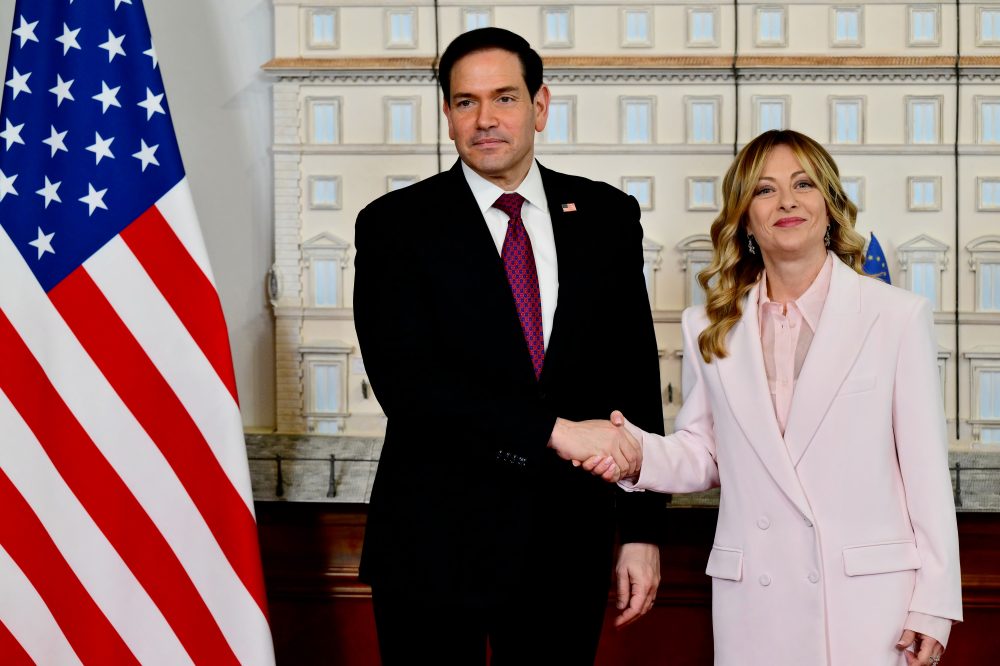

U.S. Secretary of State Marco Rubio concluded his diplomatic mission to Europe on Friday, meeting with Italian officials in an effort to rebuild relationships strained by recent conflicts and policy disputes.
Italy’s Foreign Minister Antonio Tajani emphasized the mutual dependence between Europe and America during his discussions with Rubio, expressing optimism that the visit had helped ease recent diplomatic friction.
“I believe things can go in the right direction,” Tajani stated. “I am convinced Europe needs America — Italy needs America — and the United States also needs Europe and Italy.”
Tajani expressed hope that “tensions have been calmed” following Rubio’s diplomatic outreach. The foreign ministers addressed multiple international issues, including the Iran conflict, developments in Lebanon, and situations in Venezuela and Cuba. Rubio also scheduled meetings with Italian Premier Giorgia Meloni.
The diplomatic tensions stem from President Donald Trump’s trade policies, European reluctance to support U.S. efforts in the Iran conflict, and Trump’s criticism of Pope Leo XIV, creating friction between the historically allied nations.
Meanwhile, Rubio indicated that U.S. officials expect Iran’s response to ongoing diplomatic negotiations later Friday. “We should know something today,” said Rubio, who also serves as White House national security adviser. “I hope it’s a serious offer. I really do.”
The fragile ceasefire in the Iran conflict faced additional pressure Friday as the United Arab Emirates faced missile and drone attacks, occurring just hours after American forces prevented strikes on three Navy vessels in the Strait of Hormuz and launched counterattacks against Iranian military installations.
No immediate damage reports emerged from the UAE incidents. Despite continued military exchanges, Iran and the United States have managed to avoid returning to full-scale warfare while negotiators work toward a resolution.
Key unresolved issues include Iran’s nuclear program, which prompted the U.S.-Israeli military action beginning February 28, and control of the Strait of Hormuz, a crucial shipping route that Iran has largely blocked to pressure the global economy.
Iranian officials announced Thursday they were reviewing the most recent American proposals for ending hostilities, delivered through Pakistani mediators.
In separate domestic developments, a federal judge in New York declared the Trump administration’s cancellation of over $100 million in humanities funding unconstitutional Thursday. U.S. District Judge Colleen McMahon ruled that the Department of Government Efficiency lacked authority to terminate the grants and permanently prohibited the administration from ending the funding.
The ruling favored The Authors Guild and other organizations whose grants were eliminated. Government attorneys had defended the cuts to more than 1,400 congressionally approved grants as legitimate implementation of Trump’s directives to eliminate diversity, equity and inclusion programs and reduce discretionary spending.
Additionally, a federal trade court struck down Trump’s global tariffs Thursday in a 2-1 decision. The Court of International Trade in New York determined the 10% worldwide tariffs exceeded presidential authority granted by Congress, ruling them “invalid” and “unauthorized by law.”
These tariffs were implemented after the Supreme Court invalidated broader tariffs in February. The administration is expected to appeal the decision.
In an unscheduled appearance Thursday, Trump visited the Lincoln Memorial to inspect the Reflecting Pool after having it coated in what he calls “American flag blue.” The nearly $2 million project replaced the pool’s original gray stone color, which Trump criticized as inadequate.
“It never had the color people wanted, but now it’s going to have the great color,” Trump declared, surrounded by Cabinet members including Interior Secretary Doug Burgum and Homeland Security Secretary Markwayne Mullin.