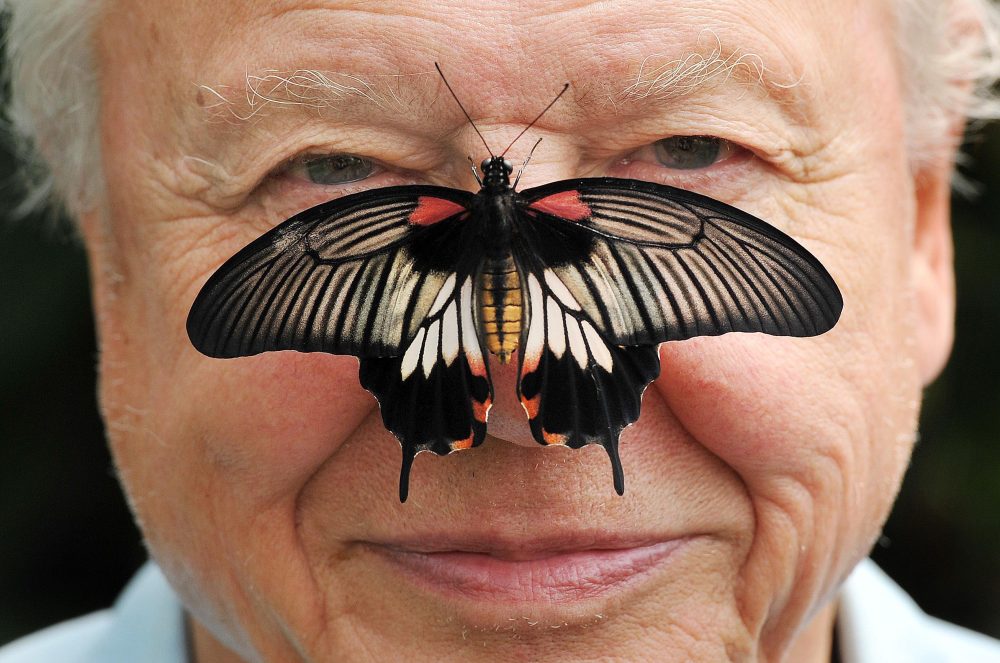

LONDON — The BBC organized a celebration at London’s Royal Albert Hall, movie theaters showcased his wildlife documentaries, and colleagues spent weeks honoring the renowned naturalist as Sir David Attenborough marked his 100th birthday on Friday.
However, the globally recognized wildlife broadcaster likely felt uneasy about all the fanfare surrounding his centennial celebration, according to Alastair Fothergill, who has produced several of Attenborough’s most celebrated documentaries.
“He’s always been very clear to all of us that work with him: ‘Remember, the animals are the stars, I’m not,’” Fothergill told The Associated Press. “So, yes, surprisingly for one of the most famous men on the planet, he doesn’t like being famous at all.”
Nevertheless, Attenborough had to embrace the recognition this week as researchers, government officials, and environmental advocates honored the broadcaster who has delivered playful gorillas, jumping whales, and miniature toxic frogs into households across the globe for more than seven decades.
Using BBC series including Life on Earth, The Private Life of Plants, and The Blue Planet, Attenborough has revealed nature’s magnificence, intensity, and occasional strangeness through his quiet, musical narration that expresses his personal wonder at the scenes before him.
Audiences who might never venture beyond their local communities were taken to the Himalayas, the Amazon rainforest, and the uncharted woodlands of Papua New Guinea. Behind the remarkable footage lay a dedication to scientific precision that educated viewers about complicated topics including evolution, wildlife behavior, and ecosystem diversity.
As scientific evidence accumulated, he started warning about climate change, marine plastic pollution, and other human-driven dangers to our planet.
This approach helped audiences grasp not just how species developed but, more crucially, the importance of conservation efforts, explained Ben Garrod, an evolutionary biologist at the University of East Anglia and fellow broadcaster who has collaborated with Attenborough.
According to Garrod, Attenborough originally viewed himself as an impartial observer but felt obligated to advocate when he witnessed that political leaders, corporate executives, and citizens weren’t treating the crisis with appropriate urgency.
“He is showing you the majesty, the ferocity, the fragility of the natural world. He shouldn’t have ever had to have turned to policymaking and advocacy,” Garrod said.
“I think it’s very easy for a lot of people to say, ‘He should have done it sooner. Why didn’t he act 20 years, 30 years, 40 years ago?’” Garrod then asked: “Why didn’t we?”
Attenborough entered the world in London on May 8, 1926, sharing his birth year with the late Queen Elizabeth II. He grew up on the campus of what is currently the University of Leicester, where his father held an administrative position.
His passion for the natural world emerged during childhood, when he would bicycle through nearby rural areas collecting treasures like empty bird nests, snake skin that had been shed, and most significantly, fossils.
“I’d find a fossil and show it to my father and he’d say ‘Good, good, tell me all about it.’ So I responded and became my own expert,” Attenborough told Smithsonian Magazine in 1981.
He continued his education by studying geology and zoology at the University of Cambridge.
Attenborough began working at the BBC in 1952, handling behind-the-scenes duties on “everything from ballet to short stories.” After approximately two months with the network, the discovery of a “living fossil” near East Africa’s coastline created worldwide excitement, and he was assigned to create a brief segment about the coelacanth.
The piece featured Professor Julian Huxley, an evolutionary biologist, presenting the story from the studio using preserved animal specimens and a coelacanth photograph to describe the fish’s importance.
Yet Attenborough believed television had greater potential.
“I’d always wanted to do films on animals around the world,” he recalled in a 1985 interview with The Associated Press. “But the attitude was, ‘We’ve got TV cameras in the studio. What’s this about spending money abroad?’”
In 1954, he successfully convinced the BBC to allow him to join a London Zoo expedition traveling to West Africa for specimen collection. This launched a ten-year period as presenter and producer of “Zoo Quest,” launching his field-based career.
Among the most memorable instances of his extensive career occurred during the 1979 program “Life on Earth,” when Attenborough met a mountain gorilla family in a forest along the Rwanda-Congo border.
In that sequence, selected as one of Britain’s greatest television moments ever, a young gorilla rests on his body while baby gorillas attempt to pull off his shoes. Attenborough smiles, chuckles, and appears overwhelmed with joy.
“I honestly don’t know how long it was,” Attenborough later told the BBC. “I suspect it was about 10 minutes, or even a quarter of an hour. I was simply transported.”
“Extraordinary, really,” he reflected. “It was one of the most privileged moments of my life.”
Attenborough has merged his television expertise, audience awareness, and scientific dedication to develop a persona capable of presenting complex wildlife, conservation, and natural history topics to mainstream viewers, noted Jean-Baptiste Gouyon, a science communication professor at University College London.
“Basically he gave wildlife television a figure, a front of the house person … which has come to embody television discourse about nature,” Gouyon said.
On his centennial birthday, admirers made efforts to reach him. In a recorded message, he mentioned expecting to observe the day quietly. That didn’t happen.
“I’ve been completely overwhelmed by birthday greetings from preschool groups to care home residents and countless individuals and families of all ages,” he said. “I simply can’t reply to each of you all separately, but I would like to thank you all most sincerely for your kind messages.”
According to Fothergill, he has no plans to retire.
“He said to me recently he feels unbelievably privileged that a man in his late 90s is still being asked to work. And, you know, he will go on forever. He will die in his safari shorts.”