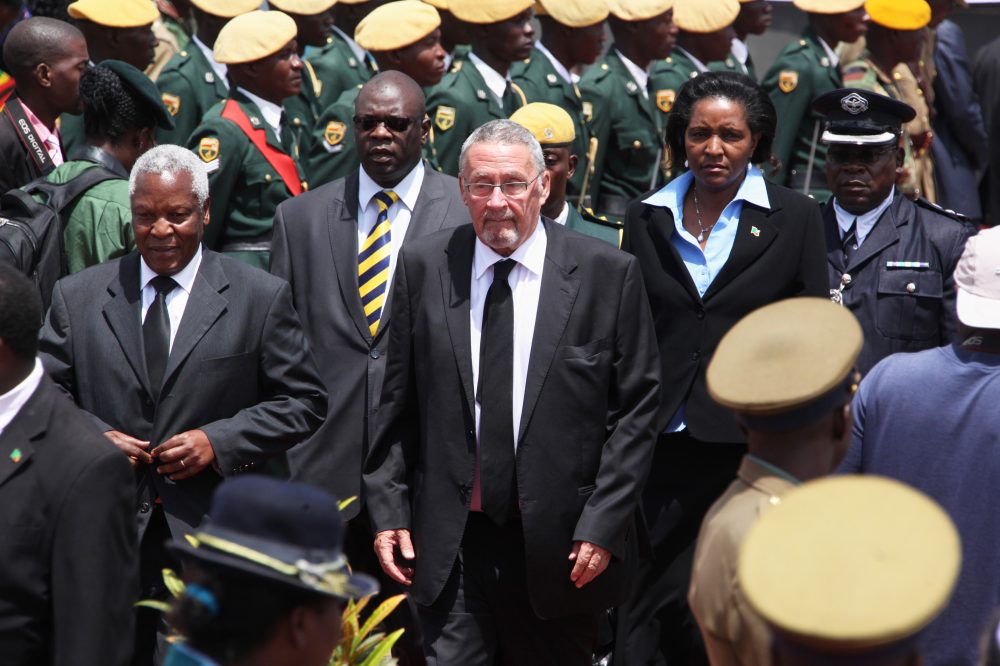
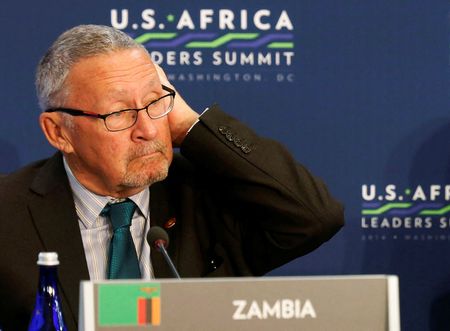
LUSAKA, Zambia — The Zambian government announced Wednesday that Guy Scott, the politician who made history by briefly serving as Africa’s first white head of state in over two decades, has died at the age of 82.
Scott held the position of vice president of Zambia and stepped into the role of acting president for a period of three months in 2014, following the in-office death of President Michael Sata.
His time as acting president marked a historic milestone — he became the first white head of state on the African continent since South Africa’s F.W. de Klerk, who was the final leader under the apartheid system. De Klerk left office after South Africa held its first all-race elections in 1994, which brought Nelson Mandela to power.
According to a government statement, Scott passed away at his farm located in the capital city of Lusaka. Zambian President Hakainde Hichilema has authorized a state funeral for Scott, though an official date has not yet been announced.
Scott, who was of Scottish and English descent, first won a seat in Zambia’s Parliament in 1991. He went on to serve as minister of agriculture, food and fisheries before being appointed vice president in 2011.
Those roles made him the first white person to serve as both vice president and, later, president of Zambia since the country gained its independence from British colonial rule in 1964.
Military exchanges between the United States and Iran stretched into a fourth consecutive night as President Donald Trump reinstated a naval blockade targeting Iranian ports and issued stark warnings that Iran’s civilian infrastructure could be next if the country refuses to negotiate.
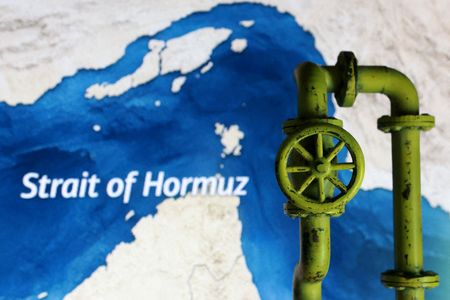
The naval blockade, which restricts ships from traveling to and from Iranian ports, was first set in motion on Tuesday after President Trump announced the measure on Truth Social. The day before, Trump had declared that the United States would serve as the “guardian” of the Strait of Hormuz.
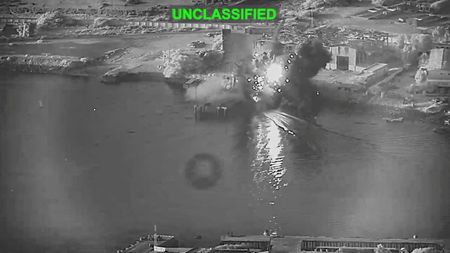
U.S. Central Command, known as CENTCOM, confirmed it had resumed offensive strikes against Iran ahead of reimposing the blockade. In a statement shared on X, CENTCOM announced: “At 3 p.m. ET today, US Central Command forces began launching an additional round of strikes against Iran to continue degrading Iranian capabilities used to attack commercial shipping in the Strait of Hormuz.” The command added that forces were also preparing “to resume the naval blockade against Iranian ports and coastal areas.”
Iran’s Islamic Revolutionary Guards Corps (IRGC) fired back with strikes of its own throughout the region. Video footage reviewed by CNN and verified through geolocation appeared to capture an Iranian drone hitting a warehouse that was already ablaze in an industrial zone near Mina Abdullah in Kuwait.
Early Wednesday local time, the IRGC claimed responsibility for striking what it described as a U.S. Army logistics and support center in Mina Abdullah, saying the facility was “set on fire and destroyed.” However, it remained unclear whether the burning structure shown in the footage had any connection to the U.S. military.
Kuwait’s fire service confirmed late Tuesday local time that crews had put out a fire “caused by a hostile Iranian aerial aggression,” according to the official Kuwait News Agency, though the report did not specify the fire’s exact location.
Iran’s military also asserted that it struck U.S. military assets at Al-Azraq Air Base in Jordan. Iran’s state news agency IRNA reported that Iranian attack drones targeted an area where F-18 fighter jets were stationed, along with an accommodation building and a large equipment hangar allegedly belonging to the U.S. Army. Notably, F-18 jets are typically deployed on aircraft carriers rather than at land bases in the Middle East, and U.S. media organizations were unable to independently confirm the claim.
On the diplomatic front, Iranian Deputy Foreign Minister Kazem Gharibabadi declared Tuesday that Tehran feels it has “no obligations” under a 14-point agreement reached with the United States the previous month. He argued that the heart of what he called the Islamabad memorandum of understanding was about ending the conflict entirely. “The core of the Islamabad memorandum of understanding concerned ending the war — an immediate and permanent cessation of the war and, in effect, of military operations against the Islamic Republic of Iran — as well as on all other fronts, including Lebanon,” he said.
In an interview with Fox News, President Trump made clear that the military campaign would only grow more intense if Iran does not return to the negotiating table. “We’re going to hit them very hard tomorrow night. We’re going to hit them very hard the night after, and then next week it gets really bad for them, because next week comes the power plants. Next week comes the bridges. We’re going to knock out all their power plants. We’re going to knock out all their bridges unless they get to the table and negotiate,” Trump said.
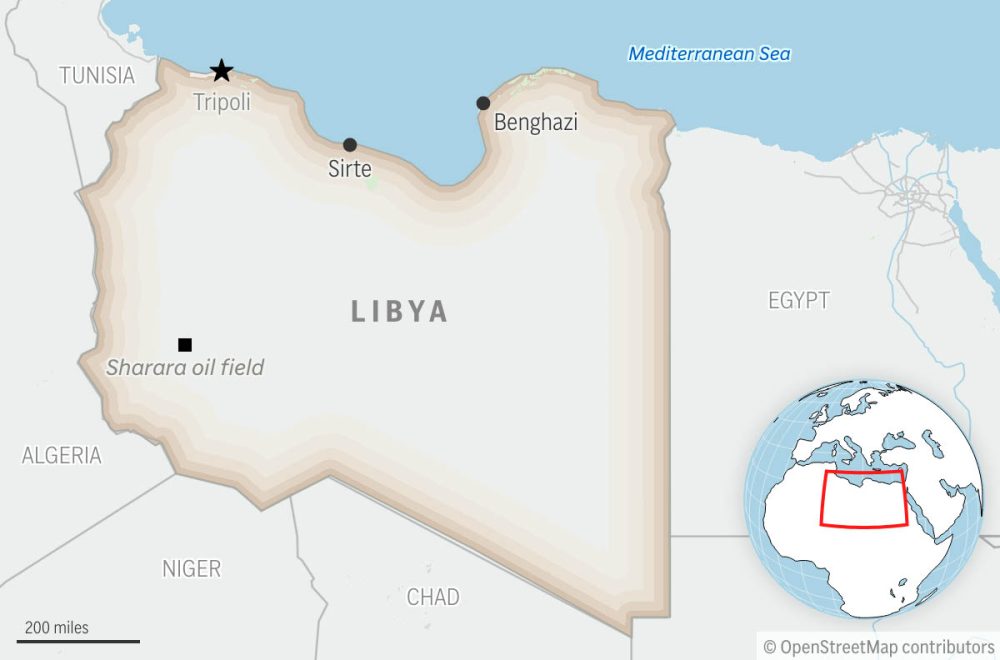
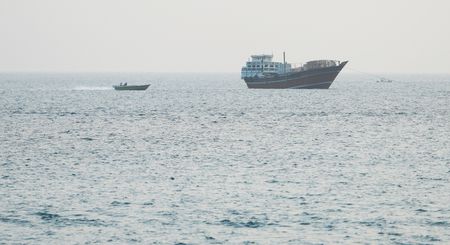
A boat packed with approximately 60 migrants — among them women and children — capsized off the eastern Libyan coast on Tuesday, leaving at least 50 people dead or unaccounted for, according to authorities.
Eastern Libya’s Coast Guard reported that the vessel went down near Bardaa Island, not far from the coastal city of Tobruk. Ten survivors were able to swim to the island on their own. A search operation for additional survivors or victims remains ongoing, the Coast Guard said.
This disaster is the most recent in a troubling series of tragedies along Libya’s coastline. Just last month, another shipwreck in eastern Libya resulted in 51 migrants dead or missing.
Libya has become one of the primary launching points for migrants attempting to cross the Mediterranean Sea in hopes of reaching Europe and building a better life. The country descended into turmoil following a NATO-backed revolt in 2011 that overthrew and killed longtime ruler Moammar Gadhafi, and it has since become a key transit hub for people fleeing violence and poverty across Africa and the Middle East.
Human smugglers routinely load migrants onto small, poorly equipped boats for the dangerous sea crossing, and thousands have lost their lives making the attempt.
According to the International Organization for Migration, more than 800 migrants were reported dead or missing along the central Mediterranean route between January 1 and May 16 of this year. In all of last year, that number exceeded 1,300.
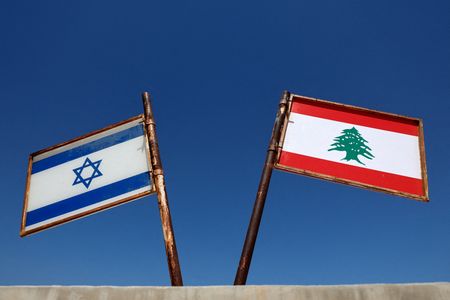
BEIRUT — Following two days of U.S.-facilitated negotiations in Rome, Lebanon and Israel have made progress toward establishing so-called “pilot zones” in southern Lebanon, where Israeli troops would pull back and transfer control to the Lebanese military, the U.S. State Department announced Wednesday.
The State Department described the discussions as “productive,” saying both parties “agreed on the structure and guidelines for the pilot zone process, to be finalized and implemented in the coming days.” Neither Lebanon nor Israel issued an immediate response to the announcement.
The two countries had previously announced a “framework agreement” on June 26 outlining a plan for Israeli forces to withdraw from large portions of southern Lebanon that they currently occupy. In return, the Iran-backed militant group Hezbollah would be required to disarm.
Under that deal, the process was supposed to kick off with two pilot zones where the Israeli military would hand over control to the Lebanese army, which would then clear those areas of any Hezbollah presence. However, progress on the ground had stalled before this week’s Rome meetings.
Lebanese President Joseph Aoun, who is scheduled to travel to Washington on July 21, said ahead of the Rome talks that his country’s delegation had been instructed “to demand the immediate withdrawal of Israeli forces from the two pilot zones before any further discussions.”
Wednesday’s State Department statement did not identify the specific locations of the pilot zones. Lebanese and Israeli officials had previously indicated they would include the towns of Froun, Ghandouriyeh, and Zawtar.
The chosen zones have sparked some debate within Lebanon. Critics pointed out that Israeli troops were not even present in most of the selected areas to begin with, raising questions about how a meaningful withdrawal could occur. The Lebanese army had pushed for larger pilot zones that covered more territory actually occupied by Israeli forces.
The current conflict between Israel and Hezbollah began when Hezbollah launched missiles across the border on March 2, two days after the U.S. and Israel carried out strikes against Iran. Hezbollah and Iran had sought to tie any end to the Lebanon conflict to the outcome of broader U.S.-Iran diplomatic talks, while the Lebanese government worked to keep those tracks separate and negotiate a ceasefire directly with Israel.
The June 26 agreement also lays the groundwork for a potential peace deal between Lebanon and Israel — two countries that technically remain at war nearly 80 years after Israel’s founding.
Looking ahead, the State Department said that once the pilot zones are implemented, “We will move to expanded technical talks … with the aim of reaching a comprehensive agreement between Israel and Lebanon.”
Despite the diplomatic movement, Hezbollah has strongly opposed the direct Lebanon-Israel negotiations, saying it will not honor the agreement and has no intention of disarming. Israeli officials, for their part, have publicly stated plans for a prolonged military presence in southern Lebanon.
CAPE TOWN, South Africa — Amazon announced Wednesday that it plans to bring its satellite internet service, called Amazon Leo, to South Africa in 2027 — apparently getting ahead of Elon Musk’s competing Starlink service in the country where Musk was born.
The company, founded by Jeff Bezos, said it will team up with South African internet provider Herotel to offer the service to the nation’s 62 million residents. Amazon described it as the company’s first satellite internet partnership on the African continent. No details about the financial terms of the deal were released at the time of the announcement.
The news comes after Musk, widely recognized as the world’s wealthiest person, publicly blasted the South African government over its regulations. Musk has claimed that rules requiring foreign communications companies to give a minority ownership stake in their local operations to Black or other non-white investors have blocked Starlink from entering the market — and he has accused the government of racial discrimination against him because he is white.
Those affirmative action policies were designed to create economic opportunities for people who were shut out under South Africa’s former apartheid system, which enforced white minority rule.
South Africa’s government has expressed support for the Amazon agreement. Communications Minister Solly Malatsi appeared alongside Amazon and Herotel representatives to formally announce the deal.
Amazon first launched its low-orbit internet satellites last year and currently has more than 390 of them in operation. By comparison, Starlink — which launched its first operational satellites back in 2019 — now has more than 10,000 satellites circling the globe. While Starlink has expanded into roughly two dozen African nations, Musk has declined to comply with South Africa’s ownership requirements, keeping the service out of that country.
Amazon also said Wednesday that the South Africa deal marks the beginning of a broader push across the African continent. As part of that effort, the company plans to work with Vanu Inc., a Lexington, Massachusetts-based firm that specializes in providing mobile internet access in developing nations.
Africa represents a significant potential market for satellite internet services. The continent is home to more than 1.5 billion people, many of whom live in rural or remote areas where traditional fixed internet connections are not available.
SALZBURG, Austria — Visitors to the Austrian birthplace of Wolfgang Amadeus Mozart are getting a unique treat as the city marks 270 years since the legendary composer came into the world. Scattered across some of Salzburg’s most iconic spots are 300 tiny gold statues of Mozart — each standing barely 50 centimeters, or just under 20 inches tall.
The Mozarteum Foundation unveiled the miniature figures on Wednesday. They were created by German concept artist Ottmar Hörl, who said his goal was not to build another grand monument, but rather to show a more personal side of the musical genius.
“I didn’t want to do a monument of Mozart. There are already enough of these. But I wanted to show his human side, that he was a normal human being despite his genius,” Hörl told the Associated Press.
To bring that human element to life, Hörl chose to show Mozart alongside his favorite dog, Pimperl. Historical accounts show that Mozart and his family were known for taking walks with their dogs through the Mirabell Garden, located near where they lived.
Mozart was born on January 27, 1756, in Salzburg, where the Mozarteum Foundation today hosts concerts, operates Mozart museums, and supports ongoing research about the composer.
The golden figures are spread across the Mirabell Garden, Mozart’s former living quarters, and several pavilions around the city. While 400 total statues were produced, only 300 are currently on display. The remaining 100 are being held in reserve — and for good reason.
“Two already got stolen within the last few hours,” said Linus Klumpner of the Mozarteum Foundation. Despite the thefts, the statues are intended to draw in a wider audience and spark curiosity about Mozart’s music.
“You come here, maybe you see the small golden heads shimmering in the sun on the horizon. And people become curious,” Klumpner said. “And then a process begins which is very much in our interest. That is to bring new people in contact with Mozart.”
For Hörl, having artwork stolen from public spaces is nothing new. During a previous installation in Bayreuth, Germany, an entire display of Richard Wagner statues was taken within just 10 days.
“That’s just the nature of public space. That means when you work as an artist in a public space you mustn’t complain about what is happening there,” Hörl said. “It ranges from destruction to theft. That’s just how it is.”
The Mozart statues will remain on display through August 30. For those who want one without resorting to theft, each statue is available for purchase at 100 euros — about $114 — while supplies last.
Hörl has a long history of large-scale public art installations. In 2010, he placed 10,000 plastic owls throughout Athens, Greece. He also created oversized plastic replicas of Albrecht Dürer’s famous hare for a “Homage to Dürer” exhibit at the Daegu art museum in South Korea. In 2009, German prosecutors decided not to pursue charges against Hörl over a series of golden garden gnomes depicted doing the Hitler salute — a gesture Hörl said was meant as satire against Nazi ideology, under a law that bans the use of symbols forbidden by the German constitution.
HONG KONG (AP) — Law enforcement officers in Hong Kong descended on two independent bookstores Wednesday, detaining five individuals suspected of selling publications considered seditious, according to local media reports.
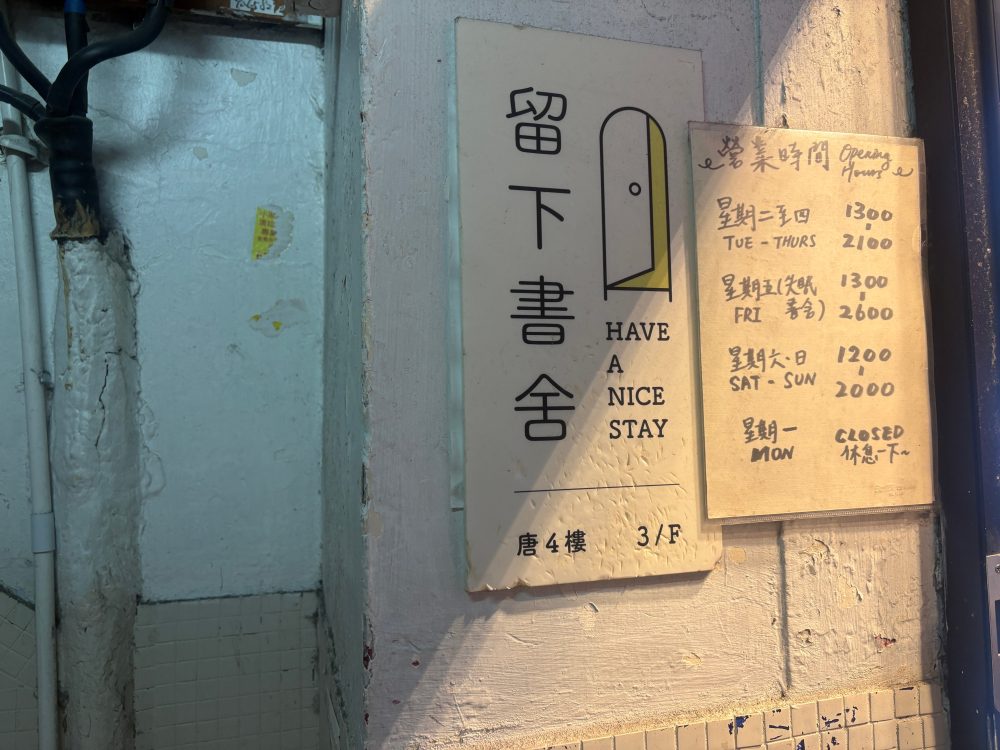
Video footage and photographs captured by several news organizations showed officers in police-marked vests removing boxes from the building that houses Have A Nice Stay, a bookshop established by former journalists. One bookseller was visibly escorted away by authorities.
Just a short distance away, a comparable scene unfolded at Greenfield Book Store, where officers were also seen removing boxes from the premises, as documented by online news outlet The Collective.
Police later confirmed they had conducted raids at two locations in the Mong Kok district, though they did not name the stores. Authorities said two men and three women were taken into custody on suspicion of violating the 2024 national security law.
Wednesday’s action represents the third wave of arrests connected to independent bookstores this year, following earlier operations in March and June — moves widely interpreted as efforts to suppress dissent in the prominent Asian financial center.
According to a police statement, investigators determined that the five suspects were believed to have displayed and sold seditious materials on-site. The content of those publications allegedly included material intended to stir up hostility toward Hong Kong’s government, courts, and law enforcement, authorities said.
Police indicated that customs officials had first flagged the case after discovering allegedly seditious books within a shipment of goods arriving in Hong Kong from abroad, though no specific titles were named.
Both stores were closed during their normal business hours on Wednesday. Attempts to reach Greenfield and a co-founder of Have A Nice Stay by phone went unanswered.
Have A Nice Stay had previously announced plans to close permanently on August 30, citing financial hardship and what it described as an unclear boundary of acceptable content in a social media post.
Hong Kong was historically recognized for its robust freedom of the press and open expression. The city even attracted residents from mainland China who crossed the border to purchase politically sensitive books unavailable at home.
Lam Wing-kee, who operated Causeway Bay Books until his death earlier this month, drew global attention in 2016 when he revealed he had been detained by Chinese authorities after traveling from Hong Kong to the city of Shenzhen. Four other individuals connected to the same bookstore had vanished in late 2015.
Lam’s disclosures alarmed many in the former British territory, where Beijing had pledged to preserve Western-style civil liberties for 50 years following Hong Kong’s handover to China in 1997.
Since the political upheaval triggered by anti-government demonstrations in 2019, independent booksellers have faced an increasingly difficult operating environment.
Officials maintain that national security legislation is essential to maintaining stability in the city. Hong Kong’s Secretary for Security Chris Tang has stated that the government has no plans to publish a formal list of banned books, calling such a measure impractical.
In March, police arrested the owner and employees of the independent Book Punch store, reportedly on suspicion of selling seditious publications — including the biography of former pro-democracy media figure Jimmy Lai, who received a 20-year prison sentence in his own national security case.
In June, two additional booksellers were arrested on suspicion of selling seditious publications and receiving money from foreign political groups.
All individuals arrested in those previous incidents were subsequently released on bail.
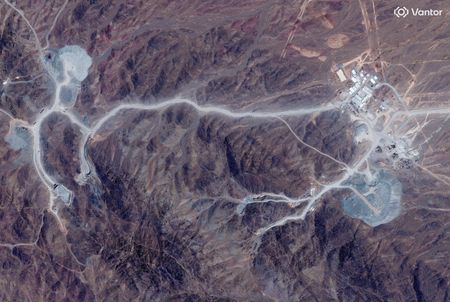
President Trump has issued a direct threat to strike a heavily fortified underground facility in Iran known as Pickaxe Mountain — a site tied to the country’s nuclear program that sits close to one of Tehran’s most significant nuclear complexes.
“We’re going to take out Pickaxe Mountain. Tell the Iranians to be ready,” Trump said during a July 13 appearance on the Hugh Hewitt Show.
The warning comes as tensions between Washington and Tehran continue to rise, with exchanges of fire in the Gulf region complicating any path toward ending the conflict.
Where exactly is this site?
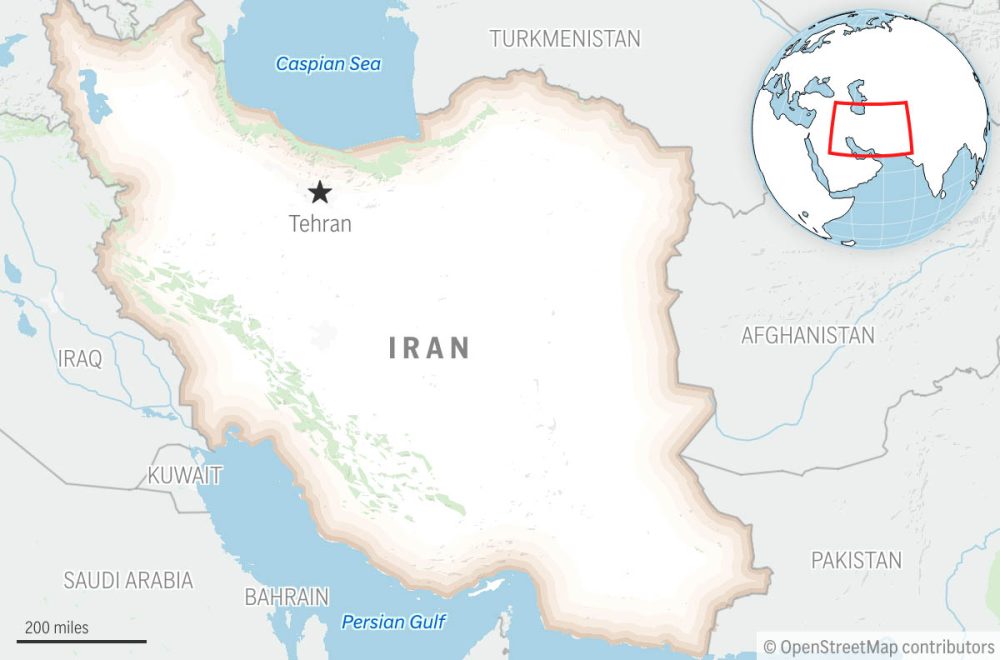
Pickaxe Mountain sits roughly 220 kilometers — about 140 miles — south of Tehran, and just 2 kilometers from the Natanz nuclear complex. The peak reaches approximately 1,600 meters above sea level.
Natanz, which housed two uranium enrichment plants, was struck during the war launched by the United States and Israel on February 28, and again during last year’s 12-day conflict. The U.N. nuclear watchdog confirmed the above-ground enrichment plant at Natanz was destroyed, while the underground one is believed to have been at least seriously damaged.
According to the Institute for Science and International Security — a U.S.-based think-tank focused on preventing the spread of nuclear weapons — the tunnel facility being built under Pickaxe Mountain was not targeted in either of those military actions.
How did the site come to be?
Construction at Pickaxe Mountain began in 2020, the Institute for Science and International Security says, following what Iranian officials described at the time as a sabotage-caused explosion at the Natanz facility. Iran said the attack caused enough damage to potentially slow the development of advanced uranium enrichment centrifuges.
Iran’s then-nuclear chief, Ali Akbar Salehi, announced in September of that year that Iran had begun building “a more modern, larger and more comprehensive hall in all dimensions in the heart of the mountain near Natanz” for the production of advanced centrifuges.
The head of the U.N. nuclear watchdog, Rafael Grossi, noted in a March interview with PBS Frontline that Iran had previously made public its plans for nuclear activity at Pickaxe Mountain. “This was part of their quite systematic intention to put their most sensitive facilities underground,” he said.
What has been built there?
Analysis of satellite imagery by the Institute for Science and International Security shows the site has two pairs of entrances, believed to lead to a single facility estimated to be at least 100 meters beneath the mountain’s surface.
Security measures include a large perimeter and heavily reinforced tunnel entrances. The eastern tunnel entrances have been partially filled in since the recent wars to block vehicle access, though they have not been completely sealed, the institute noted in a July 14 report.
Sam Lair, a fellow at the Foreign Policy Research Institute who also examined recent satellite images, told Reuters that the reinforcement of those tunnel entrances would make it more difficult to strike the facility using penetrating weapons like bunker-buster bombs.
Is the facility active, and what could it be used for?
Trump, in his July 13 comments, said the U.S. is keeping a close eye on the location. “We see no activity there. They’re not doing well with their nuclear situation. Every time we hear about it, we blow it up. So they don’t like talking about it. But we’ll probably give Pickaxe a shot relatively soon,” he said.
The Institute for Science and International Security assessed that the facility is not yet operational but that construction is ongoing. The institute also noted uncertainty about whether Iran still intends to install a large-scale centrifuge assembly operation there, given the damage done to Iran’s centrifuge manufacturing capabilities.
“Nonetheless, if Iran starts to rebuild its centrifuge manufacturing capability, it could plan to install a smaller centrifuge assembly facility in Pickaxe Mountain able to serve a nuclear weapons program,” the institute said.
How could it be attacked?
Experts believe the facility is buried too deeply to be destroyed by even the most powerful bunker-buster bombs currently in the U.S. military’s inventory.
The Institute for Science and International Security suggested the site “would be more suitable for ground forces to attack or sabotage,” while also noting that aerial strikes using deep-penetrating weapons might be able to exploit certain vulnerabilities.
Lair offered this assessment: “We can infer that there are ongoing activities at Pickaxe Mountain the Iranians wish to continue but are still concerned enough about a potential attack that they are taking steps to bolster their defenses.”
LONDON (AP) — London police announced Wednesday that a man has been taken into custody after allegedly threatening to shoot Nigel Farage, the leader of the Reform UK political party, in a social media post made back in May.
According to the Metropolitan Police, the man was arrested Tuesday on suspicion of sending threatening messages to a member of Parliament. The Telegraph newspaper reported that the alleged threat read: “I am going to shoot you in the head if you win.”
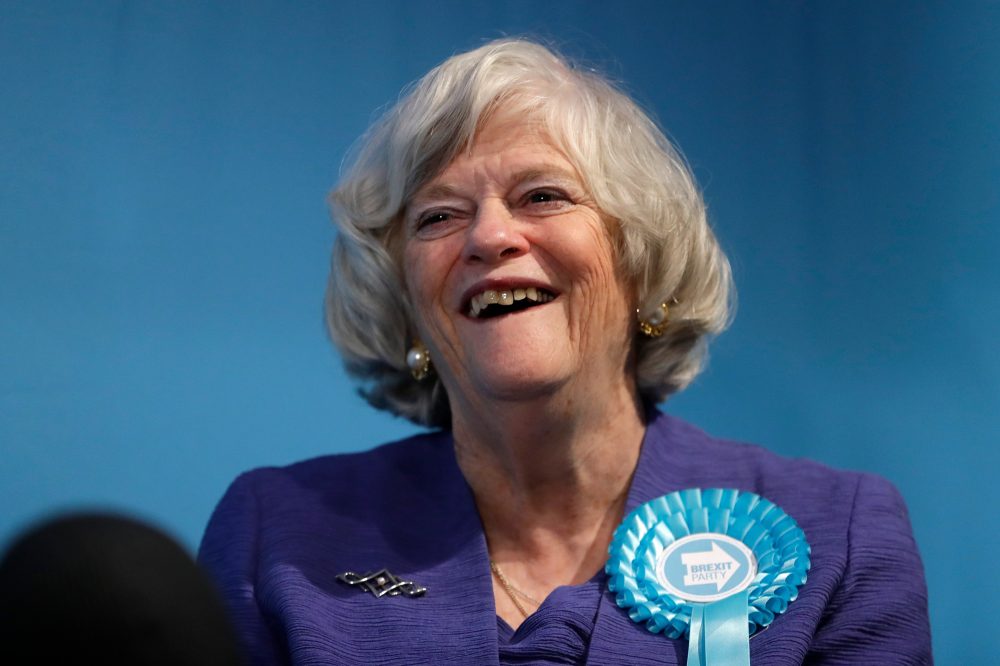
The arrest comes as concerns about the safety of politicians in the United Kingdom continue to mount, particularly following the July 8 killing of Ann Widdecombe, a former member of Parliament and fellow Reform UK member, at her rural home in southwest England.
Widdecombe was widely known in British political circles for her outspoken socially conservative positions, including her opposition to abortion and the expansion of LGBTQ+ rights. Her death has rattled the British political establishment, and the Reform UK party has since called for stronger protections for its members.
The investigation into Widdecombe’s death was taken over by counterterrorism police after new evidence came to light. Devon and Cornwall Police have faced criticism for initially stating that the killing did not appear to be terror-related and showed no signs of political motivation.
The man arrested in connection with the Farage threat was held overnight before being released on bail, police said.
Separately, Farage recently stepped down from his seat in Parliament amid an investigation into a 5 million pound — roughly $6.7 million — gift he received from a cryptocurrency billionaire that was not publicly disclosed. Farage has said the funds were intended to cover his personal security costs.
Despite resigning, Farage is now seeking re-election to that same parliamentary seat in an upcoming vote, saying he wants to demonstrate that he still holds the confidence of his constituents. Critics, however, have called the move a calculated attempt to sidestep the ongoing parliamentary investigation.
LUSAKA — The Zambian government announced Wednesday that former Vice President Guy Scott has died at 82 years old, marking the passing of a man who made history as Africa’s first white head of state in roughly 20 years.
According to a government statement, Scott passed away at his farm located in the Leopards Hill area of Lusaka after battling an illness.
Scott had served as vice president under President Michael “King Cobra” Sata between 2011 and 2014. Following Sata’s death in October 2014, Scott stepped into the role of acting president, a position he held until January 2015. That brief period in power made him the first white leader of an African nation since South Africa’s F.W. de Klerk departed office in 1994.
Born in Zambia to Scottish parents and educated at Cambridge as an economist, Scott was prevented by the country’s constitution from seeking the presidency outright — a rule that disqualified him because neither of his parents was born in Zambia.
President Hakainde Hichilema has granted Scott a state funeral, the government confirmed in its statement.
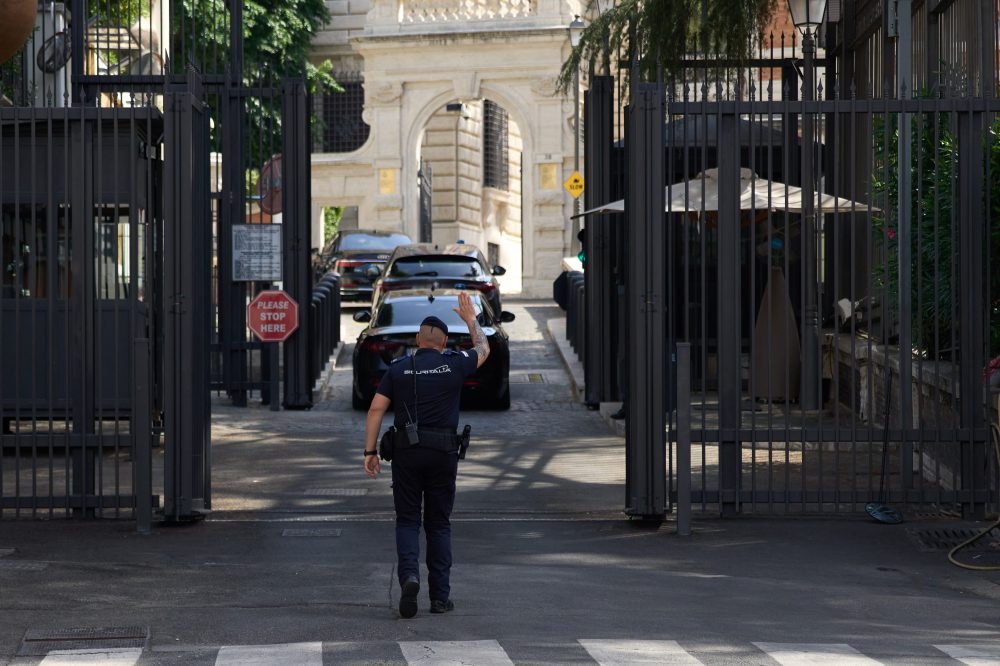
Lebanon and Israel wrapped up a two-day round of U.S.-brokered negotiations in Rome on Wednesday, with an American official reporting meaningful progress toward a plan that could trigger Israeli troop withdrawals from portions of southern Lebanon within days.
The two nations, long at odds with one another, held ambassador-level meetings at the U.S. embassy in Rome on Tuesday and Wednesday. It marked the sixth time the two sides have met face-to-face since a new war broke out on March 2 between Israel and Lebanese armed group Hezbollah — a conflict sparked by the broader regional fighting.
The foundation for these talks is a framework deal brokered by the United States on June 26. Under that agreement, Lebanon and Israel committed to a “pilot zone” approach that would involve the disarmament of militant groups — widely understood to mean Hezbollah — along with the deployment of Lebanese military forces to the south and a gradual pullback of Israeli troops currently occupying Lebanese territory.
A U.S. official, in written remarks shared with reporters, called the two days of discussions “productive and positive.”
“We agreed on the structure and guidelines for the pilot zone process, to be finalized and implemented in the coming days,” the official stated.
The official added that negotiations would now shift to a technical phase focused on putting the framework into action and ultimately reaching a “comprehensive agreement between Israel and Lebanon.”
Neither Lebanon nor Israel immediately offered their own assessments of how the talks went.
Israel’s military currently holds what it refers to as a “buffer zone” extending roughly 10 kilometers — about 6 miles — into Lebanese territory along the full stretch of the Israeli border. Israeli officials have argued the zone is essential to shield northern Israeli communities from Hezbollah attacks.
Lebanon has demanded that Israel begin pulling its forces out immediately, while Israel has maintained that its troops will stay in southern Lebanon for as long as Hezbollah remains armed.
The face-to-face negotiations have pressed forward despite sporadic deadly Israeli strikes and strong pushback from Hezbollah, which refuses to disarm. Hezbollah has said only pressure from its ally Iran can bring the war to an end and force Israel to withdraw.
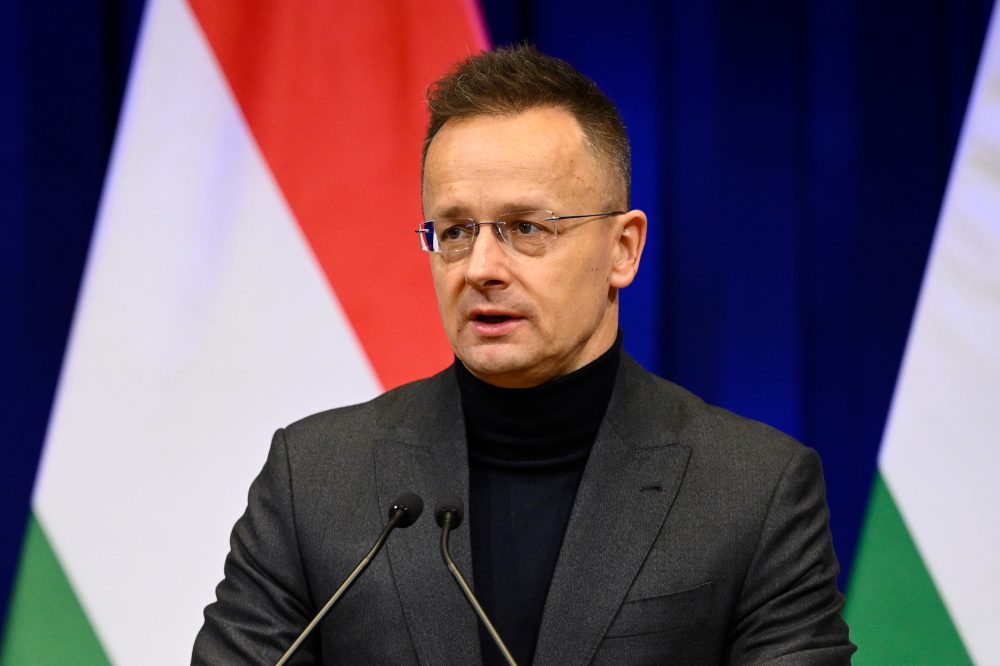
BUDAPEST, Hungary — Hungary’s former foreign minister has given up his seat in parliament and joined Chinese electric vehicle manufacturer BYD in an executive capacity, he revealed in a social media post on Wednesday.
Péter Szijjártó, who spent nearly 12 years as Hungary’s top diplomat under former Prime Minister Viktor Orbán, shared on Facebook that he had been extended “a highly prestigious offer” from the world’s leading electric carmaker “to fill an international position.”
“BYD is one of the greatest success stories in the automotive industry over the past 20 years,” Szijjártó wrote. “Starting today, I will continue to work as the executive responsible for the group’s external relations and the development of new business lines.”
Szijjártó lost his ministerial post after Orbán and his far-right Fidesz party suffered a decisive defeat in April’s elections, falling to the pro-European Tisza party and its leader, Prime Minister Péter Magyar.
Following that loss, Szijjártó had been largely absent from parliamentary votes and had rarely made public appearances or posted on social media. He had held a seat in parliament since 2002.
Back in 2023, Szijjártó — while still serving as foreign affairs and trade minister — announced that BYD would build its first European factory in Hungary. The move allowed the Chinese conglomerate to avoid European Union import tariffs on Chinese electric vehicles, which were put in place to shield Europe’s domestic auto industry.
Szijjártó played a key role in the negotiations that brought the plant to Hungary, noting at the time that the deal came together after 224 rounds of talks between BYD and the Hungarian government. He described the project as “one of the largest investments in Hungarian economic history” and confirmed that the government would offer financial incentives to support construction of the facility.
During his time in office, Szijjártó and Orbán pushed back against EU tariffs on Chinese goods and actively courted investment from Beijing, resulting in the establishment of several Chinese electric vehicle battery plants throughout Hungary. The Orbán government and China also partnered on a rail corridor linking Hungary and Serbia as part of Beijing’s “Belt and Road” global trade initiative.
Szijjártó also maintained unusually close ties with Russia throughout his tenure, even after Russia launched its full-scale invasion of Ukraine on Feb. 23, 2022. Unlike nearly all of his EU counterparts, he made repeated trips to Moscow to negotiate agreements on Russian oil and gas purchases and to meet with Russian Foreign Minister Sergey Lavrov, whom he publicly referred to as his “friend.”
In 2021, Russian President Vladimir Putin awarded Szijjártó the Russian Order of Friendship, one of the highest honors Russia can bestow on a foreign national.
Szijjártó became embroiled in controversy during Hungary’s 2026 election campaign after The Washington Post reported that he regularly phoned Lavrov from inside high-level EU meetings, providing “live reports on what’s been discussed.” Szijjártó disputed the report but acknowledged that he did speak with Lavrov before and after EU foreign minister meetings to discuss agendas and outcomes.
In March, the Orbán government filed espionage charges against a well-known Hungarian investigative journalist in connection with work the reporter had done while looking into Szijjártó’s communications with Lavrov. Those charges were later dropped after Hungary’s new government assumed office.
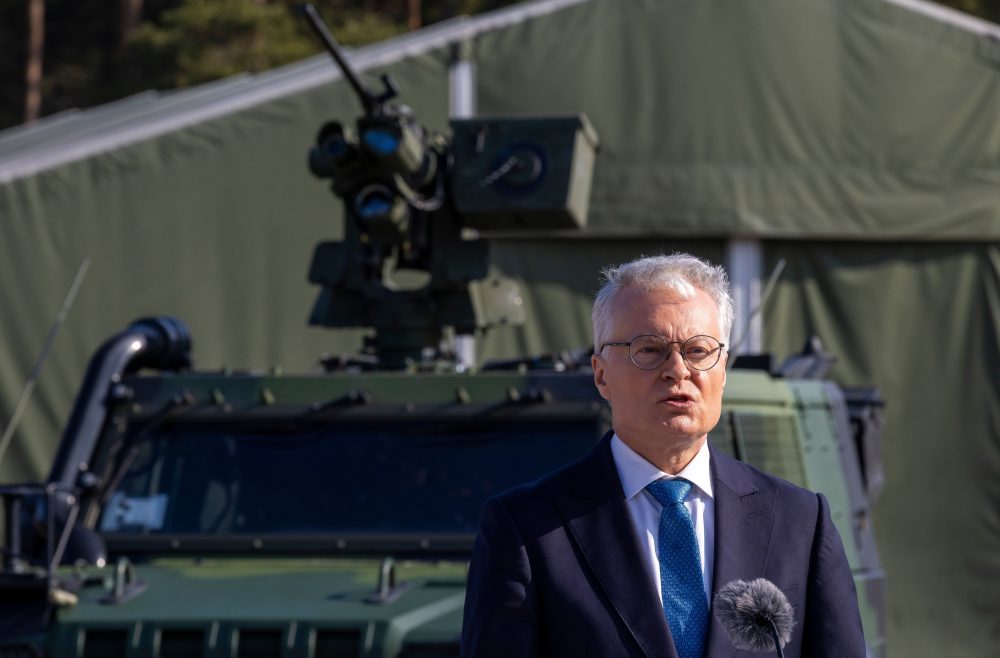
VILNIUS, Lithuania — Lithuania’s president announced Wednesday that intelligence reports point to Russia potentially planning attacks on critical infrastructure across the Baltic states and Poland.
President Gitanas Nauseda said officials are closely tracking the threat of strikes that could knock out energy and transportation systems, including facilities tied to Lithuania’s connections with the European electricity grid.
“I cannot deny that we have such information and that it concerns limited kinetic operations likely targeting critical infrastructure,” Nauseda told Lithuania’s BNS news agency.
Nauseda noted that the intelligence does not pinpoint a specific location or timeframe for any potential attack, and said the provocations could come through conventional military means or other methods.
Russia pushed back against the claims, calling them a manufactured excuse to justify NATO expanding its military presence in the Baltic region.
Latvian President Edgars Rinkevics issued a similar alert Wednesday, cautioning that as Ukraine becomes more effective at pressuring Russia on the battlefield, Moscow may retaliate by testing NATO’s eastern flank.
“Even without a total Ukrainian victory, Russia may indirectly test Article 5 and response mechanisms at the Alliance and European Union levels,” Rinkevics said, referencing NATO’s collective defense commitment.
“The next few months, or even the next 12 months, will be crucial for Baltic security,” he added.
Lithuania, Latvia, Estonia, and Poland — all situated along NATO’s eastern edge — have ramped up security around key energy and transportation infrastructure in recent months in response to the growing Russian threat.
These nations say they have been targets of Russian hybrid attacks for years, a threat that has grown sharper since Russia launched its full-scale invasion of Ukraine in 2022.
In Moscow, Kremlin spokesman Dmitry Peskov brushed aside Lithuania’s intelligence warning about alleged Russian plans to strike infrastructure in the Baltics and elsewhere in Europe.
“It’s a fresh batch of bugaboos intended to continue the brainwashing and prepare the population for further militarization,” Peskov told reporters.
“To do this, they need to create an enemy image on the other side, our side in this case,” he continued. “And use it as a pretext to continue moving NATO military infrastructure in all its forms into the Baltic states.”
Nauseda’s statements align with warnings that Polish officials have been raising in recent weeks, following several media reports suggesting Russia could carry out a limited military or hybrid provocation against Poland in the near future.
In late June, leading Polish news outlet onet.pl reported that U.S. intelligence had alerted its Polish counterparts to the possibility of a Russian attack. The outlet, citing its own sources, said potential scenarios included strikes on critical infrastructure, incursions by Russian troops near border areas, and drone operations.
Prime Minister Donald Tusk said on July 3 that these warnings deserve to be taken seriously, noting he had been raising similar concerns for weeks.
“Poland is preparing very intensively for various scenarios,” Tusk said. “I don’t want to scare anyone, but the coming months, also because of the changing nature of the war in Ukraine, could be critical.”
Tusk added that anxiety is especially high in the Baltic states.
“We are not afraid; we are preparing for various scenarios, but we cannot take this lightly,” he said. “We are conscious of the dangers also because of information coming from our allies.”
Foreign Minister Radosław Sikorski delivered a pointed message directed at Russian leader Vladimir Putin: “We know what you are planning. Don’t do it.”
Lithuania’s chief of defense, General Raimundas Vaiksnoras, recently confirmed that the military has sent additional forces to help guard strategic infrastructure amid concerns about possible Russian provocations.
Vaiksnoras told reporters that Russia’s recent hostile rhetoric aimed at the Baltic states and Poland appears to serve a larger strategic goal, warning that Moscow has long worked to undermine public confidence in state institutions, the military, and government.
Poland had already stepped up protection of key infrastructure following a November attack on rail infrastructure that was attributed to Russia.
On Monday, the European Union announced that Russia’s FSB Center 16 carried out cyber espionage and sabotage operations targeting defense industries and critical infrastructure across Europe, including a December cyberattack on a Polish combined heat and power plant that supplies heat to nearly 500,000 customers.
A recent report from the International Institute of Strategic Studies think tank concluded that Russia likely used shadow ships to launch drones over Europe, repeatedly disrupting civilian aviation between 2024 and 2026.
The Baltic region is also dealing with additional pressure from stray Ukrainian drones that have crossed into Baltic countries as Ukraine has intensified strikes on Baltic Sea ports used for Russian energy exports.
In mid-May, Latvian Prime Minister Evika Silina stepped down over her government’s response to multiple incidents involving suspected Ukrainian drones entering Latvian airspace.
In late May, for the first time in a NATO and European Union capital, residents of Vilnius, Lithuania were photographed taking shelter in underground parking garages as authorities issued warnings about unidentified drone activity in the area.
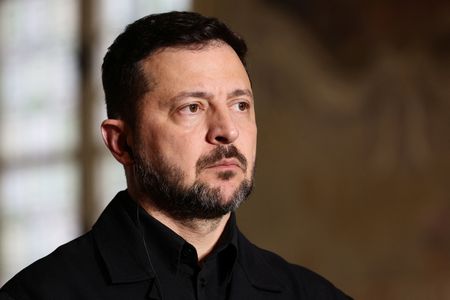
KYIV — Ukrainian President Volodymyr Zelenskiy announced Wednesday that he is backing the chief executive of the country’s state-owned energy company to take over as prime minister, while leaving unanswered questions about the future of the nation’s defence minister.
Zelenskiy moved to remove Prime Minister Yulia Svyrydenko from her position this week, just one year after she took office. Parliament formally accepted her resignation on Tuesday and is set to vote on a replacement as soon as Thursday. The president has offered little explanation for the decision beyond saying he wants to bring fresh faces into leadership roles.
Addressing reporters in Kyiv, Zelenskiy named Sergii Koretskyi — the CEO of state energy giant Naftogaz — as his top choice to lead the government. The president cited Ukraine’s urgent need to get ready for the coming winter months as the primary reason for selecting someone with an energy background.
“The priorities are clear — preparing for winter,” Zelenskiy stated. “Therefore, following all the consultations, Sergii Koretskyi is surely the most prepared candidate for the post of prime minister of Ukraine.”
Because Zelenskiy’s political party holds a majority in parliament, lawmakers are widely expected to approve his preferred pick. Under Ukrainian law, when a prime minister steps down, the entire cabinet must also resign, meaning a broad reshuffling of government positions is anticipated.
Much of the speculation has centered on whether Defence Minister Mykhailo Fedorov will keep his job in the incoming cabinet. The 35-year-old, known as an advocate for technological innovation, came from outside the traditional defence establishment and has only been in the role for six months. His tenure has coincided with a period in which Ukraine has gained momentum on the battlefield, pressing an aggressive campaign of long-range drone strikes against Russia.
When asked directly whether Fedorov would remain as defence minister, Zelenskiy declined to give a straight answer. He said he planned to meet with Fedorov and military commanders later Wednesday, ahead of a scheduled meeting with members of his ruling party in parliament.
WASHINGTON — The International Monetary Fund’s newly appointed strategy director is calling on governments around the world to protect their economic credibility and keep inflation in check as global uncertainty continues to mount.
Christian Mumssen, the fund’s new director of strategy, spoke Wednesday at an event hosted by the Atlantic Council, pointing to a wave of major economic disruptions that have hit in rapid succession — including the coronavirus pandemic, surging costs of living, trade conflicts, and ongoing wars in Ukraine and the Middle East.
“Technologically, artificial intelligence and digital finance are advancing at a speed few of us anticipated. And geopolitically, the post-war global order is giving way to a more fragmented, multipolar world,” Mumssen said.
He acknowledged that the global economy has shown surprising strength in the face of these pressures, but cautioned that the scale of ongoing changes creates an unusually high level of unpredictability.
“The global economy has proved remarkably resilient in the face of these forces. But the sheer scale of what is under way creates an exceptionally high degree of uncertainty — and we should expect the unexpected,” he said.
Mumssen stressed that governments need to stay focused on healthy public finances, managing debt, controlling inflation, and supporting employment and economic growth. He noted that price stability is particularly at risk due to frequent disruptions in global supply chains.
He also emphasized the importance of building resilience against supply shocks and geopolitical tensions, and urged nations to better manage the uncertainty that comes with today’s rapidly shifting landscape.
Mumssen called attention to the fast pace of technological change, specifically noting that the rise of artificial intelligence must be managed in a way that benefits all people, not just a select few.
He pointed out that what makes the current moment especially challenging is that multiple large-scale transformations are all happening simultaneously.
Mumssen encouraged nations to partner with the IMF in finding solutions, but expressed concern about the direction of global cooperation.
“The problem is: just when massive structural challenges and a new technological revolution would call for greater international cooperation, the global governance system is fragmenting,” he said.
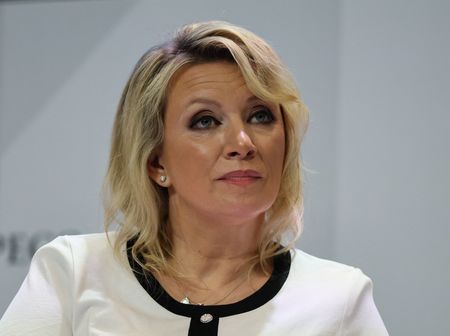
MOSCOW — Russia issued a stark warning Wednesday that any multinational military force deployed to Ukraine by Western allies in the wake of a peace agreement would be viewed as a direct threat — and treated as a legitimate target on the battlefield.
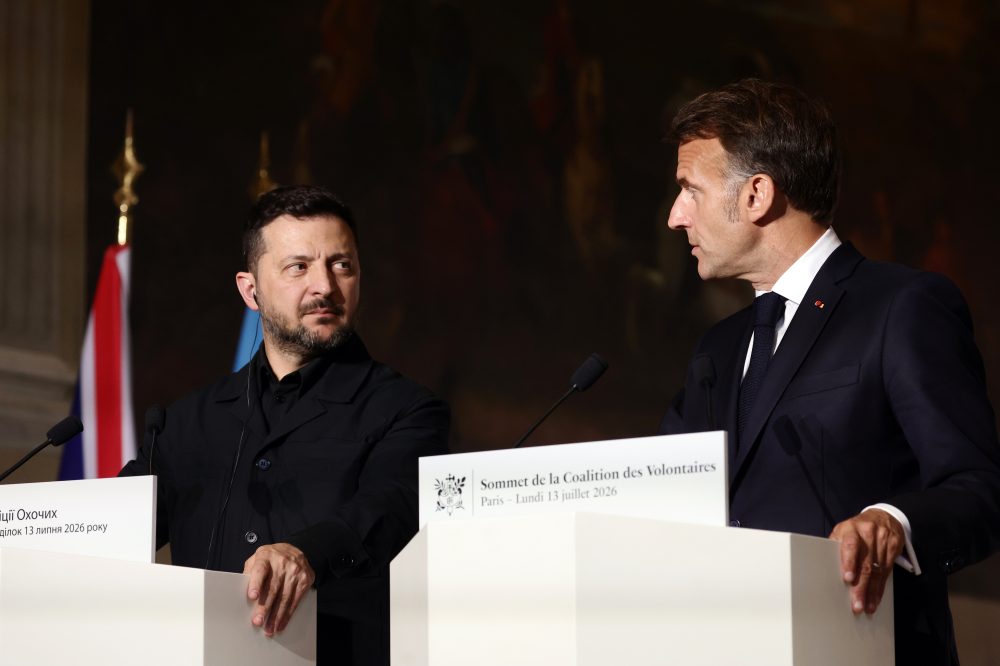
The warning followed a meeting in Paris this week among members of the pro-Ukraine “coalition of the willing,” who reaffirmed their commitment to sending troops to Ukraine once a ceasefire is in place. The stated goal of such a deployment would be to provide reassurance to Ukraine and help the country rebuild its military capabilities.
The allied nations also announced that military exercises would be conducted in the coming months to demonstrate the readiness of the planned force, officially referred to as the Multinational Force for Ukraine, or MNF-U.
Russian Foreign Ministry spokeswoman Maria Zakharova addressed the matter directly during a briefing with reporters. “In this context, we would like to reiterate that the deployment of any military contingents from countries of the so-called ‘coalition of the willing’ to Ukraine is unacceptable to our country,” she stated.
Zakharova went further, adding: “I repeat: this would amount, de facto, to foreign intervention and an escalation of threats to Russia’s security. We would regard such units as legitimate military targets.”
A computer expert who recently appeared in a Boston courtroom on federal hacking charges previously held a senior-level job at the well-known Moscow-based antivirus company Kaspersky Lab, according to a person with knowledge of the matter and records obtained by Reuters.
Denis Obrezko entered a not guilty plea last week to computer crime charges. Leaked salary records and a former coworker confirm he worked as a senior specialist at Kaspersky from 2017 to 2019. Federal prosecutors say that in the five years before joining Kaspersky, Obrezko worked for Russia’s domestic intelligence agency, the FSB.
While the hacking activity he’s accused of allegedly occurred after he departed Kaspersky, his connection to the company is expected to renew scrutiny of the antivirus firm’s relationship with the Russian government. Once a major player in the U.S. cybersecurity market, Kaspersky has been effectively pushed out of America after concerns arose about its alleged links to the Kremlin.
In an official statement, Kaspersky acknowledged his employment: “An employee with the name specified worked at the company between 2017-2019, and we have no information on the individual’s current status. The offenses charged cannot be related to the individual’s role or responsibilities during the employment at Kaspersky.”
Obrezko’s attorney, Max Nemtsev, said via email that he was unable to comment on his client’s work history. The FSB was unreachable for comment, and the Russian Embassy in Washington has not answered repeated inquiries about the case. Russia routinely denies any involvement in hacking operations.
Reuters was unable to pin down exactly what Obrezko did during his time at Kaspersky. A profile on the Russian social media platform VKontakte, linked to one of his email addresses, lists him as a graduate of Moscow’s Bauman University — a technical institution that a group of European journalists identified last year as a significant training hub for Russian government hackers. Both the VKontakte profile and leaked resume data indicate his area of study was information security. Bauman University did not respond to a request for comment.
Court documents filed by U.S. prosecutors allege that Obrezko was part of a newly uncovered hacking operation referred to as “Void Blizzard” or “Laundry Bear.” This group is accused of stealing large volumes of emails and other communications from government agencies in NATO-aligned European countries, as well as at least 11 U.S. companies, allegedly at the direction of the Russian government starting in 2023.
A federal indictment filed last week ties Void Blizzard to a Russian cybersecurity firm called Yutek-NN, where Obrezko served as deputy director beginning in 2024. The indictment made no reference to his earlier employment at Kaspersky — a connection being reported publicly for the first time here.
Yutek describes itself on its website as a wide-ranging IT company that employs “cutting-edge technology, innovative concepts, and creative design.” Russian corporate filings show the Nizhny Novgorod-based firm holds an FSB license to develop, sell, or obtain “special technical means for the covert acquisition of information.” Yutek did not respond to multiple requests for comment.
Stefan Soesanto, a lecturer at the Lucerne University of Applied Sciences and Arts in Switzerland, called the Obrezko prosecution “a vindication for all those that are already highly critical of Kaspersky.”
Kaspersky has long maintained that it operates independently of the Kremlin. Nevertheless, the U.S. Commerce Department banned the company’s software in 2024 on national security grounds, and European officials have also cautioned against its use.
Soesanto noted that the boundary between the private cybersecurity world and government intelligence agencies tends to be blurry, and that a back-and-forth flow of personnel between the two sectors isn’t exclusive to Russia or Kaspersky. “It’s really similar to how the U.S. works. It’s just that the Russians don’t really indict American former spies,” he said.
Brazil is preparing for the United States to slap a 25% tariff on thousands of its exported goods, after months of intensive negotiations between the two countries failed to produce an agreement, according to three people with knowledge of the situation.
The announcement from the Trump administration, anticipated this Wednesday, could impact more than 4,000 products shipped from Brazil to the United States — everything from sugar to pig iron — representing approximately $15 billion in yearly trade, according to figures from Brazil’s top industry lobbying group, the National Confederation of Industry.
“There were dozens of meetings, six or seven in the last month alone,” said one Brazilian official, who spoke anonymously because they were not cleared to comment publicly. “But they want the impossible.”
Brazilian officials said U.S. negotiators demanded exclusive, reduced tariff rates on certain American exports — concessions that Brazilian law does not permit the government to make unilaterally for a single trading partner.
Brazil would become the first country targeted under the Trump administration’s updated tariff approach, which leans on Section 301 of U.S. trade law — a provision that allows the government to investigate alleged unfair trade practices by other nations. This strategy rose to prominence after the U.S. Supreme Court struck down the administration’s broader global tariff policy back in February.
The U.S. Trade Representative has opened nearly 80 trade investigations, and Brazil appears set to be the first country to face consequences under this new wave of tariffs, which could eventually be extended to dozens of other nations.
The probe into Brazil, which was launched last July, pointed to several alleged unfair practices — among them, illegal deforestation and Brazil’s digital payment system known as Pix, which Washington contends puts American credit card companies at a disadvantage.
Brazil has strongly pushed back against all of those claims. In a formal letter to U.S. Trade Representative Jamieson Greer, Brazil’s Foreign Affairs Minister Mauro Vieira argued that the U.S. has not substantiated its allegations and called the investigation “arbitrary” and a form of “widespread economic pressure imposed by the U.S.”
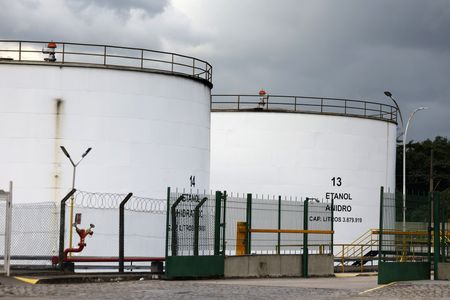
The National Confederation of Industry noted that the tariffs would hit products for which Brazil is a major supplier to the American market, including pig iron, wood moldings, cane sugar, ethanol, and tobacco. The group’s president, Ricardo Alban, said in a statement that the tariff hike “harms companies in both countries.”
Several categories of Brazilian goods are expected to be exempt from the new Section 301 tariffs, including beef, coffee, rare earths, and aircraft parts, which collectively account for the bulk of Brazil’s exports to the U.S. Those same products had previously been shielded from an earlier round of 40% tariffs the Trump administration imposed on Brazilian goods — tariffs that were politically tied to the arrest of former Brazilian President Jair Bolsonaro, a Trump ally who is currently under house arrest after being convicted of attempting to undermine democracy following his loss in the 2022 election.
Relations between the Trump administration and Brazilian President Luiz Inacio Lula da Silva — one of Latin America’s most prominent left-leaning leaders — have improved since that earlier period of tension.
The new tariffs are set to arrive less than three months before Brazil’s presidential election, in which Lula is expected to face off against Senator Flavio Bolsonaro, son of the former president.
Brazilian government sources say the country may respond with retaliatory measures once the U.S. tariffs are officially in place, depending on how severe the economic impact turns out to be.
Brazil is also caught up in a separate Section 301 investigation by the U.S. Trade Representative focused on forced labor connections within the supply chains of dozens of countries. That probe is expected to wrap up on July 24 and could result in an additional 12.5% tariff, bringing the total tariff burden on Brazilian products to 37.5%.
The escalating tension threatens to further damage a trade relationship that has already been weakening. Data from the American-Brazilian Chamber of Commerce show that the U.S. share of Brazil’s total trade dropped to 9.7% in the first half of this year, down from 12.1% during the same period in 2025 — the lowest level recorded since tracking began in 1997.
Brazilian officials say the tariffs haven’t broken the country’s economy, but they have pushed Brazilian companies to look for new partners — particularly in China.
“They are shooting themselves in the foot,” one official said of the Trump administration. “They’re pushing Brazil and other countries further and further toward Asia.”
SAO PAULO — Prosecutors in Rio de Janeiro have brought charges against 22 individuals accused of operating a complex money-laundering scheme designed to serve Brazilian criminal organizations, authorities announced Wednesday. Simultaneously, law enforcement carried out search operations across both Rio de Janeiro and Sao Paulo states.
The Organized Crime Special Action Group, known as GAECO, revealed that the alleged network moved millions of reais through recently formed shell companies. Investigators say the operation relied on tactics such as structured deposits and the use of recruited accountants to conceal where the illegal money was coming from.
Brazilian media outlets, including CNN Brasil and the news portal G1, reported that the group was believed to have laundered funds on behalf of three separate criminal gangs.
When reporters asked about those reports, the Public Prosecutor’s Office indicated that the investigation remains under seal as authorities continue working to identify additional suspects.
Among those charged, prosecutors noted, are Lebanese nationals.
DEIR AL-BALAH, Gaza Strip — Approximately a dozen people have lost their lives in Gaza over the course of just two days as a result of Israeli airstrikes, local health officials reported Wednesday. The attacks are part of a continuing Israeli military campaign in the territory, even as a ceasefire agreement with Hamas has been in place for several months.
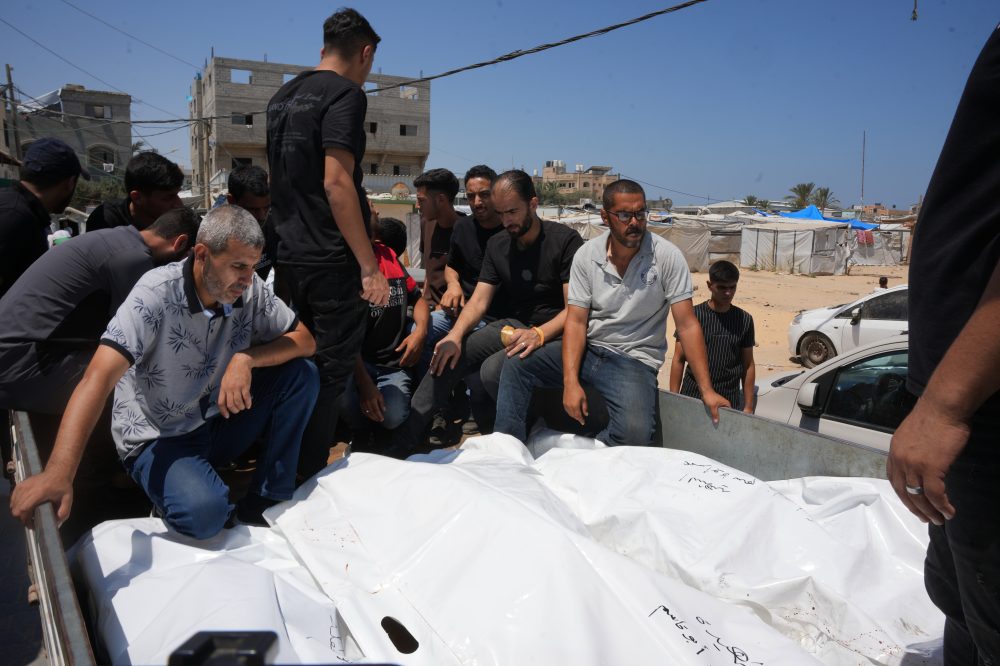
Among those killed was a woman and six police officers who died when an Israeli airstrike struck a police station in the heavily populated Jabaliya refugee camp in northern Gaza on Tuesday, according to hospital officials.
Additional strikes claimed more lives on Wednesday, when three members of the same family were killed in central Gaza. A man was also killed the previous day when a tent camp in the southern city of Khan Younis was bombed. Israeli forces additionally shot and killed a child on Tuesday in the Muwasi area, located west of Rafah, the southernmost city in Gaza, hospital officials confirmed.
The Israeli military offered no immediate response regarding the strikes in central and southern Gaza. However, in a statement focused on the Jabaliya attack, the military claimed that four of the police officers killed were Hamas militants, though it did not offer any evidence showing how those individuals were connected to planning or executing any attacks.
The Hamas-run Interior Ministry identified one of the slain officers as Col. Mohamad Marwan Salem, a senior police commander who served as head of the Jabaliya police station.
Hamas, which has governed Gaza for years, operates both an armed military wing and civilian police and security forces under the supervision of its Interior Ministry. Throughout the ongoing conflict, Israel has repeatedly targeted local police, including officers assigned to protect humanitarian aid convoys.
Israel’s military has stated that it views police stations as valid military targets when they are “being used to advance military activities, or if those present are military operatives involved in advancing terrorist activities.” The military did not clarify what specific activities it believed were occurring at the Jabaliya station, nor did it present evidence that any attacks were being organized there. Hamas maintains that its police force exists solely to preserve law and order within the territory.
These latest casualties come amid a fragile ceasefire deal reached in October that was intended to bring an end to a two-year conflict between Israel and Hamas. Although the most intense fighting has decreased, Israeli forces have continued to carry out strikes and military operations in the region.
Gaza’s Health Ministry reports that at least 1,123 people have been killed in the territory since the ceasefire went into effect. The ministry, which operates under the Hamas-led government, keeps detailed records of casualties that United Nations agencies and independent experts generally consider to be reliable. The ministry does not separate its counts between civilians and combatants.
Palestinian militants have also launched shooting attacks against Israeli troops, and Israel says its strikes are a direct response to those incidents and other violations of the ceasefire. Five Israeli soldiers have died since the ceasefire began.
The conflict traces back to the Hamas-led assault on southern Israel on October 7, 2023, which killed approximately 1,200 people and resulted in 251 individuals being taken hostage. Israel’s military response in Gaza has since killed more than 73,264 Palestinians, including those killed after the ceasefire took hold, according to Gaza’s Health Ministry.
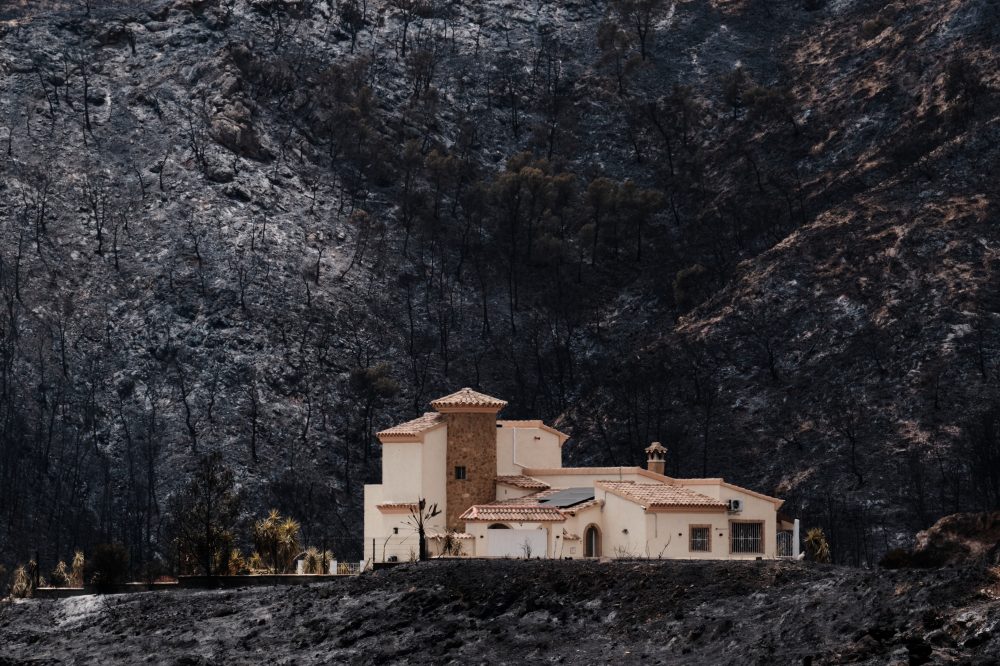
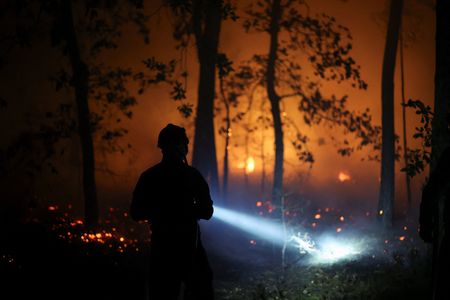
Five days after a wildfire destroyed a remote expatriate community in southern Spain, judicial authorities announced late Tuesday that all 13 victims of the disaster had been identified through biological samples.
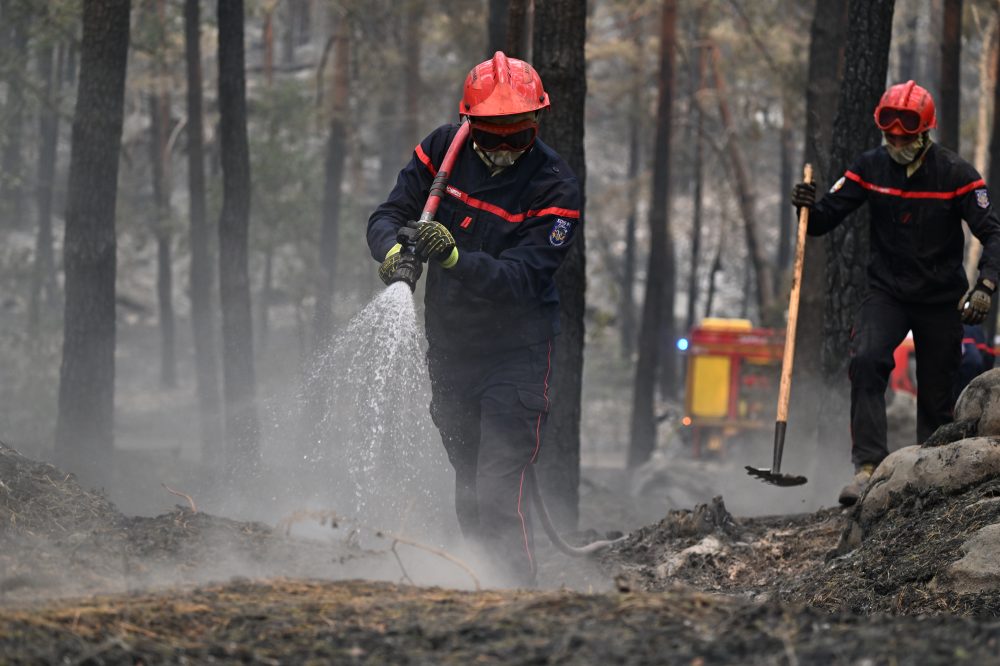
At the same time, French firefighters managed to bring a separate forest fire under control near the historic Fontainebleau area south of Paris, as dangerously high temperatures continued to grip parts of Europe.
According to a statement from judicial authorities, nearly all of the victims in the Spanish wildfire were foreign nationals — all of them adults. Among the dead were seven British citizens, including a 93-year-old woman who passed away at a hospital, three Belgian nationals, a French woman, an American, and one Spanish national. Of the 13 victims, eight were women and five were men.
Investigators had initially believed as many as 23 people were unaccounted for, but all of those individuals have since been located now that the victims have been fully identified.
The fire, known as the Los Gallardos fire, burned through approximately 70 square kilometers — about 27 square miles — of forest and agricultural land, ranking it among the deadliest wildfires Spain has experienced in recent years.
Extreme heat gripping Spain, combined with strong winds and minimal rainfall, has created dangerous conditions that allow small fires to spread rapidly and with little resistance.
According to the European Union’s Copernicus Climate Change Service, Europe is the fastest-warming continent on Earth, with temperatures rising at twice the global average rate since the 1980s.
In France, temperatures remained unusually high into Wednesday, with local highs reaching 39 degrees Celsius, or about 102 degrees Fahrenheit. The national weather agency Météo-France cautioned that the combination of intense heat and parched ground conditions was keeping wildfire risk dangerously elevated throughout the country.
The fire that swept through the renowned Fontainebleau forest south of Paris, which forced the evacuation of several nearby neighborhoods, has been brought under control. However, local authorities noted that firefighters were still working to extinguish smaller flare-ups across the affected region.
For most of its 65-year history, Amnesty International built its reputation by standing up for political prisoners across the globe. Now, the internationally recognized human rights organization has turned its attention in a very different direction.
Amnesty has published a new report declaring that human rights in the United Kingdom face a threat — not from authoritarian governments, but from groups that advocate on behalf of unborn babies and those who push back against transgender ideology and the broader LGBT agenda.
In the report, Amnesty labels these organizations as “anti-rights groups,” specifically calling out 25 pro-life organizations and 49 groups it describes as “gender critical” — a term used for those who oppose certain aspects of gender identity ideology.
The report signals a notable change in direction for an organization long associated with defending individuals imprisoned for their political or religious beliefs.
RIO DE JANEIRO — When a police officer shot and killed her 19-year-old son in a Rio de Janeiro favela back in 2014, Ana Paula Oliveira wasn’t sure she could go on living.
What pulled her through was connecting with other mothers who had suffered the same loss — attending court hearings, joining protests, and leaning on one another for emotional survival. Together, they formed a group that became her lifeline.
“Without any doubt, if I had been alone I wouldn’t have made it here, 12 years later,” Oliveira said at a recent gathering held at her son’s former school to mark the anniversary of his death. “We need one another to cry together, to smile together and to fight together.”
Oliveira and other Brazilian mothers have channeled their heartbreak into activism, determined that their sons will be remembered as human beings rather than numbers in a report. Now they are pushing for a nationwide government policy to support families of people killed by state forces — and they want public money to fund their work.
According to the nonprofit Crossfire Institute, 460 people died during police operations in Rio last year, the highest figure since 2016 and a 52% jump compared to the year before.
Drawing comparisons to the Mothers of Plaza de Mayo — the Argentine human rights organization formed by women whose children were abducted during the military dictatorship that governed Argentina from 1976 to 1983 — Oliveira’s group works to highlight the human cost of police killings and push for legal accountability, sometimes with success.
Last year, the mothers traveled to the capital, Brasilia, where they met with representatives from the judicial, legislative, and executive branches of government to present their proposal. The project was developed with backing from Raave, a network of organizations that supports people impacted by police killings in Rio.
“Raave is negotiating with the federal government to implement a pilot project … developed by the mothers, so that we can provide care and guarantee the rights of this population,” said Guilherme Pimental, a coordinator for Raave.
Crime is shaping up to be a central issue in Brazil’s October elections, as it is in other Latin American nations such as Peru and Colombia. Supporters of presidential hopeful Sen. Flávio Bolsonaro, the son of former President Jair Bolsonaro, argue that police need full backing as they confront heavily armed gangs operating in favelas — densely populated, low-income urban communities.
However, grieving mothers and advocacy groups counter that Brazilian police frequently resort to excessive force, with deadly results.
Oliveira’s son, Johnatha, was shot in the back while walking through a street in Rio’s Manguinhos favela after visiting his grandmother, she said. He died from his wounds.
“Police officers allege that they shot him to disperse a crowd” that was protesting at the time, Oliveira said. She wants the officer who fired the fatal shot convicted of intentional homicide. In 2024, a jury found the officer guilty of manslaughter without intent to kill. Prosecutors appealed that verdict successfully, but a date for a new trial has not yet been scheduled.
Monica Cunha followed a similar path, turning grief into public action. After police killed her 20-year-old son in 2006, she ran for office and became a councilwoman. This month, she is set to formally announce her candidacy for state lawmaker ahead of the October elections.
“I fight for memory, truth, justice, reparations and guarantees of nonrepetition — not only for myself, but so that no other family has to endure this pain,” Cunha wrote in an Instagram post marking the 18th anniversary of her son’s death. “The racism that kills our children and loved ones is not an isolated problem, and it must be confronted through state policies. I will keep going, turning grief into struggle.”
Brazilian police have taken more than 6,000 lives every year since 2018, according to the Brazilian Forum on Public Safety, a well-known nonprofit organization. The group’s 2025 annual report on violence in Brazil found that the largest share of victims are between the ages of 18 and 24, and that 82% of those killed by police are Black.
Police tactics in Rio’s favelas were thrust back into the spotlight last year when officers killed 117 suspected gang members in the deadliest raid in the state’s history. The operation targeted members of the criminal organization known as Red Command across two favelas. Five officers also lost their lives. Police reported arresting 113 people, seizing 118 weapons, and confiscating more than a ton of drugs during the raid.
The then-governor of Rio, Cláudio Castro, a political ally of former President Bolsonaro, defended the operation, describing its targets as “narco-terrorists” — language that echoed U.S. President Donald Trump. Last month, the Trump administration officially designated the Red Command, along with its rival First Command Capital, as foreign terrorist organizations.
Nadia dos Santos lost two sons to police violence: Cleyton, who was 18 when he was killed in 2015, and Cleyverson, who was 17 at the time of his death in 2022. Her sister, Glaucia dos Santos, also lost her son Fabricio, who was 17 when police killed him in 2014. A large mural honoring all three young men covers the front of the family’s home in Rio’s Chapadao favela complex.
The two sisters established support groups and began painstakingly investigating the circumstances surrounding each death, seeking justice through the legal system.
In 2023, the officers responsible for Fabricio’s death were sentenced to nine years in prison — a ruling that brought celebration and renewed hope to other grieving mothers, Glaucia dos Santos said.
“We want others to stay alive, so we have to stay upright” even under the crushing weight of grief, she said.
Her sister Nadia stressed the need for a national public policy on reparations, which she traveled to Brasilia to advocate for in person.
“The state should have the obligation to give us mothers who lose our sons because of the state’s violence reparations. … We fight, we work, but we become ill. We need solutions,” she said.
Oliveira offered concrete ideas for what reparations might look like, including placing victims’ names in public spaces and naming schools, hospitals, and daycare centers after them.
“There are other forms of reparation as well, such as building other public policies of nonrepetition that would help prevent new cases. … Many things need to be done, repaired, so that this barbarity does not continue,” she said.
A lead American negotiator who worked to secure the release of hostages taken during the Hamas attacks on Israel will publish a behind-the-scenes account of those efforts this coming fall.
Crown, an imprint of Penguin Random House, has announced Brett McGurk’s upcoming book, titled “Brink: Inside the Race to Free the October 7 Hostages,” will hit shelves on October 6 — nearly three years to the day after the Hamas assault that killed more than 1,000 people and resulted in over 200 individuals being taken captive.
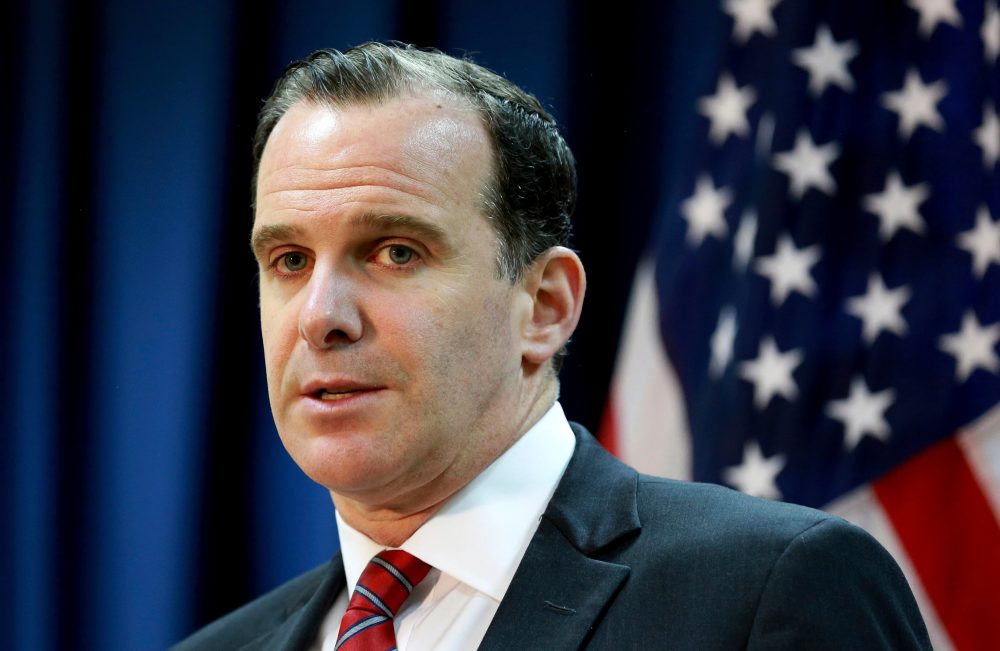
McGurk, 53, is a veteran Middle East diplomat and adviser who had already served under three presidents before President Joe Biden tapped him in 2023 to lead hostage negotiations between Israel and Hamas. Crown says McGurk will recount his intense efforts to bridge the deeply divided demands of both sides, traveling across the globe in search of a deal.
“On October 7, Hamas unleashed a devastating war and the largest hostage crisis in modern history,” McGurk said in a statement released Wednesday by Crown. “I wrote ‘Brink’ to bring readers inside the rooms as events unfolded in real time — from the Situation Room with hundreds of missiles in the air, to compounds across the Middle East where diplomacy teetered between breakthrough and collapse.”
The publisher also says McGurk will reveal details about a near-agreement prior to October 7 that could have normalized diplomatic relations between Israel and Saudi Arabia. He will also reflect on his unexpected working partnership with Steve Witkoff, an appointee of President Donald Trump, as the two navigated hostage talks during the transition between the Biden and Trump administrations. The last surviving hostages were ultimately freed in October 2025.
“‘Brink’ details the bipartisan front they forged when it mattered most, ultimately securing a deal that would save lives,” the publisher’s announcement states.
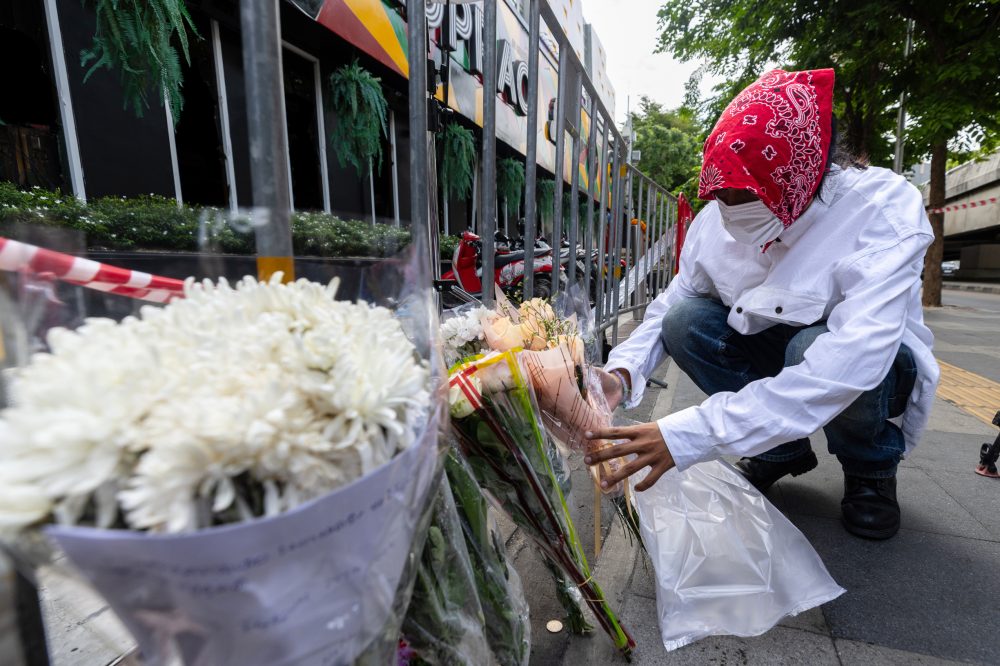
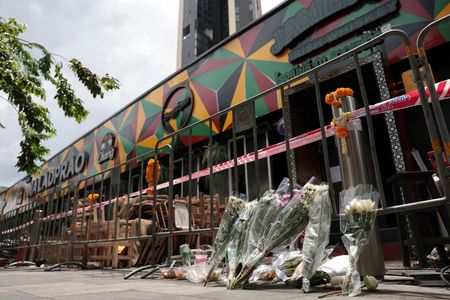
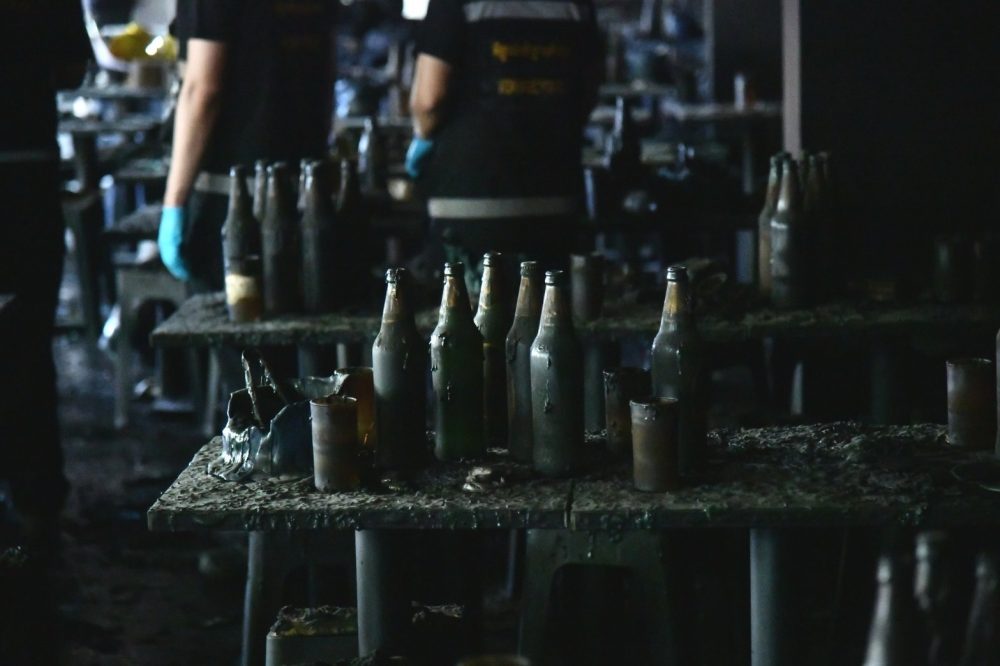
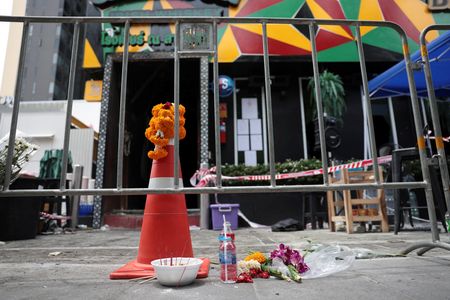
BANGKOK — Survivors and relatives of those killed in a catastrophic bar fire in Bangkok made their way to a nearby police station on Wednesday, hoping to give statements, collect belongings, and begin the process of seeking financial compensation from the bar’s owners.
The blaze erupted on Sunday night at the Rong Beer Na Ladprao bar and has now claimed at least 32 lives, with two additional victims dying in the hospital since the fire. More than 70 people were hurt, and 24 of them remain in critical condition, according to the Bangkok Metropolitan Administration.
Investigators are still working to determine what caused the fire.
According to police, many of those who perished were discovered trapped inside windowless bathrooms, locations where they had apparently sought refuge from the spreading flames.
The chief of the Institute of Forensic Medicine, Wiroon Supasingsiripreecha, told reporters Wednesday that the majority of victims died from inhaling smoke, while a smaller number succumbed to burn injuries.
One survivor, 26-year-old Natthaphong Lakhorn, was inside the bar that night with four friends. He had been seated close to the stage when the fire started. He recalled noticing white smoke drifting from the stage area, which he initially mistook for a dry ice effect used as a visual effect — until he realized it was the beginning of a fire.
Iran’s Islamic Revolutionary Guard Corps is threatening to shut down “all other export corridors that benefit the U.S. and its allies,” according to Iranian state media, following the closure of the Strait of Hormuz and the reimposition of a U.S. naval blockade around Iranian ports.
“Regional energy exports are either shared by all, or denied to all,” the IRGC declared in a statement carried by Iran’s IRNA state news agency on Wednesday.
Analysts believe Iran may be signaling that it could use its Houthi allies in Yemen to close the Bab el-Mandeb strait — a narrow waterway connecting the Red Sea to the Gulf of Aden — potentially putting two of the globe’s most critical energy shipping routes at risk simultaneously. Saudi oil exports and a large portion of worldwide shipping pass through that gateway.
A senior Houthi official warned on Monday that the group was ready to seal off the Bab el-Mandeb strait, a move he said could drive oil prices to $200 per barrel, if Saudi Arabia continued military operations against Yemen. That warning came after Houthi forces launched missiles at Saudi Arabia, accusing the kingdom of bombing an airport under their control — a development that shattered a four-year ceasefire between the two sides.
The Houthis have demonstrated before that they can disrupt global trade through the Bab el-Mandeb. Following the outbreak of the Gaza conflict in October 2023, the Iran-backed group attacked commercial vessels in the Red Sea, claiming it was targeting ships connected to Israel in solidarity with Palestinians.
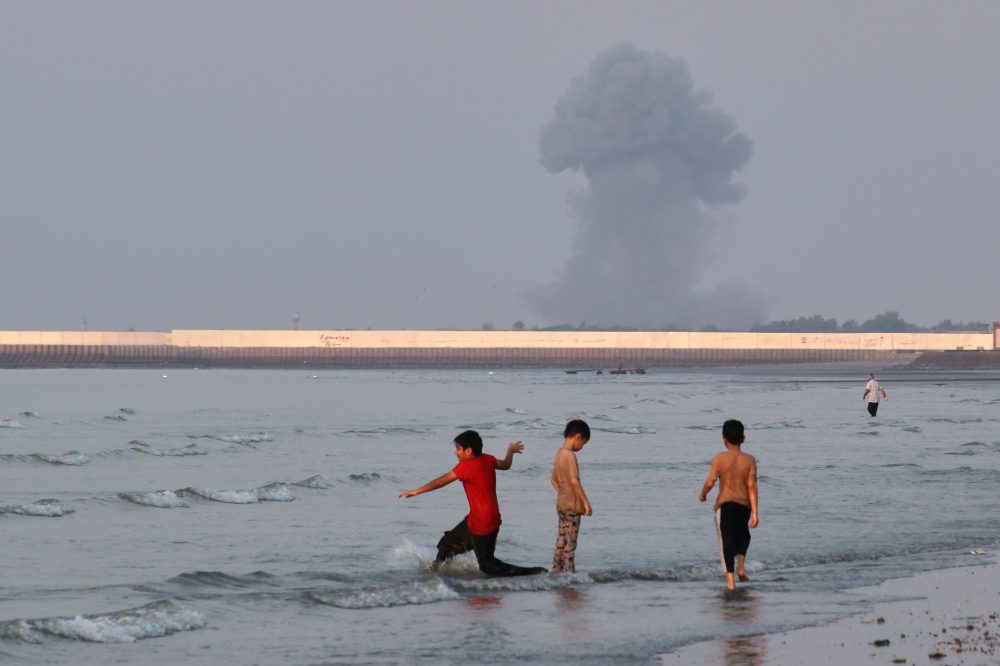
The current wave of threats follows U.S. military strikes launched to “continue degrading Iranian capabilities used to attack commercial shipping in the Strait of Hormuz,” according to a U.S. military statement. American officials say Iran attacked seven commercial ships over the past week, leaving nearly a dozen crew members dead, missing, or hurt.
Late Tuesday, the U.S. military reported it had hit dozens of military targets near the Strait of Hormuz and along Iran’s coastline. According to U.S. Central Command, that wave of strikes lasted seven hours.
The IRGC announced Wednesday that the Strait of Hormuz would stay closed until what it called “the end of America’s evils.” Prior to the conflict’s outbreak in February, roughly one-fifth of the world’s daily oil and gas shipments moved through Hormuz.
The Revolutionary Guards also said they struck what they described as command-and-control, logistics, fuel, and military equipment facilities belonging to the U.S. Fifth Fleet in Bahrain. They additionally claimed to have set fire to and destroyed a U.S. logistics facility in Kuwait’s Mina Abdullah, and said their air force targeted a U.S. base at Azraq in Jordan, striking aircraft hangars. The IRGC said some of the U.S. attacks had originated from bases on Jordanian soil.
Kuwait’s state news agency reported earlier Wednesday that a fire at a targeted site had been brought under control, though it was not immediately clear if this was the same location mentioned by the IRGC. Jordan’s air defense forces intercepted and shot down three ballistic missiles that crossed into the country’s airspace from Iranian territory early Wednesday.
The renewed hostilities between Iran and the U.S. flared up last week, unraveling a fragile truce that had been reached in June following months of fighting that has claimed thousands of lives.
President Trump on Tuesday threatened to strike Iranian power plants and bridges as early as next week if Tehran does not return to negotiations. “I’ll save the energy targets for last, but ultimately we’ll hit energy targets,” Trump said in a Fox News interview with Trey Yingst. He also said U.S. negotiators had contacted their Iranian counterparts to tell them “you better make a deal.”
As tensions continued to build, Trump on Monday floated the idea of imposing a 20% fee on ships passing through the strait — a proposal that drew strong criticism from the United Nations shipping agency and others. By Tuesday, he had abandoned that idea, saying instead that he would pursue investment agreements with Gulf states, though he offered no specifics.
Oil prices climbed further Wednesday after closing up 2% to a one-month high on Tuesday, as the ongoing conflict continues to disrupt supply through the Strait of Hormuz. Both Brent crude and West Texas Intermediate posted their highest closing prices since mid-June for the second consecutive session, with both contracts climbing again in early Wednesday trading.
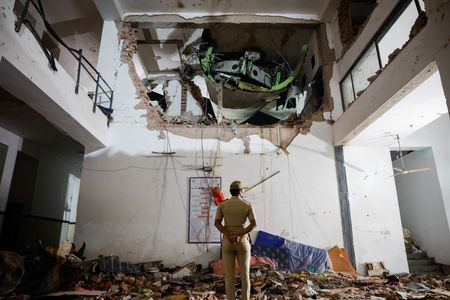
NEW DELHI — Documents filed in court reveal that India’s aircraft accident investigation agency has completed a psychological autopsy and evaluation as part of its ongoing inquiry into last year’s catastrophic Air India crash, with the psychologist’s final report already in hand.
The court filing did not specify whose psychological autopsy was performed, nor did it reveal any conclusions about the crash of the Boeing 787 that claimed 260 lives shortly after the aircraft departed from Ahmedabad, India.
India’s Aircraft Accident Investigation Bureau disclosed that investigators have put together a transcript of the cockpit voice recorder. However, analysis of data pulled in late May from an engine monitoring unit is still pending, and an examination of organizational factors connected to the crash remains underway. The agency offered no additional details beyond those disclosures.
A powerful Cambodian gambling mogul’s business empire served as the landlord for a compound that became the base of a massive scamming and human trafficking operation, a Reuters investigation has revealed.
Documents reviewed by the news agency — including a rental agreement dated March 2024 — show that Lim Heng Group leased buildings on grounds it shares with one of its casinos on the border between Thailand and Cambodia, charging above-market rental rates.
Inside those buildings, rooms had been converted to resemble police stations and bank offices from various countries, serving as the staging grounds for impersonation scams targeting victims around the world. That finding comes from interviews with the Thai military, individuals who worked inside the buildings, and two separate visits Reuters made to the property this year.
Reuters is the first news organization to reveal the commercial relationship between Lim Heng Group and the buildings where the scams took place — located just tens of meters from its Royal Hill casino.
The news agency found no direct evidence that Lim Heng Group participated in the trafficking or fraud activity at the location.
Royal Hill casino did not respond to phone calls or emails seeking comment on the cyberscam and trafficking activities. Questions sent to Lim Heng Group by registered post were delivered but never answered.
According to the independent Cambodian Human Rights Action Coalition and a Phnom Penh-based attorney specializing in business and human rights law, Piseth Duch, prosecutors can pursue charges against property landlords if it can be shown that they were aware criminal activity was taking place and allowed it to continue.
Lim Heng Group had been alerted to possible trafficking activity at Royal Hill as early as September 2024, when a company representative filed a legal complaint against two Cambodian publishers whose news outlets had reported that foreign nationals were being held against their will inside the casino compound.
Court summonses tied to those “incitement to discrimination” complaints — both dated September 16 and reviewed by Reuters — did not spell out which specific claims in the articles Lim Heng disputed.
One of the publishers, Penn Nuon, confirmed that a legal complaint had been filed in connection with his reporting on foreign nationals held at Royal Hill. He said his reporting was accurate but that he had taken down the article to resolve the matter after consulting with his attorney.
Reuters was unable to confirm whether the complaint was ultimately dropped. The Phnom Penh court where the complaints were filed did not respond to questions.
Gen. Thatchai Pitaneelaboot of the Royal Thai Police, which is heading the investigation into alleged cyberfraud at the compound, told visiting reporters that Chinese criminal groups had run scams at the Royal Hill location, though he did not provide specifics about their identities.
Thailand has confirmed Lim Heng’s ownership of the site, according to two Thai security agency reports on Cambodian cyberfraud prepared this year and reviewed by Reuters.
Southeast Asia has become home to numerous large-scale fraud operations, where mostly Chinese-led criminal organizations hold trafficked victims and force them to carry out romance scams and police-impersonation schemes. The U.S. government has estimated that Americans lost $10 billion to fraudsters operating in the region during 2024.
Jason Tower of the Global Initiative against Transnational Organized Crime nonprofit noted that many Chinese-affiliated scam syndicate operators also have ties to casinos, which give them a way to conceal illegal profits.
An Amnesty International investigation, drawing on gambling regulator records and witness accounts, found that casino owners in Cambodia were “in direct control” of at least a dozen scam centers. Reuters has not independently verified those figures.
Sophal Ear, a professor at Arizona State University who studies Cambodian politics, noted that casinos in the country are frequently controlled by individuals with political connections.
Lim Heng fits that description: he has been photographed alongside senior military generals at social events, holds a royal title equivalent to a duke, and donated $20,000 to Cambodia’s military last year, according to a business association that lists him as a member.
While the Cambodian government has pledged to shut down scam centers, it has consistently described Royal Hill as simply a hotel — even as images of fake police stations and bank offices found inside the compound were broadcast by media outlets across the globe this year.
As part of a broader crackdown, Cambodia has extradited casino owner and alleged scamming kingpin Chen Zhi to China and passed new laws directly targeting scam operations.
Chhay Sinarith, a senior Cambodian minister assigned to combat online fraud, responded to Reuters’ questions by saying the government is dedicated to working with international partners to address scam activity. He also said Cambodia is investigating alleged fraud in the area surrounding Royal Hill, but called on Thai security forces to return control of the locations they have seized in order to allow those investigations to proceed.
The Cambodian military did not respond to questions about its relationship with Lim Heng.
The Royal Hill casino itself is a weathered structure featuring neoclassical columns and gold-trimmed spires positioned just meters from the Thai border.
It sits next to two buildings where Reuters uncovered evidence of scam operations. Those structures were part of a cluster of buildings surrounded by a tall fence topped with razor wire. Thai security officials and a Thai woman named Pornpen Aimhun — who said she was trafficked to Royal Hill — indicated that at least four of the enclosed buildings were used for criminal purposes.
Reuters examined the rental agreement between Royal Hill and a Chinese national at an office inside one of the buildings, which the Thai military said appeared to have been used by scam organizers. The contract showed Royal Hill agreed to rent three buildings within its compound to the Chinese national for two years at a rate of $200,000 per month. It was signed by the tenant and by Seng Chanthy, who was at the time an employee of Royal Hill. Seng Chanthy did not respond to a request for comment on the contract.
Reuters is not publishing the name of the tenant because the news agency could not independently verify his identity or confirm his involvement in the scam activity.
That rental price was extraordinarily high for three buildings in a quiet border town. For comparison, a mixed-use building of similar size in an upscale Phnom Penh neighborhood was listed for $25,000 a month in May.
Reuters visited the casino compound in February and March at the invitation of the Thai military, which had bombed Royal Hill during a brief armed conflict with Cambodia in December. The military, which now controls the site, said it wanted to present evidence that Royal Hill had functioned as a scam facility. Thailand said it targeted Royal Hill because its troops had reported that buildings in the area had been taken over by Cambodian forces and used for drone and sniper attacks.
Cambodian information minister Neth Pheaktra told Reuters that those claims were false and that Thailand had struck civilian infrastructure.
The lease described the dimensions of two of the buildings and noted that the third contained 252 rooms, without providing additional identifying information.
Bangladesh-based architect Rizvi Hassan, who analyzed satellite imagery of the buildings on Google Earth at Reuters’ request, found that the dimensions of three of the enclosed structures matched the measurements listed in the contract. The Thai military also told Reuters that its initial survey of the site suggested two of the structures contained approximately 250 rooms.
The U.S. State Department’s 2024 human trafficking report stated that abuses within scam operations remained “widespread” in Cambodia because elites in the country owned properties used by scammers and profited financially from those crimes.
“Scam centers require physical infrastructure, access to land, and a degree of protection to operate at scale,” said Ear, the Arizona State professor.
The scam operations in the border region were among the largest in Southeast Asia: Thai security forces say the enclosed structures at Royal Hill held roughly 3,000 people and were part of a larger 200-acre scam complex.
Pornpen told Reuters she was drawn to Royal Hill in 2022 by a Facebook advertisement promising a web administrator position. She was instead forced to take part in a police-impersonation scheme before managing to escape. She described guards armed with truncheons monitoring workers, with those who fell short of quotas facing punishment.
A spokesperson for Meta, the parent company of Facebook, said the platform has built warning messages that appear when users search for keywords that may be linked to fraudulent job listings.
Reuters verified Pornpen’s account through another individual who said they were also trafficked to Royal Hill and encountered Pornpen there, as well as through the Thai police, who confirmed she is a witness in a court case related to fraud carried out at the compound.
That court has since convicted a Thai national of voluntarily working as a low-level scammer at Royal Hill, sentencing him to five years in prison, according to a police statement on the verdict, which did not name his employers or his attorney.
DUBAI, United Arab Emirates — American military forces reinstated a blockade on Iranian ports in the early hours of Wednesday, responding to Tehran’s repeated attacks on vessels attempting to navigate the Strait of Hormuz — a critical waterway that carries roughly one-fifth of the world’s oil and natural gas trade during normal times.
The move has triggered fresh retaliatory strikes across the Middle East and pushed an already fragile interim peace agreement closer to collapse. Both countries have been locked in a struggle for control of the strait, and experts warn the escalating conflict could drag the entire region back into open warfare.
The blockade was first put in place in mid-April, then lifted in mid-June — one day after the two sides signed a temporary agreement establishing a 60-day window for negotiations on issues including Iran’s nuclear program. However, those talks have largely stalled as clashes over the strait have grown more intense.
Iran’s paramilitary Revolutionary Guard issued a stark warning Wednesday in response to the renewed blockade, threatening to shut down all energy exports from the region. “The export of oil and gas from the region will be either for everyone or for no one,” the Guard declared.
President Donald Trump announced the return of the blockade on Monday and initially said he would impose a 20% fee on ships passing through the strait. He walked back that plan just hours before the blockade went back into effect, saying Gulf allies had asked him to reconsider. Trump said Tuesday that leaders from the region — describing them as “kings and emirs” — reached out and proposed a different approach.
“They said we’d love to do it a different way. We’d love to invest in the United States with billions and billions of dollars,” Trump told reporters in the Oval Office on Tuesday. He said he preferred that arrangement over charging tolls, adding, “I don’t think anybody should be able to charge a fee for the strait.” It remains unclear whether these investment commitments would be new or tied to deals previously announced following Trump’s visit to the Middle East last year.
Alongside reimposing the blockade, U.S. forces conducted another round of strikes, hitting dozens of targets over a seven-hour period, according to U.S. Central Command.
Missile alert warnings sounded in Bahrain and Kuwait early Wednesday as both countries faced incoming fire from Iran — a situation that has become a daily occurrence and is further straining any remaining ceasefire. Jordan reported shooting down three Iranian missiles. Iran claimed responsibility for attacks on all three nations.
U.S. Navy Admiral Brad Cooper, who commands Central Command, stated that Iran had launched dozens of missiles and drones at neighboring Gulf Arab nations. “U.S. forces are holding Iran accountable for unwarranted aggression that continues to endanger innocent lives,” Cooper said.
The U.S. currently has at least 19 warships in the Arabian Sea, including two aircraft carriers and an amphibious assault ship carrying more than 1,000 Marines. Central Command also noted on social media that “hundreds of military aircraft” are currently operating throughout the Middle East.
The conflict traces back to February 28, when the U.S. and Israel launched military operations against Iran, prompting Tehran to effectively close the Strait of Hormuz by attacking and threatening ships — sending oil, fertilizer, and other commodity prices sharply higher. More recently, Iran has been targeting vessels on a route near Oman that falls outside Tehran’s control but is overseen by U.S. forces, sparking the latest round of violence. While the U.S. has threatened to reopen the strait by force, analysts say doing so would require a significantly larger military force, potentially including tens of thousands of ground troops.
Iran’s ambassador to the United Nations, Amir Saeid Iravani, pushed back against the U.S. military campaign in a letter to the head of the world body, as reported by Iran’s state-run IRNA news agency. “The U.S. is the aggressor, not the victim,” he wrote.
Trump warned Tuesday night on Fox News Channel that additional U.S. strikes against Iran were planned for the following two days, and suggested bridges and power plants could become targets by next week if negotiations do not resume. At least one bridge has already been struck. “You better make a deal, or you’re not going to have anything left,” Trump warned.
U.S. Central Command confirmed strikes on multiple locations inside Iran on Tuesday. Tehran acknowledged the attacks but did not release figures on casualties or damage. Hours after the U.S. announced it had concluded its strikes, explosions were reported in at least four locations in the Iranian city of Bushehr on the Persian Gulf, according to IRNA. Iranian state media also reported blasts in the southwestern city of Ahvaz and the southern port city of Bandar Abbas, raising questions about whether Gulf Arab nations may be conducting their own retaliatory strikes without making public statements.
Kuwait reported separately that an Iranian attack on Tuesday wounded four of its navy personnel and set a building ablaze.
Under the terms of the interim agreement, Iran had agreed to allow free passage through the strait for 60 days, but the deal left unresolved what would happen afterward. Iran maintains it has the authority to manage traffic through the waterway and potentially charge fees — a position the U.S. has rejected.
On the energy markets, a barrel of Brent crude oil — the international benchmark — briefly climbed above $87 early Tuesday, though that remains well below the nearly $120 per barrel seen at the peak of the conflict. Prices dipped back to around $78 after Trump announced he was abandoning the toll plan.
Regional mediators continue their efforts to bring the United States and Iran back to the negotiating table.
BEIJING — China’s economy lost significant momentum in the second quarter of 2026, growing at its slowest annual pace in more than three years and falling short of both analyst expectations and the government’s own targets.
Official data released Wednesday showed gross domestic product in the world’s second-largest economy climbed 4.3% compared to the same period last year. That came in below the 4.5% growth analysts had predicted and represented a notable step down from the 5.0% expansion recorded in the first quarter.
The last time China posted weaker annual growth was in the fourth quarter of 2022, when strict COVID-era lockdown policies were suppressing economic activity. The latest figure also dipped below the bottom end of Beijing’s full-year growth target range of 4.5% to 5%, putting added pressure on policymakers to find ways to reinvigorate the economy.
On a quarter-over-quarter basis, the economy grew 0.9% — in line with forecasts but slower than the 1.3% gain recorded in the prior quarter. For the first six months of the year combined, GDP growth came in at 4.7%.
The underlying story of China’s economy is one of growing imbalance: industrial production remains strong, buoyed in part by AI-related exports, while consumer spending and investment continue to struggle under the strain of a prolonged housing market downturn and the ripple effects of a global oil price shock.
Hao Zhou, a Hong Kong-based analyst at Guotai Haitong Securities, said the focus has now shifted to how China’s leadership plans to hit its annual growth goal. “The policy debate now shifts toward how Beijing intends to secure its annual growth target. We expect policymakers to maintain a strong focus on supporting domestic demand, particularly consumption and infrastructure investment,” he said.
Zhou did not anticipate sweeping economic stimulus, however. “As long as external demand continues to provide a meaningful cushion to growth, authorities are likely to prefer targeted and incremental policy support rather than deploying large-scale stimulus measures,” he added.
Market watchers are now looking ahead to an anticipated late-July Politburo meeting, where new policy signals could shape economic strategy for the remainder of the year.
Activity data for June showed a mixed picture. Industrial output climbed 5.3% year-over-year, picking up from 4.5% growth in May and hitting its fastest pace in three months. Retail sales rebounded 1.0% in June after falling 0.6% in May — the best performance in three months and well above the 0.1% decline analysts had expected. Sales of communication devices, cultural and office products, tobacco, alcohol, and cosmetics all contributed to the rebound.
Over the first half of the year, services sales grew 5.3%, far outpacing the 1.1% increase in goods sales.
Investment, however, remained a weak point. Fixed-asset investment contracted 5.7% in the first six months of 2026, worse than the expected 4.9% decline and steeper than the 4.1% drop recorded through May. Private investment fell 8.5%, and even state-sector investment declined 2.3%. Infrastructure spending shrank 2.4% as government fiscal outlays lagged behind.
Andi Ji, an analyst at ITC Markets, described the situation bluntly: “A high-tech-driven industrial engine running alongside cratering domestic consumption and investment firmly highlights the economy’s deeply uneven growth momentum.”
China’s property sector continued to weigh heavily on the overall economy. Real estate investment dropped 18% in the first half of the year compared with the same period in 2025, widening from a 16.2% decline through May. New home prices fell again in June, though the pace of decline eased slightly, as weak nationwide demand overshadowed modest improvements in some major cities.
On Monday, Premier Li Qiang called for “a comprehensive and objective understanding” of current economic conditions and urged stronger counter-cyclical policy action, according to state broadcaster CCTV.
Also on Monday, China unveiled its first five-year plan centered on boosting consumption, setting a target of approximately 60 trillion yuan in annual retail sales by 2030.
Analysts widely expect Beijing to turn increasingly to fiscal tools to buffer any further economic softening, as the central bank faces limitations in deploying aggressive monetary easing even amid declining oil prices.
Minxiong Liao, senior economist at GlobalData.TS Lombard APAC, welcomed the policy direction but cautioned that more will be needed. “The recent policy focus on boosting consumption suggests Beijing is increasingly aware of this imbalance, but meaningful rebalancing will require more than trade-in subsidies and consumer incentives,” Liao said. “Unless stronger fiscal support reaches households through higher social transfers and a more robust healthcare and pension system, precautionary saving is likely to remain elevated and any improvement in consumption will probably prove gradual rather than self-sustaining.”
Shipping data revealed a noticeable uptick in vessel traffic through the Strait of Hormuz on Tuesday, with the majority of those ships connected to Iranian trade — all moving through before a U.S. naval blockade went into effect the following day.
On Tuesday, President Donald Trump reinstated a naval blockade on all Iranian ports and warned that power plants and bridges could be targeted as early as next week if Iran does not return to the negotiating table. The move marks another significant escalation in the ongoing conflict between the United States and Iran.
According to ship-tracking data from Kpler, nine of the 11 vessels that moved through the strait on Tuesday traveled along the Iranian route. Among those were three empty oil tankers — one Aframax-class ship and two Very Large Crude Carriers — that entered the waterway.
Ships leaving the strait carrying Iranian exports included one Very Large Crude Carrier loaded with 2 million barrels of crude oil, a medium-range tanker transporting refined petroleum products, and two tankers hauling liquefied petroleum gas. A methanol tanker and a dry bulk vessel carrying iron ore also exited the Gulf that day, the data showed.
No tanker traffic was recorded entering or leaving the strait to load oil and gas from other Gulf-region producers on Tuesday.
Military strikes between the U.S. and Iran have intensified throughout the week, bringing shipping through the Strait of Hormuz to a near standstill. Before the war broke out in February, roughly one-fifth of the world’s daily oil and liquefied natural gas shipments passed through the strait.
U.S. officials reported late Tuesday that Iran had attacked seven commercial vessels over the past week, resulting in nearly a dozen crew members killed, missing, or injured.
Attacks targeting Emirati supertankers have pushed Middle East spot crude prices higher this week. Prices for the nearest delivery month are now above those for future months — a market signal that supplies are running tight.
Investment bank Goldman Sachs warned in a Wednesday note that a recovery in Gulf shipping flows may be slow to materialize. Analysts noted a steep decline in traffic along Omani and international shipping lanes following the recent tanker attacks, writing that the data showed “shippers using the non-Iranian Hormuz lane remain risk-averse.”
A district court in Kathmandu, Nepal, has handed down prison sentences to two former government ministers found guilty of falsifying documents to allow Nepali citizens to be resettled in the United States under a Bhutanese refugee program, according to court documents and attorneys who spoke Wednesday.
The Kathmandu district court sentenced former Deputy Prime Minister and Energy Minister Top Bahadur Rayamajhi to four years behind bars on charges that included offenses against the state, fraud, and participation in organized crime. Former Home Minister Bal Krishna Khand received a two-year sentence as an accomplice. Both rulings were issued late Tuesday.
Rayamajhi remains in custody, while Khand has been released on bail. Neither man was reachable for comment. Both have previously denied any wrongdoing in connection with the scheme.
Dharma Raj Regmi, an attorney representing Rayamajhi, insisted his client was “never involved in policy making for the refugees” and confirmed plans to challenge the verdict through an appeal.
Khand’s attorney, Pankaj Karna, also announced intentions to appeal the ruling.
An additional 14 individuals were convicted alongside the two former ministers, including a former senior official from the home ministry and a former leader among the Bhutanese refugee community. Those individuals received sentences of up to four years, the court document indicated.
It remains unclear whether any Nepali nationals were actually relocated to the United States under false pretenses as Bhutanese refugees. The fraudulent scheme came to light in 2023, by which time both former ministers had already departed from their government roles.
The case stems from a long-running refugee situation involving approximately 120,000 Bhutanese nationals of Nepali descent who fled the neighboring Himalayan nation of Bhutan beginning in the early 1990s. Those individuals sought greater political freedoms in Bhutan, a majority Buddhist country with a population of fewer than 800,000 people.
Close to 113,000 of those refugees have since been resettled in Western nations — including the United States, Canada, and Australia — through an international third-country resettlement program, after Nepal and Bhutan were unable to reach an agreement on the refugees returning home. The United States alone has accepted roughly 100,000 of those individuals from Nepal.
Thousands of Bhutanese refugees remain in camps in eastern Nepal, still hoping to one day return to Bhutan.
The convictions come amid a broader push against corruption in Nepal. Last September, 76 people lost their lives during youth-led anti-corruption demonstrations that ultimately brought down the country’s government. A new administration backed by the Gen Z movement, led by former rapper-turned-politician Balendra Shah, 36, took power in March. Shah has vowed to pursue accountability for alleged corruption under previous governments.
BARUIPUR, India — One Saturday evening earlier this month, an 11-year-old girl stepped out of her home in a small eastern Indian town, headed to celebrate a friend’s birthday. She never came back.
According to a local police investigator, the girl was abducted, raped, stuffed into a sack and thrown — still alive — into a nearby pond by a group of men. Her lifeless body, covered in bite marks and bruises, was pulled from the trash-filled pond the following morning, July 5, as horrified residents and her 46-year-old father looked on.
“My mind is not working. I have not been able to think straight in days,” the girl’s father told Reuters. Under Indian law, the identities of the victim and her family are being withheld because disclosure of identifying details in such cases is prohibited.
The murder is the latest in a long string of brutal sexual assaults that advocates say reflect a deeply rooted crisis across India. Government data from the National Crime Records Bureau shows more than 80 rapes are reported to police each day, and activists warn that many more go unreported due to victim blaming and social stigma.
Experts point to entrenched patriarchy and misogyny, chronically understaffed police departments, and a judiciary plagued by severe backlogs as factors that embolden perpetrators. That sense of escaping consequences, activists argue, is fueling a relentless cycle of violence.
India recorded 29,536 rape cases in 2024, a number that has remained largely stagnant in recent years. Meanwhile, sexual crimes against children have climbed sharply over the past decade, with cases filed under the Protection of Children from Sexual Offences Act reaching a record 69,191.
The Baruipur case has placed Prime Minister Narendra Modi’s Bharatiya Janata Party under scrutiny, as the party recently took power in West Bengal state — where Baruipur is located — with women’s safety as one of its central campaign pledges.
The incident is not isolated. In the past month alone, at least two other cases have captured national attention. In the northwestern state of Rajasthan, a 12-year-old girl was abducted, drugged and raped by multiple men across four days at various hotels before being rescued. Police said 22 people have been arrested in that case. Separately, the Times of India reported Monday that a 7-year-old girl was raped and killed, her body discarded in an empty shaft at an under-construction shopping mall in Ghaziabad, roughly 30 kilometers from India’s parliament.
Karuna Nundy, an attorney who helped craft India’s anti-rape legislation, said no government has made a serious effort to “uproot the misogyny and patriarchy” at the heart of the problem. “There needs to be a sustained effort towards changing behaviour at the community level,” she said. “It is crucial to recruit the right kind of police personnel and appoint judges who have a gender progressive understanding of these issues.”
A sweeping legal overhaul followed the 2012 gang rape and murder of a woman on a moving bus in Delhi — a case that shocked the nation and sparked massive public protests. Tougher sentencing and fast-track courts were introduced. Yet advocates say little has changed in practice.
“Nothing is going to change simply because the regime changes. This is a deep-rooted problem embedded in our patriarchal culture, not just in West Bengal but across India,” said Satabdi Das, a gender rights activist based in Kolkata.
The government had originally planned to establish 2,600 fast-track courts dedicated to sexual crimes by 2026, but the latest official data shows only 755 have been set up, including 410 courts exclusively handling child sexual abuse cases.
India’s National Commission for Women, a government-appointed oversight body, said the Rajasthan case exposed “serious administrative lapses, policing gaps and inadequate monitoring mechanisms that allowed such criminal activities to continue.” A senior Rajasthan police officer, Hari Shankar Yadav, countered that the department acted quickly to arrest the primary suspect and rescue the child.
In the Baruipur case, the girl’s family believes a faster police response to their missing-person report that night could have saved her life. “Apart from asking a few locals about her whereabouts, the police did not do much,” a close family friend told Reuters. Community members ultimately took it upon themselves to review footage from two nearby security cameras. Police officer Arvind Kumar Anand said the department is reviewing internal reports “to see who made what mistake.”
Public frustration over slow-moving trials has also fueled support for so-called “encounter” killings — cases in which police shoot suspects under disputed circumstances. In the Baruipur case, one suspect was shot and killed after officers said he grabbed a weapon from a police team. West Bengal BJP state minister Agnimitra Paul confirmed four suspects had been arrested and one “killed in an encounter,” declaring: “The message is very clear from our government that we are not going to tolerate any kind of nonsense.”
Human rights advocates and opposition figures, however, warn that such extrajudicial killings undermine the legal system. “The police shooting of suspects is a spectacle designed to assuage the anxiety of society; that instant justice will make the crime disappear,” said Vrinda Grover, a lawyer and rights activist. “Far from deterring crime, it gives impetus to the arbitrary powers of the police and the state over the lives of citizens.”
BEIJING (AP) — Every morning at one of Beijing’s most storied landmarks, hundreds of people raise and lower their arms in flowing, bird-like motions — a centuries-old practice that remains deeply woven into Chinese daily life.
The Temple of Heaven serves as the backdrop for these daily tai chi sessions, where practitioners of all experience levels gather to exercise both body and mind. Tai chi is a physical and philosophical discipline that took shape more than 300 years ago and continues to hold strong relevance in China today.
“The environment is great and the air is good too,” said Ye Guirong, 64. “You can see we’re surrounded by trees.”
The majority of those who show up each morning are retirees in their 60s or older. Some work through their routines in groups, accompanied by soothing music playing from a speaker nearby. Others prefer to practice alone in silence.
Ye first came across tai chi in 2010. Having just retired, she was exploring the city on foot when she stumbled upon the group she now leads.
“I thought it looked good, so I started practicing,” she said.
When someone new joins a group, the leader takes them through the foundational movements. The newcomer’s form is regularly reviewed and adjusted until they advance to the next level.
Among the fundamental movements in tai chi are “White Crane Spreads Its Wings,” in which one arm lifts while the other drops, and “Part the Wild Horse’s Mane,” a sweeping, flowing sequence where the body shifts its weight forward as the arms open softly in front of the chest.
“The movements have been passed down from one instructor to another,” Ye said.
Ye leads a group called Cypress Grove, which has roughly 30 members and recently added its newest participant. Zu Hong, 59, managed to learn a 24-movement routine in approximately one month. Ye says she is now prepared to move on to the second set of movements.
“I thought tai chi looked very beautiful,” Zu said. “I wanted to exercise, so I came here to the Temple of Heaven.”
The Temple of Heaven itself has a rich history. It was established in the 15th century by a Ming dynasty emperor and functions as a complex of religious structures representing the connection between heaven and earth. Its most recognized building, the Hall of Prayer for Good Harvests, once served as the ceremonial location where emperors acted as go-betweens for humanity and the heavens, presenting offerings and prayers for successful harvests. Today the site draws tourists, and its gardens remain open to the public.
In China, tai chi carries a dual meaning. It refers to the martial art form known as Taijiquan, as well as to the philosophical framework behind it, called Taiji. Central to both is the concept of qi — often described as vital energy or a life force that moves through the body.
In traditional Chinese medicine, good health depends on qi flowing freely through a system of pathways called meridians, which are thought to link the body’s organs, limbs, and other parts. Practices like acupuncture are intended to help regulate that flow.
“Practices like tai chi and qigong are all about activating, regulating or improving the flow of qi in the body,” said James Miller, a professor of Humanities at Duke Kunshan University in China’s Jiangsu province. “That’s something very key to Daoism (Taoism), but it’s also part of the broader Chinese conception of the body and of the world.”
Qi is also believed to exist beyond the human body, flowing through the natural world — through mountains and rivers alike.
“This is also why it’s traditional to establish temples on mountains,” Miller said. “They’re understood not just as beautiful or remote places, but because they’re closer to nature.”
Tai chi comes in several styles, each featuring its own set of forms. Ye’s Cypress Grove group meets every morning at 7:40 a.m. to practice Yang-style tai chi for roughly an hour and a half. The group cycles through different routines — some involving 24, 42, or 48 movements, and others incorporating swords or fans.
“Through exercising, everyone’s health has improved,” Ye said. “Our spirits are especially good.”
The oldest recognized form of tai chi is Chen-style, which dates back to the 17th century. It was created by Chen Wangting, a military commander who later turned toward a spiritual path.
“He practiced Daoist (Taoist) methods of self-cultivation including meditation,” said Tai Chi master Chen Haitao. “Then one day he experienced a sudden awakening: the meridians throughout his body all opened, his mind became enlightened, and wisdom suddenly emerged.”
That experience transformed Chen Wangting’s life, according to Chen Haitao. Driven by a desire to share that awakening with others, he found that movement was the vehicle to do so.
The martial art and the philosophy it rests on are designed to complement one another, Chen explained. The physical movements provide the method, while the philosophy gives those movements their deeper purpose.
“One of the great benefits of Taijiquan is that it is suitable for everyone,” Chen said. “As long as you learn the basic principles correctly and maintain proper alignment, whoever practices it will benefit from it.”
After more than two decades, the United States military is set to leave Iraq by September 30, according to both American and Iraqi officials who spoke publicly on the matter Tuesday.
President Donald Trump stood beside Iraqi Prime Minister Ali al-Zaidi at the White House to deliver the news, saying the military presence is no longer considered necessary. Trump pointed to Iraq’s expanding ties with oil companies as part of a broader relationship between the two nations.
“The relationship is a whole big relationship where we don’t need the military,” Trump said. “We’re there to help them. We’re there to protect them if need be. But we don’t think that’s going to be necessary.”
Speaking through an interpreter, Prime Minister al-Zaidi offered a clear summary of the arrangement: “U.S. forces will be out of Iraq” by Sept. 30, “while U.S. companies will be inside Iraq.”
The Pentagon followed up with a statement confirming it was reaffirming a 2024 agreement — reached during the Biden administration — to formally end its combat mission against Islamic State fighters in Iraq. A significant number of U.S. troops covered under that deal have already left the country.
Over time, the U.S. has been transferring responsibility for fighting the Islamic State from American and coalition forces to Iraqi military units that were trained with American assistance. U.S. forces have gradually reduced their presence, pulling back from various locations and consolidating what remained.
The American military first entered Iraq in March 2003 with a massive air assault campaign known as “shock and awe,” which caused widespread destruction and opened the path for ground forces to advance on Baghdad. That invasion was launched on the premise that Iraqi leader Saddam Hussein had concealed weapons of mass destruction — a claim that was ultimately proven false, as no such weapons were ever found.
At the height of counterinsurgency efforts in 2007, more than 170,000 U.S. troops were stationed in Iraq. The Obama administration negotiated a reduction in forces, and by December 2011, the last combat troops had departed, leaving only a small number of personnel to support a security assistance office and protect the embassy.
The situation changed again in 2014 when the Islamic State rapidly seized large portions of Iraq and Syria. The Iraqi government invited U.S. and allied forces back to help rebuild and retrain its military and police units, which had collapsed under the pressure of the militant group’s advance.
Once the Islamic State lost control of the territory it had claimed, coalition military operations officially wrapped up in 2021. The U.S. kept roughly 2,500 troops in Iraq for training purposes and joint counter-IS operations. Most have since departed following the 2024 agreement, with only a small group of military advisers and support personnel still on the ground.
Newly released records from a Bank of Japan policy meeting have revealed the deep divisions that erupted inside the central bank when its then-chief pushed through a landmark decision to introduce negative interest rates back in 2016.
The full account of the January 2016 deliberations, made public Wednesday, shows that former BOJ governor Haruhiko Kuroda’s proposal to charge a 0.1% fee on a portion of financial institutions’ deposits held at the central bank was met with fierce pushback from within his own board. The measure narrowly passed with a 5-4 vote.
Kuroda had moved to cut a key benchmark rate below zero after an aggressive asset-buying campaign failed to stoke inflation. The goal was to stimulate economic growth and push back against a rising yen that was squeezing Japan’s export-driven economy.
The announcement rattled global markets — stocks surged, the yen dropped sharply, and government bonds rallied — as Japan followed the path already taken by the European Central Bank.
But inside the BOJ boardroom, the reaction was far more hostile. Board member Takehiro Sato raised alarms that the move could drag Japan into a race-to-the-bottom currency devaluation contest with Europe. “It’s wise to avoid falling into such a futile game,” Sato said, also warning about the damage negative rates could do to Japan’s banking sector.
Another board member, Koji Ishida, who had a background in commercial banking, argued that pushing already-low rates even further into negative territory would do little to encourage more lending or business investment.
The minutes made clear that most board members had been left out of the loop while Kuroda and his staff quietly developed the plan. Board member Sayuri Shirai did not hold back in her assessment. “It appears to be half-baked and prepared in a hurry,” she said, adding that economic conditions at the time did not justify such an extreme measure.
Board member Takahide Kiuchi said he was “extremely doubtful” that the policy could be responsibly implemented without a thorough examination of its potential economic consequences. “Markets would be very surprised and could move quite a bit temporarily. But that’s not the purpose of what we do,” Kiuchi said. “The purpose of our policy is to improve medium- and long-term economic and price conditions.”
The announcement came as an even greater shock to financial markets because Kuroda had told Japan’s parliament just days earlier that negative rates were not being considered as an option.
The BOJ ultimately brought the negative rate era to a close in 2024, dismantling that and other elements of Kuroda’s unconventional stimulus program. Current BOJ chief Kazuo Ueda has since raised interest rates on multiple occasions.
Ueda has faced his own challenges in building consensus among board members. Uncertainty stemming from an energy price shock tied to the Middle East conflict has complicated the bank’s economic outlook and its path forward on rate hikes. In April, two board members pushed for a rate increase when the BOJ chose to hold steady. Then in June, when the bank did raise rates to 1%, one member dissented in the other direction, preferring to keep rates lower.
Under BOJ practice, a condensed version of meeting minutes is released within weeks of each policy session, while the complete record of discussions is not made available until roughly a decade later.
Britain took a firm diplomatic step on Tuesday, calling in Iran’s most senior representative in London to answer for what the UK government described as Iran’s role in orchestrating proxy groups to conduct attacks across Europe in recent months.
The diplomat summoned was Charge d’Affaires Ali Nasimfar, who was brought before the British Foreign Ministry over allegations that the Islamic Revolutionary Guard Corps Quds Force directed a group to carry out a series of attacks throughout Europe between March and May.
The British Foreign Ministry identified the proxy group as the Islamic Movement of the Companions of the Right. In a formal statement, the ministry described the conduct as “completely unacceptable,” adding: “Despite repeated warnings, Iran’s intelligence services have not ceased in their hostile activity. Instead, Iran has sought to intensify its malign behaviour.”
The Iranian embassy in London was not available to respond to requests for comment outside of regular business hours. Iran, which is in a state of conflict with the United States and Israel, has previously rejected claims that it uses proxy groups.
Just a day earlier, on Monday, Britain had formally designated the IRGC and an affiliated group as security threats under newly established powers designed to stop foreign governments from using proxy organizations for activities like surveillance and sabotage.
Iran’s government responded on Tuesday, condemning the British decision. Tehran argued that the IRGC is a legitimate part of Iran’s official armed forces and charged that Britain was breaking international law by targeting a state institution.
The Quds Force serves as the international operations arm of the IRGC. The United States has previously designated the IRGC as a terrorist organization.
HAVANA — Cuba’s national power grid collapsed again on Tuesday, plunging the entire country into darkness for the third time in just two weeks, according to government officials. The repeated failures come as a U.S. oil embargo continues to strain the island’s already fragile energy infrastructure.
The fuel shortage gripping Cuba has been worsening since January, when U.S. President Donald Trump threatened tariffs against any nation that supplies oil to the island. That move deepened an already severe economic and financial crisis. Public transit has largely ground to a halt, and officials have been forced to cancel tens of thousands of scheduled surgeries.
Cuba currently produces only 40% of the fuel it requires to function, and no clear solution for restoring fuel imports appears to be on the horizon.
The state-run Electric Union said the blackout was triggered around midday by a malfunction in a generating unit located in the eastern province of Holguín, which caused what it described as “a sudden frequency change” that brought down the entire National Electric System, known as the SEN.
Both the Ministry of Energy and Mines and the Electric Union said “protocols for its restoration have been activated,” with so-called “micro-islands” of power being established and gradually linked together to restore electricity to critical locations, including hospitals and food processing facilities.
By afternoon, some neighborhoods in the capital city of Havana had their power restored, which The Associated Press confirmed on the ground. Authorities noted that roughly 4% of the city had received electricity by that point. The provinces of Guantánamo and Cienfuegos reported beginning to restore power to their hospitals, while Matanzas confirmed electricity had returned to its historic city center.
The previous week saw two separate nationwide blackouts — one on Monday and another on Friday — that left more than 9 million Cubans without electricity. Those incidents followed two additional blackouts in March, along with several regional outages across the country.
The cascading power failures are taking a heavy toll on everyday life. Beyond the energy embargo itself, the outages have contributed to transportation breakdowns, shortened work hours, and flight cancellations, while also creating serious public health concerns. Basic needs such as cooking meals, accessing clean water, and using internet or phone service have all been disrupted.
For many Havana residents, the latest blackout came as no surprise. “These blackouts are normal in Cuba now. If something else happened, it would be strange,” said Roberto Liana, 69, a retail store clerk.
Others are finding ways to cope with the new reality. Sayli Aguilera, 25, a mother of two, described how her family is getting by: “We’re improvising and doing what we can.”
Across the country, many households have turned to solar backup solutions — including panels and portable battery systems — to keep the lights on. Electric motorcycles and tricycles powered by solar energy have also become the primary way many Cubans get around.
Starting Wednesday, the thousands of people who make daily trips between southern Spain and the British territory of Gibraltar no longer have to pass through a physical border checkpoint. The removal of the border fence became official at the stroke of midnight, marking a significant shift in how the two neighboring territories interact.
The change is the result of a landmark treaty between the European Union and the United Kingdom — one that took years of difficult negotiations to finalize following Britain’s exit from the EU in 2020. The EU, the U.K., and Gibraltar’s government all signed the agreement on Tuesday.
Gibraltar is a small British Overseas Territory of roughly 38,000 residents, sitting at the very southern edge of the Iberian Peninsula. Its location — just a few miles from Morocco, where the Atlantic Ocean meets the Mediterranean Sea — gives it considerable strategic importance.
When the U.K. left the EU four years ago, Gibraltar’s relationship with the bloc was left in limbo. Negotiations over how to keep people and goods flowing freely across the border moved slowly for years before an agreement was finally reached in 2025.
U.K. Foreign Office Minister Stephen Doughty said Tuesday that the deal locks in Gibraltar’s long-term economic future and protects the territory’s interests.
EU trade representative Maroš Šefčovič also welcomed the outcome, saying the years of effort were worth it. “It has taken four years of patient, complex negotiation, but the outcome speaks for itself,” Šefčovič said. “It is a very special feeling to see a fence come down.”
Without this agreement, Gibraltar could have been forced into a hard land border with full passport checks — a serious economic threat for a territory that relies heavily on roughly 15,000 Spanish workers who cross into Gibraltar each day. Those workers make up nearly half of the territory’s entire workforce. Casual visitors crossing in both directions would also have been impacted.
Gibraltar’s Chief Minister Fabian Picardo highlighted the everyday benefits of the deal in an interview. “People who are visiting family in Spain, or whose Spanish family is visiting them in Gibraltar. Children who are going to football matches and extracurricular activities, either in Spain or in Gibraltar. They will be able to do that without having to worry about frontier queues,” Picardo said.
Under the terms of the treaty, Gibraltar is effectively brought into the EU’s Schengen free travel zone. Border checks at Gibraltar’s airport and port will be handled jointly by both U.K. and Spanish officials — an arrangement similar to the dual-checkpoint system used at Eurostar stations in London and Paris.
It’s worth noting that in the 2016 Brexit referendum, an overwhelming 96% of Gibraltar’s voters chose to remain in the EU — a result that made the territory’s post-Brexit limbo especially frustrating for residents.
Visitors arriving from countries outside the Schengen area will still need to go through the EU’s Entry-Exit System, known as EES, which launched across Europe in April. The system replaced traditional passport stamps with biometric data, including photographs and digital fingerprints.
With the fence now gone, Gibraltar has installed live facial recognition cameras at entry points and across the territory. Chief Minister Picardo said more surveillance cameras have been added throughout Gibraltar, and that the territory has also boosted its police presence and increased resources for customs and Coast Guard agencies.
“The fortress has become a digital fortress now,” Picardo said.
Spain has claimed sovereignty over Gibraltar since Britain took control of it in 1713. Relations between the two countries over the territory have gone through many phases over the centuries. While the new treaty removes the border fence and eases movement, it does not settle the long-standing dispute over who should ultimately control Gibraltar.
BOSTON — When the plane touched down at Boston Logan International Airport, the welcome was fit for a head of state: a bagpiper dressed in full traditional Scottish attire playing inside the terminal. Diplomats, the governor, and the city’s mayor were all on hand to receive the special guest.
That guest? An orange traffic cone.
The arrival of what’s being called the “Boston Cone” on Tuesday marked a new chapter in the city’s unexpected bond with Scotland’s Tartan Army. During last month’s World Cup, Scottish fans made a habit of placing traffic cones on top of statues around Boston, turning the simple orange cone into one of the tournament’s most memorable symbols.
“I have to admit, this is probably — yes, it is — my first official welcoming ceremony for a traffic cone,” Massachusetts Gov. Maura Healey said inside Terminal E, pausing to sign her name on the cone. “But it’s a pretty special one, isn’t it? Because this cone tells the story of what happened this summer. What happened in Boston, what happened in Massachusetts.”
She also got a laugh from the crowd with a playful nod to the Scottish fans’ legendary thirst. “And special thanks to the Scots for drinking all the beer,” she said. “I do promise you, when you return … we will never again run out of beer in Massachusetts.”
That was a real issue during the World Cup visit. Boston bars were caught off guard by the Tartan Army’s enthusiasm, with some establishments running dry and scrambling to arrange emergency beer deliveries. The Scottish fans essentially turned parts of downtown Boston into a home away from home — filling the streets with bagpipe music, songs, and chants. Bright orange cones appeared on top of some of the city’s most iconic statues, including Samuel Adams outside Faneuil Hall, Red Auerbach outside TD Garden, former Mayor Kevin White near Quincy Market, and even the beloved Make Way for Ducklings sculptures in the Public Garden.
Boston Mayor Michelle Wu recalled Tuesday how the city had “unofficially become New Scotland” during the visit. “There are still some traffic cones atop our most important statues,” she joked.
The special commemorative cone — decorated with artwork celebrating both Boston and Scotland and bearing the slogan “No Boston, No Party” — will spend the next week making stops at landmarks across Massachusetts. The tour is aimed at raising money for mental health charities, after which the cone will make its journey back to Scotland.
The tradition of placing orange cones on statues actually has deep roots in Glasgow, where it began as a late-night prank in the 1980s and eventually grew into an unofficial symbol of Scottish humor and irreverence. The most famous example is the Duke of Wellington statue in the city center, where the cone has become so beloved that public pushback has repeatedly stopped officials from removing it.
One of the cone’s Scottish escorts, Danny Campbell, stood beside it dressed in a kilt and offered a philosophical take on the whole phenomenon. “It’s an in-joke that’s gone too far, actually,” he said with a laugh. “But no, it isn’t a joke. This is a metaphor for life.”
Campbell explained that people can get so caught up in the routines of daily life — “going to our jobs and cooking sausages and all the sort of serious stuff that adults have to do” — that they lose sight of what truly matters.
“That’s what our countrymen represented when they came here,” he said of the Scottish fans’ time in Boston. “They left stomachs and cheeks sore from laughing, they cleaned up after themselves, they spread joy and these people came together with humor and they built relationships with each other.”
“This is not just a silly cone,” Campbell added. “It means love. It means love, and that is the whole point.”
Moscow Mayor Sergei Sobyanin announced that 340 Ukrainian drones were directed toward the area around the Russian capital over the course of a single day, with the vast majority taken down by anti-aircraft defenses well before reaching Moscow.
Writing on the messaging platform Telegram, Sobyanin stated, “Most of them were neutralised by air defence forces on the outer approaches.” He added, “More than 50 enemy drones were destroyed on their way to Moscow.”
Ukrainian drone incursions toward the Russian capital have become a frequent occurrence, and Sobyanin has made a habit of publicly reporting the tallies of intercepted aircraft.
Ukraine has been ramping up strikes against Russian infrastructure, with a heavy focus on the country’s oil industry. On Tuesday, Ukraine’s military confirmed it had launched drone attacks against the Salavat petrochemical complex located in the Urals region and the Afipsky refinery in southern Russia. These repeated strikes on oil-related facilities have led to fuel shortages across Russia.
On the other side of the conflict, Russian forces have intensified their own aerial assaults against Kyiv in recent weeks. Early Tuesday morning, Russia unleashed a combined wave of drones and ballistic missiles on the Ukrainian capital — marking the fifth such assault on Kyiv within the current month alone.
Ukrainian President Volodymyr Zelenskiy said the attack caused damage to 16 locations throughout the city, among them a school and a business. City officials also reported that multiple fires broke out across Kyiv as a result of the strikes.
LONDON — The British government has announced plans to impose a default nighttime ban on social media use for teenagers aged 16 and 17, adding another layer to its already-proposed outright ban on social media for anyone under 16.
Under the new rules, those users would automatically be locked out of social media apps from midnight until 6 a.m. Teens could choose to change that default setting if they wish. Additionally, features designed to keep users glued to their screens — such as videos that automatically queue up and play one after another — would also be turned off by default.
Officials say the goal is to avoid a sudden, unprotected leap into unrestricted social media access the moment a young person turns 16, while also shielding teenagers from the well-documented downsides of late-night screen time.
Technology minister Liz Kendall spoke to the importance of the move, saying, “These measures will be crucial in helping young people get the sleep they need, focus on school and college, and spend more quality time with family and friends.”
The announcement reflects a growing wave of concern among parents and government officials worldwide about the impact social media is having on the mental and physical health of children and teens.
Supporting the decision, a study released Tuesday found that placing restrictions on social media use led to better sleep, improved concentration, and greater overall wellbeing among young people. Researchers found that an overnight curfew was the easiest type of restriction for families to stick with and delivered the most reliable sleep improvements.
The government said the first round of regulations will be presented to parliament before the end of this year, with enforcement expected to begin in spring 2027. Officials pledged what they called “robust implementation and enforcement” of the new rules.
Still, questions remain about how effective such measures can be in practice. A team that advised Australia — which became the first country to ban social media for children — found that online platforms were struggling with even the basic first step of verifying users’ ages, making the ban largely ineffective.
Meanwhile, both Google and TikTok have each reached separate settlements in the past month over a U.S. lawsuit filed by a minor who alleged that social media platforms caused harm to his mental health.
Saudi Arabia and its coalition partners carried out overnight airstrikes on the northwestern Yemeni province of Saada after Houthi forces launched a series of ballistic missiles and drones at a Saudi international airport and two air bases.
Sources on the ground in Yemen confirmed the strikes hit Saada, which serves as the primary base of power for Houthi leader Abdul-Malik al-Houthi. The Qatari publication Al-Araby Al-Jadeed also reported on the airstrikes targeting the province, calling it “the stronghold of the Houthi leader.”
The fresh round of fighting was triggered after Yemen’s internationally recognized government — backed by Saudi Arabia — struck the runway at Sanaa International Airport in an effort to stop an Iranian aircraft carrying a Houthi delegation from landing.
In response, Houthi military spokesperson Yahya Saree announced that the period of de-escalation had come to an end. Houthi forces then unleashed a volley of ballistic missiles and drones aimed at Abha International Airport in southwestern Saudi Arabia, as well as King Khalid Air Base and Prince Sultan Air Base.
The Saudi-led military coalition reported that Saudi air defense systems successfully intercepted the missiles and drones over the kingdom’s southern region. No significant casualties were reported on the Saudi side.
The renewed hostilities represent a major turning point after years of dramatically reduced conflict between the Saudi-led coalition and the Houthi movement.
Back in April 2022, the United Nations brokered a two-month ceasefire between the coalition — which backs Yemen’s internationally recognized government — and the Houthi rebels. That agreement stopped cross-border attacks, allowed commercial flights to resume from Houthi-controlled Sanaa, and eased restrictions on fuel shipments through the Red Sea port of Hodeidah.
Although the formal truce expired in October 2022, both parties largely held to an unofficial period of reduced hostilities for four years — until the violence that erupted again on Tuesday.
A sharp divide has emerged within Israel’s defense establishment over whether former soldier Elor Azaria should be granted an early clearing of his criminal record. Defense Minister Israel Katz came out in favor of the request on Tuesday, while IDF Chief of Staff Lt. Gen. Eyal Zamir took the opposing view, arguing that Azaria has never shown remorse for his actions.
Azaria was convicted by a military court for fatally shooting Abdel-Fattah al-Sharif, a Palestinian who had stabbed an Israeli soldier. The shooting took place approximately 11 minutes after al-Sharif had already been wounded and restrained. Azaria ultimately served nine months of an 18-month prison sentence. Under current terms, his criminal record would not be automatically cleared until 2032, and his request aims to speed up that process.
The President’s Residence issued a statement saying that President Herzog “will consider the request responsibly and with due seriousness.”
After the application was reviewed by the defense establishment and passed along to the president, Zamir submitted his formal opinion opposing it. The document stated that “the position of the Head of the Personnel Directorate and the chief of staff is that the request should not be granted,” adding that clemency is reserved for “exceptional and compelling circumstances.”
Zamir based his recommendation on a legal opinion from the deputy military advocate general, who is tasked with reviewing such applications. Among the key reasons cited was that Azaria “has refrained from expressing remorse and taking responsibility for his actions” nearly ten years after his military court conviction. The chief of staff further noted that no new circumstances had emerged to justify overturning prior presidential decisions, and that no significant personal factors supported granting the request.
Katz argued the opposite, saying it is “unreasonable” for a soldier with a strong combat record to “continue to pay such a heavy price” a decade after being convicted for something that happened while on active duty. He warned that rejecting the request “sends a negative message” to soldiers serving in high-risk combat roles, and called on President Herzog to allow Azaria “to rehabilitate himself and begin a new life.”
Israel’s airport officials issued a stark warning Tuesday that tens of thousands of departing passengers could have their flights canceled starting as early as August, due to 33 American military refueling aircraft occupying critical parking spaces at Ben-Gurion Airport during one of the busiest travel periods of the year.
Plans to move the U.S. refueling planes out of Ben-Gurion Airport have stalled as tensions between the United States and Iran continue to escalate. Four more American refueling aircraft landed at the airport overnight Tuesday, compounding the problem. An additional 18 planes that had been scheduled to leave in mid-July are still on the ground.
The Israel Airports Authority Director General Sharon Kedmi sent a formal letter Tuesday morning to the transportation minister and other government officials, warning that the growing shortage of aircraft parking spaces threatens to severely disrupt the airport’s operations at the height of summer travel.
The timing could not be worse. Roughly 90,000 travelers are expected to move through Ben-Gurion Airport this coming Thursday alone, and daily passenger traffic is projected to exceed that same figure throughout August.
While an agreement between the United States and Israel did allow American aircraft to land and park at Ben-Gurion Airport, the sheer number of planes now on the ground has raised serious concerns about whether enough space remains for commercial airlines to operate normally.
Airport authorities made clear that if no solution is reached in the coming days, airlines may be forced to reduce flights or cancel bookings, potentially impacting tens of thousands of travelers during the peak summer season.
In a separate but related development, Israel’s internal security service, the Shin Bet, has extended a ban on Israeli airlines flying to the United Arab Emirates. That prohibition is now set to remain in place through the end of October 2026, citing the broader regional security situation.
The Trump administration has formally notified Congress that U.S. military operations against Iran are underway, as American forces launched a third consecutive night of strikes on Iranian targets. Separately, Iranian cruise missiles hit two tankers in the Strait of Hormuz, killing one crew member and injuring eight others.
The congressional notification has reignited debate over the administration’s responsibilities under the War Powers Act. President Donald Trump had previously informed Congress of military action on March 2. Under that law, U.S. forces may remain engaged for 60 days following a presidential notification, with the possibility of a 30-day extension — but continued operations beyond that window require congressional approval. It is not yet clear whether the White House views the latest strikes as the start of an entirely new operation, which could potentially reset the 60-day clock.
Prior to the overnight operation, Trump declared, “We will hit Iran hard tonight. Sometimes I disagree with Netanyahu, and I make sure he knows.” He also stated, “The memorandum of understanding was a test; they did not honor it.” Explosions were reported in Bandar Abbas and on Kish Island, according to Reuters.
U.S. Central Command later confirmed that the five-hour operation used precision munitions to strike coastal defense systems, missile sites, unmanned aerial vehicles, and maritime capabilities at locations including Bushehr, Chabahar, Jask, Konarak, Abu Musa, and Bandar Abbas. The military said the mission was designed to diminish Iran’s capacity to threaten commercial shipping. Officials also noted that more than 50,000 U.S. troops remain stationed throughout the Middle East.
The United Arab Emirates Defense Ministry reported that an Indian national was killed and eight crew members were wounded — four of them seriously — when Iranian cruise missiles struck two tankers in the southern Strait of Hormuz within Omani territorial waters. The ministry confirmed that fires on both ships had been put out and stated it “reserves its full right to respond to the escalation.” Reuters also cited the United Kingdom Maritime Trade Operations as reporting that a separate tanker northeast of Qalhat, Oman, was struck by an unidentified object, though no casualties were reported in that incident.
Iran’s Islamic Revolutionary Guards Corps claimed the tankers had disregarded warnings, disabled their navigation systems, and attempted to pass through what it described as a “mined route.” The IRGC cautioned that cooperation with what it called the “aggressive enemy” in the Strait of Hormuz could delay the reopening of the waterway and potentially trigger a worldwide energy crisis.
Iranian forces also claimed to have attacked targets in Bahrain and Jordan, while both countries reported successfully intercepting hostile aerial threats and missiles. Following the night’s events, President Trump said, “We are attacking their capabilities related to the Strait of Hormuz and eliminating their offensive capacity,” and added, “I think there’s a possibility for a deal.”
President Trump walked back his plan Tuesday to impose a 20% charge on cargo vessels traveling through the Strait of Hormuz, saying he now prefers Gulf leaders directing billions of dollars in investment into the United States instead.
The president said he changed his position after hearing from “kings and emirs” and other regional leaders who reached out with an alternative to the proposed transit fee.
“They said we’d love to do it a different way. We’d love to invest in the United States with billions and billions of dollars,” President Trump told reporters during an Oval Office appearance Tuesday.
Trump went on to say that the investment approach was more appealing than charging ships to pass through the strait, explaining, “I don’t think anybody should be able to charge a fee for the Strait.”
The position aligns with what U.S. officials have maintained throughout the ongoing conflict — that vessels should have free passage through the Strait of Hormuz. That stance puts Washington at odds with Iran, which has proposed collecting charges from ships using the critical waterway.
Iran has framed its proposed payments as “service fees” rather than tolls, saying the money would go toward maritime security, environmental protection, and vessel management.
It remains uncertain whether the investments mentioned by the Gulf leaders who contacted Trump would be entirely new financial commitments or simply a repackaging of deals that were already announced following the president’s Middle East visit last year.
Trump’s statements on Tuesday came against the backdrop of a third night of military exchanges between the United States and Iran. The renewed hostilities followed a breakdown in talks over a memorandum of understanding aimed at ending a conflict that began in late February.
MEXICO CITY — The Mexican government announced Tuesday that it has formally asked U.S. state attorneys general to launch criminal investigations into the deaths of migrants who died while held by Immigration and Customs Enforcement or during agency operations.
The request comes in the wake of the death of Mexican immigrant Lorenzo Salgado Araujo, who was fatally shot by an ICE agent while driving his construction crew to a job site in Houston. Since the start of U.S. President Donald Trump’s second term, 17 Mexican migrants have died during immigration enforcement — 14 while in ICE custody and three during agency operations.
Mexico’s Foreign Ministry confirmed the request was made official on Tuesday, noting that a similar appeal will also be directed to the U.S. Department of Justice. However, the United States is under no legal obligation to act on either request.
In a separate move, the Mexican government has begun sending letters to U.S. detention facilities where Mexican migrants have died. The letters demand that those centers “immediately cease the actions or omissions that resulted in these deaths, such as preventing access to prompt and expedited medical care, as well as the application of policies incompatible with medical and penitentiary standards.”
The first facility to receive such a letter was the Adelanto detention center in California, where four Mexican migrants have died.
According to Mexico’s Foreign Ministry, the letters represent an initial step toward “the eventual filing of civil lawsuits” against the private companies operating those detention centers, aimed at halting what the government describes as human rights violations.
Last week, Mexican Foreign Minister Roberto Velasco had announced his country’s intention to go directly to U.S. authorities seeking criminal investigations in cases involving Mexicans killed in ICE custody or during enforcement operations.
Salgado Araujo had no criminal record and had lived in the United States for 35 years before he was shot last Tuesday. His death triggered protests in Houston and prompted calls from Democrats and his family for an independent investigation. The Department of Homeland Security, which oversees ICE, said the 52-year-old had struck an ICE vehicle with his own, and that an agent fired in self-defense.
Foreign Minister Velasco also wrote to Volker Türk, the United Nations high commissioner for human rights, asking that U.S. authorities collect information about the migrant deaths in ICE custody and evaluate whether those events are consistent with international human rights obligations. Velasco further asked Türk to seek the opinion of the U.N. Human Rights Council — an intergovernmental body that promotes human rights globally — and request recommendations on the cases.
The escalating response reflects Mexican President Claudia Sheinbaum’s growing pushback against the Trump administration’s immigration enforcement policies. Earlier this year, Sheinbaum directed Mexico’s diplomatic missions throughout the U.S. to regularly check on ICE detainees, and her government had previously filed a complaint with Türk.
The Horn of Africa is rapidly becoming an extension of Middle Eastern geopolitical strategy, as governments on opposite shores of the Red Sea expand their footprint through military deals, port investments, energy projects, and diplomatic alliances.
Egypt recently signed a maritime cooperation agreement with Somalia, while Turkey has built a sweeping military, economic, and institutional presence there — all while maintaining close ties with Ethiopia. Saudi Arabia is growing its defense and maritime relationship with Mogadishu, and the United Arab Emirates has poured significant money into port development, most notably at Berbera in Somaliland.
Israel’s decision to formally recognize Somaliland has added a new diplomatic layer with potential security consequences, given Somaliland’s position along the Gulf of Aden. Sudan, meanwhile, stands as the starkest example of how foreign competition can deepen a country’s internal crisis.
Dr. Aly Tarek Metwally, a political affairs and regional security analyst, described the region’s growing importance to The Media Line: “The Horn of Africa has emerged as one of the most strategically significant regions in contemporary international politics. Positioned at the intersection of Africa, the Middle East and the Indian Ocean, the region has become a focal point where maritime security, international trade, geopolitical competition and regional diplomacy increasingly converge.”
Shiri Fein-Grossman, CEO of the Israel-Africa Relations Institute and former head of regional affairs at Israel’s National Security Council, echoed that view. “The Horn of Africa has become one of the principal intersections between African, Middle Eastern and global geopolitics,” she told The Media Line. “Turkey, the UAE, Saudi Arabia, Egypt, Qatar, Iran and Israel all have growing interests in the region, alongside China, the United States, the European Union and others.”
Those interests span maritime security, trade, energy, infrastructure, food security, and diplomacy.
A Shared Strategic Arena
Any vessel traveling between the Indian Ocean and the Mediterranean must pass through the Bab-el-Mandeb Strait before continuing toward the Suez Canal. That route is critical to world commerce but has grown increasingly vulnerable to conflict, piracy, and attacks launched from Yemen.
Middle Eastern nations have long had ties to the Horn, but the scale of involvement and the degree to which events in the Middle East now influence alignments on the African side of the Red Sea have grown significantly.
“Developments in the Horn of Africa can no longer be viewed in isolation from the wider strategic environment of the Red Sea and the Middle East,” Metwally said. “They form part of an interconnected regional security landscape in which stability, economic prosperity and international navigation are mutually dependent.”
Israel Recognizes Somaliland
On December 26, 2025, Israel became the first — and so far only — United Nations member state to formally recognize Somaliland as an independent and sovereign nation. Somalia condemned the move as an assault on its sovereignty. Egypt, Turkey, Djibouti, and the African Union all reaffirmed their backing for Somalia’s territorial integrity.
Somaliland has operated as a self-governing territory since 1991, with its own institutions, security forces, and political system, though Somalia continues to claim it as part of its own territory.
For Israel, geography is a driving factor. Somaliland’s coastline faces Yemen across the Gulf of Aden and sits near the Bab-el-Mandeb Strait — placing the relationship at the center of Israeli concerns about Red Sea shipping and the Houthi threat.
“Israel’s recognition of Somaliland should be understood as the convergence of diplomatic, security and economic considerations,” Fein-Grossman said. She highlighted Somaliland’s relative stability, functioning governmental institutions, and interest in long-term international partnerships. “At the same time, its location on the Gulf of Aden, opposite Yemen and adjacent to the Bab-el-Mandeb, gives it exceptional strategic importance,” she added.
Somaliland’s defense minister confirmed in June that Israel was helping train some police and military personnel, while denying that the two sides were negotiating an Israeli military base. Somaliland has also promoted potential cooperation with Israel in agriculture, water, renewable energy, healthcare, and technology.
Egypt takes a firmly different stance, grounding its position in the defense of internationally recognized borders. “Central to Egypt’s regional policy is its unwavering commitment to the principles of territorial integrity and respect for the sovereignty of states,” Metwally said, calling those principles core pillars of both the UN Charter and the Constitutive Act of the African Union.
Fein-Grossman said Israel should manage its disagreements with regional actors through ongoing dialogue with Cairo, Riyadh, and Abu Dhabi rather than expecting a unified regional response.
The UAE’s Port Investment at Berbera
Alongside Israel’s diplomatic moves, the UAE has long maintained a commercial presence in Somaliland centered on Berbera. Dubai-based DP World, an Emirati multinational logistics firm, has pledged up to $442 million in a phased plan to develop Berbera Port, an adjacent economic zone, and a transport corridor linking Somaliland’s coast with Ethiopia and the broader Horn of Africa.
That investment secures the UAE a long-term commercial foothold near one of the world’s busiest shipping lanes and bolsters Somaliland’s economic standing despite its limited international recognition.
For landlocked Ethiopia, Berbera offers a potential alternative to its heavy reliance on Djibouti for maritime trade. For Somaliland, the port brings revenue, employment, and a platform to attract further outside investment.
“Berbera has the potential to become one of the Horn of Africa’s most important logistics and commercial gateways, serving not only Somaliland but also landlocked Ethiopia and the wider region,” Fein-Grossman said.
While Emirati investment and Israeli recognition are not necessarily coordinated, the UAE’s commercial activity has strengthened Somaliland’s position and increased Berbera’s relevance to Israeli calculations about Red Sea security. Notably, the UAE has not formally recognized Somaliland as a state.
Egypt and Somalia Strengthen Ties
Somalia’s cabinet approved a maritime cooperation agreement with Egypt on July 9, covering transport, ports, and the development of Somali maritime infrastructure. The deal follows a broader expansion of bilateral relations that includes defense cooperation and Egypt’s proposed participation in African Union peace-support operations in Somalia.
Cairo views the Red Sea and the Bab-el-Mandeb as a strategic extension of the Suez Canal. Egypt’s policy is also shaped by its long-running dispute with Ethiopia over the Grand Ethiopian Renaissance Dam and its opposition to any moves that could undermine Somalia’s territorial integrity.
“For Egypt, engagement in the Horn of Africa is not driven by aspirations for regional influence but by an enduring commitment to safeguarding regional stability,” Metwally said, noting that Cairo has long viewed the Horn and the Red Sea as a natural extension of its strategic environment.
The agreement, he said, goes beyond technical port cooperation — it forms part of a broader strategic partnership aimed at strengthening Somali institutions, maritime security, and economic development.
The Egyptian-Somali relationship is also viewed in the context of Ethiopia’s January 2024 memorandum with Somaliland, which sparked a sharp dispute with Mogadishu. Turkey later brokered a reconciliation through the Ankara Declaration, with both governments reaffirming respect for sovereignty and agreeing to explore arrangements that could give Ethiopia sea access under Somali sovereign authority.
Turkey Balances Somalia and Ethiopia
Turkey has developed one of the most extensive Middle Eastern presences in the Horn of Africa. Its engagement with Somalia started with humanitarian aid and grew to encompass defense, infrastructure, education, healthcare, aviation, trade, and energy. Turkey runs a major military training facility in Mogadishu and signed a defense and economic cooperation agreement with Somalia in 2024 that includes maritime security assistance.
At the same time, Ankara has maintained significant political and economic ties with Ethiopia — a balancing act that positioned it to mediate after the Somaliland agreement fractured relations between Mogadishu and Addis Ababa.
“Turkey is one of the most significant external actors in the Horn of Africa, but its engagement should be understood within the context of a much broader, decades-long Africa strategy,” Fein-Grossman said.
Through the Turkish Cooperation and Coordination Agency, the Maarif Foundation, Turkish Airlines, the Presidency of Religious Affairs, business associations, and a growing diplomatic network, Ankara has built relationships that reach well beyond military or government-to-government contacts.
Saudi Arabia Deepens Its Somali Partnership
Saudi Arabia has also ramped up its engagement with Somalia. The two countries signed a military cooperation agreement in Riyadh on February 9, 2026, followed later that month by a separate agreement on maritime transport and port development.
Saudi interests are rooted in Somalia’s position directly across from the Arabian Peninsula, the need to protect Red Sea shipping lanes, and concerns about instability spreading from Yemen and the broader Horn. Riyadh has backed Somalia’s territorial integrity, putting it closer to Egypt and Turkey than to Israel on the Somaliland question.
Fein-Grossman cautioned against framing Saudi or Egyptian engagement as a reaction to Israel, noting that both nations have operated in the Red Sea and the Horn for decades based on their own geographic, trade, food security, and regional political interests.
Sudan: A Warning to the Region
Sudan offers the most damaging example of what happens when Middle Eastern rivalries become entangled in a domestic war. Egypt and Saudi Arabia are widely seen as aligned with the Sudanese Armed Forces. The UAE has repeatedly been accused by United Nations experts and American lawmakers of backing the rival Rapid Support Forces — accusations Abu Dhabi denies.
Those divisions have fed into a broader Saudi-Emirati rivalry that extends across Yemen, Somalia, and the Red Sea, even as both Gulf governments continue participating in diplomatic efforts to end Sudan’s conflict.
“The experience of Sudan offers an important lesson for the wider region,” Metwally said. “Local conflicts can become considerably more complex when regional rivalries overlap with domestic political crises.”
African Governments Are Active Players
Framing the Horn of Africa purely as a battleground for foreign powers risks portraying Somalia, Somaliland, Ethiopia, and Sudan as passive bystanders. In reality, each is actively pursuing its own interests. Somalia is broadening its economic and security partnerships while defending its territorial claims. Ethiopia is working to reduce its dependence on Djibouti. Somaliland is leveraging Berbera, its institutions, and its geographic position to attract recognition and investment.
“African governments are not passive participants in this process,” Fein-Grossman said. “They actively shape the strategic environment, diversify their partnerships and choose the relationships that best advance their national interests.”
She also cautioned that debates about ports, bases, and strategic rivalry often lose sight of the people most affected. “The people of Somaliland, like people across Africa, seek peace, opportunity, education, healthcare, investment and the ability to build a better future for the next generation,” she said.
Metwally similarly argued that international partnerships can genuinely support development and stronger institutions only when they respect local ownership and sovereign decision-making.
The moves by Egypt, Israel, Turkey, Saudi Arabia, and the UAE across the Horn of Africa are not isolated events. Together they reflect a broad strategic realignment stretching from the Suez Canal and the Arabian Peninsula through the Bab-el-Mandeb, the Gulf of Aden, and into the Indian Ocean. Whether that realignment leads to cooperative security or deepening rivalry will depend as much on African governments’ ability to retain control over their own futures as on the ambitions of the outside powers involved.
The United States military announced Tuesday that it is conducting a new round of strikes against Iran.
According to a social media post from the U.S. Central Command, the strikes got underway Tuesday afternoon Eastern Time.
The military action follows Iran’s announcement that it had closed the Strait of Hormuz, prompting the U.S. to prepare for a reinstatement of a blockade on Iranian shipping.
U.S. Central Command stated that the blockade is set to go into effect at 4:00 p.m. Eastern Time, or 8:00 p.m. GMT.
Israel’s parliament, the Knesset, gave final approval Monday evening to the Basic Law: Torah Study, formally enshrining Torah study as a core state value. Supporters of the law hope it will strengthen the legal footing for future legislation seeking to exempt ultra-Orthodox yeshiva students from mandatory military service.
The bill cleared the Knesset by a vote of 63 to 52. It was introduced by Degel HaTorah Chairman MK Moshe Gafni and declares that “Torah study is a fundamental value in the heritage of the Jewish people and in the State of Israel.”
Prime Minister Benjamin Netanyahu did not participate in the vote. Two members of his own Likud party — Yuli Edelstein and Dan Illouz — broke with the coalition and voted alongside the opposition against the measure.
Backers of the law, including coalition and ultra-Orthodox parties, believe that grounding Torah study in a Basic Law could help shield a future military exemption for yeshiva students from legal challenges at the High Court of Justice based on equal treatment concerns.
Ultra-Orthodox lawmakers had pushed to make the bill a priority. It became the first piece of legislation to receive final passage under a coalition agreement that had previously been reported by Ynet.
Before the vote reached the floor, the Knesset’s legal advisers required modifications to the bill’s language. An earlier version would have placed Torah study within a constitutional balancing framework alongside other values — a provision that was ultimately stripped out. The final version simply recognizes Torah study as a fundamental value.
In a related but separate controversy over military conscription, IDF Chief of Staff Lt. Gen. Eyal Zamir sent a letter Monday to Prime Minister Netanyahu, Defense Minister Israel Katz, and Foreign Affairs and Defense Committee chairman Boaz Bismuth. His letter addressed proposed legislation that would suspend the arrest of individuals who evade the draft.
Zamir objected specifically to a provision that would place the burden on the IDF to determine which individuals qualify as yeshiva students eligible to have enforcement actions paused. He argued that halting arrests, investigations, and criminal proceedings would effectively eliminate any consequences for failing to report for military duty.
“It provides an incentive not to report for military service, since it would grant immunity from prosecution and criminal proceedings,” Zamir wrote. “The proposal is therefore clearly and unequivocally inconsistent with the IDF’s needs.”
Ahead of the vote on the Basic Law, opposition party leaders issued a joint appeal urging coalition members to vote against the legislation.
DUBAI, United Arab Emirates (AP) — President Donald Trump has decided not to impose fees on ships passing through the Strait of Hormuz, announcing Tuesday that Gulf nations would instead direct investments into the United States. The decision came as a new round of American airstrikes on Iran and Iranian attacks on ships and regional allies tore apart a fragile interim peace agreement.
That temporary deal had been designed to reopen a critical global energy corridor and buy diplomats time to negotiate a lasting end to the conflict. Instead, the region has been pulled back into open warfare, global markets are feeling the strain, and commercial airlines have received fresh safety warnings.
The U.S. launched another round of airstrikes ahead of a planned restoration of its blockade on Iranian ports, according to a U.S. official who spoke with The Associated Press under the condition of anonymity due to the sensitivity of the military operation.
Before the war began, one-fifth of all the world’s traded crude oil and natural gas moved through the Strait of Hormuz — a passage that had always been open to vessels without any tolls. When the U.S. and Israel launched attacks on Iran on February 28, they effectively shut down the waterway by striking and threatening ships, a move that became their most powerful strategic lever. The closure sent prices for oil, fertilizer, and other goods sharply higher.
Iran has since targeted vessels traveling through the strait along a route managed by the U.S. military that falls outside Tehran’s control, triggering a cycle of retaliatory strikes. The U.S. has warned it is prepared to reopen the passage by force if needed.
New strikes and counterstrikes rock the region
The U.S. military’s Central Command announced strikes on multiple locations inside Iran, hitting what it described as “coastal defense systems, missile and drone sites and maritime capabilities.” Iran confirmed the strikes occurred but offered no immediate information on casualties or damage.
“These strikes will continue imposing a heavy cost on Iranian forces and degrade their ability to attack innocent civilians and commercial shipping in the Strait of Hormuz,” the U.S. military stated.
Iran then launched retaliatory attacks against Bahrain, Kuwait, and Jordan, as well as three oil tankers that had been traveling through the strait.
Two of the tankers — both linked to the United Arab Emirates — caught fire during the attacks. The International Maritime Organization reported that the assault on the tankers Mombasa and Al Bahiyah resulted in two mariners killed and 14 others injured. The UAE issued a threat of retaliation.
Dutch shipping company Stolt Tankers confirmed that one of its vessels was also attacked. The Stolt Magnesium, targeted off the coast of Oman, suffered an engine room fire, though the company reported all crew members were unharmed.
Iran’s paramilitary Revolutionary Guard claimed the Mombasa and Al Bahiyah “ignored repeated warnings.” Iran has been targeting ships that use a route through the strait that passes near Oman outside its territorial waters.
Shortly after the U.S. announced it had concluded its latest round of strikes, the Iranian city of Bushehr on the Persian Gulf was hit in at least four locations, according to Iran’s state-run IRNA news agency. The attacks renewed speculation that Gulf Arab nations may be striking back against Iran without making their involvement public.
Interim peace deal on the brink of collapse
Recent exchanges of fire had already put the temporary peace agreement under serious strain. The deal is now nearly halfway through its 60-day window — the period during which negotiators were supposed to reach a permanent agreement that would also address Iran’s nuclear program and other outstanding disputes.
Washington had lifted a blockade it first imposed in mid-April as part of the interim arrangement. The U.S. military announced it would reinstate that blockade at midnight Wednesday, Dubai time.
Trump’s original plan to charge transit fees would have represented a significant break from long-held American policy and contradicted U.S. pledges — including a recent commitment made by Secretary of State Marco Rubio during a trip to the region — that the strait would remain freely accessible to all ships.
Under the terms of the interim deal, Iran had agreed that passage through the strait would be free of charge for 60 days, but the agreement left unresolved what would happen once that period ended. Iran maintains it holds the right to regulate traffic through the strait and potentially impose fees. The U.S. has rejected that position.
The price of Brent crude oil, the global benchmark, briefly climbed above $87 per barrel early Tuesday — still well short of the nearly $120 per barrel reached during the peak of the conflict. After Trump announced he was abandoning the toll plan, prices fell back to around $78 per barrel.
Diplomats working to prevent return to all-out war
Regional mediators are still pushing to bring the United States and Iran back to the negotiating table, two regional officials said. Both officials requested anonymity given the sensitivity of the ongoing diplomatic efforts, and said a Pakistan-led mediation effort was operating around the clock to revive the ceasefire.
Separately, delegations from Lebanon and Israel held talks in Rome on Tuesday, with U.S.-mediated negotiations set to continue Wednesday. Shortly after the U.S. and Israel launched the war on February 28, the Lebanese militant group Hezbollah entered the conflict in support of its ally Iran and began striking Israel. Israel responded with a ground invasion into Lebanon.
Last month, Lebanon and Israel announced a framework agreement outlining a plan for Israeli forces to withdraw from southern Lebanon in exchange for Hezbollah disarming. Progress on implementing that agreement has stalled.
Even before the latest escalation around the strait, the conflict between Israel and Hezbollah in Lebanon had repeatedly threatened to unravel the interim peace deal. A truce is currently in place in Lebanon, but whether it can survive a return to full-scale fighting between the U.S. and Iran remains an open question.
TEL AVIV, Israel — Israel’s parliament has passed a pair of laws that essentially put a stop to the drafting of ultra-Orthodox Jewish men into the nation’s armed forces. The move is widely viewed as a last-minute attempt by Prime Minister Benjamin Netanyahu’s governing coalition to secure support from religious political parties before elections this fall.
During a lengthy legislative session spanning Monday and Tuesday, lawmakers voted to both suspend the arrests of ultra-Orthodox men who avoid the draft and to formally recognize Jewish religious study as a “foundational value” of the Israeli state.
Both measures represent major concessions by Netanyahu’s Likud party to ultra-Orthodox politicians who have long pushed to officially codify their community’s existing, informal exemption from military service — a service that is mandatory for most Jewish men and women in Israel.
The Israeli military is already dealing with a shortage of troops, and public frustration has been growing over the decades-old arrangement that has allowed ultra-Orthodox men to sidestep service. According to a parliamentary committee, roughly 13,000 ultra-Orthodox men turn 18 — the conscription age — each year, yet fewer than 10% actually join the military.
The legislation arrives after nearly three years of conflict spanning Gaza, Lebanon, and Iran, and just before the Knesset heads into its summer recess. Parliament is set to reconvene only days before the next national elections on October 27, a vote that will also serve as a public judgment on Netanyahu’s leadership during wartime.
Netanyahu, who has held office longer than any other prime minister in Israel’s history, is actively working to court ultra-Orthodox voters — also known as Haredim — in the upcoming election cycle.
Shlomit Ravitsky Tur-Paz, who leads the religious and state program at the Israel Democracy Institute think tank, offered this assessment: “Netanyahu is trying to ensure that Haredim are going to negotiate only with him after the next elections.”
Ravitsky Tur-Paz also noted that Netanyahu is facing significant pushback — not only from opposition figures but from within his own party and even from the military’s top commander.
Military chief Eyal Zamir sent a letter to Netanyahu and Defense Minister Israel Katz in which he condemned the bills, saying they were “clearly and unequivocally inconsistent” with the military’s needs, according to local media reports. “It is inconceivable that the military system under my command, which demands unprecedented sacrifice from its personnel, would be party to granting mass exemptions from prosecution,” Zamir wrote.
The roots of the ultra-Orthodox exemption stretch back to Israel’s founding in 1948, when a small group of students were allowed to pursue Jewish scholarship in an effort to rebuild a tradition nearly wiped out during the Holocaust.
Israel’s Supreme Court has since ruled those exemptions to be illegal. Legal experts say the new law formalizing Torah study — Judaism’s central religious text — gives the government a legal foundation to push back against the court’s rulings.
Opposition leader Yair Lapid was blunt in his condemnation, calling the law “an utter desecration of God’s name” that amounts to “spitting in the face” of Israeli soldiers.
Ultra-Orthodox lawmaker Moshe Gafni, who sponsored the legislation, took a very different view, calling its passage a historic moment. “For thousands of years, Torah study was the force that preserved the Jewish people throughout their diaspora and all generations,” he said, adding that the law “will be a compass for the values of the state.”
SAN JUAN, Puerto Rico — Caribbean leaders sat down with high-ranking members of the Church of England on Tuesday as momentum builds behind the push for slavery reparations, with activists also demanding independence for British, French, Dutch, and U.S. territories across the region.
The reparations commission representing Caricom, a Caribbean trade organization, was also scheduled to meet with British lawmakers during a four-day official visit to the United Kingdom — the second such trip since November. The group says it is now developing a formal framework to begin negotiations, arguing that the time for action on reparatory justice has long passed.
“We in the Caribbean remain the most colonized part of the world, and this has to stop,” said Hilary Beckles, who chairs Caricom’s reparations commission and serves as vice chancellor of the University of the West Indies.
The London meetings follow growing frustration among Caribbean leaders after a U.K. lawmaker recently suggested that Britain’s former colonies should repay it for past investments. The commission pointed out that the Caribbean includes at least 20 territories with ongoing ties to Britain, France, the Netherlands, and the United States.
Beckles also weighed in on the role of the British monarchy, saying, “I am quite sure the people of the Caribbean … will be looking to see whether their king … is going to advance this conversation about sovereignty, decolonization and reparatory justice for these crimes that have been committed.”
Barbados’ ambassador to Caricom, David Comissiong, reinforced that message, emphasizing that the first step in any reparations process must be the restoration of national sovereignty and self-determination.
Comissiong described the session with three senior Church of England clergy as a “productive meeting,” calling the church a “possible ally” in the effort. He also acknowledged King Charles III for expressing “personal sorrow at the suffering of so many” and recognizing “slavery’s enduring impact” in recent years.
At the same time, Comissiong and fellow commission members criticized the United Kingdom for abstaining from a United Nations resolution passed in March that called for reparations and labeled the trafficking of enslaved Africans “the gravest crime against humanity.” All 27 European Union member nations also abstained, while Argentina, Israel, and the United States voted against the measure.
Comissiong acknowledged that some European governments have offered apologies, built memorials and museums, and worked to preserve slavery-related sites along Africa’s west coast.
“These are some preliminary gestures that we appreciate,” he said. “But those gestures are not negotiations. … The damage that was done and that still exists today was so consequential, so deeply rooted, that it goes way beyond, way beyond gestures of memorialization.”
Historians estimate that approximately 12 million Africans were forcibly removed by European nations between the 16th and 19th centuries. Those who survived the brutal voyage across the Atlantic were enslaved on Caribbean plantations and elsewhere under horrific conditions.
Commission members addressed reporters in London ahead of their meeting with parliamentarians. One key question raised was whether the commission would establish clear guidelines on who would be eligible to receive reparations — a question that remains unresolved for the Caribbean region.
Ron Daniels, who leads the National African-American Reparations Commission, noted that discussions in the United States have focused on land, economic development, and rebuilding or expanding communications and healthcare infrastructure. “Reparations is proceeding quite effectively in the United States as a blueprint,” Daniels said.
Among the items Caricom leaders are seeking: a formal apology, improvements in education and public health, development initiatives for Indigenous communities, opportunities for repatriation and resettlement, debt cancellation, and monetary compensation, among other demands.
In early September, Jamaica’s government is expected to submit a formal petition asking King Charles III to refer legal questions surrounding slavery reparations to the Privy Council, which serves as the island’s highest court of appeal.
ABUJA — Nigeria is preparing to assume a larger role in managing humanitarian efforts within its own borders, moving away from a framework that has long been driven by international donors and United Nations agencies, officials announced Tuesday.
The announcement came during a joint transition workshop held in the capital city of Abuja, where representatives from the Nigerian government and the United Nations opened discussions on handing over greater authority for planning, coordination, and funding of humanitarian operations to Nigerian national institutions.
Nigeria’s humanitarian minister Bernard Doro described the change not as a retreat of international involvement, but rather a shift toward a government-led coordination model that would still receive technical support from the U.N. and other partner organizations.
U.N. Resident and Humanitarian Coordinator Mohamed Fall echoed that sentiment, saying the goal is not to reduce aid, but to build a new approach that draws more heavily on government and private-sector resources to power humanitarian response efforts.
The transition comes as donor funding faces mounting strain worldwide. Nigeria is seeking to strengthen its capacity to handle a range of crises, including armed conflict, displacement of people, food insecurity, flooding, climate-related disasters, and public health emergencies.
The United Nations has reported that close to 35 million Nigerians face the threat of hunger this year, a situation worsened by the collapse of global aid budgets.
Minister Doro said his ministry intends to work alongside federal and state governments, aid organizations, and affected communities to coordinate preparedness, response, and recovery efforts across the country.
He added that Nigeria aims to take the lead in developing its own humanitarian plan for 2027, with technical guidance from OCHA and the broader U.N. system.
CAIRO — A ceasefire that brought Yemen’s devastating civil war to a halt in 2022 is now under serious strain, with fresh fighting between Houthi rebels and Saudi Arabia raising fears that one of the world’s poorest nations could be dragged back into full-scale conflict.
Yemen’s civil war, which began in 2014, eventually became a proxy struggle between Iran-backed Houthi forces and a Saudi-led coalition backing the country’s internationally recognized government. While a broader conflict involving Iran that erupted on February 28 has reignited regional rivalries across the Middle East, the Houthi-Saudi truce had largely held — until this past Monday.
On that day, the Houthis announced they had fired missiles and drones at Saudi Arabia’s Abha International Airport. The rebel group said the attack was retaliation for Saudi airstrikes that hit Sanaa International Airport earlier the same day. No deaths or injuries were reported, but the exchange marked the most serious direct confrontation between the two sides in years.
The flashpoint was an Iranian aircraft carrying a Houthi delegation to Tehran for a meeting with Iran’s Supreme Leader, Ayatollah Ali Khamenei. The Houthis accused Saudi Arabia of attempting to block the plane from reaching Yemen when it tried to return. The aircraft was forced to divert and ultimately landed safely at a different airport.
Saudi Arabian officials did not respond when asked to comment on the airstrikes.
Rashad al-Alimi, who heads Yemen’s internationally recognized government, said his administration had rejected Iran’s request to allow the Houthi delegation to return. He accused the rebel group of trying to receive the Iranian flight outside of what he called “the legal and sovereign frameworks governing civil aviation.”
On Tuesday, Houthi military spokesman Brig. Gen. Yahya Saree announced via Telegram that the group had shot down a Saudi reconnaissance drone over Al Bayda province in central Yemen at dawn. He made clear the Houthis are ready to respond to any violation of Yemeni airspace.
Ahmed Nagi, a senior Yemen analyst at the International Crisis Group, said Monday’s exchange of fire was about far more than a single flight. He explained that the Saudi-led coalition imposed an air and sea blockade on Yemen back in 2015 to pressure the Houthis. By attempting to allow a direct international flight to land without coalition approval, the Houthis were trying to establish their own authority over Yemen’s airspace and challenge what they call a blockade of Sanaa’s airport.
“The Houthis were testing a new red line. If they succeeded, they could become more emboldened, raise their demands, and seek to cross additional red lines,” Nagi said.
Farea al-Muslimi, a research fellow at the Chatham House think tank in London, noted that Saudi Arabia has largely stayed on the sidelines during the broader U.S.-Israeli conflict with Iran. However, he said the kingdom is far less likely to remain passive when it sees its influence in Yemen — which shares a southern border with Saudi Arabia — being challenged.
Whether Monday’s confrontation will spiral into further fighting or prove to be an isolated incident remains unclear.
Abdel-Bari Taher, a political analyst based in Yemen, warned that the country’s weak security situation and battered economy make it a prime setting for renewed conflict and outside interference.
“The region now is in a state of an all-out confrontation,” he said. “Yemen provides a conflict-prone environment because it’s divided with militias fighting each other and lacks full control over its maritime and airspace.”
The risks extend beyond Yemen’s borders. The Iran-backed Houthis have launched repeated missile strikes against Israel throughout the ongoing regional conflict and have a well-documented history of attacking commercial ships in the Red Sea, creating major disruptions to international trade.
Taher also warned that Iran may attempt to use its Houthi allies as leverage in negotiations with the United States. With an interim ceasefire between the U.S. and Iran described as being on life support — and both sides competing for control of the Strait of Hormuz — the danger of a return to all-out war continues to grow.
WASHINGTON — The family of an American seismologist who has been held in China for close to two years without facing trial has decided to speak out, according to a Washington-based advocacy group that has been working with them.
Youlin Chen, who lives in Boston and was born in China, was taken into custody by Chinese state security agents in November 2023 while on a personal trip to visit his parents in Beijing. He has since been charged with espionage, according to Global Reach, a nonprofit organization focused on bringing wrongfully detained Americans back home.
The family came forward this week after seeing no indication that Chinese authorities planned to free Chen — even following a meeting in Beijing in May where President Donald Trump raised Chen’s case directly with Chinese President Xi Jinping, Global Reach said.
Chen’s wife, Yufang Rong, released a statement through the organization expressing deep concern for her husband. “I have not been able to speak with my husband for over 600 days and am concerned for his health and well-being,” she said.
Rong also expressed confidence that the current administration would secure her husband’s release. “President Trump has taken a personal interest in freeing Youlin. Since taking office, he has already freed 106 people and I know that he and his team will bring Youlin home to us,” she said.
Global Reach noted that Chen is the only American citizen that the State Department has officially designated as wrongfully detained in China. That classification places his case among the highest diplomatic priorities and can trigger significant efforts to secure a detainee’s freedom. The previous administration secured the release of three wrongfully detained Americans from China in 2024.
A White House spokesperson responded to questions about Chen’s situation, saying: “President Trump has been clear that he wants every American detained abroad to return home, and he has reunited over 100 individuals with their families since taking office this term.”
Eric Lebson, a Global Reach adviser working with Chen’s family, said the case could “figure prominently” in a potential meeting between Trump and Xi expected to take place in Washington in September. He said the family chose to speak publicly now because Chinese officials do not appear to be following through on any commitment Xi may have made to Trump when the president raised the matter in May.
Chen had worked as a contractor for the U.S. government, including for the State Department and the Air Force Research Lab. Much of his work involved partnering with Chinese colleagues to study seismological data. Global Reach suggested his arrest is “likely an effort by Chinese officials to learn about the techniques the U.S. uses to detect nuclear tests using seismic data.”
U.S. Embassy staff have been permitted to visit Chen on several occasions, but they are not allowed to discuss the details of his case with him, according to Global Reach. Secretary of State Marco Rubio formally designated Chen as a wrongful detainee in March. The State Department had not responded to a request for comment at the time of this report.
LONDON — British Prime Minister Keir Starmer has been presented with the Legion of Honour — France’s most prestigious national award — by French President Emmanuel Macron during a ceremony in Paris. The honor was given in recognition of Starmer’s efforts to strengthen European security in the aftermath of Russia’s invasion of Ukraine in 2022.
Starmer, who is expected to step down from his role on July 20 following a loss of confidence within his own Labour Party, worked alongside Macron throughout the ongoing conflict in Ukraine. Among their joint efforts was the creation of the Coalition of the Willing, a group of nations committed to supporting Ukraine.
The British prime minister received the award on Monday, following his attendance at what will be his final meeting of that coalition. The following day, Tuesday, he participated in Bastille Day festivities in France — an occasion that saw British military personnel march alongside French forces in the parade for the first time in over two decades.
Speaking at the ceremony, Macron expressed his appreciation for Starmer’s leadership. “Prime minister, dear Keir, I wanted to reiterate my gratitude and the gratitude of the French people, obviously for your years as a prime minister,” Macron said, according to a statement from Starmer’s office. “But I have to say, beyond that, for your personal leadership and your commitments for obviously your country, but the security of our Europe, Ukraine, the bilateral relationship, your decency.”
Singapore’s High Court has ordered Bloomberg News and one of its reporters to pay S$460,000 — roughly $355,734 U.S. dollars — in damages after finding that an article published by the outlet defamed two government ministers. The ruling was released Tuesday.
Both Bloomberg and reporter Low De Wei are each required to pay S$230,000 to the two ministers. That figure breaks down into S$170,000 in general damages and an additional S$60,000 in aggravated damages per minister, according to the court’s judgment.
Bloomberg Editor-in-Chief John Micklethwait expressed disappointment with the decision, saying the company continues to support its reporter and newsroom. In an email to Reuters, he stated: “We argued at trial that our reporting was accurate and served an important public interest, and we continue to believe that the ministers have imposed an extremely strained meaning on what was a solid story.” Micklethwait did not indicate whether Bloomberg intends to appeal the ruling.
The legal team representing the ministers did not respond to requests for comment.
In her written judgment, Justice Audrey Lim concluded: “The dominant purpose behind the article was to publish a story about the claimants, in particular about their (good class bungalow) transactions. The broader narrative of how wealthy individuals in Singapore use non-caveated transactions and trust structures to keep their dealings secret or ‘off-radar’ was the cover devised to carry that story.”
The lawsuit was brought by Home Affairs Minister K Shanmugam and Manpower Minister Tan See Leng, who sued Bloomberg and Low De Wei over a December 2024 story that examined secrecy surrounding high-end property deals. The article referenced transactions connected to both ministers.
Bloomberg had defended its coverage as a look at broader trends in luxury real estate transactions, arguing that the two ministers were simply newsworthy examples. The outlet maintained that the article never accused either minister of wrongdoing.
Attorneys for the ministers pushed for aggravated damages, arguing that Bloomberg had acted with malice. They pointed to the news organization’s decision to remove the paywall on the article after receiving a correction order issued under Singapore’s Protection from Online Falsehoods and Manipulation Act.
A Bloomberg editor, in a sworn statement, said the paywall was lifted specifically so readers could view the correction notice, which was displayed at the top of the article on Bloomberg’s website. That notice appeared alongside a statement in which Bloomberg said it “respectfully disagrees” with the correction order while standing behind its reporting.
Justice Lim found that Low had been reckless and inaccurate in characterizing local government property records as opaque for non-caveated bungalow transactions. The judge noted that such records are in fact publicly accessible and searchable through the Singapore Land Authority’s Integrated Land Information Service — a resource Low himself had used while conducting research for the story.
“I find that Bloomberg’s conduct in removing the paywall pertaining to the article also demonstrates malice,” the judge wrote.
GENEVA — The top human rights official at the United Nations is sounding the alarm over the renewed conflict between the United States and Iran, calling it a major blow to civilian populations in the region and warning of serious consequences for the global flow of essential goods.
U.N. High Commissioner for Human Rights Volker Turk issued a statement Tuesday saying the fighting “undermines peace efforts and deepens instability, with grave risks for human rights across the entire region.”
“The return to wider hostilities in the Middle East between the US and Iran is a huge setback for civilians in the region and beyond,” Turk added, calling on all parties to exercise restraint.
The latest round of overnight strikes saw the United States carrying out five hours of attacks on Iranian targets in a battle over control of the Strait of Hormuz — a critical shipping passage that Iran has claimed to have closed. This marked the third consecutive night of American military strikes against Iran.
On Tuesday, Iran’s Islamic Revolutionary Guard Corps announced that it had launched ballistic missiles at a U.S. air base in Jordan. The escalating violence has cast serious doubt on whether a memorandum of understanding signed between the two nations last month will result in a lasting ceasefire.
Turk expressed particular concern about what the potential closure of the Strait of Hormuz could mean for people around the world.
“It is a vital lifeline on which millions are reliant. Disruptions to the flow of food, medicines, and other necessary commodities have severe socio-economic and humanitarian consequences, both regionally and globally,” he said.
LONDON — British counterterrorism authorities announced Tuesday that former politician and reality television personality Ann Widdecombe, 78, was the victim of a deliberate, targeted killing, though investigators say the motive has not yet been established.
A 28-year-old man who was arrested on suspicion of murder and terrorism-related offenses is still being held as the investigation moves forward.
Laurence Taylor, who leads National Counter Terrorism Policing, spoke directly to reporters about the case. “It is clear that this was a targeted attack,” he said. “We are still working to understand the extent of any planning or preparation, and the motivation that sits behind that attack.”
Widdecombe’s death sent shockwaves through British political circles. A former member of Parliament, she had been a prominent and outspoken figure in public life for decades, widely recognized for her socially conservative positions on issues including abortion and LGBTQ+ rights.
Counterterror investigators took over the case on Monday after new evidence came to light. Initially, Devon and Cornwall Police had stated they did not believe the killing was terror-related or politically motivated.
Authorities believe Widdecombe was attacked on a Wednesday afternoon. She had been scheduled for a television interview that day but never showed up. Her body was discovered the following day at her secluded home in a rural village in southwest England.
Police have not disclosed how she died, stating only that she had suffered “serious injuries.”
The suspect was taken into custody on Saturday in South Yorkshire, a county in northern England — more than 200 miles from the village of Haytor, located on the edge of Dartmoor National Park, where Widdecombe’s body was found. He was initially arrested on murder suspicion, but after new evidence emerged while he was already in custody, authorities re-arrested him on suspicion of committing, preparing, or inciting acts of terrorism. He has not been formally charged and therefore has not been publicly identified.
Widdecombe served in the House of Commons from 1987 to 2010, holding positions that included prisons minister under Prime Minister John Major’s Conservative government in the 1990s.
Following her time in Parliament, she became a familiar face on television through appearances on reality programs including “Strictly Come Dancing” and “Celebrity Big Brother.”
She later aligned herself with the Brexit Party and briefly held a seat in the European Parliament before the United Kingdom departed from the European Union in 2020. More recently, she had become associated with the anti-immigration Reform UK party, frequently appearing in media as a spokesperson for the group.
The killing has reignited concerns about the safety of politicians in the United Kingdom. Security for public officials was previously heightened following the murders of two sitting members of Parliament — Labour lawmaker Jo Cox, who was shot and stabbed in 2016 by a far-right extremist, and Conservative David Amess, who was stabbed in 2021 by an attacker motivated by the Islamic State group.
MANILA, Philippines — Philippine police say a well-known American marine biologist was shot and killed by three masked men who forced their way into his home in the central Philippines on Sunday night.
Kent Carpenter, 73, was at a residence in the coastal town of Sibulan, in Negros Oriental province, with his Filipina companion when the intruders broke in. According to what his companion told police, one of the men pulled out a firearm and shot Carpenter in the head, killing him immediately.
National police spokesperson Col. Allen Rae Co told reporters that the attackers stole a laptop, a backpack, and an undisclosed amount of cash before fleeing the scene.
Regional police spokesperson Lt. Col. Joem Malong told The Associated Press that Carpenter’s companion suffered injuries and was receiving medical treatment. Investigators are working to establish a motive and track down those responsible.
Malong confirmed that Carpenter had been working as a lecturer at Silliman University in Dumaguete City, also in Negros Oriental province.
The U.S. Embassy in Manila had not responded to a request for comment as of the time of reporting.
Regional police director Brig. Gen. Romano Cardiño issued a statement promising accountability. “We assure the victim’s family, the community and our foreign visitors that this case is being treated with utmost urgency and no effort will be spared until justice is served,” he said.
Carpenter had served as a biological sciences professor at Old Dominion University in Norfolk, Virginia, since 1996. University officials said his research centered on the Philippines and the Coral Triangle — the waters lying between the Indian and Pacific oceans — and that his work had influenced conservation efforts across the globe. He had been in the Philippines on an extended research trip and was reportedly planning to retire in September.
Old Dominion President Brian Hemphill released a statement mourning the loss. “He dedicated his career to expanding our understanding of the world’s bodies of water and protecting some of its most vulnerable ecosystems,” Hemphill said, calling the killing sad and devastating. “His scholarship and passion impacted and inspired many individuals locally, nationally, and internationally.”
On his university webpage, Carpenter described his research as focused on evaluating the extinction risks facing fish species and aquatic plants. In a 2010 interview with the AP, he warned that uncontrolled global warming could wipe out all of the world’s coral reefs within a century.
“You could argue that a complete collapse of the marine ecosystem would be one of the consequences of losing corals,” he said at the time. “You’re going to have a tremendous cascade effect for all life in the oceans.”
According to a 2007 Old Dominion University newsletter, Carpenter’s deep connection to the Philippines began during a Peace Corps assignment there in the 1970s.
Multiple Philippine environmental and biodiversity organizations expressed grief over his death. Silliman University called him an exceptional scientist and noted that he had partnered with the institution on marine research since 1976. “Dr. Carpenter made ground-breaking contributions that transformed global understanding of Philippine marine biodiversity,” the university said in a statement.
NEW YORK — A gold trader who admitted to conspiring with a Turkish bank to help Iran sidestep U.S. sanctions by exchanging oil revenue for gold will walk free, a federal judge announced Tuesday.
U.S. District Judge Richard M. Berman indicated at a court hearing that he intends to sentence Reza Zarrab to the time he has already spent behind bars. Federal prosecutors praised Zarrab for delivering “truthful, complete and reliable” assistance to American investigators. That cooperation included testimony that he paid millions of dollars in bribes to Turkish officials to carry out the sanctions-evasion scheme.
Zarrab entered a guilty plea in 2017 on charges of conspiracy, bank fraud, and money laundering. Before he agreed to work with U.S. prosecutors in New York, he had been looking at the possibility of spending decades in federal prison.
The conclusion of Zarrab’s sentencing closes out a long and dramatic legal saga that put a serious strain on diplomatic ties between Washington and Ankara, and was followed closely by people throughout Turkey.
Turkey’s president, Recep Tayyip Erdogan, publicly dismissed the corruption allegations as an American scheme to “blackmail” Turkey, and pushed the administrations of three U.S. presidents to shut the case down.
Presidents Barack Obama and Joe Biden, both Democrats, chose not to step in. President Donald Trump — who has maintained a friendly relationship with Erdogan — let the case proceed during his first term. However, this year Trump’s Justice Department abandoned its long-running effort to prosecute Halkbank, a state-owned institution that was indicted in 2019 on allegations it helped Iran move $20 billion in sanctioned oil revenue.
Zarrab was born in Iran but moved to Turkey as a toddler with his family. He was first arrested in 2013 as part of a broad anticorruption investigation led by Turkish law enforcement — but was released quickly. Many of the officers involved in that probe were subsequently removed from their positions after Erdogan claimed the investigation was a foreign plot engineered by the U.S. government.
Three years later, Zarrab was taken into custody in Miami after arriving in the United States with his then-wife, Turkish pop star and television personality Ebru Gundes, and their then-4-year-old daughter for a vacation to Disney World.
Before agreeing to cooperate with federal authorities, Zarrab brought on former New York City Mayor Rudolph Giuliani and former U.S. Attorney General Michael Mukasey to pursue a diplomatic resolution to the case. Erdogan openly called for Zarrab’s release.
Then, in 2017, the case took a dramatic turn: Zarrab quietly pleaded guilty to the charges and then emerged as an unexpected witness at the U.S. trial of Halkbank executive Mehmet Hakan Atilla.
On the stand, Zarrab testified that he had paid millions in bribes to government and banking figures in Turkey to help Iranian interests evade U.S. sanctions. He also stated that Erdogan, while serving as Turkey’s prime minister in 2012, had personally approved two Turkish banks’ participation in fraudulent gold trades designed to give Iran access to its oil and gas income.
Atilla, who insisted he was not guilty, was ultimately convicted and received a 32-month prison sentence. Erdogan responded to the verdict by calling it “scandalous.”
Zarrab was released from jail following the trial after reporting that a fellow inmate had threatened to kill him with a knife for cooperating with U.S. authorities.
In documents submitted to the court ahead of sentencing, Zarrab’s legal team said his life had undergone major changes since the trial. He divorced Gundes in 2021 and remarried last year, wedding a former Turkish national swimmer.
His attorneys described Zarrab as “destitute and heavily in debt” in the wake of his guilty plea and cooperation, noting that both his assets and his family’s assets had been seized by the Turkish government, resulting in “many tens of millions of dollars in lost rental income” for his family’s businesses.
Following his guilty plea, Zarrab also forfeited a $288,000 boat and $88,000 in cash to the U.S. government. He has claimed he is $50 million in debt.
“Reza at long last should be allowed to rebuild his life,” his attorneys wrote in the filing. They noted that the prosecution and Turkey’s characterization of him as a traitor continue to follow him, disrupting his attempts to establish a horse farm in the United States and to move through public spaces without being identified and exposed on social media.
A fire erupted Tuesday at a building undergoing renovation in the heart of Brussels, Belgium, sending two workers to the hospital with serious burns and leaving six others missing. Officials confirmed that charred remains were discovered inside an elevator at the scene.
According to Brecht Speybrouck, a spokesman for the Labor Audit Office, the blaze began on the second floor of the structure, which is located in a major shopping district. The flames then traveled up into a lift shaft. Speybrouck said approximately 250 workers were evacuated from the building before the fire was brought under control.
Two of those workers sustained severe burns and were transported to a hospital, while six remained unaccounted for. Speybrouck confirmed that burned bodies were found inside one of the elevators, though he declined to specify how many and could not confirm whether those victims were among the six reported missing.
Emergency crews faced significant challenges reaching the elevator shaft. Brussels Mayor Philippe Close told The Associated Press that thermal imaging cameras and trained sniffer dogs were deployed to help locate victims.
Mayor Close credited the rapid response of emergency personnel, saying “firefighters, rescue workers and police were there immediately. Everyone knew what they had to do and that probably helped to avoid a greater tragedy.”
Belgium’s King Philippe visited the site several hours after the fire broke out.
Belgian Interior Minister Bernard Quintin expressed his distress over the incident, saying he was “shocked” by what had happened. In a social media post, Quintin added: “My thoughts go out to the victims, their loved ones, and everyone still in uncertainty. A sincere thank you to our fire department and all emergency services for their dedication.”
JERUSALEM — Israel’s security cabinet has given the green light to a budget of 1.3 billion shekels — roughly $434 million — to build 34 new settlements in the occupied West Bank, right-wing Finance Minister Bezalel Smotrich announced Tuesday. The decision adds further strain to an already tense situation over land widely considered essential to any future Palestinian state.
The United Nations, Palestinian leaders, and the vast majority of nations around the world consider Israeli settlements to be illegal under international law — a position Israel disputes. Many also view the settlements as one of the biggest barriers to achieving lasting peace in the region.
Smotrich, who leads the Religious Zionism party and has long stood against the creation of a Palestinian state, draws significant political support from settler communities. His party is preparing to compete in an upcoming legislative election scheduled for October 27.
With these 34 settlements, the total number established during Smotrich’s four-year term in office would reach 103. He also announced that an additional 1.075 billion shekels would be allocated to build roads connecting the new communities. The funding plan had been referred to the security cabinet by government ministers the previous month.
Smotrich described the cabinet’s vote as a landmark moment and called it a “day of celebration for Israel and settlements,” expressing gratitude to Prime Minister Benjamin Netanyahu for his backing. Current opinion polls suggest Netanyahu could lose his position in the October election.
“We are strengthening the security of the State of Israel, killing the idea of establishing a terrorist state in the heart of the country, and strengthening our hold on the homeland in Judea and Samaria,” Smotrich said in a written statement, referring to the West Bank by its biblical name.
The announcement comes amid a recent surge in violence by settlers against Palestinians and their property in the region.
Approximately 700,000 Israeli settlers currently live alongside 2.7 million Palestinians in the West Bank and East Jerusalem. While Israel has not formally claimed sovereignty over the occupied West Bank, it continues to push back against international criticism of the settlements, arguing that the territory is disputed land where Jewish people have had a presence for thousands of years.
MEXICO CITY — Mexico’s government has launched a legal offensive against the United States, filing criminal complaints with state-level prosecutors over the deaths of Mexican citizens who died while in U.S. immigration custody or during enforcement operations, according to the country’s foreign ministry.
The announcement, made Tuesday, also revealed that Mexico has sent cease-and-desist letters to U.S. detention facilities where Mexican nationals lost their lives, the ministry said in an official statement.
President Donald Trump announced Monday that the United States will impose a 20% charge on all cargo traveling through the Strait of Hormuz, positioning America as what he called the “Guardian” of the vital waterway after a ceasefire with Iran fell apart.
The breakdown stems from a dispute over Iran’s push to maintain control of the strait — a narrow, 34-kilometer (21-mile) passage that serves as the primary route for roughly one-fifth of the world’s oil supply, along with other critical goods including fertilizers. Iran shut down the strait after the U.S. and Israel attacked the country on February 28, triggering a global energy shock.
Here is a closer look at how the situation developed, how Trump’s position compares to Iran’s, and what it could mean for the rest of the world.
HAS THE U.S. CHANGED ITS POSITION ON CHARGING HORMUZ FEES?
As recently as June 25, U.S. Secretary of State Marco Rubio told Gulf states that charging for the use of international waterways was something “no country on Earth has the right” to do, and that shipping fees would never be included in any agreement with Iran.
However, Trump had already hinted at the possibility of U.S.-imposed tolls if negotiations with Iran collapsed. In a June 20 social media post, he wrote: “There will be NO TOLLS in the Hormuz Strait for 60 days during the Cease Fire Period, and there will be NO TOLLS after the 60 day period has expired, unless they are imposed by and for the United States of America, should the deal not be completed, for services rendered as the Guardian Angel to the countries of the Middle East for purposes of both past, present, and future reimbursement of costs.”
With the ceasefire now in ruins, Trump appears to have returned to that earlier position. In a social media post Monday, he stated: “The U.S.A. will be, from this point forward, known as ‘THE GUARDIAN OF THE HORMUZ STRAIT’, but as such, and as a matter of FAIRNESS, will be reimbursed, at the rate of 20% on all cargo shipped.”
Trump has offered no explanation of how such a fee would be collected or what legal authority he would rely on to enforce it.
HOW DOES TRUMP’S TOLL DIFFER FROM WHAT IRAN IS DEMANDING?
Iran’s top priority in negotiations has been securing lasting control over the Strait, whose waters it shares with Oman. Tehran views that control as its most powerful strategic tool and its best protection against future military strikes.
Iran believes the wording of last month’s interim agreement supported its position. That deal stated Iran “will make arrangements using its best efforts for the safe passage of commercial vessels with no charge for 60 days only.”
The United States, however, interpreted that language differently — viewing it as simply requiring Iran to allow safe passage without using force to restrict ships, not as granting Iran any broader authority over the waterway.
During the conflict, Tehran established what it calls the Persian Gulf Strait Authority, which it says all vessels must coordinate with before transiting the strait. Iran has also insisted ships travel only along the Iranian side of the waterway and has targeted vessels that attempted to pass near the Omani shore without its permission. Iran has suggested it may eventually charge fees for passage but has not provided specifics.
IS IT LEGAL FOR ANYONE TO CHARGE FEES FOR USING THE STRAIT?
The Strait of Hormuz runs through the territorial waters of both Iran and Oman, with the maritime boundary down the middle.
The UNCLOS maritime convention — the widely recognized framework for international sea law — states that countries bordering straits cannot charge fees simply for allowing ships to pass through. They are, however, permitted to collect limited fees for specific services such as piloting, towing, or port-related assistance, provided those charges are not applied more heavily to vessels from certain countries.
Neither Iran nor the United States has signed UNCLOS, but the convention is broadly accepted as the standard for international maritime law, and the Hormuz Strait is widely recognized as an international waterway.
A 1968 agreement between Iran and Oman, arranged through the International Maritime Organization, established traffic lanes through the middle of the Strait for large vessels. However, Iranian mine-laying during the recent conflict has rendered those lanes unsafe, according to the IMO.
WOULD THE WORLD ACCEPT THESE FEES?
Shipping industry officials say there is no modern precedent for any country unilaterally demanding payment for passage through a strait.
Oman has been in talks with Iran on the matter and issued its own guidance last month for ships transiting through its portion of the Strait — guidance that does not include any fee requirement.
Gulf states are particularly worried, as the Strait is their primary outlet to international waters for energy exports. Major importers of Gulf oil and fertilizers could also face significant consequences, especially under Trump’s proposed 20% surcharge, which analysts warn could drive global oil prices sharply higher.
DAKAR — Former Senegalese President Macky Sall is scheduled to travel to Senegal on Friday, marking his first public appearance in the country since he left office. The trip comes as he actively campaigns for the position of United Nations secretary-general.
Sall continues to be a polarizing figure back home. His attempt to delay the 2024 presidential election sparked deadly protests before Senegal’s Constitutional Council stepped in and blocked the move.
Adding to the controversy, Senegal’s Court of Auditors concluded that his administration had underreported the country’s debt and deficit numbers, suggesting roughly $7 billion in undisclosed borrowing. That figure was later revised upward, with S&P Global Ratings estimating the hidden debt at approximately $13 billion as of last July — equivalent to about one quarter of Senegal’s $40 billion economy. Sall has denied any wrongdoing.
According to posts on X, Sall plans to meet with President Bassirou Diomaye Faye before departing Dakar. He described the visit as being “part of the consultations and visits I have undertaken in connection with my candidacy.”
He also expressed hope of “having the opportunity to return to Dakar on another occasion to meet with activists and supporters.” Sall currently resides in Morocco.
The United Nations is expected to select its 10th secretary-general this year, with the chosen candidate beginning a five-year term on January 1, 2027. Sall is one of five people who have put their names forward for the role.
Should he be selected, Sall would take over from Antonio Guterres and become only the third African to hold the secretary-general position, following Egypt’s Boutros Boutros-Ghali and Ghana’s Kofi Annan.
During his presidency, which ran from 2012 to 2024, Sall guided Senegal through its emergence as an oil- and gas-producing nation.
The Houthi movement is pointing the finger at Saudi Arabia following airstrikes Monday on Sanaa International Airport, promising consequences while Yemen’s internationally recognized government offered a very different account of events.
Houthi military spokesman Yahya Saree was quick to respond once initial reports surfaced, declaring: “In an unjust aggression, the Saudi enemy carried out several airstrikes against Sanaa International Airport.”
Saree went on to say the strikes had effectively ended what had been a period of de-escalation between the two sides, and that Saudi Arabia would be held accountable for the alleged attack.
A separate, more pointed warning came from senior Houthi official Hazem al-Assad, who directed his message squarely at the Saudi capital. “The Saudi regime will discover that it has dug its own grave,” al-Assad said.
Saudi Arabia’s government communications office had not issued any response to the allegations at the time of reporting.
Yemen’s internationally recognized government told a different story. Its Defense Ministry stated earlier Monday that its armed forces had struck the Sanaa airport runway specifically to prevent an Iranian aircraft from landing there. A military spokesman added that the plane ultimately touched down safely at Hodeidah airport, a facility under Houthi control.
In a further move, the aviation authority of Yemen’s internationally recognized government announced the closure of all airports across the country to air traffic, effective immediately and until further notice.
The episode marks a significant escalation. Saudi Arabia had largely stepped back from direct confrontation with the Houthis since 2022, following years of Saudi-led airstrikes throughout Yemen and retaliatory Houthi attacks targeting Saudi oil infrastructure.
Syria’s newly established People’s Assembly convened for the first time on Sunday, electing constitutional law scholar Dr. Abdul Hamid al-Awak as its speaker. Mustafa Moussa and Dr. Madona Suhail Bashara were chosen as deputy speakers during the historic opening session — the first gathering of a Syrian legislative body since the collapse of former President Bashar Assad’s government, and the beginning of Syria’s transitional legislative period.
Syrian President Ahmed al-Sharaa attended the session, during which 206 lawmakers took the constitutional oath before choosing the assembly’s leadership and establishing a temporary legal committee to guide parliamentary procedures.
The 210-seat body is made up of 140 elected members and 70 members appointed by the president. Four seats remain unfilled — three set aside for Suwayda province, where elections could not take place, and one for Idlib following the death of a member.
Al-Awak, who hails from Hasakah province, is considered one of the most significant legal figures to emerge during Syria’s transitional period. A constitutional law professor and former judge who broke from the previous government, he led the committee that drafted Syria’s constitutional declaration guiding the transition. He has long championed the separation of powers and stronger oversight by the legislature.
However, what captured the most attention among Syrians was not the leadership election or President al-Sharaa’s remarks — it was what was missing. For the first time in more than fifty years, a Syrian president delivered a speech to parliament without being greeted by prolonged, orchestrated applause. During the presidencies of both Hafez and Bashar Assad, lawmakers had routinely stood and clapped for extended periods before the president spoke, often followed by speeches pledging loyalty and backing government policies.
Many Syrians saw the silence as a meaningful signal of a changing political atmosphere within the new legislature. The moment quickly spread across Syrian social media, with many users calling it a break from decades of parliamentary tradition, while others argued the assembly should ultimately be judged by its laws and actions rather than its opening ceremony.
The session also featured several historic firsts, including the presence of the first Kurdish woman and the first veiled woman to serve in the assembly. Dr. Bashara’s election as second deputy speaker also placed a woman in one of the legislature’s top leadership roles.
Following the session, President al-Sharaa posted on X, calling the launch of the People’s Assembly
BRUSSELS — A deadly fire erupted Tuesday at a construction site in Brussels, killing several people and prompting an ongoing search for six workers who remain unaccounted for, according to local officials.
Bodies were recovered from one of two elevators at the site, which is part of a large-scale renovation project located on the central Place de Brouckere. A spokesman for the local labour inspection service confirmed the discovery but said it remains uncertain whether those found account for all six missing workers.
The local fire brigade reported that more than 200 workers were on the job when the fire broke out early Tuesday morning. Three individuals were transported to a hospital for treatment.
When back-to-back earthquakes nearly destroyed her grandmother’s home in Caracas last month, 18-year-old Alessandra Izaguirre felt compelled to act from thousands of miles away.
“Seeing my grandma and all these people affected made me feel like I had to do something, even if it was from the U.S.,” said Izaguirre, who has spent the past few weeks preparing meals for fellow volunteers at a nonprofit’s headquarters in Doral, Florida.
Izaguirre is among thousands of people who have joined what has grown into an unusually large grassroots relief effort based at the nonprofit Global Empowerment Mission, known as GEM. Fueled by donations from across the United States and beyond, the operation remains in full swing nearly three weeks after the disaster struck.
Every day, hundreds of volunteers continue arriving at GEM’s warehouses in Doral — a community where roughly half the residents are of Venezuelan descent. They sort through donated goods tailored to the most current needs on the ground, then prepare those items for daily flights to Caracas.
The U.S. State Department has helped facilitate GEM’s operation, giving members of the Venezuelan diaspora and other supporters a reliable channel to deliver assistance. That’s particularly important given widespread concerns about theft and corruption among Venezuelan officials intercepting aid.
“Whatever we can get to the Venezuelan public is what counts,” Izaguirre said.
The relief effort also highlights a dramatic shift in the relationship between the United States and Venezuela. President Donald Trump ordered the capture of then-Venezuelan president Nicolás Maduro in an early morning raid on January 3. With U.S. military personnel now operating in the country, America has taken on a response role that would have been unthinkable just months earlier, when Trump declared the U.S. would “run” Venezuela and took control of its oil exports.
GEM founder and president Michael Capponi described the current situation as unlike anything he has seen before. He was previously turned away at the border when attempting to deliver aid under Maduro’s rule — a government that long refused humanitarian assistance, calling it foreign interference.
“This is a whole different animal,” Capponi said. “We land a private plane, it gets unloaded by U.S. soldiers, it goes in a truck we pay for and to a warehouse that we completely control. It doesn’t touch the hands of the Venezuelan government.”
The two earthquakes — measuring 7.2 and 7.5 in magnitude — struck just 39 seconds apart on June 24. At least 4,500 people were killed, with thousands more still unaccounted for. More than 850 buildings were destroyed or heavily damaged, leaving 17,000 people displaced and crippling essential infrastructure including electricity, clean water, and sanitation systems.
GEM’s facility quickly became a drop-off point for donations. Capponi said some early donors were hesitant, worried that aid would be stolen or diverted by a notoriously corrupt government. But after GEM completed its first successful distribution, the response snowballed into one of the largest relief efforts he has witnessed in decades of humanitarian work.
Major corporations including Goya, Walmart, and Amazon have contributed supplies, and professional sports teams have donated money. Still, a large portion of the aid comes from everyday people making small contributions.
“They’re going to Walmart with their credit card, buying 15 cans of food and bringing it in a shopping bag,” Capponi said. “It doesn’t sound like a lot, but when it’s 2,000 people… it’s an enormous amount of aid.”
At times, the lines of people dropping off donations stretched so long that police had to help direct traffic. Supplies have poured in from across North America — two brothers drove a U-Haul loaded with goods all the way from Canada, another group came from Mexico, and trucks have arrived from Nevada, Texas, and California.
Up to 1,000 volunteers work across three warehouses, sorting items and assembling individual care packages — each containing enough food and hygiene products to sustain two people for roughly five days. Many packages also include handwritten notes of encouragement. One reads: “Te queremos Venezuela” — “We love you, Venezuela.”
GEM’s goal is to deliver at least 100,000 care packages per month over the next three to six months, while also planning for longer-term needs such as housing.
Billy Richardson, director of U.S. logistics, said some volunteers have taken time off work just to put in hours at the warehouse, while others come straight from their jobs at the end of the day. “We almost have to kick them out at the end of the day,” he said.
Mariela Vila, 25, was moved to volunteer after remembering what it felt like when Hurricane Maria devastated her home island of Puerto Rico in 2017. “The Latino community in general gathered together to help Puerto Rico, and that made me feel really well,” said Vila, who has worked full-day shifts at GEM since the effort launched. “So I felt the need to help Venezuela.”
Close to one million pounds — roughly 454,000 kilograms — of supplies have been sent from GEM’s Florida headquarters to warehouses the organization recently leased in Caracas. GEM works with local nonprofits and trusted community contacts to run distributions in the hardest-hit areas, often twice a day.
The U.S. State Department plays a key role by coordinating with the Venezuelan government, allowing GEM to function independently and even receive support from U.S. military forces. Last Saturday, U.S. Marines used an amphibious landing craft to reach a Venezuelan beach and unload GEM packages, which were then handed directly to 2,000 people waiting in line for aid.
A State Department spokesperson told the Associated Press that partnerships with GEM and other nonprofits allow the U.S. to tap into existing donation and logistics networks, and that the GEM effort draws on “the Venezuelan American diaspora and private partners who want to donate.”
Several other U.S.-based relief organizations told the Associated Press they have also been able to work in Venezuela without interference from government officials, with some relying on partnerships with established local nonprofits.
Despite the scope of U.S. involvement, some critics argue the Trump administration should be doing more — particularly since it controls billions of dollars in Venezuelan oil revenue.
“There are a lot of transparency questions that linger on the use of that fund in a moment in which Venezuelans really need that money to be used for the protection of Venezuelans,” said Laura Cristina Dib, Venezuela program director at the human rights organization Washington Office on Latin America.
John M. Barrett, U.S. charge d’affairs for Venezuela, told reporters last week that the interim government has been “fully compliant in terms of our requests to advance this massive humanitarian response” and that oil revenue currently under U.S. Treasury control is being made available for relief efforts.
When pressed for more specifics, the State Department spokesperson said that the State and Treasury departments are “supporting the Venezuelan interim government’s budgetary operations, improving Venezuela’s liquidity and access to capital during the recovery.” The spokesperson added that the U.S. has separately contributed more than $386 million to earthquake relief, apart from any oil revenue.
In the coastal city of Maiquetía last week, a man named Yoniel Reyes sat inside a tent going through a GEM care package he had just received — packed and sealed more than 1,300 miles away in Doral. Inside were instant meals, bottled water, canned food, hydration powder, and hygiene products.
“I never imagined I would be receiving aid from the U.S.,” Reyes said. “We Venezuelans are thankful, very thankful.”
Hundreds of firefighters spent Tuesday battling two separate fires burning in the Fontainebleau forest, located south of Paris, as local authorities reported that the blazes had scorched nearly 2,000 hectares — roughly 4,900 acres — and forced approximately 1,000 residents to leave their homes.
While larger fires have been tearing through areas of southern France, the Fontainebleau fires stand out because of how close they are to the heavily populated region surrounding the French capital.
In an unprecedented move for the Paris area, water-dropping aircraft made repeated passes over the Seine River to collect water and drop it on the flames. The regional fire chief confirmed this marked the first time such planes had ever been deployed to fight fires in the Paris region.
Heavy smoke hung over the treetops throughout Tuesday as emergency crews worked to bring the situation under control. So far, no deaths or injuries have been reported.
Across the border in Spain, judicial authorities announced late Monday that they have identified 10 of the 13 people killed in a wildfire that devastated a remote expat community in southern Spain four days ago. Biological samples were used to make the identifications.
All of the victims were adults, and the majority were foreign nationals. Among those identified were five British citizens — including one woman who passed away in the hospital — three Belgian nationals, a French woman, and one Spanish national, according to a statement from judicial authorities. Ten people are still unaccounted for.
The fire, known as the Los Gallardos fire, burned through approximately 70 square kilometers — about 27 square miles — of forest and farmland, an area that exceeds the size of Manhattan.
Spain is currently enduring extreme heat, and when combined with strong winds and a lack of rainfall, those conditions are allowing small wildfires to rapidly grow out of control.
According to the European Union’s Copernicus Climate Change Service, Europe is warming faster than any other continent on Earth, with temperatures rising at twice the global average rate since the 1980s.
THE HAGUE, Netherlands — A British legal oversight body announced Tuesday that it is standing by its decision to suspend the International Criminal Court’s troubled chief prosecutor, who is facing serious allegations of sexual misconduct.
The ruling by the British Standards Board means Karim Khan remains prohibited from practicing law in his home country, even as the ICC’s governing body prepares to vote later this month on whether to remove him from his post entirely.
Khan, who is 56 years old, has been at the center of a scandal involving alleged sexual misconduct against a female aide — a controversy that has stretched on for more than two years. He has consistently denied any wrongdoing.
The board first suspended Khan back in June, a step the regulator said is reserved for “very serious and urgent cases,” following a formal complaint. After holding a hearing last week, the bar association decided to keep the suspension in place while disciplinary proceedings continue.
Just days before the British action, the executive committee of the ICC’s oversight body had already concluded that Khan was guilty of serious misconduct and recommended his removal from office.
The ultimate decision now falls to the Assembly of States Parties — the body responsible for overseeing the ICC — which will convene a special session on July 24 at United Nations headquarters in New York.
The allegations against Khan were first brought to the court’s independent watchdog more than two years ago. An Associated Press investigation found that Khan allegedly identified the woman while she was working in a different ICC department and had her transferred to his office. She later became a frequent presence on his official international travel, according to whistleblower documents.
During one overseas trip, Khan allegedly asked the woman to lie down with him on a hotel bed and then “sexually touched her,” the documents stated. Other alleged incidents described in the documents included Khan locking his office door and placing his hand in her pocket without consent. He also reportedly asked her on multiple occasions to join him on a personal vacation.
The controversy surrounding Khan’s future at the ICC comes at a particularly difficult time for the court, which is also facing pressure from the administration of U.S. President Donald Trump, a longtime critic of the institution.
On Tuesday, Secretary of State Marco Rubio announced that the United States was launching a “sweeping campaign to dismantle the threat posed by the International Criminal Court to U.S. sovereignty.”
The Trump administration has already imposed sanctions on Khan and approximately a dozen other ICC staff members in connection with warrants related to Israel and investigations involving American personnel in Afghanistan.
A deeply controversial legal case out of Canada is drawing widespread attention. A same-sex male couple has filed a lawsuit against the surrogate mother they hired after she refused to end her pregnancy when medical testing indicated the unborn child could have a cleft lip along with other potential birth defects.
The case is being characterized as a “wrongful birth” lawsuit — a legal claim typically made when parents argue they would have chosen not to continue a pregnancy had they been given accurate medical information. In this situation, however, the couple is directing that claim against the surrogate for not following through with an abortion.
Adding to the controversy is the outcome of the pregnancy itself: the child was born in good health, with only a single minor birth defect, and doctors expect the child to live a full and healthy life.
Despite that outcome, the two men are moving forward with their lawsuit, seeking $600,000 in damages from the surrogate mother.
LONDON (AP) — British lawmakers are expected to pass a new law on Tuesday designed to prevent police and other government officials from hiding their mistakes and misconduct in the wake of public tragedies — a move coming 37 years after the nation’s worst sports disaster set off a long fight for accountability.
The legislation, formally called the Public Office (Accountability) Bill, places a legal obligation on public officials to be honest about disasters and their causes, regardless of how damaging that truth might be to their own standing or careers.
The bill is widely referred to as the Hillsborough Law, a name drawn from the 1989 tragedy at Hillsborough Stadium in Sheffield, where 97 Liverpool soccer supporters lost their lives after being crushed in a standing-only section of the stadium. A major independent inquiry conducted in 2012 revealed that police had actively concealed their own errors and shifted the blame onto fans.
The bill was expected to finish its journey through the House of Commons on Tuesday, following a delay tied to disagreements over whether Britain’s intelligence services would fall under its requirements. After sustained pressure from grieving families, the government agreed that spy agencies would be included under the duty of candor — though with a special process for handling disclosures that could pose a risk to national security.
Once the House of Commons approves the bill, it will move to the House of Lords, Parliament’s upper chamber, before becoming law.
Outgoing Prime Minister Keir Starmer, who made passing this law a promise during his 2024 election campaign, was scheduled to open the Commons debate on Tuesday in one of his last acts as the country’s leader.
His successor, Andy Burnham, who was set to take over as prime minister on Monday, has spent years advocating for the Hillsborough families. Writing in the Liverpool Echo, Burnham offered a tribute to their perseverance.
“We owe this moment to the Hillsborough families,” Burnham wrote. “For 37 years, they refused to accept a lie. They stood firm when powerful institutions closed ranks against them.”
“They have shown extraordinary courage, and because they never gave up, they will leave a legacy that reaches far beyond Hillsborough. They are helping to reshape the relationship between the public and the state for generations to come.”
On April 15, 1989, Hillsborough Stadium — which had a capacity of 54,000 — was nearly packed for a match against Nottingham Forest when more than 2,000 Liverpool supporters were funneled into an already overcrowded standing section behind one of the goals. Fans were crushed against metal barriers or knocked to the ground and trampled. Many died from suffocation. The death toll includes one victim who succumbed to his injuries in 2021.
At a time when violence among soccer fans was widespread in England, police constructed a false narrative blaming the deaths on drunken, disorderly, and ticketless Liverpool supporters. That account persisted for years before being dismantled through the relentless efforts of victims’ families.
An initial inquest in 1991 ruled the deaths accidental — a verdict the families rejected and fought to overturn. That ruling was eventually reversed in 2012 following an extensive inquiry that examined previously classified documents and exposed both misconduct and negligence by police.
Then in 2016, a second inquest jury determined that the victims had been “unlawfully killed” due to failures by police, the ambulance service, and the football club that operated the stadium. The jury also concluded that fan behavior played no role in causing the deaths.
The British government issued a formal apology in 2023 for how the families had been treated over the decades and for the slow response to the inquiry’s findings.
A review by the police oversight authority, concluded last year, found that 12 officers would have faced serious misconduct proceedings had they not already died or retired from service.
MOSCOW — A Russian politician running on an anti-war platform is accusing authorities of deliberately working to shut down his campaign for a seat in the country’s parliament.
Boris Nadezhdin, who was previously blocked from challenging Vladimir Putin in Russia’s 2024 presidential race, is now attempting to collect enough signatures from supporters to qualify as a candidate for the Duma — parliament’s lower house — ahead of September elections.
Last Friday, the Russian government designated Nadezhdin a “foreign agent,” a label that carries strong implications of espionage and is used by Moscow against individuals it considers to be engaged in anti-Russian activities. Then on Monday, police brought him in for questioning related to a social media post that allegedly contained a link to content deemed “extremist.”
Speaking with Reuters on Monday evening, Nadezhdin said the government’s actions were clearly intended to silence him and prevent him from campaigning on issues including internet censorship, gasoline shortages, and Russia’s ongoing war in Ukraine.
“They wanted to ensure that, God forbid, Nadezhdin didn’t end up in the Duma doing the same thing he’s been doing all along: saying the war must stop, that Russia needs normal development and a return to a normal human life, rather than what’s happening now,” he said.
“The goal is simple: take me out of the game, prevent me from getting into the State Duma, and stop me from running a campaign — for peace, for freedom, and for things like having the internet and gasoline, at the end of the day.”
In a video released this week, Nadezhdin called for an end to what he described as a “completely senseless fratricidal war,” and urged that the conflict be frozen along its current front lines.
Speaking out against the war carries serious risks in Russia, where the Kremlin has dramatically increased its crackdown on dissent over the four-and-a-half years since the Ukraine conflict began.
While the pro-Putin United Russia party is widely expected to win the Duma elections by a comfortable margin, the campaign period tends to offer opposition voices slightly more room to speak publicly than usual.
The liberal Yabloko party, which has called for a ceasefire, has put forward hundreds of candidates for the Duma, though it is not expected to win any seats. Last month, the party’s deputy chairman, Maxim Kruglov, was sentenced to seven years in prison after being convicted of spreading false information about the Russian military.
Nadezhdin, who is 63 years old, is scheduled to appear in court this Friday for a hearing related to the alleged extremist content link — a charge he called “ridiculous.” He noted that because of an existing heart condition, even a short time behind bars could put his life in danger.
Despite the pressure, Nadezhdin posted a defiant message on Telegram on Tuesday: “We’re hanging in there, we’re not losing heart!”
LONDON — Britain’s BBC has issued a stark warning that the way it currently raises money is not capable of supporting its public broadcasting mission long-term, according to the organization’s annual report released Tuesday.
The report laid bare a notable disconnect: while 94% of adults across the UK tune into the BBC each month, only 80% of households are actually paying the licence fee that funds it.
The broadcaster is under pressure to work out a new funding arrangement with the government before its current deal runs out at the close of 2027. Potential paths forward include sticking with the existing licence fee paid by TV-watching households, transitioning to a subscription model, or bringing in revenue through advertising.
Director General Matt Brittin, a former Google executive who took the helm in May, did not mince words about the stakes involved. He described the situation as “a moment of real jeopardy” for both the BBC and the United Kingdom, while noting that efforts to reshape and reinvent the broadcaster are already underway.
Brittin also said it was appropriate for the government to be examining the licence fee — including how much it costs, what it covers, and how it should be collected going forward. He added that the government is backing the BBC’s discussions with other British broadcasters, including Channel 4, about potentially combining content into what he called a “sovereign media platform.”
The annual report also addressed the BBC’s troubled recent past. Following a string of high-profile scandals, the organization said it has made “a significant commitment to improve its culture, processes and standards in recent years.”
The report also shed light on what the BBC’s biggest stars earn. Radio presenter Scott Mills topped the list, pulling in between £745,000 and £749,999 annually, while fellow radio host Greg James earned between £440,000 and £449,999. Political presenter Laura Kuenssberg was paid between £405,000 and £409,999.
Notably, Scott Mills was dismissed from the BBC back in March following allegations related to his personal conduct.
The BBC was also thrown into crisis last year when it faced accusations of bias — allegations serious enough that U.S. President Donald Trump filed a lawsuit against the organization.
MOSCOW — The Kremlin fired back Tuesday against German Chancellor Friedrich Merz, insisting that any security guarantees for Ukraine would be meaningless without Russia’s direct involvement in crafting them.
Merz had stated Monday that decisions about Ukraine’s future security arrangements — a critical piece of any effort to bring the nearly five-year-old war to a close — should rest with Ukraine and its allies, not with Moscow.
Kremlin spokesman Dmitry Peskov called that position a clear example of the dead-end thinking he says European governments have adopted toward the conflict.
“It is impossible to formulate security guarantees without Russia’s participation; if the Europeans are truly convinced of this stance and insist upon it, this completely rules out the possibility of European countries participating in the settlement process,” Peskov told reporters.
Ukraine has maintained that it needs firm commitments from Western nations to shield it from any future Russian aggression. Russian forces currently occupy roughly one-fifth of Ukrainian territory.
Peskov also weighed in on a separate matter, calling European Union sanctions imposed Monday against the Russian tech company VK — the organization behind Russia’s MAX messaging app — “utterly absurd.”
Critics have long alleged that Russian authorities use the app as a tool for monitoring and surveilling citizens, a claim the Kremlin rejects. Peskov brushed off the sanctions, predicting the app would continue to grow rapidly regardless.
The EU, for its part, stated that VK’s development of MAX amounted to providing “technical support for the repression of civil society and democratic opposition.”
BRUSSELS (AP) — Four nations with aspirations of joining the European Union took major steps forward Tuesday in what officials are calling a landmark moment for the 27-member bloc — one not seen in more than 20 years.
Formal intergovernmental conferences were held in Brussels to ceremonially open or close negotiating tracks for the four leading EU membership candidates: Albania, Montenegro, Moldova, and war-ravaged Ukraine. Despite the milestone, full membership for any of these countries remains years down the road.
“We have not seen this in more than two decades. The last time, it was in 2002. This is a Super Tuesday for EU enlargement and Ukraine is part of it,” Enlargement Commissioner Marta Kos told reporters gathered in Brussels.
While conducting four such meetings in a single day is highly unusual, it is not without precedent. Ten countries — the majority from central Europe — were admitted to the EU in 2004. Croatia was the most recent nation welcomed into the world’s largest trading bloc, joining in 2013.
The flurry of activity Tuesday reflects sweeping political and geostrategic shifts across Europe. As recently as 2019, French President Emmanuel Macron had taken a firm stance against any expansion of the EU until the bloc itself underwent significant internal reforms.
However, Europe’s most devastating land war in decades has dramatically changed that position. Concerned about the growing foothold of Russia and China, the EU has pushed candidate nations to implement democratic reforms as a condition of moving forward.
Ukraine’s path to membership has advanced rapidly. The country only applied to join in 2022 — just four days after Russia launched its full-scale invasion. Moldova has similarly faced intense pressure from Russia throughout the process.
For Ukraine, EU membership represents a critical “security guarantee” for a stable postwar future. NATO membership would offer even stronger protections, but the Trump administration has stated that option is off the table, and other NATO members are reluctant to extend membership while the conflict is still ongoing.
Many European nations view the ongoing war as an existential threat, with fears that Russian President Vladimir Putin could set his sights on other European countries — particularly if Russia prevails in Ukraine.
“The case for Ukraine’s EU membership is very strong,” Commissioner Kos said. “The future security architecture of our continent is unimaginable without Ukraine. Ukrainians have turned their country into a military powerhouse with capabilities few other nations can match, especially with its rapidly evolving drone technologies.”
The possibility of EU membership has historically served as a powerful motivator for democratic reform. Joining the bloc has also boosted trade and created jobs, particularly in the unstable Balkans region, where a series of wars in the 1990s tore apart the former nation of Yugoslavia. The majority of current EU membership candidates are Balkan states.
Nations seeking to join the EU must complete negotiations across 35 policy areas — known as chapters — covering everything from agriculture and energy to taxation and trade. That process typically takes many years to complete.
Last month, Ukraine and Moldova opened negotiations on a cluster of five chapters tied to the core values and principles of the EU, including the rule of law, respect for fundamental rights, and the functioning of democratic institutions. On Tuesday, both countries opened a second cluster focusing on foreign relations, security and defense policies, trade policy, development cooperation, and humanitarian aid.
Albania’s session Tuesday was aimed at provisionally closing negotiating tracks in science and research, education and culture, and external relations. Montenegro — which has set a target of joining the EU in 2028 — made similar progress in the areas of competition policy and customs rules.
One key factor behind the EU’s renewed momentum is a recent change in government in Hungary. Ukraine’s accession process had long been blocked by Hungary’s nationalist former prime minister Viktor Orbán, who was widely regarded as Russia’s closest ally within the EU and a potential threat to the bloc’s cohesion. Because the candidacies of Ukraine and Moldova were linked, neither could advance while Orbán remained in power.
However, the ally of U.S. President Donald Trump was ousted by voters in April in a stunning electoral defeat after 16 years in power. Orbán had repeatedly used EU voting rules — which require unanimous agreement from all 27 member nations to open or close each negotiating chapter — to stall Ukraine’s progress.
Nine countries currently hold official EU candidate status: Albania, Bosnia, Montenegro, North Macedonia, Serbia, Georgia, Moldova, Ukraine, and Turkey. Accession talks with Georgia and Turkey remain on hold due to concerns about their democratic standards. Kosovo has applied for membership but has yet to be granted candidate status.
KYIV, Ukraine — Ukraine’s air force announced Tuesday that its defenses successfully shot down five ballistic missiles fired by Russia during a series of overnight strikes, marking the first time in nearly two weeks the country claimed to have intercepted that type of weapon.
Ballistic missiles are significantly more difficult to intercept than drones or cruise missiles. Ukraine’s air defenses likely relied on the U.S.-made Patriot surface-to-air missile system — the most capable tool available for stopping ballistic missiles — though supplies of Patriot ammunition have been running low amid the ongoing conflict with Iran.
Despite the successful intercepts, other missiles and drones broke through the defenses and struck Kyiv. Mayor Vitali Klitschko reported that the attack ignited fires at two warehouses and also caused damage to a school in the capital.
Russia’s Defense Ministry claimed the strikes were aimed at facilities in Kyiv involved in producing long-range missiles and drones for Ukraine’s military.
In total, Ukraine’s air force reported that one ballistic missile and 25 drones struck 17 separate locations, with debris falling across an additional 10 locations.
Russia’s broader goal, analysts say, is to cut off Ukrainian attacks on oil infrastructure deep within Russian territory. Those strikes have triggered severe fuel shortages inside Russia, angering the public and, according to Western analysts, slowing the Russian military’s progress along the front lines.
With another winter approaching, Ukraine is urgently working to bolster its air defense network. Russian missiles have repeatedly targeted Ukraine’s power grid since Moscow launched its full-scale invasion in February 2022.
In a significant development for Ukraine’s defense efforts, nine nations joined Ukraine on Monday in forming a coalition aimed at constructing a shared ballistic missile defense shield for Europe. Ukrainian President Volodymyr Zelenskyy said that within the next 12 months, Ukraine and its partners could jointly develop an affordable, mass-produced defense system.
Zelenskyy was still in Paris on Tuesday, where he attended France’s annual Bastille Day festivities.
At last week’s NATO summit, President Donald Trump announced that the U.S. would grant Ukraine a license to manufacture Patriot systems domestically. However, Patriots are costly, in high demand, and require years to produce — meaning any Ukrainian-built systems are still several years away from being operational.
Meanwhile, Ukraine continued its own long-range strikes against Russian targets, with oil facilities remaining a primary focus. In Russia’s southern Krasnodar region, a fire broke out at the Afipsky Oil Refinery following an attack, though local authorities said the blaze was eventually extinguished.
Unverified media reports also indicated that an oil refinery in the city of Salavat, located in the Bashkortostan region roughly 1,400 kilometers (about 900 miles) from the Ukrainian border, was struck. Bashkortostan’s leader, Radiy Khabirov, confirmed that an industrial area in Salavat had been attacked but did not identify the specific target.
Russia’s Defense Ministry stated that its own air defenses intercepted 288 Ukrainian drones overnight across multiple Russian regions, as well as over the annexed Crimea peninsula and the Azov and Black seas.
The United Nations refugee agency has launched an investigation into reports that two boats carrying members of Myanmar’s persecuted Rohingya minority sank in the Bay of Bengal.
The U.N. High Commissioner for Refugees announced in a statement Tuesday that the vessels reportedly left Myanmar’s western Rakhine state in late June before going down.
“We are deeply concerned by the potential loss of life and are working to verify further details,” the UNHCR said in its statement.
The agency has not released additional information, including how many people were believed to be aboard the boats or where exactly they sank.
Approximately 1.2 million stateless Rohingya — who are predominantly Muslim — remain stranded in overcrowded, squalid refugee camps in Bangladesh. They fled after repeated waves of violence carried out by Myanmar’s security forces.
The refugees have no safe path back to Myanmar, where the military — which killed thousands of Rohingya in 2017 in what the United States officially declared a genocide — continues to control the country. Rohingya who remain in Myanmar face severe restrictions on their movement and many are held in internment camps.
Deep cuts to foreign aid from the U.S. and other nations have resulted in food ration reductions at the refugee camps in Bangladesh. Meanwhile, fighting between Myanmar’s ruling military and an ethnic armed group in Rakhine has further destabilized the region.
The ongoing turmoil has pushed a growing number of Rohingya to attempt the treacherous sea journey to Malaysia on unsafe, makeshift boats. Thousands are reported to have died making that crossing, including infants, children, and pregnant women. Maritime authorities in the region have frequently left boats in distress unassisted, ignoring calls for help.
“Saving lives and rescuing those in distress at sea is a humanitarian imperative and a longstanding duty under international maritime law,” the UNHCR stated Tuesday, calling on nations to strengthen search and rescue operations and urging regional governments and the international community to do more.
The UNHCR said that more than 6,500 Rohingya fled and nearly 900 were reported dead or missing in 2025, making it the deadliest year on record for Rohingya attempting to leave by boat. The agency noted that this represents the highest mortality rate of any major sea route used by refugees and migrants anywhere in the world.
So far this year, more than 5,400 Rohingya have fled by boat, with 540 reported dead or missing.
ASEAN’s special envoy on Myanmar sat down with ethnic minority rebel factions and a military-formed negotiation committee in Thailand on Monday, as part of an effort to find a resolution to the country’s ongoing civil war. The Philippines announced Tuesday that all parties present expressed a willingness to move forward with dialogue.
The Monday discussions came just one day after foreign ministers from the 11-nation Association of Southeast Asian Nations held a face-to-face meeting with their Myanmar counterpart — the first such direct encounter since a military coup in 2021 that plunged the country into widespread conflict.
Myanmar’s army-backed leadership has been excluded from high-level ASEAN gatherings due to their failure to follow through on ASEAN’s five-year-old peace framework known as the “Five-Point Consensus.” Still, some member nations are hopeful that Sunday’s ministerial meeting could mark a turning point. However, some analysts have cautioned that re-engaging with Myanmar’s new nominally civilian government — led by former junta chief turned president Min Aung Hlaing — could actually undermine ASEAN’s bargaining power.
ASEAN special envoy Maria Theresa Lazaro, who also serves as the Philippines’ foreign minister, convened the talks to “discuss the way forward on an inclusive national political dialogue,” according to a statement from the Philippine foreign ministry. Representatives from select Myanmar rebel groups and the military-formed National Solidarity and Peacemaking Negotiation Committee attended the session.
“All sides expressed openness to the dialogue process and emphasised the importance of constructive dialogue,” the statement read.
Several ethnic armed organizations reached out to by Reuters declined to offer any comment.
Notably absent from the table was the National Unity Government — a shadow administration formed in exile by members of the party once led by Aung San Suu Kyi, whose democratically elected government was removed in the 2021 coup. The NUG said it received no invitation and voiced serious reservations about the nature of the talks.
“We have major questions about whether this meeting is intended to implement the ASEAN Five-Point Consensus, or if it is based on the military junta’s 100-day project and their own peace plan,” NUG Foreign Minister Zin Mar Aung told Reuters.
Shortly after taking office in April, Myanmar’s military-backed government announced a goal of initiating peace negotiations with opposition armed groups within 100 days.
The 2021 coup initially sparked widespread protests across Myanmar that eventually escalated into a multi-front civil war pitting the national armed forces against a range of rebel and militia groups. The conflict has claimed an estimated 100,000 lives and displaced approximately 3.6 million people.
Min Aung Hlaing was chosen as president in April by a parliament dominated by a pro-military party, following an election earlier this year that human rights organizations and Western governments widely condemned as illegitimate.
PAMPLONA, Spain — The celebrated San Fermin festival in Spain drew to a close Tuesday, ending with two people suffering goring injuries during the eighth and final bull run of the event.
An 18-year-old Pamplona resident was pierced in the thigh at the course’s first turn, where a bull charged into a cluster of runners — knocking two men onto the cobblestone street and tossing a third over its horns.
A second victim, a 46-year-old man from central Spain, was struck by a horn in the chest area during the final stretch of the course, where the path narrows as it leads into the bull ring. The bulls are later killed by matadors inside the ring later that same day.
Both injured men were transported to a nearby hospital for treatment. Eight additional runners also required medical care for less serious injuries, among them an 86-year-old man from Britain.
The six fighting bulls and the steers that accompany them typically complete the 875-meter (957-yard) course — from the starting pen to the bull ring — in just two and a half minutes. That rapid pace frequently catches runners off guard, particularly given that more than a thousand participants are packed into the narrow, winding street route.
The most recent fatality at a San Fermin bull run took place in 2009. Gorings and broken bones remain common occurrences, due in part to the large number of inexperienced runners and international tourists who join seasoned locals on the course. Many injuries result not from the bulls themselves, but from falls triggered by panicking runners.
This year’s festival carries added historical significance, marking 100 years since the publication of Ernest Hemingway’s novel “The Sun Also Rises,” the book widely credited with bringing the San Fermin festival to the world’s attention.
BEIJING (AP) — China’s ruling Communist Party has expelled one of its most senior officials, state media announced Tuesday, marking the latest chapter in leader Xi Jinping’s ongoing anti-corruption campaign.
Ma Xingrui held a seat on the Politburo, an elite 24-member body composed of the country’s top party leaders. State media now refers to him as a former member following the announcement.
Ma is the third sitting Politburo member — whose current term spans 2022 to 2027 — to be removed as part of the anti-corruption effort. The other two expelled members are military generals. Political analysts view the campaign as both a tool to eliminate corruption and a way for Xi to reinforce loyalty within the party’s ranks.
Signs of Ma’s downfall first emerged in April, when authorities announced he was under investigation for serious violations of party discipline and national laws, though no specifics were provided at that time. Tuesday’s reports revealed that party investigators concluded he had committed numerous violations, including accepting gifts and money, as well as engaging in what were described as “power-for-sex” and “power-for-money” exchanges.
Additional violations included using his official position to steer government contracts and job promotions toward certain individuals, and turning a blind eye to alleged criminal behavior by members of his own staff.
Ma, 66, most recently served as the Communist Party chief of the Xinjiang region until 2025. Prior to that, he was governor of Guangdong province, a major manufacturing hub located in southern China along the border with Hong Kong. In China’s political structure, the party chief holds higher authority than the governor within any province or region. By background, Ma is a trained engineer who worked in the aerospace sector before transitioning into local government.
In a separate but related development, the party’s anti-corruption body announced Tuesday that it has launched an investigation into the director of mine safety in Shanxi province, following a deadly coal mine explosion that occurred in May.
A simple conversation between a teacher and a student in the eastern German state of Saxony-Anhalt has grown into a flashpoint over political speech in classrooms — and it comes just two months before a regional election that could hand the far-right AfD party control of the state government.
Max Heckel, who teaches craft and technical work in the town of Stendal, was reported to the state’s Schools Office last year following a post-lesson exchange with a student. According to Heckel, the student asked him whether he had voted for the AfD — Alternative for Germany. He said he told the student he had not, citing in part the domestic security service’s classification of the party as “extremist.”
Weeks after that conversation, Heckel received a formal reprimand for violating rules that require teachers to stay politically neutral in the classroom. Since then, he says he has faced online harassment, threats of violence, vandalism to his car, and verbal attacks from senior AfD politicians — all while fighting the disciplinary action he considers unwarranted.
Heckel, who also works as a part-time musician and runs an informal cultural center in Stendal, argues that teachers have a responsibility to defend Germany’s democratic foundations. He says many of his colleagues are too afraid to speak up, fearing both official discipline and hostility from outside the school.
He believes the situation demonstrates that schools are already being pressured not to allow criticism of the AfD — even before the September 6 election. Polls suggest the party could capture roughly 40% of the vote, while the centre-right CDU, led nationally by Chancellor Friedrich Merz, is polling below 30%.
The state’s school authority declined to offer any comment, noting the case remains under review.
The AfD views Heckel as a symbol of left-wing influence it intends to eliminate from schools. Ulrich Siegmund, the AfD’s candidate for premier in Saxony-Anhalt, has repeatedly raised the case in the state assembly. He told Reuters the party would strip political influence from education as part of a broad overhaul.
“We want lessons to remain neutral, so that pupils can form their own views of the political landscape in this country. We don’t need teachers who campaign in any particular direction,” Siegmund said.
He dismissed the security services’ assessment of the AfD as politically driven. The party did win a temporary court order this year halting a determination by the national domestic security agency, the BfV, that it was a “confirmed right-wing extremist” organization. However, Saxony-Anhalt’s own BfV office still classifies the state branch of the party as extremist — meaning it is seen as opposing the liberal-democratic foundations of the state — a label the AfD firmly rejects.
The AfD sees Saxony-Anhalt as a launching pad toward broader national ambitions. If the party forms a regional government there for the first time, it could use education policy as a proving ground for its agenda.
Education carries special weight in Germany because the school system was deliberately structured after World War Two to guard against the return of extremist ideology. For decades, students have been required to learn about the atrocities carried out under Nazi rule in the name of racial purity and national dominance.
The AfD takes issue with that tradition — known in German as “Vergangenheitsbewaeltigung,” or coming to terms with the past — arguing it has fostered a national guilt complex and eroded pride in Germany’s heritage. The party also contends that schools have been weakened by declining academic standards and duties unrelated to education, such as integrating children from refugee families.
Hans-Thomas Tillschneider, a key architect of the AfD’s education and cultural agenda in Saxony-Anhalt, told Reuters that schooling would be a top priority under an AfD government.
“We want a completely new, a completely different education policy,” he said. “Political influence on children, as we experience it — political indoctrination — is not a job for schools.”
Under what the party calls a “patriotic cultural policy,” schools would place greater emphasis on medieval rulers and 19th-century figures from German history, such as Otto von Bismarck, known as the “Iron Chancellor.” Social support programs and integration initiatives would be eliminated.
Mainstream parties, including the CDU, argue the AfD is threatening to dismantle a post-World War Two framework built to protect democratic society. Those parties have adopted a so-called “firewall” policy, refusing to work with the AfD in any coalition arrangement, even if the party falls short of an outright majority.
Critics of the AfD say the party’s version of classroom neutrality would actually suppress informed debate and leave students less equipped to think independently about politics.
Heckel himself is unequivocal about where he stands.
“There is a duty to uphold the constitution,” he said, “and that imposes an obligation on us to protect the free and democratic basic order, both in our private lives and in the workplace.”
India’s foreign ministry announced Tuesday that it has filed a strong protest with Iran, calling in Tehran’s deputy ambassador following the killing of an Indian seafarer in the Strait of Hormuz.
The victim was one of 46 crew members aboard two vessels — the MT Al Bahiyah and the MT Mombasa — when both ships came under attack while passing through the shipping lane. Of those 46 crew members, 30 were Indian nationals, according to the ministry.
Ten additional Indian sailors were injured in the attacks, with two of them reported to be in serious condition, the ministry said in an official statement.
India described itself as “deeply concerned” by the attacks and called for an end to the targeting of commercial ships and civilian infrastructure in the region, stating such actions “must cease.”
The situation in the strait has been escalating. U.S. President Donald Trump reinstated a blockade on Iranian shipping in the Strait of Hormuz this month and put forward a proposal to charge a 20% fee to provide protection there. Iran has pushed back, saying the U.S. has no authority over the future of the waterway, which handled roughly one-fifth of the world’s oil and gas supplies before the conflict broke out on February 28.
A separate incident has also left another Indian national unaccounted for after an attack on the container ship GFS Galaxy in the strait on Sunday. Iran stated it targeted that vessel because it attempted to travel through an unauthorized route after being warned not to do so.
A night out at a popular pub in northern Bangkok turned into a tragedy late Sunday when a fire broke out just before midnight, killing at least 30 people and sending 75 others to the hospital — 24 of them in critical condition.
The blaze began at 11:57 p.m. local time (1657 GMT) at the Rong Beer Na Lat Phrao pub, likely triggered by an electrical short circuit in a ceiling air conditioning unit, according to authorities.
One survivor, 41-year-old Usa Tadsree, had stepped outside for a cigarette when she noticed the lights inside flickering, followed quickly by smoke pouring out. “I wanted to go back in to get my friends but there was intense heat coming out, so I had to run out,” she said.
A social media video verified by Reuters captured the terrifying moment — first thick smoke rolled out of the front entrance, then within seconds a powerful horizontal wall of flames shot out into the street, accompanied by screams from those inside and outside the building.
Experts who examined the scene say the rapid spread of fire was fueled by highly combustible materials used throughout the venue’s interior. Busakorn Saensookh, who chairs the Fire Protection Engineering Committee at the Engineering Institute of Thailand, visited the site after the fire. “The severity of this fire was driven by a massive fuel load,” she said.
She pointed specifically to flammable acoustic materials and decorations — including artificial trees and flowers — that had been installed across the ceiling to form a green canopy, particularly around the stage and bar areas. Reuters-verified video from inside the venue before the fire shows a green grass-like material covering the ceiling above the stage, along with what appears to be black acoustic foam panels in seating areas.
“The fire involved plastic materials, and these were relatively dense plastics. Once ignited, they produced a jet of fire as enormous amounts of heat accumulated,” Busakorn explained. “That heat was transferred downward, causing materials below to burn. Upholstered chairs were completely consumed by the fire.”
Amorn Pimanmas, president of the Thailand Structural Engineers Association, who also visited the site, said the non-fire-retardant foam used in the decorations released black smoke laced with carbon monoxide and cyanide. “People died from inhaling toxic smoke before being burned by the fire,” he said. “Several bodies showed no signs of burning.”
The comparison to another recent disaster was noted: the use of foam in the Bangkok pub’s ceiling echoes how similar material may have contributed to a deadly New Year’s Eve fire at a Swiss ski resort in Crans-Montana, which killed at least 40 people and injured 119.
Firefighter Chakrit Khongkom reached the Bangkok scene roughly five minutes after the fire started, finding the pub completely filled with smoke. “Most of the survivors were choking on the smoke,” Chakrit said. A search and rescue team he said was deployed inside found many victims collapsed near the bathrooms at the back of the venue, where authorities say multiple emergency exits were blocked by tables and beer crates.
During a visit to the site, Prime Minister Anutin Charnvirakul was told that a door previously used as an exit had been bolted shut. Body camera footage from an emergency responder, reviewed by Reuters, also showed multiple victims lying on the floor near the pub’s restrooms.
Thai police are investigating whether the blocked exits prevented people from escaping. The venue had undergone a safety inspection as recently as April.
The pub is situated at a busy intersection near train stations and two shopping malls, part of a cluster of similar bars that draw large weekend crowds for food, drinks, live music, and televised sports. The pub did not respond to requests for comment, and its owner is currently receiving medical treatment at a hospital.
Investigators also noted a regulatory loophole that may have contributed to the danger. The venue, like many others in Bangkok, was registered as a restaurant rather than an entertainment establishment — a classification that carries different and stricter fire safety requirements.
“When venues are not registered as entertainment establishments, their fire protection systems are incomplete, such as lacking smoke ventilation systems,” Amorn said. “This leads to smoke and heat accumulation, creating dangerous risks.”
Thailand has faced similar tragedies before. A 2022 nightclub fire in Chonburi killed 13 people, and a 2009 blaze at a Bangkok nightclub claimed at least 65 lives. Each time, concerns were raised about flammable materials, overcrowding, and unusable exits — yet the problems persisted.
In the wake of Sunday’s fire, Bangkok city officials say they are planning to revisit several regulations, including rules around decorative materials and the legal definition of entertainment venues.
“The risks are much greater today,” Busakorn warned. “But we are still using the same laws written 30 to 40 years ago that no longer reflect current realities.”
NEW DELHI — A prominent Indian activist pushing for the education minister’s resignation over widespread exam paper leaks reached his 17th day of a hunger strike on Tuesday, as his deteriorating health prompted opposition politicians to beg him to stop.
Sonam Wangchuk, 59, has been fasting in central New Delhi in solidarity with the founder of India’s youth Cockroach Janta Party, a group staging a sit-in demanding Education Minister Dharmendra Pradhan step down. The controversy stems from exam leaks that occurred in May, disrupting tests taken by millions of students — an unusual act of defiance against Prime Minister Narendra Modi’s government.
The Cockroach Janta Party, known as CJP, was founded by 30-year-old Abhijeet Dipke. The party describes itself as representing “the lazy, the unemployed, and the chronically correct,” and has quickly captured the attention of young Indians on Instagram, amassing 22 million followers within just days of its launch in May.
Wangchuk was seen lying on a white mattress on a stage before a small crowd, gesturing to reporters that he was too weak to speak. He had previously stated his fast could continue for up to six weeks — unless his health gave out first. A photo shared on the social platform X showed him surrounded by medical personnel, and CJP reported he had shed 8.5 kilograms as of Tuesday, with his “health continues to deteriorate.”
Dipke, speaking to onlookers and online video creators at the protest site, expressed concern for the activist’s condition. “We have been trying to convince Sonam sir to withdraw his hunger strike but he is adamant to continue it,” Dipke said. “Sonam sir is asking us to keep preparing for the march to parliament on 20th July. I feel the government wants Sonam sir and other people on hunger strike to die.”
The protest is being held at the Jantar Mantar observatory, located near parliament. On Monday, a young person also participating in the hunger strike fainted and was rushed to the hospital.
The education minister, his ministry, and the government’s chief spokesperson did not respond to requests for comment.
Several senior opposition figures called on Wangchuk — an engineer-turned-activist who served as the inspiration for a character in a hit Bollywood film — to abandon his fast. Akhilesh Yadav, a former chief minister of Uttar Pradesh state, wrote on X: “His life is invaluable to the entire world because it embodies a commitment to humanity and the environment that is as profound as his commitment to democracy.”
The protest taps into deep frustration among India’s youth, who are estimated to make up more than half of the country’s 1.42 billion people. Government figures show the national unemployment rate stood at 3.1% in 2025 for those aged 15 and older, but climbed to nearly 10% among people aged 15 to 29, and reached 13.6% in urban areas.
Anger over the exam leaks has been particularly intense after the scandal led to the cancellation of a medical college entrance examination that had been taken by 2.3 million candidates. That test was eventually rescheduled and held last month.
KUALA LUMPUR — Malaysian authorities announced Tuesday they are investigating a co-living community for so-called “digital nomads” after allegations surfaced that Israeli citizens may have entered the country illegally by using passports from other nations.
The community in question, known as The Network School, was founded in 2024 by Balaji Srinivasan, a former chief technology officer at Coinbase and a U.S.-based investor. Its website describes it as a “frontier community of techno-optimists” with a mission of “turning internet communities into physical startup societies.”
Srinivasan has publicly stated that the community is situated on a man-made island “near Singapore.” Social media posts and news reports suggest the location is Forest City, a massive $100 billion development built on reclaimed land in Malaysia’s Johor state.
Malaysia is a strong supporter of the Palestinian cause and maintains no diplomatic relationship with Israel. The country’s Immigration Department prohibits Israeli passport holders from entering Malaysia, though there is no law barring individuals with dual citizenship from entering using a non-Israeli passport.
Johor Chief Minister Onn Hafiz Ghazi was the first to call for a formal investigation on Tuesday, responding to social media users who alleged that Israeli nationals had used second passports to gain entry into the country through The Network School.
Onn Hafiz also announced via a post on X that Johor state agencies would review the commune’s adherence to local rules, including business licenses, building use, and permitted activities.
Malaysia’s Home Affairs Ministry confirmed in an official statement that the immigration department, police, and other relevant agencies had begun looking into the matter in response to the concerns raised by Onn Hafiz.
Investigators will work to identify who was present at the commune, verify the travel documents they used, and determine the stated purpose of their entry into Malaysia, the ministry said.
“If the investigation finds any violation of the law, misuse of immigration passes, provision of false information or any other offense that affects national security and interests, strict action will be taken without any compromise,” the ministry’s statement read.
The Network School had not responded to requests for comment at the time of this report.
BEIJING — China’s foreign ministry issued a sharp warning to European nations on Tuesday, urging them to watch their words and actions regarding the South China Sea and to stop supporting what Beijing describes as an “illegal ruling” — or risk damaging relations and cooperation between China and the European Union.
During a routine daily press briefing, foreign ministry spokesperson Lin Jian made the country’s position clear. “Europe is not a party to the South China Sea issue and has no right to comment on China’s legitimate territorial sovereignty and maritime rights and interests in the South China Sea,” Lin stated.
The warning followed a joint statement released the previous Sunday, in which a group of nations — including several European countries — declared that China’s broad maritime territorial claims in the South China Sea lack any legal foundation. The European Union subsequently issued its own related statement on the matter.
Beyond the verbal rebuke, China took additional diplomatic steps, with Lin confirming that officials from the embassies of the relevant countries and the EU’s delegation in China were summoned and formally presented with serious objections from the Chinese government.
PARIS — Firefighters worked through the night battling a fast-moving wildfire that swept through the storied Fontainebleau forest near Paris on Tuesday, as authorities took two people into custody suspected of igniting the blaze near one of France’s most celebrated royal landmarks.
French Interior Minister Laurent Nunez confirmed late Monday that the situation remained dangerous. “It is not under control,” he said, noting that the main Fontainebleau fire and a second nearby blaze — both of which broke out Monday afternoon — had together consumed 1,300 hectares, or roughly 3,212 acres.
Nunez warned that the fire had advanced to within just a few kilometers of the Palace of Fontainebleau, prompting officials to deploy an extensive response that included water-dropping aircraft and helicopters.
In an unprecedented move, Canadair aircraft drew water directly from the River Seine on Monday for the first time, as the fire sent a thick column of black smoke rising into the sky above the region.
Located about 70 kilometers — approximately 40 miles — from Paris, the fire forced authorities to shut down the A6 highway, a major route connecting the French capital to Lyon and southern France. Additional smaller fires in the surrounding area also disrupted high-speed rail service. Close to 900 residents were ordered to evacuate their homes.
Nunez said the Fontainebleau fire is adding to what is shaping up to be an unprecedented wildfire season for France. So far this year, 32,000 hectares have burned across the country — already surpassing the total recorded for all of 2025. “We’ll probably have a record year,” Nunez said. “We expected this with this major drought.”
The fires are unfolding as Europe endures its third heatwave of the summer, with parched vegetation and soaring temperatures driving blazes across the continent from the Iberian Peninsula to France. Scientists widely attribute the increasing frequency and intensity of wildfires to climate change.
Nunez also revealed that 59 people have been arrested across France on suspicion of deliberately starting fires. He said the suspects were roughly split between adults and minors, with some individuals identified as repeat offenders.
DAKAR — No bank card, no home address, no problem. Shoppers across Africa are finding ways to buy from major international brands like Amazon and Walmart, even though those retail giants have virtually no footprint across most of the continent.
The people making it possible are package-forwarding companies — both local startups and established global players — that are using technology and expanding internet access to work around some of Africa’s biggest obstacles to online shopping, including a lack of formal street addresses and limited access to traditional banking.
One example is a Senegalese startup called Afrety, which illustrates just how creative these intermediaries have become in connecting African consumers to products from the United States, Europe, and China.
Getting Packages to People Without Addresses
Afrety gives its customers delivery addresses at warehouses located in France, the United States, and China. Orders can be bundled together and repackaged before being sent to West Africa. When shipments arrive, customs duties are paid, providing revenue for local governments.
For customers who don’t have bank cards, payment can be made through mobile money accounts that can be loaded with cash at local kiosks. Mobile money has become a widely used alternative to conventional banking in Senegal and across much of Africa.
Once packages reach Senegal, motorbikes and vans stationed at Afrety’s depot use GPS to make deliveries throughout major cities like Dakar.
“You have to be very, very, very flexible. That’s the key word,” said Souane Diop, the company’s 34-year-old CEO, speaking to Reuters outside a depot stacked with packages bearing the Amazon label and other international brand names.
Diop said Afrety launched in 2018 with the original goal of linking informal networks of air travelers moving between France and Senegal. From those modest beginnings, the company has grown to handle four to five metric tons by air and two to three shipping containers by sea each week. To keep expenses down, Afrety rents warehouse space in France and works with partners in the U.S. and China to manage operations there.
A Much Bigger Player in the Market
Global logistics company Aramex operates on a much larger scale, running two platforms with overlapping services in Africa.
While Afrety grew from the close ties between Senegal and France — its former colonial power, which has a large Senegalese diaspora — Aramex’s Sub-Saharan Africa operations rely on a platform called MyUS, which originally served American expatriates living in Africa. Aramex acquired MyUS in 2022 and also runs its own platform, Shop and Ship, which delivers to numerous countries across the continent.
Aramex Group Chief Executive Amadou Diallo told Reuters that the company’s mission is to serve African customers who want access to brands and choices that are otherwise out of reach. Angola is one of its top destinations, but the company also operates in challenging environments, including Somalia, a country that has been torn by conflict for decades.
Growth Is Real, But So Are the Limits
Aramex describes Sub-Saharan Africa as one of its fastest-growing regions. The most popular product categories include electronics, clothing, toys, and equipment for agriculture and auto repair. The company says it plans to double its revenue from the region by 2030.
Still, significant barriers remain. For both Aramex and Afrety, most customers live in or near major cities, where income levels are higher. According to consultancy Tech Cabal Insights, e-commerce in Africa is largely concentrated in economic hubs.
Internet access has reached roughly 43% of Africa’s 1.5 billion people, but only a small portion of those users earn enough to shop online. Even in Nigeria — West Africa’s largest economy — only one in three internet users makes online purchases. In poorer regions like Central Africa, just about one in twenty people shops online, the consultancy reports.
South Africa Stands Apart
South Africa, the wealthiest economy in sub-Saharan Africa, leads the continent in both internet use and online shopping by a wide margin.
Online retail in South Africa has grown by nearly 35% per year over the past five years, reaching roughly 140 billion rand — about $7.26 billion — in 2025, according to Mastercard figures. That growth has attracted major international brands to establish their first sub-Saharan Africa operations there.
Amazon launched its first online marketplace in South Africa in 2024, where it now competes with local e-commerce leader Takealot. The first Walmart-branded stores in Africa opened in Johannesburg last year.
When asked, neither Amazon nor Walmart commented on whether they are considering expanding to other parts of sub-Saharan Africa, and neither responded to questions about sales volumes to intermediary companies.
Local and Chinese Competitors Are Pushing Back
Even as the global retail giants stay on the sidelines in much of Africa, the intermediary companies face growing competition from other directions.
Nigerian retail company Jumia — often nicknamed the Amazon of Africa — operates in eight sub-Saharan African countries, selling everything from fashion to electronics to home appliances. The company has not yet turned a profit but says it expects to break even this year.
Jumia’s Chief Executive Francis Dufay told Reuters the company is working to fend off competition from Chinese retail giants including Temu and Shein by customizing its services for each country, including opening local help centers and pickup locations in rural areas.
Executives at both Jumia and Aramex identified Nigeria as one of the African e-commerce markets with the greatest potential. The Nigerian government doesn’t regularly publish e-commerce data, but has referenced United Nations estimates putting the total market at around $75 billion in 2025.
Aramex opened a warehouse in Nigeria in April of this year. Jumia’s Dufay said business there grew by around 50% over the last quarter of 2025.
“It’s still totally underpenetrated. We’re just at the beginning of our transformation in Nigeria,” he said.
TEHRAN, Iran — Iranian state television reported Tuesday that two members of the Islamic State group have been put to death after being found guilty of taking up arms against the Islamic Republic.
The two men were named as Mohieddin Abdollahi and Hossein Palani. According to the report, they were part of an ISIS cell that came together following the group’s loss of territory in Iraq and Syria, with plans to carry out attacks within Iran’s borders.
Iranian security forces located the cell’s base of operations in the Bamo mountain region near the border with Iraq before any attacks could be launched. During the operation to neutralize the threat, several militants were killed and others were taken into custody. Three members of Iran’s Revolutionary Guard also lost their lives in the operation. Authorities reported seizing weapons, ammunition, and additional equipment at the scene.
Both men were convicted of armed rebellion against the Islamic Republic and were executed by hanging after Iran’s Supreme Court confirmed their death sentences. Officials from the judiciary did not reveal the location where the executions took place.
A fire that erupted late Sunday at the Rong Beer Na Ladprao music bar in northern Bangkok has become the deadliest blaze the Thai capital has witnessed in 17 years. The flames spread rapidly through the venue, leaving shattered windows facing the street and scorched tables still holding beer bottles inside the gutted establishment.
Authorities reported that a significant number of victims were discovered inside windowless bathrooms, areas where patrons apparently sought refuge as the fire overtook the building. The confined spaces offered little protection from the deadly blaze.
In the days following the tragedy, former customers and grieving community members have visited the site to pay their respects, leaving flowers at the location where so many lives were lost. The images captured in the aftermath paint a haunting picture of destruction and sorrow.
This report is based on a photo gallery curated by AP photo editors documenting the scene following the fire.
Iran’s Islamic Revolutionary Guard Corps announced Tuesday that it fired ballistic missiles at a U.S. air base located in Jordan, while simultaneously urging Jordanian citizens to push for the removal of American military installations from their country.
In a statement distributed through Fars News, the IRGC addressed the Jordanian people directly: “You know very well that not only do we not have any enmity with your country, but we also love you, the noble people, who understand the pain and oppression of the Palestinian people more than any other nation.”
Jordan’s military responded to the attack, announcing Tuesday that its forces intercepted and destroyed four missiles that crossed into Jordanian airspace from Iranian territory, according to the country’s state news agency.
Meanwhile, U.S. Central Command completed its latest round of strikes against Iran — a campaign carried out under orders from President Donald Trump. The five-hour assault marked the third straight night of American attacks on the country.
As the strikes unfolded, Trump moved to reinstate a naval blockade on Iranian shipping and floated the idea of charging a 20% fee on all cargo traveling through the Strait of Hormuz — a critical global waterway. Iranian media reported that several cities were hit during the U.S. strikes, with four people wounded and rescue teams deployed to affected areas.
Speaking on the “Hugh Hewitt Show” earlier Monday, Trump made clear his intentions: “Very hard tonight, and we’re going to hit them hard tomorrow. And there’s not a damn thing they can do about it.”
The renewed hostilities follow Iran’s weekend announcement that it was closing the Strait of Hormuz, a move that rattled global energy markets and cast doubt on any interim agreement to pause the ongoing conflict.
Trump had posted on Truth Social earlier Monday: “The Hormuz Strait is OPEN, and will remain OPEN, with or without Iran. We are reinstating THE IRANIAN BLOCKADE.” He added: “The U.S.A. will be, from this point forward, known as ‘THE GUARDIAN OF THE HORMUZ STRAIT’, but as such, and as a matter of FAIRNESS, will be reimbursed, at the rate of 20% on all cargo shipped.”
Iran’s senior military command pushed back, saying the U.S. has no authority over the waterway’s future. Iranian Foreign Minister Abbas Araqchi took to X to assert that Tehran is — and will remain — the strait’s true guardian, sarcastically responding to Trump’s proposed fee: “20% is of course too much. We will be fair.”
Before the conflict erupted in February, roughly one-fifth of the world’s daily oil and gas traffic moved through the Strait of Hormuz — more than 15 million barrels of fuel worth at least $1.2 billion every day. A 20% levy on that cargo could bring in approximately $240 million daily.
The United Nations shipping agency came out against Trump’s toll proposal, stating it opposes fees on internationally navigated straits and noting there is no legal foundation for imposing mandatory charges on vessels passing through.
Oil prices climbed nearly 3% on Tuesday, reaching their highest point in four weeks, driven by the reimposed U.S. naval blockade and growing fears about disruptions to global energy flows through the strait.
The UAE Ministry of Defense reported Monday that Iranian cruise missiles struck two Emirati oil tankers as they traveled through the southern lane of the strait in Omani territorial waters. The United Kingdom Maritime Trade Operations agency separately reported that a tanker had been struck by an unidentified projectile approximately 40 nautical miles northeast of Oman’s Qalhat, though it was unclear whether that incident was the same one described by the UAE.
The IRGC claimed it had hit and disabled two “offending” supertankers in the strait after the vessels allegedly ignored repeated warnings and switched off their navigation systems. The IRGC did not identify the ships or confirm whether they matched those mentioned by the UAE. It accused the U.S. of “inciting vessels to use an illegal route” and warned that working with the “aggressor enemy” would result in damage, delays in reopening the waterway, and a potential global energy crisis.
The U.S. Navy-led Joint Maritime Information Center announced that a blockade of Iran would take effect at 8:00 p.m. GMT Tuesday, applying to all vessel traffic regardless of flag and covering Iran’s entire coastline, including its ports and oil terminals. Officials noted the blockade would not interfere with neutral transit through the strait to non-Iranian destinations, and that humanitarian shipments would be allowed through after inspection.
The current conflict traces back to February 28, when the U.S. and Israel launched attacks on Iran. Iran retaliated with strikes on Israel and Gulf states hosting American military bases. The fighting has resulted in thousands of deaths and the displacement of millions of people.
The death toll from a catastrophic fire at a Bangkok live music pub has climbed to 30, Thai officials confirmed Tuesday, as the city’s governor pledged stricter safety enforcement and police launched an investigation into potential negligence and safety violations.
The fire broke out just before midnight Sunday, ripping through the Rong Beer Na Lat Phrao pub in Bangkok’s northern Chatuchak district. Witnesses described an explosion followed by a horizontal burst of flames and thick smoke that quickly consumed the single-story building.
As of Tuesday, 24 people remained in critical condition. Dozens of others who received treatment had been released from hospitals, though three people who had been admitted following the fire later died, officials said.
The pub sits at a busy intersection near train stations and two shopping malls and is part of a cluster of similar bars that draw large weekend crowds. The venue offered food, drinks, live music, and televised football matches.
Investigators believe an electrical short circuit in a ceiling-mounted air conditioning unit may have started the fire. The pub had undergone a safety inspection back in April. Police are now looking into whether emergency exits were blocked and whether flammable materials were used for stage decorations and soundproofing.
Bangkok governor Chadchart Sittipunt addressed reporters at a press conference Tuesday, saying, “We’ve set up a committee to investigate the truth, what should be improved and what rules should be changed.” He added, “We will do more random checks.”
Police said 34 individuals had been questioned so far, and that charges would be considered once all facts and evidence were collected. The pub’s owner is reportedly among those currently receiving treatment in an intensive care unit.
At a Bangkok morgue Tuesday, rescue workers were filmed moving a victim’s coffin as television cameras rolled and journalists crowded the scene. Grieving family members and friends arrived to claim their loved ones’ remains.
Outside the pub, relatives mourned the victims while forensic investigators worked to gather evidence from the fire scene.
The pub posted an apology on its Facebook page, stating it was fully cooperating with the investigation. “We apologise deeply over the very sad events that took place and express our condolences to the families of those who lost their lives and send our support to those injured,” the post read. The message drew hundreds of comments, many expressing anger and raising questions about the venue’s safety practices. The pub did not respond to phone calls or requests for comment regarding the preliminary investigation findings.
Thailand has a troubling history of deadly fires at entertainment venues. While such establishments are required to undergo fire safety inspections, those protocols are not always strictly followed. A nightclub fire in Chonburi in 2022 killed at least 13 people, and a New Year’s Eve blaze at a crowded Bangkok club in 2009 left 65 dead and roughly 200 injured — an incident that later revealed corruption and widespread safety violations.
In Bangkok’s well-known Khaosan Road backpacker area — packed with bars and nightclubs and located about 10 kilometers (6 miles) from the fire site — tourists said they were saddened by the tragedy but felt no personal safety concerns.
“It doesn’t worry us. All the places that we’ve been have been very safe,” said Connor McLernon, 30, a visitor from Boston.
His travel companion, Patricia Bello McLernon, 31, said she believed the fire was an isolated incident. “It’s just an unfortunate accident that happened and I don’t think that should deviate anybody from visiting,” she said.
PARIS — France’s annual Bastille Day celebration this year carries a message that extends well beyond French borders. Soldiers and warplanes from nations across Europe are participating in Tuesday’s grand parade through the streets of Paris, in a deliberate display of support for Ukraine and a demonstration of European military capability.
For President Emmanuel Macron, this marks his final Bastille Day in office, and he is using the occasion to host roughly 30 fellow world leaders. The gathering appears designed to signal to both Russian President Vladimir Putin and U.S. President Donald Trump that Europe stands united and is taking its own defense seriously.
At the same time, the country’s biggest national holiday is being disrupted by rapidly spreading forest fires and a dangerous heat wave — the third such event in France this year — leading officials to cancel traditional fireworks displays and firefighters’ balls in several areas.
Bastille Day falls on July 14 each year, marking the date in 1789 when Parisians stormed the Bastille fortress and prison, an act that helped ignite the French Revolution. That revolution ultimately toppled the monarchy and led to the executions of King Louis XVI and Queen Marie-Antoinette.
Today, the holiday holds a central place in French life. Presidents use it to celebrate national achievements and pride, local mayors organize village festivals, and families come together for holiday meals.
The highlight of the day is the parade beneath the Arc de Triomphe and down the Champs-Elysees — the very event that inspired U.S. President Donald Trump to organize his own military parade last year.
Ukrainian President Volodymyr Zelenskyy will stand alongside Macron and approximately 30 other heads of state or government in the designated viewing area.
Ukrainian soldiers will march along the historic cobblestone avenue, and Ukrainian co-pilots who received training in France will fly two Mirage 2000B fighter jets side by side with French air force pilots.
Speaking Monday evening, Macron called it a “great honor” to welcome “all the partners in the coalition of the willing and our Ukrainian friends who will march with us and illustrate its strategic reawakening and our unity.”
The parade will open with approximately 500 soldiers representing the “coalition of the willing” — a group of countries that have committed to assisting with Ukraine’s security after the war ends.
Military aircraft from Germany, the United Kingdom, Croatia, Poland, Denmark, Greece, Sweden, Norway, Spain, and Italy will participate in the aerial portion of the event.
This year’s parade will set a new record for troop participation, with 6,800 soldiers marching — up from 5,810 in 2025.
Wildfires are currently burning in the Fontainebleau forest south of Paris and in regions of southern France. In response, authorities in several areas, including Paris itself, have prohibited fireworks and the traditional firefighters’ balls typically held around Bastille Day. The Eiffel Tower’s drone light show was not affected and went ahead Monday night as planned.
DUBAI, United Arab Emirates — American forces carried out strikes against Iran in the early hours of Tuesday, just hours after President Donald Trump declared that the United States is “reinstating” a blockade on Iran in the Strait of Hormuz. Trump also floated the idea of charging other nations’ ships a fee for safe passage through the strait — a dramatic reversal of longstanding American policy backing freedom of navigation on international waters.
Iran wasted no time responding, launching attacks on Bahrain, Jordan, and two oil tankers linked to the United Arab Emirates that were traveling through the strait. One mariner was killed and eight others were wounded in the tanker strikes. The UAE threatened to strike back against Iran, potentially pulling the country — home to both Abu Dhabi and Dubai — into direct combat with Tehran.
At the heart of the conflict is a struggle between Iran and the U.S. for dominance over the strait, which in peacetime carried roughly one-fifth of all globally traded crude oil and natural gas. Benchmark Brent crude oil prices climbed to a one-month high of more than $84 per barrel in early Tuesday trading — still far below the nearly $120 peak reached at the height of the conflict, but high enough to threaten rising costs worldwide.
The U.S. military’s Central Command announced strikes on locations near Abu Musa, Bandar Abbas, Bushehr, Chahbahar, Jask, and Konarak, saying the targets included Iranian “coastal defense systems, missile and drone sites and maritime capabilities.” Iran confirmed that strikes occurred near those areas but did not immediately release any figures on casualties or damage.
“These strikes will continue imposing a heavy cost on Iranian forces and degrade their ability to attack innocent civilians and commercial shipping in the Strait of Hormuz,” the U.S. military stated.
Shortly after the military’s announcement, Trump described the operation as “another major attack.”
“We’re hitting them very hard. And it’ll continue, and we’ll see what happens,” he told reporters in the Oval Office. “We’re knocking out all of their offensive capability and we’re controlling the straits. We’re putting the blockade back.”
Trump also expanded on his proposal to collect tolls from ships transiting the strait — a reversal of a position he had previously taken against such charges.
“We’re protecting a very rich portion of the world,” he said. “We’re spending money. And so, what we’ve done is, we are going to be reimbursed for protection.”
This marks a significant departure from prior U.S. policy, which held that the strait should be freely open to all vessels — as it was before the U.S. and Israel attacked Iran on Feb. 28. Any move by either the U.S. or Iran to impose transit fees would run counter to international norms on freedom of navigation and could trigger further economic disruption well beyond the Middle East region. The U.S. Navy has championed freedom of the seas dating back to the Barbary Wars and the War of 1812.
The UAE’s Defense Ministry confirmed early Tuesday that Iran struck two tankers in the Strait of Hormuz, firing two cruise missiles at vessels identified as the Mombasa and the Al Bahiyah. Both tankers caught fire as a result of the attacks, though crews were able to extinguish the flames.
Iran’s paramilitary Revolutionary Guard took responsibility for the strikes, claiming the two vessels “ignored repeated warnings.”
“They chose to pass through a minefield and were subsequently targeted and disabled,” the Guard stated.
The UAE’s Defense Ministry identified the casualty as one Indian national and said six other Indians and two Ukrainians were among the wounded. The ministry issued a stern warning, saying: “The UAE reserves its full right to respond to this escalation and to take all necessary measures to protect its territory, its citizens and residents.” The Emirates used similar language prior to launching earlier attacks against Iran during the conflict. Residents in Dubai reported hearing fighter jets overhead Tuesday morning.
Bahrain also faced renewed missile attacks early Tuesday as part of Iran’s retaliation. Missile warning sirens sounded three separate times, with authorities urging the public to take shelter. No immediate reports of casualties or damage emerged from those strikes.
Jordan’s military said it intercepted four Iranian missiles, according to a statement carried by the country’s state-run Petra news agency. Jordan, which hosts American forces, has faced repeated attacks from Tehran in recent days.
The U.S. Embassy in Abu Dhabi and the U.S. Consulate in Dubai informed American citizens early Tuesday that consular appointments were canceled through Wednesday, citing “the regional security situation.”
On Monday, Trump told conservative radio host Hugh Hewitt that the agreement reached last month was “built to test” Iran, adding that “when you’re dealing with sleazebags (agreements) don’t mean much.” He added, “They didn’t honor the test.”
Iran maintains it has the right to oversee traffic through the strait and to potentially collect fees under the terms of the interim peace deal — a claim the U.S. rejects. The American military and the United Nations’ International Maritime Organization have worked to establish an alternate shipping lane through the strait along Oman’s coastline, outside Iranian jurisdiction. Iran has attacked ships using that route, arguing the U.S. is violating the interim deal. American forces have responded with strikes on Iran, which has in turn launched attacks on U.S.-allied Arab nations.
Recent exchanges of fire had already raised serious questions about the durability of the interim peace agreement. Washington had previously lifted a blockade it put in place in mid-April as part of that deal, which also called for the strait to be fully reopened.
“We are reinstating the THE IRANIAN BLOCKADE,” Trump posted on social media. “All other countries will have fair and open use of the Strait.”
Trump said the U.S. would be “reimbursed” at a rate of 20% of the value of cargo to offset “any and all costs necessary to do the job of providing safety and security.” The U.S. military announced the blockade of Iranian ports would resume at midnight local time Wednesday in Dubai.
CAIRO (AP) — Shortly after the U.S. and Israel launched military operations against Iran, a veterinarian and bird-of-prey researcher named Reza Kiamarzi set out on a difficult climb into the mountains near his home city of Isfahan in southern Iran. His goal was to locate nests of endangered falcons tucked high in the rocky cliffs.
The military strikes earlier this year happened to fall during the breeding season for two of Iran’s most prized falcon species — the Saker and the red-naped Shaheen — both among the fastest birds on the planet. Kiamarzi knew of two nests situated near military installations that had been hit, and he was determined to find out whether the blasts, ground vibrations, and noise had disrupted birds that were either laying eggs or rearing their young.
“It’s a long climb to the foot of the cliffs. And then we have to rock climb to reach the nests,” Kiamarzi said.
The ongoing conflict and a worsening economic crisis are heaping additional burdens on conservationists already working hard to protect Iran’s remarkable but threatened wildlife. For years, these groups have faced the dual challenges of climate-related threats to the country’s fragile ecosystems and the economic toll of decades of international sanctions.
Roughly two and a half times the size of Texas, Iran is home to a remarkable variety of plant and animal life spread across diverse climate zones. The northern regions along the Caspian Sea are lush and heavily forested, while the Persian Gulf coast is arid and hot. The country sits between two major mountain ranges — the Zagros and the Alborz — and serves as a vital migration corridor and rest stop for birds traveling between Eurasia and Africa, giving conservation work there a significance that extends well beyond Iran’s borders.
According to a 2024 report by Iran’s Environment Department, at least 86 animal species face the threat of extinction within the country. That list includes the Asiatic cheetah, Persian fallow deer, brown bear, leopard, black bear, Persian onager, the great bustard, and multiple species of birds of prey.
“It’s a big question how much longer we and other conservation NGOs can keep working. We’re waiting every moment to see what happens,” said Iman Ebrahimi, founder of a conservation organization based in Isfahan called AvayeBoom — a Persian phrase meaning “The Earth’s Cry.”
Kiamarzi reported that he did find the falcon nests and that the birds were still there. However, he is continuing to analyze his observations to fully understand how the bombing may have affected the falcons.
Even before the war, falcon populations in Iran were declining largely because of smuggling. Iran’s currency, which has lost more than half its value over the past year, made the illegal trade in these birds even more appealing — smugglers sell the prized hunting birds to buyers in Arab Gulf countries who pay in hard foreign currency, Kiamarzi explained.
There is a certain irony in the situation: during peacetime, military zones had actually become some of the safest places for falcons to breed. “It’s a secure area no one dares get close to, not poachers and smugglers,” he said.
U.S.-based Iranian wildlife expert Jamshid Parchizadeh has expressed concern that airstrikes targeting military installations in remote desert and mountain locations have damaged habitats that endangered cheetahs and other large predators depend on.
“These strikes in far-flung places are causing habitat degradation. Definitely this causes water and land pollution, soil contamination, destruction of land cover,” he said.
Parchizadeh, who specializes in Iran’s large carnivores, spent years studying the habitats and population declines of Asiatic cheetahs, Persian leopards, and brown bears before leaving Iran in 2022. He currently works at Michigan’s Department of Fisheries and Wildlife.
“Bombing causes wildlife disturbance for the bears, the leopards who live in the mountains — and that animal forever leaves that area from fear,” he said.
Iran’s water-scarce environment is particularly vulnerable to disruption, Parchizadeh noted. Over the past two decades, the country’s population has grown from approximately 73 million to more than 93 million people, intensifying pressure on already limited water supplies that have suffered from mismanagement and prolonged drought.
The war has also made it nearly impossible to access key wildlife sites on islands in the Persian Gulf. Even with a preliminary ceasefire agreement in place, the U.S. and Iran have continued military exchanges in the area, which is home to Iran’s vital oil and energy infrastructure.
“Unfortunately, two of the most important islands of the Persian Gulf for biodiversity are small islands along Iran’s key oil islands,” said AvayeBoom’s Ebrahimi.
He noted that reports indicate an oil slick reached at least one location near the tiny uninhabited island of Shidvar — a critical nesting ground for turtles and tens of thousands of birds.
Iran has a long cultural history intertwined with its wildlife. Traditional Persian carpet-weaving and artwork frequently featured animal imagery, including the Persian lion — a species that has not been spotted in the country in more than 70 years.
Iran was among the first nations in the world to establish an environmental protection body, creating its Environment Department just one year after the United States launched its own agency in 1970. However, restrictions on development in protected areas — which tend to be located in poorer, rural communities — have frequently created friction with local residents.
The Arjan protected area, a large stretch of land containing significant wetlands in the southern province of Fars, was originally set aside in the 1970s as part of a project to reintroduce the Persian lion into the wild. That effort was abandoned following the 1979 Islamic Revolution. Residents of the village of Dasht-e Arjan have since complained that the protected status has hurt their local economy, according to Ebrahimi.
Four years ago, AvayeBoom launched a community awareness campaign around the Arjan area, organizing workshops and local events. The campaign chose the ruddy shelduck — a waterfowl with striking orange feathers that locals already recognized — as its symbol. A mural of the bird was painted on a wall in a main town in the area.
After a ceasefire took hold in April, AvayeBoom members returned to the village and found that the campaign had significantly boosted recognition of the bird and improved overall environmental awareness among residents.
“Despite the war, the majority of people considered the environment, the nearby wetlands they have and the wildlife there very important to them,” said Fateme Kazemi, the CEO of AvayeBoom.
Recent years of anti-government protests and now the war have also led to tighter security measures. A wildlife photographer who documents birdlife along the Persian Gulf coast said she had stopped taking photographs in recent months due to safety concerns. She spoke without giving her name, citing fear for her security.
“One of the real dangers for protecting the environment is people losing their connection with nature,” she said. She added that she intends to resume her work once the peace agreement with the U.S. appears stable.
AvayeBoom, which was founded more than a decade ago in Isfahan, has undertaken conservation projects spanning Iran’s mountains, forests, deserts, and extensive wetlands. But the organization depends on local donors who are themselves being squeezed by Iran’s ongoing currency crisis. International sanctions effectively prevent Iranian nonprofits from receiving funding from foreign donors, Ebrahimi explained.
“The first thing we are worried about is that the economic situation will make protecting the environment not a priority,” he said.
Yet despite the weight of sanctions, security restrictions, and war, Ebrahimi said his organization has not given up. “Our doors haven’t closed and we’ve continued with our work,” he said.