
President Trump has issued a direct threat to strike a heavily fortified underground facility in Iran known as Pickaxe Mountain — a site tied to the country’s nuclear program that sits close to one of Tehran’s most significant nuclear complexes.
“We’re going to take out Pickaxe Mountain. Tell the Iranians to be ready,” Trump said during a July 13 appearance on the Hugh Hewitt Show.
The warning comes as tensions between Washington and Tehran continue to rise, with exchanges of fire in the Gulf region complicating any path toward ending the conflict.
Where exactly is this site?
Pickaxe Mountain sits roughly 220 kilometers — about 140 miles — south of Tehran, and just 2 kilometers from the Natanz nuclear complex. The peak reaches approximately 1,600 meters above sea level.
Natanz, which housed two uranium enrichment plants, was struck during the war launched by the United States and Israel on February 28, and again during last year’s 12-day conflict. The U.N. nuclear watchdog confirmed the above-ground enrichment plant at Natanz was destroyed, while the underground one is believed to have been at least seriously damaged.
According to the Institute for Science and International Security — a U.S.-based think-tank focused on preventing the spread of nuclear weapons — the tunnel facility being built under Pickaxe Mountain was not targeted in either of those military actions.
How did the site come to be?
Construction at Pickaxe Mountain began in 2020, the Institute for Science and International Security says, following what Iranian officials described at the time as a sabotage-caused explosion at the Natanz facility. Iran said the attack caused enough damage to potentially slow the development of advanced uranium enrichment centrifuges.
Iran’s then-nuclear chief, Ali Akbar Salehi, announced in September of that year that Iran had begun building “a more modern, larger and more comprehensive hall in all dimensions in the heart of the mountain near Natanz” for the production of advanced centrifuges.
The head of the U.N. nuclear watchdog, Rafael Grossi, noted in a March interview with PBS Frontline that Iran had previously made public its plans for nuclear activity at Pickaxe Mountain. “This was part of their quite systematic intention to put their most sensitive facilities underground,” he said.
What has been built there?
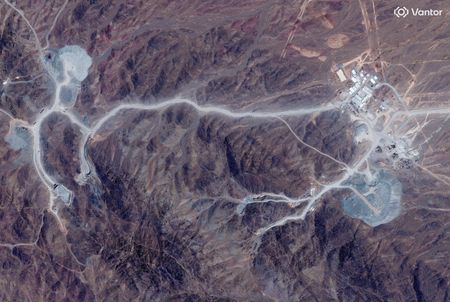
Analysis of satellite imagery by the Institute for Science and International Security shows the site has two pairs of entrances, believed to lead to a single facility estimated to be at least 100 meters beneath the mountain’s surface.
Security measures include a large perimeter and heavily reinforced tunnel entrances. The eastern tunnel entrances have been partially filled in since the recent wars to block vehicle access, though they have not been completely sealed, the institute noted in a July 14 report.
Sam Lair, a fellow at the Foreign Policy Research Institute who also examined recent satellite images, told Reuters that the reinforcement of those tunnel entrances would make it more difficult to strike the facility using penetrating weapons like bunker-buster bombs.
Is the facility active, and what could it be used for?
Trump, in his July 13 comments, said the U.S. is keeping a close eye on the location. “We see no activity there. They’re not doing well with their nuclear situation. Every time we hear about it, we blow it up. So they don’t like talking about it. But we’ll probably give Pickaxe a shot relatively soon,” he said.
The Institute for Science and International Security assessed that the facility is not yet operational but that construction is ongoing. The institute also noted uncertainty about whether Iran still intends to install a large-scale centrifuge assembly operation there, given the damage done to Iran’s centrifuge manufacturing capabilities.
“Nonetheless, if Iran starts to rebuild its centrifuge manufacturing capability, it could plan to install a smaller centrifuge assembly facility in Pickaxe Mountain able to serve a nuclear weapons program,” the institute said.
How could it be attacked?
Experts believe the facility is buried too deeply to be destroyed by even the most powerful bunker-buster bombs currently in the U.S. military’s inventory.
The Institute for Science and International Security suggested the site “would be more suitable for ground forces to attack or sabotage,” while also noting that aerial strikes using deep-penetrating weapons might be able to exploit certain vulnerabilities.
Lair offered this assessment: “We can infer that there are ongoing activities at Pickaxe Mountain the Iranians wish to continue but are still concerned enough about a potential attack that they are taking steps to bolster their defenses.”