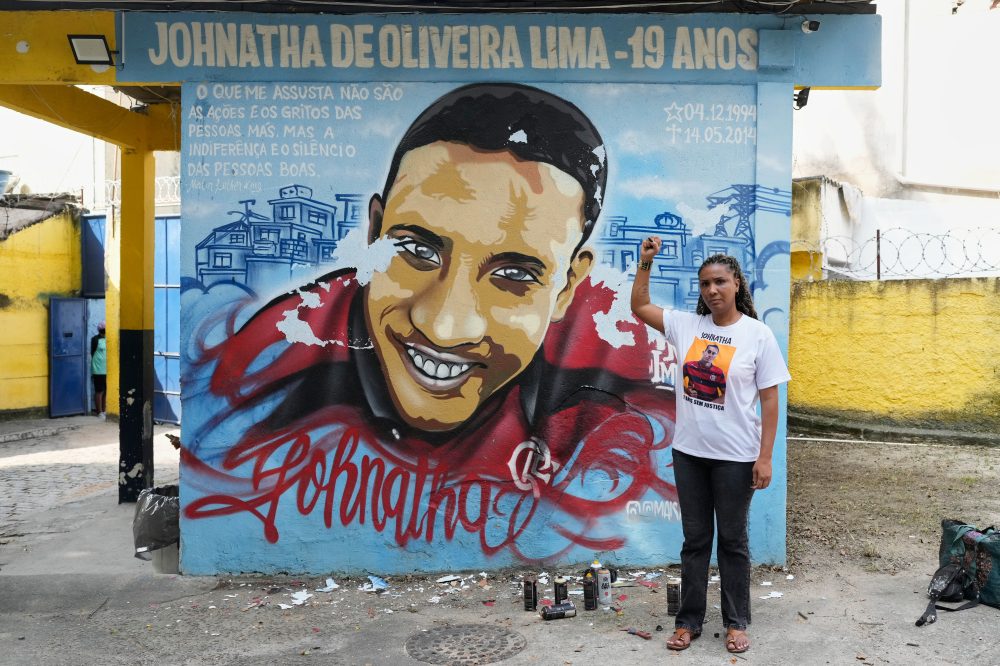

RIO DE JANEIRO — When a police officer shot and killed her 19-year-old son in a Rio de Janeiro favela back in 2014, Ana Paula Oliveira wasn’t sure she could go on living.
What pulled her through was connecting with other mothers who had suffered the same loss — attending court hearings, joining protests, and leaning on one another for emotional survival. Together, they formed a group that became her lifeline.
“Without any doubt, if I had been alone I wouldn’t have made it here, 12 years later,” Oliveira said at a recent gathering held at her son’s former school to mark the anniversary of his death. “We need one another to cry together, to smile together and to fight together.”
Oliveira and other Brazilian mothers have channeled their heartbreak into activism, determined that their sons will be remembered as human beings rather than numbers in a report. Now they are pushing for a nationwide government policy to support families of people killed by state forces — and they want public money to fund their work.
According to the nonprofit Crossfire Institute, 460 people died during police operations in Rio last year, the highest figure since 2016 and a 52% jump compared to the year before.
Drawing comparisons to the Mothers of Plaza de Mayo — the Argentine human rights organization formed by women whose children were abducted during the military dictatorship that governed Argentina from 1976 to 1983 — Oliveira’s group works to highlight the human cost of police killings and push for legal accountability, sometimes with success.
Last year, the mothers traveled to the capital, Brasilia, where they met with representatives from the judicial, legislative, and executive branches of government to present their proposal. The project was developed with backing from Raave, a network of organizations that supports people impacted by police killings in Rio.
“Raave is negotiating with the federal government to implement a pilot project … developed by the mothers, so that we can provide care and guarantee the rights of this population,” said Guilherme Pimental, a coordinator for Raave.
Crime is shaping up to be a central issue in Brazil’s October elections, as it is in other Latin American nations such as Peru and Colombia. Supporters of presidential hopeful Sen. Flávio Bolsonaro, the son of former President Jair Bolsonaro, argue that police need full backing as they confront heavily armed gangs operating in favelas — densely populated, low-income urban communities.
However, grieving mothers and advocacy groups counter that Brazilian police frequently resort to excessive force, with deadly results.
Oliveira’s son, Johnatha, was shot in the back while walking through a street in Rio’s Manguinhos favela after visiting his grandmother, she said. He died from his wounds.
“Police officers allege that they shot him to disperse a crowd” that was protesting at the time, Oliveira said. She wants the officer who fired the fatal shot convicted of intentional homicide. In 2024, a jury found the officer guilty of manslaughter without intent to kill. Prosecutors appealed that verdict successfully, but a date for a new trial has not yet been scheduled.
Monica Cunha followed a similar path, turning grief into public action. After police killed her 20-year-old son in 2006, she ran for office and became a councilwoman. This month, she is set to formally announce her candidacy for state lawmaker ahead of the October elections.
“I fight for memory, truth, justice, reparations and guarantees of nonrepetition — not only for myself, but so that no other family has to endure this pain,” Cunha wrote in an Instagram post marking the 18th anniversary of her son’s death. “The racism that kills our children and loved ones is not an isolated problem, and it must be confronted through state policies. I will keep going, turning grief into struggle.”
Brazilian police have taken more than 6,000 lives every year since 2018, according to the Brazilian Forum on Public Safety, a well-known nonprofit organization. The group’s 2025 annual report on violence in Brazil found that the largest share of victims are between the ages of 18 and 24, and that 82% of those killed by police are Black.
Police tactics in Rio’s favelas were thrust back into the spotlight last year when officers killed 117 suspected gang members in the deadliest raid in the state’s history. The operation targeted members of the criminal organization known as Red Command across two favelas. Five officers also lost their lives. Police reported arresting 113 people, seizing 118 weapons, and confiscating more than a ton of drugs during the raid.
The then-governor of Rio, Cláudio Castro, a political ally of former President Bolsonaro, defended the operation, describing its targets as “narco-terrorists” — language that echoed U.S. President Donald Trump. Last month, the Trump administration officially designated the Red Command, along with its rival First Command Capital, as foreign terrorist organizations.
Nadia dos Santos lost two sons to police violence: Cleyton, who was 18 when he was killed in 2015, and Cleyverson, who was 17 at the time of his death in 2022. Her sister, Glaucia dos Santos, also lost her son Fabricio, who was 17 when police killed him in 2014. A large mural honoring all three young men covers the front of the family’s home in Rio’s Chapadao favela complex.
The two sisters established support groups and began painstakingly investigating the circumstances surrounding each death, seeking justice through the legal system.
In 2023, the officers responsible for Fabricio’s death were sentenced to nine years in prison — a ruling that brought celebration and renewed hope to other grieving mothers, Glaucia dos Santos said.
“We want others to stay alive, so we have to stay upright” even under the crushing weight of grief, she said.
Her sister Nadia stressed the need for a national public policy on reparations, which she traveled to Brasilia to advocate for in person.
“The state should have the obligation to give us mothers who lose our sons because of the state’s violence reparations. … We fight, we work, but we become ill. We need solutions,” she said.
Oliveira offered concrete ideas for what reparations might look like, including placing victims’ names in public spaces and naming schools, hospitals, and daycare centers after them.
“There are other forms of reparation as well, such as building other public policies of nonrepetition that would help prevent new cases. … Many things need to be done, repaired, so that this barbarity does not continue,” she said.