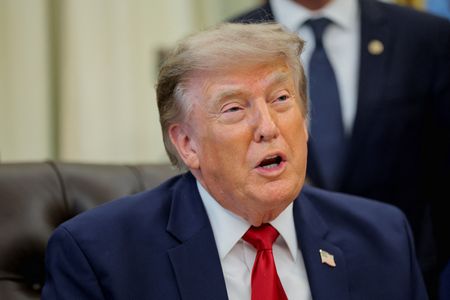

DUBAI, United Arab Emirates (AP) — President Donald Trump has decided not to impose fees on ships passing through the Strait of Hormuz, announcing Tuesday that Gulf nations would instead direct investments into the United States. The decision came as a new round of American airstrikes on Iran and Iranian attacks on ships and regional allies tore apart a fragile interim peace agreement.
That temporary deal had been designed to reopen a critical global energy corridor and buy diplomats time to negotiate a lasting end to the conflict. Instead, the region has been pulled back into open warfare, global markets are feeling the strain, and commercial airlines have received fresh safety warnings.
The U.S. launched another round of airstrikes ahead of a planned restoration of its blockade on Iranian ports, according to a U.S. official who spoke with The Associated Press under the condition of anonymity due to the sensitivity of the military operation.
Before the war began, one-fifth of all the world’s traded crude oil and natural gas moved through the Strait of Hormuz — a passage that had always been open to vessels without any tolls. When the U.S. and Israel launched attacks on Iran on February 28, they effectively shut down the waterway by striking and threatening ships, a move that became their most powerful strategic lever. The closure sent prices for oil, fertilizer, and other goods sharply higher.
Iran has since targeted vessels traveling through the strait along a route managed by the U.S. military that falls outside Tehran’s control, triggering a cycle of retaliatory strikes. The U.S. has warned it is prepared to reopen the passage by force if needed.
New strikes and counterstrikes rock the region
The U.S. military’s Central Command announced strikes on multiple locations inside Iran, hitting what it described as “coastal defense systems, missile and drone sites and maritime capabilities.” Iran confirmed the strikes occurred but offered no immediate information on casualties or damage.
“These strikes will continue imposing a heavy cost on Iranian forces and degrade their ability to attack innocent civilians and commercial shipping in the Strait of Hormuz,” the U.S. military stated.
Iran then launched retaliatory attacks against Bahrain, Kuwait, and Jordan, as well as three oil tankers that had been traveling through the strait.
Two of the tankers — both linked to the United Arab Emirates — caught fire during the attacks. The International Maritime Organization reported that the assault on the tankers Mombasa and Al Bahiyah resulted in two mariners killed and 14 others injured. The UAE issued a threat of retaliation.
Dutch shipping company Stolt Tankers confirmed that one of its vessels was also attacked. The Stolt Magnesium, targeted off the coast of Oman, suffered an engine room fire, though the company reported all crew members were unharmed.
Iran’s paramilitary Revolutionary Guard claimed the Mombasa and Al Bahiyah “ignored repeated warnings.” Iran has been targeting ships that use a route through the strait that passes near Oman outside its territorial waters.
Shortly after the U.S. announced it had concluded its latest round of strikes, the Iranian city of Bushehr on the Persian Gulf was hit in at least four locations, according to Iran’s state-run IRNA news agency. The attacks renewed speculation that Gulf Arab nations may be striking back against Iran without making their involvement public.
Interim peace deal on the brink of collapse
Recent exchanges of fire had already put the temporary peace agreement under serious strain. The deal is now nearly halfway through its 60-day window — the period during which negotiators were supposed to reach a permanent agreement that would also address Iran’s nuclear program and other outstanding disputes.
Washington had lifted a blockade it first imposed in mid-April as part of the interim arrangement. The U.S. military announced it would reinstate that blockade at midnight Wednesday, Dubai time.
Trump’s original plan to charge transit fees would have represented a significant break from long-held American policy and contradicted U.S. pledges — including a recent commitment made by Secretary of State Marco Rubio during a trip to the region — that the strait would remain freely accessible to all ships.
Under the terms of the interim deal, Iran had agreed that passage through the strait would be free of charge for 60 days, but the agreement left unresolved what would happen once that period ended. Iran maintains it holds the right to regulate traffic through the strait and potentially impose fees. The U.S. has rejected that position.
The price of Brent crude oil, the global benchmark, briefly climbed above $87 per barrel early Tuesday — still well short of the nearly $120 per barrel reached during the peak of the conflict. After Trump announced he was abandoning the toll plan, prices fell back to around $78 per barrel.
Diplomats working to prevent return to all-out war
Regional mediators are still pushing to bring the United States and Iran back to the negotiating table, two regional officials said. Both officials requested anonymity given the sensitivity of the ongoing diplomatic efforts, and said a Pakistan-led mediation effort was operating around the clock to revive the ceasefire.
Separately, delegations from Lebanon and Israel held talks in Rome on Tuesday, with U.S.-mediated negotiations set to continue Wednesday. Shortly after the U.S. and Israel launched the war on February 28, the Lebanese militant group Hezbollah entered the conflict in support of its ally Iran and began striking Israel. Israel responded with a ground invasion into Lebanon.
Last month, Lebanon and Israel announced a framework agreement outlining a plan for Israeli forces to withdraw from southern Lebanon in exchange for Hezbollah disarming. Progress on implementing that agreement has stalled.
Even before the latest escalation around the strait, the conflict between Israel and Hezbollah in Lebanon had repeatedly threatened to unravel the interim peace deal. A truce is currently in place in Lebanon, but whether it can survive a return to full-scale fighting between the U.S. and Iran remains an open question.