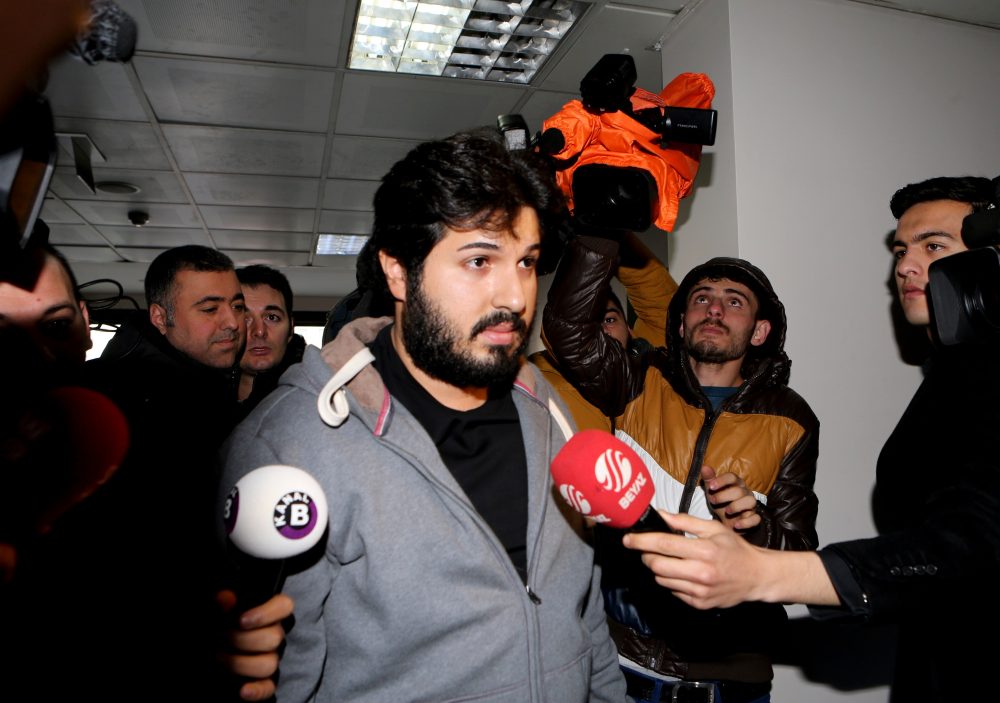

NEW YORK — A gold trader who admitted to conspiring with a Turkish bank to help Iran sidestep U.S. sanctions by exchanging oil revenue for gold will walk free, a federal judge announced Tuesday.
U.S. District Judge Richard M. Berman indicated at a court hearing that he intends to sentence Reza Zarrab to the time he has already spent behind bars. Federal prosecutors praised Zarrab for delivering “truthful, complete and reliable” assistance to American investigators. That cooperation included testimony that he paid millions of dollars in bribes to Turkish officials to carry out the sanctions-evasion scheme.
Zarrab entered a guilty plea in 2017 on charges of conspiracy, bank fraud, and money laundering. Before he agreed to work with U.S. prosecutors in New York, he had been looking at the possibility of spending decades in federal prison.
The conclusion of Zarrab’s sentencing closes out a long and dramatic legal saga that put a serious strain on diplomatic ties between Washington and Ankara, and was followed closely by people throughout Turkey.
Turkey’s president, Recep Tayyip Erdogan, publicly dismissed the corruption allegations as an American scheme to “blackmail” Turkey, and pushed the administrations of three U.S. presidents to shut the case down.
Presidents Barack Obama and Joe Biden, both Democrats, chose not to step in. President Donald Trump — who has maintained a friendly relationship with Erdogan — let the case proceed during his first term. However, this year Trump’s Justice Department abandoned its long-running effort to prosecute Halkbank, a state-owned institution that was indicted in 2019 on allegations it helped Iran move $20 billion in sanctioned oil revenue.
Zarrab was born in Iran but moved to Turkey as a toddler with his family. He was first arrested in 2013 as part of a broad anticorruption investigation led by Turkish law enforcement — but was released quickly. Many of the officers involved in that probe were subsequently removed from their positions after Erdogan claimed the investigation was a foreign plot engineered by the U.S. government.
Three years later, Zarrab was taken into custody in Miami after arriving in the United States with his then-wife, Turkish pop star and television personality Ebru Gundes, and their then-4-year-old daughter for a vacation to Disney World.
Before agreeing to cooperate with federal authorities, Zarrab brought on former New York City Mayor Rudolph Giuliani and former U.S. Attorney General Michael Mukasey to pursue a diplomatic resolution to the case. Erdogan openly called for Zarrab’s release.
Then, in 2017, the case took a dramatic turn: Zarrab quietly pleaded guilty to the charges and then emerged as an unexpected witness at the U.S. trial of Halkbank executive Mehmet Hakan Atilla.
On the stand, Zarrab testified that he had paid millions in bribes to government and banking figures in Turkey to help Iranian interests evade U.S. sanctions. He also stated that Erdogan, while serving as Turkey’s prime minister in 2012, had personally approved two Turkish banks’ participation in fraudulent gold trades designed to give Iran access to its oil and gas income.
Atilla, who insisted he was not guilty, was ultimately convicted and received a 32-month prison sentence. Erdogan responded to the verdict by calling it “scandalous.”
Zarrab was released from jail following the trial after reporting that a fellow inmate had threatened to kill him with a knife for cooperating with U.S. authorities.
In documents submitted to the court ahead of sentencing, Zarrab’s legal team said his life had undergone major changes since the trial. He divorced Gundes in 2021 and remarried last year, wedding a former Turkish national swimmer.
His attorneys described Zarrab as “destitute and heavily in debt” in the wake of his guilty plea and cooperation, noting that both his assets and his family’s assets had been seized by the Turkish government, resulting in “many tens of millions of dollars in lost rental income” for his family’s businesses.
Following his guilty plea, Zarrab also forfeited a $288,000 boat and $88,000 in cash to the U.S. government. He has claimed he is $50 million in debt.
“Reza at long last should be allowed to rebuild his life,” his attorneys wrote in the filing. They noted that the prosecution and Turkey’s characterization of him as a traitor continue to follow him, disrupting his attempts to establish a horse farm in the United States and to move through public spaces without being identified and exposed on social media.