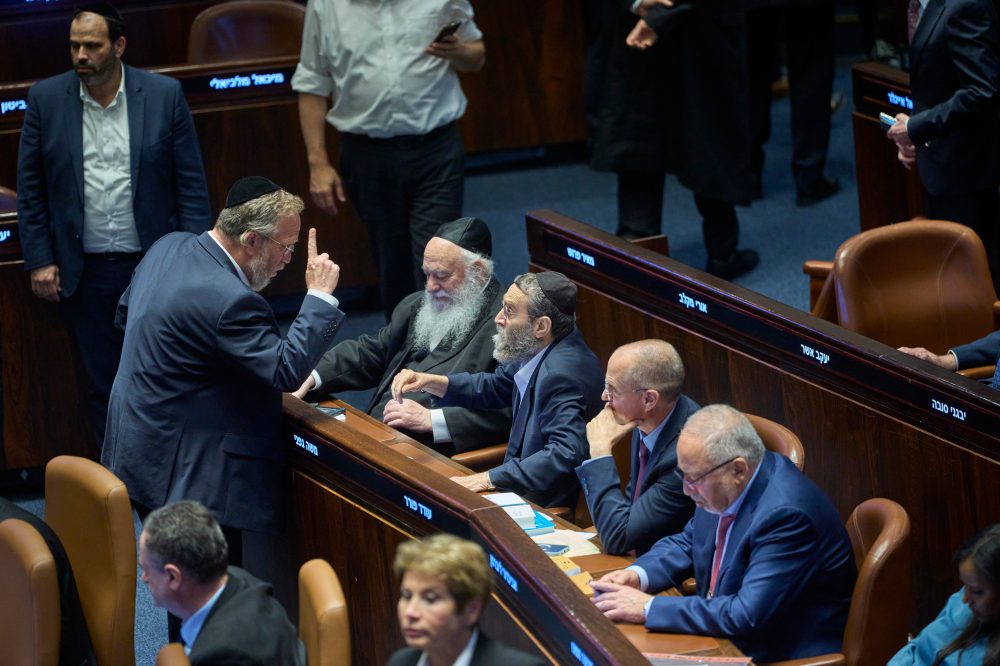

TEL AVIV, Israel — Israel’s parliament has passed a pair of laws that essentially put a stop to the drafting of ultra-Orthodox Jewish men into the nation’s armed forces. The move is widely viewed as a last-minute attempt by Prime Minister Benjamin Netanyahu’s governing coalition to secure support from religious political parties before elections this fall.
During a lengthy legislative session spanning Monday and Tuesday, lawmakers voted to both suspend the arrests of ultra-Orthodox men who avoid the draft and to formally recognize Jewish religious study as a “foundational value” of the Israeli state.
Both measures represent major concessions by Netanyahu’s Likud party to ultra-Orthodox politicians who have long pushed to officially codify their community’s existing, informal exemption from military service — a service that is mandatory for most Jewish men and women in Israel.
The Israeli military is already dealing with a shortage of troops, and public frustration has been growing over the decades-old arrangement that has allowed ultra-Orthodox men to sidestep service. According to a parliamentary committee, roughly 13,000 ultra-Orthodox men turn 18 — the conscription age — each year, yet fewer than 10% actually join the military.
The legislation arrives after nearly three years of conflict spanning Gaza, Lebanon, and Iran, and just before the Knesset heads into its summer recess. Parliament is set to reconvene only days before the next national elections on October 27, a vote that will also serve as a public judgment on Netanyahu’s leadership during wartime.
Netanyahu, who has held office longer than any other prime minister in Israel’s history, is actively working to court ultra-Orthodox voters — also known as Haredim — in the upcoming election cycle.
Shlomit Ravitsky Tur-Paz, who leads the religious and state program at the Israel Democracy Institute think tank, offered this assessment: “Netanyahu is trying to ensure that Haredim are going to negotiate only with him after the next elections.”
Ravitsky Tur-Paz also noted that Netanyahu is facing significant pushback — not only from opposition figures but from within his own party and even from the military’s top commander.
Military chief Eyal Zamir sent a letter to Netanyahu and Defense Minister Israel Katz in which he condemned the bills, saying they were “clearly and unequivocally inconsistent” with the military’s needs, according to local media reports. “It is inconceivable that the military system under my command, which demands unprecedented sacrifice from its personnel, would be party to granting mass exemptions from prosecution,” Zamir wrote.
The roots of the ultra-Orthodox exemption stretch back to Israel’s founding in 1948, when a small group of students were allowed to pursue Jewish scholarship in an effort to rebuild a tradition nearly wiped out during the Holocaust.
Israel’s Supreme Court has since ruled those exemptions to be illegal. Legal experts say the new law formalizing Torah study — Judaism’s central religious text — gives the government a legal foundation to push back against the court’s rulings.
Opposition leader Yair Lapid was blunt in his condemnation, calling the law “an utter desecration of God’s name” that amounts to “spitting in the face” of Israeli soldiers.
Ultra-Orthodox lawmaker Moshe Gafni, who sponsored the legislation, took a very different view, calling its passage a historic moment. “For thousands of years, Torah study was the force that preserved the Jewish people throughout their diaspora and all generations,” he said, adding that the law “will be a compass for the values of the state.”