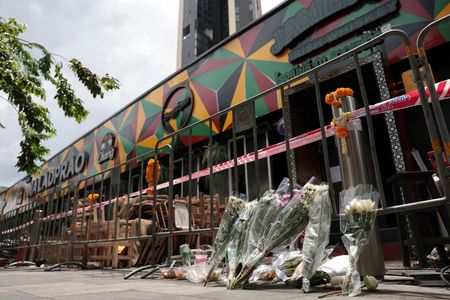

A night out at a popular pub in northern Bangkok turned into a tragedy late Sunday when a fire broke out just before midnight, killing at least 30 people and sending 75 others to the hospital — 24 of them in critical condition.
The blaze began at 11:57 p.m. local time (1657 GMT) at the Rong Beer Na Lat Phrao pub, likely triggered by an electrical short circuit in a ceiling air conditioning unit, according to authorities.
One survivor, 41-year-old Usa Tadsree, had stepped outside for a cigarette when she noticed the lights inside flickering, followed quickly by smoke pouring out. “I wanted to go back in to get my friends but there was intense heat coming out, so I had to run out,” she said.
A social media video verified by Reuters captured the terrifying moment — first thick smoke rolled out of the front entrance, then within seconds a powerful horizontal wall of flames shot out into the street, accompanied by screams from those inside and outside the building.
Experts who examined the scene say the rapid spread of fire was fueled by highly combustible materials used throughout the venue’s interior. Busakorn Saensookh, who chairs the Fire Protection Engineering Committee at the Engineering Institute of Thailand, visited the site after the fire. “The severity of this fire was driven by a massive fuel load,” she said.
She pointed specifically to flammable acoustic materials and decorations — including artificial trees and flowers — that had been installed across the ceiling to form a green canopy, particularly around the stage and bar areas. Reuters-verified video from inside the venue before the fire shows a green grass-like material covering the ceiling above the stage, along with what appears to be black acoustic foam panels in seating areas.
“The fire involved plastic materials, and these were relatively dense plastics. Once ignited, they produced a jet of fire as enormous amounts of heat accumulated,” Busakorn explained. “That heat was transferred downward, causing materials below to burn. Upholstered chairs were completely consumed by the fire.”
Amorn Pimanmas, president of the Thailand Structural Engineers Association, who also visited the site, said the non-fire-retardant foam used in the decorations released black smoke laced with carbon monoxide and cyanide. “People died from inhaling toxic smoke before being burned by the fire,” he said. “Several bodies showed no signs of burning.”
The comparison to another recent disaster was noted: the use of foam in the Bangkok pub’s ceiling echoes how similar material may have contributed to a deadly New Year’s Eve fire at a Swiss ski resort in Crans-Montana, which killed at least 40 people and injured 119.
Firefighter Chakrit Khongkom reached the Bangkok scene roughly five minutes after the fire started, finding the pub completely filled with smoke. “Most of the survivors were choking on the smoke,” Chakrit said. A search and rescue team he said was deployed inside found many victims collapsed near the bathrooms at the back of the venue, where authorities say multiple emergency exits were blocked by tables and beer crates.
During a visit to the site, Prime Minister Anutin Charnvirakul was told that a door previously used as an exit had been bolted shut. Body camera footage from an emergency responder, reviewed by Reuters, also showed multiple victims lying on the floor near the pub’s restrooms.
Thai police are investigating whether the blocked exits prevented people from escaping. The venue had undergone a safety inspection as recently as April.
The pub is situated at a busy intersection near train stations and two shopping malls, part of a cluster of similar bars that draw large weekend crowds for food, drinks, live music, and televised sports. The pub did not respond to requests for comment, and its owner is currently receiving medical treatment at a hospital.
Investigators also noted a regulatory loophole that may have contributed to the danger. The venue, like many others in Bangkok, was registered as a restaurant rather than an entertainment establishment — a classification that carries different and stricter fire safety requirements.
“When venues are not registered as entertainment establishments, their fire protection systems are incomplete, such as lacking smoke ventilation systems,” Amorn said. “This leads to smoke and heat accumulation, creating dangerous risks.”
Thailand has faced similar tragedies before. A 2022 nightclub fire in Chonburi killed 13 people, and a 2009 blaze at a Bangkok nightclub claimed at least 65 lives. Each time, concerns were raised about flammable materials, overcrowding, and unusable exits — yet the problems persisted.
In the wake of Sunday’s fire, Bangkok city officials say they are planning to revisit several regulations, including rules around decorative materials and the legal definition of entertainment venues.
“The risks are much greater today,” Busakorn warned. “But we are still using the same laws written 30 to 40 years ago that no longer reflect current realities.”