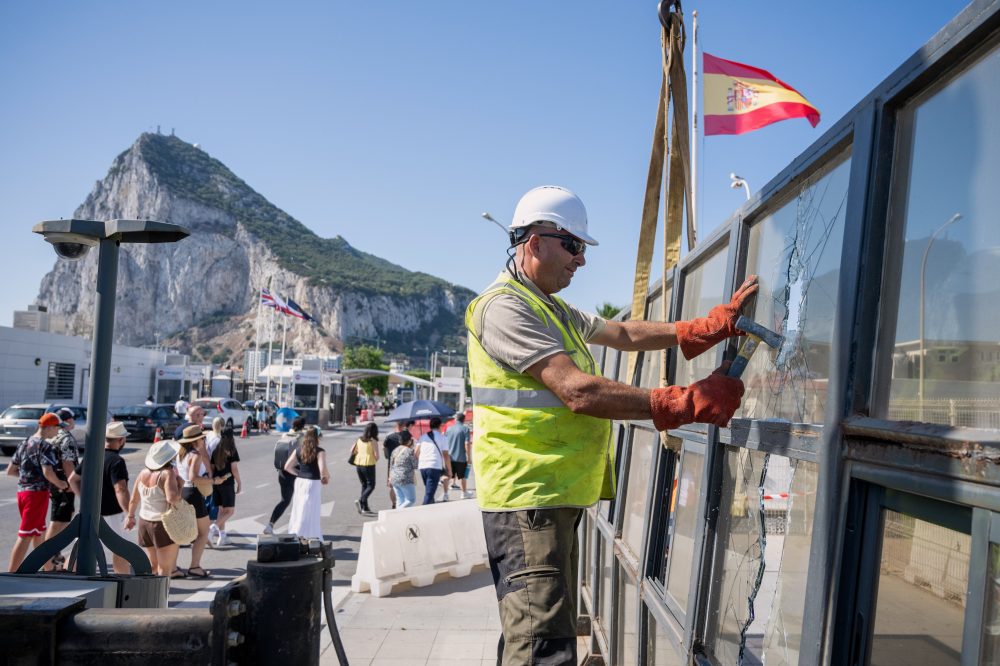

Starting Wednesday, the thousands of people who make daily trips between southern Spain and the British territory of Gibraltar no longer have to pass through a physical border checkpoint. The removal of the border fence became official at the stroke of midnight, marking a significant shift in how the two neighboring territories interact.
The change is the result of a landmark treaty between the European Union and the United Kingdom — one that took years of difficult negotiations to finalize following Britain’s exit from the EU in 2020. The EU, the U.K., and Gibraltar’s government all signed the agreement on Tuesday.
Gibraltar is a small British Overseas Territory of roughly 38,000 residents, sitting at the very southern edge of the Iberian Peninsula. Its location — just a few miles from Morocco, where the Atlantic Ocean meets the Mediterranean Sea — gives it considerable strategic importance.
When the U.K. left the EU four years ago, Gibraltar’s relationship with the bloc was left in limbo. Negotiations over how to keep people and goods flowing freely across the border moved slowly for years before an agreement was finally reached in 2025.
U.K. Foreign Office Minister Stephen Doughty said Tuesday that the deal locks in Gibraltar’s long-term economic future and protects the territory’s interests.
EU trade representative Maroš Šefčovič also welcomed the outcome, saying the years of effort were worth it. “It has taken four years of patient, complex negotiation, but the outcome speaks for itself,” Šefčovič said. “It is a very special feeling to see a fence come down.”
Without this agreement, Gibraltar could have been forced into a hard land border with full passport checks — a serious economic threat for a territory that relies heavily on roughly 15,000 Spanish workers who cross into Gibraltar each day. Those workers make up nearly half of the territory’s entire workforce. Casual visitors crossing in both directions would also have been impacted.
Gibraltar’s Chief Minister Fabian Picardo highlighted the everyday benefits of the deal in an interview. “People who are visiting family in Spain, or whose Spanish family is visiting them in Gibraltar. Children who are going to football matches and extracurricular activities, either in Spain or in Gibraltar. They will be able to do that without having to worry about frontier queues,” Picardo said.
Under the terms of the treaty, Gibraltar is effectively brought into the EU’s Schengen free travel zone. Border checks at Gibraltar’s airport and port will be handled jointly by both U.K. and Spanish officials — an arrangement similar to the dual-checkpoint system used at Eurostar stations in London and Paris.
It’s worth noting that in the 2016 Brexit referendum, an overwhelming 96% of Gibraltar’s voters chose to remain in the EU — a result that made the territory’s post-Brexit limbo especially frustrating for residents.
Visitors arriving from countries outside the Schengen area will still need to go through the EU’s Entry-Exit System, known as EES, which launched across Europe in April. The system replaced traditional passport stamps with biometric data, including photographs and digital fingerprints.
With the fence now gone, Gibraltar has installed live facial recognition cameras at entry points and across the territory. Chief Minister Picardo said more surveillance cameras have been added throughout Gibraltar, and that the territory has also boosted its police presence and increased resources for customs and Coast Guard agencies.
“The fortress has become a digital fortress now,” Picardo said.
Spain has claimed sovereignty over Gibraltar since Britain took control of it in 1713. Relations between the two countries over the territory have gone through many phases over the centuries. While the new treaty removes the border fence and eases movement, it does not settle the long-standing dispute over who should ultimately control Gibraltar.