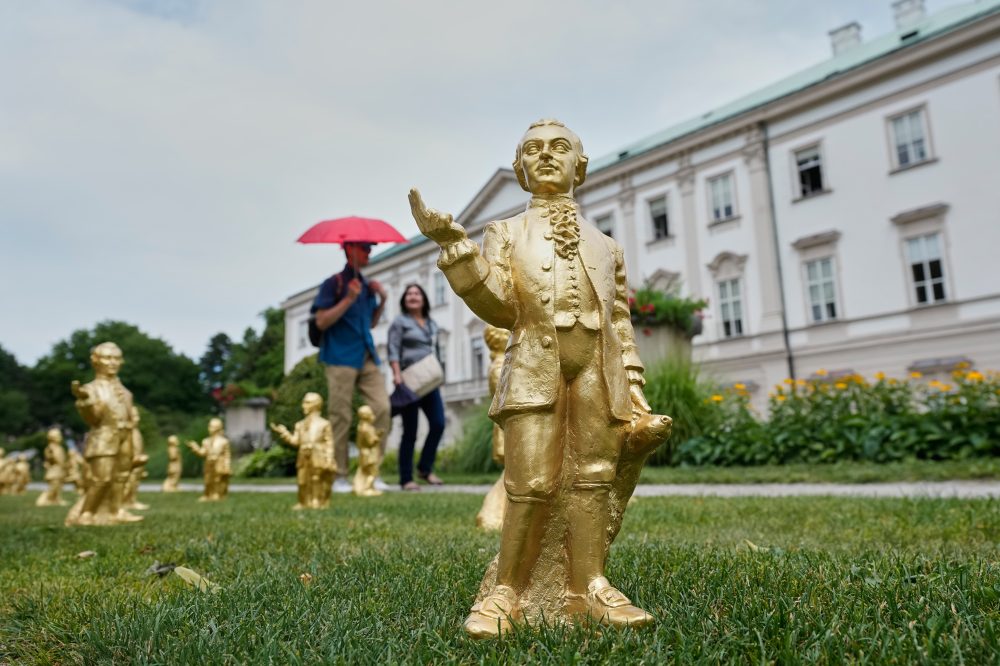

SALZBURG, Austria — Visitors to the Austrian birthplace of Wolfgang Amadeus Mozart are getting a unique treat as the city marks 270 years since the legendary composer came into the world. Scattered across some of Salzburg’s most iconic spots are 300 tiny gold statues of Mozart — each standing barely 50 centimeters, or just under 20 inches tall.
The Mozarteum Foundation unveiled the miniature figures on Wednesday. They were created by German concept artist Ottmar Hörl, who said his goal was not to build another grand monument, but rather to show a more personal side of the musical genius.
“I didn’t want to do a monument of Mozart. There are already enough of these. But I wanted to show his human side, that he was a normal human being despite his genius,” Hörl told the Associated Press.
To bring that human element to life, Hörl chose to show Mozart alongside his favorite dog, Pimperl. Historical accounts show that Mozart and his family were known for taking walks with their dogs through the Mirabell Garden, located near where they lived.
Mozart was born on January 27, 1756, in Salzburg, where the Mozarteum Foundation today hosts concerts, operates Mozart museums, and supports ongoing research about the composer.
The golden figures are spread across the Mirabell Garden, Mozart’s former living quarters, and several pavilions around the city. While 400 total statues were produced, only 300 are currently on display. The remaining 100 are being held in reserve — and for good reason.
“Two already got stolen within the last few hours,” said Linus Klumpner of the Mozarteum Foundation. Despite the thefts, the statues are intended to draw in a wider audience and spark curiosity about Mozart’s music.
“You come here, maybe you see the small golden heads shimmering in the sun on the horizon. And people become curious,” Klumpner said. “And then a process begins which is very much in our interest. That is to bring new people in contact with Mozart.”
For Hörl, having artwork stolen from public spaces is nothing new. During a previous installation in Bayreuth, Germany, an entire display of Richard Wagner statues was taken within just 10 days.
“That’s just the nature of public space. That means when you work as an artist in a public space you mustn’t complain about what is happening there,” Hörl said. “It ranges from destruction to theft. That’s just how it is.”
The Mozart statues will remain on display through August 30. For those who want one without resorting to theft, each statue is available for purchase at 100 euros — about $114 — while supplies last.
Hörl has a long history of large-scale public art installations. In 2010, he placed 10,000 plastic owls throughout Athens, Greece. He also created oversized plastic replicas of Albrecht Dürer’s famous hare for a “Homage to Dürer” exhibit at the Daegu art museum in South Korea. In 2009, German prosecutors decided not to pursue charges against Hörl over a series of golden garden gnomes depicted doing the Hitler salute — a gesture Hörl said was meant as satire against Nazi ideology, under a law that bans the use of symbols forbidden by the German constitution.