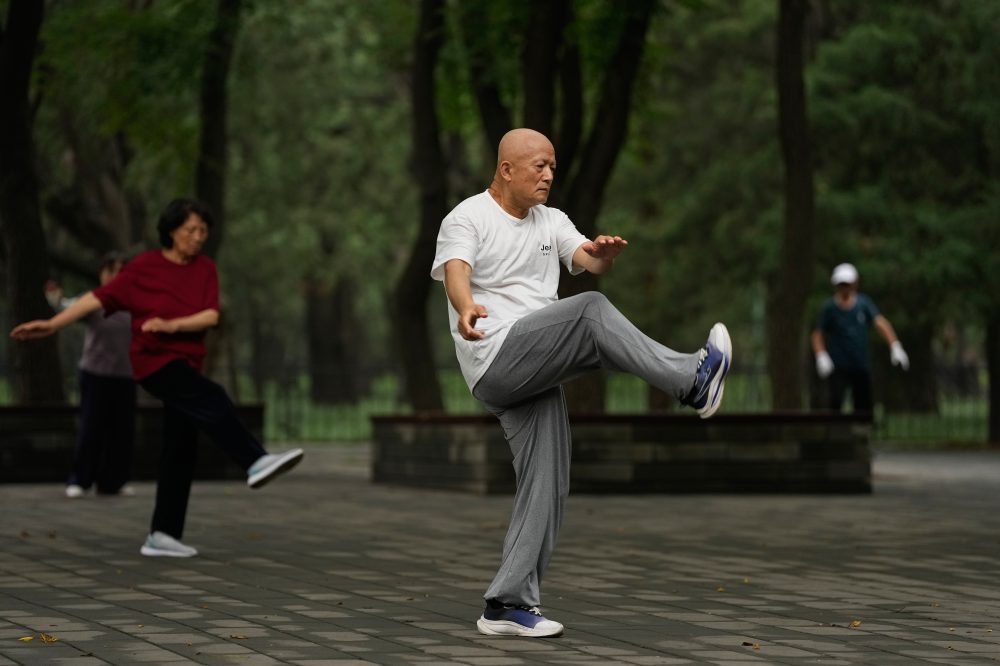

BEIJING (AP) — Every morning at one of Beijing’s most storied landmarks, hundreds of people raise and lower their arms in flowing, bird-like motions — a centuries-old practice that remains deeply woven into Chinese daily life.
The Temple of Heaven serves as the backdrop for these daily tai chi sessions, where practitioners of all experience levels gather to exercise both body and mind. Tai chi is a physical and philosophical discipline that took shape more than 300 years ago and continues to hold strong relevance in China today.
“The environment is great and the air is good too,” said Ye Guirong, 64. “You can see we’re surrounded by trees.”
The majority of those who show up each morning are retirees in their 60s or older. Some work through their routines in groups, accompanied by soothing music playing from a speaker nearby. Others prefer to practice alone in silence.
Ye first came across tai chi in 2010. Having just retired, she was exploring the city on foot when she stumbled upon the group she now leads.
“I thought it looked good, so I started practicing,” she said.
When someone new joins a group, the leader takes them through the foundational movements. The newcomer’s form is regularly reviewed and adjusted until they advance to the next level.
Among the fundamental movements in tai chi are “White Crane Spreads Its Wings,” in which one arm lifts while the other drops, and “Part the Wild Horse’s Mane,” a sweeping, flowing sequence where the body shifts its weight forward as the arms open softly in front of the chest.
“The movements have been passed down from one instructor to another,” Ye said.
Ye leads a group called Cypress Grove, which has roughly 30 members and recently added its newest participant. Zu Hong, 59, managed to learn a 24-movement routine in approximately one month. Ye says she is now prepared to move on to the second set of movements.
“I thought tai chi looked very beautiful,” Zu said. “I wanted to exercise, so I came here to the Temple of Heaven.”
The Temple of Heaven itself has a rich history. It was established in the 15th century by a Ming dynasty emperor and functions as a complex of religious structures representing the connection between heaven and earth. Its most recognized building, the Hall of Prayer for Good Harvests, once served as the ceremonial location where emperors acted as go-betweens for humanity and the heavens, presenting offerings and prayers for successful harvests. Today the site draws tourists, and its gardens remain open to the public.
In China, tai chi carries a dual meaning. It refers to the martial art form known as Taijiquan, as well as to the philosophical framework behind it, called Taiji. Central to both is the concept of qi — often described as vital energy or a life force that moves through the body.
In traditional Chinese medicine, good health depends on qi flowing freely through a system of pathways called meridians, which are thought to link the body’s organs, limbs, and other parts. Practices like acupuncture are intended to help regulate that flow.
“Practices like tai chi and qigong are all about activating, regulating or improving the flow of qi in the body,” said James Miller, a professor of Humanities at Duke Kunshan University in China’s Jiangsu province. “That’s something very key to Daoism (Taoism), but it’s also part of the broader Chinese conception of the body and of the world.”
Qi is also believed to exist beyond the human body, flowing through the natural world — through mountains and rivers alike.
“This is also why it’s traditional to establish temples on mountains,” Miller said. “They’re understood not just as beautiful or remote places, but because they’re closer to nature.”
Tai chi comes in several styles, each featuring its own set of forms. Ye’s Cypress Grove group meets every morning at 7:40 a.m. to practice Yang-style tai chi for roughly an hour and a half. The group cycles through different routines — some involving 24, 42, or 48 movements, and others incorporating swords or fans.
“Through exercising, everyone’s health has improved,” Ye said. “Our spirits are especially good.”
The oldest recognized form of tai chi is Chen-style, which dates back to the 17th century. It was created by Chen Wangting, a military commander who later turned toward a spiritual path.
“He practiced Daoist (Taoist) methods of self-cultivation including meditation,” said Tai Chi master Chen Haitao. “Then one day he experienced a sudden awakening: the meridians throughout his body all opened, his mind became enlightened, and wisdom suddenly emerged.”
That experience transformed Chen Wangting’s life, according to Chen Haitao. Driven by a desire to share that awakening with others, he found that movement was the vehicle to do so.
The martial art and the philosophy it rests on are designed to complement one another, Chen explained. The physical movements provide the method, while the philosophy gives those movements their deeper purpose.
“One of the great benefits of Taijiquan is that it is suitable for everyone,” Chen said. “As long as you learn the basic principles correctly and maintain proper alignment, whoever practices it will benefit from it.”