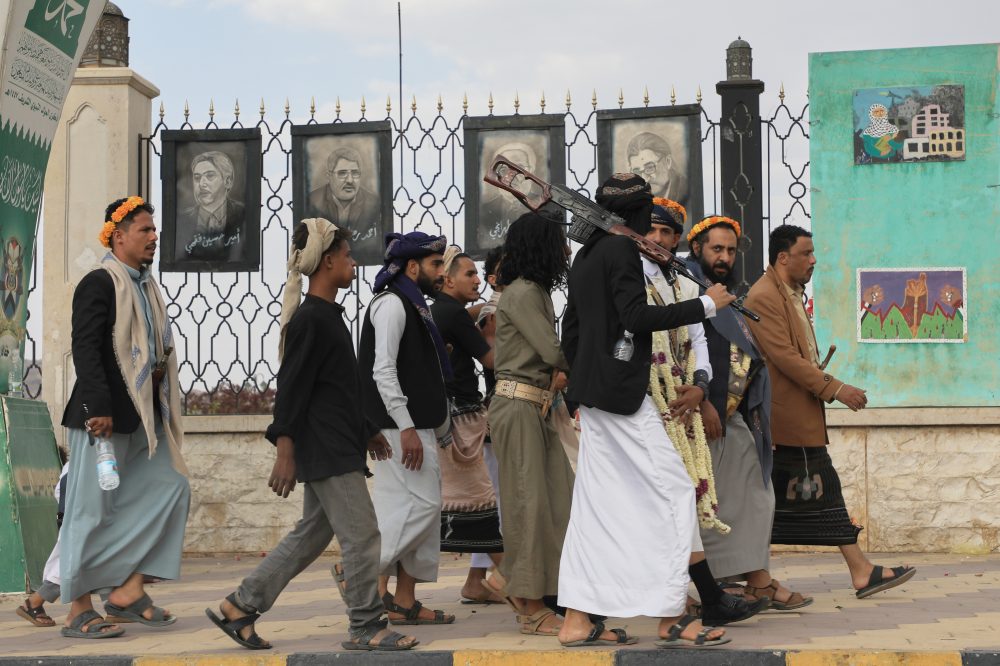

CAIRO — A ceasefire that brought Yemen’s devastating civil war to a halt in 2022 is now under serious strain, with fresh fighting between Houthi rebels and Saudi Arabia raising fears that one of the world’s poorest nations could be dragged back into full-scale conflict.
Yemen’s civil war, which began in 2014, eventually became a proxy struggle between Iran-backed Houthi forces and a Saudi-led coalition backing the country’s internationally recognized government. While a broader conflict involving Iran that erupted on February 28 has reignited regional rivalries across the Middle East, the Houthi-Saudi truce had largely held — until this past Monday.
On that day, the Houthis announced they had fired missiles and drones at Saudi Arabia’s Abha International Airport. The rebel group said the attack was retaliation for Saudi airstrikes that hit Sanaa International Airport earlier the same day. No deaths or injuries were reported, but the exchange marked the most serious direct confrontation between the two sides in years.
The flashpoint was an Iranian aircraft carrying a Houthi delegation to Tehran for a meeting with Iran’s Supreme Leader, Ayatollah Ali Khamenei. The Houthis accused Saudi Arabia of attempting to block the plane from reaching Yemen when it tried to return. The aircraft was forced to divert and ultimately landed safely at a different airport.
Saudi Arabian officials did not respond when asked to comment on the airstrikes.
Rashad al-Alimi, who heads Yemen’s internationally recognized government, said his administration had rejected Iran’s request to allow the Houthi delegation to return. He accused the rebel group of trying to receive the Iranian flight outside of what he called “the legal and sovereign frameworks governing civil aviation.”
On Tuesday, Houthi military spokesman Brig. Gen. Yahya Saree announced via Telegram that the group had shot down a Saudi reconnaissance drone over Al Bayda province in central Yemen at dawn. He made clear the Houthis are ready to respond to any violation of Yemeni airspace.
Ahmed Nagi, a senior Yemen analyst at the International Crisis Group, said Monday’s exchange of fire was about far more than a single flight. He explained that the Saudi-led coalition imposed an air and sea blockade on Yemen back in 2015 to pressure the Houthis. By attempting to allow a direct international flight to land without coalition approval, the Houthis were trying to establish their own authority over Yemen’s airspace and challenge what they call a blockade of Sanaa’s airport.
“The Houthis were testing a new red line. If they succeeded, they could become more emboldened, raise their demands, and seek to cross additional red lines,” Nagi said.
Farea al-Muslimi, a research fellow at the Chatham House think tank in London, noted that Saudi Arabia has largely stayed on the sidelines during the broader U.S.-Israeli conflict with Iran. However, he said the kingdom is far less likely to remain passive when it sees its influence in Yemen — which shares a southern border with Saudi Arabia — being challenged.
Whether Monday’s confrontation will spiral into further fighting or prove to be an isolated incident remains unclear.
Abdel-Bari Taher, a political analyst based in Yemen, warned that the country’s weak security situation and battered economy make it a prime setting for renewed conflict and outside interference.
“The region now is in a state of an all-out confrontation,” he said. “Yemen provides a conflict-prone environment because it’s divided with militias fighting each other and lacks full control over its maritime and airspace.”
The risks extend beyond Yemen’s borders. The Iran-backed Houthis have launched repeated missile strikes against Israel throughout the ongoing regional conflict and have a well-documented history of attacking commercial ships in the Red Sea, creating major disruptions to international trade.
Taher also warned that Iran may attempt to use its Houthi allies as leverage in negotiations with the United States. With an interim ceasefire between the U.S. and Iran described as being on life support — and both sides competing for control of the Strait of Hormuz — the danger of a return to all-out war continues to grow.