
DAKAR — No bank card, no home address, no problem. Shoppers across Africa are finding ways to buy from major international brands like Amazon and Walmart, even though those retail giants have virtually no footprint across most of the continent.
The people making it possible are package-forwarding companies — both local startups and established global players — that are using technology and expanding internet access to work around some of Africa’s biggest obstacles to online shopping, including a lack of formal street addresses and limited access to traditional banking.
One example is a Senegalese startup called Afrety, which illustrates just how creative these intermediaries have become in connecting African consumers to products from the United States, Europe, and China.
Getting Packages to People Without Addresses
Afrety gives its customers delivery addresses at warehouses located in France, the United States, and China. Orders can be bundled together and repackaged before being sent to West Africa. When shipments arrive, customs duties are paid, providing revenue for local governments.
For customers who don’t have bank cards, payment can be made through mobile money accounts that can be loaded with cash at local kiosks. Mobile money has become a widely used alternative to conventional banking in Senegal and across much of Africa.
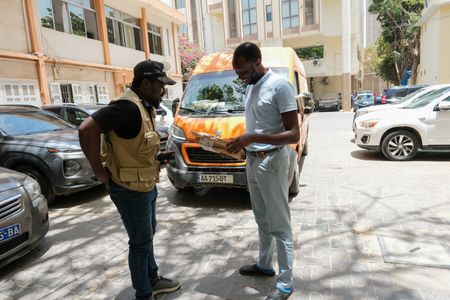
Once packages reach Senegal, motorbikes and vans stationed at Afrety’s depot use GPS to make deliveries throughout major cities like Dakar.
“You have to be very, very, very flexible. That’s the key word,” said Souane Diop, the company’s 34-year-old CEO, speaking to Reuters outside a depot stacked with packages bearing the Amazon label and other international brand names.
Diop said Afrety launched in 2018 with the original goal of linking informal networks of air travelers moving between France and Senegal. From those modest beginnings, the company has grown to handle four to five metric tons by air and two to three shipping containers by sea each week. To keep expenses down, Afrety rents warehouse space in France and works with partners in the U.S. and China to manage operations there.
A Much Bigger Player in the Market
Global logistics company Aramex operates on a much larger scale, running two platforms with overlapping services in Africa.
While Afrety grew from the close ties between Senegal and France — its former colonial power, which has a large Senegalese diaspora — Aramex’s Sub-Saharan Africa operations rely on a platform called MyUS, which originally served American expatriates living in Africa. Aramex acquired MyUS in 2022 and also runs its own platform, Shop and Ship, which delivers to numerous countries across the continent.
Aramex Group Chief Executive Amadou Diallo told Reuters that the company’s mission is to serve African customers who want access to brands and choices that are otherwise out of reach. Angola is one of its top destinations, but the company also operates in challenging environments, including Somalia, a country that has been torn by conflict for decades.
Growth Is Real, But So Are the Limits
Aramex describes Sub-Saharan Africa as one of its fastest-growing regions. The most popular product categories include electronics, clothing, toys, and equipment for agriculture and auto repair. The company says it plans to double its revenue from the region by 2030.
Still, significant barriers remain. For both Aramex and Afrety, most customers live in or near major cities, where income levels are higher. According to consultancy Tech Cabal Insights, e-commerce in Africa is largely concentrated in economic hubs.
Internet access has reached roughly 43% of Africa’s 1.5 billion people, but only a small portion of those users earn enough to shop online. Even in Nigeria — West Africa’s largest economy — only one in three internet users makes online purchases. In poorer regions like Central Africa, just about one in twenty people shops online, the consultancy reports.
South Africa Stands Apart
South Africa, the wealthiest economy in sub-Saharan Africa, leads the continent in both internet use and online shopping by a wide margin.
Online retail in South Africa has grown by nearly 35% per year over the past five years, reaching roughly 140 billion rand — about $7.26 billion — in 2025, according to Mastercard figures. That growth has attracted major international brands to establish their first sub-Saharan Africa operations there.
Amazon launched its first online marketplace in South Africa in 2024, where it now competes with local e-commerce leader Takealot. The first Walmart-branded stores in Africa opened in Johannesburg last year.
When asked, neither Amazon nor Walmart commented on whether they are considering expanding to other parts of sub-Saharan Africa, and neither responded to questions about sales volumes to intermediary companies.
Local and Chinese Competitors Are Pushing Back
Even as the global retail giants stay on the sidelines in much of Africa, the intermediary companies face growing competition from other directions.
Nigerian retail company Jumia — often nicknamed the Amazon of Africa — operates in eight sub-Saharan African countries, selling everything from fashion to electronics to home appliances. The company has not yet turned a profit but says it expects to break even this year.
Jumia’s Chief Executive Francis Dufay told Reuters the company is working to fend off competition from Chinese retail giants including Temu and Shein by customizing its services for each country, including opening local help centers and pickup locations in rural areas.
Executives at both Jumia and Aramex identified Nigeria as one of the African e-commerce markets with the greatest potential. The Nigerian government doesn’t regularly publish e-commerce data, but has referenced United Nations estimates putting the total market at around $75 billion in 2025.
Aramex opened a warehouse in Nigeria in April of this year. Jumia’s Dufay said business there grew by around 50% over the last quarter of 2025.
“It’s still totally underpenetrated. We’re just at the beginning of our transformation in Nigeria,” he said.