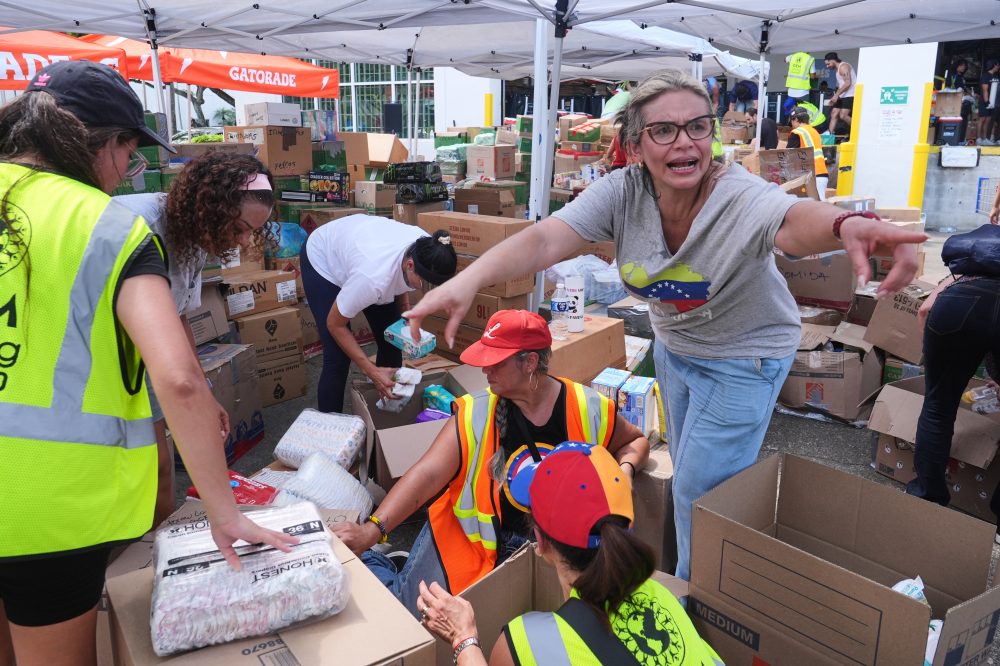

When back-to-back earthquakes nearly destroyed her grandmother’s home in Caracas last month, 18-year-old Alessandra Izaguirre felt compelled to act from thousands of miles away.
“Seeing my grandma and all these people affected made me feel like I had to do something, even if it was from the U.S.,” said Izaguirre, who has spent the past few weeks preparing meals for fellow volunteers at a nonprofit’s headquarters in Doral, Florida.
Izaguirre is among thousands of people who have joined what has grown into an unusually large grassroots relief effort based at the nonprofit Global Empowerment Mission, known as GEM. Fueled by donations from across the United States and beyond, the operation remains in full swing nearly three weeks after the disaster struck.
Every day, hundreds of volunteers continue arriving at GEM’s warehouses in Doral — a community where roughly half the residents are of Venezuelan descent. They sort through donated goods tailored to the most current needs on the ground, then prepare those items for daily flights to Caracas.
The U.S. State Department has helped facilitate GEM’s operation, giving members of the Venezuelan diaspora and other supporters a reliable channel to deliver assistance. That’s particularly important given widespread concerns about theft and corruption among Venezuelan officials intercepting aid.
“Whatever we can get to the Venezuelan public is what counts,” Izaguirre said.
The relief effort also highlights a dramatic shift in the relationship between the United States and Venezuela. President Donald Trump ordered the capture of then-Venezuelan president Nicolás Maduro in an early morning raid on January 3. With U.S. military personnel now operating in the country, America has taken on a response role that would have been unthinkable just months earlier, when Trump declared the U.S. would “run” Venezuela and took control of its oil exports.
GEM founder and president Michael Capponi described the current situation as unlike anything he has seen before. He was previously turned away at the border when attempting to deliver aid under Maduro’s rule — a government that long refused humanitarian assistance, calling it foreign interference.
“This is a whole different animal,” Capponi said. “We land a private plane, it gets unloaded by U.S. soldiers, it goes in a truck we pay for and to a warehouse that we completely control. It doesn’t touch the hands of the Venezuelan government.”
The two earthquakes — measuring 7.2 and 7.5 in magnitude — struck just 39 seconds apart on June 24. At least 4,500 people were killed, with thousands more still unaccounted for. More than 850 buildings were destroyed or heavily damaged, leaving 17,000 people displaced and crippling essential infrastructure including electricity, clean water, and sanitation systems.
GEM’s facility quickly became a drop-off point for donations. Capponi said some early donors were hesitant, worried that aid would be stolen or diverted by a notoriously corrupt government. But after GEM completed its first successful distribution, the response snowballed into one of the largest relief efforts he has witnessed in decades of humanitarian work.
Major corporations including Goya, Walmart, and Amazon have contributed supplies, and professional sports teams have donated money. Still, a large portion of the aid comes from everyday people making small contributions.
“They’re going to Walmart with their credit card, buying 15 cans of food and bringing it in a shopping bag,” Capponi said. “It doesn’t sound like a lot, but when it’s 2,000 people… it’s an enormous amount of aid.”
At times, the lines of people dropping off donations stretched so long that police had to help direct traffic. Supplies have poured in from across North America — two brothers drove a U-Haul loaded with goods all the way from Canada, another group came from Mexico, and trucks have arrived from Nevada, Texas, and California.
Up to 1,000 volunteers work across three warehouses, sorting items and assembling individual care packages — each containing enough food and hygiene products to sustain two people for roughly five days. Many packages also include handwritten notes of encouragement. One reads: “Te queremos Venezuela” — “We love you, Venezuela.”
GEM’s goal is to deliver at least 100,000 care packages per month over the next three to six months, while also planning for longer-term needs such as housing.
Billy Richardson, director of U.S. logistics, said some volunteers have taken time off work just to put in hours at the warehouse, while others come straight from their jobs at the end of the day. “We almost have to kick them out at the end of the day,” he said.
Mariela Vila, 25, was moved to volunteer after remembering what it felt like when Hurricane Maria devastated her home island of Puerto Rico in 2017. “The Latino community in general gathered together to help Puerto Rico, and that made me feel really well,” said Vila, who has worked full-day shifts at GEM since the effort launched. “So I felt the need to help Venezuela.”
Close to one million pounds — roughly 454,000 kilograms — of supplies have been sent from GEM’s Florida headquarters to warehouses the organization recently leased in Caracas. GEM works with local nonprofits and trusted community contacts to run distributions in the hardest-hit areas, often twice a day.
The U.S. State Department plays a key role by coordinating with the Venezuelan government, allowing GEM to function independently and even receive support from U.S. military forces. Last Saturday, U.S. Marines used an amphibious landing craft to reach a Venezuelan beach and unload GEM packages, which were then handed directly to 2,000 people waiting in line for aid.
A State Department spokesperson told the Associated Press that partnerships with GEM and other nonprofits allow the U.S. to tap into existing donation and logistics networks, and that the GEM effort draws on “the Venezuelan American diaspora and private partners who want to donate.”
Several other U.S.-based relief organizations told the Associated Press they have also been able to work in Venezuela without interference from government officials, with some relying on partnerships with established local nonprofits.
Despite the scope of U.S. involvement, some critics argue the Trump administration should be doing more — particularly since it controls billions of dollars in Venezuelan oil revenue.
“There are a lot of transparency questions that linger on the use of that fund in a moment in which Venezuelans really need that money to be used for the protection of Venezuelans,” said Laura Cristina Dib, Venezuela program director at the human rights organization Washington Office on Latin America.
John M. Barrett, U.S. charge d’affairs for Venezuela, told reporters last week that the interim government has been “fully compliant in terms of our requests to advance this massive humanitarian response” and that oil revenue currently under U.S. Treasury control is being made available for relief efforts.
When pressed for more specifics, the State Department spokesperson said that the State and Treasury departments are “supporting the Venezuelan interim government’s budgetary operations, improving Venezuela’s liquidity and access to capital during the recovery.” The spokesperson added that the U.S. has separately contributed more than $386 million to earthquake relief, apart from any oil revenue.
In the coastal city of Maiquetía last week, a man named Yoniel Reyes sat inside a tent going through a GEM care package he had just received — packed and sealed more than 1,300 miles away in Doral. Inside were instant meals, bottled water, canned food, hydration powder, and hygiene products.
“I never imagined I would be receiving aid from the U.S.,” Reyes said. “We Venezuelans are thankful, very thankful.”