British prosecutors announced Monday that a 28-year-old man has been charged in connection with the killing of former government minister Ann Widdecombe, who was discovered dead at her home in rural southwest England on July 9.
Widdecombe, 78, had been a well-known figure in British politics and was an active member of Nigel Farage’s populist Reform UK party at the time of her death. Authorities said she had suffered serious injuries when she was found at her home. She had left parliament in 2010.
The suspect, identified as Joshua Kerry — a white British national from northern England — has been formally charged with her murder, according to Britain’s Crown Prosecution Service. He is scheduled to appear before Westminster Magistrates’ Court in London on Tuesday.
Frank Ferguson, Chief Crown Prosecutor of the CPS Special Crime and Counter Terrorism Division, addressed the investigation in a statement: “Police enquiries into the defendant’s motives are ongoing, including a potential political or terrorist connection.”
Law enforcement had previously indicated they believed Widdecombe was deliberately targeted.
Throughout her career, Widdecombe was recognized for holding socially conservative positions. She served as a junior minister during Conservative Prime Minister John Major’s government from 1992 to 1997, and more recently acted as a spokesperson on immigration and justice for Reform UK.
A convert to Catholicism — a decision she made partly in opposition to the Church of England’s decision to ordain women as priests — Widdecombe was also known for her stances against abortion and against equalizing the age of consent for homosexual and heterosexual relationships.
A top United Nations official delivered a stark warning to the Security Council on Monday, saying children in Haiti are being held behind bars for years at a time — never once brought before a judge.
Vanessa Frazier, the UN Secretary-General’s Special Representative for Children and Armed Conflict, told the council that some children reported being detained for as long as eight years without a judicial appearance. Many of those children are being held in overcrowded cells that were designed for minors but are largely occupied by adult detainees.
“This is not acceptable,” Frazier said. “The situation of children in Haiti is amongst the most alarming anywhere in the world.”
Frazier urged that children connected to armed gangs be treated primarily as victims, and called for a comprehensive review to release detained children along with concrete steps to help them reintegrate into their communities.
According to the UN, 2,088 grave violations against children were confirmed last year in Haiti. Those violations included killings, serious injuries, abductions, forced recruitment by gangs, and sexual violence. The deaths and injuries were attributed mainly to armed gangs, Haitian police, crossfire between the two sides, and drone strikes.
U.S. Representative to the UN Mike Waltz said the United States would pursue efforts to stop gang members from using social media platforms — including TikTok, Facebook, and Instagram — to recruit children into their ranks.
Waltz also urged other nations to assist Sri Lanka, Bangladesh, and Ivory Coast with airlifts to accelerate troop deployments to the UN-backed security force operating in Haiti. That force is made up primarily of soldiers from Chad and Sri Lanka, following Kenya’s withdrawal from the mission.
Monica Juma, executive director of the UN Office on Drugs and Crime, offered a grim assessment of the gang threat during the council meeting. “Haiti’s armed gangs are no longer simply seeking to capture territory,” she said. “They are seeking to capture the systems of governance and the economic lifelines on which communities and institutions depend.”
Guyana’s government announced Monday that 10 bodies have been pulled from the water following the weekend capsizing of a ferry that had 133 people on board when it went down.
The vessel, identified as the MV Barima, went under late Saturday evening while making its way from the nation’s capital, Georgetown, to the remote northwest village of Port Kaituma. By Sunday, rescue crews had pulled 67 survivors from the water — among them 15 children — but many passengers are still unaccounted for.
Search and rescue operations have since been expanded to cover an area of 1,040 square kilometers, or roughly 401 square miles. Private vessels from the energy sector, along with divers, are assisting in the effort.
Officials have pointed to two possible contributing factors in the disaster: an inaccurate passenger manifest and suspected drug use among the crew. The ship’s captain and at least one other crew member have been taken into police custody after testing positive for marijuana.
Prime Minister Mark Phillips has opened a formal investigation into whether institutional failures played a role in the tragedy. He pledged that any individuals found responsible for negligence or misconduct would face legal consequences.
DAKAR — Senegalese President Bassirou Diomaye Faye has officially thrown his weight behind former President Macky Sall’s bid to become the next United Nations secretary-general, according to an announcement from the country’s foreign ministry on Monday. The move gives Sall a key endorsement from his home nation, despite a politically tense relationship between the two leaders.
Faye made the decision following a face-to-face meeting with Sall on Friday, the foreign ministry confirmed in its statement.
Sall led Senegal from 2012 to 2024 and is now among five candidates competing to take over from current UN Secretary-General Antonio Guterres, whose term is set to expire on December 31.
In his statement, Faye directed his government to “fully mobilize” behind Sall’s campaign, describing it as a candidacy that “is now Senegal’s candidacy in the service of Africa.”
The backing represents a meaningful political move from Faye, whose administration has repeatedly taken aim at Sall’s time in office. Sall’s effort to delay the 2024 presidential election sparked deadly protests and was ultimately overturned by the Constitutional Council.
Faye went on to win that election and took over from Sall in April 2024, but tensions between the two have persisted. Faye’s government has leveled accusations of financial mismanagement and political repression against Sall’s former administration — allegations that Sall has rejected.
Burundi, currently holding the African Union’s rotating presidency, had previously nominated Sall for the UN leadership role. Until Monday, however, Senegal had refrained from making any public endorsement of his candidacy.
SEC commissioner Greg Sankey wasted no time setting the record straight when conference media days got underway in Tampa on Monday, addressing doubts about whether talks of breaking away from the NCAA are actually serious.
“So they’re real. People have talked about that,” Sankey said. “They’ve opined about the frustrations that bring them to the point of saying we should look at something significantly different. I do not believe that is a leverage point. I think that’s just honest communication.”
Sankey added that he would rather those conversations stay behind closed doors rather than show up in the press the following morning, but acknowledged he cannot control everything. He framed the remarks as a reflection of deep dissatisfaction with the current state of college athletics.
“I would prefer that stay in a meeting room or on a videoconference, not be part of the D1.ticker the next morning, but I don’t control all of that. What I think is important is those comments represent a high level of frustration with the circumstance in which we find ourselves. We have regulated ourselves more progressively than other colleagues by choice, across our league. We’ve had different academic eligibility restrictions in the past. So we have different transfer restrictions in the past. Some of what you hear comes out of a culture that we can regulate ourselves,” he said.
Sankey made clear that the NCAA must operate in what he called “a healthy manner” or risk those frustrations growing into something far more serious.
As the leader of one of college sports’ most dominant conferences, Sankey did not shy away from describing where the SEC and the broader NCAA membership are at odds. Points of contention include a potential end to conference championship games — Sankey is firmly in favor of keeping the SEC’s title game — disagreements over the size of the College Football Playoff, and concerns about how other conferences approach scheduling.
“We had what I’ll call an unsatisfactory conversation with members of the College Football Playoff staff and some of their advisers in Destin,” Sankey said, referring to the disparity between the SEC’s demanding nine-game schedule and the easier roads some other conferences have to the playoff. “That’s rehashing from a couple months ago, that’s not a secret. That’s a reminder of that process needing to continually improve.”
“My confidence is that people will act with integrity. I do think we have questions about the understanding of the strength and rigor associated with competing in the Southeastern Conference,” he added.
Beyond conference matters, Sankey has increasingly found himself navigating the political landscape, making trips to Capitol Hill and participating in video calls as part of efforts to shape the Protect College Sports Act.
The bipartisan bill, which was introduced with backing from former Alabama head coach Nick Saban and others connected to college athletics, quickly drew opposition from both the SEC and the Big Ten in June, ahead of Congressional hearings.
Sankey has pushed Congress on several fronts on behalf of the SEC, including the need for nationwide eligibility and transfer standards, health and safety expectations for student-athletes, support for educational opportunities, scholarship protections, and oversight of agent activity. While negotiations over the bill’s provisions continue, Sankey made clear he does not view the current version as adequate.
“We support the effort behind the Protect College Sports Act. However, we believe changes to the act are necessary to make it most effective,” Sankey said. “If Congress is going to act, and again I believe it should for the reasons identified, we have one opportunity to get this legislation right. If Congress passes a bill and it’s signed into law, we won’t be returning to DC in a year or two asking and receiving help to correct the gaps that exist. That’s why it’s important that these commonsense areas be addressed now before the bill becomes law.”
As America celebrates 250 years as a nation, it’s worth taking a moment to recognize one of the country’s oldest and most important industries — farming. Agriculture has helped shape the economy, culture, and character of the United States, and nowhere is that more visible than right here in Delaware.
In the late 1700s, farming looked very different from what we see today. Most operations were small, family-run, and dependent on hand tools, animal power, and tight-knit communities to get the work done. The vast majority of people living in Delaware at that time were involved in agriculture in some way.
The 1800s brought significant change. New mechanical inventions — including the steel plow and the reaper — allowed farmers to produce more than ever before. The expansion of railroads opened up new markets, and agriculture began shifting toward a more commercial, interconnected system.
But with modernization came new headaches. Farmers struggled with unpredictable prices, difficulty accessing supplies, and a constant need to keep up with evolving practices. Cooperative organizations began forming across the country to help address these issues, and Delaware was no exception.
County Farm Bureaus were established in the early 1900s through county extension agents, who used them as a platform to promote modern farming techniques and education. The Delaware Farm Bureau was formally organized in 1920, with W.V. Cosden serving as its first president.
At the time, the organization also functioned as a purchasing cooperative, allowing farmers to pool their resources and buy seed, fertilizer, and equipment at significantly reduced prices. However, the cooperative began to struggle when non-members started taking advantage of the purchasing benefits without paying dues. The financial strain proved too much, and in 1926, the Delaware Farm Bureau was forced to shut down.
Despite the disbandment, the need for a unified agricultural voice in Delaware didn’t go away. As farmers faced the Great Depression, the demands of wartime food production, and rapid technological shifts, the importance of having an organized group standing up for their interests became undeniable. Farm numbers were declining while farm sizes were growing, and producers were being forced to adapt to entirely new business models.
In 1944, the Delaware Farm Bureau was reestablished with a renewed mission to protect Delaware agriculture and grow its membership. The organization quickly regained its footing as a vital resource for farmers — advocating on policy issues, providing educational programs, and strengthening community ties. George Simpson of Houston served as the first president of the reorganized Delaware Farm Bureau, leading efforts to unite farmers, improve communication among them, and encourage shared problem-solving.
Today’s Delaware farms bear little resemblance to those early colonial operations. Modern agriculture relies on heavy machinery, data-driven decision-making, and a global marketplace. Delaware has diversified its agricultural output over the years, with poultry, produce, and grain production now forming the backbone of the state’s farming economy.
Yet through all the changes, the core values that have long defined Delaware farming — cooperation, community, and a commitment to supporting local producers — have remained constant. The Delaware Farm Bureau stands as a testament to that enduring spirit. Its history is a reminder that agriculture isn’t simply an industry; it’s a living tradition passed down through generations of Delawareans who work the land, look out for one another, and continue to adapt to whatever challenges come their way.
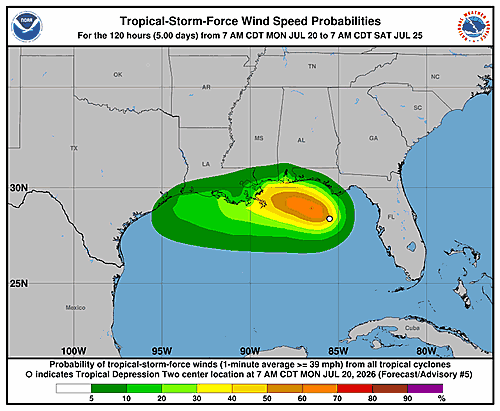
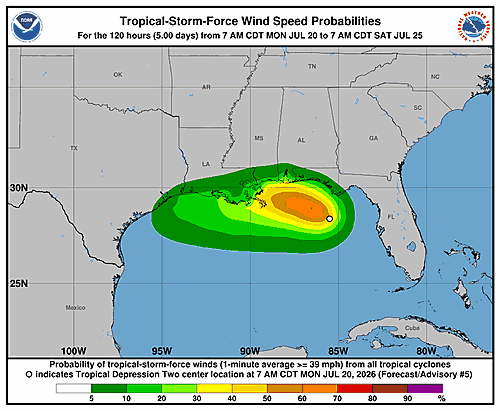
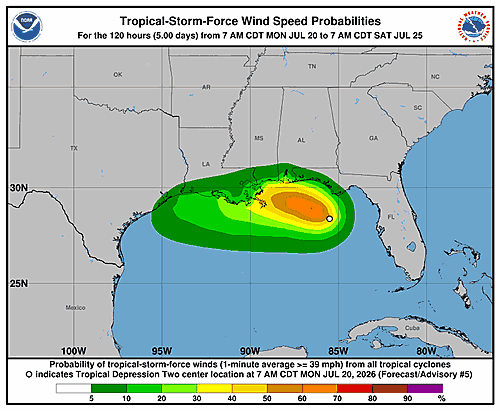
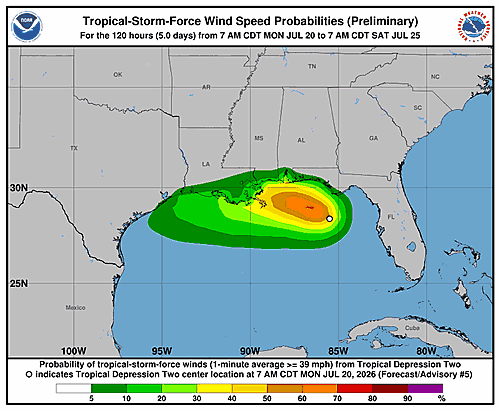
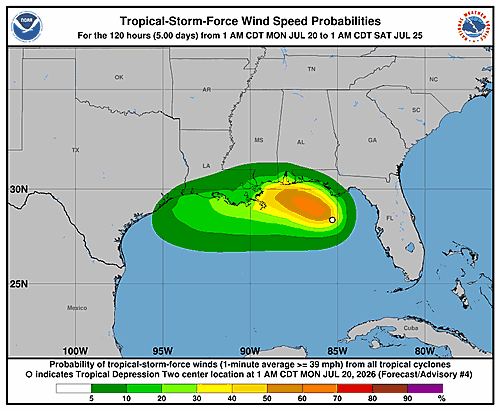
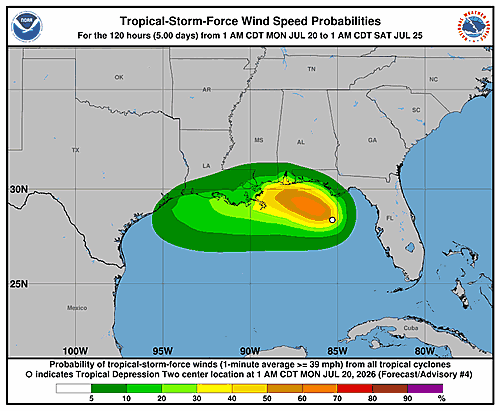
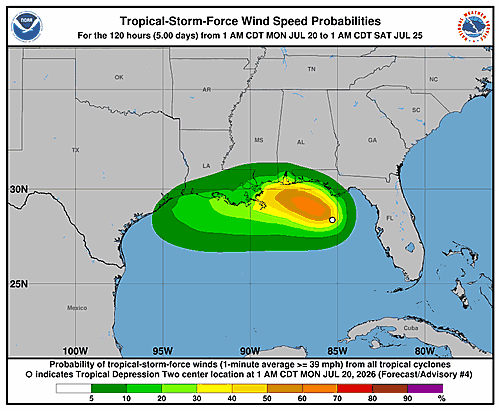
The National Hurricane Center is keeping a close eye on Tropical Depression Two, releasing updated wind speed probability graphics for the Atlantic storm system.
According to the NHC, the latest 34-knot wind speed probability forecast covers a 120-hour outlook period. The graphics were last updated on Monday, July 20, 2026, at 15:22 GMT.
Residents in potentially affected areas are encouraged to monitor the latest updates from the National Hurricane Center as forecasters continue to track the storm’s development and movement.
The National Hurricane Center has issued an updated Potential Storm Surge Flooding Map for Tropical Depression Two, with the most recent update recorded on Monday, July 20, 2026, at 4:01 PM GMT.
Storm surge flooding maps are used to help residents and emergency officials understand which areas could be at risk of inundation from a tropical system. Residents in potentially affected coastal areas are encouraged to stay informed and follow guidance from local emergency management authorities.
For the most current information on Tropical Depression Two and associated storm surge risks, residents should monitor updates from the National Hurricane Center.
The National Hurricane Center has released an updated Storm Surge Watch/Warning Map for Tropical Depression Two, with the most recent update recorded at 14:51 GMT on Monday, July 20, 2026.
The map outlines areas currently under storm surge watches and warnings associated with the tropical system. Coastal residents and those in low-lying areas are encouraged to stay informed and follow guidance from local emergency management officials.
Storm surge can pose a serious and life-threatening risk, pushing large volumes of water inland and causing significant flooding in coastal communities. Monitoring updates from the National Hurricane Center is strongly advised as the storm system continues to develop.
A tropical depression is on the move in the Atlantic, and forecasters say it could reach tropical storm strength before the day is done.
As of 1:00 PM CDT on Monday, July 20, the center of Tropical Depression Two was positioned near latitude 28.6 North, longitude 85.6 West. The system was drifting in an erratic northwestward direction at just 3 miles per hour.
The depression had maximum sustained winds of approximately 35 mph and a minimum central pressure of 1005 millibars at the time of the report.
Forecasters are expecting the system to organize further and develop into a tropical storm either this afternoon or tonight. Residents along coastal areas should continue monitoring updates from the National Hurricane Center as the storm’s path and intensity evolve.
The National Hurricane Center has issued updated wind speed probability information for Tropical Depression Two, the second named tropical system of the Atlantic season.
According to the latest graphics released by forecasters, the probability map tracks the chances of 34-knot wind speeds affecting various areas over a 120-hour forecast window.
The wind speed probability data was last updated on Monday, July 20, 2026, at 15:22 GMT. Residents in potentially affected coastal areas are encouraged to monitor the latest updates from the National Hurricane Center as the storm system continues to be tracked.
The National Hurricane Center has issued an updated potential storm surge flooding map for Tropical Depression Two, with the latest revision posted on Monday, July 20, 2026, at 4:01 PM GMT.
Storm surge flooding maps are used to help coastal residents and emergency managers understand which areas may be at risk of inundation if a tropical system makes landfall or moves close to shore.
Residents in areas that could be affected by Tropical Depression Two are encouraged to monitor updates from the National Hurricane Center and follow guidance from local emergency management officials.
The National Hurricane Center has released an updated storm surge watch and warning map for Tropical Depression Two, with the most recent update posted on Monday, July 20, 2026.
Storm surge watches and warnings are issued to alert coastal communities of the potential for dangerous and life-threatening flooding caused by rising ocean waters pushed ashore by a tropical system.
Residents in areas under a storm surge watch or warning are urged to follow guidance from local emergency management officials and stay informed through official National Hurricane Center updates.
BAMAKO — A military convoy in northern Mali was struck by a deadly ambush over the weekend carried out by fighters affiliated with al Qaeda and a Tuareg-led separatist faction, with a source close to the rebel groups saying more than 50 soldiers and allied Russian fighters lost their lives, while others were taken captive.
The assault is the latest in a string of increasingly bold attacks by the two groups, which coordinated a nationwide offensive in April that claimed the life of the country’s defence minister and struck the airport in the capital city of Bamako. Earlier this month, the groups launched a follow-up offensive aimed at seizing the town of Anefis.
According to statements issued by Mali’s armed forces, the Azawad Liberation Front (FLA), and the al Qaeda-affiliated group Jama’at Nusrat al-Islam wal Muslimin (JNIM), the attack took place Saturday between Anefis and the city of Gao in the country’s north.
Mali’s military confirmed the ambush occurred in the Tabrichat area and said it responded with retaliatory airstrikes that killed at least 20 insurgents.
In its own statement, the FLA said “dozens” of Malian soldiers and members of the Russian paramilitary Africa Corps had been “neutralised,” adding that significant material damage had occurred. A source with ties to the FLA put the pro-government death toll at more than 50. Reuters was unable to independently confirm the casualty figures.
JNIM released video footage online that appeared to depict soldiers surrendering with their hands behind their heads, as well as rebels firing on some of those captured. Reuters has not independently verified the authenticity of that footage.
Despite the violence, Mali’s army has maintained control of Anefis.
The surge in attacks presents a serious challenge to Mali’s military-led government, which rose to power through coups in 2020 and 2021 and had pledged to bring greater security to the landlocked nation in the Sahel region.
The Delaware Department of Justice’s Investor Protection Unit has scored a significant legal victory after the state’s highest court ruled in its favor.
The Delaware Supreme Court affirmed the Superior Court’s earlier dismissal of a case brought by Swan Energy, Inc., Brandon Davis, John Schiffner, and Cody Davis against the Investor Protection Unit of the Delaware Department of Justice.
The case had challenged the authority of the Investor Protection Unit — a division within the Department of Justice — to conduct hearings. With this ruling, the Supreme Court has made clear that the unit holds that authority, a decision the department is describing as a landmark opinion.
The Investor Protection Unit was the party that originally initiated the proceedings at the center of the dispute, which ultimately led to the legal challenge now resolved by the state’s Supreme Court.
Troy Jackson, a fifth-generation logger from the North Maine Woods and former state lawmaker, has quickly become the dominant choice to replace Maine’s Democratic Senate nominee after the previous candidate, Graham Platner, withdrew from the race less than two weeks ago.
Platner’s exit came after a sexual assault allegation — which he denied — effectively ended his campaign and opened the door for a wave of Democrats hoping to challenge longtime Republican Sen. Susan Collins. By Sunday, however, the competition had largely faded after Jackson’s supporters spent the weekend locking down delegate commitments ahead of this Saturday’s state convention in Bangor.
Of the 601 delegates set to cast votes this weekend, Jackson’s campaign says 481 have pledged their support. Key rivals, including Secretary of State Shenna Bellows and Nirav Shah, former director of Maine’s Center for Disease Control and Prevention, have both withdrawn from consideration. Jackson formally announced Monday that he is directing his full energy toward defeating Collins.
“I’m grateful to Democrats across Maine for putting their faith in me and in what we’re fighting for,” Jackson said in a statement. “This didn’t happen because of one person. It happened because hundreds of volunteers put in the hours, knocked on doors, made phone calls, and believed we could build something bigger than ourselves.”
Even so, winning the nomination is just the first hurdle. With roughly 100 days remaining before the general election, Jackson faces a steep climb — Collins already holds millions in campaign funds, while Jackson must build out a statewide campaign operation and appeal to Maine’s substantial independent voter bloc.
As a former state Senate president, Jackson brings more political experience than Platner did as a first-time candidate. But his embrace of progressive positions could draw sharp Republican attacks, according to Nicholas Jacobs, a political scientist at Colby College in Maine.
“The guy does have some pretty interesting positions,” Jacobs said. “Positions that are pretty far to the left of the median voter.”
Among those positions, Jackson has stated he wants to “get rid of” Immigration and Customs Enforcement — a stance that has taken on added weight after an ICE officer fatally shot a driver in Maine last week. Democrats have moved to tie Collins to the agency, while Jackson has doubled down on his call to dissolve ICE entirely.
Jackson has also championed “Medicare for All,” a proposal that would eliminate employer-based and private individual health insurance in favor of a government-administered program guaranteeing universal coverage with no premiums, no deductibles, and only minimal copays for select services.
Republicans wasted no time labeling Jackson a “socialist” on Monday. Republican National Committee spokesperson Kristen Cianci drew a comparison to former President Joe Biden’s July 2024 decision to exit the presidential race, which handed the Democratic nomination to then-Vice President Kamala Harris, who went on to lose to Republican Donald Trump.
“This entire process is just as bad as Kamala’s rigged coronation,” Cianci said, adding, “Maine voters have had their voices stolen by party insiders.”
Still, analysts say Jackson’s deep roots in Maine could work in his favor. Jacobs noted that unlike Platner, who faced a string of controversies, Jackson’s background in the logging industry and his connection to “old Maine” give him an authenticity that resonates with voters.
“He’s the real deal,” Jacobs said.
Jackson’s history in the state runs deep. In 1998, he helped organize a weeklong blockade along the Quebec border to protest the use of Canadian loggers who were undercutting pay for local workers. The standoff ended with Jackson being removed by police, but it ultimately fueled his push as a state lawmaker for stronger protections for loggers and wood haulers.
Jackson first ran for a seat in Maine’s House of Representatives in 2000 as a Republican and lost. He won the seat two years later running as an independent, then switched to the Democratic Party in 2004. He eventually rose to serve as Maine Senate president before departing the Statehouse in 2024. Earlier this year, he finished third in the Democratic gubernatorial primary, running with the backing of Platner, U.S. Sen. Bernie Sanders, and Our Revolution, the political organization Sanders founded.
For Democrats nationally, Maine is considered a critical target. The party needs to flip four Senate seats to take control of the 100-member chamber, and party leaders have identified Maine — along with Alaska, Ohio, and North Carolina — as key battlegrounds in that effort.
St. Louis City SC has secured the services of defender Jaziel Orozco for the foreseeable future, announcing a contract extension Monday that will keep the young player with the club through the 2028-29 MLS season.
The agreement with the 22-year-old, who hails from Mexico, also carries an option that could extend his stay into the 2029-30 campaign.
Since joining St. Louis City in 2025, Orozco has made 17 appearances and found the back of the net once. Prior to his time with the club, he played in four matches with Real Salt Lake back in 2022.
Sporting director Corey Wray expressed enthusiasm about keeping Orozco on the roster long term. “Jazi has put in consistent performances this season and it is clear he has a good understanding of what is being asked of him tactically,” Wray said. “Over the last six months, he has shown qualities that we value with his tactical flexibility and versatility both in and out of possession. We are excited to keep him at the club for years to come and help him continue developing as a player.”
St. Louis City is set to resume action following the FIFA World Cup break, heading into Wednesday night’s road match against the Los Angeles Galaxy.
A federal judge handed a coalition of states a legal victory on Monday, ordering a temporary halt to Paramount’s planned $110 billion acquisition of Warner Bros. Discovery while the case plays out in court.
California spearheaded the effort alongside 11 other states, filing suit on July 13 in Oakland federal court. The states contend that allowing the merger to go through would create a media giant powerful enough to drive up prices across the film and television industries, harming competition in the process.
At the heart of the states’ argument is the concern that once the deal closes, it becomes nearly impossible to reverse the damage. They warned that Paramount would quickly begin laying off workers and sharing confidential business information with Warner Bros. Discovery — steps that would be extremely difficult to walk back if a court later determines the merger violated antitrust law.
The lawsuit puts in jeopardy Paramount CEO David Ellison’s ambition to reshape his company into a formidable competitor to streaming giants like Netflix and Disney.
Paramount has fired back, saying the states are mischaracterizing well-established antitrust principles. The company also argued that dragging out the process only hurts entertainment industry workers who have already endured years of upheaval in a rapidly changing business landscape.
A group of nine U.S. senators — crossing party lines — gathered at the Farnborough airshow in England on Monday to send a message to defense contractors from allied nations: American demand for their products is not going away, and tariffs on aerospace goods should be avoided.
Republican Senator Jerry Moran delivered a direct message to foreign manufacturers. “Our message is encouragement to them to increase their capabilities to send the message that the demand signal is for real,” Moran said. “We are doing the things in Congress that suggest that the demand is only going to grow.”
Moran went further, adding, “We need more demand to meet the demand for protecting our country.” He described the airshow as an opportunity for lawmakers to engage directly with European partners “to reiterate and recommit ourselves that the United States wants to participate in a global economy and global national security.”
Democratic Senator Jeanne Shaheen pointed out that the senators in attendance represent a wide range of states where the aerospace industry plays a major role in the economy. She also highlighted that the United States had its largest-ever presence at Farnborough this year.
Shaheen drew attention to China’s growing footprint at last year’s Paris air show as context for why American visibility matters. “The fact that we have such a large presence is important not just to America’s industry but also to the partnerships that we need to have around the world to not only improve our economic security but our national security,” she said.
She also emphasized that the U.S. and the European Union have critical areas where cooperation is needed to address defense requirements and existing production backlogs.
Earlier this month, the U.S. Commerce Department announced it had finished an investigation into imported commercial aircraft, jet engines, and parts. While the probe found that foreign goods raise national security concerns, the Trump administration indicated it is not immediately pursuing new tariffs on those products.
Following significant lobbying from the U.S. aviation sector, the Trump administration agreed to exempt airplanes and parts from tariffs as part of trade agreements, after briefly imposing such tariffs last year.
Both Moran and Shaheen, along with their fellow senators at the event, have voiced opposition to tariffs on aerospace products.
Eric Fanning, CEO of the Aerospace Industries Association, highlighted the strength of the American aerospace and defense sector. He noted the industry has seen a 25% jump in exports over the past year and employs more than 2 million people in the U.S. “We are by far the global leaders,” Fanning said.
Commercial aircraft and parts have operated under a tariff-free framework established by the 1979 Civil Aircraft Agreement, an arrangement under which the U.S. aerospace sector enjoys a $75 billion annual trade surplus.
The New York Yankees sent right-handed pitcher Elmer Rodriguez down to their Triple-A affiliate in Scranton/Wilkes-Barre on Monday.
The 22-year-old had been brought up to the big league roster on Sunday to serve as the designated 27th player during the second game of a split doubleheader against the Los Angeles Dodgers. However, Rodriguez never got into the game before being sent back down.
Since breaking into the majors on April 29, Rodriguez has struggled to find his footing, going 0-2 with a 4.76 ERA while logging 17 innings across four starts at the major league level.
WASHINGTON — The director of the nation’s federal artificial intelligence testing agency has stepped down after holding the position for just three months, according to a Commerce Department spokesperson.
Chris Fall, who led the U.S. Center for AI Standards and Innovation at the Department of Commerce, submitted his resignation, the spokesperson confirmed to Reuters on July 20.
Filling the role on a temporary basis will be Arvind Raman, who currently heads the Commerce Department office responsible for overseeing the AI testing institute. Raman previously served as the dean of engineering at Purdue University.
SALISBURY, Md. — The City of Salisbury is announcing the upcoming launch of a new Prehospital Whole Blood Program through the Salisbury Fire Department, which will allow specially trained paramedics to administer low-titer O positive whole blood to critically injured patients before they ever reach a hospital.
The program is designed to deliver low-titer O positive whole blood to patients who are experiencing severe blood loss caused by traumatic injuries, medical emergencies, or other life-threatening conditions. Getting blood into a patient earlier — whether at the scene of an emergency or during transport — allows paramedics to start replacing lost blood sooner, which can significantly improve outcomes for those going into hemorrhagic shock.
Whole blood has become the go-to standard in many trauma care systems because it combines red blood cells, plasma, and platelets into a single product. That combination helps restore the body’s ability to deliver oxygen and clot blood during critical emergencies.
Setting up the program required close coordination between the fire department, its medical director, regional health care partners, and the Maryland Institute for Emergency Medical Services Systems (MIEMSS) to make sure all clinical protocols, storage procedures, tracking systems, and quality assurance standards were properly in place.
EMS Lt. John Dennis of the Salisbury Fire Department spoke to the significance of the new program. “The implementation of our Whole Blood Program represents a major advancement in emergency medical care for the citizens and visitors of Salisbury,” he said. “By bringing blood transfusion capabilities directly to the patient, our paramedics can begin a life-saving treatment, giving critically ill and injured patients a greater chance of survival. This program reflects our commitment to providing the highest level of prehospital care possible.”
The new program is expected to strengthen the fire department’s capacity to deliver advanced emergency medical services to people throughout Salisbury and the surrounding region.
The National Hurricane Center has issued an updated potential storm surge flooding map for Tropical Depression Two, with the most recent update recorded on Monday, July 20, 2026, at 4:01 PM GMT.
Storm surge flooding maps are used to help residents and emergency managers understand which areas could be at risk of inundation if a tropical system makes landfall or passes nearby. Officials encourage those in potentially affected coastal areas to stay informed and follow guidance from local emergency management authorities.
Residents are urged to check the latest updates from the National Hurricane Center as the storm system continues to be monitored.
Gas Prices Return to $4 a Gallon Amid U.S.-Iran Conflict
American drivers are once again facing a $4-a-gallon average at the pump. According to AAA, the national average for regular unleaded gasoline has returned to that threshold as military exchanges between the U.S. and Iran continue to intensify. A year ago, that same gallon would have cost an average of $3.14. The $4 figure is a national average, and many drivers in certain states have already been paying more than that for some time. Prices differ from state to state based on factors such as local fuel supply and varying tax structures. The conflict is also driving up fuel costs for consumers around the globe.
Student Loan Defaults Hit Record Levels Nationwide
A new analysis by The Associated Press reveals that more than 4.2 million Americans fell into default on their student loans between April 2025 and March 2026. That has pushed the total number of borrowers currently in default to a record-breaking 9.5 million. Many of those who defaulted had first fallen behind in 2024, when loan payments resumed after being paused during the pandemic. Hundreds of thousands more borrowers are several months behind on payments, and analysts warn another wave of defaults may be coming. Under federal rules, borrowers enter default status after going nine months without making a payment. The fallout can be severe — damaged credit scores and accounts sent to debt collectors are among the consequences that can disrupt people’s financial lives.
U.S.-Iran War Escalates; Gulf Region Feels the Impact
The United States launched a new wave of airstrikes against Iran following the announcement of another American service member’s death. Iran responded on Monday by striking Bahrain, which serves as the home base for the U.S. Navy’s 5th Fleet. Even as the two nations edge closer to full-scale conflict, some diplomatic activity is emerging. Iran’s interior minister traveled to Pakistan — considered a key go-between in the dispute — for negotiations. Meanwhile, oil prices have been climbing in recent weeks as shipping through the Strait of Hormuz has largely ground to a halt, contributing to the rise in U.S. gas prices.
EU Hits AliExpress with Record 550 Million-Euro Fine
European regulators have handed online retailer AliExpress the largest penalty ever issued under the EU’s Digital Services Act — a 550 million-euro fine for allowing unsafe and counterfeit products to be sold on its platform. The European Commission announced the fine on Monday, coming months after another online retailer, Temu, faced a similar punishment. Officials said AliExpress failed to meet its legal obligations to protect consumers. The company pushed back on the ruling, saying it has made meaningful changes to its practices. AliExpress has until October 20 to submit a plan of action. The Digital Services Act is designed to shield users from harmful content and protect their fundamental rights online.
Wall Street Stabilizes as AI Stocks Recover Some Ground
U.S. stock markets found some stability Monday as artificial intelligence-related stocks clawed back a portion of their recent losses. The S&P 500 gained 0.4%, bouncing back after its first losing week in three — and only its third down week since late March. The Dow Jones Industrial Average slipped 87 points, while the Nasdaq composite edged up 0.7%. Shares of companies including Nvidia, Sandisk, and AMD helped lead the recovery after tumbling last week amid concerns that their valuations had risen too far. Oil prices swung wildly during the day due to uncertainty over the Iran conflict but pulled back from their early highs.
Cash Overload Threatens West Bank Economy
In most economies, having plenty of cash on hand is a good thing. But in the Israeli-occupied West Bank, an excess of physical currency is creating serious problems. The Palestinian Monetary Authority says that Israel’s long-standing limits on accepting cash that piles up in Palestinian banks has triggered a growing crisis. Palestinian banks are so overwhelmed with Israeli shekels that they are running out of storage space in their vaults and turning away cash deposits from customers. That has made it increasingly difficult for residents to use paper money for everyday purchases and for businesses to deposit their earnings. Palestinian officials and business owners fear the mounting cash surplus could push the territory’s economy to the breaking point.
Who’s Behind Trump’s $3.47 Gas Stations?
President Donald Trump and his administration have been vocal supporters of the Freedom Fuel Network, a patriotically branded chain of gas stations. But tracing who actually owns and operates the venture through public records has been no easy task. Those records point to a group of New Jersey businesspeople that includes an NFL kicking coach, a Republican fundraiser, and two brothers who were ordered by a judge earlier this year to pay civil damages after unlawfully taking more than 200,000 gallons of fuel. None of the individuals involved have been willing to speak publicly about the business.
Christopher Nolan’s ‘The Odyssey’ Opens to $264 Million Worldwide
Director Christopher Nolan’s adaptation of Homer’s ancient epic poem, “The Odyssey,” opened to massive box office numbers over the weekend. The film brought in an estimated $124.5 million domestically and another $139.6 million from international markets, for a global opening weekend total of $264.1 million — surpassing even Nolan’s debut weekend for “Oppenheimer.” It marks Nolan’s strongest opening since “The Dark Knight Rises” back in 2012. The film turned one of literature’s oldest works into a major summer blockbuster. By comparison, The Walt Disney Co.’s “Moana” came in a distant second place with $19 million in its third weekend of release.
Taylor Farms Recalls Iceberg Lettuce Over Parasite Concerns
Taylor Farms has broadened a voluntary recall of its iceberg lettuce products after linking them to a multistate outbreak of cyclospora, a diarrhea-causing parasite. The California-based company said the potentially contaminated products were shipped to 27 states, including Texas, Florida, Pennsylvania, and Illinois. Cyclospora is a microscopic parasite that can contaminate produce when it comes into contact with human waste, typically through irrigation or washing with tainted water. U.S. health officials earlier this week identified lettuce from a Mexican supplier as a source of cyclospora contamination in food served at Taco Bell restaurants across five Midwestern states.
Maryland’s coastal communities will be spotlighting their agricultural roots during Agriculture Appreciation Week, scheduled to run from August 1 through August 9.
The weeklong observance is designed to recognize the vital contributions that farming and agriculture make to the region’s economy and way of life along Maryland’s coast.
Residents and visitors alike are invited to join in the celebration and learn more about the agricultural heritage that continues to shape the area.
Senior finance executives gathered at the Farnborough Airshow in England on Monday, making the case that private investors must step up to cover the shortfall left by governments that simply don’t have enough money to meet surging European defence demands.
“Public spending will not be enough, and we do need to mobilise private capital at scale,” said Cathal Deasy, global co-head of investment banking at British bank Barclays. He urged national governments to move more quickly and offer clearer direction to potential investors.
The annual aerospace event is drawing bankers and investors in record numbers this year, according to organizers, with many attracted by the possibility of profiting from a worldwide surge in defence investment driven by rising geopolitical tensions.
Still, investor enthusiasm has pulled back in recent months. Defence company stock prices have weakened, and Franco-German defence group KNDS announced this month that it was delaying its planned stock market listing until market conditions become more favorable.
More than 600 finance professionals are expected to attend the Farnborough event — roughly three times the number from 2025 — including representatives from Goldman Sachs, JPMorgan, and Qatar’s sovereign wealth fund.
“With defence companies growing, banks see an opportunity to jump in,” said Amin Mansour, a vice chairman at Dutch bank ING. He told Reuters ahead of the event that the bank now has around 50 bankers across various sectors working on defence funding deals, compared to “very few” just five years ago.
The strong run that European defence stocks enjoyed has lost momentum in 2026. An index tracking aerospace and defence companies has risen just 1.3% since the beginning of the year, while the broader STOXX 600 index has climbed 8%.
An executive at one of the largest private equity firms in the United States, who chose not to be identified, said defence company valuations went through a “reckoning” over the past year but have since stabilized and become more attractive to investors.
Others at the event pointed out that many smaller defence contractors are still being left out of private investment opportunities, largely because of complicated government procurement processes.
“It’s getting the capital into the supply chain which is challenging and which does create bottlenecks,” said Ephraim Rudman, a financial institutions group partner at Apollo.
Top-ranked professional golfer Brooke Henderson has announced she is engaged to Minnesota Twins pitching prospect Ricky Castro, sharing the exciting news with fans through an Instagram post on Sunday.
The announcement came just one week after Henderson narrowly missed capturing the Evian Championship title, falling to South Korea’s Haeran Ryu in a playoff. The couple’s engagement officially took place two days after that tournament.
The couple’s joint post captured the joy of the moment: “Engaged! 7/14/26. The beginning of forever. We are beyond excited and blessed to announce our engagement with one another! God is so good for giving us each other!”
Henderson and Castro began their relationship in March 2025 after crossing paths in Naples, Florida, where Henderson owns a home.
Henderson, 28, is one of the most accomplished golfers on the LPGA Tour, having claimed 14 victories including two major championships — the 2016 Women’s PGA Championship and the 2022 Evian Championship. The Canadian star added to her legacy with a win on home soil at the CPKC Women’s Open in Mississauga, Ontario, in August 2025.
Castro, 26, is a right-handed pitcher currently competing at the Triple-A level with the St. Paul Saints. In 10 appearances this season — including four starts — he holds a 2-1 record with a 4.13 ERA.
Authorities in Pennsylvania are on the hunt for suspects after the home of Philadelphia Eagles running back Saquon Barkley was burglarized over the weekend.
Officers with the Tredyffrin Township Police Department, located roughly 20 miles northwest of Philadelphia, responded to the residence in the early morning hours Saturday after receiving a report of a burglary in progress. By the time police arrived on scene, the suspects had already taken off.
In a news release, police confirmed that neither Barkley nor any members of his family were injured during the incident. Investigators also released an image of a white SUV that may be connected to the break-in.
Authorities said no other burglary reports were filed in the surrounding area, and they are actively looking into whether Barkley’s home was specifically singled out as a target.
The Chester County District Attorney’s office has joined the investigation and is calling on the public for assistance. “We are asking the public to help us identify those responsible by checking any home security cameras for suspicious activity in the area” from early Saturday, the office said in a statement.
As of Monday, police and the district attorney’s office had not responded to requests for comment. Messages were also left with representatives for the Eagles and Barkley seeking a response.
The break-in comes against a backdrop of a broader pattern of athlete-targeted burglaries. Back in May, Argentine authorities arrested two Chilean citizens suspected of belonging to a transnational criminal gang responsible for orchestrating home burglaries targeting well-known athletes. Among the reported victims were NFL stars Patrick Mahomes and Travis Kelce, as well as former tennis player Juan Martín del Potro, and NBA players Luka Doncic and Mike Conley Jr.
In 2024, the NFL sent a security alert to all teams and the players’ union in the wake of the burglaries connected to Mahomes and Kelce’s homes.
On the field, Barkley had a somewhat quieter 2024 season compared to his record-breaking year when he racked up 2,504 rushing yards across the regular season and playoffs — the most in NFL history. Last season, he still managed to rush for 1,140 yards and scored nine total touchdowns.
University of Delaware offensive lineman Steven Demboski has been chosen as the Blue Hens’ nominee for the prestigious Allstate AFCA Good Works Team, according to an announcement made Monday.
The Atlanta-based organization revealed Demboski’s nomination, recognizing the UD football player for his contributions beyond the gridiron.
A Washington, D.C., judge has scheduled a September 28 trial for a former Olympic canoe racer accused of intentionally damaging the Lincoln Memorial Reflecting Pool — a renovation project backed by President Donald Trump that has been mired in controversy.
D.C. Superior Court Judge Todd Edelman set the trial date for David Hearn during a Monday court hearing. It marked Hearn’s second appearance before the court since a grand jury handed down a felony property destruction charge against him.
Hearn entered a not guilty plea on July 9 and has since asked the court to throw out the case entirely. His legal team argued in a court filing that the government failed to properly preserve key physical evidence from the Reflecting Pool.
Three other individuals have also faced charges in the same court — misdemeanors — for allegedly taking pieces of paint from the pool. The felony count against Hearn, which alleges he caused at least $1,000 in damage, could carry a maximum prison sentence of 10 years if he is convicted.
President Trump ordered the pool renovated ahead of the nation’s 250th anniversary celebrations, but the project has been plagued by setbacks. What Trump initially said would cost $1.5 million has since ballooned to more than $16 million.
Trump, a Republican, has pointed to vandalism as the cause of the pool’s problems, while critics of the administration blame poor repair work. Hearn and those who support him contend that his prosecution is politically driven — an effort by the Trump administration to shift blame onto him and others for its own shortcomings.
Workers recently drained the pool again, which prompted Hearn’s attorneys to argue the government is actively destroying evidence that could prove his innocence.
“The Constitution simply does not permit the government to charge a man with destroying an object, retain exclusive custody of that object, and then drain, disturb, and alter the object before the defense may examine it, despite a written demand for its preservation. And yet that is what has happened here,” his attorneys wrote in their motion to dismiss.
Hearn, 67, previously told The Associated Press that National Guard soldiers and U.S. Park Police held him for five hours after he stopped at the pool during a bike ride on June 19. He said he reached in to look at the pool’s peeling coating and briefly touched a piece still attached to the wall, but that he released it when a park worker told him to do so.
Hearn, a Bethesda, Maryland, resident, competed in three Summer Olympics. According to the U.S. Olympic and Paralympic Committee’s website, his best result was a ninth-place finish at the 1996 Atlanta Olympic Games.
A fire-starting device was triggered Monday morning on the sidewalk outside a prominent federal building in New York City, and authorities have taken at least one person into custody, according to the FBI.
The FBI’s New York Joint Terrorism Task Force launched an investigation into the incident, which occurred outside 26 Federal Plaza. FBI Director Kash Patel announced via social media that two people suffered minor injuries as a result.
The building at 26 Federal Plaza is home to numerous government agencies, including the New York field office of the FBI itself. It also contains an immigration court where migrants have reportedly been arrested upon exiting their hearings.
Footage captured at the scene showed flames and a rising column of smoke on the sidewalk in front of the building. Additional video and images showed law enforcement officers restraining an individual and leading them away from the area.
NFL owners are moving toward locking in a contract extension with Commissioner Roger Goodell, with a deal expected to be finalized “in the coming months,” according to a Monday report from Front Office Sports.
Goodell’s existing contract is set to expire in March 2027. A new extension would keep him at the helm to guide two major upcoming negotiations — a fresh collective bargaining agreement with the players’ union and new broadcasting rights deals.
At 67 years old, Goodell is approaching a significant milestone: this coming September marks his 20th year leading the NFL.
According to the report, there is currently no known opposition among owners to extending his tenure. An announcement could come as early as the special owners’ meeting scheduled for August 26 in Atlanta, where the proposed sale of the Seattle Seahawks is also expected to be approved. Owners are also set to gather for a quarterly meeting in New York in October.
The NFL did not respond to requests for comment regarding the Front Office Sports report.
The league’s current collective bargaining agreement with the NFL Players Association is in place through the 2030 season. One of the biggest issues on the horizon is a potential expansion to an 18-game regular season schedule.
The NFL’s existing broadcast rights agreements, signed back in 2021, are valued at $110 billion over an 11-year span — though the league holds the option to exit those deals early.
Jack Campbell, a former NHL goaltender, made his retirement official on Sunday after an eight-year career between the pipes at the professional level.
Campbell, 34, last suited up for the Edmonton Oilers during the 2023-24 season. Over the course of his career, he posted a record of 93-52-18 with 10 shutouts, a .909 save percentage, and a 2.76 goals-against average across four different teams.
He earned NHL All-Star recognition with the Toronto Maple Leafs during the 2021-22 season and later signed a five-year, $25 million contract with the Edmonton Oilers in July 2022. The Oilers ultimately bought out the final three years of that deal and placed him on waivers on November 7, 2024.
In a video shared to his Instagram account, Campbell opened up about both his career and the personal challenges he faced along the way.
“I grew up my entire life chasing one dream and that was to play in the NHL,” he said. “I was fortunate enough to accomplish that goal of playing eight seasons in the NHL, becoming an NHL All-Star (2021-22) and thankfully on paper, living a pretty awesome life. Super grateful for my days of playing but what a lot of people don’t see is the personal battles that I went through throughout my career. Not having somebody to hold me accountable for having a well-balanced life, that’s when I found four years ago my life coach, who’s completely changed everything for me.”
Campbell was originally selected by the Dallas Stars with the 11th overall pick in the 2010 NHL Draft. He made his first NHL appearance with Dallas in 2013-14 before going on to play for the Los Angeles Kings from 2016 to 2020, the Maple Leafs from 2020 to 2022, and the Oilers from 2022 to 2024.
In his announcement, Campbell also reflected on what ultimately drew him away from the sport he spent his life pursuing.
“Walking away from hockey wasn’t easy,” he said. “It gave me more than I could have ever imagined. But over the last few years, I realized the work that brought me the most fulfillment wasn’t stopping pucks, it was helping people become who they’re capable of becoming.”
During his NHL playoff career, Campbell appeared in 18 postseason games, going 7-8 with a 2.28 goals-against average, a .920 save percentage, and two shutouts.
Campbell says he is now embarking on a new chapter as an identity and performance coach.
Four Indian crew members were killed and a fifth left in critical condition after a ship departing the southern Ukrainian port of Odesa was struck in an attack on Sunday, according to a statement released late Monday by India’s foreign ministry.
Ukraine’s navy reported via the Telegram messaging platform that Russia fired three cruise missiles at the vessel, identified as the Golden Leo — a ship sailing under a Guinea-Bissau flag with a crew made up of Indian and Syrian nationals.
India’s foreign ministry issued a sharp condemnation of the incident, stating: “India condemns such attacks and reiterates that targeting commercial shipping and endangering innocent civilian crew members, or otherwise impeding freedom of navigation and commerce, is deplorable and should be avoided.”
Scholar Rock announced Monday that a European Union decision on its experimental treatment for spinal muscular atrophy may be delayed until later this year, as European regulators wait for the U.S. Food and Drug Administration to weigh in on one of the company’s manufacturing facilities.
The European Medicines Agency is holding off on its review while it awaits the FDA’s assessment of Scholar Rock’s Catalent Indiana fill-finish facility, which was inspected back in April.
If the FDA gives that facility a favorable classification, it could allow the EMA’s Committee for Medicinal Products for Human Use to issue its opinion on the drug — known as apitegromab — before the end of this year.
Should that facility not receive clearance, Scholar Rock says it plans to work with European regulators to move the application forward using a second fill-finish facility that is already part of its U.S. regulatory filing. The company noted that the second site produces commercial products and is currently in good standing with both U.S. and European regulators.
CEO David Hallal expressed confidence that the company can complete the European review process regardless of which manufacturing site is ultimately used.
Scholar Rock’s stock was down roughly 1% midday following the announcement.
On the U.S. side, the FDA is also reviewing apitegromab and is expected to make a decision on the company’s application by September 30, 2026.
UBS analyst Michael Yee said the delay was not unexpected, given that the European filing had only included the Catalent facility. He added that the setback does not pose a risk to the overall program, pointing to clinical trial data showing improved motor function in patients who received the drug.
Spinal muscular atrophy is a rare genetic condition that leads to progressive muscle weakness and can interfere with a patient’s ability to move, swallow, and breathe.
Americans are seeking new credit at a rate not seen in nearly five years, according to fresh data released Monday by the Federal Reserve Bank of New York.
The findings, drawn from the bank’s latest Survey of Consumer Expectations Credit Access Survey, show that the overall rate of credit applications in June reached its highest point since October 2021.
The bank noted shifts in how consumers are approaching specific types of borrowing. “Compared to February 2026 readings, the average likelihood of applying for a new credit card, auto loan, higher credit card limit or mortgage refinance declined somewhat, while the likelihood of applying for a mortgage rose slightly,” the bank stated in its report.
The June survey also shed light on financial resilience among households. Respondents indicated there was a 34% chance they would need to come up with $2,000 to cover an unexpected expense — a slight increase from the February reading, though still lower than the 36% figure recorded in June of last year.
A person is now in custody following the deployment of an incendiary device outside a federal building in New York City on Monday morning, according to the FBI.
The incident occurred outside 26 Federal Plaza in lower Manhattan, prompting the FBI New York Joint Terrorism Task Force to launch an investigation. FBI Director Kash Patel took to social media to confirm that two people suffered minor injuries as a result of the incident.
The building at 26 Federal Plaza serves as headquarters for a range of government offices, including the New York field office of the FBI. It also houses an immigration court that has been the site of several migrant arrests following hearings.
Video footage and photographs captured at the scene showed flames and a column of black smoke rising from the sidewalk in front of the building. Officers were also seen restraining an individual and escorting them from the area.
SALISBURY, MD — Drivers and residents in Salisbury are being asked to plan ahead as a portion of North Park Drive is set to close temporarily for wastewater infrastructure work.
Construction is slated to kick off Monday, July 27, 2026, and crews anticipate the project will wrap up in roughly one month.
The affected stretch runs between 127 and 129 North Park Drive. While through traffic will not be permitted along that section of the road, homeowners and residents will still be able to reach their properties. Anyone accessing North Park Drive will need to enter and exit from the end of the street nearest to their home.
Parking along the street near the construction zone will also be restricted for the length of the project to protect the safety of both workers and the public.
The City of Salisbury acknowledged that construction disruptions can be frustrating and thanked the community in advance for its patience while the infrastructure improvements are carried out.
Drivers traveling through the area are asked to stay alert, obey all posted signs, and budget extra time for their commute when needed.
Anyone with questions about the project or the road closure can reach the Department of Water Works by calling 410-548-3180.
A 33-year-old Ellendale woman made a costly mistake Sunday night when she returned to the scene of a robbery she had just committed — walking right into the arms of waiting Dover Police officers.
The incident unfolded around 9:09 p.m. on July 19, 2026, at the Wendy’s restaurant located at 1596 S. DuPont Highway in Dover. Officers were called to the location after a robbery was reported at the fast food establishment.
According to investigators, the woman and a juvenile male had ordered food and then asked for a cash refund, claiming they were unhappy with their order. When restaurant employees explained that refunds could not be handled at the store level and that the customers would need to reach out to management, the woman grew agitated.
The situation then turned violent. The woman crossed behind the service counter into a restricted employee area and took approximately $15 from a cash register. When a female employee tried to stop the theft, the woman punched her several times in the chest. The stolen cash was then tossed out the drive-thru window, where the juvenile male was waiting to collect it.
The juvenile male also entered the restaurant during the incident. Before the two fled the scene, both suspects made threats to shoot employees.
While Dover Police were still on location conducting their investigation, the woman returned to the restaurant — apparently to retrieve an AirPod she had left behind during the robbery. Officers took her into custody without any struggle.
The suspect was identified as Shadaira Harris, 33, of Ellendale, Delaware. She was committed to Baylor Women’s Correctional Institution on a $29,000 secured bond. Harris faces the following charges:
Tropical Depression Two is showing signs of increased organization as it churns through the Gulf of Mexico, prompting officials to issue new tropical watches for portions of the Gulf Coast.
According to the National Hurricane Center, as of 10:00 AM CDT on Monday, July 20, the center of the storm was positioned near latitude 28.5 North, longitude 85.6 West. The depression was moving to the northwest at a slow pace of just 3 miles per hour.
The storm’s minimum central pressure was recorded at 1007 millibars, with maximum sustained winds of approximately 35 miles per hour.
Forecasters are urging residents along the Gulf Coast to stay informed as the system continues to develop. New watches have been issued for portions of the region as the depression shows potential for further strengthening.
The National Hurricane Center in Miami issued its fifth forecast advisory for Tropical Depression Two on Monday afternoon, placing the storm’s center near 28.5 degrees north latitude and 85.6 degrees west longitude as of 3:00 p.m. UTC on July 20, 2026.
The depression was moving toward the northwest at just 3 knots — roughly 3.5 miles per hour — a very slow pace. The storm’s position is considered accurate within 30 nautical miles. Its minimum central pressure was recorded at 1007 millibars, with maximum sustained winds of 30 knots and gusts reaching up to 40 knots.
Looking ahead, forecasters expect the system to gradually strengthen over the next several days. By Tuesday morning, maximum winds are projected to reach 35 knots, climbing to 40 knots by Tuesday evening and 45 knots by Wednesday morning. The storm is expected to maintain that intensity through Wednesday afternoon before beginning to weaken slightly as it approaches and moves inland.
According to the forecast track, the depression is expected to move inland sometime around Wednesday night into Thursday morning, near the 29.5 degrees north, 90.8 degrees west area. After landfall, winds are forecast to ease to 35 knots by Thursday morning.
The extended outlook shows the system continuing inland, with winds dropping to 30 knots by Friday and further weakening to 25 knots by Saturday as it pushes deeper over land.
Forecasters noted that track errors on extended outlooks average around 125 nautical miles on day four and 175 nautical miles on day five, with intensity errors averaging about 15 knots per day. The next advisory was scheduled for 9:00 p.m. UTC Monday. The forecast was issued by forecaster Beven.
The National Hurricane Center has released updated wind speed probability graphics for Tropical Depression Two, offering the latest look at where the storm could bring dangerous wind conditions.
The graphics, which track the probability of 34-knot wind speeds over a 120-hour period, were last updated on Monday, July 20, 2026, at 15:22 GMT.
Residents and mariners in potentially affected areas are encouraged to monitor the latest forecasts from the National Hurricane Center as the storm continues to develop.
WASHINGTON (AP) — President Donald Trump and his administration have been vocal cheerleaders for the Freedom Fuel Network, a patriotically themed convenience store chain selling gasoline at $3.47 per gallon — a nod to Trump being the 47th president.
But piecing together who actually runs the Philadelphia-area chain has been no easy task. According to records, the network — which launched just last month — is operated by a loosely connected group of businessmen: an NFL kicking coach, a Republican fundraiser, and a New Jersey entrepreneur who, along with his brother, was ordered this year by a court to pay civil damages for unlawfully taking more than 200,000 gallons of fuel.
How the chain managed to get on Trump’s radar remains unclear. All four men behind the venture either declined to speak with reporters or could not be reached for comment.
One thing is certain: Trump was a fan of the discounted prices. The president publicly celebrated the network’s gas rates just before the July 4th holiday weekend, a period when consumers were already dealing with elevated oil prices driven by the conflict with Iran.
“I am pleased to announce that a VERY smart Retailer, located throughout the Northeast, is stepping up,” Trump wrote on his Truth Social account on July 1. “America has never been stronger than it is now, and Gas Prices will soon be back to the Record Low Prices Americans enjoyed at the pump before our very successful ‘excursion’ in Iran.”
The White House followed up with a post on X several days later, celebrating the opening of the chain’s first location and sharing a video of customers waving cash and expressing gratitude to Trump outside a store decorated with American flags and a golden eagle emblem.
That first location, in Dresher, Pennsylvania, is owned by a subsidiary of Blue Owl Capital, an investment firm, according to records. Trump has held as much as $25 million in Blue Owl stock, though his most recent financial disclosure indicates he has sold nearly all of that position.
The White House denied that Trump has any personal stake in the venture and declined to elaborate on how the project came together. However, it did acknowledge that administration officials had conversations with people involved in setting up the gas station network.
“The Administration is not involved in the company, nor has the Administration given the company any funding. There is no other entity or person subsidizing the lower gasoline costs,” the White House said in a written statement.
Blue Owl owns roughly one-third of the Freedom Fuel properties, but the firm says it leases those locations to independent contractors and “is not involved in the tenant’s operations or business decisions.”
Fourteen of the chain’s 25 locations are tied to companies connected to brothers Shamikh and Syed Kazmi, who have faced a series of civil misconduct allegations, including fraud, records show.
Shamikh Kazmi is leasing eight of those stations from Blue Owl, according to state records and people with knowledge of the situation who spoke on condition of anonymity. The Associated Press connected the brothers to six additional Freedom Fuel locations through records showing those addresses were listed as headquarters for other businesses or were supplied with fuel by the brothers.
A White House official, speaking anonymously to discuss the project, said no one at the White House involved in Freedom Fuel conversations had specifically spoken with Syed Kazmi — a statement that implies discussions did take place with Shamikh Kazmi.
The Kazmi brothers have marketed themselves as elite petroleum distributors with more than 75 years of combined experience and an extensive list of corporate affiliations, according to an archived version of one of their company websites.
However, public records paint a more complicated picture. The brothers have been sued repeatedly by companies they’ve done business with, and legal filings document multiple judgments against them. They have also been accused of hiding their finances and evading process servers as a growing number of former suppliers and business partners sought payment.
In February, a federal judge in New Jersey ordered the Kazmi brothers to pay more than $600,000 to a fuel supplier that accused them of stealing gas. According to court filings, the supplier cut off the brothers after they refused to sign a new contract. The Kazmis then allegedly exploited a security gap to access the supplier’s fuel depot, and over a ten-day stretch in August 2021, tanker trucks made off with more than 230,000 gallons of fuel. A judge ruled in favor of the supplier, finding the brothers had unlawfully taken the gas. The supplier says it has still not been paid.
Syed Kazmi was hit with a $380,000 judgment two years ago in a lawsuit filed by 7-Eleven. The convenience store giant accused him of “dishonest, unethical, immoral” behavior while running a franchise location in Lawrenceville, New Jersey. That store was flagged for unsanitary conditions, including trash problems and a rodent infestation. 7-Eleven also alleged that “tens of thousands of dollars” worth of cigarettes ordered on credit had gone missing.
A federal judge held a company operated by Shamikh Kazmi in contempt in 2022 in a trademark dispute brought by BP America. Although BP had cut ties with Kazmi’s company, Diwan Petrol, two years before the legal action, BP’s signage had not been removed from the gas station as required by a court order. The judge authorized U.S. Marshals to accompany BP employees to have the signage taken down.
A man who picked up a phone number listed for the brothers said he was not the right person to speak with and directed questions to the Freedom Fuel Network’s website — which contains no contact information, phone number, or mailing address. A message submitted through an online contact form went unanswered.
Records from Delaware — a state well known for allowing companies a high degree of privacy — show that Freedom Fuel Network was registered on June 23. The formation document was signed by Randy Brown and Yoni Gontownik.
Politico and the website The Newsground have reported that Brown is a senior special teams coach with the Baltimore Ravens. He has also served as the elected mayor of Evesham Township, a New Jersey suburb of Philadelphia, where one of the Freedom Fuel stations is located. Brown, a Republican, explored a congressional run in 2021, telling a local newspaper he was a conservative and a “proud Trump supporter.”
Gontownik is a former investment director at Mercuria, a Swiss-owned commodities trading company. He and his wife reside in northern New Jersey and have been active with NORPAC, a pro-Israel political action committee, including hosting fundraising events for Republican members of Congress. Neither Gontownik nor Brown responded to requests for comment.
Jeff Lenard, a spokesperson for the National Association of Convenience Stores, said Freedom Fuel’s deeply discounted price likely means the chain is selling gas at a loss.
“It’s not unusual for retailers to have prices that are different than a market when they’re looking to make a splash,” said Lenard, whose association’s members account for the majority of retail fuel sales in the United States. He added that such promotional pricing typically lasts “a matter of hours or a matter of days.”
Social media posts and gas-price tracking websites show that per-gallon prices at Freedom Fuel locations have begun climbing this week. A station in Bensalem, Pennsylvania, was selling regular gasoline for $3.82 per gallon on Thursday — still 27 cents less than the Sunoco station directly across the street.
The Freedom Fuel Network posted a message on its website this week thanking Trump for his “strong endorsement,” which it credited for the “explosive growth” of the business.
“Despite the misinformation and baseless speculation circulating,” the statement reads, “let us set the record straight: Freedom Fuel Network is proudly lowering its prices to benefit our community.”
The National Hurricane Center has issued an updated Storm Surge Watch/Warning Map for Tropical Depression Two, with the most recent update recorded on Monday, July 20, 2026, at 14:51 GMT.
The map outlines areas currently under storm surge watches and warnings as the tropical depression continues to be monitored. Coastal residents in affected zones are encouraged to stay informed and follow guidance from local emergency management officials.
Storm surge can pose a serious threat to life and property in low-lying coastal areas. Residents should continue checking for updates from the National Hurricane Center as conditions develop.
A local weather statement was issued at 10:02 AM CDT for the New Orleans and Baton Rouge, Louisiana area, according to information from the National Hurricane Center.
The alert was released through official National Oceanic and Atmospheric Administration channels covering the Gulf Coast region. Residents in the affected Louisiana communities are encouraged to stay informed and follow guidance from local emergency management officials.
Further details on the nature and scope of the statement were not included in the available information. Those in the New Orleans and Baton Rouge areas should check with local authorities and weather services for the latest updates.
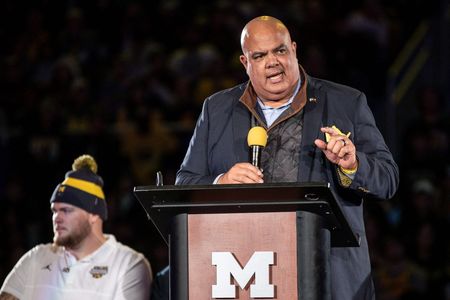
The University of Michigan confirmed Monday that Athletic Director Warde Manuel will be leaving his role at the end of the calendar year, with the school set to launch a search for his replacement.
The departure comes in the wake of two significant misconduct investigations tied to the Wolverines’ football program. Former head coach Sherrone Moore was fired in December 2025 after it was discovered he had an impermissible relationship with a female staff member, and his predecessor Jim Harbaugh was entangled in a sign-stealing controversy during the program’s 2023 national championship run.
A university spokesperson shared the news with The Detroit News, saying: “At this time, the university does not have additional public statements planned regarding these matters, nor does the university plan to release any associated documents. We can confirm, however, that Director of Athletics Warde Manuel will step down at the end of the calendar year and a search for a new AD will be conducted.”
University president Domenico Grasso announced Monday that an independent law firm, Jenner & Block LLP, had wrapped up a “culture review” of the athletic department. That review involved close to 350 interviews with 300 witnesses and an examination of more than 20,000 documents.
The school released a statement summarizing the findings: “The culture review found that weaknesses in accountability, organizational structure, oversight, and reporting created conditions in which misconduct was not always addressed consistently, promptly, or in accordance with University expectations.”
The review also noted that while Manuel showed genuine strengths — particularly in his dedication to student-athletes — he fell short when it came to acting quickly and decisively on allegations of wrongdoing by staff members within the athletic department.
Despite the controversies, Manuel’s tenure, which began in 2016, included notable athletic success. Michigan captured national championships in football in 2023, men’s basketball in the 2025-26 season, women’s gymnastics in 2021, and men’s gymnastics in 2025. Manuel, 58, had received a five-year contract extension in December 2024 worth a base salary of $1.9 million annually, a deal that was set to run through 2030.
The situation surrounding Moore was particularly serious. He was fired for cause on December 10 after being found to have maintained a long-running relationship with his then-executive assistant, Paige Shiver. On the day of his firing, Moore allegedly went to Shiver’s apartment, where she told authorities he forced his way in, grabbed two butter knives, and cornered her.
Moore was taken into custody and spent two nights behind bars. He originally faced charges of home invasion, stalking, and breaking and entering — offenses that carried potential prison sentences of up to five years.
In April, Moore was sentenced to 18 months of probation with no jail time. He was also fined more than $1,000 and prohibited from contacting Shiver or using drugs or alcohol during his probation period. The sentence came after a plea deal in which Moore entered a no-contest plea to reduced misdemeanor charges of malicious use of a telecommunications device and trespassing. Prosecutors in Washtenaw County, Michigan, then dropped the original charges, which had included third-degree felony home invasion.
On the field, Moore had compiled a 16-8 record at Michigan after taking over from Harbaugh, under whom he had served as offensive coordinator. Both coaches were caught up in the sign-stealing scandal involving former staff member Connor Stalions during the 2023 championship season. Moore ultimately received a two-game suspension as a result.
A separate scandal also loomed over the program. Former co-offensive coordinator Matt Weiss was fired on January 20, 2023, after completing his second season on Michigan’s staff. Weiss has pleaded not guilty to felony charges of aggravated identity theft and unauthorized computer access. His trial is currently scheduled for September.
Meanwhile, Harbaugh departed Michigan for the NFL’s Los Angeles Chargers, and men’s basketball coach Dusty May left following the team’s championship run to take the head coaching job with the NBA’s Dallas Mavericks in June.
LONDON — Andy Burnham wasted no time signaling his priorities as Britain’s new prime minister, telling reporters on Monday that he refuses to leave office without addressing the country’s long-standing social care crisis.
Just hours after stepping into his new Downing Street office, Burnham opened up about a deeply personal connection to the issue — his father’s struggle with Alzheimer’s disease. He pointed to a troubling pattern in which people who should be receiving social care are instead turning to an already overburdened public health system for support.
Burnham, who previously served as mayor of Greater Manchester in northwestern England, has spent years calling for an overhaul of how social care is funded and delivered. He has repeatedly argued that while politicians have stalled and delayed, countless older citizens have been forced to drain their finances and sell their homes to cover care costs.
“I think the country needs to step back here and say, ‘How have we let a situation kind of just roll on, where we know it’s a major issue, and yet no one’s got the courage to fix it?’ I just think that’s quite damning … of my generation of politicians,” Burnham said.
The new prime minister first attempted to reform social care funding during his time as health minister under Gordon Brown’s government. He said he has no intention of repeating what he described as nearly 30 years of governments avoiding the problem.
Unlike the state-funded National Health Service, social care in Britain is not provided free of charge to most residents. A long line of prime ministers has explored possible solutions — including placing a cap on out-of-pocket costs — but none have been able to build enough support for what would be a costly undertaking.
“It’s not defensible,” Burnham declared. “We need to face it and fix it.”
A federal appeals court on Monday threw out a shareholder class action lawsuit against Boeing, which accused the aerospace giant of putting profits before passenger safety and making misleading claims about its dedication to safe aircraft — all before a cabin panel blew out mid-flight on an Alaska Airlines 737 MAX 9 in January 2024.
The 4th U.S. Circuit Court of Appeals determined that shareholders, led by Rhode Island’s state treasurer, failed to present an adequate method for demonstrating how financial damages could be calculated across all members of the class.
Attorneys representing the shareholders had not responded to requests for comment at the time of publication. Boeing and its legal team also did not immediately reply to similar inquiries.
Class action lawsuits are significant because they allow groups of plaintiffs to pursue larger recoveries at a fraction of the cost of filing individual cases.
The Boeing shareholders alleged that the Arlington, Virginia-based company artificially inflated its stock price by releasing misleading statements in the aftermath of two MAX aircraft crashes — one in October 2018 and another in March 2019 — which together claimed 346 lives.
A U.S. District Judge in Alexandria, Virginia, had ruled in March 2025 that shareholders who held Boeing stock between January 7, 2021 and January 8, 2024 were eligible to pursue their claims as a unified group. With Monday’s ruling, the appeals court has returned the case to that same judge for further proceedings.
LONDON — David Lammy has departed from the United Kingdom’s government after Andy Burnham took over as prime minister, according to a Reuters report published Monday.
Lammy, who held dual roles as both Deputy Prime Minister and justice minister, shared a statement about his exit on the social media platform X.
In addition to Lammy’s departure, business minister Peter Kyle also left the government, according to a report from Sky News.
A new video profile takes a closer look at Goochland County, Virginia, where farmers are finding ways to honor long-standing agricultural traditions while also adopting innovative new methods.
The feature, produced by the Virginia Farm Bureau, highlights how the county’s farming community represents a blend of the old and the new — preserving roots in the land while looking toward the future of agriculture in the Commonwealth.
The video is available through the Virginia Farm Bureau’s YouTube channel and offers viewers an inside look at the agricultural character that defines Goochland County.
Tropical Depression Two is gradually becoming better organized over the Gulf of Mexico, according to a forecast discussion issued Monday morning by the National Hurricane Center in Miami.
Satellite images and surface observations show the storm’s low-level circulation is becoming more defined, with increased bands of thunderstorm activity forming near the center. However, data collected by an Air Force Reserve Hurricane Hunter aircraft and surface observations confirm the storm has not yet gained strength. The aircraft recorded maximum flight-level winds of 34 knots at 925 millibars, and the central pressure is around 1007 mb. Based on that data, the storm’s current intensity is set at 30 knots.
The center of the depression appears to have shifted slightly southward over the past several hours, though its overall movement remains toward the northwest at about 3 knots. Forecasters say the storm is caught between two mid-level high-pressure ridges — one to its northwest centered over the Rockies and another to its southeast near the Bahamas. As a large-scale weather trough moves into the northeastern United States, the ridge over the Rockies is expected to take over as the primary steering feature, gradually turning the storm toward the west-northwest and then westward at a slow pace.
The updated forecast track places the center near southeastern Louisiana in roughly 60 hours, then reaching southeastern Texas by the 120-hour mark. The track has been shifted slightly south compared to previous forecasts, partly due to the storm’s current position and the influence of northeasterly wind shear that may push the center a bit farther south.
The depression is currently dealing with moderate northeasterly wind shear, conditions forecasters expect to persist for another 24 to 30 hours. During that window, bursts of thunderstorm activity near and south of the center are likely to help the system strengthen into a tropical storm. After about 30 hours, the shear is forecast to increase significantly — strong enough to disrupt the storm’s vertical structure, halting intensification and causing some weakening. The peak intensity is forecast at 45 knots, expected between 36 and 48 hours from now, which is on the higher end of guidance models. Forecasters believe the system will survive through the 120-hour forecast period, though it could dissipate between 72 and 120 hours, particularly if it tracks north of the current forecast and encounters more land interaction.
Forecasters also note that the wind shear is likely to give the storm a lopsided structure, with the heaviest rainfall and strongest winds expected to occur south of the center.
Key Messages from the National Hurricane Center:
1. The depression is expected to gradually strengthen and could bring tropical storm conditions to portions of the Gulf Coast from the Florida Panhandle westward to southeastern Louisiana beginning late Monday night into Tuesday.
2. A Storm Surge Watch has been issued for the Alabama, Mississippi, and southeastern Louisiana coasts, where a life-threatening storm surge is possible.
3. Interests elsewhere in Louisiana and Texas should monitor the progress of this system, as additional watches could be required for portions of those areas later Monday or Tuesday.
4. Flash flooding will be possible through Friday along the Gulf Coast and nearby inland areas from western Florida to the middle Texas Coast, including southern portions of Alabama, Mississippi, and Louisiana.
The forecast was prepared by Forecaster Beven at the National Hurricane Center.
The National Hurricane Center in Miami released its fifth wind speed probability bulletin for Tropical Depression Two at 11:00 a.m. Eastern Daylight Time on Monday, July 20, 2026.
At the time of the report, the center of the tropical depression was located near latitude 28.5 degrees North and longitude 85.6 degrees West, with maximum sustained winds of approximately 30 knots — equal to 35 miles per hour or 55 kilometers per hour.
The bulletin provided a five-day outlook showing the probability of sustained winds reaching tropical storm force (39 mph), 50-knot force (58 mph), and hurricane force (74 mph) at specific locations along the Gulf Coast.
Among the areas with the highest cumulative probabilities of experiencing at least tropical storm-force winds over the five-day period were locations near longitude 87.0 degrees West at latitude 29.0 degrees North, where the cumulative probability reached 66 percent. Panama City, Florida, showed a cumulative probability of 14 percent, while Apalachicola, Florida, carried an 8 percent cumulative chance.
Further west, New Orleans, Louisiana, carried an 8 percent cumulative probability, and Buras, Louisiana, showed a 14 percent cumulative chance. Locations in Texas, including Galveston, showed a 7 percent cumulative probability by the end of the five-day forecast window.
The probability table covered locations stretching from Apalachicola, Florida, westward through Alabama, Mississippi, Louisiana, and into Texas, including cities such as Mobile, Gulfport, Pensacola, Baton Rouge, Lake Charles, Cameron, Port Arthur, and Galveston.
The bulletin was issued by Forecaster Beven at the National Hurricane Center.
The National Hurricane Center has issued updated wind speed probability graphics for Tropical Depression Two, the second tropical system of the Atlantic hurricane season.
The graphics display the probability of 34-knot wind speeds associated with the storm over a 120-hour forecast period. The information was last updated on Monday, July 20, 2026, at approximately 2:49 p.m. GMT.
Residents in potentially affected coastal areas are encouraged to monitor updates from the National Hurricane Center as the storm system continues to be tracked.
The National Hurricane Center has released an updated storm surge watch and warning map for Tropical Depression Two, with the most recent update posted Monday, July 20, 2026, at 14:51 UTC.
Storm surge watches and warnings indicate the potential for dangerous and life-threatening coastal flooding in areas that could be impacted by the tropical system. Residents in affected zones are urged to pay close attention to local emergency management guidance and stay informed as the storm develops.
Officials recommend that those in watch and warning areas take any necessary precautions and be prepared to act quickly if conditions worsen. Updates to the storm surge map will continue to be issued as the situation evolves.
The National Hurricane Center has issued updated graphical information for Tropical Depression Two, tracking the system’s potential wind impacts across a 120-hour forecast window.
The graphics depict the probability of 34-knot wind speeds affecting different areas as the tropical depression continues to develop. These probability maps are a key tool used by forecasters and emergency managers to assess where tropical storm-force winds may occur.
The wind speed probability graphics were last updated Monday, July 20, 2026, at 9:22 a.m. GMT. Residents in potentially affected areas are encouraged to monitor the latest updates from the National Hurricane Center as the system evolves.
The All-Star break did nothing to cool off the Boston Red Sox, who have now rattled off 13 consecutive victories heading into a highly anticipated series against another AL East team on a roll.
Boston wrapped up a sweep of first-place Tampa Bay on Sunday, pushing their streak to 13 straight wins. The franchise’s all-time record of 15 consecutive victories dates back to 1946, and the Red Sox now have a real shot at topping it this week when the Baltimore Orioles come to Fenway Park — a Baltimore squad that has itself won seven games in a row.
With the August 3 trade deadline approaching fast, teams hovering around the playoff picture may use the next week or two to decide whether to buy or sell. Boston sits at 50-48, just above the .500 mark, and currently holds the American League’s third wild card spot. Cleveland, which holds the second wild card, is only one game ahead of the Red Sox.
Seattle trails Boston by a game, and Baltimore is another game back after sweeping Houston in a three-game series. That sweep dropped the Astros to 4.5 games outside a playoff position.
Houston does have another route to October baseball, however. The Astros are actually four games out of the AL West lead — closer than they are to a wild card berth.
Detroit finds itself in a comparable situation. The Tigers are 4.5 games out of a wild card but only 6.5 games behind the AL Central-leading White Sox. How Detroit handles the trade deadline — particularly regarding star pitcher Tarik Skubal — will be closely watched around the league.
On the All-Star front, the American League defeated the National League 4-0 on Tuesday night. Cody Bellinger became the fourth New York Yankee in history to earn All-Star MVP honors. The other three? Giancarlo Stanton in 2022, Mariano Rivera in 2013, and Derek Jeter in 2000 — an award that has existed since 1962.
In other action, Colorado’s Hunter Goodman slugged three home runs in a 9-6 loss to Cincinnati on Sunday. It was his second three-homer game in less than a month — he also accomplished the feat at Minnesota on June 27. Goodman is the first player in Rockies history to hit three home runs in a single game twice in the same season.
Meanwhile, Arizona pulled off a stunning comeback against St. Louis, winning 8-7 in 10 innings despite trailing 7-0 heading into the sixth. The Cardinals surrendered two bases-loaded walks during Arizona’s three-run sixth inning. Geraldo Perdomo followed with a two-run inside-the-park home run in the seventh, and Nolan Arenado knotted the score with a two-run blast in the eighth.
St. Louis then squandered a golden opportunity in the top of the 10th. With runners on first and third and no outs, Jordan Walker hit a broken-bat flare toward shortstop Perdomo, who charged and caught the ball on the fly. Baserunner Bryan Torres, apparently anticipating the ball would drop, had strayed too far off first base and was doubled off.
Max Kepler’s hit in the bottom of the 10th sealed the victory for Arizona. According to Baseball Savant, the Diamondbacks’ win probability dipped as low as 1.5% during the sixth inning. Despite that near-miracle, Arizona’s playoff odds sit at 27.4% according to FanGraphs — and the team is just a half-game behind St. Louis for the National League’s final wild card spot.
Yemen’s Iranian-backed Houthi rebels announced Monday that they are placing an immediate maritime embargo on Saudi Arabia, citing retaliation for an ongoing blockade against Yemen and a recent strike on Sanaa International Airport. The declaration threatens yet another critical waterway for worldwide commerce and has raised alarms about a return to open conflict.
Houthi military spokesperson Yahya Saree delivered the announcement via video, calling the maritime ban effective immediately and framing it as an “equation of ‘an eye for an eye.’”
While the rebels offered limited specifics, Nasruddin Amer, the deputy head of the Houthi media office, posted on X that the Bab al-Mandeb strait would be shut down in response to what he described as Saudi Arabia’s “unjust blockade on Yemenis for over 10 years.”
The Bab al-Mandeb strait sits at the southern end of the Arabian Peninsula and serves as the entrance to the Red Sea. Approximately 12% of all global trade typically moves through the passage, and roughly a quarter of the world’s container shipping travels through the 20-mile-wide waterway on its way to or from the Suez Canal.
The Houthis previously demonstrated their capacity to disrupt traffic in the strait when they spent months attacking vessels during the Israel-Hamas conflict in Gaza, striking more than 100 ships. Whether they will carry out a similar scale of attacks against Saudi Arabia remains uncertain.
Saudi Arabia had not issued any immediate response. The kingdom is already under pressure, as it has been routing crude oil exports through its East-West Pipeline to the Red Sea as an alternative to the Strait of Hormuz — a route that Iran has controlled since the U.S. and Israel struck Iran on February 28. Saudi Arabia has been moving millions of barrels of oil per day through that pipeline.
Saudi Arabia heads a coalition that has been fighting the Houthis and imposed an air and sea blockade on Yemen starting in 2015. The conflict traces back to 2014, when the Houthi rebels captured the capital city of Sanaa and large portions of northern Yemen, driving the government out of the country. A ceasefire was established in 2022.
That truce has come under strain in recent days after the Houthis accused Saudi forces of attacking Sanaa airport in an attempt to intercept a flight carrying Houthi leaders returning from Iran, where they had attended the funeral of Supreme Leader Ayatollah Ali Khamenei. The plane diverted and landed safely at a different airport.
In response, the Houthis launched missiles and drones at Saudi Arabia’s Abha International Airport, marking the most significant clash between the two sides in years.
By permitting a direct international flight to land without clearance from the Saudi-led coalition, the Houthis were attempting to establish a new precedent giving them independent authority over Yemen’s airspace, according to experts who spoke with the AP.
Saree reinforced the group’s position Monday, stating: “We affirm the right of our great people to respond to the blockade with a blockade,” and warning that the Houthis are ready to meet “any foolish act committed by the reckless Saudi enemy … with a comprehensive and decisive escalation.”
The Houthis are considered a key component of Iran’s so-called “Axis of Resistance,” a network that also includes armed factions in Lebanon, Iraq, and the Palestinian territories.
Although the rebels have maintained a large arsenal of drones, several Houthi members previously told the AP — speaking anonymously because they were not authorized to speak to media — that supplies have been running low following the months of attacks during the Israel-Hamas war. The conflict involving Iran has further disrupted the flow of weapons to the group.
Earlier, the United States and Israel responded to Houthi attacks on shipping with an extensive air campaign targeting Houthi-controlled areas in Yemen, which ultimately led to a deal in which the rebels halted their assaults.
Any closure of the Bab al-Mandeb strait would force shipping companies to redirect vessels around the Cape of Good Hope at the southern tip of Africa, significantly driving up transportation costs worldwide.
BUDAPEST, Hungary — Hungary’s government announced Monday it is launching a formal investigation into a large investment deal with Chinese electric vehicle giant BYD, following the resignation of the former foreign minister who helped negotiate it — a man who last week left parliament to take an executive position at the automaker.
The announcement that Péter Szijjártó would be joining BYD, the world’s leading electric carmaker, set off a firestorm of conflict-of-interest accusations. Critics pointed to his role in steering significant government subsidies toward the company while he was still serving in office.
Prime Minister Péter Magyar addressed lawmakers Monday, saying Szijjártó — a close ally of former Prime Minister Viktor Orbán — had assisted BYD during his time in government “with hundreds of billions (of forints) in public money, diplomatic support and state infrastructure.”
“We will examine all the decisions, negotiations and state commitments made by Péter Szijjártó that were related to the BYD Hungary investment,” Magyar stated Monday.
Magyar said the scope of the investigation would extend beyond BYD, covering all subsidies, tax breaks, permits, environmental exemptions, and publicly funded investments granted to large multinational companies throughout Orbán’s time in power.
“We will investigate who made these decisions, who prepared them, what professional warnings were ignored, and how much burden they left on Hungarian taxpayers, workers, local communities and the environment,” Magyar said.
Neither Szijjártó nor BYD have offered any response to the conflict-of-interest allegations. The former foreign minister has described his new role as a “prestigious” chance to work for one of the “greatest success stories” in the global auto industry.
Throughout his time in government, Szijjártó played a central role in drawing Chinese investment into Hungary, including from BYD — the very company that has now hired him. BYD received substantial state support while he was in office.
Back in 2023, Szijjártó announced that BYD would build its first European manufacturing plant in Hungary, a move that allowed the company to sidestep European Union tariffs on Chinese-made electric vehicles — tariffs designed to shield Europe’s homegrown auto industry.
Then in 2025, Szijjártó announced that BYD would establish its European headquarters and a research and development center in Budapest, along with receiving 20 billion forints — roughly $63.7 million — in government support.
These deals were part of a broader strategy under the Orbán administration to position Hungary as a global center for lithium-ion battery production, primarily by recruiting Chinese battery manufacturers to open facilities across the country.
The push drew backlash from local residents, environmental advocates, and opposition politicians, who warned the industrial expansion would worsen existing environmental issues, strain Hungary’s water resources, and deepen the country’s economic dependence on China.
Szijjártó’s record as foreign minister also included maintaining unusually close ties with Russia, even after its full-scale invasion of Ukraine on February 24, 2022. Unlike nearly all of his European Union counterparts, he made repeated trips to Moscow to negotiate oil and gas purchasing agreements and to meet with Russian Foreign Minister Sergey Lavrov, whom he openly referred to as his “friend.”
He became embroiled in further controversy during Hungary’s 2026 election campaign when the Washington Post reported that he regularly called Lavrov during high-level EU meetings, providing “live reports on what’s been discussed.”
Szijjártó has rejected the report, though he acknowledged that he did speak with Lavrov before and after EU foreign minister meetings to discuss their agenda and outcomes.
At a government press conference last week, Magyar said that “as far as I know,” an investigation had already been opened into Szijjártó’s alleged ties to the Russian government.
Search and rescue teams pressed on Monday in Guyana, working to locate survivors after a ferry believed to have been carrying far more passengers than permitted capsized over the weekend. Adding to the grim situation, the government confirmed that at least 35 of the 67 people pulled from the water were never listed on the official passenger manifest.
Prime Minister Mark Phillips told reporters late Sunday that hopes of finding additional survivors are dimming. Officials believe the vessel was carrying significantly more than the documented 116 passengers and 17 crew members when it went down. Only two bodies have been recovered so far.
Phillips also disclosed that the rescued captain and at least one other crew member tested positive for marijuana. Both remain in police custody as a criminal investigation moves forward.
The vessel, identified as the MV Barima, capsized off the Essequibo coast late Saturday. It had been traveling from the capital, Georgetown, to Port Kaituma in northwestern Guyana, near the Venezuelan border.
The prime minister announced that the government is conducting an urgent and wide-ranging investigation into the accuracy of the passenger manifest, how cargo was loaded, whether safety regulations were followed, and the behavior of the captain and crew before departure.
“Let me be absolutely clear: Where negligence, misconduct or criminal wrongdoing is established, those responsible will face the full force of the law,” Phillips stated. “There will be no exceptions and no tolerance for actions that placed innocent lives at risk.”
Public Works Minister Juan Edghill described the incident as the worst marine disaster the country has seen in decades and expressed deep concern over the latest findings.
“We have a zero tolerance for members of the crew drinking or smoking while at work. And for us to have positive tests from the captain, this is serious,” Edghill said. “People’s lives are at risk, and those matters will be dealt with.”
Edghill also acknowledged that authorities cannot determine exactly how many people were on board because the manifest is unreliable.
“Nobody for the want of a few extra dollars can cheat a system and compromise the entire search-and-rescue operation,” he said. “To be confronted with a reality that despite an official manifest given to us, persons who were rescued were not manifested, that is a criminal action.”
The problem of unlisted passengers is not new. For years, travelers have complained that ferry clerks quietly sell extra seats to friends and associates for cash without recording them on the official manifest — a practice that has reportedly been going on for decades at government-run piers.
Ferries and boats serve as critical transportation in Guyana, a heavily forested nation with limited road infrastructure in its interior regions. Many residents rely on water travel because shipping cargo by ferry is considerably cheaper than using domestic airlines, which also offer daily service to inland communities.
Multiple passengers took to social media to report that water had been leaking into the cargo hold as the MV Barima made its way along the North Atlantic coast during what would become its final voyage.
The vessel was built more than 80 years ago. It last underwent major repairs when it was dry docked in 2024, and additional significant maintenance had been scheduled for October.
Delaware’s Department of Natural Resources and Environmental Control is calling on residents to sign up for the 39th annual Delaware Coastal Cleanup, taking place on Saturday, September 19.
Volunteer registration is already open, and organizers are hoping to fill spots at more than 40 cleanup sites located throughout the state.
This long-running annual event brings together community members each year to help preserve Delaware’s coastal areas and waterways.
DUBLIN — The Irish government announced Monday it is tightening the rules around electric scooters, stopping short of an outright ban but putting new restrictions in place after a troubling surge in serious accidents — particularly involving children.
Under the new measures, riders must be at least 18 years old, up from the previous minimum age of 16. They will also be required to hold a license and wear a helmet. Additionally, high-visibility jackets will be mandatory, and the sale of e-scooters capable of exceeding the legal speed cap of 20 kilometres per hour — roughly 12.4 miles per hour — will be prohibited.
The crackdown comes as Ireland joins several other European nations and cities that have moved to rein in the growing popularity of e-scooters amid rising injury rates. According to Children’s Health Ireland, which oversees all national pediatric services in the country, hospital admissions of children and young people for traumatic brain injuries linked to e-scooter accidents have jumped 50% over the past year. The organization estimates that between one and two children are showing up in emergency rooms every day this summer with e-scooter-related injuries.
Ireland’s Prime Minister had told lawmakers last week that he was leaning toward an outright ban on the devices. The head of the Irish police force voiced strong support for that idea, noting that e-scooters were also being used to assist drug dealing and, in his words, “terrorise” local communities.
While Monday’s announcement fell short of a total ban, the government made clear that option has not been ruled out. Officials said the situation will continue to be monitored.
A consultant in intensive care medicine at one of Dublin’s major children’s hospitals weighed in on the new rules, saying enforcement would be the deciding factor in whether they work. “I would certainly like to see that it would be reviewed after a period of months and if we still don’t have a fall off in injuries, I think some consideration is going to have to be given to an outright ban,” she told national broadcaster RTE.
Authorities have made an arrest following an incident in which an incendiary device was thrown at FBI headquarters in lower Manhattan, CNN reported Monday.
Video footage obtained by the network showed a suspect being taken into custody, with smoke visible rising from the area surrounding the building.
The FBI’s New York offices are located at 26 Federal Plaza, a building that also serves as a field office for Immigration and Customs Enforcement. The facility sits just a short distance from City Hall and several federal courthouses.
Google is working on a new type of server chip that would have elements of its Gemini artificial intelligence model built directly into the hardware itself, according to a report from the Information published Monday, which cited sources with knowledge of the project.
The chip, which has been informally nicknamed “Frozen v2” inside the company, is being developed by Google’s parent company, Alphabet. According to the report, the chip is intended to help solve a serious AI computing capacity shortage — a problem that has caused internal tensions and led Google Cloud to turn away potential deals with outside customers.
Alphabet’s stock climbed 3% in early trading following the report.
Here are the key details from the report:
Google is targeting a deployment date as early as 2028 for the new chip, though engineers are still working out the final design and determining how much model data will be permanently embedded into the hardware.
The chip could deliver between six and ten times the efficiency of Google’s most current custom AI chips, measured by the number of AI tokens processed per unit of energy consumed.
The “Frozen” project is focused on building an entirely new line of in-house chips that would exist alongside Google’s existing tensor processing units, known as TPUs — not replace them.
Google had not responded to a request for comment at the time of the report.
Separately, Bloomberg News reported last week that Google pushed back the launch of its newest Gemini AI model after it failed to meet the company’s internal performance targets. The company is said to be working on improvements, with a particular focus on the model’s coding abilities.
Goldey-Beacom’s cross country program has released its schedule for the 2026 season, giving fans and supporters an early look at what lies ahead for the team.
The program has built a strong reputation for delivering impressive results on the cross country circuit, and the release of the new schedule signals that the team is ready to keep that momentum going into the 2026 campaign.
EAST RUTHERFORD, N.J. — Spain captured the FIFA World Cup championship with a 1-0 victory over defending champion Argentina, with substitute Ferran Torres delivering the decisive blow in the 106th minute. Spain controlled the match throughout in terms of possession and scoring chances, but Lionel Messi and Argentina managed to hold on through regulation and into extra time. In the opening moments of the second 15-minute extra time period, Torres pounced on a bouncing ball inside the penalty area and drove a left-footed shot just beneath the crossbar and into the net to seal the title.
What to Watch Now That the World Cup Is Over
The World Cup may have wrapped up, but soccer fans won’t have to wait long for their next fix. Within weeks, many of the tournament’s top players will return to their club teams in competitions like England’s Premier League, Spain’s La Liga, and Germany’s Bundesliga. Europe’s elite clubs will also compete in the Champions League, considered the pinnacle of club soccer. In the meantime, MLS and Mexico’s Liga MX are already underway, offering fans year-round action and a chance to continue following their favorite World Cup stars.
Spain’s Champions Return Home to Royal Welcome and Madrid Parade
MADRID — Spain’s World Cup-winning squad was set to arrive back in Spain on Monday afternoon, where a celebration awaited them. The 11-man team was scheduled to be received at the Spanish royal palace and by Prime Minister Pedro Sánchez before making their way through central Madrid in a victory parade. Fans were expected to line the streets as the team traveled from Moncloa Palace to Cibeles Square. Spain secured the championship on Sunday by defeating Argentina 1-0 in New Jersey — the country’s second World Cup title, following their 2010 triumph in South Africa. Thousands flooded the streets of Madrid in celebration, though the festivities were tragically overshadowed by the death of a 13-year-old in Salamanca during the revelry.
Post-Match Scuffles Mar Spain’s World Cup Celebration
EAST RUTHERFORD, N.J. — The joy of Spain’s World Cup victory was briefly clouded by on-field confrontations between players after the final whistle. Video footage captured several players involved in a physical altercation, with Argentina defender Leandro Paredes seen appearing to grab Spain’s Eric Garcia by the throat. When Spain substitute Gavi stepped in to intervene, Paredes shoved him to the ground. Other players and Argentina head coach Lionel Scaloni moved in quickly to calm the situation. It remained unclear whether any of the players involved would face disciplinary action. Spain had won Sunday’s final 1-0 after extra time.
Michigan Athletic Director Warde Manuel to Step Down After Buyout Agreement
ANN ARBOR, Mich. — The University of Michigan and athletic director Warde Manuel have reached a buyout agreement, with Manuel set to leave his position at the end of the year. The departure ends a decade-long tenure that included four national championships but also a series of controversies. The university cited ongoing investigations into former football coach Sherrone Moore’s relationship with his executive assistant, as well as a broader inquiry into the athletic department’s culture, as factors in the decision. Under Manuel’s leadership, the department celebrated a men’s basketball national title this year and a football championship in 2023.
Ryan Fox Claims British Open Title at Royal Birkdale
SOUTHPORT, England — Ryan Fox took an unlikely path to becoming a major champion, having not turned professional until his 20s and nearly walking away from the sport early in his career. That journey made his British Open victory all the more meaningful. Fox drained a 12-foot birdie putt on the final hole to edge Cameron Young by a single stroke at Royal Birkdale. The win came on a dramatic day that saw four different players share the lead at various points, with Scottie Scheffler and Tommy Fleetwood also in the mix. Fox is now the oldest first-time major champion in a decade.
Red Sox Ride 13-Game Win Streak Into Series with Streaking Orioles
The All-Star break did nothing to interrupt the Boston Red Sox’s hot stretch. After completing a sweep of division-leading Tampa Bay on Sunday, the Red Sox have now won 13 consecutive games. The franchise record stands at 15 straight victories, set back in 1946. Boston will have a chance to chase that mark this week when the Baltimore Orioles come to Fenway Park — a team that arrives riding a seven-game winning streak of their own, setting the stage for a compelling AL East showdown.
Ohtani’s Knee Issue Keeps Him Off the Mound for Dodgers
NEW YORK — Los Angeles Dodgers two-way star Shohei Ohtani will not take his next scheduled turn as a starting pitcher due to irritation in his left knee, and there is no clear timetable for his return to the rotation. Ohtani received a lubricant injection in the knee just before last week’s All-Star break and had been expected to pitch Wednesday against Philadelphia. However, he still did not feel fully healthy while playing catch over the weekend, leading him and the team to hold off on any mound activity. Ohtani has not pitched since July 3. Dodgers manager Dave Roberts noted that Ohtani experiences no pain in the knee when batting.
Jazz Chisholm Jr. Homer Lifts Yankees Over Dodgers to Split Doubleheader
NEW YORK — Jazz Chisholm Jr. launched a go-ahead home run in the eighth inning as the New York Yankees beat the Los Angeles Dodgers 2-1 in the nightcap of a doubleheader, splitting the twin bill. Five Yankees pitchers combined to limit the Dodgers to four hits. Cody Bellinger had contributed an early RBI single for New York, which had won just once in its previous 11 home games. The victory prevented a three-game sweep by the Dodgers, who were making their first trip to the Bronx since winning the 2024 World Series. In the opener, the Dodgers cruised to an 8-2 win behind Yoshinobu Yamamoto, who threw a complete-game four-hitter — his first in 66 major league regular-season starts.
Logano Snaps Drought with Win at North Wilkesboro
NORTH WILKESBORO, N.C. — Joey Logano held off Denny Hamlin to claim his first NASCAR Cup Series win of the season Sunday night, triumphing in the first points race held at North Wilkesboro Speedway in 30 years. The victory was Logano’s 38th in Cup Series competition and ended a personal 45-race winless stretch dating back to May 2025 at Texas Motor Speedway. At 36 years old, Logano extended his streak of winning at least one race per season to 15 consecutive years — the longest active streak in the sport. The all-time record belongs to the late Kyle Busch, who won in 19 straight seasons from 2005 through 2023. Hamlin crossed the line in second, followed by Chase Briscoe, Ty Gibbs, and Shane Van Gisbergen.
Video spreading across social media appears to capture the moment Iranian missiles slammed into a Jordanian airbase, killing two U.S. service members. A third American remains unaccounted for following the Friday attack. A separate U.S. service member also lost their life in Iraq on Saturday, underscoring the deadly dangers troops face even without a direct deployment into Iran.
The U.S. military’s Central Command announced Monday that its strikes focused on Iranian military command centers, air defense installations, coastal surveillance sites, maritime assets, missile and drone launch locations, and communications infrastructure.
Iranian officials reported Sunday that at least 50 people have died and 517 others were injured in the most recent rounds of American strikes. Since the conflict began on February 28, a total of 17 U.S. service members have been killed.
According to the military, the service member who died in Iraq on Saturday was killed during what was described as a “controlled detonation” of a downed Iranian drone.
President Trump addressed the ongoing military action, saying, “We hit them very hard again tonight. And we did that in honor” of the fallen soldiers.
Reports indicate that U.S.-led strikes hit Iran’s Darkhovin nuclear facility — currently under construction — for the eighth night in a row. At least three missiles reportedly struck the site, drawing sharp condemnation from Tehran’s Atomic Energy Organization, which insists the facility is intended for peaceful purposes.
While the United States has not officially acknowledged the Darkhovin strike, the military action follows the deaths of the two American service members. Regional allies may also be participating in the strikes, responding to earlier Iranian drone and missile attacks on Kuwait, Bahrain, and Jordan. The situation represents a major escalation in an already volatile region.
Among the key developments: the Darkhovin nuclear power plant, still under construction, has been identified as the target. Tehran has condemned the strikes as a violation of international law, while the U.S. views the facility as a legitimate military objective. Gulf nations including Kuwait and Bahrain may be involved following Iranian attacks on their own soil.
As Monday’s strikes got underway, a ship caught fire in the Strait of Hormuz after being struck by a projectile near the Omani coastline, according to the British military’s United Kingdom Maritime Trade Operations center. The crew was forced to abandon ship, and the vessel remained adrift and burning hours after the initial strike.
The route skirting Oman is the same path the U.S. military has urged commercial ships to use to steer clear of Iranian-controlled waters. Iran’s Revolutionary Guard later claimed it was targeting tankers in the strait.
Earlier Monday, the United States launched another round of airstrikes on Iran — this time near a northwestern city believed to house underground missile bases — following the announcement of another American death. Iran retaliated by striking Bahrain, where the U.S. Navy’s 5th Fleet is based, as well as Kuwait.
On the economic front, benchmark Brent crude oil climbed above $90 per barrel Monday, deepening a global energy crisis tied to the ongoing conflict. The average price of a gallon of regular gasoline in the United States reached $4, adding financial strain on American households ahead of this fall’s midterm elections.
A new study from Pew Research has found a notable connection between political engagement and religious involvement among Americans.
According to the findings, the most politically active segment of the population is also the most religiously active. This group represents just 9% of all Americans, yet they stand out across multiple measures of civic and community participation — including volunteering, attending local government meetings, donating to political causes, and closely following the news. They are also more likely than any other group to regularly attend religious services.
The study also identified a second distinct group, representing 28% of the U.S. population, that is highly active in religious life but does not share the same level of political involvement.
An Egyptian court has handed down a five-year hard labor sentence to a man named Augustinos Saman after he posted videos on YouTube comparing the beliefs of Christianity and Islam.
The conviction brings renewed attention to the struggles faced by Christians living in Egypt, where followers of the faith account for roughly 10 percent of the country’s population.
Although Egypt does not typically appear among the most extreme violators of religious freedom on international watch lists, the country nonetheless enforces limitations on the religious expression and free speech of those who are not Muslim.
The Maryland State Board of Veterinary Medical Examiners is set to convene on July 23rd, 2026, beginning at 10:30 in the morning. The session will take place at the Maryland Department of Agriculture.
Board members are expected to address a range of topics during the meeting. Items on the agenda include general board business, license approvals, sanitation reports, and continuing education approval requests.
Additionally, the board will review general inquiries that have been submitted to the board, as well as discuss guidance related to Responsible Veterinarian duties.
Those seeking additional information are encouraged to reach out to the board directly for details.
Around the world, people are being killed, beaten, and imprisoned for what they believe — but a growing number are also being forced to flee their homes entirely because of their faith.
The Pew Research Center has been tracking how many people are displaced due to religious persecution, and the numbers are alarming. In 2023, residents in 58 different countries were driven from their homes because of their religious beliefs.
The crisis was most severe in the Middle East and North Africa, where 60% of countries in the region reported some level of faith-based displacement. The Asia-Pacific region was also heavily affected, with 44% of countries there experiencing similar displacement.
Delaware State Police have released the name of the young person killed in a deadly two-vehicle crash that took place Saturday night in Newark. The victim has been identified as 17-year-old Bryan Flores, a resident of Bear, Delaware.
The Troop 2 Collision Reconstruction Unit is leading the ongoing investigation into the crash. Authorities are urging anyone who saw the collision or has any related video footage to reach out to Sergeant J. Jefferson at (302) 365-8484. Tips can also be submitted through a private Facebook message to the Delaware State Police or by contacting Delaware Crime Stoppers at (800) 847-3333.
Anyone who has been affected by this tragedy or needs support is encouraged to contact the Delaware State Police Victim Services Unit and the Delaware Victim Center. Their toll-free hotline, 1-800-VICTIM-1 (1-800-842-8461), is available around the clock, 24 hours a day. You may also reach the Victim Services Unit by email at [email protected].
PINGTUNG, Taiwan — Experts bowed their heads in a show of respect Monday before beginning an excavation in southern Taiwan aimed at recovering the remains of Japanese soldiers from the Second World War.
The dig is connected to the 1944 sinking of a Japanese military transport ship and other vessels in the Bashi Channel, after they came under attack by American forces. Historian and recovery activist Kazuko Tachi says more than 4,700 soldiers and crew members lost their lives in the attack, while only 65 managed to survive.
At the time, Taiwan was a Japanese colony. The self-governing island, which China claims as its own territory, remained under Japanese rule from 1895 until the war’s end.
“It is believed that many bodies from the sunken vessel reached this shore,” said Tatsuaki Inoue, speaking on behalf of the Japan Association for the Recovery and Repatriation of War Casualties.
The excavation is taking place in Hengchun Township and is expected to last approximately one week. Should any remains believed to be Japanese be discovered and yield usable DNA samples, they would be transported to Japan during a future mission.
Japan passed a law in 2016 to speed up the recovery of war remains — an initiative that has since been extended through 2030 and now includes broader DNA testing capabilities.
According to official Japanese records, roughly 41,900 soldiers who fought for Japan during World War II died in Taiwan. Of those, approximately 26,300 bodies have been recovered, leaving around 15,600 still unaccounted for.
The most recent excavation in Taiwan prior to this one took place in 1975, when 242 bodies were recovered.
“We feel very sorry that we kept them waiting for such a long time,” Inoue said. “But on the other hand, we are very happy that we came to be able to excavate in search of their remains.”
Historians, local residents, and Japanese volunteers living in Taiwan spent years conducting interviews and gathering historical records to piece together what may have happened to those whose bodies washed ashore.
Their research suggests the remains may have been collected by local residents and placed together in a rocky coastal area near the discharge outlet of Taiwan’s Third Nuclear Power Plant, where they may still be located.
Across the broader scope of World War II, more than 2.4 million Japanese soldiers died overseas. The remains of roughly 1 million of them have never been recovered.
In response to public pressure, the Japanese government carried out three separate recovery efforts between the 1950s and the 1970s, according to Akira Nishimura, a professor of religious studies at the University of Tokyo.
“For bereaved families who have not received the remains of their loved ones, the lack of certainty regarding where and how their relatives met their end — and the feeling that they were unable to give them a proper sendoff — is likely one of the main reasons why the recovery of remains continues even 80 years later,” Nishimura said.
He also noted that religious organizations and volunteers have been essential in recovering remains and conducting memorial services, providing comfort to grieving families while keeping alive the memory of those who never came home.
In Pingtung, where Monday’s excavation got underway, two sites stand in honor of Japan’s war dead.
A monument dedicated to Japanese service members who perished in the war stands next to Chaoyin Temple, which bears an inscription reading: “We pray for the peace of all humanity in the world.”
The temple itself is dedicated to those who died in the Bashi Channel during the conflict. Inside, a Japanese flag stands beside a statue of the Buddhist Bodhisattva Ksitigarbha, a figure believed to guide and protect the souls of the deceased.
Beatrice Trefalt, an associate professor of Japanese studies at Monash University in Australia, noted that Japan’s wartime losses were distinctive in that a large number of soldiers and sailors perished at sea, making their remains impossible to recover.
“Because of the enormous amount of uncertainty about who died or not, or how, the search for remains has been a constant in postwar Japanese history,” Trefalt said.
She added that many families feel the government bears a responsibility to acknowledge those who were conscripted and died during the war.
Tachi said she only learned about the fate of the Japanese soldiers who died in the Bashi Channel after relocating to Taiwan. After local residents shared that history with her, she chose to become involved in the effort to recover their remains.
“Those Taiwanese uncles taught me the importance of holding a memorial service for the war dead,” Tachi said. “It’s been more than 80 years since the war ended but I believe it is important to pray for the war dead, which I will keep on doing.”
On a bustling Rhode Island beach filled with the sounds of seabirds, a team of biologists quietly closed in on two young American oystercatcher chicks — only to find themselves on an unexpected chase across the shoreline.
One of the football-sized birds, sporting a vivid orange bill and long legs, darted into a nearby coastal salt pond. The other briefly took flight, sending the researchers sprinting more than a mile and a half down the beach to catch up.
“There is a problem. They can fly,” said Alan Kneidel, a senior conservation biologist with the environmental group Manomet Conservation Sciences, watching the pursuit unfold.
U.S. Fish and Wildlife Service biologists eventually caught both birds, wrapping them in white pillowcases and carefully transporting them to a sand dune. There, scientists recorded body measurements and attached identification bands to the birds’ long, peach-colored legs.
The banding took place at the 787-acre Trustom Pond National Wildlife Refuge in South Kingstown, Rhode Island, and is part of a broader nationwide campaign to restore oystercatcher populations along the coasts of the Americas. The species was nearly wiped out across New England by the early 1900s due to hunting and the collection of their eggs — but their numbers are now on the rise.
Over the course of a decade, roughly $10 million was raised and 35 coastal organizations across 16 states joined the recovery effort. A significant portion of the campaign centered on raising public awareness about these distinctive birds, recognized by their piercing calls and their knack for prying open oysters and mussels with razor-sharp bills. Steps were also taken to shield their ground-level nesting sites — found on beaches, sand dunes, salt marshes, and tide wrack deposits — from predators and off-leash pets.
Between 2008 and 2023, oystercatcher populations climbed 45% along the Atlantic and Gulf coasts. That rebound carries extra weight given that a 2023 study found most shorebird species across North America are in decline.
“It’s amazing and it’s a great conservation success story,” said Maureen Durkin, a federal wildlife biologist who led the banding effort and is based at the Rhode Island National Wildlife Refuge Complex.
“It does really demonstrate how much you can accomplish when there is a dedicated group of partners that can come together and identify the needs of the species and implement conservation actions,” she said, noting that protecting at-risk species “is not easy and takes a sustained and committed effort.”
Kneidel explained that a turning point in the conservation plan came when researchers identified that “chick survival was the big thing driving the declines.” From there, organizations within the American Oystercatcher Working Group — led by Manomet’s Shiloh Schulte, a conservation biologist and field scientist who died last year in a helicopter crash in Alaska while working to protect shorebirds — developed site-specific strategies. Schulte’s early aerial surveys had revealed double-digit population declines.
“At one site, it might be recreational disturbance, at another site it might be predators, at another site it might be sea level rise or loss of dune structure that’s causing overwash events that are causing nest failure,” Kneidel said while walking along rocky Moonstone Beach, as least terns called out overhead.
On Martha’s Vineyard, a seasonal low fence with chicken wire has been installed at the entrance to a key breeding area, successfully keeping egg-eating skunks and raccoons off the beach. Informational signs have also been posted to help educate visitors about the birds. Oystercatchers there have also benefited indirectly from federal protections extended to the piping plover, a threatened shorebird that shares nesting territory. During plover nesting season, vehicle access and dogs are restricted or banned near those sites.
“With a little bit of focused effort and attention on this really charismatic bird, you can teach the public how to share the shore,” said Luanne Johnson, a wildlife biologist who founded the nonprofit BiodiversityWorks, one of the groups involved in the recovery. Martha’s Vineyard was the first location in Massachusetts to see nesting oystercatchers return, and the number of breeding pairs there has risen 77% since 2009.
In South Carolina, close to 30 breeding sites have been roped off to safeguard nesting habitat. Georgia and North Carolina have adopted similar measures, and both states also trap and euthanize predators such as foxes, raccoons, and coyotes during breeding season.
“If you focus conservation efforts on a species, especially before it becomes endangered to the point that you’re considering listing, you can actually sort of head off trouble at the pass,” said Lindsay Addison, a coastal biologist with Audubon North Carolina. She noted the state’s breeding pairs have grown nearly 20%, reaching 403. Some individual birds, including ones banded as far back as 2004 and known by designations like Dark Green 06 and Yellow 25, have become minor celebrities among bird enthusiasts.
Ted Simons, a retired emeritus professor at North Carolina State University who began researching oystercatchers on North Carolina’s Outer Banks in 1995, called the recovery a reflection of the species’ resilience. He noted that American oystercatchers have been documented nesting on rooftops in the U.S., while related species in Europe have taken to nesting in farm pastures and feeding on worms. One pair was even discovered nesting in a pothole at a bus station in Iceland.
“If these were really highly specialized birds that needed an exact prescription for survival, that would have been harder,” Simons said. “But what we found is that these birds are incredibly adaptive.”
Despite the encouraging rebound, significant threats remain.
Rising seas and coastal erosion driven by climate change continue to wash out oystercatcher nests. In response, some states like Georgia have constructed elevated nesting platforms made from oyster shells and used dredged material from shipping channels to build and maintain nesting islands. Along North Carolina’s Cape Fear River, Audubon is restoring shell rakes — beds of old oyster shells that serve as nesting grounds for the birds.
“Climate change, sea level rise, it’s a big challenge not only for oystercatchers but for all kinds of interests on the coast,” Addison said. “There’s going to be loss of habitat due to sea level rise so we have to make sure that we do what we can to provide the habitat that we can so they can get through this next bottleneck.”
Conservationists are also alarmed by recent changes to the Endangered Species Act that took effect this month. Environmental groups filed a lawsuit to block the changes, fearing that nesting sites could be disrupted by vehicle traffic or unchecked development — particularly in states with limited local protections. The revisions would permit oil and gas drilling, mining, logging, and other development activities in critical wildlife habitats, as long as the animals themselves are not directly killed or harmed. Environmentalists warn that opening habitats to such activities could push some species toward extinction.
“It’s a direct attack on the protections that have allowed many of these shorebird species to recover,” Kneidel said.
Video spreading across social media appears to capture the moment Iranian missiles struck a military airbase in Jordan, claiming the lives of two U.S. service members. A third American remains unaccounted for following the Friday attack. A separate U.S. service member was also killed in Iraq on Saturday, underscoring the deadly dangers facing troops even outside of direct combat with Iran.
The escalating conflict is hitting American consumers at the pump, with the national average for a gallon of regular gasoline climbing back to $4. Global oil benchmark Brent crude also surged past $90 a barrel Monday, deepening an energy crisis tied to the ongoing fighting.
The U.S. military’s Central Command announced that Monday’s airstrikes took aim at what it described as “Iranian military command centers, air defense and coastal surveillance sites, maritime capabilities, missile and drone launch sites and communications networks.”
Iranian officials reported Sunday that at least 50 people were killed and 517 others wounded in the most recent wave of American strikes. Since the war began on February 28, a total of 17 U.S. service members have lost their lives.
Military officials said the latest American fatality in Iraq occurred Saturday during what was described as a “controlled detonation” of an Iranian drone that had been shot down.
“We hit them very hard again tonight,” Trump said. “And we did that in honor” of the soldiers who were killed.
As the new strikes got underway early Monday, a ship burst into flames in the Strait of Hormuz after being struck by a projectile near the coast of Oman, according to the British military’s United Kingdom Maritime Trade Operations center. The crew was forced to abandon the burning vessel, which remained adrift and on fire hours later, the UKMTO reported.
The route skirting Oman is one the U.S. military has been urging commercial ships to use to steer clear of Iranian-controlled waters. Iran’s Revolutionary Guard later claimed responsibility for targeting tankers in the strait.
Early Monday, the United States launched a fresh round of airstrikes against Iran, focusing on an area near a northwestern city thought to house underground missile facilities. Iran retaliated by striking Bahrain — headquarters of the U.S. Navy’s 5th Fleet — as well as Kuwait.
The two nations have been edging steadily toward full-scale war. A temporary agreement reached last month that was intended to bring a permanent end to the fighting has since collapsed. Shipping through the Strait of Hormuz has ground nearly to a halt, and both sides have struck civilian infrastructure that millions of people depend on daily. The economic fallout is being felt by American families, with fuel prices adding new financial strain heading into the fall midterm elections.
On the edge of Rome, a major redevelopment effort funded by the European Union is working to improve daily life for approximately 4,500 residents of a 1970s housing complex — and the driving force behind the project is climate change.
The site, known as Corviale and nicknamed ‘Il Serpentone,’ or ‘The Big Snake,’ because of its long, winding Brutalist architectural design, has for decades been associated with neglect and deterioration. Now, as part of Italy’s post-pandemic recovery plan nearing its finish line, the district is being used as a model for how cities can adapt to a warming climate in their most vulnerable neighborhoods.
Giuseppe Battaglia, Rome’s councillor for the peripheries and the city’s recovery programme, explained the urgency behind the effort. “We are working to combat climate change, which is transforming a city with a Mediterranean climate into one with an objectively tropical climate,” he said.
Rome’s most recent Climate Monitoring Report underscores his point. In 2025, the city recorded more than 40 days with temperatures exceeding 35 degrees Celsius (95 degrees Fahrenheit) and 101 so-called tropical nights — evenings when the temperature never dropped below 20 degrees Celsius. The year ranked as Rome’s third hottest since 1991, trailing only 2024 and 2022.
The €58 million investment in Corviale covers a wide range of improvements, including the renovation of public squares, an open-air theatre, and public buildings upgraded for better energy efficiency — all designed to remain comfortable even during the most intense summer heat.
One standout example is the neighborhood library, which has been converted into what municipality architect Alessia Peghini describes as a “bioclimatic shelter.” The building uses recyclable materials engineered to block heat from entering. During a visit in mid-July, reporters found the indoor temperature was more than 10 degrees Celsius cooler than the air outside.
“A bench placed in the shade, or a new tree that will provide more shade make all the difference in an area where there used to be nothing,” Peghini said.
Green space has also been a priority. A reclaimed West Park, previously marred by illegal dumping, is being replanted with up to 9,500 trees and shrubs to reconnect the neighborhood with the surrounding countryside. An East Park is being developed as a space for recreation and sports. The overall focus of the work is on shared, communal spaces rather than individual apartments.
The bulk of the Corviale renovation was completed ahead of Italy’s June 30 deadline for spending from its €195 billion pandemic recovery package. Some outdoor amenities and green infrastructure are expected to be finished by the end of August.
For Alessandro Fornaci, a master craftsman who has lived in the area for many years, the changes can’t come soon enough. His printmaking studio, which also runs programs for local youth, is set to relocate to new space near the restored amphitheatre. “It was a shame to see facilities intended for public use in a state of total neglect,” he said. “Creating a mechanism that can encourage interaction and citizen participation is essential.”
Still, not all residents share his enthusiasm. Some fear the neighborhood, located southwest of Rome’s city center, will eventually slip back into disrepair as other ambitious plans have before. Massimo Vallati, a resident who founded Calciosociale — an educational initiative that combines soccer with social inclusion — acknowledged the widespread doubt. “There is a great deal of scepticism, but that is only right, because for so many years nothing was done,” he said.
Even so, Vallati believes the mistrust can be overcome. “The right way to overcome that scepticism, that fear and that resignation is through commitment and concrete actions,” he said.
Philippine Airlines made a major aircraft purchase announcement Monday, confirming firm orders for 15 Boeing 787-10 widebody jets, along with purchase rights for an additional five planes.
Aviation advisory firm IBA Group estimates the total deal could reach roughly $3.4 billion — based on projected prices after discounts — if the airline ultimately exercises its option to acquire all 20 aircraft.
A source with knowledge of the transaction said the jets will be outfitted with GE Aerospace GEnx-1 engines. The airline expects to begin receiving the new planes starting in 2031.
President Carlos Vila Nova of Sao Tome and Principe has secured a second five-year term in office, according to preliminary results released by the country’s election commission on Monday.
Vila Nova, who previously served as a public works and infrastructure minister, took Sunday’s election with more than 55% of the vote — a strong enough margin to avoid a runoff, the commission announced at a press conference.
His closest competitor, Nito Abreu, finished with more than 41% of the vote.
Vila Nova first rose to the presidency in 2021 with support from the Independent Democratic Action party, known as ADI, which controls a majority of seats in the National Assembly.
However, a political rift developed last year after Vila Nova dismissed Patrice Trovoada from the prime minister post, causing a break with the ADI. That split left Vila Nova running as an independent on Sunday, facing off against three other candidates.
Abreu had campaigned on a promise to tackle youth unemployment and address what he characterized as a mass departure of young people from the nation. The country consists of two main islands and has a population of roughly 240,000.
Sao Tome and Principe is a former Portuguese colony located off the western coast of Africa. Since transitioning to multiparty democracy in 1990, the nation has maintained a consistent record of free and peaceful elections.
The small island nation is known for cocoa production and was once considered a potential oil-producing country, though significant oil finds have not materialized.
In 2022, the government said it had foiled a coup attempt — the first in nearly 20 years — which involved at least one member of a South African apartheid-era paramilitary group known as the Buffalo Battalion.
Tempus AI announced Monday that it has reached an agreement to purchase Personalis in a transaction worth roughly $1.5 billion. The deal will bring Personalis’s cancer testing technology into the fold of Tempus AI’s growing portfolio of AI-powered precision medicine tools focused on oncology.
Beauty giant Coty has reached a $400 million agreement to surrender its Gucci Beauty licence one year before it was set to expire, a move that will sting the company’s bottom line in the short term but may ultimately help it chart a healthier course forward.
The deal comes as interim CEO Markus Strobel, a veteran of Procter & Gamble, works to steady a company whose stock has already lost 80% of its value since early 2024. Strobel stepped into the top role in January, replacing former chief executive Sue Nabi.
By agreeing to return the licence to its owner Kering by mid-2027, Coty stands to lose approximately $115 million in annual adjusted earnings — roughly 15% of its total profits — according to estimates from Barclays analyst Lauren Lieberman.
In exchange, Coty will receive $250 million upfront, with an additional $150 million due before October 2027. The company may also generate further cash through inventory sales and is expected to reduce spending on staff and marketing tied to the Gucci brand.
Kering had previously agreed to sell the Gucci fragrance and cosmetics licence to L’Oreal as part of a broader deal involving Kering’s entire beauty business.
Alfonso Emanuele de Leon, a partner at FA Hong Kong Consultancy and a veteran of the beauty industry, called the arrangement a clear positive for all parties involved. “This is a win-win-win decision,” he said.
The funds will allow Coty to begin chipping away at its net debt, which currently sits at around $2.9 billion. Rating agencies have been watching the company closely, concerned that losing the Gucci licence could temporarily squeeze profit margins.
Despite the setback, some industry observers believe Coty is better positioned than the market gives it credit for. The company had already anticipated the licence’s 2028 expiration and spent 2024 signing deals with brands including Swarovski, Etro, and Marni.
Under Strobel’s leadership, Coty has been doubling down on upscale fragrances, relaunching Marc Jacobs makeup, and working to reposition its mass-market brand CoverGirl to appeal to older, more affluent Gen X shoppers.
Akeel Sachak, partner and global head of consumer at Rothschild & Co., pushed back on the idea that losing Gucci spells disaster for Coty. “The loss of the Gucci licence will not be as prejudicial as people imagine,” he said. “Coty still has a strong fragrance business and has been diversifying in anticipation of the licence ending. It is less dependent on Gucci than the market is pricing in.”
Coty built itself into a major player in the beauty world after purchasing Procter & Gamble’s perfume, hair care, and makeup divisions for $12.5 billion back in 2015. Since then, it has sold off its hair care unit and is currently reviewing its consumer cosmetics brands — including CoverGirl and Rimmel — though high inflation and interest rates have made valuations difficult.
The company is considered relatively insulated from the wave of consolidation hitting the broader consumer goods industry, in part because top shareholder JAB Holding controls a majority stake.
Michael Ashley Schulman, a partner at Cerity Partners who previously invested in Coty at other firms but no longer holds the stock, said the company could come out stronger if it uses the proceeds to accelerate growth in licences such as BOSS, Marc Jacobs, and Kylie Cosmetics.
Schulman drew a comparison to the film industry, noting that the most successful studios build deep catalogues rather than staking everything on one blockbuster franchise. “Coty is losing its Cinderella, but even Disney knows the strongest franchise is built on a deep roster of timeless names, not a single princess,” he said.
A construction project is causing intermittent lane closures at the intersection of S Howard Street and W South Street, with a flagging operation currently in place to direct traffic through the work zone.
The lane restriction is expected to remain active until 5 PM. Drivers traveling through that area should anticipate possible delays and consider using alternate routes to avoid the slowdown.
Flaggers on site will be guiding vehicles through as work continues. Motorists are encouraged to slow down, follow all posted signs, and watch for workers in the roadway.
Northbound travelers on Route 301 are facing intermittent lane closures between Connector Road and Armstrong Corner Road due to active construction in the area.
The lane restriction is expected to remain in place until 5 PM, according to traffic officials. Drivers are encouraged to allow extra travel time or consider alternate routes if possible.
No additional details about the nature of the construction work were immediately available.
Leading airline executives delivered a clear message to the world’s top aircraft manufacturers on Monday: don’t rush the next generation of commercial jets to market before the technology is truly ready.
Speaking at the Airline Leaders Summit during the Farnborough Airshow, Paul Kent, chief commercial officer at BOC Aviation, expressed serious reservations about a compressed timeline for new aircraft development.
“I’m not keen to see a new narrowbody in a 2030 time frame,” Kent told attendees at the summit.
Kent went on to explain the risks of releasing aircraft before they are fully developed. “When you launch aircraft and they are not mature at inception, and you build that maturity through the introduction of the program, it means that you need that program to run for a considerable number of years in order for it to achieve overall economic viability,” he said.
Kent’s concerns were in line with remarks previously made by Ryanair CEO Michael O’Leary, who during his budget airline’s first-quarter earnings call cautioned against placing too much emphasis on emerging technology.
“Until somebody gets Star Trek travel, and you start beaming people around the world…instead of flying them. I think we’re dealing with 737 Maxes and Airbus Neos for the next 10 or 15 years,” O’Leary said.
Not everyone in the industry shared the same hesitation. British Airways Chief Executive Sean Doyle indicated his airline would welcome whatever new aircraft Airbus brings to market.
“We’d be very interested in whatever they’re working on,” Doyle said.
THE HAGUE, Netherlands — European Union regulators on Monday levied a record-breaking 550 million euro fine — roughly $629 million — against Chinese online shopping platform AliExpress, saying the company failed to do enough to prevent dangerous and counterfeit items from being sold through its site.
The penalty is the largest ever handed down under the EU’s Digital Services Act, which governs how large online platforms operate within the 27-member bloc. It follows a 200 million euro fine issued just months ago against another online retailer, Temu, for similar violations. Last year, Brussels penalized Elon Musk’s social media platform X with a $120 million fine.
Henna Virkkunen, the commission’s executive vice-president for tech sovereignty, security and democracy, made clear that the size of a platform is no excuse for failing to protect shoppers. “The spread of counterfeit clothing, unsafe toys, dangerous cosmetics and other illegal and harmful products is not an unavoidable cost of shopping online — it is a failure by AliExpress to comply with its obligations under the Digital Services Act,” she said in a statement.
She added: “Scale is not an excuse; risks must be identified and addressed systematically to ensure consumers can safely shop online. Today, we are holding AliExpress to this standard and request it to take action.”
In a response sent to the Associated Press, AliExpress pushed back, saying the company “has been, and continues to be, firmly committed to meeting our obligations” since the Digital Services Act took effect, and that it has “invested substantial resources in risk assessment and mitigation, product safety and consumer protection.”
The company also called the penalty excessive, stating it disagreed with the “disproportionate fine, which does not adequately reflect our established framework and the significant, proactive enhancements we have made. We are carefully reviewing the decision and considering all available options.”
Regulators said the fine covers the company’s conduct up through at least June 2025, when the commission issued a preliminary ruling that AliExpress was falling short of its legal duties — and when the company agreed to make improvements to its systems. AliExpress now has until October 20 to submit a formal action plan outlining how it will fix the problems identified.
The Digital Services Act is designed to protect internet users across Europe, targeting harmful and illegal content — including materials promoting genocide or eating disorders — while also safeguarding fundamental rights such as privacy and free expression.
Monday’s announcement comes less than three weeks after AliExpress’s parent company, Chinese technology giant Alibaba, agreed to pay $600 million to settle a dispute with the U.S. government. That case involved allegations that the Hangzhou-based company sold and imported illegal pharmaceuticals, controlled substances, regulated chemicals, and pill-making equipment into the United States.
NEW DELHI, India — Demonstrators supporting India’s youth-driven “Cockroach” movement were met with police batons and tear gas in New Delhi as they attempted to march toward Parliament, where they planned to call for the resignation of the nation’s education minister.
The movement traces its origins to May, when a Supreme Court judge sparked widespread outrage by comparing unemployed young people to “cockroaches.” That inflammatory remark, combined with the leak of critical exam papers that could shape the futures of countless young Indians, ignited a wave of public anger that gave birth to the Cockroach Janta Party.
Since its formation, the movement has grown beyond its initial demands and is now pushing for sweeping reforms across the country. Government officials have responded with a firm stance against the protesters, making clear they intend to resist the movement’s pressure.
The photographs documenting the police crackdown were curated by AP photo editors.
The Philippine military is reporting that Chinese coast guard personnel aboard a motorboat attacked a Filipino sailor at a disputed location in the South China Sea on Monday, striking him repeatedly on the head with a wooden baton and damaging his vessel.
The violent encounter took place at Second Thomas Shoal and was recorded on video by other Filipino sailors present. Philippine officials swiftly condemned the attack, while also praising the Filipino navy personnel for not taking any action that could have escalated the situation.
Chinese officials had not released any statement regarding the incident, though Beijing has consistently asserted its claim over the shoal and nearly all of the South China Sea. China has also repeatedly demanded that the Philippines remove a long-stranded, rusting navy vessel — the BRP Sierra Madre — which is staffed by Filipino navy personnel and functions as a makeshift territorial outpost.
According to the Philippine military, a Chinese coast guard inflatable boat carrying eight people was launched from a larger ship and approached the BRP Sierra Madre at close range, circling the vessel while its occupants filmed and photographed the scene.
Filipino sailors on two rubber boats calmly asked the Chinese personnel to move back. “The Chinese coast guard vessel personnel reacted violently and aggressively by striking a Philippine Navy personnel on the head with a wooden baton, causing injury and damaging the navy rubber boat,” the Philippine military stated.
Officials said the full extent of the sailor’s injuries was still being evaluated to determine whether a medical evacuation would be necessary.
“No act of coercion or aggression will deter us from carrying out our constitutional mandate or exercising the Philippines’ lawful rights in the West Philippine Sea,” the military said, referring to the South China Sea by its Philippine designation.
The Department of National Defense also issued a statement, saying: “The latest act of violence and harassment committed by the China coast guard against Philippine navy personnel … adds to a clear pattern of provocative and hostile behavior and further contributes to the People’s Republic of China’s deficit of trust and credibility.”
The Philippines intentionally grounded the Sierra Madre in the shallow waters of Second Thomas Shoal back in 1999 to establish a territorial presence there. China, which also lays claim to the shoal, later encircled the area with its own ships, creating a tense standoff that has persisted for years.
The broader territorial dispute — which also involves Brunei, Malaysia, Vietnam, and Taiwan — is among the top issues being discussed this week in Manila during talks between foreign ministers of the Association of Southeast Asian Nations and their Chinese counterpart, Wang Yi.
Both nations have been working toward a nonaggression agreement intended to reduce the risk of a major armed conflict, one that could potentially draw in the United States, which has pledged to help counter growing Chinese aggression and protect freedom of navigation in the heavily trafficked waterway.
LXP Industrial Trust announced Monday that it has agreed to be acquired by Brookfield Asset Management and Canada Pension Plan Investment Board in an all-cash transaction valued at $5.2 billion, taking the industrial real estate investment trust off the public market.
Shares of LXP climbed 4% in premarket trading following the announcement.
Under the terms of the agreement, LXP shareholders will receive $61.20 in cash for each share they hold. That figure represents a premium of approximately 4.6% above the stock’s most recent closing price, according to Reuters calculations.
The deal reflects strong investor demand for warehouse and logistics properties, a sector that has benefited from the rapid expansion of e-commerce and ongoing efforts by companies to modernize their supply chains.
The transaction comes on the heels of Brookfield’s earlier agreement this year to purchase Peakstone Realty Trust in a separate all-cash deal worth roughly $1.2 billion.
Once the acquisition is complete, LXP shares will be delisted from the New York Stock Exchange. In the meantime, the company said it intends to release its second-quarter financial results as planned on July 29.
Earlier this year, LXP reported a 2.6% increase in first-quarter adjusted funds from operations to 80 cents per diluted share, totaling $47.3 million. Prior to the deal announcement, the company carried a market capitalization of approximately $3.5 billion.
Brookfield Asset Management operates as a global alternative asset manager, while CPP Investments oversees the assets of a Canadian pension fund. BofA Securities is acting as lead financial adviser to LXP, with J.P. Morgan serving as co-financial adviser.
Mediators have handed Iran a proposal designed to lower the temperature in its ongoing conflict with the United States, according to a senior Iranian official who spoke with Reuters on Monday.
The proposal calls for a 10-day ceasefire that would give both sides time to explore ways to bring back an interim deal that was reached between the two countries last month.
MADRID — A wildfire tearing through Spain’s central Guadalajara province continued burning out of control Monday, marking its fifth consecutive day of destruction and earning the grim distinction of being the country’s largest wildfire so far this year. The situation is expected to worsen as a powerful heatwave moves closer.
The La Mierla wildfire has now scorched more than 26,000 hectares, prompting authorities to order the evacuation of three more municipalities on Monday. In total, more than 1,000 people have been displaced from their homes.
Regional leader Emiliano Garcia-Page described the scale of the emergency, noting that nearly 30 populated communities are currently surrounded by the fire. He stressed that protecting human lives and keeping the flames away from residential areas remains the top priority for crews battling the blaze.
The timing could hardly be worse. Spain’s national weather agency, AEMET, announced that the country’s third heatwave of 2026 is expected to persist at least through Thursday. Temperatures across much of the southeastern interior could climb past 40 degrees Celsius — roughly 104 degrees Fahrenheit — pushing wildfire danger to extreme levels. Some locations may see temperatures reach as high as 42 to 44 degrees Celsius by Thursday, fueled by hot, dry air sweeping northward from Africa. The agency also cautioned that dry thunderstorms could develop in mountainous regions of eastern Spain, further complicating conditions.
This latest disaster follows a deadly wildfire near Bedar, in Almeria province, that killed 13 people less than two weeks ago — one of the deadliest fires Spain has seen in decades.
Spain is already the hardest-hit country in the European Union when it comes to wildfires this year. Data from the EU’s Copernicus wildfire monitoring service shows that 104,423 hectares have burned across Spain in 2026, far outpacing France, where 41,781 hectares have burned.
The current crisis follows an already devastating fire season last summer, when Spain saw 354,747 hectares burned and 63 large wildfires — the highest annual burned area recorded in the past ten years. Scientists have linked the trend of increasingly severe wildfire seasons in Spain and across southern Europe to climate change.
Two aerospace companies have pulled back the curtain on a jointly developed autonomous aircraft platform built to serve both military and commercial customers — a collaboration that reflects a growing trend of startups joining forces to reduce costs and bring products to market faster.
Archer Aviation and Anduril, a defense technology company, developed the platform together under an agreement reached in 2024. On Monday, at the Farnborough Airshow in England, Anduril introduced the military version of the aircraft, named Thunder — a Group 5 autonomous attack rotorcraft designed to operate alongside both current and future crewed attack and assault aircraft.
Archer CEO Adam Goldman explained to Reuters that the team built a purpose-specific aircraft rather than modifying an existing one. “Anduril has done a very good job of identifying needs and then building ahead of those needs before programs ever get announced… They identified a need, and we built a very specific aircraft for that need,” Goldman said.
He added, “When you want to look at a product that can have large-scale use on the defense side, they typically will need to be built and designed and catered towards that very specific customer and use case.”
Archer, which made its name developing electric air taxis, is expected to unveil its commercial version of the platform and name its first commercial customers before the week is out.
Shane Arnott, Anduril Industries’ senior vice president of programs and engineering, said Thunder is aimed at “anyone who operates Apache, anyone who operates armed reconnaissance helicopters.”
The platform runs on a series hybrid-electric powertrain and features tilt rotors engineered to adjust rotor speed depending on flight conditions. It is built to support a wide range of missions, including military strikes, cargo transport, remote logistics, and operations from hard-to-reach locations.
The move comes as electric vertical takeoff and landing aircraft developers have been searching for ways to grow beyond the urban air taxi market, which was once projected as a trillion-dollar industry. Certification delays, a lack of infrastructure, and high capital demands have slowed progress in that sector, pushing companies to explore hybrid-electric propulsion and broader markets.
For Archer, the Anduril partnership opens doors to the defense sector and heavier commercial applications at a time when the air taxi outlook remains uncertain. The two companies have already completed multiple test flights using full-scale surrogate aircraft, and Thunder’s first official flight is scheduled for 2027.
Despite a setback involving an unmanned rocket explosion earlier this year, NASA says its Artemis III mission is still on course for 2027, according to NASA Administrator Jared Isaacman.
Isaacman made the remarks Monday at the Farnborough Airshow in England, telling Reuters that preparations for the mission are progressing well. The Artemis program is designed to return astronauts to the moon by 2028, combining NASA’s own spacecraft with technology developed by private companies.
NASA’s Space Launch System rocket will carry a crew inside the Orion deep-space capsule, which is being built by Lockheed Martin. Meanwhile, SpaceX and Blue Origin are each developing lunar landers that will transport astronauts between orbit around the moon and the lunar surface.
Before any crewed moon landing takes place, Artemis III will serve as a practice run in low Earth orbit. A crew of four astronauts will fly aboard Orion and rehearse docking and rendezvous procedures with versions of SpaceX’s Starship Human Landing System and Blue Origin’s Blue Moon lander.
“We are still very much planning for that,” Isaacman said, referring to the 2027 timeline. “The parts that are in NASA’s greatest control, which would be all things SLS and Orion related, are doing incredibly well.”
Both landers have already experienced delays, and some industry insiders have questioned whether they will be ready in time. Concerns grew in May when an uncrewed Blue Origin New Glenn rocket blew up during a hot-fire test at the company’s only launch facility in Florida. Blue Origin has stated it plans to finish repairs and get back to flying by the end of this year.
Isaacman said NASA has contingency plans ready if New Glenn encounters additional setbacks. “Plan A is launching on New Glenn, and they have a year to do that. So I’m very confident they’ll be able to achieve it,” he said.
NASA is also keeping a close eye on SpaceX’s upcoming Starship test flight this week, particularly the performance of its Raptor engines and heat shield — both essential to making the rocket reusable.
Isaacman also noted that SpaceX’s $75 billion initial public offering in June could be a positive development for NASA, since it gives one of the agency’s most important partners more financial resources. “We have a critical partner of NASA that’s now very well capitalized,” he said. “The more firepower and resources they have available to throw at a problem is a good thing.”
At the airshow, Isaacman also weighed in on Europe’s desire to develop its own space capabilities, arguing that international partners should focus on filling gaps rather than duplicating what the U.S. is already doing. “Every contribution has to help us achieve our goal faster,” he said. “We need our international partners to contribute in ways that enable the mission that are not overlapping.”
British startup CuspAI announced Monday that it has secured $450 million in a new funding round, drawing support from the UK government and the investment fund of Amazon founder Jeff Bezos. The company is working to use artificial intelligence to discover previously unknown materials that could reshape major industries, including the semiconductor sector.
Alongside the fundraising announcement, CuspAI unveiled the AI Materials Foundry — a coalition of more than 45 companies, including chip designer Nvidia and social media giant Meta. The group aims to pool the computing power necessary to build software that helps researchers identify and develop new materials.
The Series B funding round was led by investment firms Kleiner Perkins and NEA, pushing CuspAI’s total valuation to $2.6 billion. The company has outlined plans to grow its presence across the United States, the Asia-Pacific region, and Europe.
In a blog post published on Medium, CuspAI co-founders Chad Edwards and Max Welling made the case for urgency: “If we don’t make progress fast, the next 50 years of industrial progress will be constrained by a single challenge: the world needs materials that don’t yet exist.”
The company says the collaboration is designed to break through what it describes as a materials bottleneck — a shortage of advanced substances holding back progress in semiconductors, clean energy, and advanced manufacturing.
CuspAI’s AI platform, called MIRA, is designed to let partners run complete discovery processes, described as going “from generative materials design through simulation, synthesis route planning and coordinated experimental validation.”
New investors joining the round include the UK’s Sovereign AI Venture Fund, Bezos Expeditions, Glade Brook Capital Partners, Lux Capital, AMD Ventures, and the Netherlands’ Invest-NL.
The startup also announced that Advanced Micro Devices board member and semiconductor industry veteran Abhi Talwalkar has joined its advisory board, alongside prominent AI researchers Yann LeCun and Geoffrey Hinton.
Additionally, CuspAI said it has brought on former Apple and Google executive John Giannandrea to help build out its U.S. foundry operations.
Drivers heading northbound on B Street should be aware of an active lane restriction currently in place due to ongoing construction work.
The left shoulder on B Street northbound, between New Castle Avenue and South Heald Street, is closed. The closure is scheduled to remain in effect until 3 PM.
Motorists traveling through the area are advised to slow down, stay alert, and allow for extra travel time if passing through the affected stretch of road.
A tropical depression churning in the Gulf of Mexico is expected to gain enough strength to be classified as a tropical storm before the day is out, forecasters say.
As of 7:00 AM Central Daylight Time on Monday, July 20, the center of Tropical Depression Two was positioned near latitude 28.6 North, longitude 85.6 West. The storm was drifting to the northwest at just 3 miles per hour.
The system’s minimum central pressure stood at 1006 millibars, with maximum sustained winds clocking in at approximately 35 mph — just below the 39 mph threshold needed to earn tropical storm status.
Air Force Hurricane Hunter aircraft are currently flying into the depression to gather real-time data on its structure and intensity.
Residents along Gulf Coast communities should monitor the latest updates from the National Hurricane Center as the storm continues to develop.
Drivers heading through the Rothbury Road and Kerfoot Farm Road intersection should expect intermittent lane closures due to active construction in the area.
The lane restrictions are scheduled to remain in place until 5 p.m., according to traffic officials. Motorists are encouraged to use caution when traveling through the work zone and to budget extra time for their commute.
No additional details regarding the nature of the construction project were immediately available. TV Delmarva will provide updates as more information becomes available.
The National Hurricane Center has released updated wind speed probability graphics for Tropical Depression Two, tracking the storm system in the Atlantic basin.
The graphic shows the probability of 34-knot wind speeds over a 120-hour forecast period. The wind speed probability image was last updated on Monday, July 20, 2026, at 9:22 AM GMT.
Forecasters and residents in potentially affected coastal regions are encouraged to monitor the National Hurricane Center for the latest updates as the storm system continues to be evaluated.
A bill that would permanently lock the United States into daylight saving time — ending the twice-yearly ritual of changing clocks — is heading into a difficult fight in the Senate, a lawmaker warned Monday.
Senator John Kennedy, a Republican, revealed that President Donald Trump recently reached out to him by phone, asking for his support on the legislation. The bill cleared the U.S. House of Representatives last week and would do away with the clock-changing tradition that has been practiced across most of the country since the 1960s.
Kennedy said he told the president he would back the measure, but he cautioned that the road ahead in the Senate will not be easy. Speaking to reporters on the sidelines of the Farnborough air show in England on Monday, Kennedy was blunt about the challenge ahead. “It’s going to be a dog fight,” he said.
Bristol Myers Squibb announced Monday that it is purchasing the most advanced AI computing system from chip manufacturer Nvidia, with the goal of accelerating how the company finds and develops new medicines.
The pharmaceutical giant said it will become the first life sciences company to acquire an Nvidia DGX SuperPOD built on Nvidia’s Vera Rubin platform. Nvidia introduced the Vera Rubin architecture earlier this year as the next step beyond its current lineup of AI computing systems.
The price of the deal was not made public. Company executives noted the purchase builds on an earlier, smaller SuperPOD system Bristol Myers had previously obtained from Nvidia — a system that is roughly two to three generations older than the new Vera Rubin-based hardware.
Across the pharmaceutical industry, companies are pouring more money into AI infrastructure in hopes of pinpointing drug targets more quickly and increasing the likelihood that experimental treatments will hold up in clinical trials.
Robert Plenge, the company’s chief research officer, explained that the upgraded system will allow Bristol Myers to evaluate far more potential drug candidates during the early phases of development. “Maybe before we could do 10 and now we can do dozens,” he said.
Plenge added that AI tools are already trimming the time it takes to prepare medicines for clinical testing by 20% to 30%, and he believes that figure could climb as high as 50% in the years ahead. He also noted that one experimental treatment for sickle cell disease currently in early-stage clinical development likely would never have been identified without the help of AI-driven research.
Greg Meyers, the company’s chief digital and technology officer, said the decision to invest in the new system was partly driven by the rapidly expanding computing needs that come with deploying larger AI models throughout the company’s research operations. Bristol Myers currently uses AI across all of its small-molecule drug programs and in most of its large-molecule efforts.
Meyers also highlighted that the new system offers significant energy efficiency gains compared to older hardware. “When you host these things, you have to pay an electric bill,” he said. “Think of it as 10 times more compute capacity per watt spent … Electricity is not getting cheaper.”
Northbound travelers on Ashford Road should be prepared for a slowdown this afternoon. A flagging operation is currently underway in the area between Brockton Road and Whitby Drive.
The traffic control measure is expected to remain in effect until 5 PM. Drivers are encouraged to allow extra travel time or consider using an alternate route to avoid the delay.
PARIS — French lawmakers are in a race against time, pushing to finalize a deal on legislation that would prohibit children under the age of 15 from accessing social media platforms — with the goal of having the ban in place when students return to school in September.
With Parliament’s summer break approaching fast, a joint committee made up of seven members of the National Assembly and seven senators convened Monday to hammer out a compromise. The effort hit a snag after the European Commission determined that the most recent version of the bill did not fully align with European Union law.
French President Emmanuel Macron has been a vocal supporter of the ban, which could stand as one of the last significant pieces of legislation passed under his leadership before he departs office next year.
The central disagreement between the two legislative chambers involves which platforms the ban would actually cover. The National Assembly voted to apply the ban across all online social networking services, while senators preferred to create a specific blacklist of prohibited platforms. Both sides agree the ban would not apply to online encyclopedias, educational or scientific directories, or open-source software development and sharing platforms.
The bill also includes a prohibition on mobile phone use in high schools and was crafted to align with the EU Digital Services Act — a set of strict regulations designed to protect internet users online.
While both the French government and the EU Commission share the goal of safeguarding minors, the Commission found that parts of the French bill overlap with existing EU rules and asked French officials to revise the draft. French senators have argued that the blacklist approach was not the part the Commission objected to, pointing instead to provisions they say grant too much authority to France’s regulatory body overseeing audiovisual and digital communications.
“Everyone must rise to the importance of the issue at stake, which is nothing less than protecting the physical and mental health of our children,” the Senate said in a statement.
If both chambers can reach an agreement, a final vote could happen as early as Tuesday. However, because of a required notification period under EU law, the legislation cannot officially become law before August 10.
France’s national health watchdog reports that one out of every two teenagers spends between two and five hours per day on a smartphone. A report it released in December found that roughly 90% of children between the ages of 12 and 17 go online daily via smartphones, and 58% of those kids use their devices to access social networks.
That same report identified several harmful effects tied to social media use among young people, including lower self-esteem and greater exposure to content linked to dangerous behaviors such as self-harm, drug use, and suicide. A number of French families have filed lawsuits against TikTok, claiming the platform’s content contributed to their teenagers taking their own lives.
Earlier this month, European Commission President Ursula von der Leyen called for restrictions on children’s access to social media. A special EU advisory panel recommended banning access for children under 13 until technology companies can demonstrate their platforms are safe for young users.
Von der Leyen also stated that children under the age of 3 should have no screen exposure whatsoever, and she singled out infinite scrolling as one of several “addictive” features that tech companies need to address.
Globally, concern over the impact of social media on young, still-developing minds has led to a wave of new regulations. Countries including Australia, the United Kingdom, Turkey, and Indonesia have enacted bans preventing children under 15 or 16 from using platforms such as TikTok, YouTube, and Instagram.
The European Commission is expected to put forward a proposal for all 27 EU member nations to consider in the coming months.
The National Hurricane Center is keeping a close watch on Tropical Depression Two, releasing updated wind speed probability graphics for the storm system.
According to the latest data from the National Hurricane Center, the 34-knot wind speed probability forecast for Tropical Depression Two was last updated on Monday, July 20, 2026, at 9:22 a.m. GMT.
Residents along the Atlantic coast are encouraged to continue monitoring official National Hurricane Center forecasts as the storm system develops.