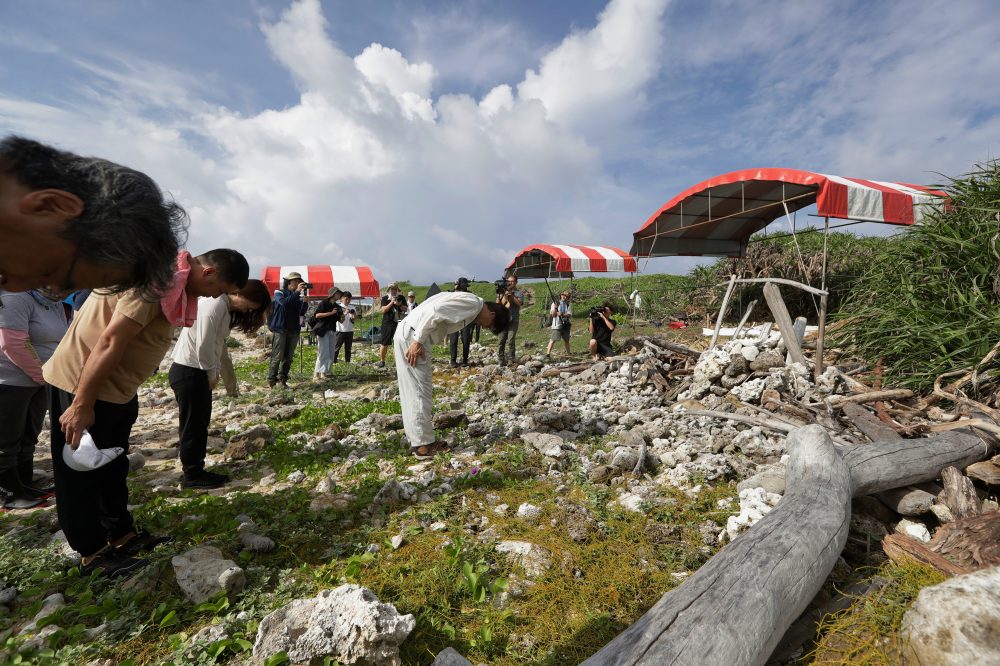

PINGTUNG, Taiwan — Experts bowed their heads in a show of respect Monday before beginning an excavation in southern Taiwan aimed at recovering the remains of Japanese soldiers from the Second World War.
The dig is connected to the 1944 sinking of a Japanese military transport ship and other vessels in the Bashi Channel, after they came under attack by American forces. Historian and recovery activist Kazuko Tachi says more than 4,700 soldiers and crew members lost their lives in the attack, while only 65 managed to survive.
At the time, Taiwan was a Japanese colony. The self-governing island, which China claims as its own territory, remained under Japanese rule from 1895 until the war’s end.
“It is believed that many bodies from the sunken vessel reached this shore,” said Tatsuaki Inoue, speaking on behalf of the Japan Association for the Recovery and Repatriation of War Casualties.
The excavation is taking place in Hengchun Township and is expected to last approximately one week. Should any remains believed to be Japanese be discovered and yield usable DNA samples, they would be transported to Japan during a future mission.
Japan passed a law in 2016 to speed up the recovery of war remains — an initiative that has since been extended through 2030 and now includes broader DNA testing capabilities.
According to official Japanese records, roughly 41,900 soldiers who fought for Japan during World War II died in Taiwan. Of those, approximately 26,300 bodies have been recovered, leaving around 15,600 still unaccounted for.
The most recent excavation in Taiwan prior to this one took place in 1975, when 242 bodies were recovered.
“We feel very sorry that we kept them waiting for such a long time,” Inoue said. “But on the other hand, we are very happy that we came to be able to excavate in search of their remains.”
Historians, local residents, and Japanese volunteers living in Taiwan spent years conducting interviews and gathering historical records to piece together what may have happened to those whose bodies washed ashore.
Their research suggests the remains may have been collected by local residents and placed together in a rocky coastal area near the discharge outlet of Taiwan’s Third Nuclear Power Plant, where they may still be located.
Across the broader scope of World War II, more than 2.4 million Japanese soldiers died overseas. The remains of roughly 1 million of them have never been recovered.
In response to public pressure, the Japanese government carried out three separate recovery efforts between the 1950s and the 1970s, according to Akira Nishimura, a professor of religious studies at the University of Tokyo.
“For bereaved families who have not received the remains of their loved ones, the lack of certainty regarding where and how their relatives met their end — and the feeling that they were unable to give them a proper sendoff — is likely one of the main reasons why the recovery of remains continues even 80 years later,” Nishimura said.
He also noted that religious organizations and volunteers have been essential in recovering remains and conducting memorial services, providing comfort to grieving families while keeping alive the memory of those who never came home.
In Pingtung, where Monday’s excavation got underway, two sites stand in honor of Japan’s war dead.
A monument dedicated to Japanese service members who perished in the war stands next to Chaoyin Temple, which bears an inscription reading: “We pray for the peace of all humanity in the world.”
The temple itself is dedicated to those who died in the Bashi Channel during the conflict. Inside, a Japanese flag stands beside a statue of the Buddhist Bodhisattva Ksitigarbha, a figure believed to guide and protect the souls of the deceased.
Beatrice Trefalt, an associate professor of Japanese studies at Monash University in Australia, noted that Japan’s wartime losses were distinctive in that a large number of soldiers and sailors perished at sea, making their remains impossible to recover.
“Because of the enormous amount of uncertainty about who died or not, or how, the search for remains has been a constant in postwar Japanese history,” Trefalt said.
She added that many families feel the government bears a responsibility to acknowledge those who were conscripted and died during the war.
Tachi said she only learned about the fate of the Japanese soldiers who died in the Bashi Channel after relocating to Taiwan. After local residents shared that history with her, she chose to become involved in the effort to recover their remains.
“Those Taiwanese uncles taught me the importance of holding a memorial service for the war dead,” Tachi said. “It’s been more than 80 years since the war ended but I believe it is important to pray for the war dead, which I will keep on doing.”