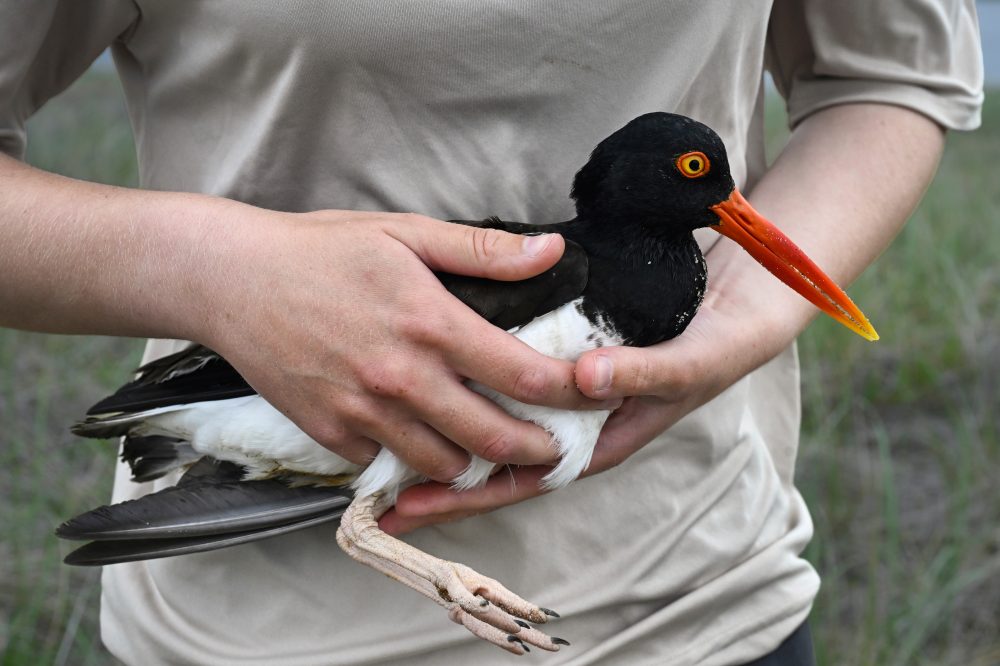

On a bustling Rhode Island beach filled with the sounds of seabirds, a team of biologists quietly closed in on two young American oystercatcher chicks — only to find themselves on an unexpected chase across the shoreline.
One of the football-sized birds, sporting a vivid orange bill and long legs, darted into a nearby coastal salt pond. The other briefly took flight, sending the researchers sprinting more than a mile and a half down the beach to catch up.
“There is a problem. They can fly,” said Alan Kneidel, a senior conservation biologist with the environmental group Manomet Conservation Sciences, watching the pursuit unfold.
U.S. Fish and Wildlife Service biologists eventually caught both birds, wrapping them in white pillowcases and carefully transporting them to a sand dune. There, scientists recorded body measurements and attached identification bands to the birds’ long, peach-colored legs.
The banding took place at the 787-acre Trustom Pond National Wildlife Refuge in South Kingstown, Rhode Island, and is part of a broader nationwide campaign to restore oystercatcher populations along the coasts of the Americas. The species was nearly wiped out across New England by the early 1900s due to hunting and the collection of their eggs — but their numbers are now on the rise.
Over the course of a decade, roughly $10 million was raised and 35 coastal organizations across 16 states joined the recovery effort. A significant portion of the campaign centered on raising public awareness about these distinctive birds, recognized by their piercing calls and their knack for prying open oysters and mussels with razor-sharp bills. Steps were also taken to shield their ground-level nesting sites — found on beaches, sand dunes, salt marshes, and tide wrack deposits — from predators and off-leash pets.
Between 2008 and 2023, oystercatcher populations climbed 45% along the Atlantic and Gulf coasts. That rebound carries extra weight given that a 2023 study found most shorebird species across North America are in decline.
“It’s amazing and it’s a great conservation success story,” said Maureen Durkin, a federal wildlife biologist who led the banding effort and is based at the Rhode Island National Wildlife Refuge Complex.
“It does really demonstrate how much you can accomplish when there is a dedicated group of partners that can come together and identify the needs of the species and implement conservation actions,” she said, noting that protecting at-risk species “is not easy and takes a sustained and committed effort.”
Kneidel explained that a turning point in the conservation plan came when researchers identified that “chick survival was the big thing driving the declines.” From there, organizations within the American Oystercatcher Working Group — led by Manomet’s Shiloh Schulte, a conservation biologist and field scientist who died last year in a helicopter crash in Alaska while working to protect shorebirds — developed site-specific strategies. Schulte’s early aerial surveys had revealed double-digit population declines.
“At one site, it might be recreational disturbance, at another site it might be predators, at another site it might be sea level rise or loss of dune structure that’s causing overwash events that are causing nest failure,” Kneidel said while walking along rocky Moonstone Beach, as least terns called out overhead.
On Martha’s Vineyard, a seasonal low fence with chicken wire has been installed at the entrance to a key breeding area, successfully keeping egg-eating skunks and raccoons off the beach. Informational signs have also been posted to help educate visitors about the birds. Oystercatchers there have also benefited indirectly from federal protections extended to the piping plover, a threatened shorebird that shares nesting territory. During plover nesting season, vehicle access and dogs are restricted or banned near those sites.
“With a little bit of focused effort and attention on this really charismatic bird, you can teach the public how to share the shore,” said Luanne Johnson, a wildlife biologist who founded the nonprofit BiodiversityWorks, one of the groups involved in the recovery. Martha’s Vineyard was the first location in Massachusetts to see nesting oystercatchers return, and the number of breeding pairs there has risen 77% since 2009.
In South Carolina, close to 30 breeding sites have been roped off to safeguard nesting habitat. Georgia and North Carolina have adopted similar measures, and both states also trap and euthanize predators such as foxes, raccoons, and coyotes during breeding season.
“If you focus conservation efforts on a species, especially before it becomes endangered to the point that you’re considering listing, you can actually sort of head off trouble at the pass,” said Lindsay Addison, a coastal biologist with Audubon North Carolina. She noted the state’s breeding pairs have grown nearly 20%, reaching 403. Some individual birds, including ones banded as far back as 2004 and known by designations like Dark Green 06 and Yellow 25, have become minor celebrities among bird enthusiasts.
Ted Simons, a retired emeritus professor at North Carolina State University who began researching oystercatchers on North Carolina’s Outer Banks in 1995, called the recovery a reflection of the species’ resilience. He noted that American oystercatchers have been documented nesting on rooftops in the U.S., while related species in Europe have taken to nesting in farm pastures and feeding on worms. One pair was even discovered nesting in a pothole at a bus station in Iceland.
“If these were really highly specialized birds that needed an exact prescription for survival, that would have been harder,” Simons said. “But what we found is that these birds are incredibly adaptive.”
Despite the encouraging rebound, significant threats remain.
Rising seas and coastal erosion driven by climate change continue to wash out oystercatcher nests. In response, some states like Georgia have constructed elevated nesting platforms made from oyster shells and used dredged material from shipping channels to build and maintain nesting islands. Along North Carolina’s Cape Fear River, Audubon is restoring shell rakes — beds of old oyster shells that serve as nesting grounds for the birds.
“Climate change, sea level rise, it’s a big challenge not only for oystercatchers but for all kinds of interests on the coast,” Addison said. “There’s going to be loss of habitat due to sea level rise so we have to make sure that we do what we can to provide the habitat that we can so they can get through this next bottleneck.”
Conservationists are also alarmed by recent changes to the Endangered Species Act that took effect this month. Environmental groups filed a lawsuit to block the changes, fearing that nesting sites could be disrupted by vehicle traffic or unchecked development — particularly in states with limited local protections. The revisions would permit oil and gas drilling, mining, logging, and other development activities in critical wildlife habitats, as long as the animals themselves are not directly killed or harmed. Environmentalists warn that opening habitats to such activities could push some species toward extinction.
“It’s a direct attack on the protections that have allowed many of these shorebird species to recover,” Kneidel said.