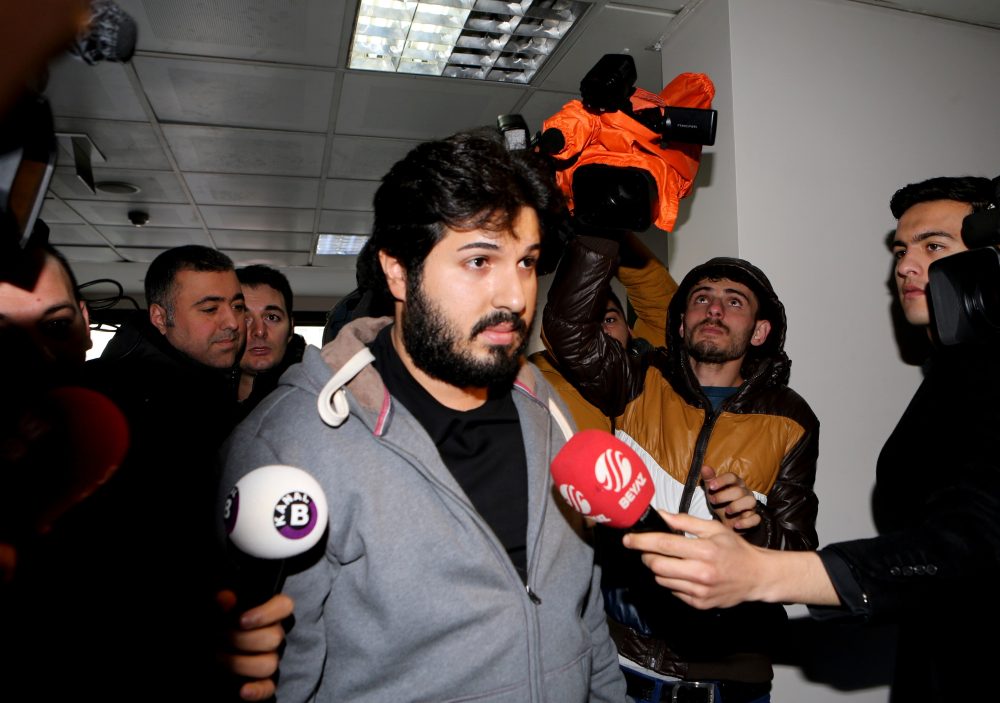
NEW YORK — Federal prosecutors are asking a New York judge to show leniency toward a Turkish-Iranian gold trader set to be sentenced next week after he admitted to helping Iranians and their government dodge U.S. sanctions — and then turned around to become a key government witness in a major corruption case.
In a sentencing memorandum filed Monday, prosecutors told a federal judge in New York that international gold trader Reza Zarrab delivered meaningful assistance to the United States. That help included revealing that he had paid millions of dollars in bribes to Turkish government and banking officials, and taking the witness stand during a December 2017 trial.
Zarrab’s testimony was central to the conviction of Turkish banker Mehmet Hakan Atilla, who received a prison sentence of more than two years. Following that verdict, Turkey’s President Recep Tayyip Erdogan publicly called the outcome “scandalous.”
Prosecutors described Zarrab’s October 2017 guilty plea — on charges of conspiracy, bank fraud, and money laundering — as the beginning of cooperation they characterized as “truthful, complete and reliable,” as well as significant, useful, and timely. They also acknowledged that his decision to cooperate exposed him to serious personal danger.
While testifying for a week at the 2017 trial, Zarrab recounted being attacked inside prison by a fellow inmate armed with a knife, who claimed he had been instructed to kill Zarrab because of his cooperation with U.S. authorities.
Monday’s filing from prosecutors referenced that threat directly. According to the memorandum, the inmate at the Metropolitan Detention Center in Brooklyn told Zarrab he would be killed for cooperating against “big people in Turkey.” The incident led to Zarrab being removed from the prison facility and placed into FBI custody.
Prosecutors also noted that the Turkish government moved to freeze and seize Zarrab’s assets after he began working with U.S. authorities.
The years-long gap between Zarrab’s guilty plea and his upcoming sentencing is not unusual in complex federal cases where a cooperating witness may be needed for multiple trials down the road.
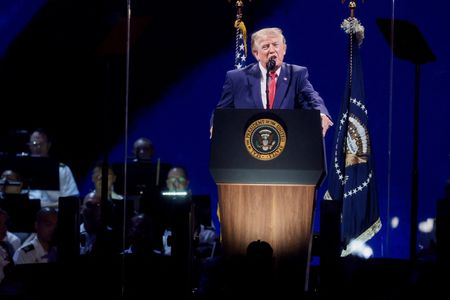
Last month, a Manhattan judge approved the dismissal of a separate criminal case the U.S. government had filed against Halkbank, a Turkish state-owned bank. That move to drop the charges came during a period of improved relations between Erdogan and President Donald Trump.
Following a meeting between the two leaders at the NATO summit in The Hague last year, Erdogan told reporters that Trump is quick to return his calls — a detail widely seen as a sign of their close relationship.
“With my friend Trump, we are opening the door to a new era in Turkish-American relations,” said Erdogan, who has led Turkey for 13 years.
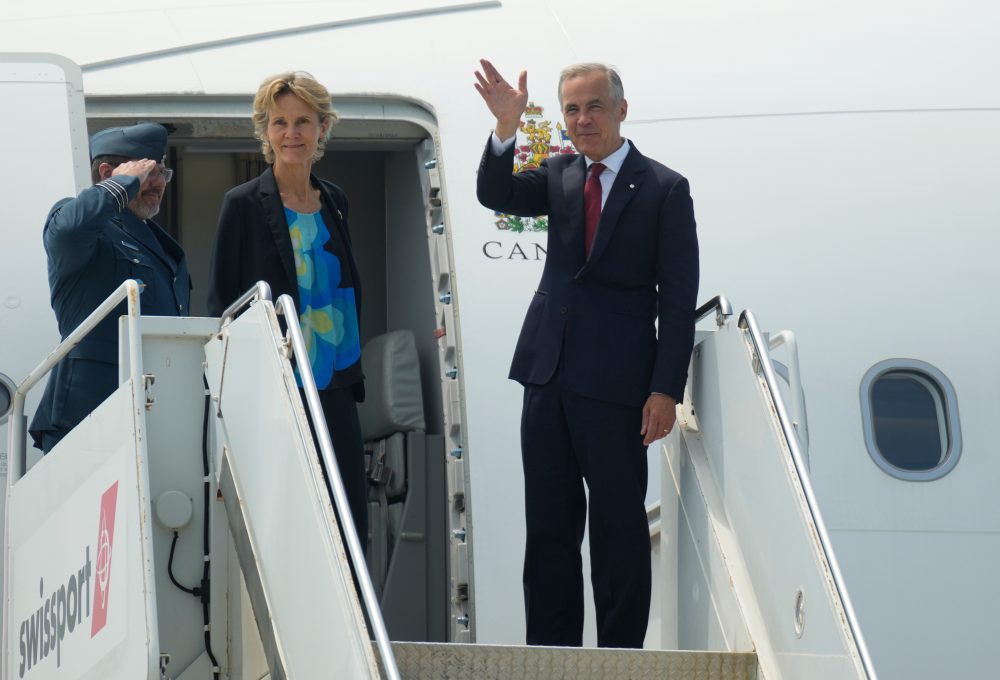
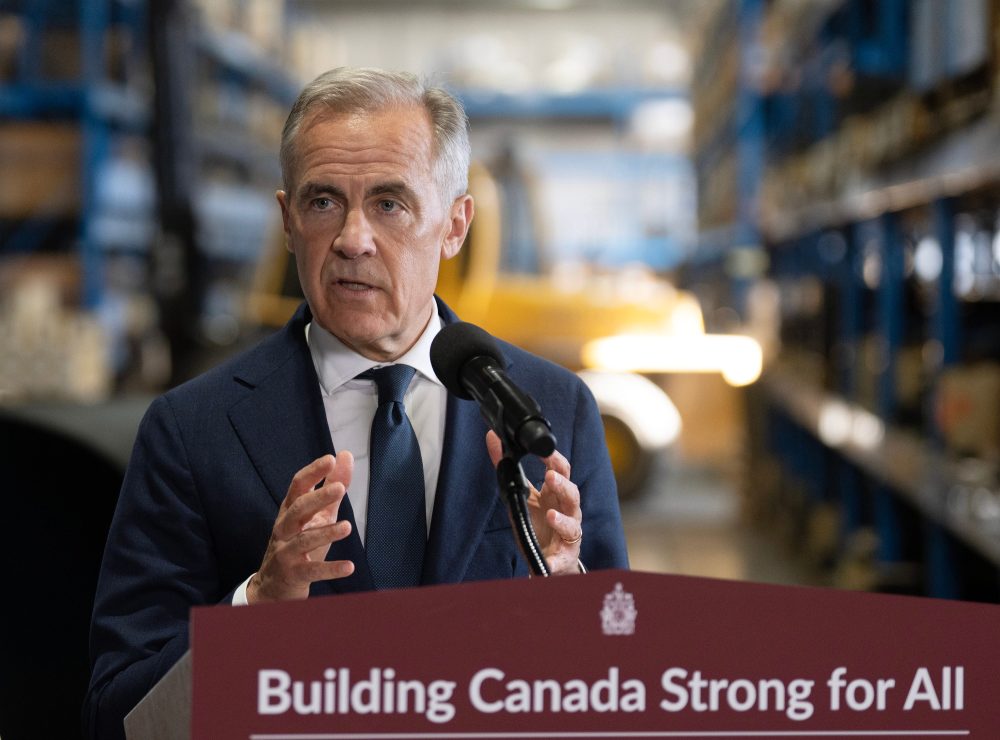
TORONTO — Canada announced Monday that Germany’s ThyssenKrupp Marine Systems has been selected as the preferred supplier for a new fleet of up to 12 submarines, a deal Prime Minister Mark Carney described as the biggest military procurement in the country’s history.
The announcement was made ahead of Carney’s departure for this week’s NATO summit, where alliance members are under pressure to back up pledges of higher defense spending with solid, concrete plans.
Speaking at a military base in Halifax, Nova Scotia, Carney said the TKMS platform is best suited for operations in Arctic waters and for working alongside NATO allies. “The submarine is proven and capable. It is used widely by our allies. TKMS provides submarines to over a third of the NATO alliance, and is the leading submarine provider to navies around the world,” he said.
ThyssenKrupp beat out South Korea’s Hanwha Ocean for the contract. The German company noted that its submarines would improve coordination among allies since many NATO nations already operate its conventionally powered vessels. Canada will now move into further negotiations with TKMS as the preferred supplier.
Canada has committed to significantly ramping up its military spending after falling short of NATO targets for years. Carney has pledged to increase defense spending to 5% of gross domestic product by 2035. Canada only recently met NATO’s previous benchmark of 2% of GDP this year. He added that Canada’s fiscal framework has already set aside funding to reach 4% of GDP in total spending by 2030, ahead of NATO’s own schedule.
Carney also said that Germany and Norway have offered to share some of their production slots so Canada can take delivery of submarines sooner than originally planned. The expectation is that Canada will have four submarines in service by 2034.
The new fleet is intended to replace Canada’s four aging Victoria-class submarines, which were bought secondhand from the United Kingdom in the late 1990s.
No American company submitted a bid for the contract, as the United States only manufactures nuclear-powered submarines. Canada was specifically seeking conventionally powered diesel-electric vessels.
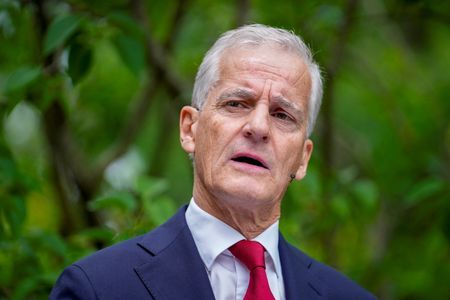
OSLO — Norway is pressing China to use its direct connections to the Russian government to help push for a negotiated end to the ongoing war in Ukraine, Norwegian Prime Minister Jonas Gahr Stoere announced Monday.
“China is probably the country with the best and most direct access to the Russian leadership. We expect, hope and strongly urge China to use that channel,” Stoere told reporters following his meeting with Chinese Foreign Minister Wang Yi in Oslo. He noted that Ukraine dominated the bulk of their conversation.
Stoere also warned that China’s continued close partnership with Russia is holding back the potential for stronger ties between China and Europe. “There is a potential for deeper cooperation between Europe and China, but as long as this war goes on and China is a close partner of Russia, that is a limitation on that opportunity,” he said.
Earlier Monday, Norwegian Foreign Minister Espen Barth Eide described the dialogue with China about ending the conflict as “constructive and promising.” When asked whether China had signaled a willingness to bring Russia to the negotiating table, Eide was cautious but optimistic. “I’m not a spokesperson for China. I’m not going to quote them, but there are some hints in what they say,” he remarked.
Norwegian officials stated that peace talks should begin without any preconditions, starting with a ceasefire along the existing front lines in Ukraine. Stoere described this as a significant sacrifice on Ukraine’s part, noting, “That is, in itself, a major concession from Ukraine’s side. It is inside their territory.”
Wang Yi’s visit to Oslo came after previous stops in Denmark, Sweden, and Finland as part of his Nordic tour. Reuters indicated it had reached out to the Chinese delegation in Oslo for comment.
Meanwhile, U.S. President Donald Trump said Monday that a resolution to the Ukraine conflict is “getting closer than people realize” and indicated he plans to address the issue during meetings in Turkey this week at a NATO summit.
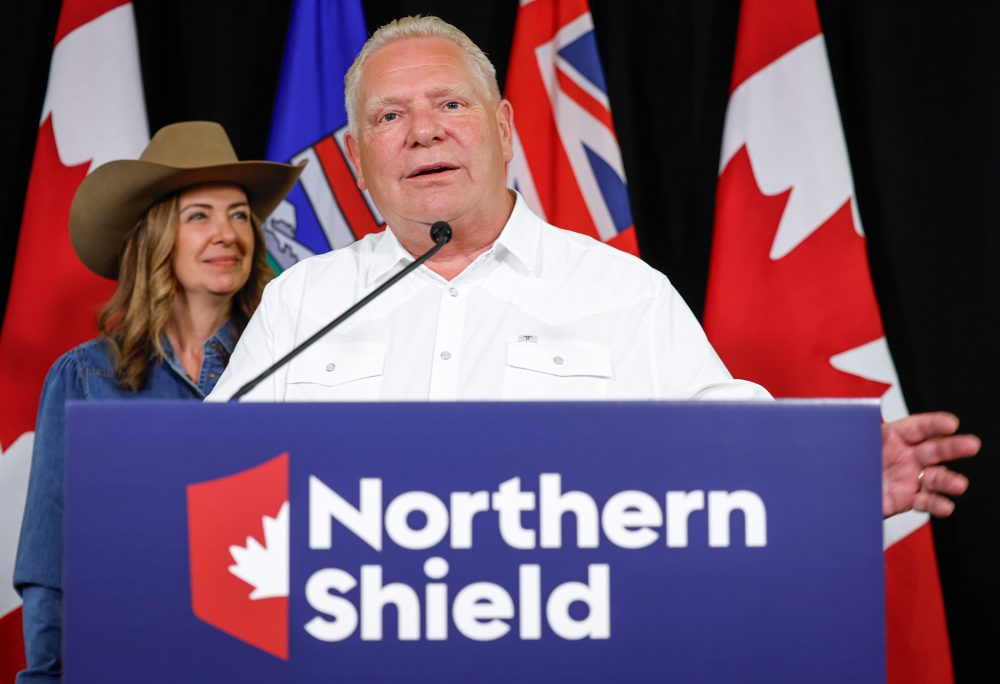
The Canadian provinces of Alberta and Ontario announced Monday a joint proposal to build a major pipeline carrying western Canadian crude oil eastward, with the possibility of eventually reaching Atlantic export terminals — a move driven by Canada’s desire to find new buyers beyond the United States.
Alberta Premier Danielle Smith outlined the plan, describing a proposed 3,300-kilometer (roughly 2,050-mile) pipeline running from Hardisty, Alberta, to Sarnia, Ontario. The line would be capable of moving up to 500,000 barrels of oil per day, with the potential to scale up to 800,000 barrels. Smith said the corridor could one day be extended to Canada’s Atlantic coastline, creating a pathway for oil exports to European markets.
Canada’s crude oil flows primarily to the United States, its largest buyer by a wide margin, while Alberta holds one of the biggest proven oil reserves on the planet.
Ontario Premier Doug Ford expressed support for the plan, saying it would be a worthwhile investment whether funded through public or private money. Officials said a feasibility study is in the works.
“There is still a lot of work ahead of us to deliver,” Ford said.
The proposal comes with significant obstacles, including securing financing, navigating regulatory approvals, and holding required consultations with Indigenous communities. A comparable project known as Energy East was scrapped in 2017 after facing years of political, regulatory, and environmental opposition, including strong resistance from Quebec.
Daniel Béland, a political science professor at McGill University in Montreal, offered a cautious assessment. “It’s technically feasible but it would be a massive undertaking. We are only at a very early stage of the project and we don’t have the final route or cost estimates yet,” he said. “It’s not even sure the Hardisty-Sarnia pipeline will ever be built so the idea it could at some point reach the Atlantic sounds quite speculative at this stage to say the least.”
Just last week, Smith and Prime Minister Mark Carney moved forward on a separate pipeline proposal — a taxpayer-subsidized project targeting the Pacific coast to boost exports to Asian markets. That effort involves a partnership with the federally owned Trans Mountain Corp. and Calgary-based Pembina Pipeline. Smith noted that the extent of any private-sector involvement in that project has not yet been finalized.
Smith has publicly stated her goal of doubling Alberta’s oil output to 8 million barrels per day over the next decade to 15 years. She has also argued that the previous federal government under former Prime Minister Justin Trudeau harmed Alberta’s energy sector and stoked sentiment in favor of provincial independence.
Alberta is set to hold a vote this fall on whether to pursue a referendum on breaking away from the rest of Canada.
Andrew Leach, an energy economist and professor at the University of Alberta, described Smith’s production targets as “incredibly ambitious,” pointing out that Alberta dealt with serious inflation the last time it tried to ramp up output at a similar pace. He also raised questions about whether oil producers would have any incentive to route their crude to Sarnia if there was no infrastructure in place to move it further from there.
Prime Minister Carney acknowledged last week that Canada’s greenhouse gas emissions would likely climb in the short term as his government pushes forward with pipeline expansion. He has made broadening Canada’s export reach a central priority in response to the trade conflict with U.S. President Donald Trump, pledging to pursue greater access to markets across Europe and Asia.
CARACAS — Venezuelan authorities announced Monday that the death toll from the country’s twin earthquakes has climbed to 3,535, with nearly 18,000 people still left without homes more than a week after the disaster hit the capital and surrounding coastal regions.
Top lawmaker Jorge Rodriguez released the latest official figures, which show 16,740 people were injured and 17,854 left without housing following the June 24 quakes. The two tremors, measuring magnitudes 7.2 and 7.5, struck within seconds of one another.
The updated numbers highlight the enormous scope of destruction in and around Caracas and La Guaira, the coastal area that suffered the worst damage, as public frustration over the government’s handling of the crisis continues to grow.
Venezuela’s social vice presidency reported that at least 12,800 displaced people are currently sheltering in 80 facilities spread across Caracas and La Guaira.
Acting President Delcy Rodriguez has pushed back against criticism of the government’s disaster response, which many Venezuelans have described as slow and insufficient. She said security forces were deployed immediately following the earthquakes and announced the establishment of a new military unit dedicated to handling future emergencies and disasters.
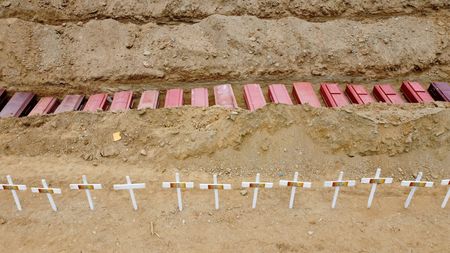
Reuters reporters on the ground in La Guaira Monday observed trucks and forensic workers carrying coffins, while heavy equipment dug trenches in an open field marked with white crosses — the site where authorities were burying unidentified victims.
The United Nations confirmed it is continuing to expand aid operations in coordination with the Venezuelan government in Caracas.
“Some search and rescue teams remain deployed in the affected areas, while other specialized engineering teams and medical support continue to arrive,” U.N. spokesperson Stephane Dujarric told reporters Monday.
Dujarric added that a full assessment of humanitarian needs — which will guide an updated relief plan — is nearly finished, though he did not provide a timeline for its release. U.N. agencies are already delivering services at three camps and evaluating additional sites where support could be expanded.
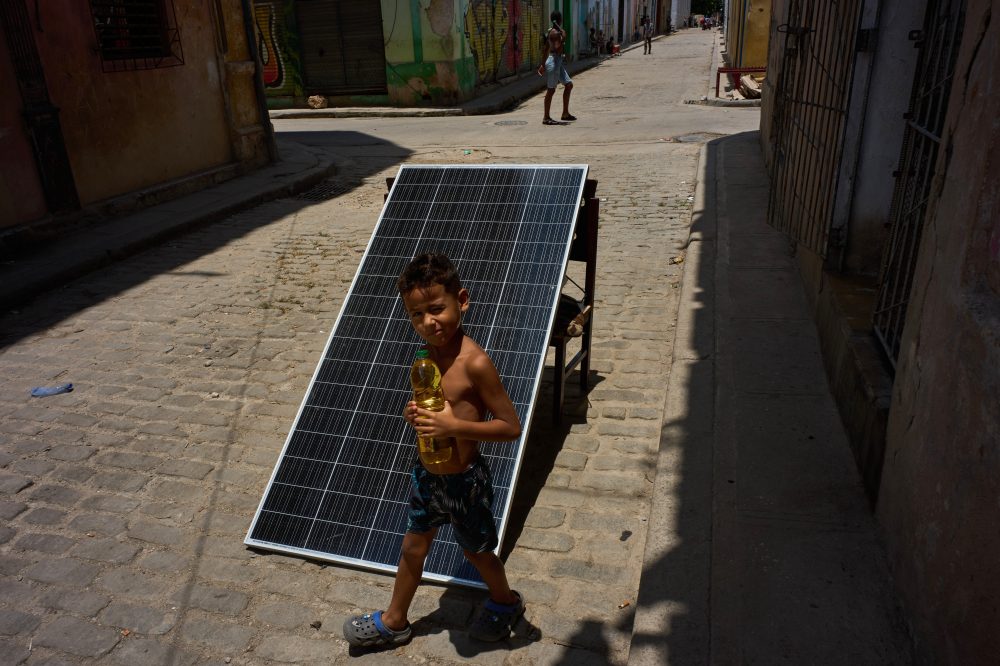
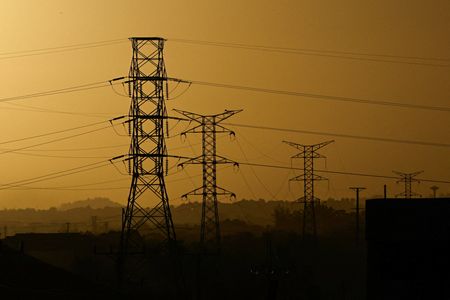
HAVANA, Cuba (AP) — A total blackout plunged all of Cuba into darkness Monday as the nation’s dwindling fuel supply and deteriorating power grid pushed the island to a breaking point.
Cuba’s state-run Electric Union announced the outage on X, noting that the cause is still being investigated. The country’s Ministry of Energy and Mines also posted on X, stating that emergency protocols to restore power have been set in motion.
The island’s fuel shortage has been mounting since January, when U.S. President Donald Trump threatened tariffs against any nation that sells or provides oil to Cuba. The threat deepened an already severe economic and financial crisis on the island, bringing public transportation to a near standstill and forcing officials to cancel tens of thousands of scheduled surgeries.
In Havana, the sudden darkness left residents anxious and scrambling. Lina May, 36, said she was left wondering when the lights would return so she could simply prepare a meal.
“I just told my dad that we have to buy charcoal because otherwise we won’t eat and we’ll starve,” she said.
Richard Valdés, 40, described the blackout as just the most recent in a long string of hardships.
“We’re without power again,” he said. “Now we have no water, no gas, nothing until they restore it.”
Cuba currently produces only 40% of the fuel it requires. A Russian tanker delivered 730,000 barrels of oil to the island in late March, but that supply was fully depleted by the end of April.
To cope with the shortage, the Cuban government has been implementing intentional power cuts that can last more than 24 consecutive hours at a time.
Previous major outages include a mid-May blackout that darkened the island’s eastern provinces and a mid-March event that knocked out power across the entire island.
Mario Pedroso, a 33-year-old Havana resident, reflected the weary acceptance shared by many Cubans when asked about Monday’s total blackout.
“Oil hasn’t come in here for a while, and we have no way to solve the problem,” he said. “We have to resist, as we Cubans say. That’s all.”
Paris-based fashion house Christian Dior has landed one of the most talked-about bridal commissions in recent memory, dressing both Taylor Swift and Travis Kelce in Haute Couture designs for their wedding held at Madison Square Garden in New York.
The designs were crafted by Dior creative director Jonathan Anderson, a Northern Irish designer who took the reins at the French luxury house just one year ago after spending 11 years leading Loewe. The wedding outfits were made at Dior’s ateliers located at 30 Avenue Montaigne in Paris and were developed through close collaboration between Anderson and the couple.
No photographs from the tightly controlled ceremony have yet been released to the public, but the fashion world is already buzzing. The win gives Dior a clear advantage over rival Chanel in the competition for fashion’s most sought-after celebrity partnerships.
Chanel’s own creative director, Matthieu Blazy — also new to his position — made waves earlier this year when he designed an intricately beaded bridal gown for pop star Dua Lipa’s wedding in Sicily in June. However, the massive media attention surrounding Swift’s nuptials is expected to generate far greater visibility for Dior, one of the flagship brands under the LVMH luxury group, as it works to reignite consumer interest in a slowing luxury market.
Swift’s 273 million Instagram followers and devoted global fanbase represent a level of exposure that few traditional marketing campaigns could achieve.
Thomai Serdari, a luxury brand strategist and marketing professor at New York University’s Stern School of Business, explained the significance of the moment. “The commission ensures that Dior, and by extension Jonathan Anderson, are commemorated for years to come in the history of pop culture,” she said.
At Dior’s Haute Couture show held Monday in Paris, guests in the front row were eagerly discussing Swift’s wedding gown. Sheila Hicks, a 91-year-old American textile artist who previously collaborated with Anderson on a Dior bag design, shared her reaction with reporters. “When she picked Jonathan I thought, someone was advising her correctly,” Hicks said. “It projects that she’s on the ball — that she’s working with the right people.” Hicks also offered her vision for the gown, saying it “shouldn’t be overwhelming, but it should definitely have a very strong personality.”
In the weeks before the ceremony, speculation ran high about who would design Swift’s dress. Stella McCartney, one of the singer’s frequently favored designers, and Givenchy’s Sarah Burton were among the names most often mentioned as possible choices.
While Swift regularly wears a variety of high-end labels, she is rarely seen at fashion industry events and has frequently spotlighted smaller or lesser-known brands. Her engagement ring, for instance, came from independent jeweler Artifex Fine Jewelry. She wore Ralph Lauren for her engagement photo shoot, but ultimately chose French couture for her wedding day.
Anderson has had a particularly active bridal season. Within just the past month, Dior revealed two additional Haute Couture wedding gowns he designed — one worn by Chinese model Ming Xi and another by Brazilian influencer Elisa Zarzur.
Still, dressing celebrities for their weddings does not always translate into broader business success for luxury fashion labels. Lauren Sanchez wore a custom Dolce & Gabbana gown for her Venice wedding to Amazon founder Jeff Bezos during a lavish three-day event last year, yet the Italian brand has since been seeking financing and is currently in debt renegotiations with banks. Similarly, Valentino — which designed a gown for Nicola Peltz’s 2022 wedding to Brooklyn Beckham — reported a financial loss last year and is also working through negotiations with creditors.
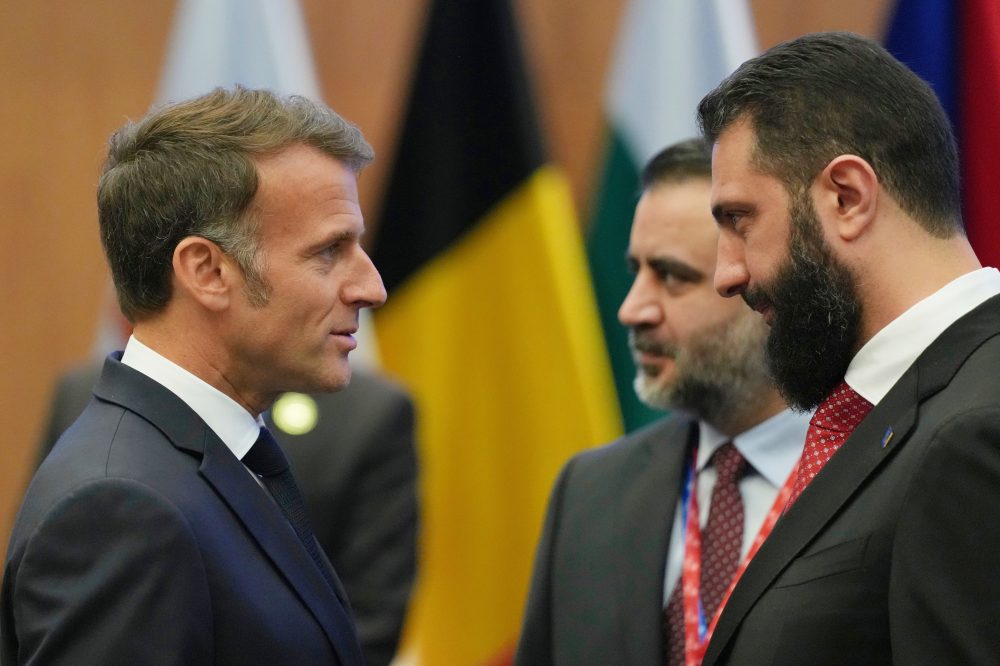
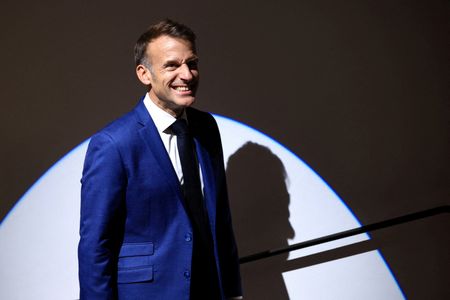
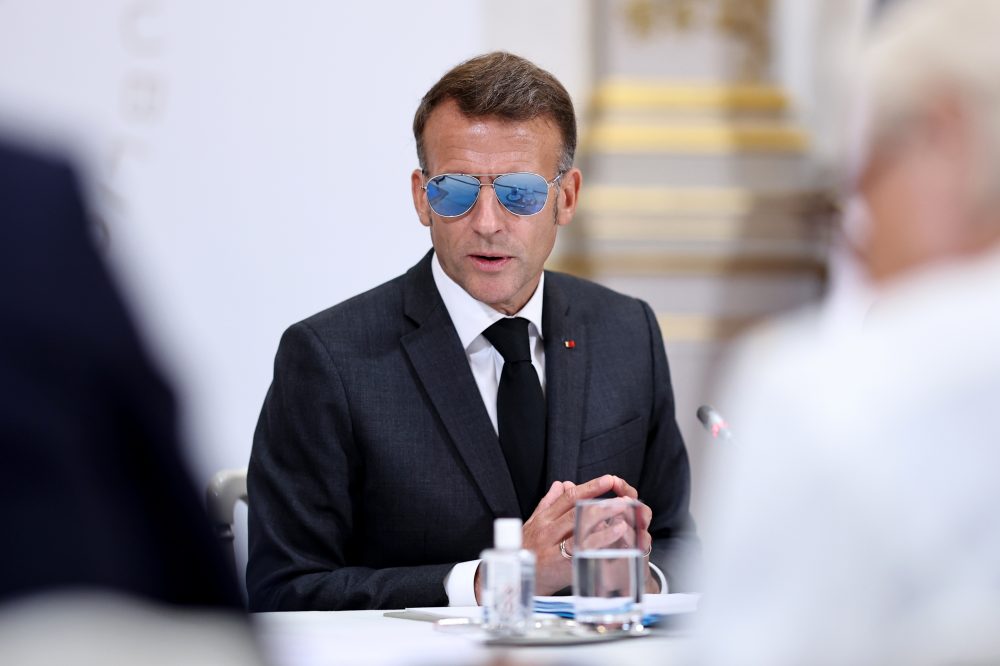
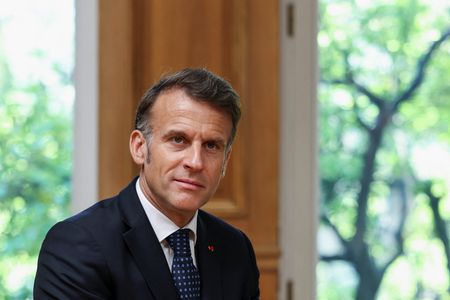
DAMASCUS, Syria — French President Emmanuel Macron touched down in the Syrian capital on Monday, becoming the first major leader from western Europe or North America to set foot in the country since Bashar al-Assad was driven from power in 2024.
While Ukrainian President Volodymyr Zelenskyy had made a visit in April, Macron’s arrival marks a significant milestone as the first visit by a Western leader of his standing.
The trip comes at a time of relative calm across the Middle East following a month of conflict involving Iran and Lebanon. After leaving Syria, Macron is scheduled to travel to Ankara, Turkey, for the NATO summit. Syrian President Ahmad al-Sharaa is also expected to attend that gathering and is anticipated to hold a high-profile meeting with U.S. President Donald Trump.
Syria’s state-run SANA news agency reported that Macron arrived alongside a business delegation, with talks planned around regional security as well as economic and investment opportunities.
Upon landing, Macron was welcomed at the Damascus airport by Syrian Foreign Minister Asaad al-Shibani.
In a post on X, Macron stated: “I have come to express France’s commitment to the Syrian people. For a sovereign Syria, united in its diversity and at peace with its neighbors. Together, let us open a new chapter of stability and peace.”
Macron’s office indicated that France stands behind all those who can “contribute to build a new Syria,” in keeping with the aspirations that emerged during the 2011 Arab Spring — a wave of uprisings across the Middle East that demanded political reform and change.
The French president was set to meet with al-Sharaa at the presidential palace and to connect directly with a range of Syrian citizens, his office noted. Specific details of the visit were withheld for security purposes.
Macron had previously hosted al-Sharaa in Paris in May 2025, during which he pushed European and U.S. leaders to remove long-standing economic sanctions on Damascus. The majority of those sanctions have since been lifted.
France stood by Syria’s new leadership even when other nations remained skeptical, given al-Sharaa’s background as the former head of the Hayat Tahrir al-Sham militant group, which had previously been tied to al-Qaida and operates under Islamist leadership.
Western governments had raised particular concerns about the rights of women and minority groups under the new administration, and whether Syria’s leadership would move toward a more democratic system of governance.
Syria has largely avoided being drawn into the region’s recent armed conflicts, but the nation continues to bear the scars of 13 years of internal war. That prolonged conflict left vast portions of the country in ruins, pushed millions of people into poverty, and is estimated to require hundreds of billions of dollars in reconstruction funding. While Syria has signed memorandums of understanding with various countries and major corporations for large-scale investment projects, those agreements have not yet translated into concrete results.
LA GUAIRA, Venezuela — Noel Márquez was at his girlfriend’s apartment when twin earthquakes brought down the high-rise building where he lived with his family, setting it ablaze. He rushed back and called out desperately. The only response came from his 17-year-old brother Leonel, whose legs were trapped beneath concrete columns that would have required heavy machinery to move.
Márquez and his father, both of whom survived, could hear Leonel through the layers of debris — crying out in pain, begging for help, choking on smoke — as they waited for a crane that never arrived. After several agonizing hours, Leonel went silent.
As devastating as that was, Márquez said the worst part came next: attempting to retrieve his family members’ remains with little more than his bare hands and a saw. He was forced to cut off limbs to free the bodies of Leonel and his mother. He could not reach his eight-months-pregnant sister, his grandmother, or other relatives still buried in the wreckage — and with them, any chance of giving them a proper burial.
“It’s unfair. It’s inhumane, everything that is happening,” said Márquez, 26, speaking from an overcrowded temporary morgue set up at the La Guaira port. “We couldn’t get my brother out because we didn’t get a response from the state … and after 11 days, we are still requesting a crane.”
Márquez represents a vast number of Venezuelans who, after days of torment, have been left largely on their own — searching not for survivors, but for the remains of the people they loved, and for some measure of peace.
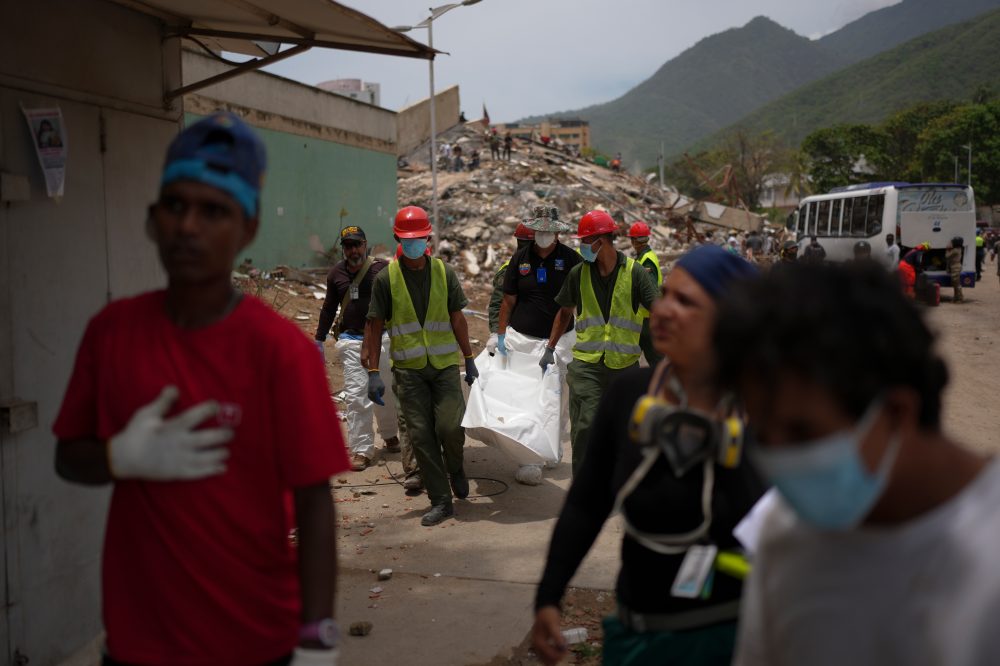
International rescue teams, quietly accepting that the odds of finding anyone alive after 12 days under the debris are essentially zero, are preparing to leave the country. Local officials have shifted their attention toward finding shelter for the thousands of people displaced by the disaster. But the task of recovering the dead has fallen heavily on the families themselves.
“I found her hand, but her torso is crushed,” said Norely Rodríguez, working to free her 5-year-old daughter from the ruins in La Guaira, the hardest-hit area. “I want to see if I can get her out whole.”
Survivors say that just as the government failed to respond quickly enough to rescue the living in the immediate aftermath of the quakes, families are now similarly under-resourced as they try to recover the dead nearly two weeks later.
The passage of time has made the process increasingly grim. “It has been difficult because the bodies are already in an advanced state of decomposition, decomposed to such an extent that many times when we try to remove them, they fall apart,” said William Gomez, a firefighter working in La Guaira.
Authorities announced Sunday that the confirmed death toll had climbed to 3,342, with an additional 16,740 people reported injured. Beyond those numbers lies an unknown count of victims still buried beneath the rubble. While no official tally exists, more than 30,000 missing persons reports have been submitted to a website created by the Venezuelan opposition.
Over the weekend in La Guaira, no government civil defense workers or security personnel were observed helping families dig through the wreckage. The overwhelming majority of those searching were ordinary civilians using their hands or basic tools like pickaxes and shovels, with occasional assistance from firefighters and Mexican rescue workers still in the country.
“We are the ones helping ourselves: our family. Nobody else helps us except for a few volunteers,” said Yeikhary Urbina, who on Saturday discovered the bodies of her mother and brother suspended under mounds of concrete, appearing to be locked in an embrace.
Rescue teams from Italy, Argentina, Spain, and other nations have already gone home. The Venezuelan government has not officially called off the search for survivors, but officials have shifted their public messaging — moving away from highlighting dramatic rescues on social media and toward announcing rebuilding plans under a program called Venezuela Reborn.
“Venezuela is entering a process of infrastructure recovery, of housing recovery,” acting President Delcy Rodríguez said on state television Saturday.
Families still searching face new horrors with each passing day. Some have spent days digging only to find remains so badly decomposed that identification is nearly impossible. Others have found nothing at all. “She kept asking, ‘Why did God play this trick on me?’” said Geraldine Perdomo, describing her sister’s desperate search through the rubble of her home for any confirmation that her two daughters had died.
And some, like Márquez, endured days of grueling effort to recover their loved ones’ bodies, only to lose track of them again in the disorder of the makeshift morgue beneath grain silos at La Guaira port, where bodies have been arriving in a near-constant stream since the June 24 earthquakes. Márquez said that on Sunday — a week after he brought in the bodies — he learned authorities had located his mother and grandfather. But his brother Leonel, he said, “is still missing because of the negligence here.”
Márquez and many other residents of the country’s public housing towers — built years ago for low-income families under former socialist leader Hugo Chávez — say their concerns about government neglect go back long before this disaster. Several of those high-rise buildings, each housing hundreds of families, collapsed entirely during the earthquakes, renewing questions about the quality of their construction.
Alexander, a 42-year-old police officer who lived in one of the towers, was shaking with anger on Sunday. He blamed the government for ignoring residents’ longstanding concerns about the structural integrity of the building, for failing to send rescue crews in time to save his wife and three daughters, and now for not providing the heavy equipment needed to help him recover their bodies.
“Not a single person from the government was here,” he said. He asked to be identified only by his first name, fearing that as a government employee, speaking out against authorities could put him at risk of retaliation.
After 11 days of searching, he finally reached the last member of his family still unaccounted for — his 12-year-old daughter. Her body was decomposed but intact.
“She was waiting for me to pull her out,” he said, holding the black plastic body bag in his arms.
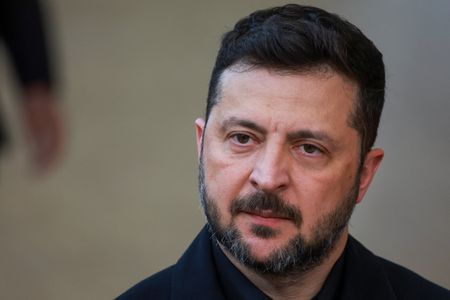
Ukrainian President Volodymyr Zelenskiy spoke out Monday about what he described as a critical shortage of weapons needed to shield Ukraine from Russian ballistic missile attacks.
In his nightly video address, Zelenskiy called the situation deeply troubling, saying: “It is simply absurd that, in the modern world, production has still not been scaled up to the level actually required to protect people from ballistic terror.”
The Ukrainian leader went on to say that Ukraine already possesses the technical knowledge to manufacture the necessary defense systems. He added that if Ukraine were granted U.S. licenses to produce U.S. Patriot missile systems, “our production would be sufficient not only to defend Ukraine but also to assist partners who need them.”
ANKARA, Turkey — The Netherlands is set to unveil a package of defence agreements and plans valued at more than €3 billion — roughly $3.43 billion — at a NATO forum taking place Tuesday in Ankara, according to Dutch Defence Minister Dilan Yesilgoz.
Speaking with Reuters during an interview in the Turkish capital on Monday, Yesilgoz outlined some of what is expected to be announced, including a partnership with Belgium focused on air defence and a collaboration with Britain involving naval vessels. She also indicated the Netherlands is seeking to expand joint defence projects with Germany.
“We have several levels of plans with countries around us, within NATO,” Yesilgoz said. “For the Netherlands, it will be … well over 3 billion euros that we will have new — not only pledges, but concrete plans.”
The minister held back additional specifics ahead of the formal announcements, which are part of a broader wave of declarations expected from NATO member nations at the forum. The flurry of pledges is designed to demonstrate that alliance members are ramping up their defence budgets — a priority pushed by U.S. President Donald Trump.
Trump is scheduled to join the leaders of NATO’s 31 other member nations for the summit, which kicks off Tuesday evening with a dinner. The gathering continues Wednesday with a session of the alliance’s top decision-making body, the North Atlantic Council.
When asked whether she felt confident the United States would stay committed to NATO despite Trump’s past remarks questioning his dedication to the alliance, Yesilgoz was measured but firm. “I have to be confident, because I know that we need each other,” she said.
She went on to say that “we need each other … for our own safety and security,” and described it as “healthy for Europe to invest more in its own defence and defence industries regardless of who is at the White House at the moment.”
French President Emmanuel Macron touched down in Syria on Monday, according to Syria’s state news agency, becoming the first leader of a European Union nation to visit Damascus since rebel forces ousted longtime ruler Bashar al-Assad in 2024.
The historic trip signals a major shift in how the international community views Syria under its new leadership. The country is now led by President Ahmed al-Sharaa, a former al Qaeda commander who has managed to forge strong relationships with Western and Middle Eastern nations — governments that had previously refused to engage with the Assad regime.
Sharaa is working to rebuild a nation left in ruins after 13 years of devastating civil war, and Macron’s visit underscores Syria’s rapidly changing role in the geopolitical landscape of the region.
LIMA — Peruvian leftist presidential candidate Roberto Sanchez formally stepped aside Monday, acknowledging conservative Keiko Fujimori as the winner of Peru’s presidential election — several days after the country’s electoral authorities made their official declaration.
Sanchez and his political party released a joint statement Monday saying they “recognized that the National Elections Board had officially proclaimed the electoral results.” According to the final vote count, Fujimori received 50.135% of the vote in the June 7 runoff election.
Cuba’s national power grid went dark Monday afternoon, with the country’s grid operator confirming a total collapse that left approximately 10 million people on the Caribbean island without electricity.
Grid operator UNE announced the complete nationwide outage and said crews are actively investigating what triggered the failure.
The island has been dealing with a worsening energy situation for months, enduring blackouts that have stretched from several hours to multiple days at a time. Officials have pointed to a badly deteriorated power infrastructure and a U.S.-imposed oil blockade that has severely restricted the island’s fuel supply as contributing factors.
For everyday Cubans, Monday’s total grid failure is another blow in an already exhausting situation. Rolling blackouts have already made it difficult for many residents to work or get a good night’s sleep during the sweltering Caribbean summer.
Cuba’s Communist-run government has faced a prolonged economic crisis for years, but the situation has reached new levels of severity under mounting pressure from U.S. President Donald Trump.
Adding to the severity of Monday’s collapse — nearly two-thirds of the island was already experiencing power outages before the grid failed entirely.
WARSAW — Four European nations say they are well on their way to establishing a new joint defence financing plan. Britain, the Netherlands, Finland, and Poland issued a joint statement Monday declaring they have made “significant progress” on what is being called the Multilateral Defence Mechanism, with a goal of having it fully in place by 2027.
The announcement arrives just ahead of a NATO summit taking place this week in Ankara, Turkey, where the question of how to fund military buildup across allied nations is expected to dominate discussions. The MDM is one of several competing efforts designed to draw more private investment into defence spending among allied countries.
In their joint statement, the four nations noted, “We have benefited from the support of a broader group of allies in developing the technical details of this model.”
The countries also outlined plans to grow the coalition behind the initiative, stating they intend to move into the next phase of development alongside nations that formally declare their participation this autumn.
The MDM is not the only initiative vying for attention in the increasingly busy world of defence financing. Another major effort, known as the Defence, Security and Resilience Bank, is also gaining momentum. Canada is working to announce approximately 10 founding member nations for the DSRB at the upcoming NATO summit.
Poland’s finance ministry did not respond to questions about whether it is in talks to join the DSRB. Britain, for its part, has already ruled out joining that initiative, choosing instead to focus its efforts on the MDM project.
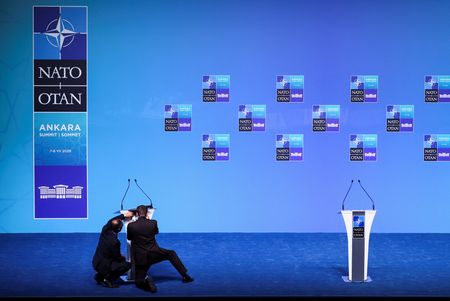
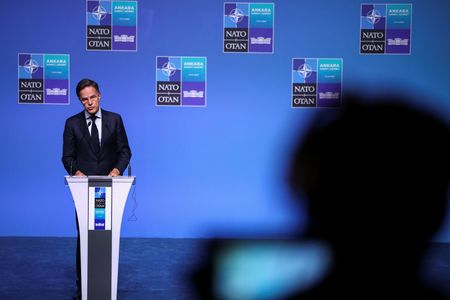
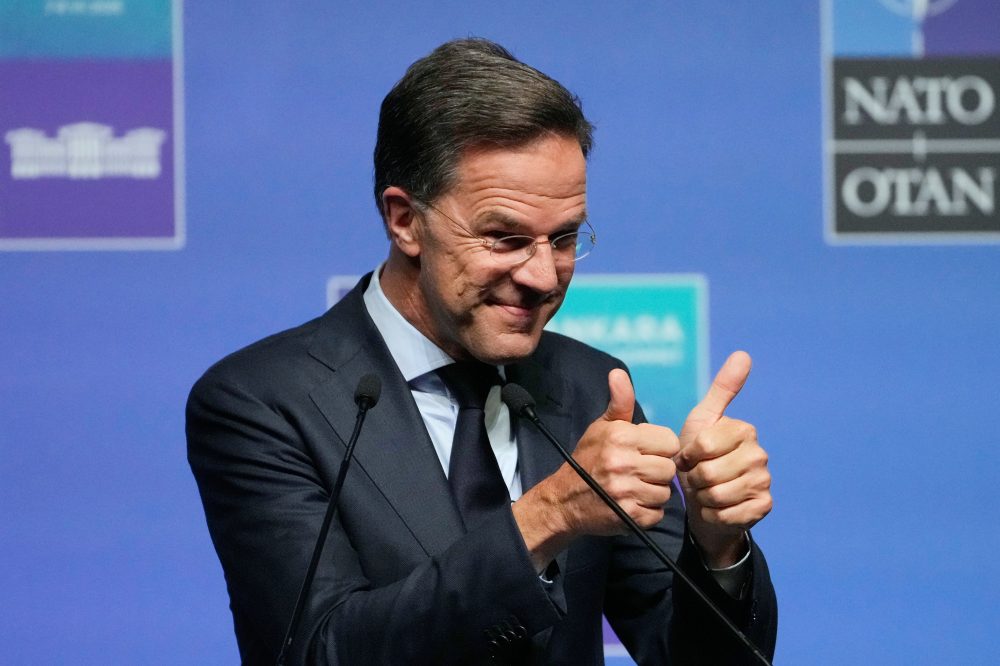
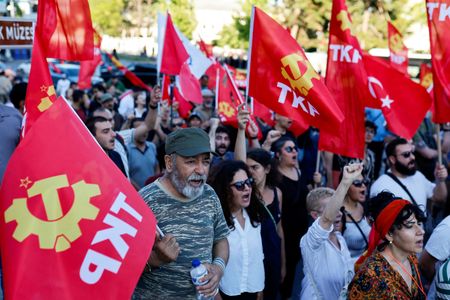
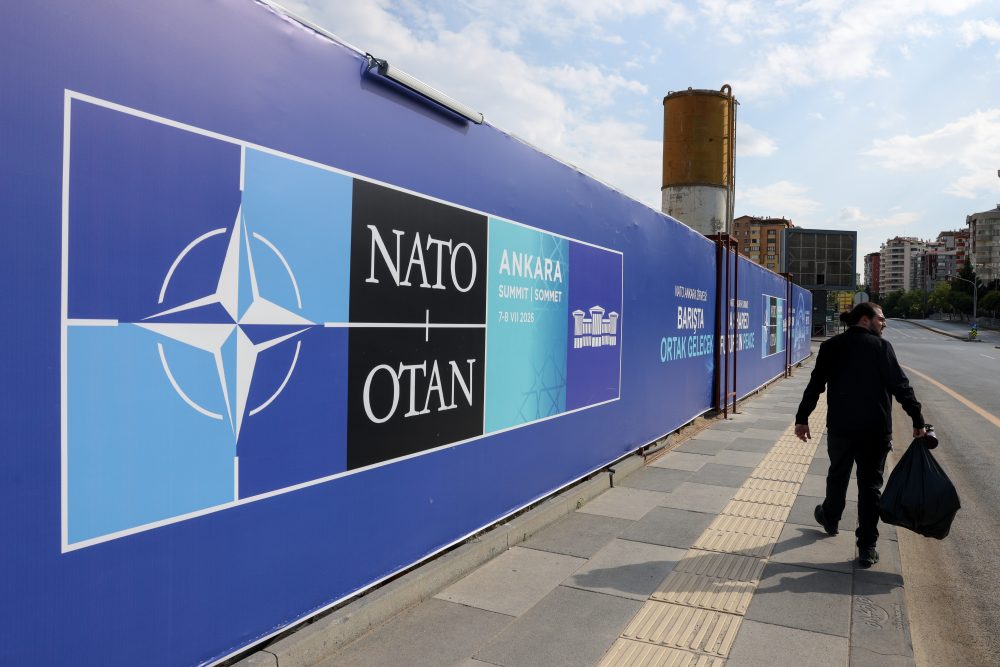
ANKARA — NATO Secretary General Mark Rutte emphasized that the freedom to protest and a free press are fundamental pillars of democracy, speaking out after Turkey carried out a sweeping crackdown on dissidents in the days leading up to this week’s major alliance summit.
Turkey is hosting leaders from all 32 NATO member nations, along with officials from partner countries, at a summit in Ankara scheduled for Tuesday and Wednesday. In preparation, Turkish authorities have significantly tightened security throughout the capital, prohibiting public demonstrations, putting up barricades, and shutting down roadways.
On Sunday alone, more than 100 people were taken into custody during protest marches organized by leftist parties and groups. Separately, 103 additional individuals were arrested during anti-terror raids conducted across Ankara.
When reporters asked Rutte at a press conference about those detentions and arrests — which included journalists and a well-known comedian — he made clear that democratic governance involves far more than holding elections.
“And of course democracy is for people to organise demonstrations if they so choose. So it’s much more than only free elections, and when it comes to media,” Rutte said, adding that it was important for NATO that journalists be able to attend major events in person. A number of independent Turkish journalists were reportedly denied press credentials for the summit.
Turkish officials maintain that the detentions and security operations were aimed at rooting out militant activity and have no connection to the NATO gathering.
In recent years, Western nations — including Turkey’s fellow NATO allies — have largely gone quiet on concerns about human rights and civil liberties in Turkey. Critics of President Tayyip Erdogan’s government argue that this silence has allowed an authoritarian drift to take hold, weakened the country’s political opposition, and sidelined NATO’s core founding principles of democracy and the rule of law.
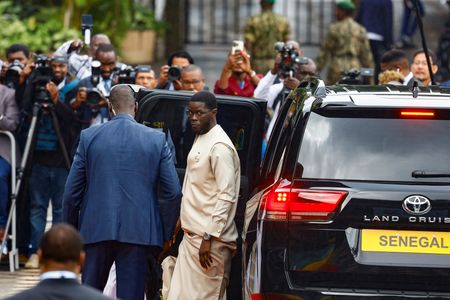
DAKAR — Senegal’s President Bassirou Diomaye Faye is moving forward with plans to establish his own political party, according to a statement from a coalition that supports him — the clearest sign yet of a lasting break between Faye and the prime minister he recently removed from office.
The pro-Faye coalition announced late Friday that the president has directed senior adviser Aminata Toure to put together a task force responsible for building the new party.
Up until now, Faye had been a member of the ruling Pastef party, which is led by Ousmane Sonko. Faye removed Sonko from the prime minister’s post in May, bringing to a head months of growing friction between the two men.
Sonko has since taken on the role of speaker of the National Assembly, where he has been pushing for changes to the constitution. Among those proposed changes is a provision that would prohibit a sitting president from also leading a political party.
Lawmakers approved those constitutional changes last week, but Faye has decided the matter should go to a public referendum. No date for that vote has been announced.
All of this political turmoil is playing out while Senegal faces a significant financial crisis tied to the discovery that the previous government had misreported the country’s debt levels.
Both Faye and Sonko are now looking ahead to local elections set for 2027, which are expected to reveal how much grassroots support each leader commands throughout the country.
AIX-EN-PROVENCE, FRANCE — With France’s 2027 presidential election drawing closer, centrist political hopefuls are making their case to the country’s business community, promising they can bring government spending under control without putting the brakes on economic growth.
The push comes as French corporate leaders grow increasingly anxious about whether centrist politicians — scrambling to reclaim voters lost to the far right and the hard left — will stay committed to fiscal responsibility.
Current polling shows that the far-right National Rally’s eventual presidential nominee will likely be a strong contender to reach the election’s second-round runoff. At least one survey has also suggested that hard-left leader Jean-Luc Melenchon could make the runoff if the political center stays divided.
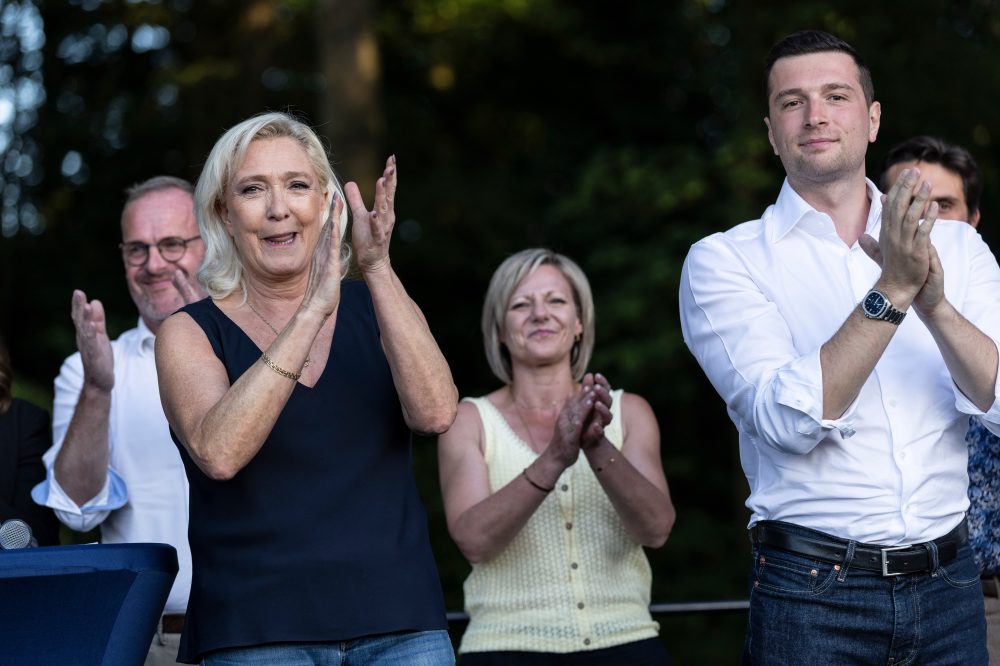
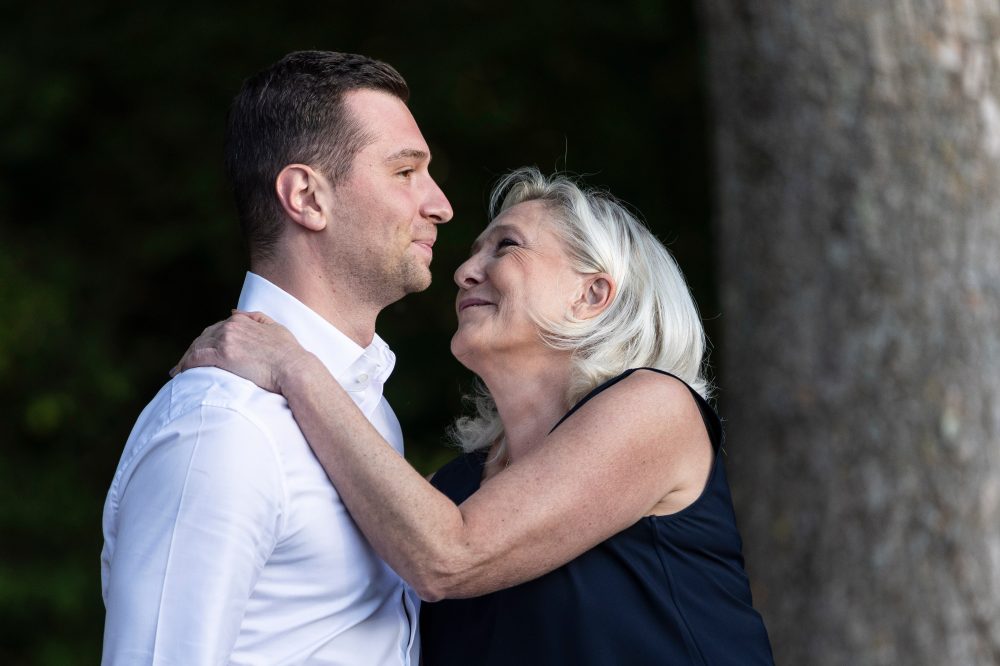
The question of who will represent the far right may be answered soon. Marine Le Pen and her protege Jordan Bardella are waiting on a Paris court ruling set for July 7, when judges will decide on Le Pen’s appeal of an embezzlement conviction and a five-year ban from seeking elected office.
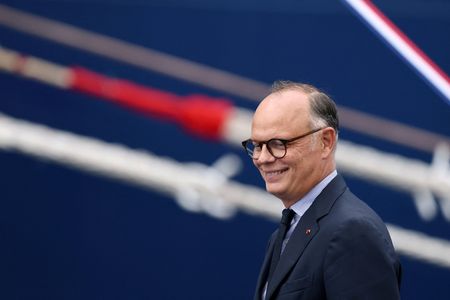
Two former prime ministers who served under President Emmanuel Macron — Edouard Philippe and Gabriel Attal — were among the declared and potential candidates who appeared at an annual business conference in Aix-en-Provence last week, each making the argument that he is best suited to repair the country’s finances.
Attal, 37, drew enthusiastic applause from the audience when he promised to run the government with the efficiency of a private company and remove ministers who fail to deliver results.
“In your company, when a finance director fails to meet their targets or overspends, there’s usually a consequence. It must be the same for those who run the government,” he said.
Tackling the Deficit
France has repeatedly broken European Union rules that limit budget deficits to 3% of gross domestic product. Attal, who held the prime minister’s post in 2024, told the newspaper Le Parisien that he would reduce the deficit from its current 5.1% down to 3% before 2032. He said the bulk of those savings would have to come from welfare spending, which makes up two-thirds of the budget, along with further changes to the pension system and unemployment benefits.
Philippe, who served as prime minister from 2017 to 2020 and currently serves as mayor of Le Havre, told the business publication Les Echos that he would also cut the deficit — from 5% of GDP this year down to 2% by the end of the next presidential term in 2032. He has proposed holding a national referendum to enshrine budget discipline rules in the French constitution and said he would push to raise the retirement age further. The government had paused a gradual increase in the retirement age from 62 to 64, putting that change on hold until after the upcoming election.
Opinion polls suggest Philippe may have the strongest chance among centrists of preventing a far-right candidate from reaching the presidency. At the Aix-en-Provence gathering, he pledged to help dismantle trade barriers within the European Union and work toward consolidating the bloc’s fragmented capital markets.
Xavier Girre, the CEO of French utility group Suez, said his message to any presidential contender is simple: regulatory and tax stability are essential for any future government to give businesses the clear outlook they need to make investment decisions.
A Crowded Field
For years, France’s top business figures kept their distance from Le Pen and her party, which has had little success breaking into corporate boardrooms. But with polls now pointing toward a possible far-right victory next year, some business leaders are beginning to show interest in understanding the movement’s economic positions.
“Business leaders believe that far-right politicians have made progress in their economic analysis and in their understanding of the French economy,” said Alexandre Medvedowsky, who leads the lobbying firm NSI.
Despite that shift in attitude, neither the National Rally nor Jean-Luc Melenchon’s France Unbowed party received invitations to the three-day business conference — consistent with prior years. The event’s organizers said in an emailed statement that the decision to exclude both parties was reached through a group vote.
Benoit Derigny, who oversees the French operations of staffing company ManpowerGroup, noted that center-left and center-right politicians largely agree on what is wrong with France, including its heavy debt burden. He told Reuters that with so many candidates crowding the political center, they will need to differentiate themselves by explaining how they would prioritize limited government resources.
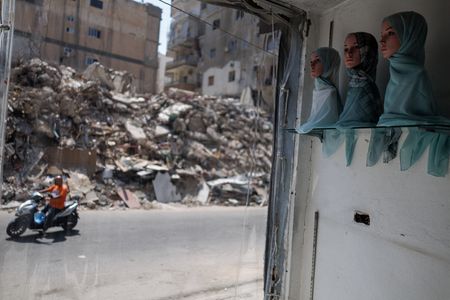
On the beachfront of the coastal city of Tyre, the sounds of war have faded just enough for children to splash in the waves and families to relax under umbrellas — a fragile glimpse of normalcy slowly returning to southern Lebanon.
But just steps away from that shoreline calm, a far grimmer reality awaits the hundreds of thousands of people trickling back to their hometowns after months of displacement. They face the twin burdens of rebuilding lives shattered by Israeli airstrikes and living under the constant shadow of renewed fighting between Israel and Iran-backed Hezbollah.
“People are coming back to Tyre to rebuild, to work — all the restaurants are open again,” said local resident Ali Skaiky, still dripping from a swim and clutching a rubber float. “We still hear strikes and fighting at night, but it’s far away. There’s destruction beyond imagination, but we hope everything will stay calm.”
Skaiky is one of roughly 400,000 people who have returned to southern Lebanon since a ceasefire between Israel and Hezbollah took effect. The truce has not ended the fighting entirely, but it has significantly reduced its intensity.
Those coming home are clearing debris, reopening shops, and trying to piece back together the routines the war tore apart. For many, however, the new normal means keeping a bag packed, staying glued to the news, and never venturing too far from home.
For Fadlallah Qassim, 42, coming home meant facing devastating destruction head-on — including a direct hit on his own house.
“We returned to find the whole house caved in with rubble, and all the furniture ruined,” he said. “I cleaned up, fixed it, and brought some basic things for the house, now my wife, children and I all live in one room.”
In the nearby village of Srifa, where entire neighborhoods were left in ruins, 55-year-old Suzan Fakih described the emotional blow of returning to a place that no longer felt familiar.
“The moment you arrive, it doesn’t feel like your village anymore,” she said. “Everything is black and grey. It hurts your soul. You look around and think, ‘This can’t be the village I’ve lived in all my life.’”
Srifa sits deep in southern Lebanon, near where Israeli forces continue to occupy a stretch of territory and carry out regular strikes on what the Israeli military describes as Hezbollah targets. In surrounding areas, Israel has demolished nearly entire villages.
Fakih said the fear of being forced to flee again never fully leaves residents’ minds.
“I can’t remember a time in my life when I wasn’t living with a bag packed, ready to leave. A few quiet years pass, then you pack your bags and run again,” she said.
Lebanon’s social affairs ministry reports that 600,000 additional people remain internally displaced due to the ongoing violence and widespread destruction. Many families whose homes were completely destroyed are still sheltering in schools or the rented accommodations they escaped to during the fighting.
Lebanon has endured the deadliest regional fallout since U.S. and Israeli strikes on Iran in February set off a broader conflict. Fighting spread to Lebanese soil on March 2, when Hezbollah launched attacks on Israel in solidarity with Tehran, prompting an Israeli air and ground campaign in response. Lebanon’s health ministry reports that more than 4,300 people have been killed in the country since the conflict began.
About 20 miles farther north, in the Bekaa Valley town of Sohmor, residents who recently returned home describe living with the same persistent uncertainty. Mohammad Sweid, 31, a manual laborer, continues to pay rent on the house his family fled to during the war — keeping it as a safety net should they need to leave again.
“If something happens again, we may not find another place,” he said.
In the Lebanese capital Beirut, residents of Dahiyeh — a suburb controlled by Hezbollah that has been repeatedly struck by Israel over the past two years due to its role as a hub for Hezbollah’s leadership — are also cautiously working to rebuild.
Moussa Ghamloush, 68, has been repairing his bomb-damaged home and working to reopen his restaurant, which was completely leveled in a separate strike. Despite everything, he says he has no intention of leaving permanently.
“We’re not the kind of people who leave. Our roots are here. We stayed, and if there’s a third war, we’ll stay again.”
Morocco’s counterterrorism agency announced Monday that it had successfully broken up a plot to carry out attacks on sensitive sites and public security targets — a scheme tied to an Islamic State affiliate operating in the Sahel region of Africa.
The Central Bureau for Judicial Investigations, known by its French acronym BCIJ, said ten individuals were taken into custody during coordinated operations carried out across the cities of Agadir, Taroudant, Casablanca, Hajeb, Tetouan, Fqih Ben Salah, and Safi.
According to the agency, early investigative findings revealed that the suspects had sworn loyalty to Islamic State and were receiving direct orders from the group’s Sahel-based branch to execute attacks on Moroccan soil.
The case highlights the growing threat from extremist organizations operating in the Sahel, where both Islamic State and al Qaeda-linked groups have significantly expanded their foothold in Burkina Faso, Mali, and Niger.
When authorities conducted searches, they uncovered bladed weapons, military-style clothing, documents with instructions for constructing explosive devices, digital materials, and chemical substances, the BCIJ stated.
Investigators also discovered a modified vehicle suspected of being prepared for use in either a suicide bombing or a vehicle-ramming attack.
At a warehouse connected to the group, security forces additionally found butane gas cylinders and pressure cookers — some packed with nails and others wired to electrical components.
BCIJ data indicates that Islamic State branches operating across Africa have recruited more than 130 Moroccan fighters in recent years.
Since the agency was founded in 2015, it has broken up dozens of militant cells and detained more than 1,000 individuals suspected of jihadist activity.
The most recent jihadist attack to occur on Moroccan territory took place in 2023, when three IS loyalists fatally shot a Moroccan police officer in Casablanca.
DEIR AL-BALAH, Gaza Strip — Hamas announced Monday that it has disbanded its governing body in the Gaza Strip and is getting ready to hand over authority to a technical committee that has United Nations backing, as part of a ceasefire arrangement facilitated by the United States.
The militant group stopped short of addressing whether it would take the critical step of laying down its weapons or turning over security responsibilities to an international force. However, Hamas framed the decision as a demonstration of its dedication to rebuilding Gaza following years of devastating conflict.
It remained uncertain whether the announcement — which came from a lower-ranking official — would result in any real, tangible changes on the ground.
The Board of Peace, the newly formed entity led by President Donald Trump and tasked with governing and rebuilding Gaza, acknowledged the Hamas announcement but made clear it would evaluate the situation based on “actions, not promises.” In a statement posted to X, the board emphasized that the technocratic committee must take control of all weapons in Gaza, as outlined in the ceasefire agreement.
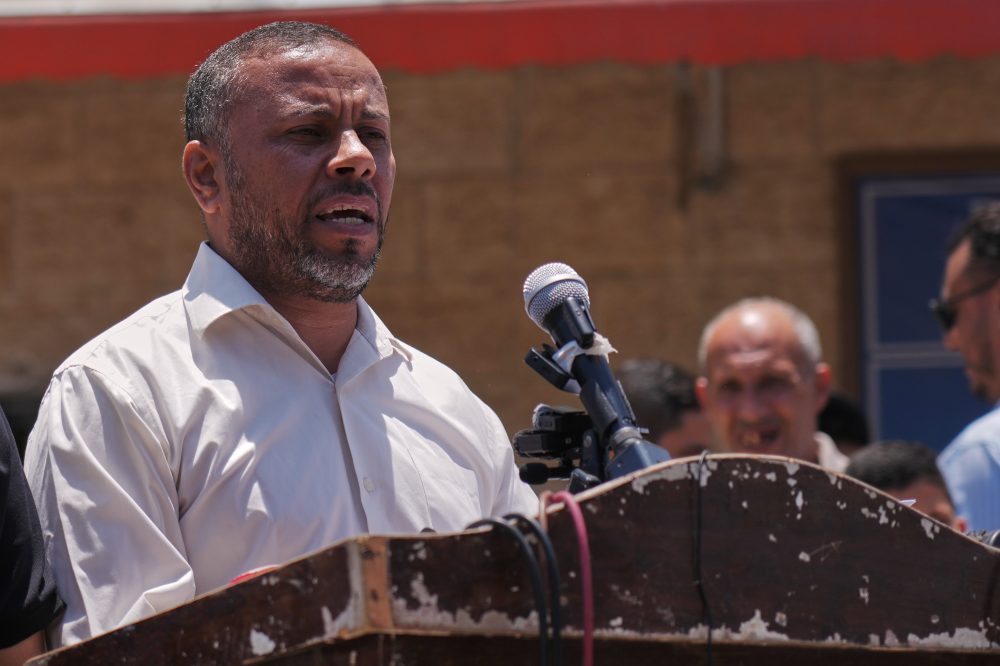
At a press conference held Monday in the courtyard of Al-Aqsa Hospital in Deir al-Balah, Ismail al-Thawabta, general director of the Hamas-run Government Media Office, stated that “only technical and professional staff” would remain in place to handle the day-to-day operations of the Palestinian territory.
“All employees working in service provision are ‘state employees’ and are fully prepared to work under the National Committee for the Administration of Gaza,” al-Thawabta said. Hamas spokesperson Hazem Qassem described the development as “a positive step forward on the path to implement the ceasefire deal.”
Israel, however, rejected the announcement outright. “The alleged resignation of the Hamas government, where all of the Hamas members stay in their positions, is a spin that has no significance,” said an Israeli official who spoke anonymously because they lacked authorization to address the media.
The committee of technocrats is headquartered in Cairo and is led by Ali Shaath, an engineer born in Gaza who previously served as an official with the Palestinian Authority. The committee’s role is to restore basic services and oversee civilian affairs under the watch of both the United Nations and the Board of Peace.
Even nine months after the ceasefire was signed, talks between Israel and Hamas remain largely at a standstill over how to carry out the agreement’s second phase, which includes Hamas disarming and the rebuilding of Gaza. Hamas has maintained that the terms of the first phase must be fully implemented before any discussion of its weapons can take place.
The war was ignited by the October 7, 2023 attack carried out by Hamas-led militants, which resulted in the deaths of approximately 1,200 people in Israel and the taking of 251 hostages. Since then, Israel’s military campaign in Gaza has killed 73,098 Palestinians, according to figures from Gaza’s Health Ministry.
The Health Ministry, which operates under the Hamas-led government, is run by medical professionals and keeps detailed records that United Nations agencies and independent experts generally consider reliable. The ministry does not separate civilian deaths from militant deaths, though it reports that women and children account for roughly half of all fatalities.
Israeli military strikes have dropped off significantly since the ceasefire took hold on October 10, but they have continued on a near-daily basis. Israel’s military maintains that it is targeting Hamas operatives and other militants, frequently stating those individuals were in the process of planning attacks.
On Monday alone, Israeli strikes claimed the lives of at least five people across Gaza — three in Khan Younis in the southern part of the territory and two others in an apartment building in Gaza City, according to health officials. The Israeli military stated it struck a Hamas operative in the Gaza City attack and a Palestinian Islamic Jihad militant in the Khan Younis strikes.
Militants have also continued launching shooting attacks against Israeli troops inside Gaza, and five Israeli soldiers have been killed since the ceasefire went into effect.
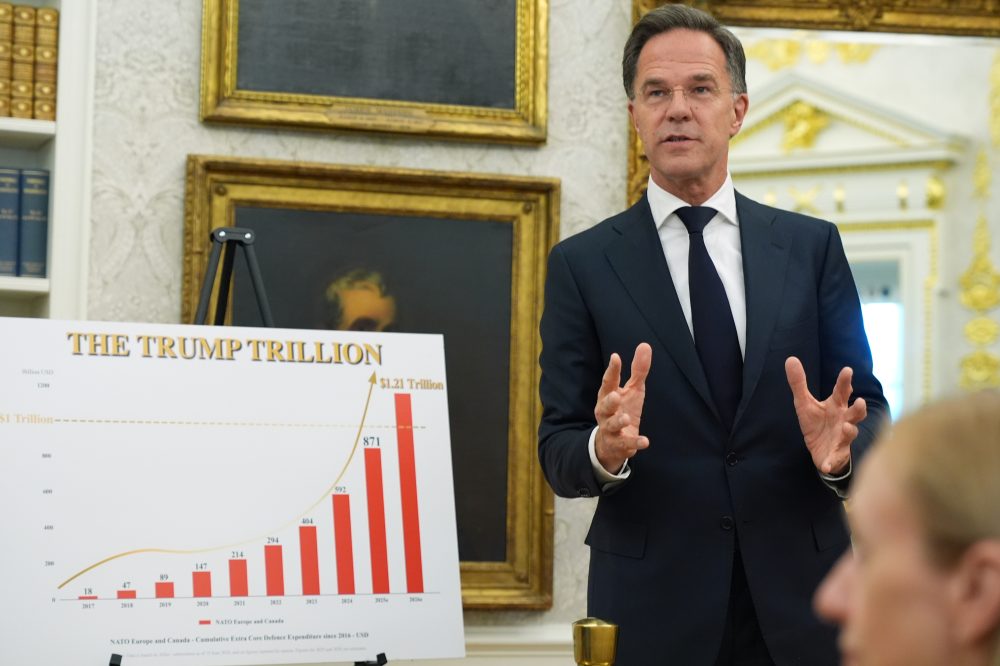
ANKARA, Turkey — NATO Secretary-General Mark Rutte stood firm Monday in calling on the alliance’s member nations to bring “clear, concrete and credible plans” to the table for meeting defense spending targets, ahead of the annual NATO summit in Ankara, Turkey.
All 32 member nations agreed last year to direct 5% of their gross domestic product toward defense-related expenditures — specifically, 3.5% toward actual defense budgets and another 1.5% toward infrastructure improvements such as roads, bridges, and ports that would allow troops and military equipment to move more efficiently during conflicts.
Not all members are fully on board. Spain accepted the overall goal but argued it could meet NATO’s security needs without committing that level of spending. Meanwhile, some nations are still falling short of the alliance’s previous, lower benchmark of 2% of GDP.
Rutte struck a more optimistic tone when discussing European allies and Canada, saying “the evidence we see so far is impressive.” He noted NATO projections show those nations will collectively spend $258 billion more on defense in 2025 and this year combined compared to prior years.
Even so, those figures may not be enough to satisfy the Trump administration. President Donald Trump has repeatedly criticized U.S. allies for not spending enough on their own defense, and has previously threatened to withhold American military protection from nations he deemed to be falling short.
Rutte delivered his remarks in the Turkish capital just ahead of a two-day summit set to begin Tuesday — a gathering that carries added weight as the United States continues to scale back its security commitments in Europe.
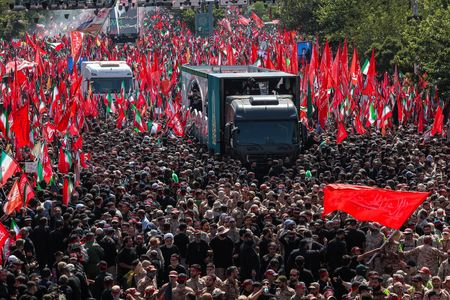
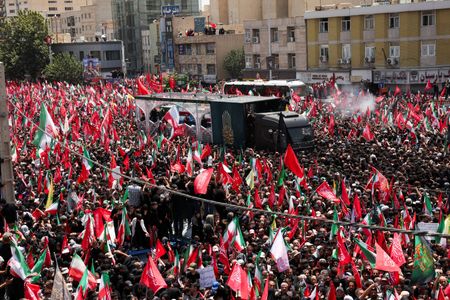
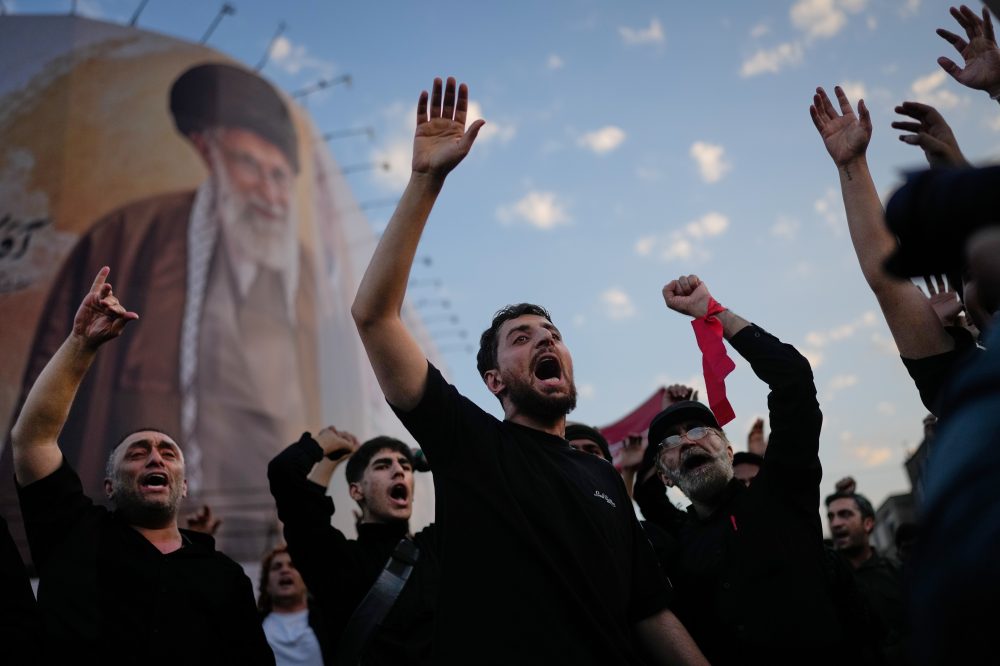
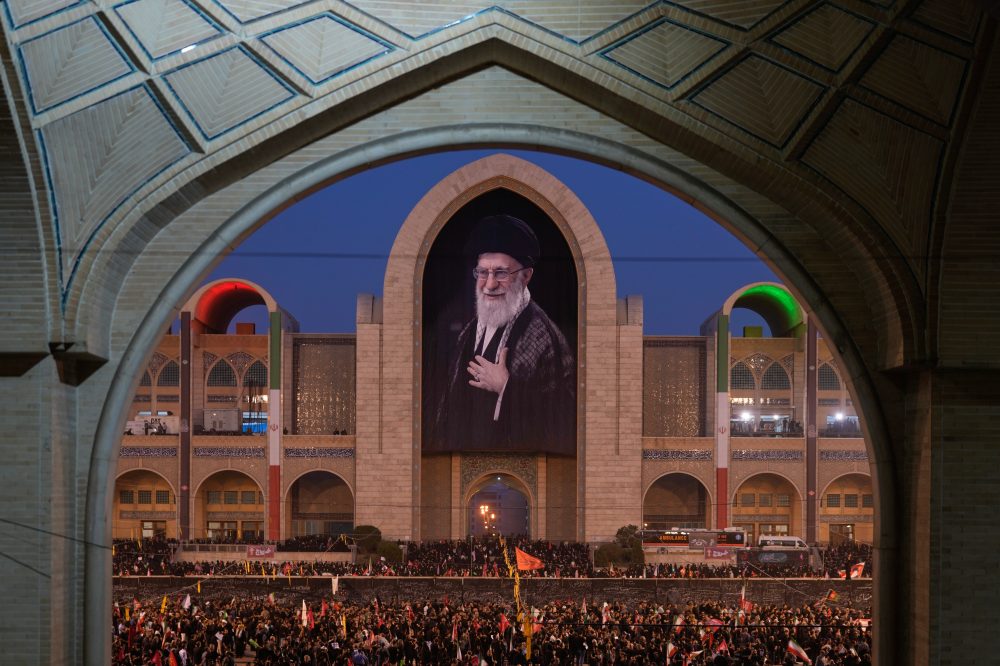
BEIRUT — The massive crowds that gathered in Tehran to mourn the passing of Iranian Supreme Leader Ayatollah Ali Khamenei carried a message that extended far beyond grief. For Iran’s leadership, the outpouring was a statement directed squarely at the United States and Israel: their campaign to cripple the Islamic Republic had not succeeded.
Rather than appearing battered by a war that was triggered by U.S. and Israeli strikes on February 28, Iran chose to project an image of unity, resilience, and determination to influence what happens next in the region.
According to regional officials, diplomats, and analysts, that posture of survival is now the foundation of Iran’s negotiating strategy — with the funeral serving as the moment Tehran attempted to turn endurance into political leverage.
A 60-day ceasefire, which Washington had hoped would restart diplomacy around Iran’s nuclear ambitions, has instead opened a different kind of competition. In this new contest, Iran’s geographic position — not its uranium stockpiles — has emerged as its most powerful card.
Tehran is working to convert gains made during the conflict into lasting strategic influence, particularly by pushing for formal recognition of its dominant role around the Strait of Hormuz, the narrow waterway through which roughly a fifth of the world’s oil and liquefied natural gas flows.
The 60-day countdown toward a final agreement, tied to the ceasefire and an accompanying memorandum of understanding, has not yet officially begun. In that gap, Iran is calling the shots.
Alex Vatanka of the U.S.-based Middle East Institute said Tehran views Hormuz less as a money-making opportunity and more as a source of political standing. “The symbolic part is more important for the Iranians than revenues,” Vatanka said. “They want some kind of symbolic acceptance that the Strait is Iran’s. It’s about accepting Iran as the sovereign power over the Strait.”
Drawing on a Persian proverb, Vatanka put it bluntly: “Why give away a diamond for a lollipop?” In Tehran’s view, control of Hormuz is the diamond. Sanctions relief and access to frozen assets are the lollipop.
Iran’s parliamentary leadership has reinforced this stance. Parliament Speaker Mohammad Bagher Qalibaf declared that “the Strait of Hormuz is our greatest power tool; we must properly protect this divine blessing,” and vowed that Iran would “under no circumstances relinquish its rights” there.
Regional sources and diplomats say Iran is intentionally dragging its feet in negotiations to cement what it sees as the rewards of the war before pivoting back to the nuclear issue. Alan Eyre, a former U.S. diplomat with deep expertise on Iran, said Tehran sees no urgency on uranium while its position on Hormuz remains unsettled. “Iran is perfectly happy to play for time and just drag negotiations out,” Eyre said. “It wants control of Hormuz and is holding talks to institutionalise that control.”
That control could take shape through transit arrangements, coordination agreements, or fees for services along the strategic corridor, while Gulf nations watch to see whether Washington can reverse the new reality on the ground.
Eyre also noted that Iran believes U.S. President Donald Trump — facing domestic political pressures and reluctant to spark another confrontation ahead of November’s midterm congressional elections — is under greater pressure to reach a deal than Iran is to offer concessions. “The Iranians know that President Trump wants to get out; he wants to move on,” Eyre said. “They know they can squeeze him because time is on their side.”
Aaron David Miller, a former U.S. Middle East negotiator, said Washington’s military campaign failed to dislodge Iran’s leverage, leaving American diplomacy with a flawed ceasefire that has itself become a point of contention. He said Tehran has little incentive to engage seriously on its nuclear program until it is satisfied that the new reality around Hormuz is accepted and that meaningful headway has been made on freeing billions of dollars in frozen assets held abroad.
“The 60-day clock was always a fantasy,” Miller said. “The Iranians are not going to move to the nuclear file until they’re relatively confident they’ve achieved this new status quo. They want to make sure that Trump understands, and that the world understands, that there’s no going back to February 27.”
Miller pointed to what he called the defining reality of the post-war landscape: neither U.S. military force nor the threat of a naval blockade fundamentally changed Iran’s position on the strait. “They’re not going to give it up,” he said.
Ebtesam Al-Ketbi, president of the Emirates Policy Center, argued that by ending the war without resolving its root causes, Washington may have inadvertently elevated Hormuz from a pressure point into a permanent source of leverage for Tehran. Gulf officials fear that Iran’s demonstrated ability to shape events around the strait has given it an advantage it will be unwilling to trade away, even for sanctions relief or nuclear concessions.
“They are twisting the arms of the Americans and everybody,” Al-Ketbi said. “Now that they have found this Hormuz treasure, they will not leave it.”
Analysts say Washington will likely have to accept a reopening of the strait largely on terms set by Tehran. As Eyre summarized: “No one’s going to win, but Iran will lose less than the United States will.”
BAKU — Azerbaijan’s Foreign Ministry took formal diplomatic action Monday, calling in Russia’s ambassador to lodge a protest over what it characterized as a Russian drone attack on a fuel station owned by the state oil and gas company SOCAR, located in Ukraine’s Mykolaiv region. The strike occurred on Sunday.
Russia has been targeting fuel stations across Ukraine as a countermeasure against Kyiv’s growing campaign striking energy infrastructure inside Russia — attacks that have led to fuel shortages across numerous Russian regions.
Azerbaijan’s Foreign Ministry noted that this was not an isolated incident, pointing out that other SOCAR-operated facilities in Ukraine — including an oil storage depot in Odesa — had already suffered damage in earlier military strikes.
“The continuation of such incidents, despite repeated warnings, indicates the deliberate nature of these attacks,” the ministry stated in an official release.
As of Monday, Russia had not issued any public response to Azerbaijan’s diplomatic complaint or the allegations made against it.
Since Russia launched its large-scale military invasion of Ukraine in February 2022, Azerbaijan has worked to preserve its relationships with both Moscow and Kyiv. The country has provided humanitarian assistance to Ukraine while stopping short of joining the Western-led sanctions imposed on Russia.
Pakistan has been quietly working to bring together Libya’s rival factions in an effort that, if successful, would significantly boost Islamabad’s standing on the world diplomatic stage, two Pakistani sources have revealed.
The mediation push comes as observers have watched for months as the United States has worked to find a diplomatic resolution in Libya — a country that has been divided between competing eastern and western governments ever since a civil war erupted following the 2011 NATO-backed uprising that brought down Muammar Gaddafi.
Pakistan has already played a notable role this year as a go-between in separate talks involving the U.S. and Iran, a contribution that has been repeatedly acknowledged by the Trump administration. One of the Pakistani sources said the U.S. is “fully aware and involved” in Pakistan’s efforts in Libya as well.
Saudi Arabia is also supporting the initiative, both sources confirmed. Pakistan and Saudi Arabia signed a mutual defence agreement last year, and Riyadh has long sought to extend its influence in Libya.
According to both sources, the mediation effort got underway late last year, with both Libyan sides requesting Pakistan’s participation. How closely Pakistan has been coordinating with other regional players remains unclear.
Pakistan’s foreign ministry, its military media wing, officials from both Libyan factions, and the foreign ministries of Qatar, Turkey, Saudi Arabia, and the United States did not respond to requests for comment.
What a Unity Plan Could Look Like
Analysts say any workable plan to reunite Libya would need to satisfy the competing interests of outside powers while resolving long-standing disputes over government posts, election rules, and oil revenues — issues that have derailed previous attempts at reconciliation.
“The United States has been pushing hard in Libya,” said Jalel Harchaoui, a contributor to Britain’s Royal United Services Institute think tank, “but the format it is trying to impose is still loose and ill-defined.”
A summary of a proposed “Libya Reunification Plan” obtained by Reuters would create a 36-month transitional power-sharing arrangement under a body called the Government of National Consensus and Presidential Council.
Under the proposal — which one Pakistani source noted is still being refined — Abdulhamid Dbeibah of the U.N.-recognized, western-based Libyan Government of National Unity would serve as prime minister, while Saddam Haftar, deputy commander of the eastern-based Libyan National Army, would chair the Presidential Council.
The faction loyal to Saddam Haftar’s father, Khalifa Haftar — the Libyan National Army’s commander-in-chief — controls a large portion of Libya’s oil infrastructure. The plan would give him authority over the national budget.
One Pakistani source said Pakistan intends to play “an active role in making sure this whole arrangement stays in play,” though details are still being worked out.
Pakistan’s Diplomatic Moves
Last month, Pakistan’s army chief Asim Munir held a meeting with Saddam Haftar in Rawalpindi. Just days afterward, Haftar traveled to Washington, where he sat down with Secretary of State Marco Rubio.
The State Department said at the time that Rubio welcomed the efforts of Libyan leaders to overcome their divisions and reaffirmed Washington’s support for a unified Libya.
While analysts consider Pakistan a secondary player in Libya — where the U.S., the UAE, Turkey, and Egypt have competed for influence for years — Islamabad has maintained ties with both Libyan sides, something other regional actors may not be able to claim.
As Reuters reported in December, Pakistani officials have pursued defence ties with the eastern-based Libyan National Army, including discussions about the possible sale of JF-17 fighter jets and Super Mushshak trainer aircraft, despite an active U.N. arms embargo.
Meanwhile, the rival western government recently sought direct talks with Pakistan as well, according to an unreported document reviewed by Reuters.
Qatar and Turkey — one of the western government’s most significant backers — were among those who encouraged Pakistan to take on a mediation role, two Pakistani sources familiar with the situation said.
Tarek Megerisi, director of geopolitical advisory firm Informmi, offered a note of caution, warning that there is no guarantee any agreement reached would hold. He pointed to a deal struck last year between the leaders of Rwanda and the Democratic Republic of the Congo that fell apart within months.
LONDON (AP) — The United Kingdom moved Monday to impose sanctions on nine Russian individuals and organizations accused of developing chemical weapons used in two high-profile poisoning cases — one targeting opposition leader Alexei Navalny and another aimed at a former Russian intelligence officer living in England.
Britain’s Foreign Office announced the measures against seven individuals and two scientific research institutes, saying they played roles in producing the epibatidine toxin used to poison Navalny at an Arctic prison facility in 2024, as well as the Novichok nerve agent deployed in a 2018 attack in the English city of Salisbury. That attack targeted former Russian spy Sergei Skripal and left him and his daughter seriously injured. A local woman named Dawn Sturgess also died as a result of the attack.
Among those sanctioned were the Russian state scientific research institute SC Signal and GNIII VM, also known as the State Scientific Research and Testing Institute for Military Medicine, along with multiple senior officials and scientists.
Foreign Secretary Yvette Cooper condemned the actions, stating that “Russia’s repeated use of chemical weapons is a sickening violation of international law and a direct threat to global security.”
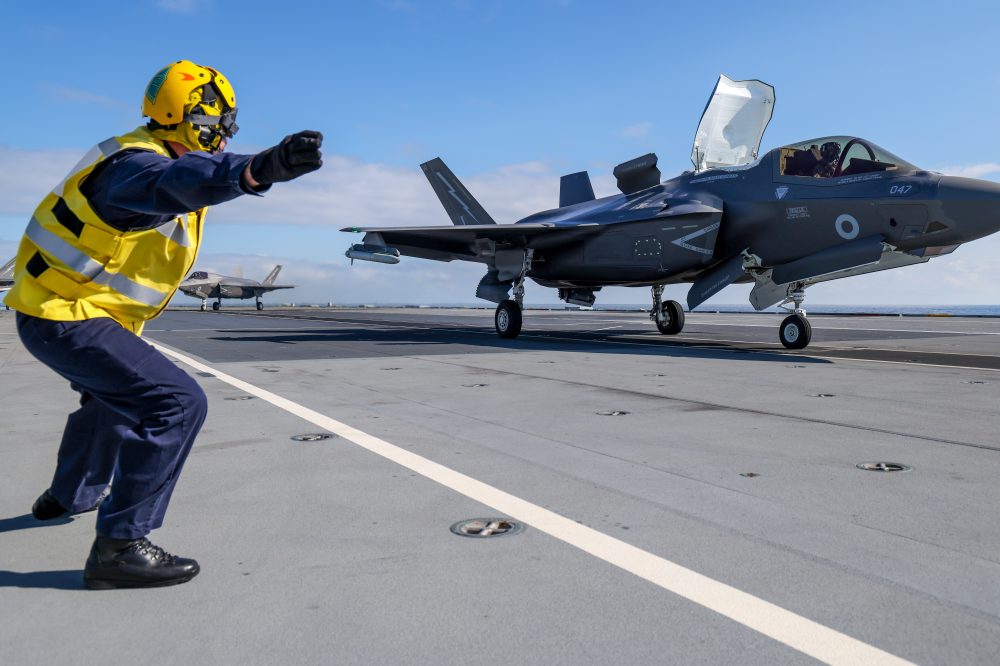
Separately on Monday, Britain’s defense ministry released photographs showing U.K. F-35 fighter jets intercepting a Russian Bear-F maritime patrol aircraft that had approached a British carrier strike group in the Norwegian Sea. The HMS Prince of Wales and other British ships are currently operating in the Arctic as part of NATO missions.
According to the ministry, the incident occurred on Thursday when the Russian aircraft “passed at low altitude and unnecessarily close to HMS Prince of Wales and dropped a large number of sonobuoys in close proximity to the carrier.” Sonobuoys are floating monitoring devices that use sonar technology to detect submarines and other vessels.
“This activity was unsafe and unprofessional. The Russian aircraft was intercepted and escorted by two UK F-35 jets from HMS Prince of Wales until it left the area,” the defense ministry said in an official statement.
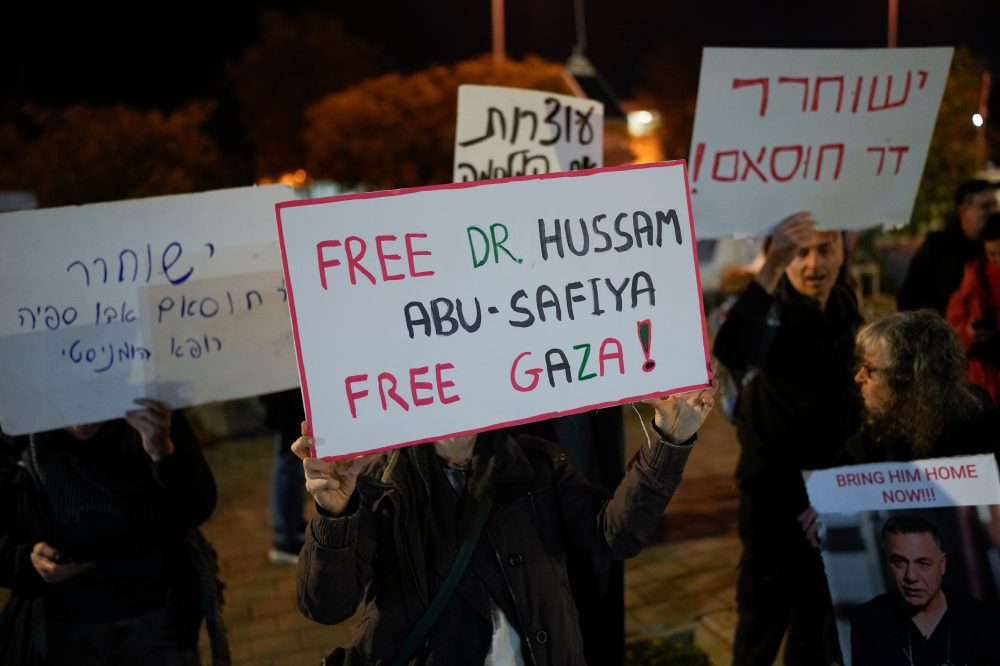
Hamas announced Monday that it has dismantled its de facto governing body in Gaza, signaling a willingness to hand power over to a group of Palestinian technocrats as part of a U.S.-backed peace plan — while simultaneously pressing Israel to follow through on its own obligations under the stalled agreement.
The governing body that Hamas dissolved had been overseeing ministries in Gaza for more than a decade. Its elimination was a key requirement under a post-war framework laid out by U.S. President Donald Trump following the start of a fragile ceasefire with Israel in October.
Hamas clarified, however, that the ministries themselves and their staff would remain in place. The group also said it would continue to oversee security and policing in areas of Gaza still under its control as a result of the U.S.-brokered truce.
The Trump-appointed Board of Peace, which was created to monitor implementation of the plan, acknowledged Hamas’s action but stopped short of endorsing it. The board stated that “ultimately, our assessment will be guided by actions, not promises, to meet the critical needs of the people of Gaza.”
Israel had not issued an immediate response to Hamas’s announcement. Hamas has accused Israel of repeatedly breaking the terms of the ceasefire and failing to carry out other elements of the agreement, which requires Israeli forces to pull out of Gaza in exchange for Hamas laying down its weapons.
At a press conference in Gaza City on Monday, Ismail Al-Thawabta, director of the Hamas government media office, confirmed that the head of the “Government Emergency Committee” oversight body had stepped down and that the body had been formally dissolved.
Al-Thawabta described the move as “a demonstration of the seriousness of these measures, in implementation of the agreed arrangements, and to facilitate the administrative transition process” to the U.S.-backed National Committee for the Administration of Gaza.
Under the Trump-backed plan, Hamas is expected to transfer governmental oversight to that National Committee — a body made up of Palestinian technocrats backed by the United States.
Ali Shaath, who leads the 15-member National Committee, said his group was prepared to take on its responsibilities in Gaza once the “necessary resources and enabling conditions for its work are in place.” In a Facebook post, Shaath wrote that “the fundamental requirements for the commission’s success are the existence of one authority and one law under a clear reference framework, and one weapon subject to that authority.”
The situation on the ground in Gaza remains dire. Israeli forces currently control more than 60% of the territory, which Prime Minister Benjamin Netanyahu describes as a buffer zone meant to prevent Hamas attacks. Netanyahu has stated that Israel will not withdraw from Gaza.
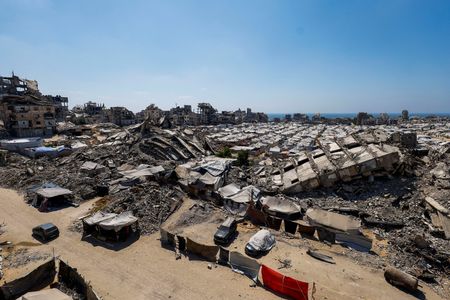
Israel’s military campaign has displaced nearly the entire population of approximately 2 million people, most of whom are now living in tents or damaged structures along a narrow coastal strip still under Hamas control.
On Monday, Gaza health officials reported that an Israeli airstrike killed a couple inside an apartment in the Tel Al-Hawa neighborhood of Gaza City. Two additional strikes — one hitting a tent sheltering displaced civilians and another targeting a vehicle in Khan Younis in the south — left three people dead and at least 20 others wounded, according to medics. The Israeli military did not immediately comment on the incidents.
Hamas has refused to disarm until Israel stops its attacks in Gaza. Israel maintains that its military operations since the ceasefire have been aimed at neutralizing militant threats. The small coastal territory has been in ruins for more than two and a half years since the current conflict was ignited by Hamas’s October 7, 2023 attacks on Israel.
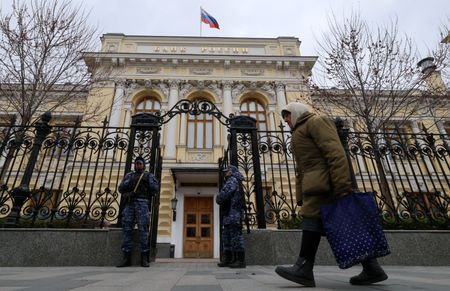
A confidential European intelligence report is warning that Russia could be headed toward a full-blown banking crisis, with the country’s ongoing war against Ukraine placing enormous financial strain on its lenders.
The two-page document, recently prepared to brief European officials on the condition of Russia’s financial sector, outlines how vulnerable Russian banks have become to additional Western penalties. Reuters obtained a copy of the report.
Although Russian banks have largely managed to survive the wave of sanctions that followed Moscow’s full-scale invasion of Ukraine in 2022, the June report cautions that worsening loan quality and rising household debt levels have created an “explosive” risk. The warning comes just as the European Union is finalizing a 21st round of sanctions — expected to be completed in July — that would target banks and cryptocurrency networks.
Russia’s central bank did not respond to requests for comment on the report’s findings, though officials there have recently downplayed the likelihood of a major financial collapse.
With the financial toll of a four-year conflict steadily draining government funds, Russia has leaned more heavily on its banks to prop up businesses and borrowers. According to the report, this has loaded those banks with significant risk at a time when the broader economy is showing signs of strain.
Russia’s Economy Ministry has already lowered its growth projections, cutting its gross domestic product forecast to 0.4% for 2026 — down from an earlier estimate of 1.3% — and to 1.4% for 2027, compared to a previous forecast of 2.8%.
The intelligence document, officially titled “Note on the probability of a banking crisis in Russia in 2026,” describes how banks have been pressured into offering discounted loans to defense contractors, homebuyers, and other borrowers. The report’s authors noted that government-backed lending programs, loan restructuring arrangements, and state support have obscured just how fragile the banks really are.
“The situation creates the illusion of a dynamic economy that, in reality, conceals an explosive situation which an economic shock, such as an ambitious package of sanctions against banks … could trigger,” the report stated.
Loans extended to defense firms, government-backed regional projects, and homeowners have swelled the volume of credit that may go unpaid, the report’s authors said. They estimate that roughly 10% of corporate loans are now considered doubtful — a significant jump from 2024 — while some major banks reported retail non-performing loan ratios as high as 15% in 2025.
The report also revealed that more than 500,000 Russians filed for personal bankruptcy in 2025, a figure nearly one-third higher than the year before. Meanwhile, state programs have encouraged more than 13 million Russians to carry at least three loans at the same time.
Russian central bank Deputy Governor Filipp Gabunia pushed back on those concerns last month, saying that “vulnerabilities in the financial sector are not critical.” He pointed to bank capital reserves being at their highest level in three years, and noted that corporate bad loans had held steady at around 4% over the past year and a half.
Outside analysts offered a mixed assessment. “Russia’s economy is stagnating but the dominance of the state and defence spending means there is no immediate financial crisis to hand,” said Chris Weafer, a Russia expert at consultancy Macro Advisory.
Weafer was skeptical that new Western measures would push Russia over the edge. “Asia ignores sanctions. So the idea that a fresh round will tip Russia into crisis is wishful thinking,” he said, adding that defense expenditures were helping keep unemployment low and wages elevated.
The European Union has rolled out extensive sanctions against Russia since the invasion began, targeting bank revenues, international financial transfers, energy exports, and the defense industry. Russia has shown resilience in the face of those measures, while Europe has struggled with enforcement due to the absence of a central oversight authority.
Adding to Europe’s challenges, the United States under President Donald Trump eased some sanctions, at one point temporarily allowing Russian oil sales — though that waiver lapsed in mid-June.
European diplomats are now working on a package that would expand sanctions to cover banks, cryptocurrency networks, drone manufacturing, and oil traders and refiners. The proposed measures would add scores of individuals and entities to the blacklist, including nearly 90 banks, pushing the total number of sanctioned lenders to more than 100 — representing over half of Russia’s internationally connected banking institutions.
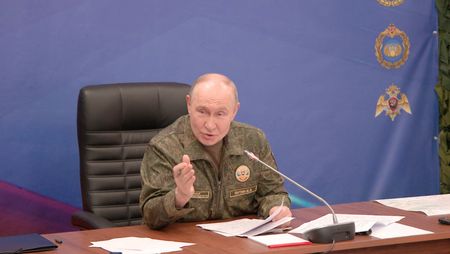
Russian President Vladimir Putin recently declared that Russia would continue pursuing its goal of fully seizing four Ukrainian regions, dismissing what he described as a new Ukrainian proposal to scale back hostilities. Putin also indicated that Russia anticipates a resumption of U.S.-led diplomatic efforts to end the conflict, pending resolution of what he called the “hot phase” of the U.S.-Israeli confrontation with Iran.
There are signs that the financial pressure is mounting. Russia’s second-largest lender, VTB, is planning to increase its financial reserves, according to the bank’s first deputy CEO, who spoke with Reuters on Friday. The move is intended to provide a buffer against higher fuel prices and potential loan losses.
Data from the Russian central bank also shows that the amount of cash being kept outside the banking system has climbed more than 17% compared to the same period last year, now exceeding 19 trillion roubles — roughly $243 billion. That trend is squeezing banks that depend on customer deposits to fund their lending operations.
Taras Skvortsov, chief financial officer of Russia’s largest bank, Sberbank, acknowledged the pressures but suggested the banking sector has adapted. “All major banks are already under sanctions … and when they were introduced in 2022, there was stress,” he told Reuters. “By 2026, everyone has become so used to it. Many clients of the sanctioned banks do not even know about sanctions.”
DAR ES SALAAM, Tanzania — Tanzanian authorities have rounded up dozens of individuals in the days leading up to planned anti-government demonstrations, escalating a broader crackdown targeting calls for democratic reform and the freedom of a prominent opposition figure.
On Sunday, army spokesperson Sylvester Mangure issued a warning to the public against taking part in any demonstrations, following a government-imposed ban on political rallies announced the previous week. Mangure also accused unidentified individuals of “recruiting youth” to join the protests, while claiming those individuals had falsely suggested the military supported the planned demonstrations.
Young activists have called for protests on Tuesday, a date that coincides with the 72nd anniversary of the ruling party’s founding. Their demands include democratic changes and the release of opposition leader Tundu Lissu, who faces treason charges after he publicly pushed for electoral reforms ahead of last year’s general election.
President Samia Suluhu Hassan was declared the winner of the disputed October election with 97% of the vote, even as the two main opposition parties — Chadema, which Lissu leads, and ACT Wazalendo — boycotted the contest. A government-appointed committee found that more than 500 people died during three days of violent unrest that followed the election. Human rights organizations and opposition figures contend the actual death toll was considerably higher.
Mangure urged citizens on Sunday to report anyone they suspected of organizing or recruiting for the protests, while vowing that the military would protect the nation’s stability.
“The army encourages citizens to continue engaging in nation-building activities without fear, and it will not hesitate to take action against those disrupting peace as provided for under the constitution,” he stated.
Security forces have significantly increased their presence throughout Dar es Salaam, the country’s commercial hub, with soldiers and police officers deployed along major roads and in public areas. Critics argue the show of force is designed to discourage would-be protesters, though authorities have stopped short of officially linking the heightened security to Tuesday’s planned demonstrations.
Tuesday also marks the opening of the city’s 50th Dar es Salaam International Trade Fair, known locally as SabaSaba, one of the nation’s largest annual commercial gatherings.
Police spokesperson David Misime said on Saturday that law enforcement had stepped up operations and moved against groups allegedly working to mobilize participants for what officials are calling illegal demonstrations.
“Strong action will be taken against anyone who participates in the unlawful riots being mobilized through social media,” Misime warned.
Prime Minister Mwigulu Nchemba revealed last week that arrests had already been made in connection with efforts to recruit young people for Tuesday’s protests, though he declined to provide a specific number of those detained.
LONDON (AP) — Nigel Farage is a politician who typically thrives in the spotlight, but he has gone noticeably quiet in recent weeks.
The leader of the anti-immigration party Reform UK has pulled back from his near-weekly press conferences and regular media appearances as scrutiny mounts over financial gifts he allegedly failed to disclose.
Farage, a well-known British supporter of U.S. President Donald Trump, insists he has done nothing wrong. Still, the questions surrounding his finances have fueled speculation about whether his political future — once seen as a possible path to prime minister — could be in jeopardy.
Reform UK holds just eight of the 650 seats in the House of Commons, yet the party consistently outpolls both the ruling Labour Party and the main opposition Conservatives in public surveys.
Farage is already the subject of a probe by Parliament’s standards watchdog over a 5 million pound ($6.7 million) gift from a Thailand-based cryptocurrency billionaire. Then on Sunday, an opposition politician called on the same watchdog to launch a second investigation — this time over donations from a convicted fraudster.
Liberal Democrat lawmaker Josh Babarinde stated that “there is a serious question as to whether Mr. Farage met his obligations under the Code of Conduct” for members of Parliament.
The Sunday Times has published claims about Farage’s financial ties to George Cottrell, a 32-year-old aristocratic crypto-gambling entrepreneur who has served as an on-and-off aide to the Reform UK leader.
Cottrell was taken into custody at Chicago’s O’Hare airport in 2016 while traveling alongside Farage. He faced 21 counts related to money laundering, fraud, blackmail, and extortion after allegedly offering to launder money for undercover agents who were posing as drug traffickers. He ultimately pleaded guilty to a single wire fraud charge, admitting he had tried to deceive criminals on the dark web by pretending to be a money launderer. He spent eight months behind bars.
Despite his criminal history, Cottrell remains close to Farage. The Sunday Times reported that Cottrell provided funding for Farage’s staffing and security ahead of Britain’s 2024 general election, as well as access to a London townhouse located near Buckingham Palace.
Reform Treasury spokesman Robert Jenrick described Cottrell as an “old friend” of Farage with no official role in the party. Jenrick confirmed that Cottrell had covered expenses for Farage’s security and staff but said those payments were made “before he became a Member of Parliament” in July 2024.
Under U.K. rules, newly elected lawmakers are required to disclose any gifts valued at more than 300 pounds ($400) that they received in the prior 12 months — unless the gift “could not be reasonably thought by others” to be connected to their political activities.
Farage responded to the allegations by calling the situation an “establishment hit job.”
“I have done no wrongdoing, followed the rules and I am now considering legal action against The Sunday Times,” he said in a statement.
Parliamentary standards commissioner Daniel Greenberg is separately investigating a 5 million pound ($6.6 million) donation Farage received from Christopher Harborne, a British businessman based in Thailand. Farage has characterized that money as a personal gift used to pay for security, and says it was received before he won his seat in the House of Commons.
Should Farage be found in violation of parliamentary rules, he could face suspension. A suspension lasting 10 days or more would give voters in his Clacton constituency in eastern England the right to call a special election for his seat.
Such an outcome would deal a significant blow to a party whose rise mirrors the nationalist, anti-immigration approach associated with Trump. Farage has made the issue of migrants crossing the English Channel in small boats a central part of his platform — calling it an invasion — though critics accuse him of inflaming the issue rather than solving it.
Reform UK, which has attracted several high-profile defectors from the Conservative Party, scored major gains in local and regional elections in May. Those results contributed to Prime Minister Keir Starmer being pushed out by members of his own Labour Party.
However, Reform UK has also dropped three consecutive special elections it had hoped to win, raising questions about whether its support is beginning to slip. The most recent defeat came against Labour’s Andy Burnham, who is expected to succeed Starmer as prime minister within weeks.
The controversy surrounding Reform UK’s funding has renewed calls to overhaul Britain’s political finance laws. While strict limits exist on election spending, political parties are currently allowed to accept unlimited donations so long as donors are U.K. voters or businesses registered in Britain.
In March, the government announced plans to ban cryptocurrency donations to political parties and impose an annual cap of 100,000 pounds ($134,000) on donations from British voters living abroad. Reform UK had received 12 million pounds ($16 million) from Harborne in the previous year alone.
On Monday, the government expanded that policy, saying the 100,000 pound cap would also apply to donors who relocate to the U.K. from abroad, for one year following their arrival.
A gang of masked thieves carried out a rapid smash-and-grab robbery at a French museum dedicated to the works of luxury glassmaker Rene Lalique and his family, museum staff confirmed — the latest in a string of bold art heists to strike France in recent months.
The burglars forced their way through the front entrance of Musee Lalique, located in the town of Wingen-sur-Moder in the Alsace region of eastern France, roughly 60 kilometers — or about 40 miles — northwest of Strasbourg. Once inside, they made off with around 20 pieces of jewelry collectively worth several million euros, according to France Info and other media outlets reporting on the Sunday morning incident.
The theft happened with remarkable speed. In a statement posted to Instagram, the museum noted that the jewelry was taken “in a very short space of time.” Officials confirmed that the break-in triggered security alarms, staff had already identified which pieces were missing, and law enforcement was actively reviewing closed-circuit television footage as part of an ongoing investigation.
The museum declined to provide further specifics about which items were stolen.
According to the museum’s website, the facility is home to more than 650 works, spanning Art Nouveau jewelry, Art Deco glass, and crystal pieces. Rene Lalique, who passed away at age 85 in 1945, launched his career as a jeweler and became celebrated for incorporating “glass, enamel, horn, ivory and semi-precious stones in his creations.”
In the wake of the robbery, the museum announced it would be shutting its doors temporarily. “The museum will be closed for the forthcoming days in order to make sure it can then be re-opened with full security,” officials stated.
The incident follows a similarly alarming break-in at Paris’s world-renowned Louvre museum last October. While several suspects in that case have since been arrested, the stolen items — described as priceless — have yet to be recovered.
As NATO allies gather for this week’s summit, Secretary General Mark Rutte is expected to tout member nations’ commitment to ramping up military spending. However, the effort has been far from uniform, and the financial strain is already showing in several countries’ budgets.
Facing pressure from U.S. President Donald Trump, all 32 NATO members agreed at last year’s summit to push defence spending to 5% of GDP by 2035 — more than double the combined level for European nations and Canada in 2025.
Since that agreement, two distinct groups have formed. One group, led by Germany and many Nordic and eastern European countries, has managed to carve out the budget room to increase military spending. The other group includes several major economies that are finding the task much harder.
“The UK isn’t managing, for example. France isn’t and Italy isn’t either,” said Guntram Wolff, a senior fellow at the Bruegel economics think tank, referring to the three largest European economies after Germany.
NATO reports that its European members along with Canada spent $90 billion more on defence in real terms last year compared to 2024, as they work toward raising core military spending to 3.5% of GDP by 2035, with an additional 1.5% of GDP earmarked for security-related expenditures.
Ahead of the summit, Rutte highlighted that last year’s new spending amounts to $139 billion in nominal terms and expressed a “strong commitment” to reaching the combined 5% target on schedule.
Germany plans to use a rule change that exempts defence items from tight borrowing restrictions, allowing it to more than double its spending to over €200 billion (approximately $228.38 billion) between now and 2030, according to a budget draft reviewed by Reuters before a cabinet meeting Monday.
Poland, Lithuania, and Estonia — nations where concern about the threat from Russia runs highest — are already well on their way to meeting the new targets. Poland in particular devoted 4.3% of its GDP to defence last year.
Elsewhere, the drive faces both political and financial obstacles.
Britain recently unveiled plans to add an extra £15 billion ($20.01 billion) to its defence budget, with part of that offset by cuts in other areas. However, it came to light that one-third of the total remains without a funding source, presenting an early budget headache for likely incoming Prime Minister Andy Burnham.
Beyond the funding gap, the plan drew criticism from opposition politicians and former military leaders for not specifying when defence spending would reach 3% of GDP — a stepping stone to meeting Britain’s NATO obligation of 3.5% of GDP by 2035.
“Defence spending will likely remain one of the biggest fiscal pressures facing the UK in the medium term,” said Max Warner, senior research economist at the Institute for Fiscal Studies, a think tank.
Italian Prime Minister Giorgia Meloni is expected to announce at the summit that Italy — despite carrying one of Europe’s heaviest debt loads — will raise its combined core and non-core defence spending to 2.8% of GDP in 2026, roughly 0.71 percentage points above last year’s level. However, with increased military spending unpopular among many voters ahead of next year’s national elections, much of the increase will come from domestic security areas such as police operations.
France outlined plans in April to lift its defence spending from around 2% of GDP to 2.5% by the end of the decade, even as it works to bring its overall deficit in line with euro area rules — a difficult financial target as the country approaches its own presidential elections next year.
Spain’s Socialist government, meanwhile, is not expected to move from its position of refusing to spend more than 2.1% of GDP on defence, with any new resources likely directed heavily toward technologies that also have civilian uses.
Adding another layer of concern, NATO officials have questioned the spending figures submitted by the Czech Republic, Slovenia, and Albania, who claimed to have met the alliance’s previous target of 2% of GDP. Those three countries have been asked to review and resubmit their numbers.
“For us, the challenge is to ensure that Allies remain on the credible path towards that 3.5% commitment. If you keep on bumping along at 2%, then you’re not on the credible path,” a senior NATO official said.
Bruegel’s Wolff noted that, unlike at last year’s summit in the Hague, European leaders can now face Trump and point to the fact that they have stepped up to support Ukraine’s war effort, which has demonstrated its ability to hold back Russian advances.
Even so, some observers caution that even if European publics are beginning to accept greater military spending, defence industry suppliers may need stronger assurances that government spending will stay elevated before they commit to the investments needed to expand production capacity.
“There has been a before Trump, and there will be an after Trump, so this 5% target can change any time,” said Ana Boata, head of economic research at Allianz Trade. “So I think there is a bit of scepticism from European defence companies to actually ramp up investments in order to ramp up production,” she added.
JERUSALEM — Prime Minister Benjamin Netanyahu’s government has declared it will resist a Supreme Court order concerning a media regulatory body, bringing back to the forefront a contentious legal and political battle that had deeply divided Israel in the period before Hamas launched its October 7, 2023 attack.
The move comes as the country prepares for a national election anticipated by late October.
What Did the Government Say?
In a statement issued Sunday, the government described a June 17 Supreme Court ruling on the makeup of the Second Authority for Television and Radio as a clear example of the judiciary overstepping its boundaries.
Justice Minister Yariv Levin and Communications Minister Shlomo Karhi both stated that their government would not comply with the ruling.
Levin was the driving force behind a 2023 effort to limit the Supreme Court’s authority — a push that triggered widespread protests across Israel before being set aside following Hamas’ attack. In recent months, however, Netanyahu’s nationalist-religious governing coalition has begun reviving portions of that controversial judicial reform plan.
What Does the Declaration Actually Mean?
In practical terms, the declaration is expected to have little direct effect on the media regulator itself. However, opponents argue the broader implications are serious, saying the move undermines the rule of law and the democratic foundations of the Israeli state. They also warn it could push the country toward chaos and a constitutional standoff between the executive and judicial branches.
“Apparently nothing really happened, but essentially something very dramatic did happen,” said Dina Zilber, Israel’s former deputy attorney general. Zilber said the government had, for the first time, used its formal executive authority to openly disregard a court order, calling it “a harsh blow to the rule of law and to the separation of powers.”
What Is the Political Background?
Israel is scheduled to hold elections by late October, though no specific date has been confirmed. Polling data suggests Netanyahu’s right-wing coalition is likely to lose that vote.
Netanyahu’s Likud party is expected to hold internal primaries ahead of the election, and ministers competing for favorable placement on the party list may be looking to appeal to their base by taking strong stances against the judiciary and media — both of which Netanyahu’s coalition has frequently labeled as left-wing elitist institutions.
Where Does Netanyahu Stand?
Netanyahu himself has not made any public comments on the government’s declaration.
His Cabinet Secretary Yossi Fuchs sought to soften the tone set by ministers Levin and Karhi, clarifying that the government statement did not call for outright disobedience of the court’s ruling, but rather expressed sharp criticism and pledged to pursue all available legal avenues to have the ruling overturned.
The issues of media and judicial power are particularly sensitive for Netanyahu, who is currently standing trial on corruption charges that he denies. Two of the three criminal cases against him involve alleged regulatory favors granted to media figures. Netanyahu has characterized his prosecution as a politically motivated left-wing effort to remove a democratically elected right-wing leader from power.
How Has the Public Responded?
Critics contend that the Netanyahu government is attacking democratic institutions while attempting to shift public focus away from the security failures surrounding the October 7 attack and the ongoing toll of more than two years of war in Gaza, Lebanon, and with Iran.
Israeli President Isaac Herzog, Opposition Leader Yair Lapid, and Attorney General Gali Baharav-Miara have each publicly spoken out against the government’s declaration.
DUBAI — A British couple being held in an Iranian prison on espionage charges is continuing a hunger strike over conditions inside the facility, while also being denied proper medical care and communication with their loved ones, according to HRANA, a U.S.-based Iranian human rights news agency.
HRANA reported Monday, citing information from an unidentified source familiar with the couple’s situation, that Craig and Lindsay Foreman have lost approximately 16 kilograms and more than 14 kilograms respectively since beginning the strike. The organization said Lindsay Foreman had gone roughly 10 days without a medical examination despite experiencing dizziness, body tremors, and severe physical weakness.
According to HRANA, the couple was recently permitted to speak by phone with their attorney, but they remain prohibited from contacting family members or communicating with one another. Items sent by the British embassy — including medications, eyeglasses, books, and personal hygiene products — have not been delivered to the pair, even though prison medical staff and ward officials reportedly approved the items.
The Foremans were taken into custody in January 2025 while making their way through Iran on a motorcycle trip. They were each sentenced to 10 years behind bars on espionage charges, a verdict that was upheld on appeal in June. Both have denied any wrongdoing, stating that no evidence was presented against them and that they were not given a fair chance to defend themselves.
Iranian authorities did not respond to requests for comment.
Britain’s foreign minister Yvette Cooper spoke out against the couple’s sentencing in February, calling it “totally unjustifiable” and pledging that the British government would keep pushing for their release.
Iran’s Revolutionary Guards have a history of detaining foreign nationals and dual citizens, most often on charges related to espionage or national security. Human rights organizations have characterized such arrests as a tactic used to gain leverage in international disputes, describing the practice as part of a broader pattern of politically motivated imprisonment. Iranian officials have rejected that characterization, maintaining that the cases involve genuine security matters.
France appears ready to consider selling the Franco-Italian SAMP/T air defense system to Turkey, marking a notable shift after years of political resistance, according to five sources with knowledge of the situation. The development opens the door to more serious discussions between the two countries.
Four of those sources indicated the change came after French President Emmanuel Macron and Italian Prime Minister Giorgia Meloni held talks during a summit on June 25, just ahead of this week’s NATO gathering in Turkey. However, negotiations are still in their earliest phases.
“Before, there was a clear lack of openness, now there is openness,” one source familiar with the discussions told reporters.
The French presidency, when presented with questions about the matter, said it could not confirm the information and pointed to what it called “significant inaccuracies” — though it did not identify what those inaccuracies were or elaborate further. France’s foreign ministry and defense ministry both declined to comment, deferring to the presidency. Turkey’s foreign ministry did not respond to requests for comment.
Sources said Paris has set aside some of the political concerns that had previously stalled progress, though some hesitations remain. Turkey, France, and Italy had launched cooperation on a potential long-range air defense program between 2017 and 2018, exploring the possibility of jointly developing and producing such a system. That effort ground to a halt as relations between Paris and Ankara deteriorated over conflicts in Syria and Libya, as well as disputes in the Eastern Mediterranean involving Greece and Cyprus.
The SAMP/T — also referred to as the Mamba — is manufactured by the Franco-Italian Eurosam consortium, which includes MBDA France, MBDA Italy, and Thales. The system is capable of tracking dozens of targets at the same time, intercepting multiple threats simultaneously, and is the only European-built system that claims the ability to shoot down ballistic missiles. It is frequently compared to the American Patriot system, though analysts remain divided on its effectiveness, noting it has not yet seen combat use.
Turkey holds NATO’s second-largest military force, but air defense is a significant vulnerability — the country lacks a fully developed missile defense network of its own and depends heavily on NATO systems and aircraft. Ankara has been pursuing the SAMP/T as part of its broader “Steel Dome” integrated air and missile defense initiative.
One source said Italian Prime Minister Meloni and Turkish President Tayyip Erdogan also discussed the matter during a phone call on July 3. Turkish Defense Minister Yasar Guler told Reuters in June that Ankara was weighing options including both the U.S. Patriot and the SAMP/T, and remained open to arrangements involving technology transfers and joint manufacturing.
A Turkish official noted the process had been frozen since 2020 due to Eastern Mediterranean tensions and European Union sanctions. “Now, it appears there is political will on all three sides — Turkey, Italy, France — for this process to advance,” the official said.
Outside of France and Italy, the SAMP/T has only been exported to Singapore. In recent years it has been transferred to Ukraine, and France deployed the system earlier this year to assist the United Arab Emirates in defending against Iranian missile attacks. Italy also sent the system to Turkey in mid-June as part of NATO defense planning.
Any potential agreement would likely involve the newer generation of the system, which is currently being introduced into French and Italian military service. Erdogan and Macron are scheduled to meet on the sidelines of the NATO summit to address bilateral matters.
At NATO’s 2025 summit in The Hague, Erdogan had already pressed Macron to drop his opposition following a thaw in relations between the two leaders. Two sources cautioned that France would still need to address concerns from Greece and Cyprus — both countries with which France has signed strategic defense agreements — before any sale could move forward.
For years, Turkish officials viewed France as the primary political barrier to the program, while Italy has consistently supported sharing the SAMP/T with Turkey to deepen defense industry ties. Momentum has picked up over the past year as Ankara has stepped up efforts to bolster its missile defenses amid growing regional instability, and as NATO allies have taken a fresh look at defense cooperation needs.
Sources emphasized that France’s new openness should not be read as a green light for a sale. “This is just the beginning. It will be a long journey if France agrees to sell it,” said Murat Aslan, a defense and security researcher at Turkey’s SETA foundation.
Deadly violence erupted inside a prison on the outskirts of Sri Lanka’s capital, claiming the lives of at least 25 people and sending more than 100 others to the hospital, according to officials and a local television station reporting Monday.
Police confirmed the unrest broke out at the prison in Negombo, located roughly 35 kilometers — about 22 miles — north of the capital city of Colombo. The disturbance started Sunday and carried over into Monday. Police spokesman Chandana Herath acknowledged there were fatalities but said he could not immediately verify the death toll as reported by local television station Hiru.
According to the TV station’s reporting, those killed and wounded included both prisoners and prison staff members.
Authorities have not yet determined what triggered the violent outbreak.
A hospital official at the main state-run medical facility in the area confirmed that more than 100 people had been admitted for injuries connected to the prison violence. The official spoke without being identified, saying he was not authorized to give statements to the press, and did not provide details about the nature of the injuries.
Sri Lanka’s prison system is severely overcrowded. More than 39,000 inmates are currently held in facilities that were built to hold only 10,000 people.
Four people lost their lives on July 6 after an Israeli drone struck a vehicle in Nabatieh, a city in southern Lebanon, according to Lebanon’s state news agency.
The attack targeted the vehicle directly, resulting in four fatalities, the agency reported.
PARIS (AP) — A Paris appeals court is scheduled to deliver a ruling Tuesday that could determine whether French far-right leader Marine Le Pen will be allowed to compete in France’s 2027 presidential election.
If Le Pen is barred from the race, her 30-year-old protege and National Rally party president Jordan Bardella would step in as the party’s candidate.
Le Pen, 57, is contesting a March 2025 court decision that found her and fellow National Rally members guilty of misappropriating European Parliament funds by employing aides between 2004 and 2016 who allegedly performed party work rather than parliamentary duties. If the conviction stands, she could face a ban from holding elected office, an electronic monitoring tag, or both.
Here is a look at key moments in the careers of Le Pen and Bardella, and how the National Rally evolved into one of France’s most significant political parties:
Marine Le Pen was born on August 5 in Neuilly-sur-Seine, west of Paris. She is the youngest of three daughters of Jean-Marie Le Pen, who would go on to lead the far-right National Front party.
Jean-Marie Le Pen established the far-right National Front, anchoring it in anti-immigration and nationalist ideology. Over the following decades, he repeatedly denied the Holocaust and faced multiple convictions for antisemitism, discrimination, and inciting racial violence.
Bardella was born on September 13 in Drancy, in the northeast of Paris, in what is considered mainland France’s poorest region. He was raised in public housing and is of Italian and Algerian descent.
Jean-Marie Le Pen stunned France by advancing to the presidential runoff, where he was defeated in a landslide by Jacques Chirac. That result signaled the far right’s emergence as a meaningful force in French politics.
Marine Le Pen took over from her father as president of the National Front, beginning a sustained effort to broaden the party’s appeal and shed its extremist reputation. She would later expel her father from the party following renewed controversial statements he made four years into her leadership.
Le Pen made her first presidential run, finishing third in the opening round with nearly 18% of the vote. That same year, a then-17-year-old Bardella joined the National Front.
Le Pen advanced to the presidential runoff for the first time but was defeated by centrist candidate Emmanuel Macron, who captured 66.1% of the vote compared to her 33.9%. During this period, Bardella served as one of the party’s spokespersons, becoming a recognizable face on French television.
The National Front rebranded itself as the National Rally as part of Le Pen’s ongoing strategy to make the party more palatable to mainstream French voters.
At age 23, Bardella led the National Rally’s slate in European Parliament elections. The party finished first in France, earning him a seat as a Member of the European Parliament. He also rose to become one of the party’s vice presidents.
Le Pen reached the presidential runoff for the second time in a row, this time winning more than 41% of the vote against Macron — the best performance ever recorded by France’s far right in a presidential election. Bardella was elevated to president of the National Rally.
The National Rally became the largest single party in the powerful National Assembly but fell short of securing an outright majority.
On March 30, a Paris court found Le Pen and other National Rally officials guilty of misusing European Parliament funds. She was sentenced to prison and banned from seeking public office for five years, with that ban taking effect immediately. She filed an appeal.
The Paris Court of Appeal is now set to issue its decision Tuesday — a ruling that will determine whether Le Pen remains eligible to seek the presidency in 2027. The presidential election is scheduled for April 18 and May 2, to select a successor to Macron, who is constitutionally prohibited from seeking a third consecutive term.
Brazilian Senator Flavio Bolsonaro traveled to Washington to ask the Trump administration at a Monday hearing to hold off on a proposed 25% tariff on Brazilian goods — at least until after Brazil’s October election — in an effort to separate himself from trade levies his political opponents have pinned on him.
Back in June, the Trump administration put forward the tariff proposal, citing alleged trade violations including illegal deforestation and what it described as unfair electronic payment practices. The announcement came shortly after Bolsonaro — son of former Brazilian President Jair Bolsonaro and a presidential hopeful himself — had met with top U.S. officials.
That timing gave Brazilian President Luiz Inacio Lula da Silva, who is widely expected to seek reelection, the opening to blame the right-wing senator for helping bring on the tariffs. Bolsonaro has rejected that accusation.
After the senator later met with U.S. President Donald Trump, the Brazilian government released a statement calling the visit troubling. “It is deplorable that, once again, members of the Bolsonaro family are traveling to the United States to advocate for foreign interference in Brazil,” the statement read.
The younger Bolsonaro’s effort to make U.S.-Brazil relations a central campaign issue fits into a broader pattern of Trump’s increasing involvement in Latin American politics, which has included the capture of former Venezuelan President Nicolas Maduro in Caracas and backing right-wing candidates such as Colombia’s Abelardo De La Espriella, who narrowly won his presidential race last month.
In a formal filing with the U.S. Trade Representative, Bolsonaro pushed back against new tariffs, writing that imposing them now “would hand the current Brazilian government precisely the political victory it has been engineering.”
Public opinion in Brazil appears divided on the matter. A survey released last month by polling firm Quaest found that 47% of Brazilians sided with Lula’s claim that Bolsonaro asked the U.S. to impose new tariffs, while 35% believed Bolsonaro’s counter-claim that he had actually asked for the opposite.
One academic observer described the senator’s Washington trip as an attempt at political damage control. “They are trying to do damage control,” said Leonardo Paz, a professor of international affairs at Ibmec and Fundacao Getulio Vargas, two academic institutions based in Rio de Janeiro.
Brazilian officials have spent months in negotiations with U.S. counterparts trying to head off the tariffs. But Bolsonaro contended that Brazil had not done enough to find common ground with Washington, and proposed that any decision on the levies be suspended for 180 days.
In his submission to the U.S. Trade Representative, Bolsonaro wrote: “Brazil holds general elections in October 2026, and the political landscape that determines the viability of any negotiated resolution will be redefined within roughly ninety days.”
The U.S. has until July 15 to decide whether to move forward with the so-called Section 301 tariffs. If imposed, the tariffs would still exempt certain products, including beef, coffee, rare earths, and aircraft parts.
This latest Washington visit is part of a continuing effort by the Bolsonaro family to cultivate support from the Trump administration. That effort has previously included negotiations to seek White House involvement in the legal case against the elder Bolsonaro, who faced trial over his attempt to reverse his 2022 election loss. Trump had imposed steep tariffs on Brazilian goods last year, characterizing that legal case as a witch hunt. The former president was ultimately convicted.
Despite the senator’s efforts, his push to prevent new tariffs appears to have gained little traction so far. In response to a letter Bolsonaro sent last month asking Washington not to pile on additional levies, Secretary of State Marco Rubio replied that U.S. officials “continue to have substantial differences in resolving the issues” that were cited as justification for the proposed tariffs.
The Danish government has formally stepped into a high-stakes legal battle at the European Court of Justice, filing a written intervention in a case that could determine whether major tech companies must pay for news content they host on their platforms, the country’s Culture Ministry announced Monday.
The lawsuit was originally brought in 2023 by Streamz, Google, Meta, Spotify, and Sony against the Belgian government. The tech companies argue that Belgium’s way of implementing Article 15 of the Digital Single Market Directive — a European Union rule governing press publishers’ rights — conflicts with broader EU law.
Denmark has chosen to side with Belgium in the dispute, which is commonly referred to as the Streamz case. The Danish government is also taking part in the oral hearing scheduled for July 6 and 7.
At the heart of Denmark’s position is the push to hold tech giants financially accountable when newspaper articles or other media content appear on their platforms. Danish officials argue that if the court rules in favor of the tech companies, it could significantly weaken the rights that news publishers currently hold under the Digital Single Market Directive.
At the oral hearing, Denmark plans to urge the court to clearly spell out the boundaries of press publishers’ rights and the obligations tech companies have to compensate publishers when their content is displayed on those platforms.
Denmark’s Culture Minister Zenia Stampe was direct in her criticism of the tech industry’s approach to media content. “In the end, it hits the Danish media hard and damages our democracy,” Stampe said, emphasizing that tech giants should not be permitted to profit from media content without providing payment to those who created it.
This is not Denmark’s first foray into European copyright disputes involving technology companies. The country has also taken part in a separate landmark European copyright case examining whether Google’s use of press releases to train artificial intelligence systems is legally permissible.
Raul Guillermo Rodriguez Castro, the grandson of former Cuban President Raul Castro, has signaled a willingness to enter into negotiations with the United States, according to an interview published by USA Today on Monday.
When asked about the possibility of talks, Rodriguez Castro was direct: “I can negotiate with anyone designated by the U.S. If given the opportunity, (of course with) Trump.”
Beyond diplomatic talks, Rodriguez Castro also indicated that Cuba would be willing to free individuals currently held as political prisoners — though he noted that such a move would depend on the right conditions being in place.
Twenty-five people have died and approximately 100 others were wounded after two groups of inmates clashed inside a prison in Sri Lanka, according to two police sources and a hospital source who spoke with Reuters.
The violence started Sunday between convicted prisoners and detainees being held at the facility, which is located in the coastal town of Negombo — roughly 35 kilometers, or about 20 miles, north of the commercial capital of Colombo. The fighting continued into Monday.
The cause of the confrontation had not been determined as of Monday.
According to police sources, sections of the prison were still being searched and officials were working to get a full accounting of those killed and injured.
Army spokesman Brigadier Waruna Gamage told Reuters that the military had been called upon to assist law enforcement, though troops had not yet been deployed. “Military has been requested to provide support to the police but at the moment they are on standby,” he said.
Footage aired by Derana TV showed a large police presence gathered outside the prison entrance. A police bus was seen departing the facility carrying injured inmates, with some of them lying on the floor of the vehicle.
China’s navy launched a long-range ballistic missile from one of its nuclear-powered submarines in the South Pacific on Monday, a rare move that triggered protests and alarm from several countries in the region.
According to China’s official Xinhua News Agency, the missile lifted off at 12:01 p.m. and carried a simulated warhead. It was the second such test China has conducted in the Pacific in recent years — the country previously fired an intercontinental ballistic missile with a dummy warhead two years ago, which itself was the first such test in international waters since 1980.
China’s Ministry of Defense, through a statement reposted from Xinhua, described the launch as part of routine annual training that followed international law and was not aimed at any specific nation or target.
Analysts noted that the 2024 launch mirrored similar ballistic missile testing carried out by the United States for its own submarine fleet, viewing it as a signal of China’s growing ambitions as a global superpower.
Australia, Japan, and New Zealand all spoke out against the test. The New Zealand government said it received advance notice of the launch only hours before it took place and pointed out that the missile was fired into the South Pacific Nuclear Free Zone — a region protected under the 1986 Treaty of Rarotonga, which bans nuclear weapons throughout the area. China ratified the treaty’s protocols in 1987, committing not to test nuclear weapons within the zone or threaten its use against member nations with territory there.
New Zealand’s Foreign Minister Winston Peters issued a pointed response, telling The Associated Press: “It appears that despite our long-standing concerns about this type of activity, China carried out the test within hours of informing us.”
The launch happened on the same day Australia and Fiji signed a new mutual defense agreement designed to push back against Chinese influence in the Pacific. Australia’s Foreign Minister Penny Wong, speaking to reporters in Fiji, said: “Australia has been clear with China that we regard this as destabilizing to the region.”
Japan’s Defense Ministry called on Beijing to reconsider its missile testing practices to prevent projectiles from flying over Japan or creating other security risks. Chief Cabinet Secretary Minoru Kihara stated: “China’s military activities, combined with its lack of transparency, has become a grave concern for Japan and the international society,” pointing to Beijing’s heightened military presence near Japan and its growing defense budget.
China’s government dismissed the criticism, with a Ministry of Foreign Affairs spokesperson saying: “We hope that the relevant countries will avoid overinterpretation.”
China officially maintains a policy of not being the first to use nuclear weapons, but it continues to invest heavily in nuclear technology and weapons as part of a broader effort to modernize its military forces.
According to the Nuclear Threat Initiative, a Washington-based think tank, China operates a fleet of six ballistic-missile submarines along with 59 nuclear-powered attack submarines. A Pentagon report to Congress released in late 2025 estimated that China held approximately 600 nuclear warheads in 2024, with projections showing the country on pace to surpass 1,000 warheads by 2030.
Britain’s Royal Navy aircraft carrier operating in the Norwegian Sea was repeatedly approached by a Russian patrol plane last week before British fighter jets stepped in to escort the aircraft out of the area, in the latest flashpoint between NATO and Russia.
The UK government labeled the encounter “unsafe and unprofessional.” The incident took place on July 2 and comes just days before a NATO gathering in Ankara on Tuesday, where alliance members are expected to commit €70 billion in military support to Ukraine for 2026.
According to British officials, a Russian “Bear-F” maritime patrol aircraft flew at low altitude and came “unnecessarily close” to HMS Prince of Wales — the aircraft carrier at the heart of a naval formation known as a carrier strike group.
Britain’s Ministry of Defence released a statement saying the Russian plane “dropped a large number of sonobuoys in close proximity to the carrier.” Sonobuoys are devices designed to detect and track submarines operating underwater.
In response, two F-35 fighter jets launched from HMS Prince of Wales to intercept the Russian aircraft and remained on scene until it departed the area.
The British carrier strike group is currently operating under NATO command in the High North, a mission aimed at strengthening security across the North Atlantic amid growing concern over Russian military activity in the region.
Earlier this year, Britain deployed naval vessels to guard against potential attacks on undersea cables and pipelines after Russian submarines spent more than a month in and around UK waters.
In a separate announcement Monday, Britain confirmed that defence minister Dan Jarvis had recently traveled to visit UK forces aboard the carrier while it was stationed in waters near Iceland.
Enormous crowds gathered in the Iranian capital of Tehran on Monday for a funeral procession honoring Ayatollah Ali Khamenei, the slain supreme leader, marking the largest single event in a week of sweeping memorial ceremonies that have underscored the continued hold of Iran’s clerical establishment.
State television broadcast drone footage capturing tens of thousands of people packed tightly along a central Tehran boulevard. A large truck carrying the coffins of Khamenei and four of his family members moved slowly through the crowd, while fire hoses sprayed water from above to help keep mourners cool in the heat.
At one point, as the procession passed beneath a bridge, mourners hurled stones at a billboard hanging overhead. The sign depicted U.S. President Donald Trump with a bullet pointed at his head and carried the message: “The U.S. killed our father. We won’t let you go!”
Participants waved Iranian flags and red banners bearing a slogan calling on the “avengers of Khamenei” — a phrase rooted in a central event of Shi’ite Islam, referencing the killing of the Prophet Muhammad’s grandson in battle during the seventh century.
On Sunday, three of Khamenei’s sons prayed beside his coffin at a large Tehran prayer hall. Notably absent, however, was Mojtaba Khamenei, the son who has since taken over as Iran’s supreme leader. Believed to have been seriously wounded in the attack that killed his father, Mojtaba has not been seen publicly since the conflict began on February 28 with airstrikes by Israel and the United States on Iranian territory.
The formal mourning period began Friday, when the coffins of the elder Khamenei, one of his daughters, her 14-month-old child, a son-in-law, and the wife of Mojtaba were placed on display for Iranian officials and visiting foreign dignitaries. Large outdoor ceremonies followed on Saturday and Sunday before Monday’s major procession through Tehran’s streets.
Later this week, Khamenei’s remains are scheduled to travel to Qom, a significant Shi’ite seminary city in Iran, and then to two Shi’ite shrine cities in neighboring Iraq, before returning to Iran for burial inside a medieval shrine complex located in the city of Mashhad.
The conflict that triggered these events has since concluded. A preliminary peace agreement reached last month left Iran’s clerical government intact and claiming victory, with the country asserting new influence over global energy markets through its control of the Strait of Hormuz.
President Trump has also declared victory in the conflict, though the goals he outlined at the start — dismantling Iran’s nuclear and missile programs, halting its ability to strike neighboring countries, and fostering conditions for Iranians to overthrow their government — have not yet been fully realized. Trump stated over the weekend that formal peace negotiations with Iran had been pushed back by one week due to the ongoing funeral ceremonies.
Israel’s defense minister, Israel Katz, said Monday that Khamenei was killed because he directed a program aimed at destroying Israel. “Any Iranian leader who will again try to pursue plans to destroy Israel will be killed as well,” Katz warned.
GENEVA — The United Nations Human Rights Council voted Monday to formally condemn rising violence carried out by Sudan’s paramilitary Rapid Support Forces in the city of al-Obeid, while also launching an emergency investigation into human rights abuses in the area.
Britain, which chaired the special session, had already sounded the alarm over what it described as the potential for mass atrocities, warning that the RSF’s buildup of forces around one of Sudan’s largest cities echoed the violence that devastated al-Fashir in North Darfur the previous year.
Britain’s Human Rights Ambassador Eleanor Sanders addressed the council directly, stating: “These horrors must not be repeated.”
CAIRO — The United Nations children’s agency announced Monday that more than 300 children have been killed or wounded over the past six months in Sudan’s ongoing war, with drone strikes accounting for the majority of those casualties.
Sudan has been locked in a devastating conflict between its national military and the paramilitary Rapid Support Forces since April 2023. Fighting is now centered in the Kordofan, Darfur, and Blue Nile states, where drone warfare is responsible for roughly 60% of all casualties, according to UNICEF.
The United Nations, the United States, the United Kingdom, and other nations have raised serious concerns about possible atrocities as the Rapid Support Forces and the military battle for control of el-Obeid, a strategically important city in North Kordofan.
The war has claimed the lives of at least 59,000 people, forced approximately 13 million from their homes, and driven large portions of Sudan into famine conditions. More than 30 million people currently require humanitarian assistance.
Drone attacks and artillery fire have struck civilian infrastructure — including schools, markets, and fuel and water stations — putting more than 500,000 people at risk. Civilians in affected areas have endured near-siege conditions for over a year.
“Children are being caught in a relentless cycle of violence, displacement and deprivation,” said Sheldon Yett, UNICEF’s representative for Sudan.
The U.N. urged all parties involved to shield civilians and civilian infrastructure from attack, open pathways for fast and unrestricted humanitarian aid delivery, and take every available step to keep children out of harm’s way.
The global economy handled the loss of more than one billion barrels of oil supply since the start of the Iran war far better than many had feared — but with strategic reserves now largely depleted and lasting peace still uncertain, the risk of future price surges remains very real.
When Tehran moved to choke off the Strait of Hormuz following U.S. and Israeli military strikes launched on February 28, the move sparked widespread alarm about a devastating worldwide energy shortage.
The four-month conflict that followed did produce the most severe energy disruption ever recorded, according to the International Energy Agency. At its peak, the supply shortfall reached 14 million barrels per day.
Despite those staggering figures, the nightmare scenario of empty fuel stations across Asia and Europe never came to pass. Benchmark Brent crude oil prices did climb sharply, reaching around $126 per barrel in April — though that remained roughly $20 short of the all-time record set in 2008. Prices have since fallen back below where they stood when the war first began.
“This suggests traders viewed the disruption as serious but manageable, reflecting confidence in today’s more resilient energy and economic systems,” said John Baffes, senior economist at the World Bank.
World Bank figures show that since the oil crisis of the 1970s, the role oil plays in driving economic activity has dropped by more than half in most developed nations and by about 20% in emerging and developing economies.
Three key factors helped prevent the worst outcomes during the Gulf crisis. Saudi Arabia and the UAE found new export routes around the blockage. China and other Asian nations cut back on oil purchases. And countries worldwide likely drew down roughly one billion barrels from their strategic reserves, including through a record-breaking coordinated release led by the IEA.
When the war erupted, China held nearly 1.4 billion barrels of oil in storage, according to the U.S. Energy Information Administration — more than the combined 1.2 billion barrels held by all 32 IEA member nations, including the United States’ 413 million barrels.
China’s rapid shift toward electric vehicles in recent years, along with its flexibility in oil and petrochemical production, also played a role, according to Ilia Bouchouev of the Oxford Institute for Energy Studies.
“They are managing the market a lot better than (the Organization of the Petroleum Exporting Countries) used to,” said Bouchouev, a former head of derivatives trading at Koch Global Partners.
China, the world’s largest oil importer, helped ease demand pressure globally. The IEA’s release of 400 million barrels of reserves provided additional relief at a time when U.S. President Donald Trump was repeatedly declaring that the war’s end was near.
“Traders always took the view this can’t go on much longer,” said Neil Atkinson, a former IEA official.
Analysts at Societe Generale noted that Washington’s messaging — that more oil supply was on the way — made hedge funds reluctant to place large bets on rising prices.
Following the signing last month of a preliminary peace agreement, markets have moved quickly back toward normal conditions.
“The market seems to have decided that this peace deal is for real,” Atkinson said.
Yet the situation remains far from what it was before the conflict began.
Saudi Arabia, Kuwait, Qatar, Iraq, and Bahrain are resuming production and exports, but repairing the damage Iranian attacks caused to their energy infrastructure could take years in some cases.
While oil prices suggest traders expect a swift return to pre-war supply levels, tanker traffic data through the Strait of Hormuz tells a more cautious story.
The current 60-day ceasefire between Washington and Tehran is also ticking down, with progress toward a permanent agreement moving slowly and major issues — including the future of Iran’s nuclear program — still unresolved.
On top of all that, the world faces the enormous challenge of restoring oil inventories. The global economy weathered the crisis by drawing down stockpiles at a record rate, according to IEA data, depleting the very safety cushions meant to guard against supply emergencies.
“It doesn’t mean we can’t operate without one, it just means that forward prices could be more prone to spikes,” Bouchouev said.
That kind of price volatility carries a heavy cost. Reuters calculations based on oil demand of 104 million barrels per day show that every $5 rise in oil prices adds approximately $190 billion in annual expenses to the global economy.
Refilling oil reserves was never inexpensive, and the war has likely made it more costly. Before the conflict, the European Central Bank had projected 2027-2028 oil prices at $63 to $64 per barrel. A June ECB report now puts that estimate at $65 to $75 per barrel on average.
At current Brent prices, replacing the reserves drawn down during the Iran war would likely cost upward of $70 billion.
Until that replenishment happens, the world is essentially operating without a financial safety net in a still-uncertain environment.
“The markets may be underestimating the risk of further oil flow disruptions,” said Saul Kavonic, head of research at MST Marquee. “Iran is likely to continue to find pretexts to stymie flows through the strait.”
A raging wildfire in southwestern France has driven 10,000 people from their homes across approximately two dozen small towns and villages situated near the border with Spain, and officials are warning that powerful winds Monday could make the situation significantly worse.
The blaze has already consumed around 4,600 hectares in the foothills of the French Pyrenees, according to local prefect Pierre Regnault de la Mothe, who shared the update on the social media platform X.
France’s Interior Minister Laurent Nunez appeared on French television network TF1 Monday morning to deliver a grim assessment. “This morning conditions are deteriorating again,” he said. “Today the battle resumes.”
Unusually intense heat waves that swept across France and much of western Europe during May and June have left large stretches of land parched and highly susceptible to wildfire this season.
The fire, known as the Trevillach blaze, is burning close to the route of the Tour de France’s third stage. Local authorities have shut down that portion of the race to the general public so that emergency responders can move through the area freely. While the race itself will continue, the convoy of team support vehicles that normally accompanies it will be significantly reduced.
Across the border in Spain, the fire burned through 2,200 hectares — with 97 percent of that damage occurring within the protected natural area of Les Gavarres. Catalan officials reported late Saturday that the fire on the Spanish side had stabilized and was expected to be fully extinguished by the end of the week.
Authorities have arrested a worker employed by a company contracted by Catalonia’s regional government. The suspect is believed to have accidentally ignited the wildfire while using an angle grinder along the side of a road.
Further south, in Spain’s eastern Castellon province, another wildfire prompted the evacuation of 500 people after it spread into the Sierra de Espadan national park, an area known for its significant cork oak forest.
Leaders from all 32 NATO member nations are set to convene in Ankara, Turkey on Tuesday and Wednesday for a high-stakes alliance summit. The gathering comes as President Donald Trump continues to press European nations to dramatically increase their defense spending, and following months of friction between the U.S. and its European partners over the Iran war and the situation in Greenland.
Trump’s repeated criticism of the alliance, combined with announced withdrawals of American troops from Europe and a six-month review of U.S. military presence on the continent, has created significant uncertainty among alliance members heading into the summit.
What’s on the Agenda?
The Trump administration has been pushing hard for European nations to take on greater responsibility for their own defense and to significantly increase their defense investment. Officials anticipate that leaders will spend considerable time discussing progress toward spending targets, ramping up weapons manufacturing, and how to shift more of the defense burden from the United States to Europe.
Who Will Be in the Room?
In addition to the 32 NATO member nation leaders, Ukrainian President Volodymyr Zelenskiy, South Korean President Lee Jae Myung, European Council President Antonio Costa, and European Commission President Ursula von der Leyen are all expected to join NATO leaders for a dinner on Tuesday evening.
What Will Leaders Say About Defense Spending?
European leaders are expected to demonstrate to Trump that they are making good on a commitment made at last year’s summit in The Hague — a pledge to spend 5% of gross domestic product on defense and defense-related measures by the year 2035.
According to a draft of the summit declaration reviewed by Reuters, leaders are expected to announce: “In 2025, European Allies and Canada increased their investments in core defence requirements by more than $139bn.”
The declaration is also expected to include this statement: “We are building the future: a stronger Europe in a stronger NATO — a modernised Alliance. European Allies and Canada, working with the United States, are assuming greater responsibility for the Alliance’s defence.”
Support for Ukraine
NATO members are expected to reaffirm their backing for Ukraine and commit to further military assistance. The draft declaration indicates leaders plan to say: “For 2026, Allies pledge €70bn in military equipment, assistance and training for Ukraine and affirm their sovereign commitments to sustaining at least equivalent levels in 2027.”
A portion of that funding will come from existing bilateral commitments and an EU loan facility providing €60 billion for Ukrainian defense investment and procurement covering 2026 through 2027. The United States is not expected to contribute to that funding pool.
Defense Industry Focus
While last year’s summit centered on agreeing to new spending pledges, this year’s focus is expected to shift toward actually scaling up weapons production and accelerating defense innovation. A defense industry forum will be held in Ankara on Tuesday, where deals worth tens of billions of dollars are anticipated to be announced.
Will Iran Be Discussed?
European officials are worried that the ongoing Iran conflict — and Trump’s frustration with European governments over their handling of it — could cast a shadow over the summit. The expected declaration states that “allies reiterate that Iran must never have a nuclear weapon and call on Iran to fully respect freedom of navigation in the Strait of Hormuz.”
What Does Host Nation Turkey Want?
As the host country, Turkey is expected to use the summit to showcase its growing defense manufacturing capabilities and renew its longstanding push for alliance members to remove all restrictions on defense trade within NATO.
Turkish President Tayyip Erdogan is also expected to seek progress with allies including France and Italy on the potential purchase of SAMP/T missile defense systems and broader defense cooperation agreements.
In one-on-one talks with Trump, Erdogan is expected to highlight the improving relationship between Ankara and Washington while pushing for the removal of U.S. sanctions and restored access to the F-35 fighter jet program.
Other Meetings on the Sidelines
On the margins of the summit, NATO foreign ministers are expected to meet with counterparts from Bahrain, Kuwait, Qatar, and the United Arab Emirates, and to hold a dinner discussion with Ukraine’s foreign minister and European Union foreign policy chief Kaja Kallas. NATO defense ministers are also scheduled to hold talks with ministers from Australia, Japan, New Zealand, and South Korea.
BEIJING — China’s military launched a missile from a nuclear submarine into the Pacific Ocean on Monday, according to the country’s state-run media, prompting concern and criticism from several nations in the region.
The People’s Liberation Army Navy fired the missile — fitted with a dummy warhead — into international Pacific waters at 12:01 p.m. local time (0401 GMT), the official Xinhua news agency reported. The missile came down in what Xinhua called “designated waters,” though no specific location was provided.
Xinhua characterized the launch as a “routine arrangement” tied to China’s yearly military training schedule, emphasizing that it was not directed at any particular country or target.
Australian Foreign Minister Penny Wong confirmed that China had given advance notice of the planned test, but she still labeled the launch as “destabilising” for the broader region.
“Australia has been clear that this proposed test is in the context of a rapid military buildup by China, which is lacking in the transparency and reassurance as to intent that the region expects,” Wong told reporters at a press conference in Suva, the capital of Fiji.
Japan’s government also said it had been notified ahead of the launch and called on China to reconsider. “We expressed our grave concern over the Chinese military’s increased activity,” Tokyo stated. Japanese authorities added that China had separately alerted Japan’s Coast Guard on Sunday about possible falling space debris that could land within Japan’s exclusive economic zone. Japan’s Kyodo news agency later reported, citing a government source, that the missile had landed outside that zone.
New Zealand Foreign Minister Winston Peters described his country as “deeply concerned” by the test, noting that New Zealand had been informed “within hours” of the launch.
“New Zealand considers this an unwelcome and concerning development. We, like our neighbours in other Pacific countries, have no interest in China using the South Pacific as a testing site for missile capability,” Peters said in a written statement.
China’s most recent intercontinental ballistic missile test before this one took place in 2024 — an uncommon launch that drew international attention to the country’s growing military strength.
BALLOUNEH, Lebanon — Long before she became one of the most celebrated food writers in the Middle East, Anissa Helou never imagined a career in cooking or writing. She stumbled into both worlds almost by chance when she was in her late 30s.
Now 74, Helou has built a devoted following across the region and around the globe, publishing close to a dozen books since the 1990s on the cuisines of the Middle East and beyond. Just last month, she was honored with Britain’s prestigious Guild of Food Writers Lifetime Achievement Award.
Born to a Lebanese mother and a Syrian father, Helou grew up in a Christian household where she spent countless hours watching her mother, grandmother, and paternal aunt work in the kitchen. Those early experiences gave her a deep appreciation for the culinary traditions of both Lebanon and Syria — two countries celebrated throughout the region for their rich and flavorful food.
“I was always fascinated by the kitchen, by their movements (and) by how they put things together, by the chopping,” Helou said of those early mentors. “I love being in the kitchen with them and of course I loved eating.”
Her newest book, “Lebanon: Cooking the Foods of My Homeland,” had its official launch in late June in Beirut at a ceremony held at Lebanon’s Tourism Ministry. The event drew a crowd that included food critics and restaurant owners.
The book arrives at a difficult moment for Lebanon, which has endured two wars in the past three years involving Israel and the Hezbollah militant group. One section of the book focuses specifically on food traditions in some of the southern Lebanese villages that have suffered the most severe destruction.
During multiple visits to the south — the most recent in October 2023 — Helou found that residents had developed their own distinct takes on traditional dishes. One example is mujadara, a dish built primarily around lentils. While it is commonly prepared with rice elsewhere, southern Lebanese cooks are more likely to use bulgur wheat.
“I discovered more, like, variations and added dishes, rather than something that was a complete revelation,” Helou said.
She has gathered walnuts from a tree growing beside the massive barrier that divides southern Lebanon from northern Israel, and she has spoken with residents who have lost their homes and livelihoods in the Hezbollah-Israel conflict.
One person who left a lasting impression on her was Moussa Ibrahim, from the southern village of Dibbine — an area that has seen intense fighting between Israeli troops and Hezbollah fighters. The violence in 2024 cost Ibrahim his business, which produced mouneh: a traditional Lebanese method of preserving vegetables, fruits, grains, and dairy through techniques such as sun-drying, salting, pickling, and submerging in olive oil.
A world traveler with a wide-ranging palate, Helou said she also has a deep love for Korean and Japanese food in addition to Middle Eastern cuisine.
“Lebanese, Iranian and Moroccan are among the greatest cuisines,” Helou said earlier this month from her late mother’s apartment in the Mount Lebanon town of Ballouneh.
“Lebanese cuisine is kind of a little bit more sophisticated, a lot fresher, more vibrant” than some other Middle Eastern food, she added, while preparing a traditional Lebanese lamb confit known as awarma.
When asked which city in the region produces the finest food, Helou didn’t hesitate — and her answer took her outside Lebanon entirely. She pointed to Aleppo, Syria’s largest city.
Aleppo is known for its centuries-old covered market — which sustained heavy damage during Syria’s civil war that began in March 2011 — and for a complex, layered cuisine shaped by Persian, North African, and Armenian influences.
“I think that Aleppo is undoubtedly the gastronomic capital of the Middle East, regardless of me being Syrian,” she said.
Helou’s work has also been shaped by global events. When the Islamic State group seized large portions of Syria and Iraq and declared a caliphate in 2014 — sparking a wave of deadly attacks and a surge in anti-Islamic sentiment worldwide — she responded by writing a book featuring roughly 300 recipes from Muslim countries.
“I was thinking, one way of presenting Islam and Muslim people positively could be through their foods,” she said.
Helou left Lebanon at 21 and now holds citizenship in Lebanon, Syria, and the United Kingdom. She has spent much of her adult life in Britain and Italy, though she continues to visit Lebanon regularly, cooking alongside locals and learning how they prepare specific dishes.
For years as a young woman, she refused to cook at all — even telling a partner at the time not to count on her for meals.
“I didn’t want to be domesticated. I was like a feminist and so I didn’t cook for a very long time,” she said.
Her attitude shifted after watching a friend cook a meal and seeing the joy it brought her partner. That moment nudged her toward the kitchen.
Her path to food writing began in 1992, when a conversation with a group of Lebanese expatriates sparked the idea of creating a cookbook filled with her mother’s recipes — filling a gap she noticed in Lebanese culinary literature. As luck would have it, a publisher was already searching for someone to write exactly that kind of book.
“That’s how I started, by sheer coincidence,” Helou said.
MALINDI, Kenya (AP) — The walls are concrete, the beams are wood, and the building isn’t finished yet. But 54-year-old Nuru Mohammed is already envisioning the future. As her daughter clears away the last traces of sand, Mohammed directs other women hanging fishing nets along the walls as decoration. Within days, a new beachside restaurant on Kenya’s Indian Ocean coast will welcome its first customers — another way to earn a living beyond the sea.
“For us women, this is hope,” says Mohammed, who spent most of her life as one of the rare fisherwomen in Malindi, a town located northeast of the port city of Mombasa. “It will help support many families that have depended on the ocean for decades.”
All along East Africa’s coastline, fishing communities are turning to tourism, ecosystem restoration, and conservation-based enterprises, reshaping their connection to the sea as climate change, overfishing, and deteriorating ocean health put their traditional ways of life at risk.
In Kenya, women are transforming restored mangrove forests into revenue streams through beekeeping and ecotourism. In Tanzania’s Zanzibar archipelago, fishing villages are safeguarding coral reefs through community-managed closures. In Mozambique, sea grass restoration is generating employment while breathing life back into marine habitats. Taken together, these initiatives are redefining what it means to be resilient — not by walking away from the ocean, but by healing it while building lasting livelihoods.
“Communities that depend on the ocean are also its best stewards,” said Andreane Martel, project director for a conservation initiative known as ReSea. “When local people, especially women, lead conservation, they protect biodiversity while creating more resilient and inclusive livelihoods.”
Mohammed said she has had boats stolen and now finds it nearly impossible to compete against large industrial trawlers. A nearby Chinese-owned fish processing facility stands as a stark symbol of how dramatically the industry has changed.
“I can’t compete with that kind of power or scale,” she says.
“It has been tough,” Mohammed says, her eyes on the water. “I fought to remain a fisherwoman. But I think it’s a fight I can no longer win.”
About ten kilometers — roughly six miles — away, where the Sabaki River flows into the Indian Ocean, Beatrice Mwanyiro manages a mangrove nursery and restaurant constructed by ReSea, a 30-member women’s cooperative supported by the Canadian government.
“We have to adapt to the changing times,” Mwanyiro says. “The number of fish coming into the shallow waters are falling every year. Without another source of income, we won’t be able to feed our families.”
Mangroves, coral reefs, sea grass meadows, and nearshore fisheries do far more than provide food. They shield coastlines from storms and lock away enormous quantities of carbon. But rising ocean temperatures, pollution, habitat destruction, and overfishing are putting all of those ecosystems in jeopardy.
Mohamed Somo, a fishing community leader in Lamu — a UNESCO heritage site — says boats that once returned with catches of up to 100 kilograms, or about 220 pounds, of fish now frequently bring back fewer than 30 kilograms, or around 66 pounds.
Kenyan law bars trawlers from operating within 5 nautical miles, or 9 kilometers, of shore, yet fishers say some vessels regularly venture much closer. The problem reaches far beyond Kenya’s waters. According to the U.N. Food and Agricultural Organization, illegal, unreported, and unregulated fishing drains an estimated $23 billion from the global economy each year, while endangering marine life and the food security of billions of people who rely on fish as their main source of protein.
“The trawlers fish offshore during the day, but at night they move into the shallow waters where artisanal fishers work,” Somo says. “By morning, there’s very little left for us.”
The mounting pressure on coastal communities has elevated ocean conservation as a political priority, as people fight both for survival and for the protection of the marine economies they depend on.
“Coastal communities are on the frontlines of climate change and declining ocean health, but they are also among the strongest drivers of resilience,” said Jerry Mang’ena, co-founder and executive director of Action for Ocean, a Tanzania-based organization focused on mangrove restoration along the country’s coastline.
“Supporting sustainable livelihoods, from aquaculture and eco-tourism to ecosystem restoration, helps families adapt while reducing pressure on the ocean. If we’re serious about protecting our seas, we must invest in the people who have cared for them for generations.”
At a recent gathering called the Our Ocean Conference in Mombasa, conservation organizations called on African governments to ratify the Biodiversity Beyond National Jurisdiction Agreement — also known as the BBNJ Agreement or “High Seas” treaty. The landmark United Nations pact establishes marine protected areas in international waters and provides for the fair sharing of marine resources. It took effect in January, and as of April had been signed by 145 countries and formally ratified by 81.
How negotiations over additional ratifications unfold could significantly affect the lives of fishers like Mohammed as they work to build futures less dependent on increasingly unpredictable catches.
“The BBNJ Agreement gives African governments a historic opportunity to protect the high seas and safeguard the future of our fisheries,” said Aliou Ba, oceans campaign lead at Greenpeace Africa.
“But protecting the ocean also means confronting illegal, unreported and unregulated fishing that is stripping African waters of marine life and robbing coastal communities of food and income,” he said. “Governments cannot afford to delay.”
PARIS (AP) — A French appeals court is set to rule Tuesday on whether Marine Le Pen will be allowed to pursue what would be her fourth presidential campaign — and what many believe would be her best shot yet at leading the country. If the court blocks her, she has already been preparing a potential replacement.
That replacement is Jordan Bardella — but he is far from simply a younger version of Le Pen.
Perhaps the most significant difference between the two is one that cannot be changed: Bardella does not carry the Le Pen name. For a substantial portion of French voters, especially those on the political left, that surname carries deeply negative associations. Marine Le Pen inherited both the name and the party from her father, Jean-Marie Le Pen, who founded the organization and was widely despised for his far-right views and repeated legal violations, among them Holocaust denial.
If Tuesday’s court ruling bars Le Pen from next year’s election — the race to succeed two-term President Emmanuel Macron, who is constitutionally prohibited from seeking another term — or if it leads her to step aside in favor of Bardella, French voters will be weighing the two National Rally figures against one another.
Bardella currently serves as president of National Rally, the party Jean-Marie Le Pen originally founded in 1972 under the name National Front. Under Bardella’s leadership, the party has continued pushing its anti-immigration message. He has spoken of a France he describes as being overwhelmed by immigration, particularly from Africa, saying there are “many people who today no longer recognize the France that they loved.”
Where Bardella differs from Le Pen is in his approach to economic issues. He has worked to appeal to business owners and wealthier conservative voters with a more pro-business tone, while Le Pen has traditionally concentrated on cost-of-living concerns and government intervention — themes that tend to resonate with working-class supporters.
Le Pen handed the party’s leadership to Bardella in 2022, after years of working to make the organization more appealing to mainstream voters. That effort included distancing herself from her father — ultimately expelling him from the party — and walking back some of her more controversial policy positions, such as calls for France to exit the European Union and abandon the euro in favor of the old French franc.
The party has operated under the National Rally name since 2018 and became the largest single party in the National Assembly in 2024.
Luc Rouban, a senior researcher at Sciences Po, a Paris school of political sciences, who studies the party, says not carrying the Le Pen name could actually work in Bardella’s favor. “Symbolically, it would signal a break with the legacy of the old National Front, of Jean-Marie Le Pen,” he said.
That legacy has long been a liability for Marine Le Pen. Critics and historians have repeatedly tied her to her father’s associations with those who collaborated with Nazi occupiers during World War II, as well as his hate-speech convictions. Bardella, as the first party leader without the Le Pen name, may not face that same line of attack as effectively.
“Jean-Marie Le Pen’s legacy is a very heavy burden to carry,” Rouban said. “If you move beyond the Le Pen family, you’re entering different territory.”
Le Pen herself, who is 57, has spoken positively about Bardella’s age — he is 30. “We are complementary,” she said in a recent interview. “I have a certain experience, but Jordan has an absolutely incredible dynamism; he has the strength and energy of his youth.”
Bardella also has a stronger presence on social media. His Instagram following is nearly double Le Pen’s, and his 2.3 million TikTok followers surpass her 1.5 million. That digital reach could help him connect with younger voters — a group that has increasingly tuned out national elections. France’s national statistics agency found that only 17% of voters between the ages of 18 and 29 cast ballots consistently in 2022, when Macron defeated Le Pen in the presidential runoff for the second time. That figure is a sharp drop from 31% who voted consistently back in 2002.
Le Pen grew up surrounded by politics. Her father served in the legislature from 1956 to 1962, before she was born in 1968. She joined the National Front as a teenager and, after earning a law degree, first ran as a candidate at age 24 in the 1993 legislative elections.
Bardella, by contrast, has built his political career primarily in the European Parliament. Some analysts argue his comparatively limited experience could make it harder for him to connect with older voters, and that he might struggle under the intense pressure of a first presidential campaign.
However, Victor Mallet, the author of “Far-Right France: Le Pen, Bardella and the Future of Europe,” cautions against underestimating him. “A lot of people thought the same thing about Donald Trump,” Mallet said. “They thought, you know, this guy has no experience of government, his policies don’t make any sense, and he was elected twice.”
At least eight Rohingya Muslims — among them several children — were killed and a number of others wounded early Monday morning after intense monsoon rainfall triggered a series of landslides across refugee camps in southeastern Bangladesh, according to officials.
The camps, located in Cox’s Bazar, are home to more than 1.2 million Rohingya people and make up the largest refugee settlement on the planet. The vast majority of residents fled Myanmar in 2017 following a military crackdown in that neighboring Buddhist-majority nation, where Rohingya are considered outsiders.
Most families in the camps are sheltered in temporary structures built from bamboo and plastic sheeting, perched on steep, treeless hillsides that become extremely dangerous during the yearly monsoon season.
The slides struck four different areas within the camps, collapsing shelters and burying them in mud while residents were still asleep. In a separate but related incident, a Bangladeshi man was also killed and two of his family members were hurt when a section of hillside gave way and crashed into their home in Cox’s Bazar, police reported.
“Eight people have died in landslides caused by heavy rain,” said Tumpa Das, a police official based in Cox’s Bazar.
Das added that ongoing rainfall has raised the likelihood of additional slides, with thousands of refugees still occupying unstable terrain.
Mohammed Mizanur Rahman, the Bangladeshi official responsible for refugee relief and repatriation efforts, said authorities are acting quickly to protect lives. “We’re moving people out of high-risk areas as quickly as possible to prevent any more casualties,” he said.
The tragedy comes at a particularly tense time, as renewed violence in Myanmar’s Rakhine State is raising fears that a new wave of Rohingya refugees could attempt to cross into Bangladesh. Bangladeshi authorities have increased their presence along the border after reports emerged of people gathering nearby hoping to enter the country.
Bangladesh’s meteorological agency has predicted continued heavy rainfall in the days ahead, keeping officials on high alert for additional landslides and flash flooding.
Deadly landslides and floods are a recurring threat each monsoon season in the refugee camps, routinely claiming lives and destroying homes, roads, and essential services.
KHARKIV REGION, Ukraine (AP) — From a basement command post in Ukraine’s Kharkiv region, drone pilots stare at thermal camera feeds streamed from aircraft flying hundreds of kilometers away over Russian-held territory, patiently waiting for vehicles to appear on the roads that keep enemy forces alive and fighting.
When a target comes into view, the pilots guide their aircraft into a dive, striking deep behind Russian lines to disrupt the flow of fuel, food, ammunition and other critical supplies.
“Our mission is to cut logistics,” said Kat, commander of Ukraine’s K-2 brigade, which operates midrange drones. “Cut off their supply lines, and the infantry on the front line have no food, no ammunition, no night vision, no batteries. Nothing. That’s how we’re wearing them down in every sense.”
Soldiers who spoke with The Associated Press agreed to be identified only by their military call signs rather than their real names, as required by military regulations.
Ukrainian commanders say the sustained strikes on major highways carrying fuel, ammunition and reinforcements have made Russian logistics slower, more expensive and far less predictable. That pressure, they say, has helped slow Russian advances and supported Ukrainian counterattacks, including strikes into illegally annexed Crimea aimed at cutting the peninsula off from the mainland.
Until recently, much of that territory was out of Ukraine’s reach. Short-range front-line drones couldn’t cover the distance, while long-range drones were saved for high-value strategic targets far away. That left a corridor roughly 25 to 200 kilometers (15 to 125 miles) wide where Russian troops and supplies could move with little interference.
Fixed-wing midrange drones outfitted with Starlink satellite communications have begun filling that gap, effectively turning Russia’s logistical rear into a contested zone.
“They’re ensuring that the Russians are constantly pressured along their supply logistics lines and that they are unable to supply certain parts of the front so that the situation may be more controllable,” said Samuel Bendett, a researcher at the Center for Naval Analyses.
Bendett noted that Ukraine will need to keep up the pressure while Russia works to develop countermeasures. He expects Moscow to eventually adapt, but said Russia’s larger military allows it to absorb greater losses in the meantime.
“The question is whether Ukraine can keep this pressure up over the next few weeks and months,” he said.
The infrastructure behind Ukraine’s midrange drone campaign blends into the surrounding landscape. Ordinary offices double as command centers. A carpenter’s workshop serves as a drone assembly point. A modest village home becomes a launch site.
The headquarters of K-2, one of Ukraine’s most elite drone units, is housed in an unremarkable workspace littered with coffee mugs, energy drink cans and e-cigarettes. In May alone, the unit launched 800 midrange drones from that room, with 650 successfully hitting their intended targets.
The pilots work in civilian clothes under bright fluorescent lights, eyes locked on computer monitors — looking more like office workers than combatants. But the grids on their screens are target lists and satellite maps. After plotting each flight path, a separate team launches the drones more than 200 kilometers (125 miles) away. Control then shifts to the Kharkiv pilots, who fly the aircraft for up to four hours, reaching more than 100 kilometers (60 miles) behind Russian lines.
Some pilots were forced from their hometowns by Russia’s invasion and now find themselves peering down at familiar streets through a drone’s camera — passing old schools and childhood neighborhoods as they search for hidden Russian troops and weapons caches.
A whiteboard in the unit tracks an ongoing competition among its 10 drone crews. The current record stands at 17 consecutive successful strikes.
Missing a high-value target leaves a mark too. After one such miss, brigade commander Col. Kyrylo Veres got on the line with the crew and asked bluntly: “Are you drunk?”
Some days the camera reveals little more than a fuel truck or a single soldier on a motorcycle. Other days, operators spot more significant targets — a loaded multiple rocket launcher or a gathering of Russian troops.
Among the unit’s top pilots is Pharaon, 20, who says the work feels like a natural extension of the video games he grew up playing.
“When I was a kid, I used to go to computer clubs where we played Counter-Strike over a local network,” he said. “The competition here is pretty much the same. It’s about who can kill more enemy troops or take out the biggest target.”
A major turning point came earlier this year when SpaceX cut off Russian forces’ unauthorized use of Starlink satellite services, disrupting Russian drone operations and communications. That shift gave Ukraine a significant advantage, allowing its upgraded drones to better evade detection, resist jamming and strike with greater accuracy while Russia scrambled to respond.
“The blocking of Starlink for Russian forces was one of the most significant battlefield developments of the year,” said Rob Lee, a senior fellow in the Foreign Policy Research Institute’s Eurasia Program.
Pharaon said the impact on mission success has been dramatic. “What’s changed is that now eight out of every 10 sorties are successful,” he said, noting that just a few months ago the success rate was the reverse.
K-2 operates the Dart, one of the more affordable drones in Ukraine’s growing midrange fleet. Built from polystyrene, wood and 3D-printed components, the Dart is designed primarily to hit Russian logistics convoys. Larger models, such as the Hornet, carry heavier payloads and are used to strike bridges and other infrastructure.
Before each mission, crews inspect batteries, cameras, flight controllers and the Starlink terminal — the most critical piece of equipment keeping the drone connected during flight. The drones are then transported to hidden launch sites near the front, where a soldier with the call sign Buckwheat checks each Starlink connection before the aircraft are catapulted into the air.
“It’s gotten a little quieter now. You can tell the pressure from the enemy has eased,” Buckwheat said.
Russian forces were caught off guard when the campaign ramped up three months ago. Since then, they have begun deploying mobile fire groups and other countermeasures to intercept the drones. But Ukraine’s speed, scale and element of surprise have so far kept it ahead.
Bendett pointed to coordination problems within the Russian military as a key vulnerability. Even if one sector identifies the drone threat, that information may not reach neighboring units in time to intercept the aircraft.
Ukraine’s campaign targets the major highways connecting occupied Mariupol, Berdyansk, Melitopol and the Crimean Peninsula — the primary supply arteries for Russian forces fighting in southern and eastern Ukraine. Commanders say the sustained strikes have pushed Russia onto slower, less efficient resupply routes.
Ukrainian military intelligence says the drones have made portions of the land corridor linking Russia to Crimea too hazardous for normal operations, slowing the movement of fuel, ammunition and reinforcements.
In response, Russia is “significantly increasing the number of their mobile anti-aircraft units and fixed machine-gun positions, and are deploying more interceptor crews near major cities,” Pharaon said. Drone pilots now plan their routes around known enemy positions and can sometimes see the flashes of anti-aircraft fire through their cameras as their aircraft slips past.
Lee said Russia has been testing electronic warfare systems against Starlink since 2024 and has now begun deploying them more broadly. So far, their effectiveness has been limited.
“I think they have some success, but we’ll have to wait and see,” he said.
LONDON (AP) — Prince Harry is returning to the United Kingdom this week, and as usual, his arrival is generating plenty of attention from the British press.
The son of King Charles III is scheduled to attend several charity events beginning Tuesday. But for many royal observers, the bigger story is whether his wife, Meghan, and their two children — Prince Archie and Princess Lilibet — will be joining him, and whether the young royals will finally get some quality time with their grandfather, King Charles.
British tabloids and television news programs have spent the past 10 days buzzing with speculation about the family’s travel plans, but much remains uncertain as Harry works to secure protection for his family after a government committee declined to approve taxpayer-funded security.
“With just days to go until Harry’s first public engagement in the UK on Tuesday … very little is guaranteed at all,” the Times of London reported Saturday. The Telegraph put it more bluntly: “For Archie and Lilibet to meet the king, it’s now or never.”
Harry, who served in the British Army in Afghanistan, organized the trip partly to mark the one-year countdown to the Invictus Games — the Paralympic-style athletic competition he created to inspire and support military veterans recovering from injuries sustained in combat.
Also drawing attention this week is a Tuesday ruling at the High Court in London, where a judge is set to deliver a verdict in Harry’s privacy lawsuit against the publisher of the Daily Mail.
According to reports sourced from off-the-record briefings and unnamed individuals close to the royal family, the decision about whether to bring the children largely depends on whether the British government agrees to extend security coverage to Harry and his family. This has been a recurring issue every time the prince has returned to Britain since he and Meghan relocated to North America six years ago.
British authorities have maintained that Harry is not entitled to automatic protection because he is no longer an active working member of the royal family, and that his security needs will be evaluated on a case-by-case basis, as they would be for any high-profile celebrity. Harry, however, argues that his children cannot safely travel to Britain without protection, as their royal status continues to make them targets.
The decision on security rests with a government committee called Ravec, which determines who qualifies for state-funded protection.
The outcome could create headaches for the royal family, which has been trying to demonstrate its public value amid months of damaging headlines about the connections between the late financier and convicted sex offender Jeffrey Epstein and the former Prince Andrew, now known as Andrew Mountbatten-Windsor.
Royal commentator Tina Brown weighed in on the situation on X, writing: “In the paranoid atmosphere of waiting for more Andrew shoes to drop, Ravec and the royals themselves are terrified of public blowback if taxpayers are asked to fund protection for the House of Sussex. The issue is not a hill that either the king or the government wants to die on, and who can blame them?”
Early reports suggested that Archie, 7, and Lilibet, 5, would be making the trip, but those plans appeared to fall apart after the Daily Telegraph reported that Ravec had once again turned down Harry’s request for protection.
The Times of London reported that Harry was described as “distraught” following the decision and told friends he would not allow his children to be “chased by paparazzi” through the streets of London.
By Sunday, it had become apparent that Meghan and the children would not be with Harry when he arrives in London on Monday, though there remained some possibility they could join him at a later point during the visit.
Despite the security dispute, Harry has expressed a desire to repair his relationship with his 77-year-old father, who is currently receiving treatment for an undisclosed form of cancer. Harry has also said he wants his children — who first encountered the king during the late Queen Elizabeth II’s Platinum Jubilee celebrations in 2022 — to now spend meaningful time with their grandfather while they are old enough to form lasting memories of the experience.
Relations within the royal family have been strained since Harry and Meghan stepped back from royal duties and moved to California to pursue media opportunities outside the constraints of life as working royals.
Things deteriorated further after Harry released a tell-all memoir containing unflattering portrayals of royal family members and serious allegations about the damaging relationship between the monarchy and the British press.
Among the more explosive claims in his book, titled “Spare,” was the accusation that members of the royal family leaked information about one another to journalists in exchange for favorable coverage. Harry was particularly critical of Queen Camilla, alleging she shared private conversations with the media as part of an effort to improve her public image following her long-running affair with Charles while he was heir to the throne.
After losing a legal battle over the security issue last year, Harry expressed hope for a family reconciliation, while also suggesting that the royals had tried to block him from receiving police protection as punishment for stepping away from his royal role.
“I would love reconciliation with my family. There’s no point in continuing to fight anymore,” Harry told the BBC. “I don’t know how much longer my father has.”
MELBOURNE, Australia — Australia and Fiji have officially signed a new bilateral defense agreement, marking the second major diplomatic achievement in less than a year for Australian Prime Minister Anthony Albanese in his effort to limit Chinese influence across the South Pacific.
Albanese and Fijian Prime Minister Sitiveni Rabuka put pen to paper on the Ocean of Peace Alliance in Fiji’s capital city of Suva. The two leaders also signed a separate economic agreement called the Vuvale Union, through which Australia has committed to investing more than 1 billion Australian dollars — roughly $693 million U.S. — in Fiji over the next ten years.
The Ocean of Peace Alliance is the first mutual defense treaty Fiji has ever entered into. For Australia, it is the fourth such agreement, coming after a 1951 treaty with the United States and New Zealand, and a bilateral defense pact signed with Papua New Guinea just last year.
Albanese described the weight of the new commitment, telling reporters: “The Ocean of Peace Alliance introduces a mutual defense obligation and there’s no higher obligation than to come to each other’s aid at a time of need.”
Rabuka expressed confidence that China would not react harshly to the newly signed agreements. “I do not expect China to have any severe pushback on either government. And I believe that they will welcome the understanding that is between Australia and Fiji,” he said. He added, “It does not threaten Fiji’s relationship with China nor Australia’s relationship with China.”
The Fijian prime minister described the agreements as being built on three core principles: deeper cooperation on security matters, stronger economic ties, and closer connections between the people of both nations.
“This is a clear affirmation of Australia’s sustained commitment to the stability, resilience and prosperity of the Blue Pacific region at a time of global uncertainty,” Rabuka said. He further noted, “These treaties reflect our shared understanding of the evolving and interconnected challenges that are facing our region.”
Australia has been working since 2022 to reinforce its position as the preferred security partner in the Pacific, following China’s signing of a secretive security agreement with the Solomon Islands that year. That deal sparked concerns about the potential construction of a Chinese naval base in the South Pacific.
Albanese is scheduled to travel to the Solomon Islands on Tuesday to meet with Prime Minister Matthew Wale after both nations agreed to pursue further talks on a security arrangement. Wale indicated during a visit to Australia last month that his new government plans to review the existing deal with Beijing.
On Wednesday, Albanese is set to host Papua New Guinea Prime Minister James Marape and Tongan Prime Minister Fatafehi Fakafānua in the Australian city of Brisbane. That same day, Australia’s defense treaty with Papua New Guinea — its closest neighbor — officially takes effect.
Just last week, Australia and Vanuatu signed a long-anticipated bilateral security and economic agreement known as the Nakamal Agreement. The deal, signed between Albanese and Vanuatu Prime Minister Jotham Napat in the Australian capital, explicitly blocks China from establishing a military base on the island nation. The agreement was finalized nine months after Vanuatu rejected an earlier version, citing concerns that it could restrict the country’s ability to draw in infrastructure investment. China voiced concern last week that the Nakamal Agreement may be aimed at Beijing.
MANILA, Philippines — A Philippine senator has been placed under arrest on large-scale plunder allegations, making him the second member of the country’s upper house to be detained in just over a month amid a sweeping corruption investigation.
Sen. Rodante Marcoleta, 71, a lawyer by profession, was taken into custody Monday at the Sandiganbayan, a special court dedicated to anti-corruption cases located in suburban Quezon City. He had arrived at the court alongside his legal team to challenge the charges filed against him and to request a postponement of his arrest.
Speaking to reporters gathered outside the courtroom, Marcoleta addressed the court’s decision to order his detention based on a preliminary review of the case. “Let’s respect that,” he said. He was subsequently escorted away by police. Because plunder is the charge against him, he is not entitled to post bail.
Marcoleta is a member of Iglesia ni Cristo, also known as the Church of Christ. The religious organization staged a three-day demonstration involving more than 15,000 members at a democracy landmark along one of metropolitan Manila’s most heavily traveled roads, protesting both the charges against Marcoleta and his anticipated arrest. The mass gathering caused significant traffic disruptions throughout the area.
President Ferdinand Marcos Jr. called off two scheduled public engagements outside his office on Tuesday, citing concern over the large-scale protest mounted by the religious group, which has a well-established reputation for mobilizing massive demonstrations.
The Office of the Ombudsman, which serves as a specialized anti-corruption prosecutor, announced it filed the plunder charge against Marcoleta last week. According to the office, Marcoleta allegedly received 75 million pesos — equivalent to approximately $1.2 million — described as campaign contributions from three supporters, which he failed to report in his legally required financial disclosure statement.
Earlier last month, Sen. Jinggoy Estrada, a political ally of Marcoleta, was also arrested and held on a non-bailable plunder charge. Estrada, 63, is accused of collecting more than 570 million pesos — roughly $9.3 million — in kickback payments tied to a government flood-control project. He has firmly denied those accusations, which stem primarily from allegations made by a former government public works engineer.
Both Marcoleta and Estrada were known supporters of former President Rodrigo Duterte and his daughter, Vice President Sara Duterte. On Monday, the 24-member Senate, sitting in its capacity as an impeachment court, was set to begin the trial of Sara Duterte, who was impeached by a sweeping vote in the House of Representatives back in May. She has denied the charges against her, which include accumulating undeclared wealth and publicly threatening to have the president killed.
A third senator with close ties to the Duterte family, Ronald dela Rosa, has gone into hiding following the issuance of an arrest warrant by the International Criminal Court. The ICC named him as a co-perpetrator alongside the former president in connection with the killings of mostly low-income drug suspects during a violent anti-narcotics campaign carried out under Duterte’s watch. Dela Rosa previously served as the national police chief who initially implemented those crackdowns.
Former President Duterte himself was arrested last year on the ICC’s orders and transported to the Netherlands, where he is scheduled to stand trial on November 30 on charges of crimes against humanity.
Two years ago, a bearded young Russian man sat quietly on a bench in the German city of Hamburg, drawing no particular attention from passersby. But Yury Shekhvatov was not simply enjoying the summer weather — he was bracing himself for news that would change his life.
More than 1,100 miles away in Moscow, a military court was behind closed doors delivering a verdict in the trial of his wife, playwright Svetlana Petriychuk, and theatre director Zhenya Berkovich.
“I took several phones with me, and I sat and waited,” Shekhvatov recalled.
The news arrived through online feeds and messages from friends, and it was exactly what he had feared. The two women, who had been arrested in 2023, each received six-year sentences in a penal colony. The charge: “justifying terrorism” through a play that Petriychuk had written and Berkovich had directed.
At trial, the women argued that their play — “Finist the Bright Falcon,” which portrays Russian women who wed Islamic State fighters — was meant to stand against terrorism, not encourage it. The court was not persuaded.
Human rights advocates described the convictions as a troubling new low in the Russian government’s crackdown on free expression during wartime. The Kremlin offered no response to the case.
On Wednesday, July 8 — the second anniversary of that sentencing — Shekhvatov says he plans to return to that same bench overlooking a canal, sit in silence, and look through old photographs of his wife.
When asked what infuriates him most about the ordeal, he pointed to what he described as the cold indifference of Russia’s judicial system.
“Once you’re caught up in this system, things just roll along on autopilot,” he told Reuters.
“They opened the case, and it just dragged on; the investigator shuffled some papers around, and then the judge sat there putting on an act, pretending to be a rather intelligent man who was well-versed in literature… He went through the motions of looking into everything, yet he knew all along that the verdict would simply be handed down to him.”
Russia’s constitution calls for an independent judiciary insulated from political influence, but human rights organizations say the reality — particularly in high-profile or politically sensitive cases — is very different, with acquittals being extremely rare.
Shekhvatov, who had served as Petriychuk’s theatrical agent, said many people in the arts community publicly rallied behind her, sometimes at considerable personal risk. But he was deeply hurt by others who had worked closely with her and never reached out — not even with a private message of support.
“To me, that is just monstrous — something I will never be able to understand,” he said.
Petriychuk, now 46, is currently held at a penal colony in the Moscow region, where she and other inmates spend six days a week working in a sewing workshop. Her sentence still has three years left to run.
Following her arrest in May 2023, Shekhvatov wrote lengthy letters to her every single day for the first two years. These days, they communicate mainly through brief messages on a prison service app and are permitted to speak by phone a few times each month.
Shekhvatov, 38, said he developed a deliberate approach to supporting his wife emotionally — meeting her wherever she was mentally rather than trying to steer her toward a different mindset.
“From the outside you could see that things would hardly turn out well, but when she had moments of hope I always supported her and said, ‘Yeah, yeah — we’ll fight, absolutely, we’ll do it.’
“And when she was sad, on the other hand, I didn’t try to shift her mindset — like ‘No, let’s be positive, let’s fight…’
“It’s hard to describe how a person feels when they’re in prison… What they really want is total support in the broadest sense — just to be understood and supported.”
He maintains a website, freesveta.org, dedicated to raising awareness about Petriychuk’s case and keeping her play in the public eye. “Finist the Bright Falcon” has now been performed more than 75 times across the globe in 13 different languages.
While working as a massage therapist and health coach to make ends meet, Shekhvatov is also building knowledge of the publishing world with the goal of one day becoming his wife’s literary agent.
“She has always dreamed of writing prose, not just plays… (After her release) it will all happen — global bestsellers,” he said. “I haven’t the slightest doubt, not for a second, that when she gets out and starts writing, it will sell all over the world, get translated and so on. And I’ll make sure it happens.”
PAMPLONA, Spain — Bill Hillmann has been gored by bulls three separate times during Spain’s famous running of the bulls, yet nothing could keep him away from this year’s San Fermin festival.
The reason for the extra buzz this year: it marks 100 years since Ernest Hemingway published the novel that launched him to literary stardom and put the city of Pamplona on the global map.
Hemingway’s 1926 work “The Sun Also Rises” has held readers spellbound for generations with its Jazz Age story of American and British bohemians seeking to fill an inner emptiness through exotic travel, heavy drinking, and the tortured pursuit of unattainable love.
The novel’s enormous success cemented its place as a pillar of American literature, standing alongside F. Scott Fitzgerald’s “The Great Gatsby.” It also brought widespread use of the phrase “lost generation” to describe the circle of early 20th-century writers living as expatriates in Paris. Hemingway’s stripped-down writing style permanently reshaped American literature.
Hillmann, who grew up in Chicago, was just 19 years old when Hemingway’s powerful portrayal of the bull-running tradition first grabbed his attention — particularly the scenes of ordinary Spaniards risking injury to sprint through the streets alongside the bulls, guiding them toward the bull ring. This year’s festival gets underway Monday with fireworks over a crowded plaza, and the first of eight bull runs takes place Tuesday.
“It was the first book I ever read,” Hillmann told the Associated Press while standing in Pamplona, looking out over the pen where bulls are held before being released onto the cobblestone route. “I sat there for about six hours, well past midnight, reading the book. And by the time I was done with that book, I was going to be a writer and I was going to be a bull runner.”
Since that night with the book, the now 44-year-old Hillmann has run alongside bulls in Spain hundreds of times — both in Pamplona and at dozens of other bull runs across the country. His passion for Hemingway and Pamplona has never faded, even after one goring nearly took his life.
That deep connection to the novel eventually led Hillmann to earn a doctorate in English. He now teaches “The Sun Also Rises” at East-West University in Chicago and writes about the bull-running tradition.
Hillmann is far from alone. Americans continue to be the largest group of foreign participants in the San Fermin bull runs. In 2022, 16% of all bull runners were American — the highest share among any foreign nationality and four times the number from neighboring France, according to figures from Pamplona’s City Hall.
A Dallas-based tour company called “Running Of The Bulls” has helped thousands of Americans make the trip to San Fermin over the years. Its operator, Bruce Anderson, says Hemingway’s novel turned the festival into a must-do experience for many people. This year, his company is bringing 1,400 attendees to Pamplona, with more than two-thirds coming from the United States.
“There’s a lot of energy, a lot of excitement around just remembering that book and the impact that it’s had,” said Anderson, who has been a Hemingway admirer his whole life. He spoke inside Pamplona’s art deco Café Iruña — a prominent drinking spot in the novel that today features a life-size statue of Hemingway leaning against the bar.
Anderson, who sports a thick white beard, even resembles Hemingway. Local Spaniards frequently call out to him using the writer’s famous nickname: “Papa!”
Hemingway’s presence is woven into the fabric of Pamplona. Hotels and bars display busts of him or post signs noting that he once visited. Outside the city’s bull ring — which also has a statue of the author — a large banner honoring the novel hangs with a quote showing how the festival left Hemingway at a loss for words: “At noon of Sunday, the 6th of July, the fiesta exploded. There is no other way to describe it.”
During his final visits to Pamplona, Hemingway regularly stayed at the Perla Hotel. His suite there still contains furniture from the 1950s, the era of his visits. The room, which looks out over the bull run route, also holds two glass bookcases filled with dozens of copies of “The Sun Also Rises.”
“Hemingway did a lot for Pamplona because he made it known around the world,” said Fernando Hualde, who spent four decades working as a receptionist at the hotel.
Still, Hemingway’s legacy in the city is complicated.
Beyond feminist criticism of his aggressively masculine public image, Hemingway has also faced pushback from animal rights advocates for his celebration of bullfighting. In “The Sun Also Rises,” he devotes far more attention to the courage of bullfighters than to the bull runs themselves.
Animal welfare activist Brook Spurling, speaking during a protest against the San Fermin bullfights, argued that “Hemingway wrote about many, many themes that today would not be accepted into society. He writes about hunting, about war, and we don’t want to be appreciating these themes today.”
Former hotel receptionist Hualde noted that some Pamplona residents resent Hemingway’s early promotion of the festival, blaming it for the overtourism now straining the once-quiet regional city.
Pamplona is home to 200,000 people but welcomes more than a million additional visitors during the festival. While most are Spanish, roughly 15% come from outside the country. Many visitors — especially younger ones — follow Hemingway’s lead when it comes to drinking heavily.
Some locals take quiet pride in places untouched by the Hemingway legend. Literature professor Gabriel Insausti of Pamplona’s University of Navarra recalled visiting a bar that displayed a sign reading, “Hemingway was not here.”
“In general, Hemingway has become a product of a franchise associated with San Fermin festival that has obscured his novel,” Insausti said. “People know who Hemingway is, but they haven’t read his novel.”
Hillmann warned that the large number of inexperienced foreign runners today makes the Pamplona bull runs more hazardous than ever. The last fatality occurred in 2009, but gorings and other injuries happen regularly. Beginners can easily panic and make a wrong move, triggering dangerous pileups or pushing someone into a bull’s path.
In 2014, Hillmann himself was seriously gored after he said a fellow runner’s poor decision left him exposed to a charging bull. Blood was pouring from his leg in such quantities that he believed he was dying.
After yet another goring in 2017, Hillmann spoke to the AP from his hospital bed in Pamplona and made clear he had no intention of stopping. “People think this is just crazy people running. There is real art. If you pay attention, you can see it,” he said at the time.
Hemingway’s granddaughter, actress Mariel Hemingway, remembers being treated “like royalty” when she attended San Fermin in years past. Mariel, who has written and spoken publicly about her grandfather’s mental illness and his suicide in 1961, believes his work will stand the test of time.
She sees his themes as timeless — including his preoccupation with death.
“Identity, love, purpose, and how to rebuild after profound loss … those themes haven’t ever changed. That’s what’s great about my grandfather,” Mariel Hemingway told the AP from her home in Idaho. “I think he captured something that will never go away.”
LONDON (AP) — When temperatures shattered records across Europe this past June, a Welsh school where teacher Mark Morris works was among hundreds across the United Kingdom forced to shut its doors.
With no air conditioning or fans available, and sunlight pouring through windows that barely open — some not at all — Morris said holding his design and technology classes was simply not possible when temperatures in Wales reached a record 35.9 degrees Celsius (96.6 degrees Fahrenheit).
“Even in a normal summer, the heat on those south-facing windows becomes unbearable,” said Morris, who teaches high school students subjects like woodworking and food preparation. “If there’s anything that you need to turn the oven on, you can forget about it. There’s no way anybody could carry on.”
Over 1,000 schools in the U.K. shut down for multiple days or released children early during the late June heat event, which toppled temperature records across the continent. The closures disrupted education and created economic ripple effects as parents with jobs scrambled to arrange childcare.
Experts say the widespread school closures have laid bare just how ill-equipped Britain is to handle what climate scientists now describe as a “new normal” — more frequent and more severe heat waves. Aging public buildings such as schools, hospitals, and care homes are among the hardest hit. Air conditioning is rarely found in these structures, and poor ventilation causes indoor temperatures to become dangerously stifling.
The British government’s own climate advisers noted in a recent report that these buildings were “built for a climate that no longer exists today” — designed to retain heat during cold winters, not to stay cool during extended stretches of extreme warmth.
At schools that remained open during the June heat wave, students and staff turned to low-tech workarounds: small handheld fans, water spray bottles, and cold popsicles replacing hot lunches. Blinds were pulled shut, and some people lay on the floor in the dim light — the coolest spot available. A few even soaked their bare feet in buckets of water.
Even so, with roughly 30 people packed into each classroom, conditions could quickly become a health risk.
“We’ve had members teaching in extremely hot conditions, to the extent that we’ve had reports of members passing out in classrooms while trying to teach,” said Wayne Bates, a health and safety spokesperson with the teachers’ union NASUWT.
Bates’ organization, along with other unions, has long pushed the British government to establish a maximum allowable workplace temperature. He noted that many school buildings constructed between the 1950s and 1970s have far outlived their intended lifespan, and that four out of five schools still have asbestos embedded in their structures — making it difficult to retrofit air conditioning systems.
Dave Woods, a head teacher at Beaconsfield Primary School in west London, pointed out that newer construction is not necessarily better. The newer section of his school, built just about a decade ago, actually performs worse in the heat than the original building constructed in 1908. He said the older structure benefits from high ceilings and thick brick walls that naturally keep it cooler.
“You would have thought in 2017, there would have been more thinking ahead because we already knew about changes to climate, changes to global temperatures,” said Woods, who also serves as vice president of the National Union of Headteachers.
Woods is exploring the possibility of adding air conditioning to portions of the campus, but tight finances are a major obstacle. He said U.K. schools have been chronically underfunded for more than a decade, with government funding slashed during austerity measures in the 2010s and never restored. His school now receives just 7,000 pounds (about $9,348) annually for repairs.
That falls well short of what’s needed, given that outfitting the school with air conditioning could run close to 20,000 pounds (roughly $26,700) — and pressing problems like leaking roofs also demand attention.
“We’re already looking at some longer-term things, like more tree planting to provide shade onto buildings, external screening onto windows or use of solar film to reflect some of the glare,” Woods said. “But nothing’s going to happen extremely quickly.”
The Climate Change Committee, an independent advisory body to the British government, warned in a May report that by 2050, with approximately 2 degrees Celsius of global warming, heat waves in southern England could routinely surpass 40 C (104 F). Without action, the number of days per year when indoor temperatures in thousands of English schools could reach 35 C is projected to rise by 70% compared to current levels, resulting in more lost school days and declining educational outcomes.
The committee recommended starting with low-cost “passive cooling” methods such as window blinds and external shading, but said that schools, care homes, and hospitals most at risk should have air conditioning installed within the next 25 years — ideally using low-carbon systems like heat pumps capable of both heating and cooling.
Richard Millar, the committee’s director of adaptation, stressed that investment must begin now.
“Our key message overall is that the effects being felt now, when we think about heat particularly, this isn’t something that we’ve historically thought about as one of the key hazards from weather or from climate change in the U.K.,” Millar said. “We increasingly need to think about heat as the evidence of the last few weeks shows us. And this is one of areas where we have a gap in terms of a proper plan for how this is led, particularly about the public services side of it.”
“It’s not just a future problem. Those impacts are here,” Millar added. “And we’re not prepared for today’s weather, let alone tomorrow’s.”
Australian Prime Minister Anthony Albanese found himself issuing a public apology Monday after a crude comment he made about pop icon Kylie Minogue during a comedy podcast sparked backlash from women’s rights groups and opposition lawmakers.
During the interview, host Nikki Osborne posed the question of which of three well-known Australian female celebrities Albanese would marry, date, or “shag” — a vulgar term in Australia used to refer to sexual intercourse.
At first, Albanese tried to sidestep the question, noting that he had recently gotten married. But Osborne pushed further, asking who he would pick if his marriage were to fall apart. Albanese responded, “Kylie, clearly.”
Osborne then followed up: “You’d marry Kylie, and shag her, and date her?” To which Albanese replied, “All of the above.”
The remarks quickly drew condemnation. Senator Sarah Henderson was among the opposition lawmakers who spoke out, calling the comments “disrespectful to women, embarrassing to Australians and demean the office of Prime Minister.”
Albanese wasted no time in releasing a formal apology. “I apologise unequivocally for the comments,” he said in a written statement issued Monday.
A representative for Minogue had not yet responded to media requests for comment at the time of the report.
Australia has a well-known informal political culture, where politicians are regularly asked about topics ranging from sports to pop culture during media appearances.
Iran kicked off a large funeral procession Monday through its capital city of Tehran to honor the late Supreme Leader Ayatollah Ali Khamenei.
Khamenei’s coffin, draped in a flag, along with the coffins of family members who died in an airstrike on February 28 — at the outset of the war launched by Israel and the United States — are being transported on a truck through Tehran’s streets.
The procession is making its way toward Mehrabad International Airport as part of the formal mourning ceremonies.
Iran’s theocratic government is expecting large crowds to turn out across the city, viewing the attendance as a public demonstration of support for the ruling regime.
Iranian state television confirmed the procession had officially gotten underway.
To accommodate the mourning period, authorities have closed off streets, restricted airspace, and brought much of daily life to a halt. The ceremonies are scheduled to wrap up Thursday, when the 86-year-old Khamenei will be laid to rest at the Imam Reza shrine in Mashhad, his birthplace.
Meanwhile, the United States continues to push forward with diplomatic negotiations with Iran. Those talks are focused on fully reopening the Strait of Hormuz, scaling back Iran’s disputed nuclear program, and achieving a lasting end to the ongoing war. However, negotiations appear to be paused until after the burial takes place.
MANILA — A Philippine anti-graft court moved to arrest a key ally of Vice President Sara Duterte on Monday, issuing a warrant for Senator Rodante Marcoleta on a plunder charge just hours before the Senate convened a high-profile impeachment trial that could shape Duterte’s political future.
Marcoleta had been set to serve as a senator-judge in the impeachment proceedings against Duterte. If two-thirds of the 24-member Senate votes to convict her, Duterte could be disqualified from running in the 2028 elections, in which she is currently considered the leading candidate to succeed President Ferdinand Marcos Jr.
Marcos and Duterte ran together on a joint ticket in 2022, but that partnership has since collapsed into an intense rivalry.
The anti-graft court issued the arrest warrant after the Ombudsman’s office accused Marcoleta of accepting 75 million pesos — roughly $1.2 million — from private donors during his 2025 Senate campaign, an alleged violation of anti-corruption laws. The court also issued a hold departure order, barring the senator from leaving the Philippines.
In a statement released last week, the Ombudsman declared, “A public servant owes no personal debt to any donor that supersedes what they owe the Filipino people.”
News of the impending arrest sparked protests last week, organized by a religious group with 2 million members. The demonstrations snarled traffic throughout the capital, Manila, and forced Marcos to cancel scheduled events outside the presidential palace.
Marcoleta’s office had not issued a response as of Monday. The senator told supporters last week that he was ready to face imprisonment.
The case is not the first of its kind in recent weeks. Last month, Senator Jose “Jinggoy” Estrada was taken into custody on plunder charges amid suspicions that he accepted kickbacks connected to infrastructure projects.
TAIPEI — Taiwan’s government says it is closely watching a growing number of Chinese naval movements as the military exercise season reaches its peak, including joint operations involving Russia, according to a senior Taiwanese security official who spoke Monday.
Taiwan, which operates as a self-governing democracy, is claimed by China as part of its territory. The island strongly rejects that claim and maintains that its own people have the sole right to determine their future. Taiwanese officials say the window of warning time before any potential military attack continues to narrow.
Taiwan National Security Bureau Director-General Tsai Ming-yen addressed reporters at parliament, noting that the period from July through September represents the height of Chinese military drill activity. He said officials are comparing current operations with previous ones to identify any emerging “new patterns.”
Tsai confirmed that four Chinese naval formations are currently active in the Western Pacific.
“Overall, during this seasonal peak for exercises, the mobilisation of Chinese Communist naval and maritime forces has indeed shown an upward trend,” Tsai stated.
China’s defense ministry had not responded to requests for comment at the time of this report.
On Sunday, both China’s defense ministry and Russian state media announced that the two countries’ naval forces would conduct joint exercises in the waters and airspace near the Chinese city of Qingdao this week. Tsai said Taiwanese officials became aware of those planned drills last week and held internal briefings ahead of time.
He also noted that the joint Chinese-Russian operations appear aimed at challenging the “denial and defence strategy” built by the United States and its allies along the First Island Chain — a stretch of territory running from Japan through Taiwan, the Philippines, and Borneo.
By Friday, Taiwan was tracking a record number of more than 110 Chinese military and Coast Guard vessels operating along the First Island Chain, according to a post on X by Joseph Wu, secretary-general of Taiwan’s National Security Council, published late Saturday.
This follows a 2023 incident in which Taiwan spotted two Russian warships off its eastern coastline.
KYIV, Ukraine — Russia unleashed a barrage of missiles and drones on Ukraine’s capital overnight into Monday, leaving at least three people dead, according to authorities. The assault began just hours after Ukrainian President Volodymyr Zelenskyy had publicly warned that a major Russian strike was on the way.
Tymur Tkachenko, the head of Kyiv’s City Military Administration, reported via Telegram that a residential building in the Podilskyi district partially collapsed during the attack. In the Darnytsia district, multiple high-rise buildings sustained damage, and rescuers believed people were trapped beneath the debris.
“These are residential buildings. Places where people slept and lived their ordinary lives,” Tkachenko wrote.
The strike, which was still ongoing in the early hours of Monday morning, involved multiple waves of ballistic missiles, cruise missiles, and drones. The sounds of explosions rang out across Kyiv as residents fled to underground metro stations seeking safety.
Monday’s attack follows a deadly combined Russian strike just days earlier that claimed the lives of at least 31 people in the capital. In a late Sunday Telegram post, Zelenskyy again urged Western allies to strengthen Ukraine’s air defense systems, specifically calling for more Patriot missiles. He argued that allowing those supplies to run low only encourages Russia to continue its four-year war against Ukraine.
SEOUL — South Korea’s President Lee Jae Myung is calling on government officials to move without delay in getting major chip and artificial intelligence projects off the ground, following a sweeping investment announcement made last week.
Speaking at a government meeting on Monday, Lee stressed that the nation’s ability to lead in advanced industries depends on how quickly it can act. He cautioned that bottlenecks in permitting, land acquisition, and securing reliable power and water supplies could jeopardize South Korea’s position in the global race for technological dominance.
“In this situation, it appears the outcome will be decided by who moves faster and who secures the lead first,” Lee said. “Only speed matters.”
Lee pointed to the Yongin industrial complex as an example of how slow the process can be, noting it took six years from site selection to breaking ground — and that timeline was actually considered relatively quick. He called on officials to shorten environmental reviews and other approval steps wherever possible, and said processes that are typically handled one after another should instead be pursued simultaneously.
The president also directed officials to get ahead of power and water infrastructure needs rather than waiting until projects are underway. He highlighted electricity as a particularly critical concern for chip manufacturing facilities, noting that companies have already expressed worries about reliable baseload power supply despite growth in renewable energy. Lee ordered officials to proactively address those concerns.
Lee also said government representatives and corporate leaders should begin talking about specific locations for the planned facilities.
Last week, South Korea unveiled a plan involving more than $576 billion in investment targeting the chip and AI sectors, with a goal of establishing global leadership and spreading economic growth beyond the Seoul metropolitan area. Samsung Electronics and SK Hynix are each set to invest 400 trillion won — roughly $260 billion apiece — to construct new chip manufacturing sites in the country’s southwest. An additional 81 trillion won is expected to flow into a chip-packaging cluster in the Chungcheong region.
SYDNEY — Australia and Fiji have formalized a new mutual defence alliance, signing the agreement on Monday alongside a separate treaty designed to deepen economic and security cooperation between the two Pacific nations.
Fiji Prime Minister Sitiveni Rabuka described the newly signed agreements as a meaningful upgrade in the relationship between the two countries.
Canada is poised to make a major defense decision Monday, selecting either a German or South Korean firm to construct a fleet of 12 submarines in what would rank among the country’s largest-ever military contracts.
The two companies in the running are Germany’s ThyssenKrupp Marine Systems and South Korea’s Hanwha Ocean. The deal, worth tens of billions of dollars, would deliver 12 conventionally powered submarines to the Canadian navy.
The decision is expected to come before Prime Minister Mark Carney travels to a NATO summit being held in Turkey, as member nations across the alliance continue ramping up their defense budgets.
On Monday, Carney is scheduled to visit a Canadian Armed Forces base in the Atlantic-coast province of Nova Scotia, where he plans to unveil “new measures to make Canada more secure, resilient, and prosperous.”
A spokesperson for the prime minister declined to confirm that the submarine contract announcement would specifically be part of that event. However, Carney stated back in May that a decision would be coming within a matter of weeks.
Canada’s existing submarine fleet — four Victoria class vessels — is barely operational at this point, making the new procurement a pressing priority.
The German-Norwegian consortium ThyssenKrupp Marine Systems has argued that its submarines would strengthen NATO as a whole, pointing out that it has already provided a large share of the alliance’s conventional submarine fleet.
Hanwha Ocean, meanwhile, has launched an aggressive advertising push and emphasized the economic advantages its proposal would bring to Canada. Last month, the South Korean company brought its KSS-III diesel-electric submarine to British Columbia following the vessel’s completion of the South Korean navy’s first-ever crossing of the Pacific Ocean.
Both bidders have stressed that their proposals would create jobs and drive investment within Canada.
Carney’s government has committed to meeting NATO’s elevated defense spending goals, pledging to dedicate 5% of Canada’s gross domestic product to defense by 2035. Canada reached the alliance’s previous benchmark of 2% of GDP this year.
MANILA, Philippines — The Philippine Senate, sitting as an impeachment court, launched the trial of Vice President Sara Duterte on Monday in what is shaping up to be one of the most politically explosive legal proceedings the country has seen in years — unfolding amid a deep and bitter feud between Duterte and President Ferdinand Marcos Jr.
Authorities deployed more than 6,000 police officers, including anti-riot units, around the Senate building as both supporters and opponents of Duterte were expected to gather outside. According to a pretrial plan reviewed by The Associated Press, Duterte or her legal team may appear at the outset of the proceedings, which are scheduled to run for 92 days.
The charges against her include accumulating unexplained wealth, misusing confidential government funds, and publicly threatening to arrange the assassination of Marcos, his wife, and a former House speaker if she were killed as a result of their political conflict. Duterte has denied the allegations.
A guilty verdict could permanently disqualify her from ever holding public office again — a devastating outcome for someone who has publicly declared her intention to run for president in mid-2028, when Marcos is set to complete his six-year term. The two had been running mates in the 2022 elections, combining the political muscle of two of the Philippines’ most powerful dynasties, but their partnership quickly unraveled.
Sara Duterte is the daughter of former President Rodrigo Duterte, who preceded Marcos in office. The elder Duterte was arrested last year on orders from the International Criminal Court and transported to The Hague, where he remains in detention. He was scheduled to face trial on November 30 over alleged crimes against humanity.
Those charges are rooted in the violent anti-drug campaign Rodrigo Duterte oversaw during his presidency, which left thousands of mostly impoverished suspects dead and drew sharp criticism from Western governments and human rights organizations. While he has denied ordering extrajudicial killings, he repeatedly made public threats against drug suspects while in office.
The vice president has placed the blame for her father’s arrest and transfer to the ICC squarely on President Marcos.
The two political figures also hold starkly different views on foreign policy. Marcos has deepened military cooperation with the United States, the Philippines’ treaty ally, and has taken a firm stance against China’s increasingly aggressive behavior in the contested South China Sea. In contrast, Rodrigo Duterte cultivated warm relationships with Chinese President Xi Jinping and Russian President Vladimir Putin while threatening to distance the Philippines from Washington. Sara Duterte has drawn criticism for failing to speak out against China’s actions — including the use of powerful water cannons — against Filipino military personnel and fishermen in the disputed waters.
Last month, the House of Representatives, where Marcos’ political allies hold a commanding majority, voted by a wide margin to impeach the vice president. The articles of impeachment cited unexplained wealth, misappropriation of confidential government funds, and the public assassination threat.
While Duterte has broadly rejected the charges, she has declined to address them in detail publicly ahead of the trial. Her allies have characterized the impeachment as a politically motivated campaign orchestrated by Marcos and his inner circle to neutralize her and her Senate supporters.
To secure a conviction, at least 16 of the Senate’s 24 members — two-thirds of the chamber — must vote against her.
The trial comes as several senators aligned with the Duterte camp face serious legal troubles of their own. Sen. Jinggoy Estrada, who supports the Duterte family, was arrested last month on a nonbailable plunder charge tied to a flood-control project bribery scandal. He has denied any wrongdoing.
Another pro-Duterte senator, Rodante Marcoleta, is facing possible arrest on a nonbailable plunder charge stemming from allegations that he received large campaign contributions and failed to disclose them in his financial disclosures. Marcoleta has denied any irregularities.
A third senator, Ronald dela Rosa, has gone into hiding after the ICC issued an arrest warrant naming him as a co-perpetrator in the killings carried out during the Duterte administration. Dela Rosa previously served as Rodrigo Duterte’s national police chief and was the first to implement the then-president’s deadly crackdown on illegal drugs.
Ukraine’s capital city of Kyiv was struck by a Russian missile attack in the early morning hours of Monday, July 6, with local officials reporting that people were left trapped inside a severely damaged building not far from the city center.
Journalists from Reuters on the ground in Kyiv reported hearing multiple explosions both within the city and in surrounding areas. They also witnessed Ukrainian air defense systems working to intercept incoming Russian drones during the attack.
Kyiv’s mayor took to Telegram to inform residents that a residential building had been struck in the historic Podil neighborhood. “People are trapped on the seventh to ninth floors,” the mayor wrote.
The mayor also noted that debris from drones had come down on a second residential building within the same district, as well as in other parts of the city, which is home to approximately 3 million people.
Monday’s attack follows a deadly strike just last Thursday, when Russia unleashed hundreds of drones and dozens of missiles on Kyiv, killing at least 30 people.
LONDON — The United Kingdom took steps Monday to strengthen its rules around foreign political donations, aiming to prevent outside money from shaping British elections in what Housing Minister Steve Reed described as a fight against “dodgy funding.”
The push for reform began last year after the government launched a review into foreign financial meddling in politics, triggered by the jailing of a former Reform UK politician who accepted bribes in exchange for making pro-Russia speeches and statements.
That review concluded that Britain faces an ongoing threat from foreign nations — specifically naming Russia, China, and Iran — attempting to interfere with and weaken the country’s democratic processes. Those findings led directly to the new regulations now taking effect.
The timing is notable, as Reform UK leader Nigel Farage is currently under investigation by parliament’s standards watchdog. The inquiry centers on whether Farage should have disclosed a £5 million ($6.68 million) donation from a Thailand-based cryptocurrency billionaire — money that was given before Farage announced he would run for a seat in parliament.
Britain’s Ministry of Housing, Communities and Local Government announced Monday that going forward, political candidates must declare any donations exceeding £2,230 that were received before they officially became a candidate. They must also demonstrate that any pre-candidacy funding came from legitimate sources.
“By holding overseas donors to tougher standards and requiring candidates to prove where their funding comes from, we are taking world-leading action to protect the integrity of our elections and tackle the threats we face from abroad,” Reed said in a prepared statement.
Additional provisions in the updated rules require individuals who move to the UK from other countries to live there permanently for at least one year before they are permitted to make a political donation of £100,000 or more. Donations from companies will now also be evaluated based on past post-tax profits rather than revenue, a change designed to ensure that only businesses with genuine ties to the UK can contribute.
These latest measures expand on rules announced back in March, which placed a £100,000-per-year cap on donations from British citizens living abroad and banned contributions made in cryptocurrency until a proper regulatory framework is in place.
Reform UK, which has led national opinion polls for more than a year, has maintained that no rules were violated regarding the donation Farage received from crypto investor Christopher Harborne. According to data from the Electoral Commission, Harborne supplied roughly two-thirds of Reform’s total funding last year.
Farage faced additional scrutiny on Sunday when he was referred to parliament’s standards watchdog following a report alleging he failed to disclose certain other benefits.
Canadian Prime Minister Mark Carney is expected to reveal which company will be awarded a contract to construct 12 submarines for Canada’s navy when he makes an announcement on Monday, according to a report from the Globe and Mail published Sunday.
The timing of the announcement is significant — Carney is scheduled to travel to Turkey for a NATO leaders’ summit on Tuesday and Wednesday, and sources cited by the Globe and Mail indicate the submarine contract decision will come before his departure.
A request for comment sent to the Prime Minister’s Office had not received a response at the time of reporting.
Two companies are vying for the lucrative naval contract: Thyssenkrupp Marine Systems (TKMS), a joint German-Norwegian venture, and Hanwha Ocean, a shipbuilder based in South Korea.
Canada has been under pressure from the United States to boost its defense spending. The country has already met NATO’s military spending benchmark of 2% of gross domestic product ahead of its original schedule. NATO leaders have collectively agreed to raise defense and security-related spending to 5% of GDP by the year 2035.
In addition to the submarine announcement, Canada is working to gather approximately 10 founding nations for a proposed global defense bank, with plans to unveil that initiative at the upcoming NATO summit.
MANILA — The impeachment trial of Philippine Vice President Sara Duterte got underway Monday, a proceeding that analysts say will help define the country’s 2028 presidential race while deepening a bitter divide between two powerful political dynasties that has thrown the Senate into chaos.
The verdict will carry consequences far beyond Duterte’s political future — it will also serve as a test of public faith in the Philippines’ institutions. Experts warn that how the process is perceived matters just as much as the outcome itself.
“If it is seen as politically motivated or lacking credibility, questions may linger regardless of the outcome,” said Ederson Tapia, a public administration professor at the University of Makati.
How long the trial will take remains uncertain. Factors like procedural disputes, witness lists, and evidence presentations will all play a role in determining the pace. For reference, a 2012 impeachment trial involving a former chief justice stretched on for four months. To secure a conviction, at least 16 of the Senate’s 24 members must vote in favor. Opinion polls currently show Duterte as a top contender for the 2028 presidential race, though a guilty verdict could derail those ambitions.
“If the public perceives the process to have been fair, an acquittal could strengthen her position,” Tapia added.
This marks the first-ever impeachment trial of a Philippine vice president. The charges against Duterte include misappropriating government funds, accumulating wealth she cannot explain, and making threats against President Ferdinand Marcos Jr., the first lady, and a former House Speaker.
Duterte, whose father is former President Rodrigo Duterte, has denied all allegations and maintains the impeachment is a politically driven attack against her.
Congressman Robert “Ace” Barbers, who serves as spokesperson for the prosecution, dismissed her claims. “That is to be expected,” he said. “We will let the evidence speak for itself.”
Jean Encinas-Franco, a political science professor at the University of the Philippines, stressed that both sides need a full and fair opportunity to make their case. She pointed to the impeachment of then-President Joseph Estrada as a cautionary tale — a Senate vote to block key evidence sparked public fury, brought the trial to a halt, and fueled mass protests that ultimately led to Estrada’s removal from office in January 2001.
“They really have to make sure that both the prosecution and the defence are given enough time and voice … so the public does not perceive the trial as favouring one side,” she said.
Duterte’s attorney, Michael Poa, said the defense team is ready to demonstrate that the charges are “baseless.” He was unable to confirm whether Duterte herself would appear at Monday’s opening session, noting that the summons allowed her to be represented by her legal team.
FROM ALLIES TO ADVERSARIES
Marcos and Duterte — both heirs to two of the Philippines’ most influential political families — ran together on the same ticket in 2022. That partnership has since collapsed into an increasingly hostile feud, a rupture that intensified following Rodrigo Duterte’s arrest and transfer to the International Criminal Court in March of last year.
The fallout has spilled directly into the Senate, casting uncertainty over how the trial will play out.
In May, as the Senate was preparing to receive the impeachment complaint from the House of Representatives, Duterte ally Senator Ronald “Bato” dela Rosa suddenly reappeared in the chamber after being absent from public view since November. His vote proved decisive in installing Alan Peter Cayetano as Senate president.
Dela Rosa then remained inside the Senate building before quietly slipping out in the early hours of May 14 — just hours after gunfire and disorder broke out inside the parliament building. His current whereabouts are unknown.
Cayetano had previously served as the running mate of Duterte’s father in the 2016 election. Rodrigo Duterte is currently in The Hague awaiting trial on murder charges stemming from his administration’s “war on drugs.” Dela Rosa, who served as national police chief during much of that crackdown — in which thousands of suspects died — faces similar ICC charges. Both men deny any wrongdoing.
Roughly a month after the Senate leadership clash, a rival bloc of senators secured enough support to elect Senator Sherwin Gatchalian as Senate president.
While the internal power struggle has exposed the Senate’s deep divisions, analysts caution that the leadership battle should not be read as a reliable preview of how individual senators will vote in the actual trial.
“The impeachment process creates a different set of incentives and constitutional responsibilities than leadership contests or coalition politics,” Tapia said.
The trial’s outcome could also shape who becomes the leading presidential candidate from the Marcos camp in 2028, as Marcos himself is constitutionally prohibited from running for a second term.
The Venezuelan information ministry announced Sunday that the combined death toll from two major earthquakes has reached 3,342, with the latest numbers painting a grim picture of the ongoing humanitarian crisis.
Beyond the fatalities, officials report that 16,470 people sustained injuries in the disaster, while 17,345 individuals have been left without a place to live.
The updated figures came on the same day that interim President Delcy Rodriguez addressed the nation during ceremonies marking Venezuela’s 215th independence day. During her speech, Rodriguez pushed back against mounting criticism that the government’s response to the earthquakes was too slow and fell short of what was needed.
Rodriguez stated that she moved quickly to send security forces to the affected areas following the quakes. She also announced the establishment of a new military unit that will be dedicated to responding to emergencies and natural disasters going forward.
Turkish authorities detained more than 100 people Sunday during an anti-NATO protest march organized by the Communist Party of Turkey, known as the TKP, ahead of a major alliance summit scheduled for next week in Ankara.
Turkey is set to host leaders from all 32 NATO member nations, along with officials from partner countries, for a summit taking place Tuesday and Wednesday in the capital. In preparation for the high-profile gathering, authorities have significantly increased security throughout Ankara, prohibiting demonstrations, blocking off large sections of the city, and shutting down numerous roads.
The TKP released a statement saying it had organized a protest march at Kizilay square, located in central Ankara, and that more than 100 party members — including party administrators — had been taken into custody.
Video from the scene showed protesters waving flags and chanting phrases such as “Murderer NATO, get out of country” and “No passage to NATO” as riot police moved in, deploying tear gas to scatter the demonstrators.
In Istanbul, a separate TKP-organized march drew hundreds of participants who walked from Taksim Square to Dolmabahce. Two additional protests were held by leftist organizations in the city’s Kadikoy district. Despite a visible police presence, those Istanbul demonstrations remained peaceful with no confrontations reported.
“We have gathered today in many parts of Turkey to protest against NATO,” TKP Secretary General Kemal Okutan declared during the Istanbul demonstration.
“We said that we would not hand over Ankara to supporters of NATO, that we would not allow Ankara to remain silent. We have fulfilled that promise,” he added.
The Turkish government had not issued any response to the protests or the detentions as of Sunday.
Last month, authorities arrested 103 people during anti-terror raids in Ankara in which a total of 225 individuals were detained. On Sunday, media also reported that 39 additional people — among them journalists from independent news organizations, activists, and academics — were detained in anti-terror operations conducted across the country.
Tuncer Bakirhan, co-chair of Turkey’s pro-Kurdish DEM Party, and Kemal Kilicdaroglu, the court-appointed chairman of the main opposition Republican People’s Party, both condemned the detentions, calling them unacceptable actions that interfere with basic rights in the lead-up to the NATO summit.
“The country has been fully turned into a detention centre by using the NATO summit as an excuse,” Bakirhan wrote on X. “We are living through days of undeclared martial law.”
Turkish prosecutors have previously stated that the operations were aimed at uncovering militant group activities, making no reference to the upcoming summit in their explanations.
WASHINGTON — The White House has announced that President Donald Trump plans to sit down with Ukrainian President Volodymyr Zelenskyy and Syrian President Ahmad al-Sharaa on Wednesday as part of his attendance at the NATO summit being held in Turkey.
White House spokesperson Anna Kelly confirmed both meetings during a call with reporters, offering a preview of the upcoming summit in Ankara. Trump is also scheduled to meet with Turkey’s President Recep Tayyip Erdogan on Tuesday, and before heading back to the United States on Wednesday, he is expected to hold a news conference, according to Kelly.
The meeting with Zelenskyy is taking place against the backdrop of a war between Russia and Ukraine that is now in its fifth year. Both Zelenskyy and Russian President Vladimir Putin separately called Trump on Saturday to congratulate him on the July Fourth celebration marking the 250th anniversary of American independence.
Following his call with Trump, Zelenskyy posted a statement on X saying the two leaders discussed conditions on the front lines of the war, where analysts indicate Russian advances have largely stalled. Ukraine has also ramped up its own strikes, showing it can hit targets deeper inside Russian territory.
Zelenskyy expressed optimism, saying there is “a real prospect of ending this war,” and indicated that conversation would continue at the NATO gathering in Ankara.
On the Russian side, Kremlin foreign affairs adviser Yuri Ushakov said that during Putin’s phone call with Trump, the president reaffirmed his “readiness to help achieve a quick cessation of hostilities and search for peaceful solutions to settle the crisis” in Ukraine.
A senior U.S. official, speaking anonymously on Sunday to describe the administration’s thinking, said Trump feels a strong sense of urgency to bring the conflict to a close and intends to discuss that with Zelenskyy. The official also indicated Trump is expected to follow up with Putin after his Ankara meeting with the Ukrainian president.
As for the planned meeting with Syrian President al-Sharaa, U.S. officials offered no details about what the two leaders intend to discuss.
Trump has recently drawn attention for repeatedly suggesting that Syria take on Hezbollah in Lebanon — a notion that has surprised many in the region and complicated ongoing negotiations related to the conflict with Iran. Al-Sharaa, who previously led an Islamic insurgent group and whose rebel forces drove Bashar Assad from power in Syria, has said he has no desire to pursue that course. He has suggested Trump’s remarks were misunderstood, even as Trump has continued to make them.
President Donald Trump is preparing to attend this week’s NATO summit in Turkey, where he plans to hold a series of high-stakes meetings with world leaders in an effort to advance peace in Ukraine, according to a senior U.S. official.
Trump is expected to arrive at the summit on Tuesday. His first sit-down will be with Turkish President Tayyip Erdogan, the host of the summit. The White House also confirmed that Trump will meet with Syrian President Ahmed al-Sharaa and hold a press conference during the visit.
A senior U.S. official, speaking to reporters on the condition that their name not be used, confirmed that Trump will sit down with Ukrainian President Volodymyr Zelenskiy on Wednesday. The purpose of that meeting, the official said, is to discuss “how we can end the war.”
The official described the current state of the conflict in stark terms. “The battlefield has clearly frozen over the last couple of months and neither side is making a lot of progress,” the official said. “The president feels a real sense of urgency to try to bring this to a stop.”
In addition to the Ukraine discussions, Trump is also expected to press fellow NATO member nations to increase what they spend on their own national defense, the official added.
JERUSALEM — In an unprecedented move, members of Israel’s cabinet voted Sunday to openly reject a Supreme Court ruling concerning the nation’s broadcast regulatory authority, sparking fears of a full-blown constitutional crisis.
This marks the first time Prime Minister Benjamin Netanyahu’s government has directly defied a court ruling, though tensions with the judiciary are nothing new. Following the 2022 elections, the government attempted to curb the court’s powers — a move that drew widespread international criticism and triggered massive protests across Israel. Those judicial reform efforts were put on hold after the Hamas attacks of October 7, 2023, though some elements have since been revived.
At the heart of the dispute is a legal requirement that Israel’s Second Authority for Television and Radio maintain a minimum number of members in order to conduct official business. The government contends that because the council no longer meets that threshold, it lacks the authority to approve appointments or carry out other functions. Despite this, on June 17, the Supreme Court ordered the council to press forward regardless.
On Sunday, the cabinet voted unanimously to reject that court order. Communications Minister Shlomo Karhi and Justice Minister Yariv Levin announced the decision in a joint statement. Opposition figures were quick to denounce the move.
Opposition leader Yair Lapid declared that “the government had turned criminal.”
“This is the most serious constitutional crisis in Israel’s history. It’s the destruction of the foundations of our democracy,” Lapid said in a statement.
Karhi and Levin — with Levin being a leading advocate for reshaping Israel’s judicial system — proposed that the government refuse to recognize any decisions or actions taken by the council until the legal membership requirement is satisfied. The cabinet’s formal statement asserted that the court had overstepped its bounds and pledged to “act through all legal means at its disposal to nullify the decision.”
“A ruling that contradicts the law will not be recognised and decisions made under it are null and void,” the cabinet statement read.
Karhi went further, arguing that judges are not lawmakers, and warned that any future decisions made by the media regulator would be “worthless.” Levin added that when parliament passes a law, the court is bound to respect it.
Israeli President Isaac Herzog pushed back strongly, warning that defying Supreme Court rulings threatens national unity.
“I have already made it clear, and I will repeat it again and again — disobedience to a court ruling is a red line that must not be crossed under any circumstances,” Herzog said.
Cabinet Secretary Yossi Fuchs sought to soften the tone of the ministers’ remarks, insisting the cabinet was not calling for outright defiance but rather offering “sharp criticism” of a ruling it believes conflicts with existing law. “The government declared that it will use all legal tools at its disposal to overturn the decision in the future. How do legal tools become disobedience to a ruling?” Fuchs wrote on X.
Netanyahu himself has not made any public comment on the cabinet’s decision, but his political rivals have been vocal. Naftali Bennett, who served as prime minister from 2021 to 2022, warned that “not adhering to court rulings brings anarchy in the streets and the disintegration of our country.”
Gadi Eisenkot, who currently leads in polls as a potential successor to Netanyahu, accused the government of “raising a hand against Israeli democracy” and said Netanyahu was “dividing Israel.”
The cabinet’s defiance could have real-world consequences for Israeli media. It may delay or block the potential sale of Channel 13 — one of Israel’s major commercial television networks and a frequent critic of Netanyahu — to a group of high-tech entrepreneurs. Additionally, the dispute could determine whether the right-leaning, pro-Netanyahu Channel 14 retains its classification as a “small channel,” a designation that provides it with regulatory advantages and exemptions.
No official date has been set for new elections, though one is widely anticipated to take place in September or October.
DAMASCUS, Syria — French President Emmanuel Macron is preparing to make a historic trip to Syria, Syrian state media announced Sunday, which would make him the first leader from a Western nation to set foot in the country since former President Bashar Assad was removed from power in 2024.
The visit follows a meeting in Paris in May 2025, when Macron welcomed Syrian President Ahmad al-Sharaa — the former Islamist leader who took control of Damascus — and pledged to push both the European Union and the United States to ease the heavy economic sanctions that had long burdened Syria. Most of those sanctions have since been lifted.
The French presidential palace offered no comment on the reported Syria trip when contacted Sunday. Syria’s state-run SANA news agency, citing al-Sharaa’s office, confirmed the planned visit but stopped short of providing a specific date. Notably, Macron is scheduled to attend a NATO summit in Ankara, Turkey, on Tuesday and Wednesday.
According to SANA, Macron will not be traveling alone — he is expected to bring investors and representatives from French companies, signaling a potential economic dimension to the visit.
Syria continues to grapple with the aftermath of a 14-year conflict that claimed the lives of nearly half a million people and forced millions more to flee their homes. The country’s infrastructure has been left in ruins, and despite large investment commitments from various nations and businesses, Syria still requires hundreds of billions of dollars to rebuild and pull its population out of poverty.
CAIRO — At least two Palestinians lost their lives Sunday when an Israeli airstrike hit a crowd of people along Omar Al-Mokhtar road in the center of Gaza City, located in the northern part of the enclave, according to health officials on the ground.
Medical personnel reported that several additional individuals sustained injuries in the strike. The Israeli military had not issued any statement addressing the incident as of Sunday.
Israel has conducted repeated strikes in Gaza following a U.S.-brokered ceasefire agreement with Hamas that was reached in October of last year. Israeli officials have maintained that these strikes target militants who pose a threat to Israeli forces in Gaza or who were involved in the 2023 attack.
Hamas has charged Israel with breaking the terms of the ceasefire. Meanwhile, Nikolay Mladenov, the envoy to Gaza appointed by U.S. President Donald Trump through the Board of Peace, has stated that both sides have failed to uphold the agreement.
Negotiations between Israel and Hamas remain stalled over how to carry out the second phase of the ceasefire deal, which calls for Hamas to disarm and for Israeli forces to withdraw from the territory.
In the eight months since the ceasefire went into effect, more than 1,060 Palestinians — a large portion of them civilians — and four Israeli soldiers have been killed in Gaza, based on figures provided by each side. Hamas has not disclosed its own casualty numbers.
Russia’s Defense Ministry announced Sunday that Ukraine has declined to pause military operations around the eastern town of Kostiantynivka, blocking a proposed exchange of fallen Ukrainian soldiers’ remains.
The ministry said Russia put forward a six-hour ceasefire in and around Kostiantynivka on Monday to allow for the handover of Ukrainian servicemen’s bodies, giving Kyiv a deadline of 9:00 a.m. GMT Sunday to respond to the offer.
The announcement comes after Russian military commanders briefed President Vladimir Putin on Friday, telling him that Russian forces had seized control of Kostiantynivka. Ukraine pushed back on that claim, insisting its troops remain in control of the town.
Kostiantynivka has been a long-sought target for Russia as part of its ongoing military campaign in the Donetsk region of eastern Ukraine.
Ukraine’s defense ministry and general staff had not responded to requests for comment at the time of this report.
Hundreds of firefighters are working around the clock to battle wildfires in both Portugal and Greece, with neighboring countries stepping in to provide critical support as blazes continue to burn across southern Europe.
In central Portugal’s Vouzela region, more than 1,200 firefighters supported by nearly 400 vehicles and 15 aircraft have been working to extinguish a fire that ignited Thursday. By Sunday, the blaze had scorched roughly 12,000 hectares — equivalent to about 120 square kilometers or 46 square miles — according to data from the European Union’s Copernicus satellite mapping agency.
The EU’s Civil Protection and Humanitarian Aid agency reported that Spain dispatched 120 firefighters and 45 vehicles to assist Portugal on Friday, while firefighting aircraft from both Italy and Spain were also sent to the region to help combat the massive fire.
Meanwhile, in Greece, a fast-moving fire broke out Saturday evening at a recycling plant near the Oraiokastro suburb of Thessaloniki — the country’s second-largest city. The blaze prompted evacuation alerts for three surrounding suburbs and a facility that houses 157 people with special needs.
Strong winds fueled the fire overnight, requiring approximately 160 firefighters to battle the flames until water-dropping aircraft could be deployed at daybreak, according to the fire department.
On Sunday, authorities urged residents in parts of Thessaloniki to stay inside their homes and keep windows and doors closed because of toxic smoke coming from the burning recycling facility, which had been engulfed by the wildfire on the city’s outskirts.
Oraiokastro’s mayor, Pandelis Tsakiris, told Greece’s state broadcaster ERT that a number of homes and businesses sustained damage in the fire, though he noted that a full assessment would be needed before a complete picture of the destruction could be determined.
A 76-year-old man was taken into custody on suspicion of accidentally starting the fire. Authorities allege he caused sparks from his vehicle that ignited roadside vegetation. He was scheduled to appear before a prosecutor on Sunday.
The recycling plant fire came just days after a separate wildfire in a nearby area claimed the lives of a 12-year-old boy and his father.
Fire department spokesman Brigadier Ioannis Artopoios, speaking on ERT television Sunday, noted that the vast majority of wildfires in Greece stem from human carelessness — including sparks from farming equipment, tossed cigarettes, and outdoor grills. “This means most of them could have been avoided,” he said.
Greece has long struggled with devastating wildfires during its hot, dry summer months. A 2018 fire east of Athens killed more than 100 people, and a 2023 wildfire that swept through a remote nature reserve in northeastern Greece became the largest wildfire ever recorded within the European Union.
In response to the growing threat — worsened by climate change — Greece has been expanding its use of technology to detect and fight fires. The country is integrating a network of four satellites, launched into low orbit in May, designed to monitor for wildfire activity.
While much of western Europe has endured intense heatwaves this summer, Greece has so far avoided the worst of them. Still, dozens of fires have broken out across the country, affecting both the mainland and its islands.
TEL AVIV, Israel — The attorney representing a well-known Palestinian physician held by Israeli forces for the past 18 months is raising urgent alarms about his client’s deteriorating health and alleged mistreatment in custody, according to the human rights organization handling his case.
Hussam Abu Safiya, who served as the director of Kamal Adwan Hospital in northern Gaza, became a prominent symbol of healthcare workers struggling to care for patients throughout the ongoing conflict between Israel and Hamas.
Abu Safiya guided the hospital through an 85-day military siege, recording and releasing video messages pleading for international assistance before he was taken into custody in December 2024. He has not faced any formal charges.
The Israeli military has stated that Abu Safiya, who is 53 years old, is under investigation on suspicion of cooperating with or being affiliated with Hamas. Staff members and international aid organizations who worked alongside him have disputed those claims.
The human rights group Physicians for Human Rights Israel and Abu Safiya’s attorney, Nasser Odeh, reported that during a visit on July 2, Abu Safiya appeared severely weakened and was unable to sit up without difficulty. Odeh noted that his client had fresh injuries around his eyes, ears, and neck, and was having trouble breathing.
Both Odeh and Physicians for Human Rights Israel have filed petitions seeking to have Abu Safiya moved to a different detention facility.
Following an appearance before Israel’s Supreme Court last month — where his continued detention without charges was challenged — Odeh stated that Abu Safiya had endured both physical and psychological mistreatment and had been held in solitary confinement for extended stretches of time.
Abu Safiya appeared briefly via video link during that court hearing, visibly pale and thin, with marks resembling welts visible on both of his arms.
Israel’s Prison Service dismissed the claims as “false and entirely without factual basis.” While declining to address the specifics of the case due to privacy concerns, the agency stated that all individuals in its custody are held in compliance with the law and receive medical attention in line with Ministry of Health standards.
“The Israel Prison Service rejects allegations of abuse, torture, starvation, or denial of medical treatment,” the prison service said in a statement.
Israel has faced mounting international criticism over how Palestinian prisoners and detainees have been treated since the conflict with Hamas began in October 2023. Both human rights organizations and the United Nations have alleged that patterns of abuse have been widespread and systematic.
The number of Palestinians held in Israeli detention rose sharply after the war began, with thousands still remaining behind bars. Reporting has previously documented deeply troubling conditions within those facilities.
The conflict began on October 7, 2023, when the Gaza-based militant group carried out an attack on southern Israel, killing approximately 1,200 people and taking 251 individuals hostage. In the Israeli military campaign that followed, more than 73,000 Palestinians have been killed in Gaza, according to figures from the territory’s Health Ministry, which does not differentiate between civilian and combatant deaths.
French President Emmanuel Macron is set to travel to Syria in an effort to strengthen bilateral relations and address matters of shared concern, according to Syria’s presidential media directorate, which announced the visit on Sunday.
Macron will be accompanied by a delegation that includes investors and representatives from French companies. While in Syria, he is expected to participate in a roundtable discussion with President Ahmed al-Sharaa alongside Syrian delegations.
Syria’s presidential media directorate did not provide a specific date for when the visit will take place.
British military officials are reporting that a cargo ship came under attack Sunday in the Red Sea off the coast of Yemen, marking the latest in a series of maritime incidents near the conflict-riddled country.
The United Kingdom Maritime Trade Operations center said the attack occurred near the coastal city of Hodeida, an area currently under the control of Iranian-backed Houthi rebels.
According to the UKMTO, the vessel reported being “under attack by unknown armed assailants” approximately 30 nautical miles — or about 55 kilometers — southwest of Hodeida. Authorities said they are actively investigating the incident.
As of Sunday, no group had stepped forward to claim responsibility for the attack, and a Houthi spokesman did not immediately respond when contacted for comment.
The Houthis have previously threatened to resume attacking ships in the area, though they had not been actively carrying out such attacks in recent weeks. In the past, the rebel group launched drones and missiles at vessels passing near the narrow Bab al-Mandab Strait at the southern end of the Red Sea. Those earlier attacks during the Gaza war compelled many shipping companies to redirect their vessels around the southern tip of Africa rather than using the Suez Canal route at the Red Sea’s northern end.
Meanwhile, Somali pirates have also been increasingly active in the nearby Gulf of Aden. On July 1, suspected pirates struck a vessel 76 nautical miles — roughly 140 kilometers — south of the port town of Balhaf in southeastern Yemen. The UKMTO reported that four armed men aboard a small craft boarded the ship and caused minor damage to the vessel’s bridge.
Nigeria’s government announced Sunday that two of its citizens lost their lives last month in South Africa, amid a surge of violent anti-immigrant unrest targeting African workers in the country.
According to Nigeria’s Ministry of Foreign Affairs, the two men were killed on June 28 — just two days before an unofficial deadline that protesters had set, demanding that all foreigners depart the country. Officials say one of the victims was allegedly killed by police officers, while the other was killed by unknown attackers.
South African police had not responded to a request for comment from The Associated Press at the time of reporting.
The unrest traces back to protests that erupted in April and May, when demonstrators blamed foreign nationals for the country’s high unemployment rate, rising crime, and strain on public services. The violence and attacks on African migrants prompted Nigeria, Ghana, and Malawi to bring their citizens home and call in South African diplomats for formal discussions.
Nigerian Foreign Ministry spokesperson Kimiebi Imomotimi Ebienfa issued a pointed statement in response to the deaths: “These two killings come at a time when foreigners are being unduly targeted in South Africa. This raises questions about deliberate attempt by some elements to wrongfully generalise and tag well-meaning, hard-working, and respectable Nigerians as criminals.”
South Africa has a long and troubled history with anti-migrant violence. In 2008, more than 60 people were killed in attacks on foreigners that international human rights organizations described as xenophobic.
LONDON — A spokesperson for British politician Nigel Farage is rejecting claims that the Reform UK leader may have violated parliamentary disclosure rules, following a report that he failed to declare certain benefits he received.
The Sunday Times reported that in the twelve months before his election to parliament, Farage was provided with security services, social media assistance, and a place to stay by George Cottrell, a longtime political ally. Cottrell served prison time in the United States in 2017 after pleading guilty to wire fraud. The newspaper also noted that Cottrell had involvement in cryptocurrency.
Farage’s spokesperson fired back at the report, calling it “baseless and contrived.” The spokesperson added, “Contrary to the story’s tone, no parliamentary rules have been broken.”
This is not the first time Farage’s finances have come under scrutiny. Parliament’s standards watchdog is already looking into whether Farage should have disclosed a £5 million — roughly $6.7 million — donation he received from Christopher Harborne, a Thailand-based cryptocurrency investor, before Farage announced his 2024 parliamentary run.
Farage has maintained that the money from Harborne was an unconditional personal gift, which he says falls outside parliamentary disclosure requirements, and that it was intended to cover his personal security costs. That donation only became public knowledge after a newspaper reported it in April.
Britain’s health minister James Murray weighed in on the matter during a Sunday BBC appearance, saying, “I think quite a lot of questions come up in relation to his finances. He seems to have a bit of a flexible relationship with transparency.”
Under parliamentary rules, newly elected members of parliament are required to disclose financial interests and “registrable benefits” received in the prior twelve months, though personal gifts are excluded from that requirement.
Reform UK currently leads national opinion polls in Britain, a position that has elevated Farage as a potential future prime minister following a possible 2029 election — and has intensified public interest in his financial dealings.
Farage is still awaiting the result of the ongoing parliamentary investigation. Should investigators determine he committed a serious breach of disclosure rules, he could face suspension from the House of Commons. A suspension lasting ten days or longer could trigger a recall petition, which might force a special election in his constituency.
A Ukrainian strike on Russian-occupied Crimea left one person dead and two others wounded in the early morning hours of Sunday, according to officials installed by Moscow in the region. The attack occurred as both sides in the conflict were separately engaging U.S. President Donald Trump in talks about bringing the war to a close.
The Russia-appointed regional governor, Sergei Aksyonov, reported the casualties on Telegram, noting that one of the injured was in serious condition. He offered no further details about the nature of the attack.
Over recent weeks, Ukraine has intensified its strikes against key infrastructure targets in Crimea as part of a broader military strategy to cut off the Russian-held peninsula. The peninsula was forcibly seized and illegally annexed by Russia in 2014.
Western analysts and officials say Ukraine’s growing use of long-range strikes has demonstrated its capacity to inflict significant damage on Russia, putting increased pressure on Moscow at a time when Russian ground advances have largely stalled.
The overnight violence followed separate phone conversations that both Ukrainian President Volodymyr Zelenskyy and Russian President Vladimir Putin had with Trump on Saturday.
Zelenskyy posted on X that he reached out to Trump to mark the 250th anniversary of American independence, and that the two leaders talked about conditions along the front lines. “There is a real prospect of ending this war, and America’s determination will be crucial. We agreed to continue the conversation in person during the NATO summit in Ankara,” Zelenskyy wrote.
The Kremlin confirmed that Putin and Trump also spoke by phone Saturday in what it described as a “constructive” exchange lasting nearly an hour and a half — their fourth such conversation this year. Kremlin foreign affairs adviser Yuri Ushakov said Putin used the call to congratulate Trump and the American people on the Independence Day milestone.
Ushakov said Trump reaffirmed his willingness to help bring about a swift end to the fighting and pursue peaceful solutions. Trump’s envoys Steve Witkoff and Jared Kushner, he added, will continue their mediation efforts and remain prepared to travel to Moscow.
According to Ushakov, Putin reiterated Russia’s preference for a diplomatic resolution, provided that what he called Russia’s fundamental positions are taken into consideration. Putin also accused Ukraine and its European allies of pushing to extend and even escalate the conflict, claiming that the so-called European “party of war” is operating under a flawed understanding of the situation on the ground.
Putin also told Trump that Russian forces are making steady progress on the battlefield, specifically pointing to the capture of the Ukrainian stronghold of Kostyantynivka as a significant step toward what he described as the “liberation” of the entire Donetsk region. Ukrainian officials have disputed Russia’s claim that Kostyantynivka has fallen.
Qatar announced Sunday that all maritime activities are set to resume right away, according to a statement from the country’s Transport Ministry shared on X.
The announcement reverses a temporary advisory issued on June 29, which had called for the suspension of sailing and fishing vessels until further notice. Commercial shipping had been excluded from that earlier restriction.
In Sunday’s statement, the ministry called on all vessel operators and users to “abide by the maritime regulations and instructions in effect, to ensure the highest levels of safety and security for all trips.”
Qatar offered no explanation for why the original June 29 advisory was issued. However, it came just one day after the country announced that one of its citizens had been killed after suffering shrapnel injuries tied to what officials called “military operations in the region” — a death that followed the disappearance of the individual’s vessel.
BEIJING — The naval forces of China and Russia are preparing to conduct joint military exercises in the waters and airspace near the Chinese port city of Qingdao beginning next week, according to announcements from China’s defense ministry and Russian state media on Sunday.
China’s defense ministry noted in an official statement that once the drills conclude, participating forces from both countries will move on to conduct joint maritime patrols in relevant areas of the Pacific Ocean.
The exercises are held on a yearly basis and are described as being “aimed at jointly addressing security challenges and maintaining regional peace and stability,” according to the statement.
Russia’s state-run RIA news agency reported that vessels from Russia’s Pacific Fleet — including a cruiser, a corvette, a diesel-electric submarine, and a rescue ship — had already arrived in Qingdao ahead of the drills, which are scheduled to take place from July 6 through July 13.
TEHRAN — Three sons of Ayatollah Ali Khamenei, Iran’s slain supreme leader, gathered beside their father’s coffin during funeral ceremonies on Sunday, though his successor — another son — was nowhere to be seen.
Iranian state television broadcast footage of Mostafa, Meysam, and Masoud Khamenei standing in prayer behind a row of coffins arranged in the open courtyard of Tehran’s Imam Khomeini Grand Mosalla, a large religious complex in the capital.
Notably absent was Mojtaba Khamenei, who has assumed the role of supreme leader following his father’s death. No public images or appearances of Mojtaba have emerged since the February 28 attack in which Israel and the United States bombed Iranian targets at the start of the war, killing his father along with other family members.
Sources close to Mojtaba’s inner circle told Reuters that his face was disfigured in the attack and that he sustained a serious injury to one or both of his legs.
Also attending Sunday’s ceremonies were Iranian President Masoud Pezeshkian and Parliament Speaker Mohammad Baqer Qalibaf, both of whom prayed behind the coffins. Masoud Khamenei was visibly emotional, wiping away tears with a keffiyeh — the chequered scarf that carries symbolic meaning in Iran as a sign of revolutionary commitment and solidarity with Palestinians — while an imam led the funeral prayers.
Khamenei’s coffin was placed on public display outdoors under glass on Saturday, alongside the coffins of his daughter, son-in-law, daughter-in-law, and 14-month-old granddaughter, following a day of indoor viewing for senior Iranian officials and foreign dignitaries.
Massive crowds have gathered at the Mosalla, with many mourners weeping and some beating their chests in a traditional display of grief. The Iranian metro system reported recording 7 million trips from late Saturday through Sunday morning as people made their way to the site.
The Islamic Republic has organized an extensive week of funeral processions to honor Khamenei. Following a large procession planned for central Tehran on Monday, his remains will travel to the seminary city of Qom for ceremonies on Tuesday. From there, the body will be flown to Iraq for observances at the Shi’ite holy shrine cities of Najaf and Kerbala on Wednesday, before returning to Iran on Thursday for a final procession in Mashhad, where he will be buried near the tomb of a medieval Shi’ite imam.
Iranian authorities have pledged to provide transportation, food, and lodging to help bring millions of people out for the upcoming processions.
A ceasefire has halted the four-month conflict under a deal with Washington that Iranian authorities say will deliver significant economic gains — which they characterize as a victory over a superpower. U.S. President Donald Trump told the Axios news website that peace negotiations had been paused for one week in light of the funeral proceedings.
TAIPEI — Taiwan’s defense ministry announced Sunday that it has reinstated “anti-communist” patriotic instruction for military academy graduates, ending a roughly 25-year absence of the program and citing an escalating threat posed by China.
During the Cold War era, warnings about the dangers of China’s communist government — which considers Taiwan part of its own territory — were common throughout Taiwanese society. However, formal “anti-communist patriotic education” for military graduates was phased out in 2002, replaced simply by “patriotic education.”
Taiwan’s defense ministry said in an official statement that the classes were being restored because of growing military and infiltration risks from China. “It is necessary for them to clearly understand national security threats and recognise the military mission of ‘why we fight, and for whom we fight,’” the statement read.
Officials from several government bodies will deliver lectures to graduates under the revived program. Those agencies include the Mainland Affairs Council, which shapes Taiwan’s China policy, as well as the National Security Council, the Ministry of Justice, and the top government think tank Academia Sinica.
“The aim is to establish among graduates a clear awareness of friend and foe,” the defense ministry added.
China’s defense ministry did not respond to a request for comment. China has never formally abandoned the possibility of using military force to bring Taiwan under its authority.
The announcement came as Chinese military activity around Taiwan reached new levels. Joseph Wu, secretary-general of Taiwan’s National Security Council, posted on X late Saturday that as of Friday, Taiwan was monitoring a record of more than 110 Chinese military and coast guard ships operating along the first island chain.
“China’s massive maritime mobilization along the 1st Island Chain is a clear sign of its expansionism,” Wu wrote, referring to the stretch of territory running from Japan through Taiwan, the Philippines, and Borneo.
On Saturday, China’s coast guard launched a new patrol off Taiwan’s eastern coastline, drawing a strong rebuke from Taipei. Taiwan’s government maintains that Beijing has no authority over those waters and firmly rejects China’s sovereignty claims over the island.
ANKARA, Turkey — For nearly two years, NATO Secretary-General Mark Rutte has had one overriding mission: keep the United States from walking away from the world’s most powerful military alliance. His strategy has relied heavily on flattery and carefully staged presentations aimed at keeping U.S. President Donald Trump satisfied — but that task is getting harder as this week’s summit in Turkey approaches.
The challenge has evolved considerably since Rutte took the job. Early on, the main friction point was money. Trump had long complained that NATO member nations were not dedicating enough of their national budgets to defense. That issue appeared to be largely resolved at last year’s summit, when allied nations pledged to match American defense spending as a share of their gross domestic product.
But the alliance’s central problem has shifted. The real challenge now is converting those financial commitments into actual military strength — especially as European nations grow increasingly anxious about a potential Russian attack.
Rutte made another bold attempt to ease tensions during a White House visit last month. He brought along a chart boldly labeled “The Trump Trillion” in gold lettering, illustrating $1.2 trillion in combined defense spending by European allies and Canada since 2017. The presentation was loaded with American imagery and credited Trump as the driving force behind the spending surge.
Trump, however, did not appear impressed. He expressed frustration that some NATO allies had declined to join the United States and Israel in the war against Iran — a conflict launched without consulting alliance members.
“We don’t need their money — we don’t need anything,” Trump said. “I just want loyalty.”
Trump also suggested he might have skipped the upcoming summit altogether if it were not being hosted by Turkish President Recep Tayyip Erdogan — a leader Trump appears to hold in unusually high regard. Even so, both Erdogan and Rutte will face significant pressure to keep the gathering on track.
Traditionally, NATO’s top civilian official — always a European, never an American — works to build consensus among the alliance’s 32 member nations and speak on their collective behalf. But under Trump, both Rutte and his predecessor, Jens Stoltenberg, have had to spend enormous energy simply keeping the United States inside the alliance.
Trump has threatened to withdraw from NATO entirely, floated the idea of pulling American troops out of Europe, and declared his intention to acquire Greenland — a semi-autonomous territory belonging to alliance member Denmark. He has also cast doubt on whether the U.S. would defend allies that fall short on defense spending, shaking confidence across the alliance.
Rutte’s flattery has at times drawn criticism. He was widely mocked for comparing Trump to a father figure. But last month’s Oval Office presentation took things further, featuring props evoking the American flag and charts highlighting tens of thousands of U.S. jobs tied to European military orders — a backlog worth $300 billion. Rutte referred to Trump as “the leader of the free world” throughout the pitch.
He also gently pushed back on Trump’s Iran complaints, pointing out that up to 5,000 American aircraft departed from European bases before an April ceasefire took hold.
The alliance cannot function without American participation. Europe is being pressed to take greater responsibility for its own security at the very moment Russia — the original reason NATO was formed — presents a growing threat.
Last month, the Pentagon caught its NATO partners off guard by announcing it would reduce the troops, warships, aircraft, and drones it would contribute if a member nation came under attack. Trump has also sent contradictory signals about whether U.S. troop levels in Europe would go up or down.
Those cutbacks and mixed messages have weakened alliance unity at a particularly dangerous time. A study released Thursday found that Russia has been testing European defenses with drone flights near military installations across several countries.
Every NATO summit is designed to reaffirm the alliance’s core commitment to collective defense — the principle that an attack on one member is an attack on all, as spelled out in Article 5 of the NATO treaty. That provision has only been triggered once, when allies rallied behind the United States following the September 11, 2001 attacks.
Last year’s summit was held in The Hague, the hometown of Rutte, a former Dutch prime minister. The Dutch royal family hosted a dinner, and Trump spent the night at the king’s palace. Rutte managed to secure a major defense spending commitment from the allies, and Trump departed in good spirits, calling his NATO counterparts a “nice group of people.”
This year’s gathering is in the hands of Erdogan, a NATO member known for his independent approach to foreign policy. His close relationship with Trump may help hold the American president at the table, but analysts doubt it will be enough to heal the deeper divisions within the alliance.
Rutte has been working to persuade Trump that European nations are now spending enough on defense that the United States can shift its focus toward the security threat posed by China, while Europe manages the ongoing war in Ukraine.
But Trump’s latest demand — for loyalty — is not something that can be captured in a chart or a dollar figure, leaving Rutte with a far more difficult sell heading into the summit.
Rutte’s predecessor, Stoltenberg, offered a stark warning in his memoir about a 2018 summit that Trump nearly derailed. “If an American president says he no longer wishes to defend the other allies and leaves a NATO summit in protest, then the NATO treaty and its security guarantee aren’t worth very much,” Stoltenberg wrote.
DENYSHI, Ukraine — On a sheer granite cliff rising above a river roughly two hours west of Kyiv, hundreds of festival-goers set up camp on a sprawling outdoor grounds. During the day, attendees scaled the rock face, cooled off in a nearby reservoir, or tried their hand at stand-up paddleboarding. When the sun went down, live bands and DJs filled the forest with rock and electronic music.
The Stoned Climbers festival, held last week in Ukraine’s Zhytomyr region, stands as the country’s largest outdoor event combining rock climbing with live music. Like so many public gatherings in a nation at war, the weekend mixed everyday fun with unavoidable reminders of the conflict just beyond the treeline.
Throughout the weekend, attendees received repeated air raid alert notifications on their phones. Soldiers on leave quietly mingled with the crowd, and festival organizers directed all proceeds from this year’s event toward a fundraising effort supporting Ukraine’s Azov Brigade. One notable difference from the previous year: no Russian drones or missiles passed overhead on their way toward Kyiv.
The festival is entirely volunteer-run and was launched in 2023 by a group of roughly 15 friends who had spent more than a year climbing together after becoming captivated by the climbing culture surrounding Yosemite, the American national park long considered one of the birthplaces of modern rock climbing — a place where climbers forged a counterculture built around tent living, van life, and months spent on granite valley walls.
“We realized climbing could be much more than just a sport,” said festival co-founder Dmytro Isaienko, 39. “It’s about a specific way of life — in nature, camping, on the rocks.”
Isaienko and his circle of friends set out to break the idea that climbing was only for elite athletes. Their debut festival drew around 150 visitors. This summer, that number surpassed 500, with the majority being beginners or casual climbers.
Putting together the festival during wartime has given it a deeper meaning, Isaienko said. He believes that creating spaces where people can gather, pick up new skills, and spend time with one another has become an important tool for maintaining mental health through years of conflict.
“You need to get away from the war for a while,” he said. “Leave Kyiv and come spend some time here together, a little longer than usual.”
Down at the base of the cliffs, instructors guide complete newcomers through the basics — securing harnesses, chalking their hands, and locating their next grip on the granite surface. Each time a climber reaches the summit of the 25-meter (82-foot) cliff — often for the very first time — everyone nearby erupts in applause.
Among this year’s first-timers was 21-year-old Liliia Karpach, who made the trip from Ukraine’s western Lviv region for her first Stoned Climbers experience.
“I decided to come because it had been a very long time since I’d climbed on real rocks,” she said. “I also wanted to meet the community in person and get to know new people.”
Karpach described climbing as both a mental and physical challenge, and encouraged others to give it a chance.
“If you’re really nervous about coming on your own, invite some friends,” she said. “Even if neither of you knows how to climb, you’ll have a good time together.”
For 24-year-old instructor Andrii Lamei, watching first-time climbers find their confidence is the most fulfilling part of the festival. While guiding a young woman through her first ascent, he calmly talked her through the toughest stretch of the climb. As she moved higher, her steps grew steadier and more assured. When she reached the top, Lamei called up to her before she descended.
“Look around,” he shouted. “Enjoy the moment. You made it.”
“Climbing helps you work with stress,” Lamei said. “It helps you manage stressful situations in everyday life.”
Lamei dreams of climbing abroad someday, but like most Ukrainian men, wartime travel restrictions prevent him from leaving the country.
“I want to go across the border to visit Yosemite, to visit Norway’s mountains, but I can’t,” he said. “But maybe this is how I’m forced to enjoy what I have here.”
For Isaienko, that sentiment is exactly what makes events like Stoned Climbers so important. While many Ukrainians have pressed pause on parts of their lives since the war began, he hopes the community forming around these cliffs proves that new traditions can still take root.
“This is a festival for everyone,” he said. “Including people who have never tried climbing before.”
And with every first-time climber who reaches the top, the cheers rising from below suggest that community is steadily growing — one handhold at a time.
TEHRAN, Iran — During Sunday’s funeral ceremony for Iran’s late Supreme Leader Ayatollah Ali Khamenei, a performing poet stood before a crowd of hundreds of thousands in the capital city of Tehran and openly called for the death of U.S. President Donald Trump.
It marked the first time an emcee at the funeral directly made such a call, though the event had already featured posters and graffiti demanding the deaths of both Trump and Israeli Prime Minister Benjamin Netanyahu. These extreme sentiments have persisted even as Tehran continues negotiations with the United States aimed at permanently ending a war that has disrupted energy supplies around the world.
The poet, Mohammad Rasouli, stirred the crowd into chants of “Death to America!” and “Death to Israel!” as he addressed mourners through loudspeakers.
Rasouli directed a pointed question at the crowd about Trump, asking: “Why is the most bastard man in the world still alive?” The crowd responded with loud cheers, and again erupted when Rasouli declared that “the world is no longer a good place for” Trump.
Sunday’s gathering drew significantly more attendees than the previous day’s ceremony. Mourners clad in black made their way to the funeral site, carrying flags and banners honoring Khamenei while also displaying messages calling for Trump’s killing — all while Trump was delivering a speech in Washington to mark the 250th anniversary of the founding of the United States.
During that Washington address, Trump spoke about the American military, saying: “We’ve had tremendous success. You look at Venezuela, you look at Iran. We wiped it out, wiped out their military.”
U.S. federal authorities have been monitoring Iranian threats against Trump and other members of his administration for years. The tension traces back to Trump’s 2020 order to kill Gen. Qassem Soleimani, who commanded the Quds Force, the expeditionary arm of Iran’s paramilitary Revolutionary Guard. While Iran has repeatedly denied any plot to assassinate Trump, hard-line propaganda produced in Iran has long suggested the American president was a target.
Khamenei, who led Iran for decades, was killed at the age of 86 in an airstrike on February 28 at the start of the Iran war. His funeral could serve to strengthen Iran’s theocratic government and bolster the standing of his son, Ayatollah Mojtaba Khamenei, who has taken over as the country’s new supreme leader.
The political stakes are high as Iran attempts to use its strategic position along the Strait of Hormuz as leverage in ongoing peace negotiations with the United States, while also remaining on guard against the possibility of further Israeli military action.
The funeral had been postponed while the war continued, and diplomatic talks between the two nations are currently on hold pending the conclusion of the funeral proceedings.
North Korean leader Kim Jong Un personally watched a series of weapons tests conducted aboard a 5,000-ton warship called the Kang Kon, the country’s state media reported Sunday, as part of his ongoing effort to build a nuclear-armed naval force.
According to the official Korean Central News Agency, the tests took place on Friday and included the firing of a strategic cruise missile capable of carrying a nuclear warhead, along with the ship’s main gun and automatic cannons. The military also evaluated the destroyer’s electronic warfare systems and tested its ability to detect targets and process battlefield information.
Kim watched the exercises from shore before directing officials to finish all remaining trials and bring the Kang Kon into active service within the next two months, the state news agency reported.
The Kang Kon tests follow North Korea’s commissioning of its first 5,000-ton destroyer, the Choe Hyon, in late June — an event Kim celebrated with a high-profile ceremony where he declared his navy’s nuclear buildup was on track.
The Choe Hyon was first shown publicly in April 2025, with Kim describing it as a significant step toward giving his military a longer operational reach and the ability to strike first. State media has said the warship carries a variety of weapons systems, including anti-aircraft and anti-ship weapons, along with ballistic and cruise missiles capable of delivering nuclear payloads.
South Korean officials and outside analysts believe the vessel was likely constructed with help from Russia, reflecting the growing military relationship between the two countries. However, some experts have raised doubts about how capable the ship would actually be in real combat conditions.
The Kang Kon was introduced to the public one month after the Choe Hyon, in May 2025, but suffered damage during a failed launch ceremony at the northern port city of Chongjin. Kim responded with anger to the mishap. North Korea later announced the ship had been repaired and relaunched in June, though outside observers have questioned whether it is truly combat-ready.
Beyond these two vessels, Kim has set an ambitious shipbuilding agenda, calling for the production of two new 5,000-ton destroyers each year over the next five years, along with the development of a larger 10,000-ton warship. He has also expressed interest in building a nuclear-powered submarine and has called for intercontinental ballistic missiles that can be launched from underwater — goals he outlined at February’s Workers’ Party congress.
TIRANA, Albania — Tens of thousands of demonstrators took to the streets of Albania’s capital for the 35th consecutive night Saturday, keeping up their demand that Prime Minister Edi Rama step down, that his government be temporarily replaced, and that the country undergo constitutional reform and a crackdown on corruption.
Television footage showed enormous crowds moving along Tirana’s main boulevard toward Skanderbeg Square. The exact number of participants has not been independently confirmed.
The nightly protests were originally triggered by a luxury coastal resort development project in a protected natural area — a project connected to U.S. President Donald Trump’s son-in-law, Jared Kushner. Over time, the demonstrations have expanded into a broader movement against the government and corruption. Crowds were heard chanting “New Albania” and “Edi Rama, resign.”
Saturday’s march was rich in symbolic gestures. A large bust of Rama was constructed and then pulled down using a rope — a moment deliberately echoing the February 1991 collapse of a statue of longtime communist ruler Enver Hoxha, an event Albania marks on February 20th each year. Since Saturday also happened to fall on Rama’s 62nd birthday, some in the crowd brought “birthday cakes” fashioned from cement, a pointed jab at the construction projects at the center of the controversy. Protesters also sang a mocking version of “Happy Birthday” directed at the prime minister.
Some participants carried pink flamingo balloons, a nod to the birds said to be endangered by the resort construction. The ongoing protest movement has come to be known as “the pink flamingo revolution.”
After roughly two hours of marching, a large portion of the crowd headed to a nearby police station to demand the freedom of individuals who had been detained during protests near parliament on Thursday.
Some demonstrators smashed the windows of the police station, and officers responded by turning a water cannon on the crowd to push people back.
Large video screens line Mexico City’s Paseo de Reforma ahead of Sunday’s World Cup round-of-16 showdown between Mexico and England — but they share space with a sobering reminder of the nation’s ongoing crisis: posters representing more than 135,000 people who have gone missing, a number that has climbed sharply since 2006 when then-President Felipe Calderon launched a military campaign against the country’s drug cartels.
The famous thoroughfare has been shut down repeatedly in recent weeks — not only for post-match celebrations, but for protests as well.
Mexico has co-hosted the tournament alongside the United States and Canada, and the national team has impressed, reaching the knockout stage without allowing a single goal. Yet not everyone is caught up in the excitement. Many Mexicans are wrestling with how to feel genuine pride in their team while confronting economic struggles and civil unrest at home.
Podcaster and journalist Carlos Mendoza explained the dynamic to Reuters: “As long as Mexico wins, we all live with that national dopamine rush that allows us to avoid thinking about uncomfortable things, such as the United States’ accusations of alleged collusion between Morena (ruling party) politicians and drug trafficking.”
He added a warning: “But the world doesn’t stop: when the World Cup ends … reality is still there, waiting.”
On the economic front, while inflation showed signs of easing in early June, the country’s core inflation rate remains above the Bank of Mexico’s standing target of 3%. Adding to the frustration, ticket prices for World Cup matches — held across Mexico, the U.S., and Canada — have soared into the thousands of dollars, putting attendance out of reach for many ordinary fans.
“One of the biggest offences of this tournament — and not just in Mexico — is that fans can no longer go to the stadium to see their national team. Before, the limitation was getting tickets; now, the limitation is paying for them,” Mendoza said.
Mexico’s first knockout-stage victory in 40 years, a win over Ecuador in the round of 32, was celebrated widely — but the festivities near Reforma turned tragic when four people were killed during the post-match revelry.
Protests Persist Alongside the Party
Anti-World Cup graffiti still marks walls around the city and near the Azteca Stadium, remnants of demonstrations that broke out in the early days of the tournament. Members of teachers’ union group CNTE set up camp in the city center, their tents blocking major roads.
The union members are pushing the government to honor a campaign promise to repeal a 2007 law that restructured the pension and social security system for public-sector workers, and they are also seeking pay raises.
For many fans, it takes a conscious effort to separate their love of the national team from frustrations with the country’s leadership. Local politician Rodrigo Cordera captured that sentiment on social media: “You can get excited about 90 minutes of football. You can worry about the country, get angry at FIFA, and detest the politics and organisation of the Mexico City government. Life isn’t black and white.”
Mexican President Claudia Sheinbaum continues to enjoy solid public support. A poll released by newspaper El Financiero put her approval rating at 69%, recovering from a slight dip that started in March. Her administration has stated that locating missing persons is a top national priority.
Local resident Alejandra Gonzalez offered a grounded perspective on what the World Cup does — and doesn’t — accomplish for the country: “The tournament does not clear our troubles but places them in a lower priority among society, and the government leverages the euphoria to delay relevant and urgent decisions.”
She also expressed cautious hope, saying: “I hope so (the celebrations inspire a positive national moment), but besides the positive attitude, we also need to think in a critical way to keep pointing out the inequalities and inconsistencies from the government, industries, and ourselves as citizens.”
Win or lose on Sunday, it seems reality remains close at hand for millions of Mexicans watching their team play.