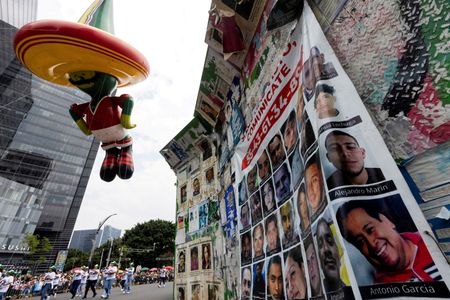

Large video screens line Mexico City’s Paseo de Reforma ahead of Sunday’s World Cup round-of-16 showdown between Mexico and England — but they share space with a sobering reminder of the nation’s ongoing crisis: posters representing more than 135,000 people who have gone missing, a number that has climbed sharply since 2006 when then-President Felipe Calderon launched a military campaign against the country’s drug cartels.
The famous thoroughfare has been shut down repeatedly in recent weeks — not only for post-match celebrations, but for protests as well.
Mexico has co-hosted the tournament alongside the United States and Canada, and the national team has impressed, reaching the knockout stage without allowing a single goal. Yet not everyone is caught up in the excitement. Many Mexicans are wrestling with how to feel genuine pride in their team while confronting economic struggles and civil unrest at home.
Podcaster and journalist Carlos Mendoza explained the dynamic to Reuters: “As long as Mexico wins, we all live with that national dopamine rush that allows us to avoid thinking about uncomfortable things, such as the United States’ accusations of alleged collusion between Morena (ruling party) politicians and drug trafficking.”
He added a warning: “But the world doesn’t stop: when the World Cup ends … reality is still there, waiting.”
On the economic front, while inflation showed signs of easing in early June, the country’s core inflation rate remains above the Bank of Mexico’s standing target of 3%. Adding to the frustration, ticket prices for World Cup matches — held across Mexico, the U.S., and Canada — have soared into the thousands of dollars, putting attendance out of reach for many ordinary fans.
“One of the biggest offences of this tournament — and not just in Mexico — is that fans can no longer go to the stadium to see their national team. Before, the limitation was getting tickets; now, the limitation is paying for them,” Mendoza said.
Mexico’s first knockout-stage victory in 40 years, a win over Ecuador in the round of 32, was celebrated widely — but the festivities near Reforma turned tragic when four people were killed during the post-match revelry.
Protests Persist Alongside the Party
Anti-World Cup graffiti still marks walls around the city and near the Azteca Stadium, remnants of demonstrations that broke out in the early days of the tournament. Members of teachers’ union group CNTE set up camp in the city center, their tents blocking major roads.
The union members are pushing the government to honor a campaign promise to repeal a 2007 law that restructured the pension and social security system for public-sector workers, and they are also seeking pay raises.
For many fans, it takes a conscious effort to separate their love of the national team from frustrations with the country’s leadership. Local politician Rodrigo Cordera captured that sentiment on social media: “You can get excited about 90 minutes of football. You can worry about the country, get angry at FIFA, and detest the politics and organisation of the Mexico City government. Life isn’t black and white.”
Mexican President Claudia Sheinbaum continues to enjoy solid public support. A poll released by newspaper El Financiero put her approval rating at 69%, recovering from a slight dip that started in March. Her administration has stated that locating missing persons is a top national priority.
Local resident Alejandra Gonzalez offered a grounded perspective on what the World Cup does — and doesn’t — accomplish for the country: “The tournament does not clear our troubles but places them in a lower priority among society, and the government leverages the euphoria to delay relevant and urgent decisions.”
She also expressed cautious hope, saying: “I hope so (the celebrations inspire a positive national moment), but besides the positive attitude, we also need to think in a critical way to keep pointing out the inequalities and inconsistencies from the government, industries, and ourselves as citizens.”
Win or lose on Sunday, it seems reality remains close at hand for millions of Mexicans watching their team play.