
DEIR AL-BALAH, Gaza Strip — Hamas announced Monday that it has disbanded its governing body in the Gaza Strip and is getting ready to hand over authority to a technical committee that has United Nations backing, as part of a ceasefire arrangement facilitated by the United States.
The militant group stopped short of addressing whether it would take the critical step of laying down its weapons or turning over security responsibilities to an international force. However, Hamas framed the decision as a demonstration of its dedication to rebuilding Gaza following years of devastating conflict.
It remained uncertain whether the announcement — which came from a lower-ranking official — would result in any real, tangible changes on the ground.
The Board of Peace, the newly formed entity led by President Donald Trump and tasked with governing and rebuilding Gaza, acknowledged the Hamas announcement but made clear it would evaluate the situation based on “actions, not promises.” In a statement posted to X, the board emphasized that the technocratic committee must take control of all weapons in Gaza, as outlined in the ceasefire agreement.
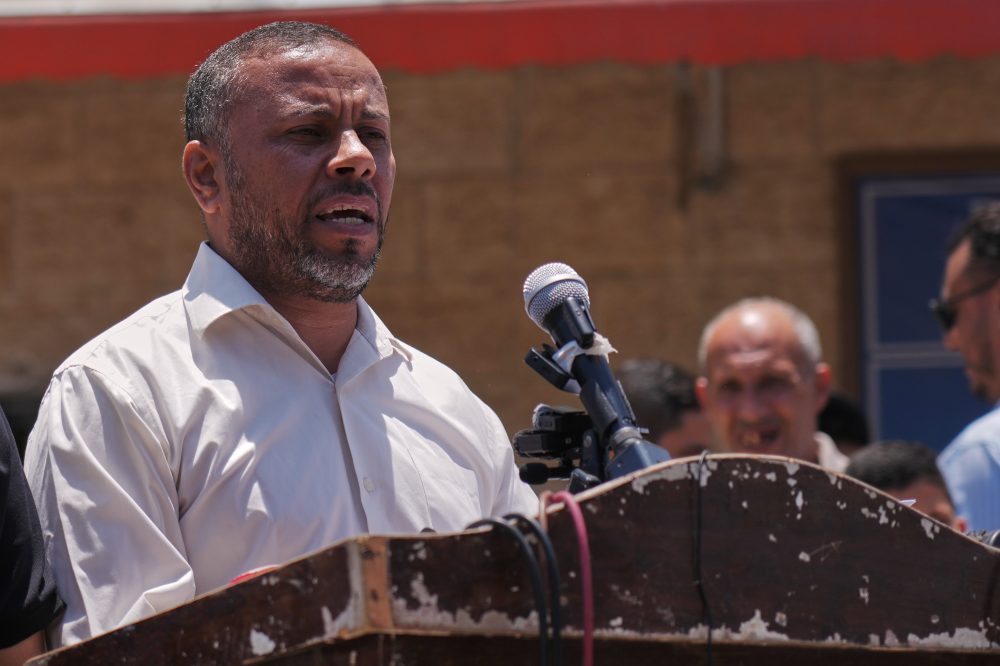
At a press conference held Monday in the courtyard of Al-Aqsa Hospital in Deir al-Balah, Ismail al-Thawabta, general director of the Hamas-run Government Media Office, stated that “only technical and professional staff” would remain in place to handle the day-to-day operations of the Palestinian territory.
“All employees working in service provision are ‘state employees’ and are fully prepared to work under the National Committee for the Administration of Gaza,” al-Thawabta said. Hamas spokesperson Hazem Qassem described the development as “a positive step forward on the path to implement the ceasefire deal.”
Israel, however, rejected the announcement outright. “The alleged resignation of the Hamas government, where all of the Hamas members stay in their positions, is a spin that has no significance,” said an Israeli official who spoke anonymously because they lacked authorization to address the media.
The committee of technocrats is headquartered in Cairo and is led by Ali Shaath, an engineer born in Gaza who previously served as an official with the Palestinian Authority. The committee’s role is to restore basic services and oversee civilian affairs under the watch of both the United Nations and the Board of Peace.
Even nine months after the ceasefire was signed, talks between Israel and Hamas remain largely at a standstill over how to carry out the agreement’s second phase, which includes Hamas disarming and the rebuilding of Gaza. Hamas has maintained that the terms of the first phase must be fully implemented before any discussion of its weapons can take place.
The war was ignited by the October 7, 2023 attack carried out by Hamas-led militants, which resulted in the deaths of approximately 1,200 people in Israel and the taking of 251 hostages. Since then, Israel’s military campaign in Gaza has killed 73,098 Palestinians, according to figures from Gaza’s Health Ministry.
The Health Ministry, which operates under the Hamas-led government, is run by medical professionals and keeps detailed records that United Nations agencies and independent experts generally consider reliable. The ministry does not separate civilian deaths from militant deaths, though it reports that women and children account for roughly half of all fatalities.
Israeli military strikes have dropped off significantly since the ceasefire took hold on October 10, but they have continued on a near-daily basis. Israel’s military maintains that it is targeting Hamas operatives and other militants, frequently stating those individuals were in the process of planning attacks.
On Monday alone, Israeli strikes claimed the lives of at least five people across Gaza — three in Khan Younis in the southern part of the territory and two others in an apartment building in Gaza City, according to health officials. The Israeli military stated it struck a Hamas operative in the Gaza City attack and a Palestinian Islamic Jihad militant in the Khan Younis strikes.
Militants have also continued launching shooting attacks against Israeli troops inside Gaza, and five Israeli soldiers have been killed since the ceasefire went into effect.