
On the beachfront of the coastal city of Tyre, the sounds of war have faded just enough for children to splash in the waves and families to relax under umbrellas — a fragile glimpse of normalcy slowly returning to southern Lebanon.
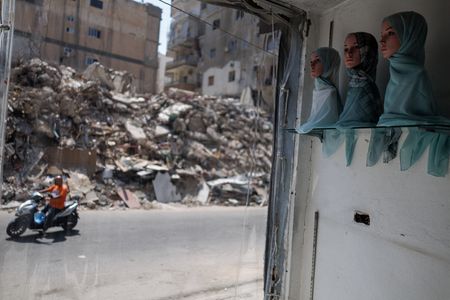
But just steps away from that shoreline calm, a far grimmer reality awaits the hundreds of thousands of people trickling back to their hometowns after months of displacement. They face the twin burdens of rebuilding lives shattered by Israeli airstrikes and living under the constant shadow of renewed fighting between Israel and Iran-backed Hezbollah.
“People are coming back to Tyre to rebuild, to work — all the restaurants are open again,” said local resident Ali Skaiky, still dripping from a swim and clutching a rubber float. “We still hear strikes and fighting at night, but it’s far away. There’s destruction beyond imagination, but we hope everything will stay calm.”
Skaiky is one of roughly 400,000 people who have returned to southern Lebanon since a ceasefire between Israel and Hezbollah took effect. The truce has not ended the fighting entirely, but it has significantly reduced its intensity.
Those coming home are clearing debris, reopening shops, and trying to piece back together the routines the war tore apart. For many, however, the new normal means keeping a bag packed, staying glued to the news, and never venturing too far from home.
For Fadlallah Qassim, 42, coming home meant facing devastating destruction head-on — including a direct hit on his own house.
“We returned to find the whole house caved in with rubble, and all the furniture ruined,” he said. “I cleaned up, fixed it, and brought some basic things for the house, now my wife, children and I all live in one room.”
In the nearby village of Srifa, where entire neighborhoods were left in ruins, 55-year-old Suzan Fakih described the emotional blow of returning to a place that no longer felt familiar.
“The moment you arrive, it doesn’t feel like your village anymore,” she said. “Everything is black and grey. It hurts your soul. You look around and think, ‘This can’t be the village I’ve lived in all my life.’”
Srifa sits deep in southern Lebanon, near where Israeli forces continue to occupy a stretch of territory and carry out regular strikes on what the Israeli military describes as Hezbollah targets. In surrounding areas, Israel has demolished nearly entire villages.
Fakih said the fear of being forced to flee again never fully leaves residents’ minds.
“I can’t remember a time in my life when I wasn’t living with a bag packed, ready to leave. A few quiet years pass, then you pack your bags and run again,” she said.
Lebanon’s social affairs ministry reports that 600,000 additional people remain internally displaced due to the ongoing violence and widespread destruction. Many families whose homes were completely destroyed are still sheltering in schools or the rented accommodations they escaped to during the fighting.
Lebanon has endured the deadliest regional fallout since U.S. and Israeli strikes on Iran in February set off a broader conflict. Fighting spread to Lebanese soil on March 2, when Hezbollah launched attacks on Israel in solidarity with Tehran, prompting an Israeli air and ground campaign in response. Lebanon’s health ministry reports that more than 4,300 people have been killed in the country since the conflict began.
About 20 miles farther north, in the Bekaa Valley town of Sohmor, residents who recently returned home describe living with the same persistent uncertainty. Mohammad Sweid, 31, a manual laborer, continues to pay rent on the house his family fled to during the war — keeping it as a safety net should they need to leave again.
“If something happens again, we may not find another place,” he said.
In the Lebanese capital Beirut, residents of Dahiyeh — a suburb controlled by Hezbollah that has been repeatedly struck by Israel over the past two years due to its role as a hub for Hezbollah’s leadership — are also cautiously working to rebuild.
Moussa Ghamloush, 68, has been repairing his bomb-damaged home and working to reopen his restaurant, which was completely leveled in a separate strike. Despite everything, he says he has no intention of leaving permanently.
“We’re not the kind of people who leave. Our roots are here. We stayed, and if there’s a third war, we’ll stay again.”