
PAMPLONA, Spain — Bill Hillmann has been gored by bulls three separate times during Spain’s famous running of the bulls, yet nothing could keep him away from this year’s San Fermin festival.
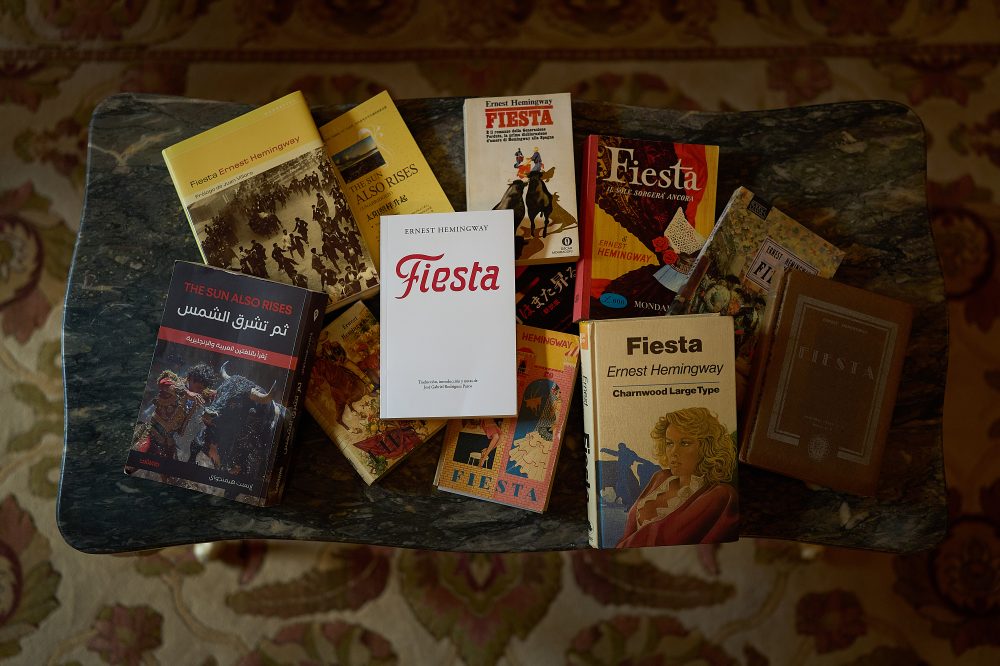
The reason for the extra buzz this year: it marks 100 years since Ernest Hemingway published the novel that launched him to literary stardom and put the city of Pamplona on the global map.
Hemingway’s 1926 work “The Sun Also Rises” has held readers spellbound for generations with its Jazz Age story of American and British bohemians seeking to fill an inner emptiness through exotic travel, heavy drinking, and the tortured pursuit of unattainable love.
The novel’s enormous success cemented its place as a pillar of American literature, standing alongside F. Scott Fitzgerald’s “The Great Gatsby.” It also brought widespread use of the phrase “lost generation” to describe the circle of early 20th-century writers living as expatriates in Paris. Hemingway’s stripped-down writing style permanently reshaped American literature.
Hillmann, who grew up in Chicago, was just 19 years old when Hemingway’s powerful portrayal of the bull-running tradition first grabbed his attention — particularly the scenes of ordinary Spaniards risking injury to sprint through the streets alongside the bulls, guiding them toward the bull ring. This year’s festival gets underway Monday with fireworks over a crowded plaza, and the first of eight bull runs takes place Tuesday.
“It was the first book I ever read,” Hillmann told the Associated Press while standing in Pamplona, looking out over the pen where bulls are held before being released onto the cobblestone route. “I sat there for about six hours, well past midnight, reading the book. And by the time I was done with that book, I was going to be a writer and I was going to be a bull runner.”
Since that night with the book, the now 44-year-old Hillmann has run alongside bulls in Spain hundreds of times — both in Pamplona and at dozens of other bull runs across the country. His passion for Hemingway and Pamplona has never faded, even after one goring nearly took his life.
That deep connection to the novel eventually led Hillmann to earn a doctorate in English. He now teaches “The Sun Also Rises” at East-West University in Chicago and writes about the bull-running tradition.
Hillmann is far from alone. Americans continue to be the largest group of foreign participants in the San Fermin bull runs. In 2022, 16% of all bull runners were American — the highest share among any foreign nationality and four times the number from neighboring France, according to figures from Pamplona’s City Hall.
A Dallas-based tour company called “Running Of The Bulls” has helped thousands of Americans make the trip to San Fermin over the years. Its operator, Bruce Anderson, says Hemingway’s novel turned the festival into a must-do experience for many people. This year, his company is bringing 1,400 attendees to Pamplona, with more than two-thirds coming from the United States.
“There’s a lot of energy, a lot of excitement around just remembering that book and the impact that it’s had,” said Anderson, who has been a Hemingway admirer his whole life. He spoke inside Pamplona’s art deco Café Iruña — a prominent drinking spot in the novel that today features a life-size statue of Hemingway leaning against the bar.
Anderson, who sports a thick white beard, even resembles Hemingway. Local Spaniards frequently call out to him using the writer’s famous nickname: “Papa!”
Hemingway’s presence is woven into the fabric of Pamplona. Hotels and bars display busts of him or post signs noting that he once visited. Outside the city’s bull ring — which also has a statue of the author — a large banner honoring the novel hangs with a quote showing how the festival left Hemingway at a loss for words: “At noon of Sunday, the 6th of July, the fiesta exploded. There is no other way to describe it.”
During his final visits to Pamplona, Hemingway regularly stayed at the Perla Hotel. His suite there still contains furniture from the 1950s, the era of his visits. The room, which looks out over the bull run route, also holds two glass bookcases filled with dozens of copies of “The Sun Also Rises.”
“Hemingway did a lot for Pamplona because he made it known around the world,” said Fernando Hualde, who spent four decades working as a receptionist at the hotel.
Still, Hemingway’s legacy in the city is complicated.
Beyond feminist criticism of his aggressively masculine public image, Hemingway has also faced pushback from animal rights advocates for his celebration of bullfighting. In “The Sun Also Rises,” he devotes far more attention to the courage of bullfighters than to the bull runs themselves.
Animal welfare activist Brook Spurling, speaking during a protest against the San Fermin bullfights, argued that “Hemingway wrote about many, many themes that today would not be accepted into society. He writes about hunting, about war, and we don’t want to be appreciating these themes today.”
Former hotel receptionist Hualde noted that some Pamplona residents resent Hemingway’s early promotion of the festival, blaming it for the overtourism now straining the once-quiet regional city.
Pamplona is home to 200,000 people but welcomes more than a million additional visitors during the festival. While most are Spanish, roughly 15% come from outside the country. Many visitors — especially younger ones — follow Hemingway’s lead when it comes to drinking heavily.
Some locals take quiet pride in places untouched by the Hemingway legend. Literature professor Gabriel Insausti of Pamplona’s University of Navarra recalled visiting a bar that displayed a sign reading, “Hemingway was not here.”
“In general, Hemingway has become a product of a franchise associated with San Fermin festival that has obscured his novel,” Insausti said. “People know who Hemingway is, but they haven’t read his novel.”
Hillmann warned that the large number of inexperienced foreign runners today makes the Pamplona bull runs more hazardous than ever. The last fatality occurred in 2009, but gorings and other injuries happen regularly. Beginners can easily panic and make a wrong move, triggering dangerous pileups or pushing someone into a bull’s path.
In 2014, Hillmann himself was seriously gored after he said a fellow runner’s poor decision left him exposed to a charging bull. Blood was pouring from his leg in such quantities that he believed he was dying.
After yet another goring in 2017, Hillmann spoke to the AP from his hospital bed in Pamplona and made clear he had no intention of stopping. “People think this is just crazy people running. There is real art. If you pay attention, you can see it,” he said at the time.
Hemingway’s granddaughter, actress Mariel Hemingway, remembers being treated “like royalty” when she attended San Fermin in years past. Mariel, who has written and spoken publicly about her grandfather’s mental illness and his suicide in 1961, believes his work will stand the test of time.
She sees his themes as timeless — including his preoccupation with death.
“Identity, love, purpose, and how to rebuild after profound loss … those themes haven’t ever changed. That’s what’s great about my grandfather,” Mariel Hemingway told the AP from her home in Idaho. “I think he captured something that will never go away.”