
ANKARA, Turkey — For nearly two years, NATO Secretary-General Mark Rutte has had one overriding mission: keep the United States from walking away from the world’s most powerful military alliance. His strategy has relied heavily on flattery and carefully staged presentations aimed at keeping U.S. President Donald Trump satisfied — but that task is getting harder as this week’s summit in Turkey approaches.
The challenge has evolved considerably since Rutte took the job. Early on, the main friction point was money. Trump had long complained that NATO member nations were not dedicating enough of their national budgets to defense. That issue appeared to be largely resolved at last year’s summit, when allied nations pledged to match American defense spending as a share of their gross domestic product.
But the alliance’s central problem has shifted. The real challenge now is converting those financial commitments into actual military strength — especially as European nations grow increasingly anxious about a potential Russian attack.
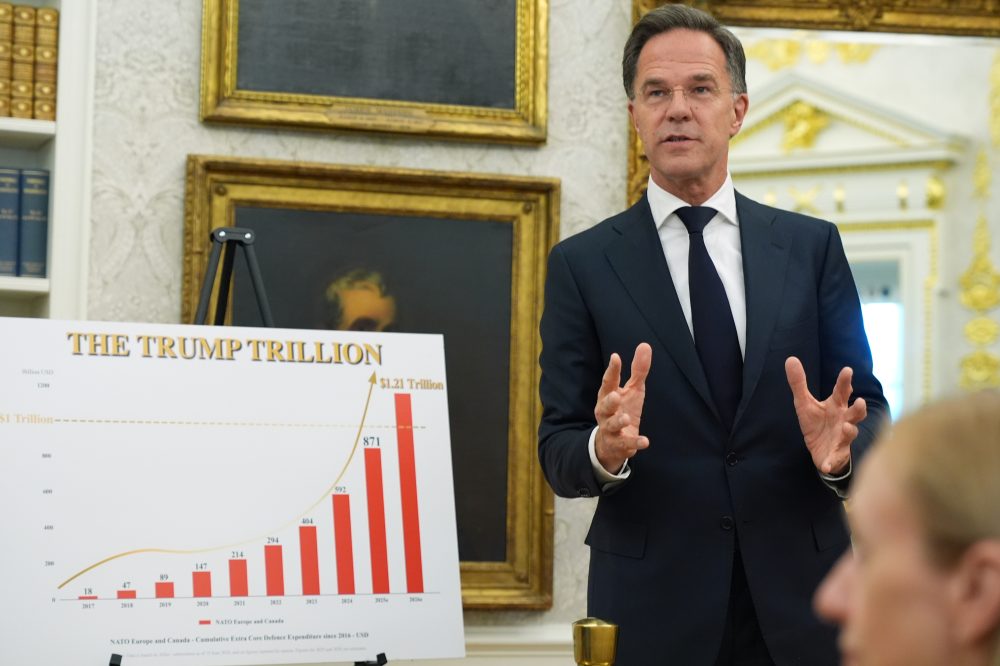
Rutte made another bold attempt to ease tensions during a White House visit last month. He brought along a chart boldly labeled “The Trump Trillion” in gold lettering, illustrating $1.2 trillion in combined defense spending by European allies and Canada since 2017. The presentation was loaded with American imagery and credited Trump as the driving force behind the spending surge.
Trump, however, did not appear impressed. He expressed frustration that some NATO allies had declined to join the United States and Israel in the war against Iran — a conflict launched without consulting alliance members.
“We don’t need their money — we don’t need anything,” Trump said. “I just want loyalty.”
Trump also suggested he might have skipped the upcoming summit altogether if it were not being hosted by Turkish President Recep Tayyip Erdogan — a leader Trump appears to hold in unusually high regard. Even so, both Erdogan and Rutte will face significant pressure to keep the gathering on track.
Traditionally, NATO’s top civilian official — always a European, never an American — works to build consensus among the alliance’s 32 member nations and speak on their collective behalf. But under Trump, both Rutte and his predecessor, Jens Stoltenberg, have had to spend enormous energy simply keeping the United States inside the alliance.
Trump has threatened to withdraw from NATO entirely, floated the idea of pulling American troops out of Europe, and declared his intention to acquire Greenland — a semi-autonomous territory belonging to alliance member Denmark. He has also cast doubt on whether the U.S. would defend allies that fall short on defense spending, shaking confidence across the alliance.
Rutte’s flattery has at times drawn criticism. He was widely mocked for comparing Trump to a father figure. But last month’s Oval Office presentation took things further, featuring props evoking the American flag and charts highlighting tens of thousands of U.S. jobs tied to European military orders — a backlog worth $300 billion. Rutte referred to Trump as “the leader of the free world” throughout the pitch.
He also gently pushed back on Trump’s Iran complaints, pointing out that up to 5,000 American aircraft departed from European bases before an April ceasefire took hold.
The alliance cannot function without American participation. Europe is being pressed to take greater responsibility for its own security at the very moment Russia — the original reason NATO was formed — presents a growing threat.
Last month, the Pentagon caught its NATO partners off guard by announcing it would reduce the troops, warships, aircraft, and drones it would contribute if a member nation came under attack. Trump has also sent contradictory signals about whether U.S. troop levels in Europe would go up or down.
Those cutbacks and mixed messages have weakened alliance unity at a particularly dangerous time. A study released Thursday found that Russia has been testing European defenses with drone flights near military installations across several countries.
Every NATO summit is designed to reaffirm the alliance’s core commitment to collective defense — the principle that an attack on one member is an attack on all, as spelled out in Article 5 of the NATO treaty. That provision has only been triggered once, when allies rallied behind the United States following the September 11, 2001 attacks.
Last year’s summit was held in The Hague, the hometown of Rutte, a former Dutch prime minister. The Dutch royal family hosted a dinner, and Trump spent the night at the king’s palace. Rutte managed to secure a major defense spending commitment from the allies, and Trump departed in good spirits, calling his NATO counterparts a “nice group of people.”
This year’s gathering is in the hands of Erdogan, a NATO member known for his independent approach to foreign policy. His close relationship with Trump may help hold the American president at the table, but analysts doubt it will be enough to heal the deeper divisions within the alliance.
Rutte has been working to persuade Trump that European nations are now spending enough on defense that the United States can shift its focus toward the security threat posed by China, while Europe manages the ongoing war in Ukraine.
But Trump’s latest demand — for loyalty — is not something that can be captured in a chart or a dollar figure, leaving Rutte with a far more difficult sell heading into the summit.
Rutte’s predecessor, Stoltenberg, offered a stark warning in his memoir about a 2018 summit that Trump nearly derailed. “If an American president says he no longer wishes to defend the other allies and leaves a NATO summit in protest, then the NATO treaty and its security guarantee aren’t worth very much,” Stoltenberg wrote.