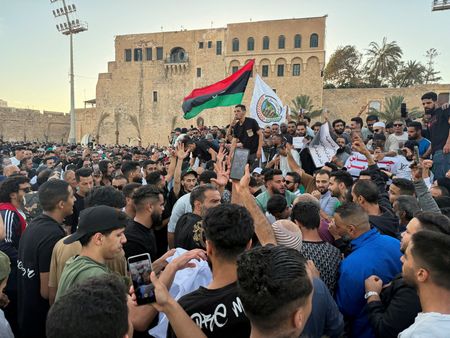

Pakistan has been quietly working to bring together Libya’s rival factions in an effort that, if successful, would significantly boost Islamabad’s standing on the world diplomatic stage, two Pakistani sources have revealed.
The mediation push comes as observers have watched for months as the United States has worked to find a diplomatic resolution in Libya — a country that has been divided between competing eastern and western governments ever since a civil war erupted following the 2011 NATO-backed uprising that brought down Muammar Gaddafi.
Pakistan has already played a notable role this year as a go-between in separate talks involving the U.S. and Iran, a contribution that has been repeatedly acknowledged by the Trump administration. One of the Pakistani sources said the U.S. is “fully aware and involved” in Pakistan’s efforts in Libya as well.
Saudi Arabia is also supporting the initiative, both sources confirmed. Pakistan and Saudi Arabia signed a mutual defence agreement last year, and Riyadh has long sought to extend its influence in Libya.
According to both sources, the mediation effort got underway late last year, with both Libyan sides requesting Pakistan’s participation. How closely Pakistan has been coordinating with other regional players remains unclear.
Pakistan’s foreign ministry, its military media wing, officials from both Libyan factions, and the foreign ministries of Qatar, Turkey, Saudi Arabia, and the United States did not respond to requests for comment.
What a Unity Plan Could Look Like
Analysts say any workable plan to reunite Libya would need to satisfy the competing interests of outside powers while resolving long-standing disputes over government posts, election rules, and oil revenues — issues that have derailed previous attempts at reconciliation.
“The United States has been pushing hard in Libya,” said Jalel Harchaoui, a contributor to Britain’s Royal United Services Institute think tank, “but the format it is trying to impose is still loose and ill-defined.”
A summary of a proposed “Libya Reunification Plan” obtained by Reuters would create a 36-month transitional power-sharing arrangement under a body called the Government of National Consensus and Presidential Council.
Under the proposal — which one Pakistani source noted is still being refined — Abdulhamid Dbeibah of the U.N.-recognized, western-based Libyan Government of National Unity would serve as prime minister, while Saddam Haftar, deputy commander of the eastern-based Libyan National Army, would chair the Presidential Council.
The faction loyal to Saddam Haftar’s father, Khalifa Haftar — the Libyan National Army’s commander-in-chief — controls a large portion of Libya’s oil infrastructure. The plan would give him authority over the national budget.
One Pakistani source said Pakistan intends to play “an active role in making sure this whole arrangement stays in play,” though details are still being worked out.
Pakistan’s Diplomatic Moves
Last month, Pakistan’s army chief Asim Munir held a meeting with Saddam Haftar in Rawalpindi. Just days afterward, Haftar traveled to Washington, where he sat down with Secretary of State Marco Rubio.
The State Department said at the time that Rubio welcomed the efforts of Libyan leaders to overcome their divisions and reaffirmed Washington’s support for a unified Libya.
While analysts consider Pakistan a secondary player in Libya — where the U.S., the UAE, Turkey, and Egypt have competed for influence for years — Islamabad has maintained ties with both Libyan sides, something other regional actors may not be able to claim.
As Reuters reported in December, Pakistani officials have pursued defence ties with the eastern-based Libyan National Army, including discussions about the possible sale of JF-17 fighter jets and Super Mushshak trainer aircraft, despite an active U.N. arms embargo.
Meanwhile, the rival western government recently sought direct talks with Pakistan as well, according to an unreported document reviewed by Reuters.
Qatar and Turkey — one of the western government’s most significant backers — were among those who encouraged Pakistan to take on a mediation role, two Pakistani sources familiar with the situation said.
Tarek Megerisi, director of geopolitical advisory firm Informmi, offered a note of caution, warning that there is no guarantee any agreement reached would hold. He pointed to a deal struck last year between the leaders of Rwanda and the Democratic Republic of the Congo that fell apart within months.