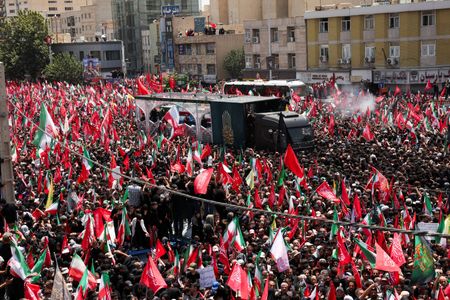

Enormous crowds gathered in the Iranian capital of Tehran on Monday for a funeral procession honoring Ayatollah Ali Khamenei, the slain supreme leader, marking the largest single event in a week of sweeping memorial ceremonies that have underscored the continued hold of Iran’s clerical establishment.
State television broadcast drone footage capturing tens of thousands of people packed tightly along a central Tehran boulevard. A large truck carrying the coffins of Khamenei and four of his family members moved slowly through the crowd, while fire hoses sprayed water from above to help keep mourners cool in the heat.
At one point, as the procession passed beneath a bridge, mourners hurled stones at a billboard hanging overhead. The sign depicted U.S. President Donald Trump with a bullet pointed at his head and carried the message: “The U.S. killed our father. We won’t let you go!”
Participants waved Iranian flags and red banners bearing a slogan calling on the “avengers of Khamenei” — a phrase rooted in a central event of Shi’ite Islam, referencing the killing of the Prophet Muhammad’s grandson in battle during the seventh century.
On Sunday, three of Khamenei’s sons prayed beside his coffin at a large Tehran prayer hall. Notably absent, however, was Mojtaba Khamenei, the son who has since taken over as Iran’s supreme leader. Believed to have been seriously wounded in the attack that killed his father, Mojtaba has not been seen publicly since the conflict began on February 28 with airstrikes by Israel and the United States on Iranian territory.
The formal mourning period began Friday, when the coffins of the elder Khamenei, one of his daughters, her 14-month-old child, a son-in-law, and the wife of Mojtaba were placed on display for Iranian officials and visiting foreign dignitaries. Large outdoor ceremonies followed on Saturday and Sunday before Monday’s major procession through Tehran’s streets.
Later this week, Khamenei’s remains are scheduled to travel to Qom, a significant Shi’ite seminary city in Iran, and then to two Shi’ite shrine cities in neighboring Iraq, before returning to Iran for burial inside a medieval shrine complex located in the city of Mashhad.
The conflict that triggered these events has since concluded. A preliminary peace agreement reached last month left Iran’s clerical government intact and claiming victory, with the country asserting new influence over global energy markets through its control of the Strait of Hormuz.
President Trump has also declared victory in the conflict, though the goals he outlined at the start — dismantling Iran’s nuclear and missile programs, halting its ability to strike neighboring countries, and fostering conditions for Iranians to overthrow their government — have not yet been fully realized. Trump stated over the weekend that formal peace negotiations with Iran had been pushed back by one week due to the ongoing funeral ceremonies.
Israel’s defense minister, Israel Katz, said Monday that Khamenei was killed because he directed a program aimed at destroying Israel. “Any Iranian leader who will again try to pursue plans to destroy Israel will be killed as well,” Katz warned.