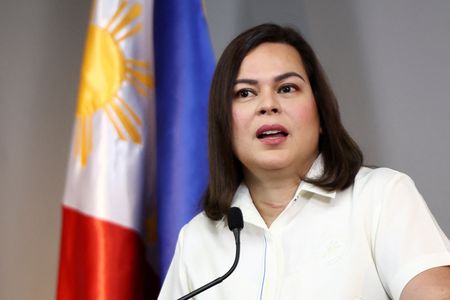

MANILA — The impeachment trial of Philippine Vice President Sara Duterte got underway Monday, a proceeding that analysts say will help define the country’s 2028 presidential race while deepening a bitter divide between two powerful political dynasties that has thrown the Senate into chaos.
The verdict will carry consequences far beyond Duterte’s political future — it will also serve as a test of public faith in the Philippines’ institutions. Experts warn that how the process is perceived matters just as much as the outcome itself.
“If it is seen as politically motivated or lacking credibility, questions may linger regardless of the outcome,” said Ederson Tapia, a public administration professor at the University of Makati.
How long the trial will take remains uncertain. Factors like procedural disputes, witness lists, and evidence presentations will all play a role in determining the pace. For reference, a 2012 impeachment trial involving a former chief justice stretched on for four months. To secure a conviction, at least 16 of the Senate’s 24 members must vote in favor. Opinion polls currently show Duterte as a top contender for the 2028 presidential race, though a guilty verdict could derail those ambitions.
“If the public perceives the process to have been fair, an acquittal could strengthen her position,” Tapia added.
This marks the first-ever impeachment trial of a Philippine vice president. The charges against Duterte include misappropriating government funds, accumulating wealth she cannot explain, and making threats against President Ferdinand Marcos Jr., the first lady, and a former House Speaker.
Duterte, whose father is former President Rodrigo Duterte, has denied all allegations and maintains the impeachment is a politically driven attack against her.
Congressman Robert “Ace” Barbers, who serves as spokesperson for the prosecution, dismissed her claims. “That is to be expected,” he said. “We will let the evidence speak for itself.”
Jean Encinas-Franco, a political science professor at the University of the Philippines, stressed that both sides need a full and fair opportunity to make their case. She pointed to the impeachment of then-President Joseph Estrada as a cautionary tale — a Senate vote to block key evidence sparked public fury, brought the trial to a halt, and fueled mass protests that ultimately led to Estrada’s removal from office in January 2001.
“They really have to make sure that both the prosecution and the defence are given enough time and voice … so the public does not perceive the trial as favouring one side,” she said.
Duterte’s attorney, Michael Poa, said the defense team is ready to demonstrate that the charges are “baseless.” He was unable to confirm whether Duterte herself would appear at Monday’s opening session, noting that the summons allowed her to be represented by her legal team.
FROM ALLIES TO ADVERSARIES
Marcos and Duterte — both heirs to two of the Philippines’ most influential political families — ran together on the same ticket in 2022. That partnership has since collapsed into an increasingly hostile feud, a rupture that intensified following Rodrigo Duterte’s arrest and transfer to the International Criminal Court in March of last year.
The fallout has spilled directly into the Senate, casting uncertainty over how the trial will play out.
In May, as the Senate was preparing to receive the impeachment complaint from the House of Representatives, Duterte ally Senator Ronald “Bato” dela Rosa suddenly reappeared in the chamber after being absent from public view since November. His vote proved decisive in installing Alan Peter Cayetano as Senate president.
Dela Rosa then remained inside the Senate building before quietly slipping out in the early hours of May 14 — just hours after gunfire and disorder broke out inside the parliament building. His current whereabouts are unknown.
Cayetano had previously served as the running mate of Duterte’s father in the 2016 election. Rodrigo Duterte is currently in The Hague awaiting trial on murder charges stemming from his administration’s “war on drugs.” Dela Rosa, who served as national police chief during much of that crackdown — in which thousands of suspects died — faces similar ICC charges. Both men deny any wrongdoing.
Roughly a month after the Senate leadership clash, a rival bloc of senators secured enough support to elect Senator Sherwin Gatchalian as Senate president.
While the internal power struggle has exposed the Senate’s deep divisions, analysts caution that the leadership battle should not be read as a reliable preview of how individual senators will vote in the actual trial.
“The impeachment process creates a different set of incentives and constitutional responsibilities than leadership contests or coalition politics,” Tapia said.
The trial’s outcome could also shape who becomes the leading presidential candidate from the Marcos camp in 2028, as Marcos himself is constitutionally prohibited from running for a second term.