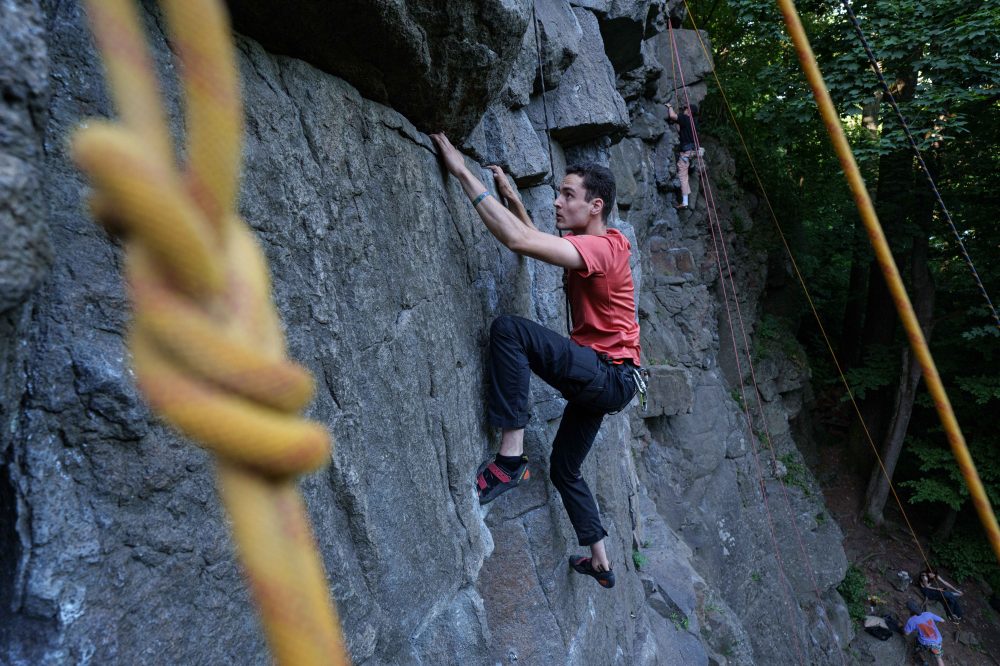

DENYSHI, Ukraine — On a sheer granite cliff rising above a river roughly two hours west of Kyiv, hundreds of festival-goers set up camp on a sprawling outdoor grounds. During the day, attendees scaled the rock face, cooled off in a nearby reservoir, or tried their hand at stand-up paddleboarding. When the sun went down, live bands and DJs filled the forest with rock and electronic music.
The Stoned Climbers festival, held last week in Ukraine’s Zhytomyr region, stands as the country’s largest outdoor event combining rock climbing with live music. Like so many public gatherings in a nation at war, the weekend mixed everyday fun with unavoidable reminders of the conflict just beyond the treeline.
Throughout the weekend, attendees received repeated air raid alert notifications on their phones. Soldiers on leave quietly mingled with the crowd, and festival organizers directed all proceeds from this year’s event toward a fundraising effort supporting Ukraine’s Azov Brigade. One notable difference from the previous year: no Russian drones or missiles passed overhead on their way toward Kyiv.
The festival is entirely volunteer-run and was launched in 2023 by a group of roughly 15 friends who had spent more than a year climbing together after becoming captivated by the climbing culture surrounding Yosemite, the American national park long considered one of the birthplaces of modern rock climbing — a place where climbers forged a counterculture built around tent living, van life, and months spent on granite valley walls.
“We realized climbing could be much more than just a sport,” said festival co-founder Dmytro Isaienko, 39. “It’s about a specific way of life — in nature, camping, on the rocks.”
Isaienko and his circle of friends set out to break the idea that climbing was only for elite athletes. Their debut festival drew around 150 visitors. This summer, that number surpassed 500, with the majority being beginners or casual climbers.
Putting together the festival during wartime has given it a deeper meaning, Isaienko said. He believes that creating spaces where people can gather, pick up new skills, and spend time with one another has become an important tool for maintaining mental health through years of conflict.
“You need to get away from the war for a while,” he said. “Leave Kyiv and come spend some time here together, a little longer than usual.”
Down at the base of the cliffs, instructors guide complete newcomers through the basics — securing harnesses, chalking their hands, and locating their next grip on the granite surface. Each time a climber reaches the summit of the 25-meter (82-foot) cliff — often for the very first time — everyone nearby erupts in applause.
Among this year’s first-timers was 21-year-old Liliia Karpach, who made the trip from Ukraine’s western Lviv region for her first Stoned Climbers experience.
“I decided to come because it had been a very long time since I’d climbed on real rocks,” she said. “I also wanted to meet the community in person and get to know new people.”
Karpach described climbing as both a mental and physical challenge, and encouraged others to give it a chance.
“If you’re really nervous about coming on your own, invite some friends,” she said. “Even if neither of you knows how to climb, you’ll have a good time together.”
For 24-year-old instructor Andrii Lamei, watching first-time climbers find their confidence is the most fulfilling part of the festival. While guiding a young woman through her first ascent, he calmly talked her through the toughest stretch of the climb. As she moved higher, her steps grew steadier and more assured. When she reached the top, Lamei called up to her before she descended.
“Look around,” he shouted. “Enjoy the moment. You made it.”
“Climbing helps you work with stress,” Lamei said. “It helps you manage stressful situations in everyday life.”
Lamei dreams of climbing abroad someday, but like most Ukrainian men, wartime travel restrictions prevent him from leaving the country.
“I want to go across the border to visit Yosemite, to visit Norway’s mountains, but I can’t,” he said. “But maybe this is how I’m forced to enjoy what I have here.”
For Isaienko, that sentiment is exactly what makes events like Stoned Climbers so important. While many Ukrainians have pressed pause on parts of their lives since the war began, he hopes the community forming around these cliffs proves that new traditions can still take root.
“This is a festival for everyone,” he said. “Including people who have never tried climbing before.”
And with every first-time climber who reaches the top, the cheers rising from below suggest that community is steadily growing — one handhold at a time.