
LA GUAIRA, Venezuela — Noel Márquez was at his girlfriend’s apartment when twin earthquakes brought down the high-rise building where he lived with his family, setting it ablaze. He rushed back and called out desperately. The only response came from his 17-year-old brother Leonel, whose legs were trapped beneath concrete columns that would have required heavy machinery to move.
Márquez and his father, both of whom survived, could hear Leonel through the layers of debris — crying out in pain, begging for help, choking on smoke — as they waited for a crane that never arrived. After several agonizing hours, Leonel went silent.
As devastating as that was, Márquez said the worst part came next: attempting to retrieve his family members’ remains with little more than his bare hands and a saw. He was forced to cut off limbs to free the bodies of Leonel and his mother. He could not reach his eight-months-pregnant sister, his grandmother, or other relatives still buried in the wreckage — and with them, any chance of giving them a proper burial.
“It’s unfair. It’s inhumane, everything that is happening,” said Márquez, 26, speaking from an overcrowded temporary morgue set up at the La Guaira port. “We couldn’t get my brother out because we didn’t get a response from the state … and after 11 days, we are still requesting a crane.”
Márquez represents a vast number of Venezuelans who, after days of torment, have been left largely on their own — searching not for survivors, but for the remains of the people they loved, and for some measure of peace.
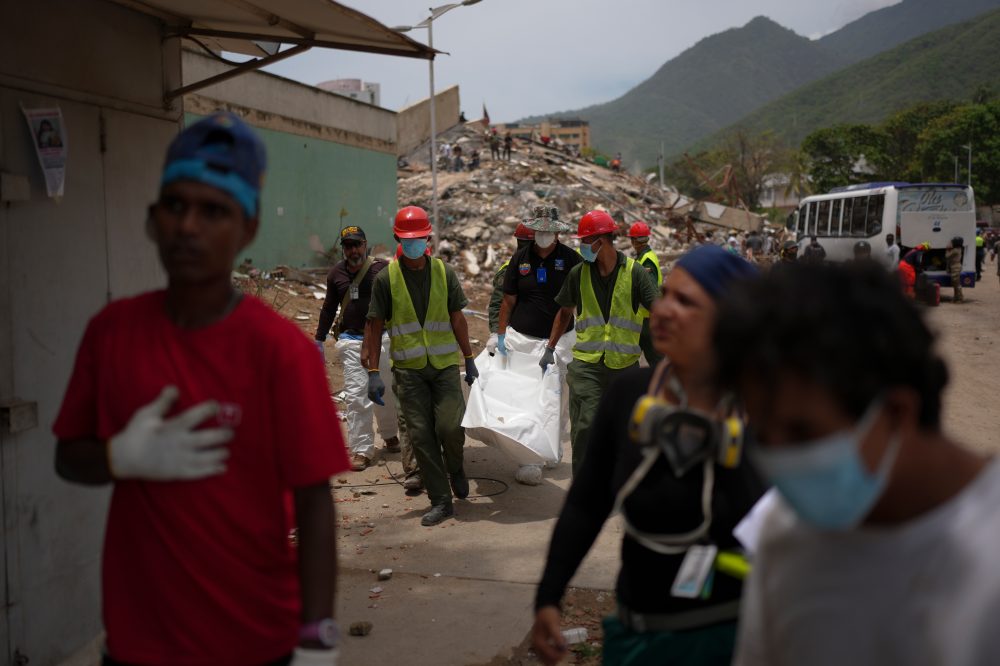
International rescue teams, quietly accepting that the odds of finding anyone alive after 12 days under the debris are essentially zero, are preparing to leave the country. Local officials have shifted their attention toward finding shelter for the thousands of people displaced by the disaster. But the task of recovering the dead has fallen heavily on the families themselves.
“I found her hand, but her torso is crushed,” said Norely Rodríguez, working to free her 5-year-old daughter from the ruins in La Guaira, the hardest-hit area. “I want to see if I can get her out whole.”
Survivors say that just as the government failed to respond quickly enough to rescue the living in the immediate aftermath of the quakes, families are now similarly under-resourced as they try to recover the dead nearly two weeks later.
The passage of time has made the process increasingly grim. “It has been difficult because the bodies are already in an advanced state of decomposition, decomposed to such an extent that many times when we try to remove them, they fall apart,” said William Gomez, a firefighter working in La Guaira.
Authorities announced Sunday that the confirmed death toll had climbed to 3,342, with an additional 16,740 people reported injured. Beyond those numbers lies an unknown count of victims still buried beneath the rubble. While no official tally exists, more than 30,000 missing persons reports have been submitted to a website created by the Venezuelan opposition.
Over the weekend in La Guaira, no government civil defense workers or security personnel were observed helping families dig through the wreckage. The overwhelming majority of those searching were ordinary civilians using their hands or basic tools like pickaxes and shovels, with occasional assistance from firefighters and Mexican rescue workers still in the country.
“We are the ones helping ourselves: our family. Nobody else helps us except for a few volunteers,” said Yeikhary Urbina, who on Saturday discovered the bodies of her mother and brother suspended under mounds of concrete, appearing to be locked in an embrace.
Rescue teams from Italy, Argentina, Spain, and other nations have already gone home. The Venezuelan government has not officially called off the search for survivors, but officials have shifted their public messaging — moving away from highlighting dramatic rescues on social media and toward announcing rebuilding plans under a program called Venezuela Reborn.
“Venezuela is entering a process of infrastructure recovery, of housing recovery,” acting President Delcy Rodríguez said on state television Saturday.
Families still searching face new horrors with each passing day. Some have spent days digging only to find remains so badly decomposed that identification is nearly impossible. Others have found nothing at all. “She kept asking, ‘Why did God play this trick on me?’” said Geraldine Perdomo, describing her sister’s desperate search through the rubble of her home for any confirmation that her two daughters had died.
And some, like Márquez, endured days of grueling effort to recover their loved ones’ bodies, only to lose track of them again in the disorder of the makeshift morgue beneath grain silos at La Guaira port, where bodies have been arriving in a near-constant stream since the June 24 earthquakes. Márquez said that on Sunday — a week after he brought in the bodies — he learned authorities had located his mother and grandfather. But his brother Leonel, he said, “is still missing because of the negligence here.”
Márquez and many other residents of the country’s public housing towers — built years ago for low-income families under former socialist leader Hugo Chávez — say their concerns about government neglect go back long before this disaster. Several of those high-rise buildings, each housing hundreds of families, collapsed entirely during the earthquakes, renewing questions about the quality of their construction.
Alexander, a 42-year-old police officer who lived in one of the towers, was shaking with anger on Sunday. He blamed the government for ignoring residents’ longstanding concerns about the structural integrity of the building, for failing to send rescue crews in time to save his wife and three daughters, and now for not providing the heavy equipment needed to help him recover their bodies.
“Not a single person from the government was here,” he said. He asked to be identified only by his first name, fearing that as a government employee, speaking out against authorities could put him at risk of retaliation.
After 11 days of searching, he finally reached the last member of his family still unaccounted for — his 12-year-old daughter. Her body was decomposed but intact.
“She was waiting for me to pull her out,” he said, holding the black plastic body bag in his arms.