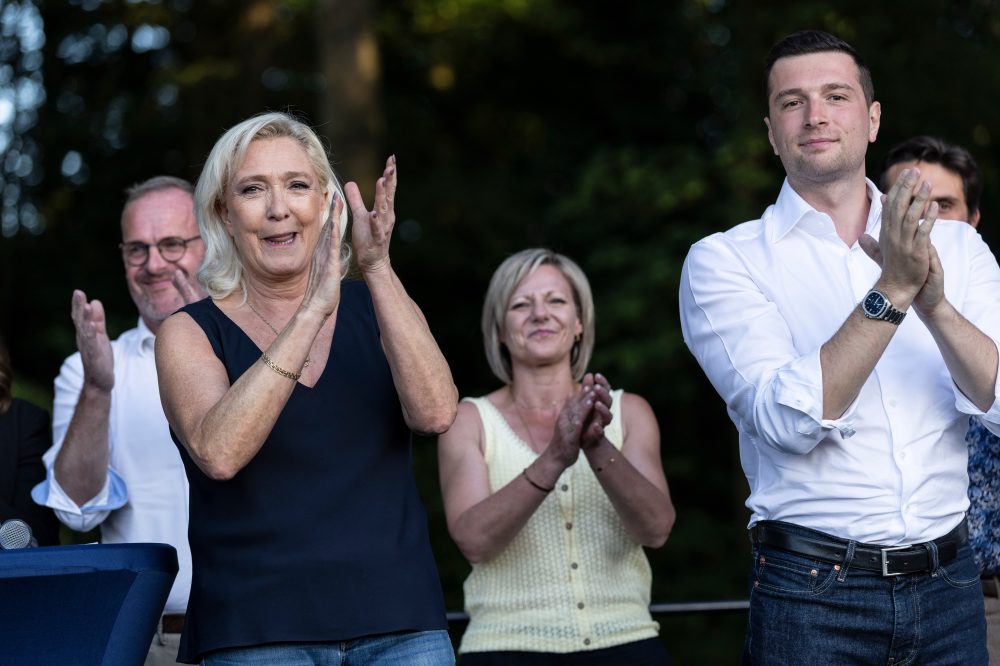

PARIS (AP) — A Paris appeals court is scheduled to deliver a ruling Tuesday that could determine whether French far-right leader Marine Le Pen will be allowed to compete in France’s 2027 presidential election.
If Le Pen is barred from the race, her 30-year-old protege and National Rally party president Jordan Bardella would step in as the party’s candidate.
Le Pen, 57, is contesting a March 2025 court decision that found her and fellow National Rally members guilty of misappropriating European Parliament funds by employing aides between 2004 and 2016 who allegedly performed party work rather than parliamentary duties. If the conviction stands, she could face a ban from holding elected office, an electronic monitoring tag, or both.
Here is a look at key moments in the careers of Le Pen and Bardella, and how the National Rally evolved into one of France’s most significant political parties:
Marine Le Pen was born on August 5 in Neuilly-sur-Seine, west of Paris. She is the youngest of three daughters of Jean-Marie Le Pen, who would go on to lead the far-right National Front party.
Jean-Marie Le Pen established the far-right National Front, anchoring it in anti-immigration and nationalist ideology. Over the following decades, he repeatedly denied the Holocaust and faced multiple convictions for antisemitism, discrimination, and inciting racial violence.
Bardella was born on September 13 in Drancy, in the northeast of Paris, in what is considered mainland France’s poorest region. He was raised in public housing and is of Italian and Algerian descent.
Jean-Marie Le Pen stunned France by advancing to the presidential runoff, where he was defeated in a landslide by Jacques Chirac. That result signaled the far right’s emergence as a meaningful force in French politics.
Marine Le Pen took over from her father as president of the National Front, beginning a sustained effort to broaden the party’s appeal and shed its extremist reputation. She would later expel her father from the party following renewed controversial statements he made four years into her leadership.
Le Pen made her first presidential run, finishing third in the opening round with nearly 18% of the vote. That same year, a then-17-year-old Bardella joined the National Front.
Le Pen advanced to the presidential runoff for the first time but was defeated by centrist candidate Emmanuel Macron, who captured 66.1% of the vote compared to her 33.9%. During this period, Bardella served as one of the party’s spokespersons, becoming a recognizable face on French television.
The National Front rebranded itself as the National Rally as part of Le Pen’s ongoing strategy to make the party more palatable to mainstream French voters.
At age 23, Bardella led the National Rally’s slate in European Parliament elections. The party finished first in France, earning him a seat as a Member of the European Parliament. He also rose to become one of the party’s vice presidents.
Le Pen reached the presidential runoff for the second time in a row, this time winning more than 41% of the vote against Macron — the best performance ever recorded by France’s far right in a presidential election. Bardella was elevated to president of the National Rally.
The National Rally became the largest single party in the powerful National Assembly but fell short of securing an outright majority.
On March 30, a Paris court found Le Pen and other National Rally officials guilty of misusing European Parliament funds. She was sentenced to prison and banned from seeking public office for five years, with that ban taking effect immediately. She filed an appeal.
The Paris Court of Appeal is now set to issue its decision Tuesday — a ruling that will determine whether Le Pen remains eligible to seek the presidency in 2027. The presidential election is scheduled for April 18 and May 2, to select a successor to Macron, who is constitutionally prohibited from seeking a third consecutive term.