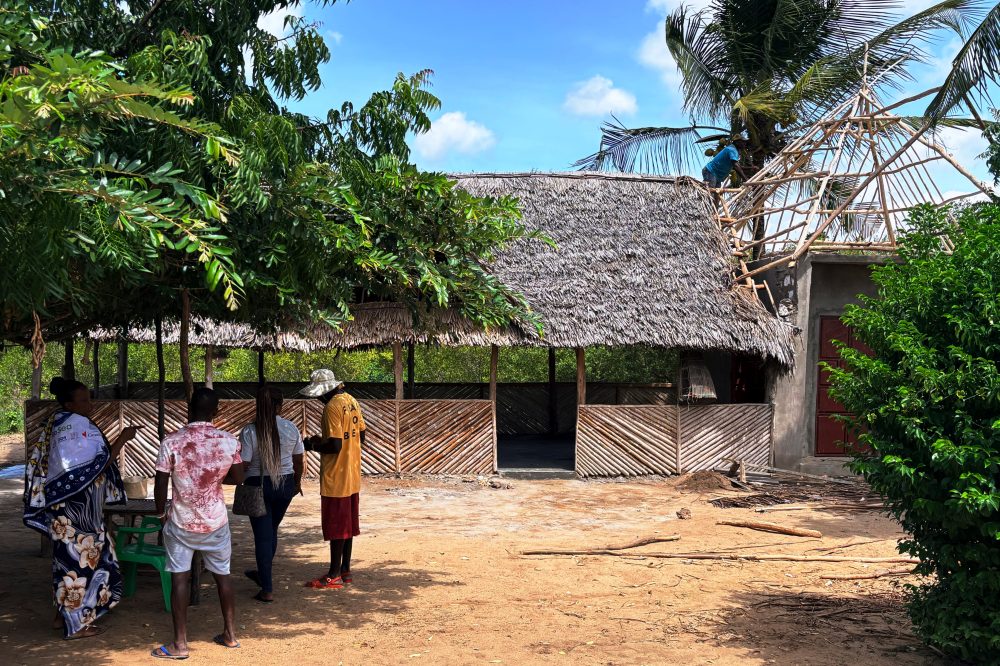

MALINDI, Kenya (AP) — The walls are concrete, the beams are wood, and the building isn’t finished yet. But 54-year-old Nuru Mohammed is already envisioning the future. As her daughter clears away the last traces of sand, Mohammed directs other women hanging fishing nets along the walls as decoration. Within days, a new beachside restaurant on Kenya’s Indian Ocean coast will welcome its first customers — another way to earn a living beyond the sea.
“For us women, this is hope,” says Mohammed, who spent most of her life as one of the rare fisherwomen in Malindi, a town located northeast of the port city of Mombasa. “It will help support many families that have depended on the ocean for decades.”
All along East Africa’s coastline, fishing communities are turning to tourism, ecosystem restoration, and conservation-based enterprises, reshaping their connection to the sea as climate change, overfishing, and deteriorating ocean health put their traditional ways of life at risk.
In Kenya, women are transforming restored mangrove forests into revenue streams through beekeeping and ecotourism. In Tanzania’s Zanzibar archipelago, fishing villages are safeguarding coral reefs through community-managed closures. In Mozambique, sea grass restoration is generating employment while breathing life back into marine habitats. Taken together, these initiatives are redefining what it means to be resilient — not by walking away from the ocean, but by healing it while building lasting livelihoods.
“Communities that depend on the ocean are also its best stewards,” said Andreane Martel, project director for a conservation initiative known as ReSea. “When local people, especially women, lead conservation, they protect biodiversity while creating more resilient and inclusive livelihoods.”
Mohammed said she has had boats stolen and now finds it nearly impossible to compete against large industrial trawlers. A nearby Chinese-owned fish processing facility stands as a stark symbol of how dramatically the industry has changed.
“I can’t compete with that kind of power or scale,” she says.
“It has been tough,” Mohammed says, her eyes on the water. “I fought to remain a fisherwoman. But I think it’s a fight I can no longer win.”
About ten kilometers — roughly six miles — away, where the Sabaki River flows into the Indian Ocean, Beatrice Mwanyiro manages a mangrove nursery and restaurant constructed by ReSea, a 30-member women’s cooperative supported by the Canadian government.
“We have to adapt to the changing times,” Mwanyiro says. “The number of fish coming into the shallow waters are falling every year. Without another source of income, we won’t be able to feed our families.”
Mangroves, coral reefs, sea grass meadows, and nearshore fisheries do far more than provide food. They shield coastlines from storms and lock away enormous quantities of carbon. But rising ocean temperatures, pollution, habitat destruction, and overfishing are putting all of those ecosystems in jeopardy.
Mohamed Somo, a fishing community leader in Lamu — a UNESCO heritage site — says boats that once returned with catches of up to 100 kilograms, or about 220 pounds, of fish now frequently bring back fewer than 30 kilograms, or around 66 pounds.
Kenyan law bars trawlers from operating within 5 nautical miles, or 9 kilometers, of shore, yet fishers say some vessels regularly venture much closer. The problem reaches far beyond Kenya’s waters. According to the U.N. Food and Agricultural Organization, illegal, unreported, and unregulated fishing drains an estimated $23 billion from the global economy each year, while endangering marine life and the food security of billions of people who rely on fish as their main source of protein.
“The trawlers fish offshore during the day, but at night they move into the shallow waters where artisanal fishers work,” Somo says. “By morning, there’s very little left for us.”
The mounting pressure on coastal communities has elevated ocean conservation as a political priority, as people fight both for survival and for the protection of the marine economies they depend on.
“Coastal communities are on the frontlines of climate change and declining ocean health, but they are also among the strongest drivers of resilience,” said Jerry Mang’ena, co-founder and executive director of Action for Ocean, a Tanzania-based organization focused on mangrove restoration along the country’s coastline.
“Supporting sustainable livelihoods, from aquaculture and eco-tourism to ecosystem restoration, helps families adapt while reducing pressure on the ocean. If we’re serious about protecting our seas, we must invest in the people who have cared for them for generations.”
At a recent gathering called the Our Ocean Conference in Mombasa, conservation organizations called on African governments to ratify the Biodiversity Beyond National Jurisdiction Agreement — also known as the BBNJ Agreement or “High Seas” treaty. The landmark United Nations pact establishes marine protected areas in international waters and provides for the fair sharing of marine resources. It took effect in January, and as of April had been signed by 145 countries and formally ratified by 81.
How negotiations over additional ratifications unfold could significantly affect the lives of fishers like Mohammed as they work to build futures less dependent on increasingly unpredictable catches.
“The BBNJ Agreement gives African governments a historic opportunity to protect the high seas and safeguard the future of our fisheries,” said Aliou Ba, oceans campaign lead at Greenpeace Africa.
“But protecting the ocean also means confronting illegal, unreported and unregulated fishing that is stripping African waters of marine life and robbing coastal communities of food and income,” he said. “Governments cannot afford to delay.”