
Hamas announced Monday that it has dismantled its de facto governing body in Gaza, signaling a willingness to hand power over to a group of Palestinian technocrats as part of a U.S.-backed peace plan — while simultaneously pressing Israel to follow through on its own obligations under the stalled agreement.
The governing body that Hamas dissolved had been overseeing ministries in Gaza for more than a decade. Its elimination was a key requirement under a post-war framework laid out by U.S. President Donald Trump following the start of a fragile ceasefire with Israel in October.
Hamas clarified, however, that the ministries themselves and their staff would remain in place. The group also said it would continue to oversee security and policing in areas of Gaza still under its control as a result of the U.S.-brokered truce.
The Trump-appointed Board of Peace, which was created to monitor implementation of the plan, acknowledged Hamas’s action but stopped short of endorsing it. The board stated that “ultimately, our assessment will be guided by actions, not promises, to meet the critical needs of the people of Gaza.”
Israel had not issued an immediate response to Hamas’s announcement. Hamas has accused Israel of repeatedly breaking the terms of the ceasefire and failing to carry out other elements of the agreement, which requires Israeli forces to pull out of Gaza in exchange for Hamas laying down its weapons.
At a press conference in Gaza City on Monday, Ismail Al-Thawabta, director of the Hamas government media office, confirmed that the head of the “Government Emergency Committee” oversight body had stepped down and that the body had been formally dissolved.
Al-Thawabta described the move as “a demonstration of the seriousness of these measures, in implementation of the agreed arrangements, and to facilitate the administrative transition process” to the U.S.-backed National Committee for the Administration of Gaza.
Under the Trump-backed plan, Hamas is expected to transfer governmental oversight to that National Committee — a body made up of Palestinian technocrats backed by the United States.
Ali Shaath, who leads the 15-member National Committee, said his group was prepared to take on its responsibilities in Gaza once the “necessary resources and enabling conditions for its work are in place.” In a Facebook post, Shaath wrote that “the fundamental requirements for the commission’s success are the existence of one authority and one law under a clear reference framework, and one weapon subject to that authority.”
The situation on the ground in Gaza remains dire. Israeli forces currently control more than 60% of the territory, which Prime Minister Benjamin Netanyahu describes as a buffer zone meant to prevent Hamas attacks. Netanyahu has stated that Israel will not withdraw from Gaza.
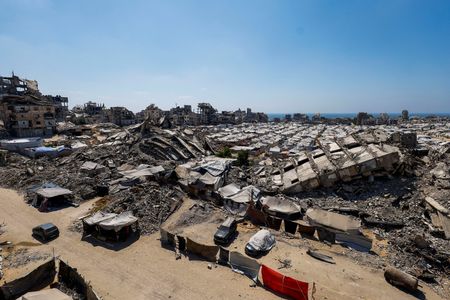
Israel’s military campaign has displaced nearly the entire population of approximately 2 million people, most of whom are now living in tents or damaged structures along a narrow coastal strip still under Hamas control.
On Monday, Gaza health officials reported that an Israeli airstrike killed a couple inside an apartment in the Tel Al-Hawa neighborhood of Gaza City. Two additional strikes — one hitting a tent sheltering displaced civilians and another targeting a vehicle in Khan Younis in the south — left three people dead and at least 20 others wounded, according to medics. The Israeli military did not immediately comment on the incidents.
Hamas has refused to disarm until Israel stops its attacks in Gaza. Israel maintains that its military operations since the ceasefire have been aimed at neutralizing militant threats. The small coastal territory has been in ruins for more than two and a half years since the current conflict was ignited by Hamas’s October 7, 2023 attacks on Israel.