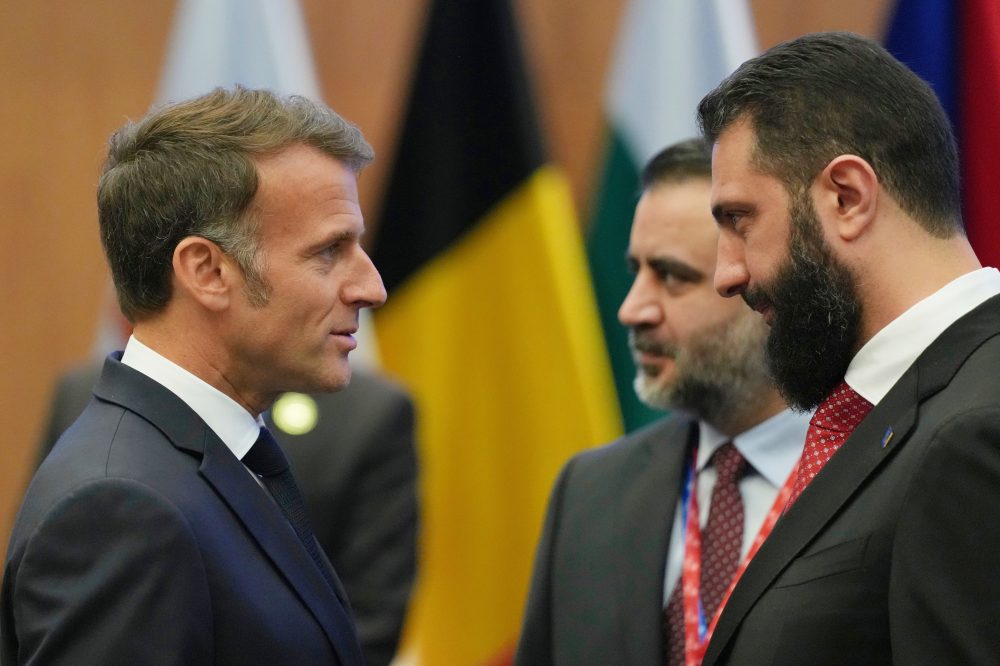

DAMASCUS, Syria — French President Emmanuel Macron touched down in the Syrian capital on Monday, becoming the first major leader from western Europe or North America to set foot in the country since Bashar al-Assad was driven from power in 2024.
While Ukrainian President Volodymyr Zelenskyy had made a visit in April, Macron’s arrival marks a significant milestone as the first visit by a Western leader of his standing.
The trip comes at a time of relative calm across the Middle East following a month of conflict involving Iran and Lebanon. After leaving Syria, Macron is scheduled to travel to Ankara, Turkey, for the NATO summit. Syrian President Ahmad al-Sharaa is also expected to attend that gathering and is anticipated to hold a high-profile meeting with U.S. President Donald Trump.
Syria’s state-run SANA news agency reported that Macron arrived alongside a business delegation, with talks planned around regional security as well as economic and investment opportunities.
Upon landing, Macron was welcomed at the Damascus airport by Syrian Foreign Minister Asaad al-Shibani.
In a post on X, Macron stated: “I have come to express France’s commitment to the Syrian people. For a sovereign Syria, united in its diversity and at peace with its neighbors. Together, let us open a new chapter of stability and peace.”
Macron’s office indicated that France stands behind all those who can “contribute to build a new Syria,” in keeping with the aspirations that emerged during the 2011 Arab Spring — a wave of uprisings across the Middle East that demanded political reform and change.
The French president was set to meet with al-Sharaa at the presidential palace and to connect directly with a range of Syrian citizens, his office noted. Specific details of the visit were withheld for security purposes.
Macron had previously hosted al-Sharaa in Paris in May 2025, during which he pushed European and U.S. leaders to remove long-standing economic sanctions on Damascus. The majority of those sanctions have since been lifted.
France stood by Syria’s new leadership even when other nations remained skeptical, given al-Sharaa’s background as the former head of the Hayat Tahrir al-Sham militant group, which had previously been tied to al-Qaida and operates under Islamist leadership.
Western governments had raised particular concerns about the rights of women and minority groups under the new administration, and whether Syria’s leadership would move toward a more democratic system of governance.
Syria has largely avoided being drawn into the region’s recent armed conflicts, but the nation continues to bear the scars of 13 years of internal war. That prolonged conflict left vast portions of the country in ruins, pushed millions of people into poverty, and is estimated to require hundreds of billions of dollars in reconstruction funding. While Syria has signed memorandums of understanding with various countries and major corporations for large-scale investment projects, those agreements have not yet translated into concrete results.