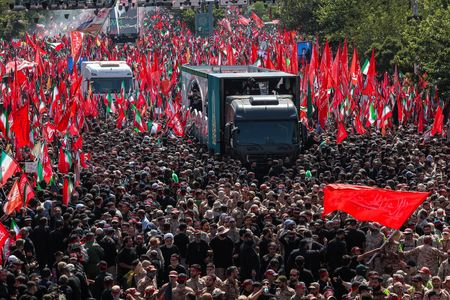

BEIRUT — The massive crowds that gathered in Tehran to mourn the passing of Iranian Supreme Leader Ayatollah Ali Khamenei carried a message that extended far beyond grief. For Iran’s leadership, the outpouring was a statement directed squarely at the United States and Israel: their campaign to cripple the Islamic Republic had not succeeded.
Rather than appearing battered by a war that was triggered by U.S. and Israeli strikes on February 28, Iran chose to project an image of unity, resilience, and determination to influence what happens next in the region.
According to regional officials, diplomats, and analysts, that posture of survival is now the foundation of Iran’s negotiating strategy — with the funeral serving as the moment Tehran attempted to turn endurance into political leverage.
A 60-day ceasefire, which Washington had hoped would restart diplomacy around Iran’s nuclear ambitions, has instead opened a different kind of competition. In this new contest, Iran’s geographic position — not its uranium stockpiles — has emerged as its most powerful card.
Tehran is working to convert gains made during the conflict into lasting strategic influence, particularly by pushing for formal recognition of its dominant role around the Strait of Hormuz, the narrow waterway through which roughly a fifth of the world’s oil and liquefied natural gas flows.
The 60-day countdown toward a final agreement, tied to the ceasefire and an accompanying memorandum of understanding, has not yet officially begun. In that gap, Iran is calling the shots.
Alex Vatanka of the U.S.-based Middle East Institute said Tehran views Hormuz less as a money-making opportunity and more as a source of political standing. “The symbolic part is more important for the Iranians than revenues,” Vatanka said. “They want some kind of symbolic acceptance that the Strait is Iran’s. It’s about accepting Iran as the sovereign power over the Strait.”
Drawing on a Persian proverb, Vatanka put it bluntly: “Why give away a diamond for a lollipop?” In Tehran’s view, control of Hormuz is the diamond. Sanctions relief and access to frozen assets are the lollipop.
Iran’s parliamentary leadership has reinforced this stance. Parliament Speaker Mohammad Bagher Qalibaf declared that “the Strait of Hormuz is our greatest power tool; we must properly protect this divine blessing,” and vowed that Iran would “under no circumstances relinquish its rights” there.
Regional sources and diplomats say Iran is intentionally dragging its feet in negotiations to cement what it sees as the rewards of the war before pivoting back to the nuclear issue. Alan Eyre, a former U.S. diplomat with deep expertise on Iran, said Tehran sees no urgency on uranium while its position on Hormuz remains unsettled. “Iran is perfectly happy to play for time and just drag negotiations out,” Eyre said. “It wants control of Hormuz and is holding talks to institutionalise that control.”
That control could take shape through transit arrangements, coordination agreements, or fees for services along the strategic corridor, while Gulf nations watch to see whether Washington can reverse the new reality on the ground.
Eyre also noted that Iran believes U.S. President Donald Trump — facing domestic political pressures and reluctant to spark another confrontation ahead of November’s midterm congressional elections — is under greater pressure to reach a deal than Iran is to offer concessions. “The Iranians know that President Trump wants to get out; he wants to move on,” Eyre said. “They know they can squeeze him because time is on their side.”
Aaron David Miller, a former U.S. Middle East negotiator, said Washington’s military campaign failed to dislodge Iran’s leverage, leaving American diplomacy with a flawed ceasefire that has itself become a point of contention. He said Tehran has little incentive to engage seriously on its nuclear program until it is satisfied that the new reality around Hormuz is accepted and that meaningful headway has been made on freeing billions of dollars in frozen assets held abroad.
“The 60-day clock was always a fantasy,” Miller said. “The Iranians are not going to move to the nuclear file until they’re relatively confident they’ve achieved this new status quo. They want to make sure that Trump understands, and that the world understands, that there’s no going back to February 27.”
Miller pointed to what he called the defining reality of the post-war landscape: neither U.S. military force nor the threat of a naval blockade fundamentally changed Iran’s position on the strait. “They’re not going to give it up,” he said.
Ebtesam Al-Ketbi, president of the Emirates Policy Center, argued that by ending the war without resolving its root causes, Washington may have inadvertently elevated Hormuz from a pressure point into a permanent source of leverage for Tehran. Gulf officials fear that Iran’s demonstrated ability to shape events around the strait has given it an advantage it will be unwilling to trade away, even for sanctions relief or nuclear concessions.
“They are twisting the arms of the Americans and everybody,” Al-Ketbi said. “Now that they have found this Hormuz treasure, they will not leave it.”
Analysts say Washington will likely have to accept a reopening of the strait largely on terms set by Tehran. As Eyre summarized: “No one’s going to win, but Iran will lose less than the United States will.”