
The Canadian provinces of Alberta and Ontario announced Monday a joint proposal to build a major pipeline carrying western Canadian crude oil eastward, with the possibility of eventually reaching Atlantic export terminals — a move driven by Canada’s desire to find new buyers beyond the United States.
Alberta Premier Danielle Smith outlined the plan, describing a proposed 3,300-kilometer (roughly 2,050-mile) pipeline running from Hardisty, Alberta, to Sarnia, Ontario. The line would be capable of moving up to 500,000 barrels of oil per day, with the potential to scale up to 800,000 barrels. Smith said the corridor could one day be extended to Canada’s Atlantic coastline, creating a pathway for oil exports to European markets.
Canada’s crude oil flows primarily to the United States, its largest buyer by a wide margin, while Alberta holds one of the biggest proven oil reserves on the planet.
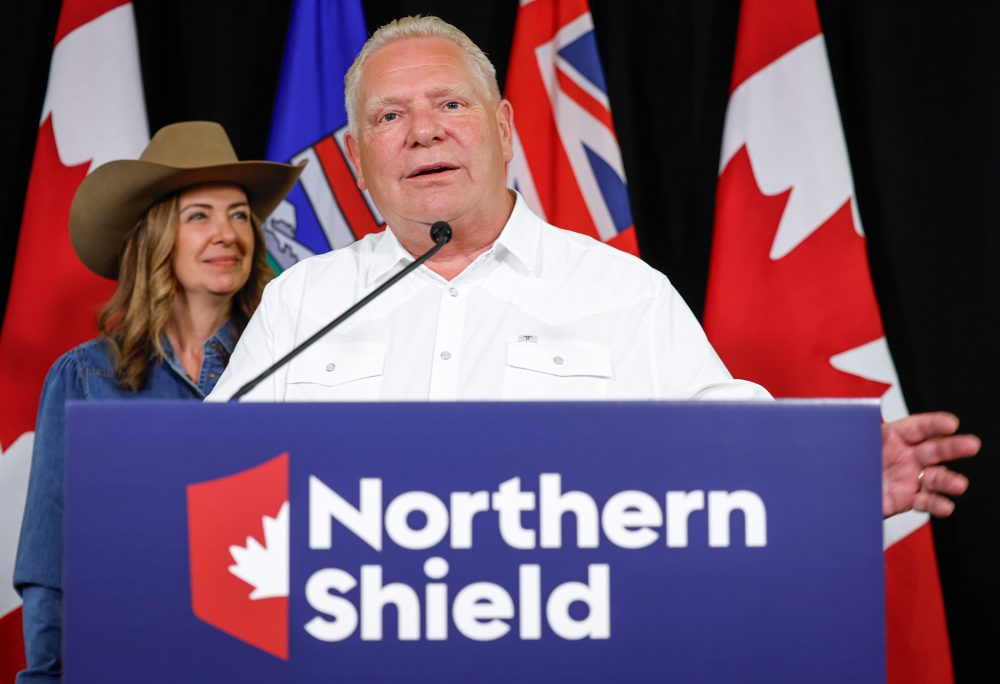
Ontario Premier Doug Ford expressed support for the plan, saying it would be a worthwhile investment whether funded through public or private money. Officials said a feasibility study is in the works.
“There is still a lot of work ahead of us to deliver,” Ford said.
The proposal comes with significant obstacles, including securing financing, navigating regulatory approvals, and holding required consultations with Indigenous communities. A comparable project known as Energy East was scrapped in 2017 after facing years of political, regulatory, and environmental opposition, including strong resistance from Quebec.
Daniel Béland, a political science professor at McGill University in Montreal, offered a cautious assessment. “It’s technically feasible but it would be a massive undertaking. We are only at a very early stage of the project and we don’t have the final route or cost estimates yet,” he said. “It’s not even sure the Hardisty-Sarnia pipeline will ever be built so the idea it could at some point reach the Atlantic sounds quite speculative at this stage to say the least.”
Just last week, Smith and Prime Minister Mark Carney moved forward on a separate pipeline proposal — a taxpayer-subsidized project targeting the Pacific coast to boost exports to Asian markets. That effort involves a partnership with the federally owned Trans Mountain Corp. and Calgary-based Pembina Pipeline. Smith noted that the extent of any private-sector involvement in that project has not yet been finalized.
Smith has publicly stated her goal of doubling Alberta’s oil output to 8 million barrels per day over the next decade to 15 years. She has also argued that the previous federal government under former Prime Minister Justin Trudeau harmed Alberta’s energy sector and stoked sentiment in favor of provincial independence.
Alberta is set to hold a vote this fall on whether to pursue a referendum on breaking away from the rest of Canada.
Andrew Leach, an energy economist and professor at the University of Alberta, described Smith’s production targets as “incredibly ambitious,” pointing out that Alberta dealt with serious inflation the last time it tried to ramp up output at a similar pace. He also raised questions about whether oil producers would have any incentive to route their crude to Sarnia if there was no infrastructure in place to move it further from there.
Prime Minister Carney acknowledged last week that Canada’s greenhouse gas emissions would likely climb in the short term as his government pushes forward with pipeline expansion. He has made broadening Canada’s export reach a central priority in response to the trade conflict with U.S. President Donald Trump, pledging to pursue greater access to markets across Europe and Asia.