
AIX-EN-PROVENCE, FRANCE — With France’s 2027 presidential election drawing closer, centrist political hopefuls are making their case to the country’s business community, promising they can bring government spending under control without putting the brakes on economic growth.
The push comes as French corporate leaders grow increasingly anxious about whether centrist politicians — scrambling to reclaim voters lost to the far right and the hard left — will stay committed to fiscal responsibility.
Current polling shows that the far-right National Rally’s eventual presidential nominee will likely be a strong contender to reach the election’s second-round runoff. At least one survey has also suggested that hard-left leader Jean-Luc Melenchon could make the runoff if the political center stays divided.
The question of who will represent the far right may be answered soon. Marine Le Pen and her protege Jordan Bardella are waiting on a Paris court ruling set for July 7, when judges will decide on Le Pen’s appeal of an embezzlement conviction and a five-year ban from seeking elected office.
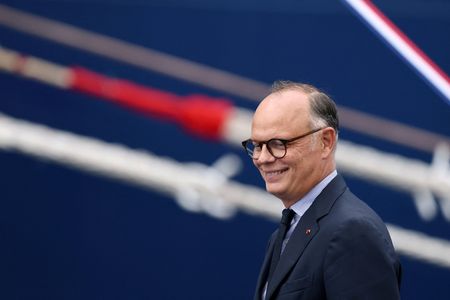
Two former prime ministers who served under President Emmanuel Macron — Edouard Philippe and Gabriel Attal — were among the declared and potential candidates who appeared at an annual business conference in Aix-en-Provence last week, each making the argument that he is best suited to repair the country’s finances.
Attal, 37, drew enthusiastic applause from the audience when he promised to run the government with the efficiency of a private company and remove ministers who fail to deliver results.
“In your company, when a finance director fails to meet their targets or overspends, there’s usually a consequence. It must be the same for those who run the government,” he said.
Tackling the Deficit
France has repeatedly broken European Union rules that limit budget deficits to 3% of gross domestic product. Attal, who held the prime minister’s post in 2024, told the newspaper Le Parisien that he would reduce the deficit from its current 5.1% down to 3% before 2032. He said the bulk of those savings would have to come from welfare spending, which makes up two-thirds of the budget, along with further changes to the pension system and unemployment benefits.
Philippe, who served as prime minister from 2017 to 2020 and currently serves as mayor of Le Havre, told the business publication Les Echos that he would also cut the deficit — from 5% of GDP this year down to 2% by the end of the next presidential term in 2032. He has proposed holding a national referendum to enshrine budget discipline rules in the French constitution and said he would push to raise the retirement age further. The government had paused a gradual increase in the retirement age from 62 to 64, putting that change on hold until after the upcoming election.
Opinion polls suggest Philippe may have the strongest chance among centrists of preventing a far-right candidate from reaching the presidency. At the Aix-en-Provence gathering, he pledged to help dismantle trade barriers within the European Union and work toward consolidating the bloc’s fragmented capital markets.
Xavier Girre, the CEO of French utility group Suez, said his message to any presidential contender is simple: regulatory and tax stability are essential for any future government to give businesses the clear outlook they need to make investment decisions.
A Crowded Field
For years, France’s top business figures kept their distance from Le Pen and her party, which has had little success breaking into corporate boardrooms. But with polls now pointing toward a possible far-right victory next year, some business leaders are beginning to show interest in understanding the movement’s economic positions.
“Business leaders believe that far-right politicians have made progress in their economic analysis and in their understanding of the French economy,” said Alexandre Medvedowsky, who leads the lobbying firm NSI.
Despite that shift in attitude, neither the National Rally nor Jean-Luc Melenchon’s France Unbowed party received invitations to the three-day business conference — consistent with prior years. The event’s organizers said in an emailed statement that the decision to exclude both parties was reached through a group vote.
Benoit Derigny, who oversees the French operations of staffing company ManpowerGroup, noted that center-left and center-right politicians largely agree on what is wrong with France, including its heavy debt burden. He told Reuters that with so many candidates crowding the political center, they will need to differentiate themselves by explaining how they would prioritize limited government resources.