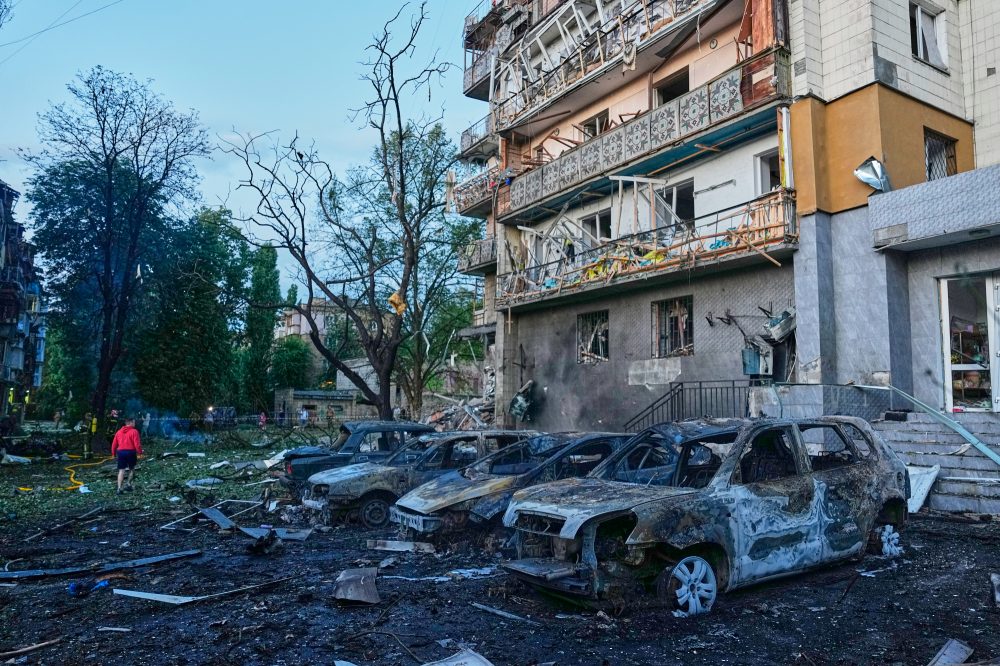
Ukrainian officials reported Sunday that Russian forces targeted an international cargo ship in the Black Sea, just off the southern Ukrainian city of Odesa, killing at least five crew members.
The vessel was registered under the flag of Guinea-Bissau and had departed port with a load of corn aboard. Prime Minister Sergii Koretskyi said the ship’s crew of 17 included sailors from India and Syria, along with one Ukrainian national.
Koretskyi added that eight crew members were pulled to safety, though the ship remained engulfed in flames as of late Sunday evening. Five additional crew members are still missing.
A Reuters journalist on the ground in Odesa witnessed thick smoke rising from a large ship visible off the coastline. Russia has not issued any public statement regarding Sunday’s strike.
The attack is part of a broader pattern of escalating Russian assaults on deepwater port facilities in southern Ukraine — ports that handle a significant share of the country’s grain exports and other essential cargo. These strikes have intensified in recent weeks as the conflict enters its fifth year.
Ukraine’s acting Foreign Minister Andrii Sybiha took to social media platform X to condemn the attack, writing: “A civilian ship. An international crew. A route serving global food security. Putin saw another target.”
“This attack leaves no room for illusions. Putin’s Russia does not care whom it kills,” Sybiha added, referring to Russian President Vladimir Putin.
The assault follows a deadly weekend of Russian strikes in the region. On Saturday, one person died when Russian forces hit port infrastructure in Odesa, striking a vessel flying the flag of Antigua and Barbuda. The day before that, three people were killed in Russian attacks on Odesa and Mykolaiv.
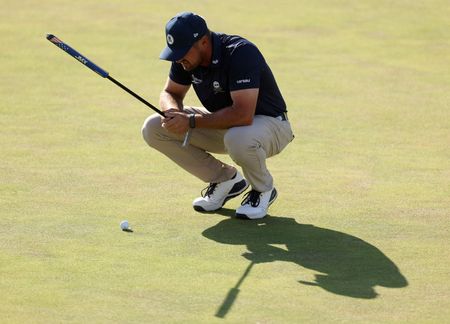
Bryson DeChambeau’s turbulent week at The Open Championship came to a close just as it started — with the golfer refusing to face reporters after his round.
For the third consecutive day, DeChambeau turned down requests to speak with the media following his final round at Royal Birkdale Golf Club. Starting the day four strokes behind Sam Burns, DeChambeau carded a 2-over-par 72, wrapping up the tournament at 4 under par and tied for 14th place — six shots back of champion Ryan Fox of New Zealand.
DeChambeau’s ongoing avoidance of the press was a constant storyline throughout the week, though it was largely overshadowed by a two-stroke penalty handed down after his second round on Friday. The penalty, issued by the R&A, knocked him from one shot off the 36-hole lead to three strokes behind the leaders.
He was never able to claw his way back into contention, posting a 1-under 69 on Saturday before a triple bogey on the 11th hole Sunday effectively ended any remaining hope of a comeback.
The only time DeChambeau spoke to anyone outside of television during the entire week was following his opening-round 67 on Thursday — and even then, he bypassed a traditional press conference in favor of a one-on-one conversation with an R&A representative.
On Friday evening, while DeChambeau drove balls on the Royal Birkdale practice range well after dark, his agent stepped in to speak on his behalf. The controversy centered on the fifth hole, where rules officials ruled that DeChambeau had improved the path of his swing by stomping down tall grass behind his ball — a charge he disputed directly with officials at the time.
“He’s a lot of things. He’s not a cheater,” agent Brett Falkoff told reporters. Falkoff also noted that DeChambeau had seriously considered withdrawing from the tournament in protest. “He’s a big boy. He’ll see how he feels. But he certainly feels he was unfairly penalized.”
Shortly after midnight local time, DeChambeau took to X to share his thoughts: “Obviously disappointed with the ruling. I don’t agree with it, but it is what it is. This fires me up. Onto the weekend. Let’s get it.”
The uncertainty surrounding whether DeChambeau would actually withdraw caused the R&A to delay releasing third-round tee times longer than usual, frustrating fellow competitors.
“It was a bit of a joke, really,” said Englishman Marco Penge. “I’m staying at home this week, which is an hour away, and not getting a tee time until 11 p.m. is not great, really, when the tournament probably finished at — we could have at least got a heads up for what time the first tee time was going to be. Obviously there was a lot of commotion, so that delayed things.”
Northern Ireland’s Rory McIlroy was equally unimpressed. “Late night for everyone,” he said. “Yeah, look, I won’t pretend to be up here and defend Bryson. I’m not particularly fond of him. I think a lot of it’s performative. I think a lot of it’s for attention. To hold the tournament hostage like that, and to have all of us, players, volunteers, everyone waiting on him to depart, I didn’t feel like it was a great look.”
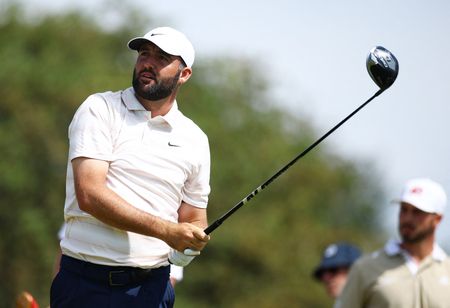
World No. 1 Scottie Scheffler had stayed quiet on the matter during Saturday’s round but opened up after Sunday’s final round, making clear he does not view DeChambeau as someone who cheats.
“I hate saying stuff out here because I don’t want anything to get taken out of context,” Scheffler said. “All I’ll say is Bryson, I’ve known him for a long time, and he’s a lot of things, but he’s definitely not a cheater. I’ve never seen him cheat once, whether we were having a putting contest on the putting green or chipping contest, or anytime we played amateur golf, I never saw anything suspicious. When you’re watching him there from that camera angle, maybe he was a touch careless around his ball, but I don’t think he did anything intentionally.”
The Open was the only major championship in 2026 where DeChambeau made the cut. The LIV Golf star’s two major titles came at the U.S. Open in 2020 and 2024.
A U.S. military service member died Saturday while handling unexploded ordnance in northern Iraq, according to U.S. Central Command.
The military said the service member was killed “during a controlled detonation of unexploded ordnance” — material that had come from a “downed Iranian one-way attack drone,” according to a statement released by Central Command on Sunday.
A vehicle crash on Interstate 95 northbound is causing lane restrictions near Exit 5A, according to Delaware transportation officials.
The left lane at the merge point has been shut down as a result of the incident. Travelers heading northbound in that area should be prepared for reduced lanes and potential backups.
Drivers are encouraged to remain alert, slow down when approaching the area, and consider alternate routes if possible until the lane is fully reopened.
A crash on Interstate 95 northbound prompted the closure of the left lane at the Exit 5A merge area, according to a traffic incident report from Delaware’s transportation authority.
The lane closure was put in place as crews responded to the scene. Motorists traveling northbound in that stretch were urged to slow down and be prepared for potential backups near the merge point.
No further details regarding the number of vehicles involved or any injuries were included in the initial report. Drivers were encouraged to check for updates on road conditions before heading out.
For the first time since 2023, Scottie Scheffler has gone through an entire men’s major championship season without hoisting a trophy.
The World No. 1 put together a final-round 3-under-par 67 on Sunday at Royal Birkdale Golf Club in one last attempt to climb the leaderboard, but it wasn’t enough. Scheffler wrapped up the week at 7 under par, sharing fourth place with Englishman Tommy Fleetwood at the Open Championship.
Cameron Young had already set the clubhouse target at 9 under, but New Zealand’s Ryan Fox came charging late to claim the Claret Jug, finishing at 10-under 270 to win the championship.
Scheffler reflected on his strategy heading into Sunday’s round. “Going into today, I had some experience in comebacks in stuff like this,” he said, “and I told myself if I could go out and shoot 4 under on the front nine, I’d be right in it because the leaders wouldn’t have barely teed off yet, and that would have put me at 8, and (54-hole leader Sam Burns) would have been at 10.”
Despite the outcome, the world’s top-ranked player said he had no regrets about how he approached the day. “I definitely don’t regret any of the decisions that I made, either off the tee or going into greens today. I did a good job of staying aggressive and was committed to what I’m doing, and I was very proud of kind of how I played this week when I felt like things weren’t going necessarily my way. It was mentally, for me, I think, a really, really good week.”
Scheffler reached the turn 3 under for the round and 7 under overall. A birdie putt of 14 and a half feet at the par-3 12th hole moved him to 8 under for the first time, putting him briefly in contention.
However, the wheels came off at the 13th hole. Scheffler’s tee shot found the rough on the right side, and his second shot barely moved, staying on the hillside just in front of him. The resulting bogey stung, and a weak chip at the par-3 15th led to another dropped shot.
Scheffler — who struggled with his putter throughout the week — recovered with an 11-foot birdie at the 16th before a dramatic sequence unfolded at the par-5 17th.
After another missed fairway, Scheffler attempted a blind 3-wood from behind a large mound. The ball had enough distance to reach the green but veered sharply left, coming to rest near some tournament infrastructure.
As volunteers began hunting for the ball, Scheffler waved them off. A rules official traveling with his group granted him relief from the obstruction.
“The rules official said it landed just barely left of the grandstand thing,” Scheffler explained. “I don’t know what you call that, like a sponsor area or something. And (caddie Ted Scott) had a bead right on where it was coming down.”
Scheffler said he weighed his options carefully. “We tried to figure it out. I said, ‘If I find it, does that help me; can I drop it?’ — since that would be about 50 yards closer to the hole. He said, ‘Yes, you can then use that spot, but you might have to go to the other side of the TIO (temporary immovable obstruction),’ which I didn’t know exactly where that would be, and that’s not a great angle coming across there. So decided to stop the search and go back and drop it doing point-of-entry TIO relief.”
The calculated decision worked in his favor. Scheffler dropped the ball short of the grandstand, giving himself a clear view of the pin. He then stuck his third shot 11 feet away and drained the birdie putt to get back to 8 under — an unlikely outcome from a chaotic situation.
But the 18th hole proved to be his undoing. Needing a birdie to match Young at the top of the leaderboard, Scheffler again missed the fairway. His approach settled next to a bunker short of the green, and he failed to get up and down for par, sliding back to 7 under to close out his week.
Scheffler, 30, has not won a tournament of any kind since The American Express back in January — his 20th career PGA Tour victory. He also arrived in England coming off his first missed cut in four years at the Scottish Open the previous week. Still, he downplayed any concern about the recent dry spell.
“Just those little kind of bounces,” he said. “My ball on 14 I think is in the fairway, I come up there, it’s in the pot bunker. Little stuff like that over the course of the week tends to add up. I competed really well this week. I did a good job of staying patient and hit the ball really nice over the course of four days. Maybe yesterday was the only day I didn’t strike it as well as I would have liked to.”
Philadelphia Eagles running back Saquon Barkley and his family were targeted in a burglary at their suburban Philadelphia home early Saturday, according to the Tredyffrin Township Police Department.
The incident happened around 5 a.m., when officers were sent to Barkley’s home after a burglary-in-progress call was received. By the time police arrived, the suspected burglars had already left the scene. Barkley and his family were not hurt.
At least one of the suspects had entered the home while Barkley and his family were inside. Authorities are searching for at least two individuals and have released a photo of a white SUV believed to be tied to the crime.
Tredyffrin Township Police Captain Tyler Moyer said the well-being of those inside the home was the top priority. “They were home, and fortunately, as you know, with any situation like this, our main concern is that the residents of that home at the time were unharmed, which they were,” Moyer said. “They were fine afterwards, obviously unsettled, as anyone would be.”
Chester County detectives are working alongside Tredyffrin Township police on the case, the Chester County District Attorney’s Office confirmed.
“We are incredibly grateful that the Barkley family was not injured during this incident,” the D.A.’s office said in a statement on social media. “We are asking the public to help us identify those responsible by checking any home security cameras for suspicious activity in the area around 5:00 a.m. If you saw anything unusual or have video that may assist investigators, please contact the Tredyffrin Township Police Department immediately.”
Given that a number of professional athletes have been targeted in theft-related crimes in recent months, Tredyffrin Township police said they plan to reach out to federal authorities to determine whether this incident may be connected to a broader pattern.
“We will look at all angles of this because we know, obviously, it’s been all over the news in the past few years about different professional athletes’ homes getting burglarized,” Moyer said.
Northbound travelers on Route 1 near Dover are facing delays this morning after a crash forced the closure of the left lane at the Dover Toll Plaza.
The incident is affecting the EZ-Pass lane at the plaza, backing traffic up from South Bay Road to the toll plaza itself. DelDOT is reporting delays in the range of five to ten minutes for drivers passing through the area.
Motorists are urged to use caution, consider alternate routes if possible, and allow extra time when traveling northbound through the Dover Toll Plaza until the lane is reopened and the crash is cleared.
Motorists should be aware of a full road closure currently in effect on Fleetwood Pond Road.
The closure spans the section of Fleetwood Pond Road between Old Furnace Road and Baker Mill Road, and is the result of ongoing construction work in the area.
The road is expected to remain closed through July 22nd. Drivers are advised to seek alternate routes and allow extra travel time until the construction is complete.
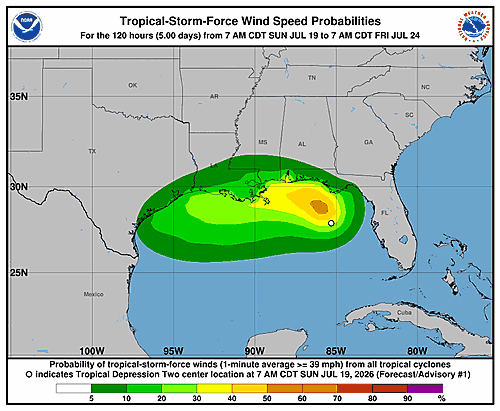
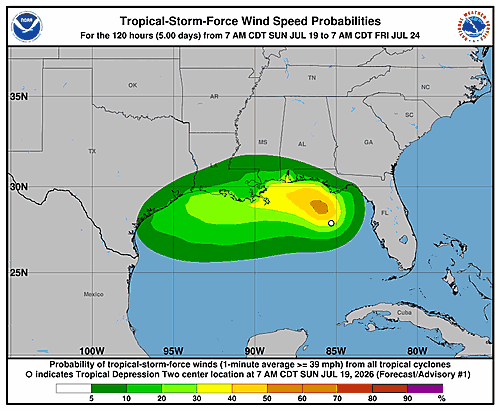
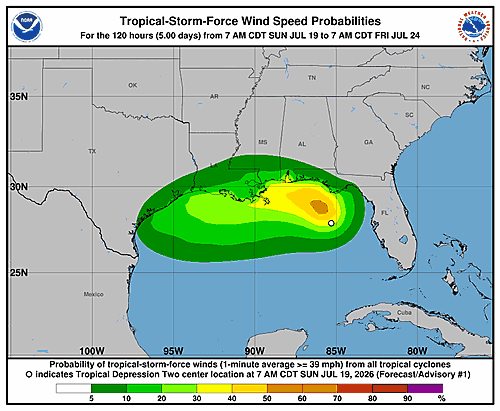
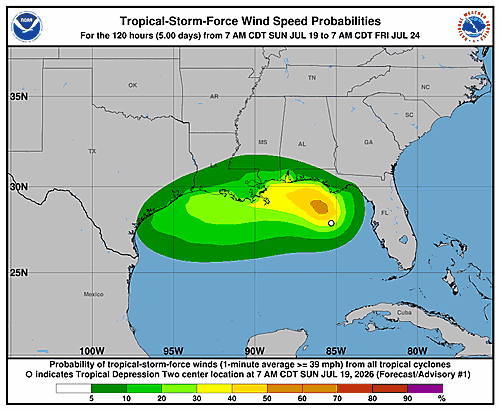
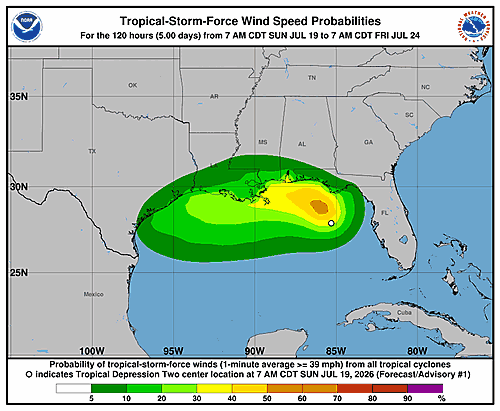
The National Hurricane Center is tracking Tropical Depression Two in the Atlantic Ocean, releasing updated wind speed probability graphics for the system.
According to the latest data from the National Hurricane Center, the 34-knot wind speed probability forecast was last updated on Sunday, July 19, 2026, at 15:21 GMT.
Residents in coastal areas are encouraged to continue monitoring official National Hurricane Center updates as the storm system develops.
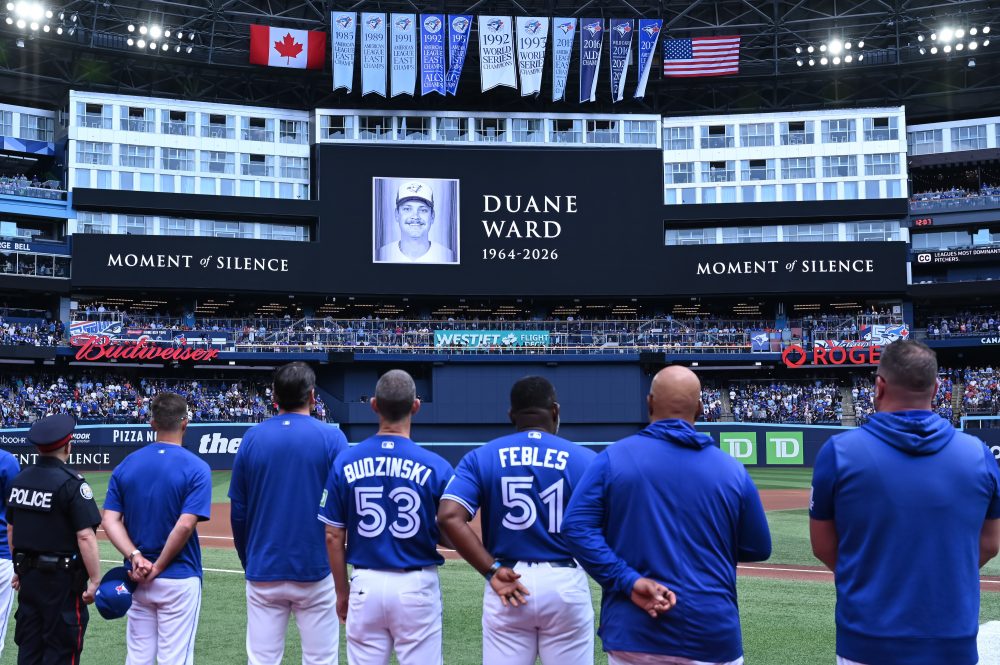
TORONTO (AP) — The Toronto Blue Jays announced Sunday that Duane Ward, one of the greatest relief pitchers in franchise history and a two-time World Series champion, has died of natural causes at the age of 62.
According to the team, Ward had traveled to Toronto on Friday alongside several former teammates from the back-to-back championship squads of 1992 and 1993. However, he was not present at Saturday’s pregame ceremony at Rogers Centre, which featured a statue unveiling honoring those title-winning teams. More than two dozen players, coaches, and front office members from those rosters participated in the celebration.
The Blue Jays released a statement expressing their grief: “Duane will always be a cherished part of the Blue Jays family, and we will be forever grateful for his contributions to our organization and to baseball in Canada.”
Prior to Sunday’s game against the Chicago White Sox, the club honored Ward with a scoreboard tribute video and a moment of silence. The organization did not provide additional details regarding the circumstances surrounding his death.
Over his career with Toronto, which spanned from 1986 to 1995, Ward appeared in 452 games. His 121 career saves stand as the highest total in Blue Jays franchise history.
Ward made his only All-Star team in 1993, the same year he led the entire American League with 45 saves — a single-season record that still belongs to the Blue Jays organization.
In Game 6 of the 1993 World Series against Philadelphia, Ward was the pitcher of record when Joe Carter hit his legendary series-clinching home run, cementing Ward’s place in baseball history.
The Los Angeles Dodgers are left without answers on when two-way star Shohei Ohtani will pitch again, after knee irritation in his left leg forced him out of the starting rotation.
Ohtani had been scheduled to take the mound Wednesday against the Philadelphia Phillies. However, Dodgers manager Dave Roberts addressed reporters ahead of Sunday’s doubleheader with the New York Yankees, making clear there is no timetable for Ohtani’s return to pitching duties.
“Kind of where we’re at right now … I would say that it’s going to be some time,” Roberts said. “I say that it’s not going to be a day-by-day thing.”
Ohtani’s most recent pitching appearance came on July 3 against San Diego. His performance on the mound has declined noticeably over the past month — after allowing just five earned runs and 30 hits across his first 10 starts for a 0.74 ERA, he gave up 12 earned runs and 25 hits over his following four outings, pushing his ERA during that stretch to 4.38.
The knee issue required a lubricant injection on July 12, yet Ohtani has remained in the Dodgers’ batting lineup for each of the last nine games, including Sunday’s opener against the Yankees.
At the plate, Ohtani has been productive despite the injury, slashing .300/.364/.733 with four home runs and eight RBIs over the team’s previous eight games. He did sit out the All-Star Game on Tuesday, however.
Stefanos Tsitsipas is back in the winner’s circle. The former World No. 3 and two-time Grand Slam finalist claimed his 13th career ATP title Sunday, defeating No. 7 seed Raphael Collignon 6-4, 6-7 (3), 6-3 in the final of the EFG Swiss Open Gstaad in Switzerland.
The 27-year-old Greek player had gone without a title for 16 months — his last victory coming in March 2025, when he defeated Canada’s Felix Auger-Aliassime in straight sets at the Dubai Open. As a result of Sunday’s win, Tsitsipas will jump 30 places in the world rankings to No. 55 when updated on Monday.
Tsitsipas entered the tournament unseeded and had to work his way through the draw, knocking out No. 5 seed Ignacio Buse of Peru and No. 4 seed Arthur Rinderknech of France before reaching the final. His serve was a key weapon throughout the match — he recorded four aces without a single double fault, won 21 of 29 second-serve points, and successfully saved two of the four break points he faced.
His opponent, Belgium’s Collignon, was making his first-ever appearance in an ATP final. The 24-year-old, currently ranked No. 42 in the world, showed plenty of fight — taking the second set in a tiebreaker to force a third set. However, Tsitsipas broke Collignon’s serve twice in the deciding set, including on match point, to seal the championship.
Nordea Open
In Bastad, top seed Andrey Rublev made quick work of his final, needing just 77 minutes to defeat defending champion and No. 2 seed Luciano Darderi 6-4, 6-3 and claim his second title at the venue.
The 28-year-old Russian, who previously won at Bastad in 2023, also ended his own title drought — his most recent win before Sunday had come in February 2025 at Doha. Rublev was dominant on serve, winning 33 of 38 first-serve points — an impressive 86.8% clip. He broke Darderi’s serve to close out the first set, then fended off a break point while leading 2-0 in the second.
The victory snapped Rublev’s five-match losing streak against Top 20 opponents and will push him up two spots to No. 14 in the world rankings. Darderi, ranked No. 18, struggled throughout — committing three double faults, saving only two of four break points, and failing to convert either of his chances to break Rublev’s serve.
New Zealand’s Ryan Fox delivered one of the most dramatic finishes in recent British Open history on Sunday, sinking a 20-foot birdie putt on the 18th hole at Royal Birkdale to capture the 154th edition of the prestigious championship.
Fox entered the final hole tied with Cameron Young at nine under par, but a brilliant approach shot set up the decisive birdie that gave him a one-stroke victory over the American.
At 39 years old, Fox becomes only the second New Zealand man to win the Open Championship, joining Bob Charles, who claimed the title back in 1963 at Royal Lytham.
Fox closed out the tournament with a final-round 68, finishing at a total of 270. Young, who posted a remarkable final-round 64, finished in second place at 271. American Sam Burns, who had held the overnight lead, ended up in third place at eight under par.
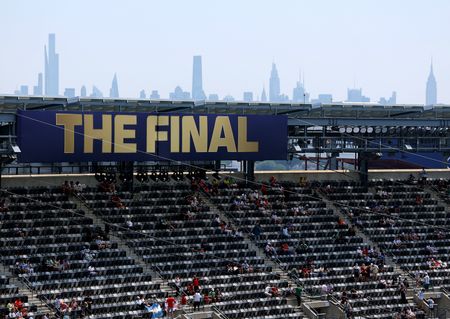
EAST RUTHERFORD, New Jersey — After nearly six weeks of drama, heartbreak, and unforgettable moments, the World Cup tournament is down to its final two teams. The New York New Jersey stadium in East Rutherford was gearing up Sunday to host the championship match pitting a composed and confident Spain — chasing their second world title — against a fired-up Argentina, looking to defend their crown in what many hope will be the perfect farewell chapter to Lionel Messi’s legendary career.
Concerns about air quality, which had been a worry due to a heavy blanket of smoke from Canadian wildfires settling over the region for several days, faded along with the haze. Temperatures that had been oppressively hot in recent weeks also eased, and fans arrived to find clear skies and pleasant conditions at the New Jersey venue.
The expected presence of U.S. President Donald Trump added significant security measures to an already high-profile event. Hundreds of journalists, entertainers, and event volunteers endured lines stretching up to three hours, with Secret Service agents using wands to screen everyone entering. Fans experienced somewhat faster entry at the gates but then faced lengthy waits inside for food and merchandise.
Supporters dressed in Argentina’s iconic blue and white or Spain’s red and yellow began making their way into the stadium well ahead of the 3 p.m. ET kickoff. A pre-match closing ceremony featuring Post Malone and Tom Cruise was scheduled to begin at 1:30 p.m. ET.
The ceremony also included American singer Jennifer Hudson performing the U.S. national anthem and tenor Christopher Macchio singing “America the Beautiful,” giving the event a distinctly American feel. It marks the first time since the inaugural World Cup in 1930 that two Spanish-speaking nations have met in the final.
The tournament has embraced a number of American sporting traditions throughout — some of them not without controversy. These include mid-half “hydration” breaks that broadcasters have used to air additional commercials, as well as championship rings for the winning team.
Sunday’s finale added yet another American tradition: a star-studded halftime show in the style of the Super Bowl, featuring pop icons Madonna and Shakira. That addition is expected to push the standard 15-minute halftime break to at least 20 minutes, and possibly as long as half an hour.
Despite ticket prices running well into the thousands of dollars, fans have been eager to witness the clash between two of soccer’s all-time great programs. Dozens of ticketholders lined up at merchandise stands hoping to grab keepsakes from the historic occasion, with jerseys priced at $130 each. Support inside the stadium appeared to be fairly evenly divided between the two nations. The stadium is normally home to the NFL’s New York Giants and Jets.
“I was in the final in 2010 in South Africa, when Spain won the other World Cup,” said Dxema Azcarate, sporting a Spain jersey and the country’s flag painted on his cheek. “I’m not sure I’m going to have an opportunity for a third time in my life.”
The Oklahoma City Thunder have shipped 2025 All-Defensive wing Luguentz Dort off to the Atlanta Hawks in a three-team transaction that also loops in the Dallas Mavericks, ESPN reported Sunday.
As part of the deal, the Thunder receive three second-round draft picks, former No. 1 overall pick Zaccharie Risacher heads to Dallas, and guard Ryan Nembhard moves to Atlanta.
Although Dort had been a fixture in Oklahoma City’s starting lineup for several seasons, the trade wraps up a busy stretch of roster moves for the Thunder. Combined with earlier trades involving Isaiah Joe and Aaron Wiggins, Oklahoma City has now collected seven second-round picks while getting their payroll below the second apron threshold.
The Thunder exercised Dort’s $17.7 million team option, brought in three future draft assets, and created a $17 million trade exception in the process. The move also opens the door for Dort to ink a long-term contract in Atlanta — something that simply wasn’t financially workable in Oklahoma City.
At 27 years old, Dort joins a young and promising Hawks roster that features Dyson Daniels and Nickeil Alexander-Walker. Atlanta won more playoff games against NBA champion New York Knicks than any other team this past postseason. The Hawks also freed up more than $40 million in cap space heading into next summer.
Dort earned a spot on the NBA’s All-Defensive team in 2025 and finished fourth in Defensive Player of the Year voting. Over 69 games last season, he put up 8.3 points and 3.6 rebounds per game. Across seven seasons with Oklahoma City, he averaged 11.6 points and 3.8 rebounds.
Risacher, 21 and in just his second NBA season, averaged 9.6 points and 3.8 rebounds across 67 games. He saw limited action in the playoffs, logging only 23 minutes. The forward finished runner-up to the Spurs’ Stephon Castle in the 2025 Rookie of the Year race.
Nembhard, 23, appeared in 60 games for the Mavericks as an undrafted rookie guard last season. He made 19 starts and averaged 6.6 points, 5.3 assists, and 2.2 rebounds per game before being moved to Atlanta in this deal.
Motorists traveling northbound through the Dover Toll Plaza are facing disruptions after a crash forced the closure of EZ Pass lanes at that location.
The incident has prompted officials to shut down the EZ Pass lanes in the northbound direction, leaving drivers without access to the electronic toll option in that area.
Travelers approaching the Dover Toll Plaza heading north are advised to allow extra time and be prepared for potential backups as crews work to address the situation.
No additional details regarding injuries, the number of vehicles involved, or an estimated reopening time were included in the initial report. TV Delmarva will provide updates as more information becomes available.
The National Hurricane Center has issued updated wind speed probability information for Tropical Depression Two, the second named tropical system of the Atlantic season.
Graphics released by the agency show the probability of 34-knot wind speeds affecting different regions over a five-day, or 120-hour, forecast window.
The wind speed probability data was last updated on Sunday, July 19, 2026, at 15:21 GMT. Residents in potentially affected coastal areas are encouraged to monitor the latest updates from the National Hurricane Center as the storm develops.
A tropical depression is slowly drifting off the west coast of Florida, prompting forecasters to keep a close eye on the system’s movements.
According to the National Hurricane Center, as of 1:00 PM Central Daylight Time on Sunday, July 19, the center of Tropical Depression Two was positioned near latitude 27.8 north, longitude 85.0 west. The storm was barely moving, tracking north-northwestward at only 1 mile per hour.
The depression had a minimum central pressure of 1011 millibars, with maximum sustained winds of approximately 30 miles per hour. At that wind speed, the system remains classified as a tropical depression, below the 39 mph threshold required for tropical storm status.
Forecasters will continue to monitor the slow-moving system for any signs of strengthening or a change in direction.
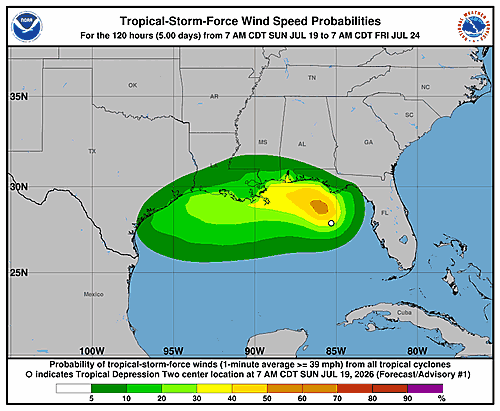
The National Hurricane Center has issued updated wind speed probability graphics for Tropical Depression Two, with the latest information reflecting conditions as of Sunday, July 19, 2026 at 15:21 GMT.
The graphic released by forecasters shows the 34-knot wind speed probabilities over a 120-hour period, giving forecasters and the public a look at where tropical storm-force winds may be felt as the system develops.
Residents are encouraged to continue monitoring official National Hurricane Center updates as the storm system evolves.
Delaware State Police have launched a death investigation after a man’s body was discovered in a pond on the grounds of a Newark hospital.
Around 10:30 a.m. on July 18, 2026, troopers were called to Christiana Hospital at 4755 Ogletown Stanton Road in Newark following a report of a deceased individual found in a retention pond near the hospital’s entrance. Upon arrival, officers located a 30-year-old man from Wilmington in the shallow water along the pond’s edge.
Because of the suspicious nature of the discovery, the Delaware State Police Homicide Unit has taken over the investigation.
The man’s remains were transferred to the Delaware Division of Forensic Science, where officials will work to determine both the cause and manner of death.
Investigators are urging anyone who may have relevant information to reach out to Detective M. Csapo at (302) 741-2729. Tips can also be submitted by sending a private message to the Delaware State Police on Facebook, or by contacting Delaware Crime Stoppers at (800) 847-3333.
Anyone who has been affected by this incident or has lost a loved one to a sudden death can reach the Delaware State Police Victim Services Unit and Delaware Victim Center around the clock by calling the toll-free hotline at 1-800-VICTIM-1 (1-800-842-8461). The Victim Services Unit can also be contacted by email at [email protected].
The Chicago Fire are reportedly sending their top striker, Hugo Cuypers, to CF Monterrey of Liga MX, with multiple media outlets confirming the transfer agreement.
Cuypers, a Belgian forward who has been nicknamed “the European Goal Machine” by the website SoyFutbol, is currently the leading scorer in Major League Soccer this season, having netted 13 goals in only 11 appearances. According to The Athletic, Chicago will take in a base fee of $7.5 million, with an additional $500,000 potentially coming through performance-related add-ons.
During his time with the Fire, Cuypers scored 40 goals across 75 matches after the club originally brought him in for $12 million back in February 2024.
The deal comes just under two weeks after another MLS star made the same move to Monterrey. Columbus Crew leading scorer Diego Rossi transferred to the Mexican club for $8 million after tallying 37 goals and 20 assists in 88 games for Columbus. Rossi wasted no time making an impact, picking up an assist in his Rayados debut — a 3-2 season-opening victory on Saturday.
Oklahoma City is set to part ways with starting forward and defensive standout Lu Dort, shipping him to Atlanta as part of a three-team arrangement, according to a source familiar with the deal who spoke to The Associated Press on Sunday.
Under the terms of the trade, Atlanta will also acquire Ryan Nembhard from Dallas, while the Hawks will send former top overall draft selection Zaccharie Risacher to the Mavericks. Oklahoma City, meanwhile, will receive three heavily protected second-round draft picks in return. The source spoke on the condition of anonymity, as the transaction has not yet cleared the required NBA approval process.
The move serves multiple purposes across all three franchises. It allows Oklahoma City to trim enough payroll to drop below the NBA’s second apron threshold, gives Atlanta a proven defensive presence in Dort, and hands Dallas yet another former No. 1 overall pick. Risacher will join Kyrie Irving — the 2011 top selection — and Cooper Flagg, the 2025 top pick, on the Mavericks’ roster, giving Dallas the most former No. 1 overall picks of any team in the league.
Dort spent all seven of his NBA seasons in Oklahoma City, averaging 11.6 points per game over that stretch. Risacher, who finished as a runner-up for the 2024-25 Rookie of the Year award, averaged 11.1 points across two seasons with Atlanta. Nembhard, in his first professional season, averaged 6.6 points per game for Dallas.
The trade was first reported by ESPN, The Stein Line, and The Atlanta Journal-Constitution.
HANAMAKI, Japan — Japanese power hitter Rintaro Sasaki has announced he will sign with the Miami Marlins, choosing to pursue his baseball career in the United States rather than playing professionally in Japan.
Last week, the Marlins selected Sasaki in the eighth round of Major League Baseball’s amateur draft out of Stanford University. At the same time, the Fukuoka SoftBank Hawks chose him with a first-round pick in the Nippon Professional Baseball draft, setting up a difficult crossroads decision for the young slugger.
The weight of that choice was clearly visible at a Sunday press conference held in his hometown, where Sasaki struggled to hold back tears while addressing the crowd.
“More than anyone else, I believe I understand my own limitations and how much I still need to improve,” Sasaki said. “Even if this path ultimately turns out to be the wrong choice, I do not want to live with regret. Rather than defining my life by whether I succeed or fail, I want to define it by whether I had the courage to take on a challenge. With that belief in mind, I ultimately decided to pursue this path.”
Sasaki has deep roots in Japanese baseball royalty — he played under Toru Ohtani, father of Japanese superstar Shohei Ohtani. He also holds the all-time Japanese high school home run record with an impressive 140 career home runs. Coming out of high school, he already turned heads by opting out of the Nippon Professional Baseball draft to instead attend Stanford University.
Now 21 years old and playing first base, Sasaki spent two seasons with Stanford. As a sophomore last year, he batted .262 with 16 home runs and 47 RBIs.
Reflecting on the long road to his decision, Sasaki explained what ultimately tipped the scales. “I went back and forth on this decision until the very end,” he said. “Ever since I chose to attend Stanford, I have always had a strong desire to challenge myself in the United States. In the end, that desire won out. I felt that I wanted to see how far I could go by challenging myself in America, and that feeling became stronger than anything else.”
NEW YORK (AP) — Director Christopher Nolan has done it again. His ambitious film adaptation of Homer’s ancient epic poem, “The Odyssey,” opened to an estimated $124.5 million in U.S. ticket sales and an additional $139.6 million from international markets, making it a stronger debut than his Oscar-winning “Oppenheimer” and his best opening weekend since “The Dark Knight Rises” in 2012.
Nolan demonstrated once again that his name alone is a box-office force. While most modern Hollywood hits rely on established franchises and intellectual property, Nolan transformed one of the oldest stories in literary history into a summer blockbuster sensation.
The film, produced by Universal, came with considerable financial risk. Its production budget reached $250 million, placing it among the priciest R-rated films ever made, with Universal spending an additional $125 million on marketing. That investment came on the heels of “Oppenheimer,” which won the Academy Award for Best Picture in 2023.
Demand for “The Odyssey” was extraordinary, particularly for IMAX screenings. Tickets for some 70 mm IMAX showings went on sale a full year before the film’s release. To keep up with demand, some theaters even added midnight and 3 a.m. screenings — and those sold out too. The film is the first Nolan feature shot entirely with IMAX cameras.
The IMAX format drove a significant portion of ticket sales, generating $29.6 million domestically and $51.8 million globally — the company’s best single weekend ever. IMAX has reserved its screens exclusively for “The Odyssey” for three weeks. Of the 41 IMAX locations capable of projecting the film in 70 mm, those screens alone accounted for $6.3 million in ticket sales.
Nolan has been a key figure in bringing audiences back to movie theaters since the pandemic. His film “Tenet” was among the first major releases to return to theaters in 2020. Then in 2023, “Oppenheimer” and Greta Gerwig’s “Barbie” together created what many consider the defining moviegoing moment of the decade. “Oppenheimer” went on to earn $975 million worldwide.
“The Odyssey” arrives during what is shaping up to be Hollywood’s strongest summer since 2019. According to Rentrak, ticket sales are running roughly 10% ahead of last year’s pace. The industry is anticipating its first $10 billion domestic year since before the pandemic.
One lingering question is whether the film’s opening will prove front-loaded, since many fans had this weekend marked on their calendars for months. The film faced no new competition this weekend and won’t next weekend either. IMAX reported that presales for the second weekend are already ranking among their top 10 all-time, suggesting many viewers are simply waiting to see the film in their preferred format.
The next significant competition for “The Odyssey” will come from Sony’s “Spider-Man: Brand New Day,” set for release July 31 — a film that also happens to star two members of “The Odyssey” cast, Tom Holland and Zendaya.
The film features Matt Damon in the lead role as Odysseus, with Tom Holland playing his son Telemachus, Anne Hathaway as Penelope, Zendaya as the goddess Athena, Robert Pattinson as the suitor Antinous, and Charlize Theron as the sea nymph Calypso.
Nolan’s casting choices drew some controversy, particularly his selection of Lupita Nyong’o as Helen and Elliot Page as a soldier, which prompted criticism from some conservative commentators. Elon Musk publicly called Nolan a “coward” over Nyong’o’s casting.
Despite that backlash, the film has become one of the year’s biggest cultural moments at the cinema. Critics have responded enthusiastically, giving it a 95% fresh rating on Rotten Tomatoes, and audiences awarded it an “A” CinemaScore.
Maine Secretary of State Shenna Bellows announced Sunday that she is pulling out of the Democratic contest for U.S. Senate, shrinking the field of candidates just days before the party must settle on a nominee to take on Republican Senator Susan Collins this fall.
In a written statement, Bellows said she believes she can do the most good by remaining in her current role as secretary of state, pointing to what she described as President Donald Trump’s escalating threats to democracy. She called on fellow Democrats to come together quickly, saying the party has no time to spare if it hopes to unseat Collins.
Bellows’ decision comes in the wake of a chaotic stretch for Maine Democrats. Their previously chosen nominee, Graham Platner, suspended his campaign on July 8 after a woman accused him of sexually assaulting her during a relationship roughly five years ago. Platner has denied the allegation but acknowledged that pressure from both state and national Democratic leaders made it impossible for him to stay in the race.
Platner had locked up the Democratic nomination in June, capturing more than 70 percent of the primary vote. His path to the nomination had been cleared in April when his main opponent, Governor Janet Mills, dropped out of the running.
Maine’s Democratic Party now has until July 27 to select a new nominee through a party convention. The stakes are high nationally as well — Republicans currently hold a 53-47 Senate majority, and flipping Maine’s seat is considered a key piece of Democrats’ strategy to reclaim control of the chamber in the midterm elections.
Collins is widely viewed as the most vulnerable Republican senator heading into 2026, and she is the only Republican incumbent running for re-election in a state that former Vice President Kamala Harris carried in the 2024 presidential race. Harris beat Trump in Maine by approximately seven percentage points that year.
Despite those favorable conditions for Democrats, Collins has proven difficult to beat. She has held her Senate seat since 1997, and Democrats have not won a Senate race in Maine since 1988.
The Toronto Blue Jays announced Sunday that former relief pitcher Duane Ward, a cornerstone of the franchise’s back-to-back World Series championship teams, has passed away at age 62 from natural causes in Toronto.
Ward had traveled to the city on Friday but did not take part in Saturday’s celebration at Rogers Centre honoring the 1992 and 1993 World Series title teams, an event attended by more than two dozen former players, coaches, and executives.
The Blue Jays released a statement paying tribute to the late pitcher: “Duane will be deeply missed by our fans, and we extend our heartfelt condolences to his family. Duane will always be a cherished part of the Blue Jays family, and we will be forever grateful for his contributions to our organization and to baseball in Canada.”
Originally selected ninth overall in the 1982 draft by the Atlanta Braves, Ward made his major league debut with Atlanta on April 12, 1986. He was later dealt to Toronto in July in exchange for veteran starter Doyle Alexander. Over his career with the Blue Jays, Ward accumulated 121 saves and made 452 appearances on the mound — both ranking second in franchise history.
During Toronto’s first World Series run in 1992, Ward served as the bullpen’s primary setup man, posting a 1.95 ERA with 103 strikeouts. The very next year, he stepped into the closer’s role and earned an All-Star selection, finishing with a 2.13 ERA and a league-best 45 saves as the Blue Jays repeated as champions.
Ward was nothing short of dominant in the postseason, going 3-0 with a 1.13 ERA and two saves across 19 playoff appearances, including eight World Series outings. He was the pitcher of record in Game 6 of the 1993 World Series — the game made famous by Joe Carter’s walk-off home run that clinched the title over the Philadelphia Phillies.
“Whether setting the stage in the eighth inning or closing out wins, he will be remembered for the role he played in some of the greatest moments in Blue Jays history,” the team’s statement read.
Across 462 total games split between Toronto and Atlanta, Ward finished his career with a 32-37 record, a 3.28 ERA, 679 strikeouts, and 286 walks over 666 2/3 innings pitched.
A shoulder injury — a torn rotator cuff combined with biceps tendinitis — cost Ward the entire 1994 season. He returned briefly in 1995, appearing in four games before calling it a career.
A New Mexico native, Ward was inducted into the Canadian Baseball Hall of Fame in 2020.
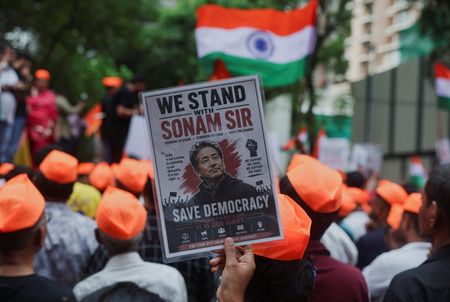
Authorities in India have blocked a planned march on the country’s parliament by followers of the youth-driven “Cockroach” movement, raising the prospect of a serious confrontation as pressure mounts for Prime Minister Narendra Modi’s education minister to resign over widespread exam paper leaks.
The movement gained renewed momentum after police forcibly transported hunger-striking activist Sonam Wangchuk to a hospital on Saturday. In the days that followed, hundreds of demonstrators gathered at a protest site in anticipation of a march timed to coincide with the opening of parliament’s monsoon session on Monday.
Though the movement first built its base largely through social media — drawing 22 million Instagram followers within days of its launch in May — it has since expanded well beyond the internet, becoming a significant political challenge for Modi’s government. The movement was originally sparked by exam paper leaks that disrupted the academic futures of millions of young people.
Wangchuk, who is 59 years old, shared his views through a message posted by his wife on the social platform X on Sunday. He described the planned march as “India’s 2nd FREEDOM MOVEMENT” and said it would stand for “freedom from injustice (like paper leaks)” and “freedom from fear (my illegal detention).”
Despite those calls to action, police announced that existing orders in the New Delhi district prohibit any gathering of five or more people, with the sole exception being a designated protest area at the Jantar Mantar observatory, where demonstrators have already been camped out for more than three weeks.
“As parliament session is commencing from 20 July, strict security arrangements are in place to ensure public safety, security of protectees, and the protection of vital government installations,” police stated on X.
The Cockroach Janta Party, however, made clear it had no intention of backing down. “The march is happening for sure. We are figuring out the rest,” said a spokesperson who declined to be identified while plans were still being finalized.
Earlier Monday, a Delhi court ruled that officials had acted within legal boundaries when they moved Wangchuk to a government-run medical facility, noting that he had not sought admission on his own despite his health declining.
Judge Mini Pushkarna stated that medical staff had provided only oral fluids and supplements with Wangchuk’s agreement, and concluded: “It cannot be said that any force is being used against Mr Sonam Wangchuk or that his bodily autonomy is being violated in any manner whatsoever.”
Wangchuk’s wife, Gitanjali Angmo, had asked the court for permission to have him transferred to the privately operated Medanta Hospital, with her legal team arguing that the family had the right to choose where he received care. The government pushed back, saying it needed to prioritize his medical wellbeing and noted that his wife and immediate family had been granted around-the-clock access to him.
Angmo took to X to express her frustration over the heavy police presence at the hospital, writing that “it is not medical care. It is illegal detention.”
Safdarjung Hospital reported that Wangchuk’s vital signs remained stable, though his blood test results were “marginally altered” and he required continuous monitoring.
The rapid rise of the Cockroach movement reflects deep frustration among India’s young population, driven by persistent high unemployment rates and repeated instances of exam papers being leaked before test day.
Boeing says it is still on course to hand over two new Air Force One jets in 2028, but the company warns that finishing the project will come with a higher price tag — adding to a program that is already billions of dollars over budget and years behind schedule.
The aerospace giant was awarded a $3.9 billion contract back in 2018 to build the aircraft. Since then, costs have climbed to more than $5 billion. The new planes are meant to replace the current Air Force One jets, which have been in service since 1990.
Steve Parker, CEO of Defense, Space & Security, spoke to reporters ahead of the Farnborough Airshow in the United Kingdom, offering an update on the program’s status.
“We’re on track for 2028,” Parker said, adding that he anticipates the first aircraft will move into testing next year.
However, he acknowledged that more spending is expected before the project wraps up. “I do expect to see some cost growth there as we come through and we finish off the wiring and the structures, as well as finishing up our own certifications,” he said.
The program involves converting two Boeing 747-8 aircraft into highly specialized presidential jets loaded with advanced communications equipment and defensive systems.
In the meantime, the United States accepted a luxury Boeing 747 from Qatar in May 2025 for use as a temporary presidential aircraft. That jet has since been put into service as a bridge aircraft. Security concerns prompted President Donald Trump to skip flying the Qatari jet home from Turkey, choosing instead to travel on an older Air Force One.
Even if Boeing meets the 2028 delivery target, the program will still be running four years behind its original timeline.
In the aftermath of two fatal shootings involving U.S. Immigration and Customs Enforcement officers during traffic stops, the Trump administration’s border czar announced Sunday that ICE will require its officers to use at least one body camera when conducting vehicle stops.
“They exonerate more law enforcement than they convict, and I want officers to wear body cameras because I want the American people to see what the officers saw when they took that action,” border czar Tom Homan said during an appearance on the “Fox & Friends Weekend” program.
Homan’s announcement follows two separate incidents earlier this month in which federal immigration officers fatally shot men during traffic stops — one in Texas and another in Maine — just six days apart. Neither incident was captured on body camera footage.
In a second interview, this time on CBS’s “Face the Nation,” Homan explained that funding for the cameras had been delayed due to the partial government shutdown earlier this year.
“The cameras have been purchased right now,” Homan said. “They’re training the trainer in deploying the cameras nationwide.”
The shootings drew fresh public attention to ICE’s tactics after an officer on July 13 fatally shot a Colombian driver in Biddeford, a coastal Maine town roughly 15 miles south of Portland. Six days prior to that, another ICE officer in Houston shot and killed a Mexican national.
Homan had announced last week that the agency would pause most vehicle stops nationwide to review its procedures. However, within 24 hours of that announcement, President Donald Trump ordered agents to resume those stops.
The two shootings triggered protests in Maine, Houston, and Boston, and renewed concerns about ICE officers operating without body cameras.
ICE first launched a body camera pilot program in 2024, placing cameras with officers in five cities: Baltimore, Buffalo, Detroit, Philadelphia, and Washington, D.C. The Trump administration moved last year to slow the program’s expansion, pushing Congress to slash its funding by 75%, according to a Reuters report from January.
In February, following the deaths of two U.S. citizens during an immigration enforcement operation in Minnesota, the then-head of the U.S. Department of Homeland Security, Kristi Noem, said the body camera program would be expanded to ICE agents across the country “as funding is available.”
At least seven people have been killed during federal immigration enforcement operations since January 2025, when President Trump launched a mass deportation effort after returning to office on a campaign pledge to crack down on immigration.
The National Hurricane Center has released updated wind speed probability graphics for Tropical Depression Two, an Atlantic tropical system currently being monitored by forecasters.
The latest graphic, showing the probability of 34-knot wind speeds over a 120-hour period, was last updated on Sunday, July 19, 2026 at 15:21 GMT.
Residents along the East Coast, including those on the Delmarva Peninsula, are encouraged to keep a close eye on National Hurricane Center updates as the storm system continues to be tracked.
The National Hurricane Center has issued updated wind speed probability graphics for Tropical Depression Two, tracking the storm system’s potential impact across a wide area.
The forecast graphic, which covers a 120-hour outlook period, illustrates the probability of 34-knot wind speeds reaching different locations as the tropical depression continues to develop.
The wind speed probability information was last updated on Sunday, July 19, 2026, at 15:21 GMT, according to data from the National Hurricane Center.
Residents and mariners are encouraged to monitor the latest updates from the National Hurricane Center as the storm system evolves.
NEW YORK (AP) — Los Angeles Dodgers superstar Shohei Ohtani has been pulled from his next pitching start and is not expected to take the mound again for a significant stretch of time, all due to irritation in his left knee.
The four-time MVP had a lubricant injection administered to the knee just ahead of last week’s All-Star break, with the expectation that he would be ready to pitch Wednesday against Philadelphia. But after throwing on the side this weekend, Ohtani still wasn’t feeling fully right, prompting him and the club to hold off on even a bullpen session to test the knee.
Ohtani’s last pitching appearance came on July 3, and there is currently no clear timeline for when he’ll be back on the mound.
Dodgers manager Dave Roberts addressed the situation Sunday before his team’s doubleheader against the New York Yankees. “I would say that it’s going to be some time,” Roberts said. “It’s not going to be a day-to-day thing.”
Roberts was careful to point out that Ohtani experiences no pain in the knee while batting. The slugger was in the starting lineup for Sunday’s first game, hitting leadoff as the designated hitter, and Roberts said he would decide later whether to play Ohtani in the second game as well.
“We just want to continue to give it the best chance to kind of get in a good spot,” Roberts said. “As he said, as we feel, it’s the pitching and the torque on landing on that leg. That kind of gets it upset. So I think that hitting doesn’t do that. So I think that for us, we’re trying to give it as much time as possible.”
Authorities in Peru confirmed Sunday that a 5.5 magnitude earthquake struck the country’s Andes region, leaving at least five people dead, more than 20 injured, and approximately 300 displaced from their homes.
According to the U.S. Geological Survey, the quake hit Saturday evening at 9:24 p.m. The epicenter was pinpointed roughly 2 kilometers — about 1.24 miles — west-southwest of the city of Sicaya in Huancayo province, at a depth of 10 kilometers, or about 6.21 miles.
Peru’s National Civil Defense Institute issued a statement noting that the full count of missing persons has yet to be determined. A number of buildings were either destroyed or significantly damaged in the quake, among them a local church and convent.
Luis Vásquez, who heads the local civil defense office, spoke to reporters about the widespread destruction, saying that the use of rustic adobe materials in construction in that Andean area “has contributed to the greater impact and damage.”
One of the most severely affected areas was Chongo Bajo, an agricultural community where video footage aired by local media showed distressed family members of victims gathering outside badly damaged homes, wrapped in blankets. Animals were also found trapped beneath rubble.
Hermenegilda Guamalato, a resident who was searching for shelter with her three children in the neighboring province of Huayucachi, spoke to a local radio station about her situation. “My home has been destroyed,” she said.
Peru sits along the Pacific “Ring of Fire,” making earthquakes a regular occurrence in the country. In 2007, a far more powerful magnitude 7.9 quake devastated the province of Pisco in the Ica region, resulting in nearly 600 deaths.
New York City health officials announced Saturday that a second person has died as a result of a Legionnaires’ disease outbreak on Manhattan’s Upper East Side.
The outbreak has now sickened a total of 72 people, with the first fatality disclosed on Friday and the second confirmed just one day later.
New York City Health Commissioner Dr. Alister F. Martin expressed sorrow over the loss in an official statement. “We are heartbroken to learn that another New Yorker has lost their life to Legionnaires’ disease on the Upper East Side. Our deepest condolences are with their loved ones as they grieve,” he said.
Legionnaires’ disease is a serious form of pneumonia triggered by bacteria that grows in warm, standing water. Investigators have concentrated their efforts on testing cooling towers associated with large building air conditioning systems. Property owners whose towers tested positive have been directed to drain and disinfect them.
While authorities have not yet identified a definitive source for this particular outbreak, they noted that the number of new cases has been steadily falling — a sign that people are likely no longer being exposed to the Legionella bacteria.
According to the U.S. Centers for Disease Control and Prevention, Legionnaires’ disease can be treated, but roughly 10% of those who contract it will die from complications.
This is not the first time New York City has faced such an outbreak. Last year, a similar situation in the city’s Harlem neighborhood left seven people dead and more than 100 others ill.
The National Hurricane Center has released updated wind speed probability graphics for Tropical Depression Two, an Atlantic storm system currently being monitored by forecasters.
The latest wind speed probability chart, which shows the likelihood of 34-knot winds affecting various areas, was last updated on Sunday, July 19, 2026, at 15:21 UTC.
Residents in potentially affected coastal areas are encouraged to monitor updates from the National Hurricane Center as the storm system continues to be tracked.
A passenger ferry with 116 people aboard sank off the coast of Guyana in South America late Saturday night, leaving many passengers still missing as rescue teams worked to find survivors.
An air traffic control tower received a distress call at 11:01 p.m. Saturday from the vessel, identified as the MV Barima, according to local reports. The call set off an immediate search and rescue response in the area.
The ferry, which carried both 116 passengers and 17 crew members, went down in the North Atlantic coast waters while en route to the village of Port Kaituma. The point of departure for the vessel was not immediately known.
As of Sunday morning, 67 people had been rescued, among them 15 children. The fate of the remaining passengers and crew members had not yet been determined.
Guyana’s Prime Minister Mark Phillips addressed reporters Sunday morning, saying the rescue effort would press forward. “The operation will continue until all efforts have been exhausted,” he said.
Guyana’s Minister of Public Utilities and Aviation, Deodat Indar, announced that emergency family assistance centers have been set up to give families access to information and support during the crisis.
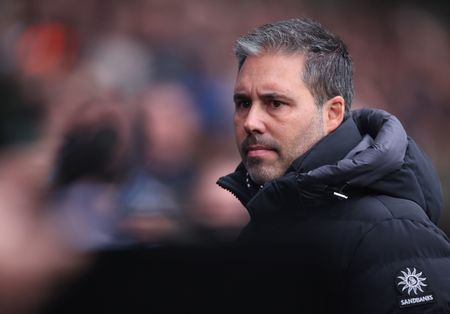
According to a report from The Athletic, the Portland Timbers are preparing to hire Marti Cifuentes as their new head coach, bringing in a coach with more than ten years of experience working in European soccer.
The 44-year-old Cifuentes would step into the role currently held by interim coach Jack Cassidy, who took over after the organization parted ways with Phil Neville back in May. Portland comes into this coaching change with some momentum, having just defeated rival Seattle Sounders 5-1 on Thursday. The club currently holds an 11th-place standing in the Western Conference with a record of 5-8-2 and 17 points, sitting three points behind a playoff berth with 19 games still to play.
Born in Barcelona, Spain, Cifuentes most recently served as head coach of Leicester City in the EFL — a club that has since been relegated to EFL League One. His coaching résumé also includes stints with Queens Park Rangers and Hammarby, among other clubs.
The Saturday night report noted that former Austin FC head coach Josh Wolff and Panama national team head coach Thomas Christensen were also finalists for the position, as Portland considered candidates from both within the United States and internationally.
The Athletic had previously reported that former Philadelphia Union head coach Jim Curtin — who is slated to take over as Austin’s head coach next season — had also held discussions with Portland regarding the vacancy.
Canada announced Sunday that it will temporarily turn away foreign nationals who have traveled to Congo in the last 21 days, implementing new border measures aimed at preventing the spread of Ebola.
The decision puts Canada at odds with the World Health Organization, which has specifically advised countries not to impose travel or trade restrictions on Congo, where authorities are currently battling a significant Ebola outbreak. The U.N. health agency has warned that such restrictions can fuel stigma and actually make outbreaks more difficult to manage.
“People from affected regions and African communities have faced unfair suspicion,” WHO said in a statement last month. “The spread of Ebola is not determined by nationality or ethnicity.” The agency currently considers the risk of Congo’s Ebola outbreak spreading to other countries to be low.
Canada’s Public Health Agency defended the decision in a Sunday statement, saying that “limiting entry of foreign nationals who have been in (Congo) in the previous 21 days may reduce public health risks for Canadians.”
The new restrictions are scheduled to go into effect Monday, July 20, at 11:59 p.m. EDT, according to the Public Health Agency of Canada. The agency did not respond to a request for additional comment.
Ebola is primarily transmitted through direct contact with the bodily fluids of an infected person. As of July 15, Congo had recorded more than 2,100 Ebola cases, with 828 of those resulting in death.
Canada’s announcement follows a similar move by the United States last week, which blocked Americans who had recently been in Congo from returning home through commercial flights. Seven American aid workers who traveled to Congo to help fight the outbreak are currently in quarantine at a facility in Kenya.
The Manning family’s legendary football tradition is alive and well, with yet another member of the dynasty stepping onto the gridiron. Marshall Manning, the son of Pro Football Hall of Fame quarterback Peyton Manning, has enrolled at Baylor School in Chattanooga, Tennessee, as part of the Class of 2030.
Head coach Erik Kimrey confirmed this week that the 15-year-old will back up starting quarterback Keegan Croucher, a four-star recruit who has already committed to Ole Miss in the 2027 class. According to the 247Sports composite, Croucher ranks as the No. 11 quarterback prospect in that class.
“We’re excited about him,” Kimrey said of the younger Manning.
Marshall is Peyton’s only son and has a twin sister named Mosley. Currently listed at 5-foot-9 and 150 pounds by 247Sports, many expect him to grow considerably given his family’s physical makeup. His father Peyton and uncle Eli — both two-time Super Bowl champions — stand 6-foot-5. His grandfather Archie, a former NFL quarterback, is 6-foot-3. His cousin Arch, who is 6-foot-4, is expected to start at quarterback for Texas during the 2026 season.
Baylor School is widely regarded as a football powerhouse that consistently sends players to major college programs. In addition to Croucher, the team’s roster includes running back David Gabriel Georges, also in the 2027 class. The 247Sports composite ranks Georges as the No. 2 running back and No. 10 overall prospect in the nation. He has yet to commit to a school but is drawing interest from multiple Power Four programs.
The Baylor School team currently sits at No. 12 in the 2026 MaxPreps Preseason Top 25 Rankings.
Marshall may not be the last Manning to play quarterback at a high level. While the children of uncle Cooper — including Arch — are grown, uncle Eli has three daughters and an 8-year-old son named Charlie, keeping the possibility of future Manning quarterbacks very much alive.
The National Hurricane Center is keeping a close watch on Tropical Depression Two, releasing updated wind speed probability graphics for the storm system.
According to the latest data from the National Hurricane Center, the 34-knot wind speed probability map for the storm was last updated on Sunday, July 19, 2026, at 15:21 UTC.
Residents and mariners in areas that could be impacted by the tropical system are encouraged to monitor updates from the National Hurricane Center as forecasters continue to track the depression’s development and movement.
Lifting the World Cup trophy brings glory, championship rings for the first time in tournament history, and a moment that will define a nation’s sports legacy — along with a very large check.
The team that wins the 2026 World Cup will receive $51 million in prize money. The runner-up will take home $34 million.
FIFA set a new record with the prize structure for this year’s tournament, distributing a combined $871 million among the 48 participating nations. That total includes more than $100 million that was added in April after several European soccer federations pushed for additional compensation to help offset the high travel and lodging costs associated with a tournament spread across three countries.
While $51 million is a substantial amount, it’s relatively modest when placed alongside the enormous sums routinely spent in professional soccer. It’s also less than what last year’s Club World Cup winner earned in a tournament that was also held in the United States.
To put the number in perspective: the $51 million top prize is actually less than the transfer fee paid this week by English club Brighton for a 19-year-old Croatian defender, Luka Vušković, who spent most of the World Cup on the bench.
FIFA distributes prize money to the 48 national federations through two channels: bonuses tied to how far each team advances in the tournament, and flat payments to help cover training and preparation costs before the competition begins.
Every competing nation receives at least $12.5 million simply for participating. That includes $10 million in prize money for qualifying and competing in the group stage, plus $2.5 million to cover pre-tournament preparation expenses. The upfront payment structure was established at previous World Cups to prevent disputes over unpaid bonuses, which had been a recurring issue in the past.
Prize amounts increase as teams advance deeper into the tournament.
Several federations — particularly from Europe — had raised concerns with FIFA that the original prize structure set last year would result in financial losses unless their team advanced well into the knockout rounds. They also noted that teams playing matches in the United States faced certain tax obligations that were not applicable in Canada or Mexico, the other two host countries.
France federation president Philippe Diallo told the sports publication L’Equipe that he had spent several months bringing the issue to FIFA President Gianni Infantino’s attention, arguing that World Cup teams were not being fairly compensated compared to what Club World Cup winner Chelsea received one year ago — $115 million, a nine-figure sum that FIFA had promised in order to convince top European clubs to participate in the revamped competition.
The $51 million prize for the 2026 champion is a notable increase from the $42 million Argentina’s federation received for winning the 2022 World Cup in Qatar. That 32-team tournament had a total prize fund of $440 million.
Here is the full breakdown of prize payouts for the 2026 tournament:
Champion: $51 million Runner-up: $34 million Third place (England): $30 million Fourth place (France): $28 million Quarterfinalists (5th through 8th): $20 million each Round of 16 (9th through 16th): $16 million each Round of 32 (17th through 32nd): $12 million each Group stage exits (33rd through 48th): $10 million each
Beyond the prize money, FIFA is required under World Cup rules to cover business-class round-trip flights for each federation, as well as accommodations and meals for a delegation of up to 50 people, which includes players. Hotel costs are covered starting five nights before a team’s first match and through one night after elimination. FIFA also pays for domestic travel for up to 50 delegation members and provides a dedicated fleet of vehicles, including an equipment truck.
Federations are responsible for securing adequate insurance coverage — including injury, accident, illness, and travel — as well as any incidental hotel costs and housing for delegation members beyond the covered group.
As for the trophy itself: the original World Cup trophy is never permanently awarded. The championship team receives a gold-plated replica to keep, while the original remains in FIFA’s possession. The trophy presentation takes place during the post-match ceremony on the field.
It’s important to note that FIFA pays the prize money directly to the national federations — not to individual players. Each federation determines internally how that money is distributed among its players and staff.
As one example, U.S. Soccer will retain 20% of any prize money it receives. The remaining 80% will be divided equally between the U.S. men’s and women’s national teams, in accordance with a landmark 2022 agreement that made the American governing body the first in the sport to guarantee equal pay for both its men’s and women’s programs.
A local weather statement was issued at 11:00 AM EDT for the Tallahassee, Florida area, according to information released by the National Hurricane Center.
The statement was distributed through official weather channels serving the Tallahassee region. No additional details from the statement’s content were available for further reporting.
Residents in and around Tallahassee are encouraged to stay informed by following updates from their local emergency management officials and weather services.
A local weather statement was issued at 10:11 AM CDT for the Mobile, Alabama and Pensacola, Florida region, according to information from the National Hurricane Center.
The statement, originating from the National Hurricane Center’s text advisory system, was directed at residents in the Mobile, Alabama and Pensacola, Florida areas.
Those living in or near the affected region are encouraged to stay informed and follow guidance from local emergency management officials as conditions develop.
A tropical depression has formed in the Gulf of Mexico off the west coast of Florida, according to the National Hurricane Center. In response, forecasters have issued a Tropical Storm Watch for the Florida Panhandle.
As of 10:00 AM CDT on Sunday, July 19, the center of the storm — designated Tropical Depression Two — was positioned near latitude 28.0 North, longitude 85.3 West. The system was drifting to the north-northwest at a slow pace of just 2 miles per hour.
The depression had a minimum central pressure of 1011 millibars, with maximum sustained winds of approximately 30 mph. Residents and visitors along the Florida Panhandle should monitor the latest updates from the National Hurricane Center as the storm continues to develop.
The National Hurricane Center in Miami issued its first official advisory Sunday afternoon on Tropical Depression Two, a newly organized tropical system now churning in the Gulf of Mexico.
As of 3:00 p.m. UTC on Sunday, July 19, 2026, the center of the depression was located near latitude 28.0 degrees north, longitude 85.3 degrees west. Forecasters say the position is accurate within about 30 nautical miles.
The storm is moving very slowly — nearly drifting — toward the north-northwest at just 2 knots. Its minimum central pressure is estimated at 1011 millibars, with maximum sustained winds of 25 knots and gusts reaching up to 35 knots.
Looking ahead, forecasters expect the system to gradually strengthen. By Monday morning, winds are projected to reach 30 knots with gusts to 40 knots. By Monday evening, the storm could approach tropical storm strength with winds near 35 knots. The system is forecast to continue slowly intensifying through Wednesday, potentially reaching 50 knots — just below hurricane strength — by the evening of July 22.
The extended outlook shows the storm tracking westward toward the Gulf Coast, with the center possibly moving inland near the Louisiana coast area by July 24, 2026, while still carrying winds of around 45 knots.
The National Hurricane Center notes that track forecasts carry an average error of about 125 nautical miles on day four and 175 nautical miles on day five, meaning the storm’s exact path remains uncertain. Intensity forecasts also carry an average error of about 15 knots per day.
Ships within 300 nautical miles of the storm’s center have been asked to submit reports every three hours to help forecasters track the system. The next full advisory was scheduled for 9:00 p.m. UTC Sunday, with an intermediate public advisory due at 6:00 p.m. UTC. The advisory was issued by forecaster Cangialosi.
A tropical depression has officially formed in the northeastern Gulf of America, and forecasters at the National Hurricane Center in Miami are watching it closely as it slowly drifts toward the Florida Panhandle.
The system, designated Tropical Depression Two, was classified Sunday morning after developing a well-defined low-level circulation over the past several days. While convective activity — the storm-related thunderstorm clusters — remains uneven due to dry air pushing in from the northeast, there is enough persistent storm activity near the center and in surrounding bands to qualify it as a tropical depression. The circulation is described as large and still relatively weak.
Based on surface weather observations and earlier satellite wind data, the storm’s initial intensity has been set at 25 knots, or about 30 miles per hour, with a minimum central pressure of 1011 millibars. Air Force Hurricane Hunter aircraft are scheduled to fly into the system later Sunday to get a better picture of its structure.
Pinpointing the storm’s exact movement has been tricky since it only recently became well organized, but forecasters believe it is currently drifting north-northwestward at about 3 knots. The system is caught between competing weather features — a ridge over the western Atlantic, another ridge over the south-central and southwestern United States, and a trough over the northeastern U.S. — all of which are creating weak steering currents.
That pattern is expected to carry the depression slowly northwestward through Monday night, bringing it close enough to the Florida Panhandle to produce tropical storm conditions there. A Tropical Storm Watch has already been issued for that area. After that, forecasters expect the storm to turn westward or west-northwest as a ridge over the southern United States expands eastward, potentially pushing the system near or across the Gulf Coast during the middle and latter part of the week.
Strengthening is expected to be slow at first, given the storm’s sprawling structure, nearby dry air, and some northeasterly wind shear working against it. However, forecasters expect it to reach tropical storm status as it approaches the Florida Panhandle over the next day or two. There may be a better window for additional strengthening once the system turns westward, though how much it intensifies will depend heavily on how much time it spends over land versus open water.
The National Hurricane Center’s track forecast leans toward the upper end of available computer model guidance, though forecasters acknowledge there is low confidence in the forecast given uncertainty about how much land interaction the storm will experience.
Key Messages from the National Hurricane Center:
1. The depression is forecast to gradually strengthen and could bring tropical storm conditions to parts of the Florida Panhandle, where a Tropical Storm Watch is in effect.
2. Residents in Alabama, Mississippi, Louisiana, and Texas should monitor the storm’s progress, as watches may be needed for portions of those areas within the next day or two.
3. Flash flooding will be possible through Thursday along the eastern and central Gulf Coast, stretching from western Florida through southern Alabama, Mississippi, and Louisiana.
The forecast was issued by Forecaster Cangialosi at the National Hurricane Center.
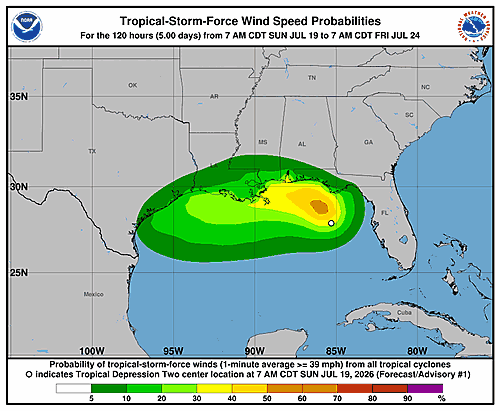
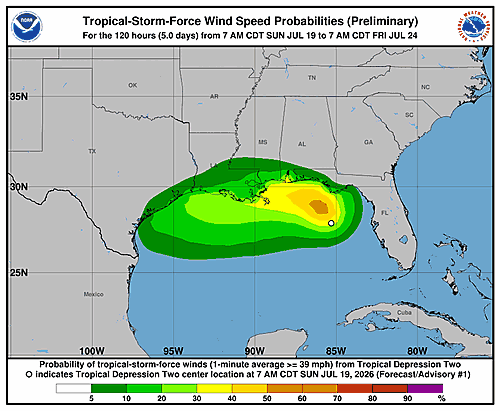
The National Hurricane Center in Miami issued its first wind speed probability bulletin for Tropical Depression Two on Sunday, July 19, 2026, at 3:00 p.m. Coordinated Universal Time.
At the time of the report, the center of the tropical depression was positioned near latitude 28.0 degrees North and longitude 85.3 degrees West, with maximum sustained winds of approximately 25 knots — about 30 miles per hour or 45 kilometers per hour.
The bulletin outlines the probability of locations along the Gulf Coast experiencing sustained wind speeds reaching at least 39 mph (tropical storm force), 58 mph, or 74 mph over the following five days.
According to the probability table, Apalachicola, Florida faces a 26 percent cumulative chance of experiencing tropical storm-force winds of at least 39 mph by the end of the five-day forecast period. Panama City, Florida carries a 31 percent cumulative probability for the same wind threshold.
Pensacola, Florida shows a 12 percent cumulative probability of reaching tropical storm-force winds, while Mobile, Alabama stands at 11 percent. Areas along the Louisiana coast, including New Orleans and Houma, each carry a 13 percent cumulative chance of tropical storm-force conditions.
Further west, Galveston, Texas has a 15 percent cumulative probability of sustained winds reaching at least 39 mph, with a 3 percent chance of winds hitting 58 mph or higher.
The report was prepared by forecaster Cangialosi at the National Hurricane Center. Residents across the Gulf Coast are encouraged to monitor future updates as the storm system continues to develop.
The National Hurricane Center has issued updated wind speed probability graphics for Tropical Depression Two, tracking the system’s potential impact over the next five days.
The graphic displays the probability of 34-knot wind speeds associated with the tropical depression, covering a 120-hour forecast period. These probabilities help forecasters and the public understand where the storm’s winds are most likely to be felt.
The wind speed probability information was last updated on Sunday, July 19, 2026, at 14:55 GMT, according to the National Hurricane Center.
Residents along the East Coast, including those on the Delmarva Peninsula, are encouraged to monitor updates from the National Hurricane Center as the system continues to develop.
WASHINGTON (AP) — For the first time since it was established three decades ago, a little-known federal court designed to handle deportation cases involving suspected terrorists has been put to use by the Trump administration.
The Alien Terrorist Removal Court was created in 1996 but sat completely unused until last Wednesday, when the Justice Department submitted an application seeking to remove an unnamed individual from the United States. The person’s identity was withheld from the single-page filing posted on the court’s website.
The court’s chief judge, Joan Ericksen, responded in writing after a hearing was held the following day. She indicated the court had concerns about the government’s legal arguments, noting there were “questions about the nexus that the government alleges between the actions of the respondent and the specific sections and subsections it invokes with respect to those actions.”
Ericksen, who serves as a federal judge in Minnesota, wrote that the government’s answers during the hearing suggested it could use more time to sharpen its case. “The answers persuaded the Court that the Government could benefit from the opportunity for more thoughtful consideration,” she wrote. She gave the Justice Department until this coming Wednesday to submit additional information.
The court’s legal foundation comes from the Antiterrorism and Effective Death Penalty Act of 1996. Under that law, the attorney general can file a sealed application to deport someone believed to be an “alien terrorist.” If approved, a public hearing must follow, during which the government bears the burden of proving the individual fits that classification. Either the attorney general or deputy attorney general must sign off on any application.
Federal law outlines several ways a person could be classified as an “alien terrorist,” including having participated in terrorist activity, promoting or supporting such activity, or belonging to a group that encourages terrorism.
The court consists of five judges chosen by Chief Justice John Roberts. According to a summary on the Federal Judicial Center’s website, the court had never received a petition or conducted any hearings prior to last week.
The move comes as the Trump administration has pursued an aggressive deportation agenda over the past year. That effort has included invoking a 1798 wartime statute known as the Alien Enemies Act to remove Venezuelan migrants accused of belonging to a terrorist gang. During proceedings in that case, a Washington judge named James Boasberg suggested the Alien Terrorist Removal Court would be the appropriate venue for deportation requests based on national security concerns.
“In fact, Congress has an answer for us, doesn’t it? Because they created the Alien Terrorist Removal Court,” Boasberg said at the time. “So if there’s a national security concern with having these hearings…you can always go to the ATRC, which would be a first, but that’s what it’s there for, right?”
The story was originally reported by Court Watch, an independent news outlet.
SOUTH HAVEN, Mich. — When Senate candidate Haley Stevens hits the campaign trail, she focuses on manufacturing, taking on President Donald Trump, and making the case that she’s the Democrat best suited to win Michigan. What she tends not to bring up is the powerful pro-Israel organization that has spent tens of millions of dollars working to get her elected.
The American Israel Public Affairs Committee — better known as AIPAC — along with its affiliated groups, has pumped nearly $30 million into supporting Stevens. That figure represents the single largest investment the organization has ever made in one race. Their goal: defeating progressive candidate Abdul El-Sayed in the August 4 Democratic primary.
Even as AIPAC’s spending has fundamentally changed the dynamics of the race, Stevens has largely steered clear of discussing the group. At a campaign stop in West Michigan in July, she was asked twice about AIPAC and responded with more than 800 words — never once naming the organization. Israel was mentioned just once, when she expressed hope that “the U.S. and Israel working together to rebuild Gaza.”
When the Associated Press asked whether she welcomed AIPAC’s backing, Stevens replied: “Anyone who supported me is supporting me because of my dedication to the people of Michigan, and the things that I have done for Michiganders.”
The exchange captures just how politically sensitive AIPAC has become within the Democratic Party, as Israel’s war in Gaza has deepened divisions over U.S. policy. AIPAC’s mission centers on electing lawmakers who support a strong U.S.-Israel relationship and policies it says benefit both nations’ security. The organization did not respond to a request for comment, and its super PAC, United Democracy Project, also declined to speak on the record.
The stakes are especially high in Michigan, which is home to the largest Arab American population in the country. El-Sayed’s progressive allies are casting the race as a broader referendum on whether grassroots organizing can hold its own against a tidal wave of outside money.
New York Rep. Alexandria Ocasio-Cortez, who has been campaigning for El-Sayed in Michigan, put it plainly: “One of the laws of nature in politics is whoever spends the most money wins. It is an opportunity to show that things other than money can win in America.”
Stevens, a four-term congresswoman, raised only half of what El-Sayed brought in during the most recent fundraising period ending June 30. Her campaign said in a statement that it is “raising the resources we need to win this race.” Through early July, Stevens’ own campaign had spent just $12,000 on advertising before increasing that figure to nearly $1 million, according to AdImpact. Outside groups, however, have collectively spent close to $50 million boosting her candidacy — including roughly $12 million from a group called A Stronger Michigan that has not disclosed its donors.
El-Sayed has made AIPAC’s massive financial footprint a defining issue of his campaign, accusing Stevens of serving the interests of wealthy donors rather than everyday voters. Sen. Bernie Sanders, campaigning alongside El-Sayed at rallies in Detroit, Lansing, and Grand Rapids, was blunt in his assessment: “She is nothing more than an employee of these billionaires.”
Stevens has said she supports “comprehensive campaign finance reform.”
Many Michigan voters may not even realize that the ads flooding their television screens are being funded by AIPAC. The spots never reference Israel, instead spotlighting Stevens’ record on manufacturing and featuring former President Barack Obama. Former Rep. Andy Levin, who lost to Stevens in a 2022 Democratic primary after redistricting — with AIPAC spending millions against him — noted the deliberate strategy. “AIPAC never runs on AIPAC. They never even talk about Israel and Palestine,” said Levin, who is Jewish. “If you’re just a voter and you see a million ads, you don’t know who paid for it.”
The two candidates have staked out starkly different positions on Israel’s military campaign in Gaza. Stevens, though not Jewish, has long been among Congress’ most vocal supporters of Israel, describing herself as a “proud pro-Israel Democrat” and once saying during a Hanukkah celebration that “Israel comes to me in my dreams.” She has, however, criticized Israeli Prime Minister Benjamin Netanyahu, saying during a recent debate that he “has not made us safer, has not brought us closer to peace, and he’s endangered Jews here in America and around the world.”
El-Sayed, the son of Egyptian immigrants, has taken a sharply different stance. He has labeled Israel’s military campaign in Gaza a “genocide,” called the Israeli government “evil,” and argued repeatedly that AIPAC warps Democratic politics. “The reason that we’ve seen this war fought is because of the impact of AIPAC in our politics,” he said at a recent debate.
The war in Gaza was sparked by Hamas’ October 7, 2023 attacks inside Israel, which killed approximately 1,200 people and resulted in 251 being taken hostage. The conflict has now stretched beyond 1,000 days. According to Gaza’s Health Ministry, Israel’s retaliatory military offensive has killed more than 73,000 Palestinians.
If victorious, El-Sayed would become the first Muslim ever elected to the U.S. Senate. He has addressed questions about whether his faith could be a liability in a competitive general election. “When they raise questions about my ‘electability,’ they are usually pointing to the most obvious thing about me that makes me ‘different’ — that’s my name and my Muslim faith,” he wrote in an email to supporters. “Faith, to me, isn’t just about an identity. It’s about the choices that I make every single day about how I live my life.”
El-Sayed’s campaign has spent approximately $3.2 million of its own funds on advertising, with around $1 million in outside support. Rather than competing dollar-for-dollar with Stevens, his team has emphasized grassroots organizing, reporting more than 10,000 volunteers recruited statewide. When asked about Stevens’ volunteer numbers, her campaign said it has “hundreds across Michigan.” “This election will come down to the many versus the money,” El-Sayed wrote.
Support for Israel within the Democratic Party has been eroding since the Gaza war began. Earlier this week, 103 House Democrats voted — unsuccessfully — to block $3.3 billion in U.S. aid to Israel, the most visible sign yet of the party’s internal fracture. Among them was New York Rep. Pat Ryan, who had previously backed aid to Israel and accepted support from AIPAC. “I expect groups like AIPAC will not support me in my future elections and frankly, I don’t want their support,” Ryan posted on social media, later announcing he was returning the money.
Similar tensions played out in Michigan during the 2024 Senate race, when Democratic activists pushed now-Sen. Elissa Slotkin to take a tougher stance on Israel’s actions in Gaza. Slotkin, who is Jewish, had already distanced herself from AIPAC years before the race. She went on to defeat Republican Mike Rogers by fewer than 20,000 votes. Rogers is running for Senate again this year and faces no opposition in the Republican primary.
Even so, some observers question whether the Israel issue will ultimately drive most primary voters to the polls. Michigan political strategist Adrian Hemond offered this perspective: “It’s not that Democratic primary voters love AIPAC. They obviously don’t. But this doesn’t even register as an issue that’s influencing voting behavior for the overwhelming majority of primary voters.”
The New Castle County Division of Police is actively working to combat human trafficking, pursuing ongoing investigations, following up on leads, and reaching out to support victims across New Castle County and the surrounding region.
To assist in these efforts, Delaware’s first and only dedicated Human Trafficking Hotline is available around the clock, giving victims, concerned community members, and those reporting suspected incidents direct access to both law enforcement and victim support services.
Boeing’s commercial airplane division is setting its sights on boosting production of its top-selling 737 MAX jet, with the company’s aviation chief signaling plans to push output beyond its current approved levels.
The head of Boeing Commercial Airplanes told reporters Sunday that the company is evaluating additional production increases for the 737 MAX after receiving approval from federal regulators in May to manufacture up to 47 aircraft per month.
The Federal Aviation Administration had placed an extraordinary cap on Boeing’s production following a 2024 mid-air safety incident that exposed serious quality and safety problems throughout the company’s manufacturing operations.
“We’re using the safety management system and our safety risk assessment on when we’re stable and ready to go to the next rate,” Boeing Commercial Airplanes CEO Stephanie Pope said during a media roundtable held ahead of the Farnborough Airshow in London.
“I’ve got the team focused on stabilising at 47. Once we get to 47, we’ll go to 52, and then we’ll just keep studying that,” she added.
Pope made clear that Boeing’s presence at the international airshow is centered on improving manufacturing — “not order announcement,” as she put it.
“Backlog is incredibly strong. Demand is not our issue. If we announce some orders along the way, we’ll celebrate with our customers based on if they want to do that,” Pope said.
Rather than drumming up new business, she said Boeing’s main goal at the biennial industry gathering — which draws top executives from across the global aviation sector — is to engage with customers and suppliers.
“We’re going to understand what their challenges are, and then we’re going to update them on our products,” Pope said.
PARIS — France gathered Sunday to remember the Vel d’Hiv roundup, a deeply shameful chapter in the country’s wartime history when French police carried out a mass arrest of Jewish people in 1942.
Over two days in July of that year, French police seized thousands of Jewish men, women, and children — tearing children away from their mothers and sending them all to Nazi death camps. France holds a yearly ceremony to honor those victims and keep the memory of what happened alive, particularly as antisemitism continues to rise across the country.
France is home to the largest Jewish population in Europe and has experienced a sharp increase in antisemitic acts — including threats, vandalism, and physical attacks — since the Hamas assault on Israel on October 7, 2023, and the war in Gaza that followed.
Just ahead of Sunday’s ceremony, French authorities reported that a memorial plaque in Paris had been vandalized. The plaque honored a couple and their daughter who sheltered a 13-year-old child during the roundup and were recognized by Israel with the title Righteous Among the Nations.
Alice Rufo, a deputy defense minister, responded to the vandalism with strong words. “To attack the Righteous is to desecrate the entire universe,” she said. “The plaque will be restored. Their memory remains undiminished. In the face of antisemitism, in all its forms, the Republic will not yield an inch.”
The Vel d’Hiv roundup took place under the Vichy France government, which came to power after Nazi Germany invaded France in 1940 and collaborated with the Nazi regime.
The name Vel d’Hiv comes from the Winter Velodrome, a sports arena where many of those arrested were held before being transported to concentration and extermination camps. On July 16 and 17, 1942, more than 4,500 police officers took part in the operation, with dozens of buses pressed into service. It stands as the single largest roundup of Jewish people conducted in France during World War II. Arrests continued through July 20, and in total, 13,152 people were deported — one-third of them children.
It was not until 50 years after the end of World War II that France’s leadership formally admitted the government’s role in the Holocaust. Then-President Jacques Chirac issued an official apology for French authorities’ participation in the Vel d’Hiv raids.
PHOENIX (AP) — For years, Rep. Andy Biggs earned a reputation as one of Washington’s most unyielding conservatives, leading the House Freedom Caucus and pushing President Donald Trump’s agenda while clashing with Republican leadership. Now, his fellow Arizona congressman Rep. David Schweikert is arguing that kind of all-or-nothing approach is exactly what has been costing Republicans elections in Arizona.
The two have spent decades navigating the turbulent waters of Arizona Republican politics, but on Tuesday they face each other directly in a gubernatorial primary. The contest has evolved into a fundamental debate over what direction the GOP must take to reclaim its footing and defeat Democratic Gov. Katie Hobbs, widely regarded as the most vulnerable Democratic governor in the nation.
Biggs carries Trump’s endorsement and the backing of Turning Point Action, and he built his name in Congress as a fierce opponent of compromise. But he has never had to run a competitive general election race against a Democrat. Schweikert, on the other hand, is making the case for a brand of Republicanism that many in the party consider outdated.
“Biggs lives in a district where if he were a turtle running as a Republican, you’re going to win it,” said Kathleen Dunbar, 75, a former Tucson City Council member who intends to vote for Schweikert. “Schweikert lives in a district that’s very much like the state of Arizona, where he has to win the independents. And he’s done it eight times in the last 16 years.”
Trump’s support is Biggs’ most powerful asset — but it comes with complications in Arizona. No Republican has lost a statewide primary with Trump’s endorsement, yet since 2018, only one Trump-backed candidate, former Gov. Doug Ducey, has gone on to win a statewide general election. Despite registered Democrats being outnumbered by both Republicans and independents in the state, Democrats currently hold both U.S. Senate seats and the top three state offices.
In 2022, a Trump-endorsed group of Republican nominees — with former local television anchor Kari Lake leading the ticket as the gubernatorial candidate — refused to soften their message heading into the general election, betting that an energized base would carry them to victory. It did not.
Biggs pushes back on any comparison to Lake and has been working to smooth out his hardline image. After supporting Trump’s effort to block certification of the 2020 election results, Biggs now declines to say whether President Biden’s victory was legitimate. He has also begun highlighting moments when he has reached across party lines.
Kathy Babits, 71, a retired occupational therapist from Scottsdale who plans to vote for Biggs, said she was not moved by Schweikert’s warnings that Biggs would be too polarizing in a general election matchup.
“As long as people get behind him and as long as things don’t change too much, I’m in favor,” Babits said.
Both men are fiscal conservatives representing neighboring suburban Phoenix districts in the East Valley — the two wealthiest and whitest congressional districts in Arizona. Their differences, however, are most apparent in how they operate.
Biggs boasts of his close relationship with Trump and made a name for himself in the House as a roadblock to bipartisan deals. He played a significant role in ousting Republican Speaker Kevin McCarthy and participated in an unsuccessful effort to remove McCarthy’s successor, Mike Johnson. He has staked out some of the most conservative positions in Congress on government spending — voting against COVID-19 economic relief early in the pandemic and, as a state legislator, once proposing to eliminate Arizona’s Medicaid program entirely. His political base is rooted in the fast-growing, family-heavy outer suburbs of metro Phoenix.
“I like his style and his policies and his mannerisms,” said Don Dobie, a Biggs supporter from Scottsdale. “And he looks like a trustworthy guy.”
Schweikert has kept his distance from Trump publicly — no photos together — though he has generally supported Trump’s policy priorities and avoids criticizing him openly. He has instead cultivated an image as a policy-focused lawmaker laser-locked on the federal deficit. He has held his seat even as many of the college-educated, higher-income Republicans in his district drifted away from the party during the Trump era.
To win, Schweikert needs voters like Jeff Clark, a retired telecommunications engineer from Scottsdale who has grown disillusioned with his party’s alignment with Trump.
“Once they say they’re Trump-sponsored and everything, I’m sorry, it’s just not going to work,” Clark said.
Even so, Clark did not cast a ballot in the governor’s race. He believes Biggs has the nomination locked up, and he didn’t feel Schweikert had done enough in Congress to earn his vote.
Michael LoBello, a 79-year-old retiree from Scottsdale who voted for Biggs, said Republicans are losing in Arizona because they haven’t been forceful enough in pushing Trump’s priorities, including the SAVE America election bill.
“Stand up for the people,” LoBello said. “Just stand up for us. They’re forgetting who they represent, and that’s the people.”
Meanwhile, Schweikert’s congressional seat — considered a top battleground in the fight for a House majority — has drawn intense competition in both party primaries.
On the Democratic side, the Democratic Congressional Campaign Committee has made the controversial decision to back Marlene Galán-Woods, a former television news anchor who previously identified as a Republican. Her late husband, Grant Woods, served as Arizona’s Republican attorney general in the 1990s and later became a prominent Trump critic.
Her main challenger is Amish Shah, an emergency medicine physician and former state legislator who ran as the Democratic nominee in 2024 but lost narrowly to Schweikert.
“I like his background in medicine,” said Jeff Cohen, 69, an attorney from Cave Creek who voted for Shah. “And he actually came to my door and I met him. It made a difference. Old-style politics.”
On the Republican side, former Arizona Cardinals kicker Jay Feely holds Trump’s endorsement but has faced criticism for living outside the district — he resides in Biggs’ district and had originally planned to run there before Trump endorsed someone else. Feely is competing against Joseph Chaplik, a former state legislator with strong support among grassroots party activists, and businessman John Trobough.
Delaware State Police are looking into a deadly two-vehicle collision that took place Saturday night in Newark.
The crash happened around 10:45 p.m. on July 18, 2026, along Stanton Christiana Road near Old Stanton Christiana Road. According to investigators, a Toyota Camry was heading southwest along the road and navigating a curve when it lost control and crossed into the path of a Toyota Sienna traveling northeast in the center lane. The passenger side of the Camry collided with the front of the Sienna.
The Camry’s driver, a 17-year-old male from Bear, Delaware, was rushed to a nearby hospital, where he later died from his injuries. His identity is being withheld pending notification of his family.
The driver of the Sienna, a 46-year-old woman from Middletown, Delaware, was also transported to a hospital. Her injuries were described as non-life-threatening.
The stretch of road where the crash occurred was shut down for roughly three hours while police worked the scene.
The Delaware State Police Troop 2 Collision Reconstruction Unit is continuing its investigation. Anyone who saw the crash or has relevant video footage is urged to reach out to Sergeant J. Jefferson at (302) 365-8484. Tips can also be submitted through a private Facebook message to the Delaware State Police or by contacting Delaware Crime Stoppers at (800) 847-3333.
Anyone in need of support after losing a loved one to a sudden death, or who has been a victim or witness of a crime, can contact the Delaware State Police Victim Services Unit and Delaware Victim Center. Their toll-free hotline is available around the clock at 1-800-VICTIM-1 (1-800-842-8461). You may also reach them by email at [email protected].
SOUTHPORT, England — American golfer Sam Burns will tee off in Sunday’s final round of the 154th British Open holding a two-stroke advantage at 10 under par, as he chases his first major title and a chance to become the 13th consecutive first-time winner at golf’s most storied major championship.
Despite Burns’ lead, a number of top competitors are lurking and ready to make a move should he stumble. Among them is world number one Scottie Scheffler, who entered his fourth round six strokes back but quickly got off to a hot start by making birdies on each of his first two holes at a sun-drenched Royal Birkdale.
English fan favorite Tommy Fleetwood, who is attempting to become the first English player to claim the Open title since Nick Faldo did so in 1992, will begin the day five shots behind Burns. Hard-hitting American Bryson DeChambeau sits just four shots off the lead heading into the final 18 holes.
Conditions at Royal Birkdale are expected to be sunny with light to moderate winds as the field battles for the coveted Claret Jug.
Here are some additional highlights from the day’s action:
Burns is scheduled to tee off at 1320 GMT as he looks to become the fourth straight American to win the Open Championship.
Cameron Young was among those making a charge up the leaderboard, reaching seven under par after posting four birdies through just five holes in his round.
American Rickie Fowler turned in a strong round of 66 on Sunday to finish the tournament at three under par overall.
Spain’s former world number one Jon Rahm saw his hopes of a comeback derailed early when he hit his tee shot out of bounds on the opening hole, leading to a double bogey and leaving him eight shots behind the leader.
World number two Rory McIlroy stood at three under par for the championship as he made his way through the front nine.
LONDON — Social media influencer brothers Andrew and Tristan Tate were taken into custody in Miami on Saturday after prosecutors in the United Kingdom announced a new wave of rape and sex trafficking charges against them.
Britain’s Crown Prosecution Service announced the new charges stem from evidence provided by Bedfordshire Police in southeastern England and involve four additional alleged victims. The charges cover rape, assault, trafficking, and offenses connected to indecent images of a child and extreme pornography.
With the latest charges, the total number of alleged victims in the UK has risen to seven. The brothers have denied any wrongdoing. Their legal troubles now span three countries — the United States, the United Kingdom, and Romania — in what has become a lengthy international legal saga.
Andrew Tate, 39, and Tristan Tate, 38, hold dual U.S.-British citizenship and have built a social media empire centered around themes of wealth, male dominance, and misogyny. Andrew, a former professional kickboxer who describes himself as a misogynist, has accumulated more than 10 million followers on X, the majority of whom are boys and young men. He has been removed from platforms including YouTube, TikTok, and Instagram for violating their hate speech policies. He also operates an online program where he claims to teach young men how to build wealth and attract women. Tristan Tate is also a former kickboxer.
Both brothers are vocal supporters of U.S. President Donald Trump.
British prosecutors said the newly announced charges relate to alleged offenses that occurred between 2010 and 2017. Andrew Tate faces seven additional counts of rape, three counts of arranging or facilitating trafficking for sexual exploitation, three counts of assault, and 19 charges tied to indecent images of a child and extreme pornography. Tristan Tate faces one count of sexual assault, two counts of rape, and three counts of arranging or facilitating sex trafficking.
The Crown Prosecution Service stated that it “has requested the extradition of the Tates from the U.S. They have been arrested and await extradition proceedings to the U.K.”
These are in addition to charges the brothers already face in the UK involving three other alleged victims — including rape, bodily harm, human trafficking, and controlling prostitution for gain — covering the period between 2012 and 2015. In June, a UK High Court judge rejected a legal attempt by the Tates to obtain the names of their accusers.
In Romania, the brothers were arrested in late 2022 alongside two Romanian women. All four were accused of participating in criminal schemes to lure women for sexual exploitation. They denied those allegations, and the Romanian case has stalled due to legal and procedural complications, though it has not been closed. A separate legal case against the brothers also exists in Romania.
Andrew Tate has repeatedly insisted that Romanian prosecutors have no evidence against him and has claimed there is a political conspiracy aimed at silencing him.
UK authorities had previously sought the brothers’ extradition once their Romanian legal proceedings wrapped up. However, in February 2025, Romanian authorities lifted travel restrictions on the brothers, allowing them to depart the country. They flew to Florida aboard a private jet.
Romania’s foreign minister stated at the time that a U.S. official within the Trump administration had expressed interest in the brothers’ legal situation in Romania. When asked whether his administration had pressured Romania to release the Tates, President Trump said he knew “nothing about” the case.
A ferry with 116 passengers and crew members on board capsized off the coast of Guyana on Sunday, according to authorities, with 53 people rescued as search and rescue teams continued their efforts.
The vessel, identified as the MV Barima, was traveling along the North Atlantic coast from the capital, Georgetown, heading to Port Kaituma, according to Guyanese Prime Minister Mark Phillips.
A distress call came in at 11:01 p.m. local time — 3:01 GMT — triggering a rescue operation that brought in both government and privately owned boats, Public Works Minister Juan Edghill announced via Facebook.
The boat went down in waters near the Pomeroon River, authorities confirmed.
It remains unclear how many people, if any, may have died in the incident. Guyanese officials, however, expressed hope that additional survivors would be located.
According to Edghill, the MV Barima was equipped with 250 life jackets, two rigid life rafts, and six inflatable life rafts at the time of the capsizing.
Prime Minister Phillips is personally overseeing the government’s response to the disaster.
That eerie orange glow in the sky from wildfire smoke may look alarming, but the real danger is something you cannot even see. Tiny particles carried in wildfire haze can trigger both short-term and long-lasting health problems, according to experts.
Wildfire smoke can hang over cities for days at a time — as seen recently when fires burning in Canada sent hazardous air drifting across multiple U.S. states, affecting millions of people. Health officials are urging people to stay inside and take active steps to clean the air within their homes.
If your home has central air conditioning, it can be a powerful tool for filtering out smoke particles. Make sure you are replacing filters on schedule and using the highest filtration level your system can handle. Filters rated MERV 13 or higher are considered ideal. Set your system to recirculate indoor air and, if possible, close any vents that draw air in from outside. The University of Oregon’s Center for Wildfire Smoke Research and Practice recommends keeping the fan running throughout the entire smoke event — not just when the system is actively cooling.
If you are shopping for a portable air filter, look for a HEPA-rated model or one specifically designed to capture fine pollution particles. Be sure to avoid units that produce ozone, which is itself a harmful air pollutant.
If budget is a concern and you can only afford one portable unit, use it to turn a single room into a “clean room” where you spend the majority of your time.
“The basic message is that something is better than nothing,” said Amy Kalkbrenner, an environmental epidemiologist at the University of Wisconsin-Milwaukee.
There is also a low-cost, do-it-yourself option that has real science behind it. Homemade air filters — built by duct-taping furnace filters onto a box fan — have been shown to work effectively. Researchers at the Environmental Protection Agency found that these DIY units perform just as well as small commercial air purifiers when it comes to removing fine particles from the air.
“The good news is they really work,” Kalkbrenner said.
To build one, you will need four 20-by-20-inch furnace filters rated MERV 13 or higher, a box fan, cardboard, and duct tape. The EPA’s website provides instructions, including a modified version that uses only one or two filters. The fan should be positioned to blow outward, with the arrows on the filters pointing inward. Seal everything tightly with tape so no air bypasses the filters.
It is worth noting that many window air conditioners, mini-split heat exchangers, and portable air conditioners lack the filtration needed to remove fine smoke particles. However, heat itself is also a health hazard.
“When smoke and heat occur together, the impacts on your health are even greater than when they occur by themselves,” said Jess Downey, a researcher at the University of Oregon’s Center for Wildfire Smoke Research and Practice.
Downey said the best approach is to run the air conditioning while also using an air purifier or DIY box fan filter. She also recommends making sure your window AC unit is well-sealed in the window frame. Window units should be set to recirculate indoor air, and portable single-hose units should be used as little as possible, according to the University of Oregon wildfire smoke center.
If you do not have air conditioning at all, finding any relief from the heat and smoke is important. Head to a library, shopping mall, or another public space with clean, cool air.
Regardless of what type of cooling system you have, sealing gaps where outside air can sneak in is critical. Use towels, tape, or whatever you have available to block those entry points.
“Being from Chicago, I think you can liken it to trying to keep the cold air out,” said Dr. Khalilah Gates, a lung doctor with Northwestern Medicine. “Any areas in which air can come in, consider sealing up those areas to reduce the amount that’s coming into the home.”
When smoke levels are elevated, experts also advise against burning anything indoors — that means candles, fireplaces, and even gas stoves. Plan your meals ahead of time to avoid needing to cook during peak smoke periods.
Exposure to wildfire smoke can cause shortness of breath, chest tightness, headaches, and a burning feeling in the nose and eyes.
“When you ever start to feel those symptoms and they’re not severe, it’s important to acknowledge, ‘Oh, my body is responding to this. I need to move away from it. I need to move inside,’” Gates said.
If symptoms become severe — including wheezing, difficulty breathing, or significant distress — Gates says you should go to the emergency room right away.
JERUSALEM — Israel is preparing to accept a new wave of U.S. aerial refueling aircraft, an Israeli military official announced Sunday, as the conflict between the United States and Iran has grown more intense over the past week.
Both the U.S. and Iran have stepped up their military strikes since an interim ceasefire agreement, reached roughly a month ago, fell apart. The renewed hostilities have raised concerns about a potential return to full-scale war. Israel has not participated in the most recent round of U.S. attacks against Iran.
The Israeli official stated that the U.S. had “decided to adjust its force posture in the region” and “to reinforce the existing fleet of aerial refuelling aircraft stationed in Israel with additional refuelling aircraft.”
A second senior Israeli official indicated that dozens of American refueling planes are expected to arrive in the country.
The U.S. Embassy in Jerusalem did not respond to requests for comment. American forces have maintained dozens of refueling aircraft in Israel since the conflict began with U.S. and Israeli strikes against Iran on February 28.
Citing three U.S. and Israeli officials, Axios reported Friday that the Trump administration had notified Israel it was sending additional dozens of refueling planes ahead of a possible expansion of military operations targeting Iran.
The Israeli military official explained that in order to limit disruptions to civilian air travel, and based on operational and logistical factors, the U.S. “chose to station some of the refuelling aircraft at Israeli Air Force bases,” in addition to commercial airports.
In May, Sharon Kedmi, director general of the authority, revealed that 70% of operations at Ben Gurion — Israel’s primary international airport — had been restricted due to the space and resources being consumed by U.S. military activity. Following those concerns, the U.S. agreed to shift some of its aircraft to Israeli Air Force bases, according to a spokesperson for Transport Minister Miri Regev.
As of June 25, a total of 98 U.S. military aircraft were present in Israel, the spokesperson confirmed.
A low-pressure system churning over the Gulf of Mexico near Florida is growing more organized and has an 80% chance of developing into a cyclone within the next 48 hours, the U.S. National Hurricane Center announced in a Sunday advisory.
The Miami-based forecasting agency says the system is expected to continue developing gradually, with a tropical depression likely to form either later Sunday or by Monday. The storm is projected to drift slowly toward the north or northwest as it strengthens.
Jordanian officials are pushing back against claims made by the U.S. embassy in Amman, saying no evacuation order has been issued for the airport or seaport in the city of Aqaba.
Government spokesperson Mohammad Al-Momani addressed the matter in a written statement to Reuters on Sunday. “No potential threats have been recorded by the relevant Jordanian authorities in the past few hours,” he said. “The airport and port are operating normally.”
The U.S. embassy had previously stated that both the airport and seaport had been evacuated due to what it described as a “specific and credible threat,” though it did not elaborate on the nature of that threat.
The embassy also urged American citizens to avoid traveling to either location and to stay up to date with any security guidance issued by Jordanian authorities.
The dispute comes amid heightened regional tensions. The U.S. military reported on Saturday that two of its service members were killed in Jordan and a third was unaccounted for following an Iranian attack.
Over the course of the past week, Jordan has said on multiple occasions that it intercepted Iranian missiles traveling through its airspace.
Former UFC fighter and two-time NCAA champion Ben Askren announced his retirement from competitive wrestling on Saturday after dropping a comeback match to former UFC welterweight champion Belal Muhammad at the UW-Milwaukee Panther Arena.
The event, put together by Real American Freestyle, was a deeply personal milestone for Askren, who had faced a life-threatening bout with pneumonia last year that required a double lung transplant. He has spoken previously about spending roughly 40 days in a coma and losing a significant amount of weight during the long road to recovery.
Despite still dealing with physical setbacks from his illness, the 2008 Olympian stepped back onto the mat on his 42nd birthday, having stated in advance that it would be his final competitive appearance.
Askren came out strong, building a 3-0 lead through aggressive pressure and sharp defense. However, his body began to wear down as the match wore on, and Muhammad rallied to claim a 6-3 victory.
After the loss, Askren left his wrestling shoes on the mat — a symbolic gesture marking the end of his career.
“My legs gave out, they wouldn’t carry me any longer,” Askren said. “For sure it’s my last time on the mat. I couldn’t find a better place to do this. I worked hard over the last year. It was tough.”
“Every day I woke up and thanked God for the chance to do it just one more time,” he added.
Askren had previously stepped away from mixed martial arts in 2019 following a brief run in the UFC.
American professional boxer Hannah Rapp died on Saturday after being struck by a car while out cycling, according to a statement from the Brazos County Sheriff’s Office in Texas. She was 26 years old.
Rapp had built an impressive record in the ring, going 8-0-1 across her first nine professional fights and claiming the North American Boxing Federation featherweight title. Most recently, she had stepped up to challenge Tiara Brown for the WBC featherweight championship last month, falling short in a unanimous decision loss.
The World Boxing Council expressed deep sorrow over her passing. WBC president Mauricio Sulaiman offered a heartfelt tribute, saying, “She was an exceptional boxer, but above all, an invaluable member of our boxing family. We join in the grief that overwhelms her loved ones, her team, and all those who had the privilege of knowing and supporting her throughout her brilliant career.”
The Brazos County Sheriff’s Office announced that Charles Medina, 31, has been taken into custody and charged with manslaughter in connection with Rapp’s death.
FRANKFURT — German Chancellor Friedrich Merz hinted Sunday that a recent high-profile resignation could give him the opening he needs to make changes to his cabinet.
When asked by broadcaster ZDF whether he was considering reshuffling his government, Merz did not rule it out. “It could be an opportunity,” he said.
He went further, adding, “This could be an opportunity to reconsider the composition of the federal government.”
The comments came following the weekend resignation of a senior political figure, though Merz stopped short of spelling out what specific changes, if any, he intends to make.
BEIJING (AP) — The Chinese company that once held ownership of British Steel is calling on the United Kingdom to pay compensation for investment losses following the government’s nationalization of the steel manufacturer last week.
The British government assumed operational control of the company after Jingye Group indicated it was considering shutting down the blast furnaces at its Scunthorpe facility in northern England — the last remaining site in the United Kingdom capable of producing “virgin steel” directly from raw materials.
In a statement posted on WeChat, Jingye Group argued that the nationalization damaged the UK government’s credibility, rattled international investors, and resulted in major losses for both the company and British taxpayers. The firm also called on the UK government to stop what it described as “trampling on international investment rules.”
Jingye announced it has launched formal negotiation procedures under applicable bilateral investment agreements, while reserving all its rights — including the option to pursue international arbitration. The company also said it intends to represent British taxpayers in seeking legal accountability from the UK government and British Steel’s leadership, though it did not elaborate on exactly how it plans to pursue that course of action.
“The U.K. disregarded Jingye’s continuous investment and significant contribution and was only willing to provide almost zero compensation,” the company stated.
For its part, the UK government said last week that an independent review will be conducted to assess whether Jingye Group is owed any compensation at all.
The Department for Business and Trade announced the nationalization on July 17, stating that the move would protect thousands of jobs and serve the UK’s national interest by securing a domestic supply of steel for major construction and defense projects.
Steel has been produced at the Scunthorpe site for more than 130 years, with roots tracing back to advances in steelmaking technology developed during the Industrial Revolution. The plant currently employs around 2,700 workers.
Jingye purchased British Steel in 2020, claiming at the time that it rescued the company from a financial crisis.
China’s Foreign Ministry weighed in on Saturday, warning that how the UK chooses to resolve the matter will directly shape how Chinese investors perceive the British investment climate and the reliability of the UK government.
“China urges the UK to earnestly respect market principles and the spirit of contract, and find solutions on compensation and other issues acceptable to both sides,” the ministry said in an official statement.
The ministry added that China supports its companies in defending their legitimate interests through legal channels.
Voters in Sao Tome and Principe headed to the polls on Sunday as the tiny cocoa-producing island nation in Africa held its presidential election. Sitting president Carlos Vila Nova is hoping to secure another five-year term, though he now finds himself running without the support of the country’s most powerful political party.
Vila Nova, who previously served as a public works and infrastructure minister, first won the presidency in 2021 through a runoff election. At that time, he had the endorsement of the Independent Democratic Action party — known by its Portuguese initials, ADI — which controls a majority of seats in the National Assembly.
That alliance collapsed last year when Vila Nova removed Patrice Trovoada from the prime minister’s post. The move triggered a break with ADI, leaving Vila Nova to campaign as an independent this time around against three other candidates.
His primary opponent, Nito Abreu, has made youth employment and population retention a centerpiece of his campaign. Abreu has pledged to create more jobs for young people and address what he calls a growing trend of young residents leaving the country. Sao Tome and Principe consists of two main islands and is home to roughly 240,000 people.
The nation was once a Portuguese colony and sits off the western coast of Africa. Since adopting multiparty democracy in 1990, it has maintained a consistent record of free and peaceful elections.
That record faced a serious test in 2022 when the government announced it had foiled a coup attempt — the first in nearly 20 years. The plot reportedly involved at least one member of a South African apartheid-era militia called the Buffalo Battalion.
The Africa Center for Strategic Studies, which is affiliated with the U.S. Department of Defense, noted in a briefing that Sunday’s election represents an opportunity for the country to demonstrate that the attempted coup was, in its words, “an isolated aberration rather than an ongoing feature of national politics.”
According to the country’s election commission, there are 142,298 registered voters eligible to cast ballots. Polling locations opened at 7 a.m. local time and were set to close at 6 p.m. Early results are anticipated either late Sunday or by Monday. If no candidate receives more than 50 percent of the vote, a runoff election will follow. The country also has legislative elections scheduled for September.
Sao Tome and Principe had at one point been considered a potential oil-producing nation, but exploration efforts have not resulted in any significant discoveries.
Chinese chipmaker CXMT Corp pulled off Asia’s largest IPO of the year so far, raising $8.6 billion, but investor enthusiasm fell short of the frenzy seen in recent Chinese technology listings, according to a Sunday filing — a sign that a global chip stock selloff is weighing on market sentiment.
Institutional investors — including mutual funds, pension funds, and insurance companies — put in orders for a combined 1.24 trillion shares against the 2.17 billion shares made available to them. That works out to an oversubscription rate of around 570 times, which analysts would consider strong under normal conditions.
However, the figure pales in comparison to other recent listings on Shanghai’s STAR Market. Shares offered by Zhuhai Trinomab Pharmaceutical Co, Chongqing Genori Technology Co, and Wuhan Changjin Photonics were each oversubscribed by more than 5,000 times by institutional buyers.
The cooler reception follows an earlier announcement that the retail portion of CXMT’s IPO was oversubscribed 243.93 times — also lower than recent benchmarks — further signaling that investor appetite has softened.
The backdrop is a sharp global selloff in chip stocks, as investors from South Korea to Silicon Valley begin questioning whether the artificial intelligence boom has become overextended. In China specifically, the STAR Market — which is home to many of the country’s top semiconductor companies — has fallen roughly 25% from its July 1 peak, erasing more than 4 trillion yuan, or approximately $590 billion, in market value.
CXMT holds the position of the world’s fourth-largest maker of DRAM chips, trailing only Samsung, SK Hynix, and Micron Technology. DRAM, which stands for dynamic random-access memory, is a critical component found in smartphones, computers, servers, and a wide range of other electronics. Demand for the chips has surged alongside the AI boom.
The company has not officially announced a listing date on the STAR Market, though sources told Reuters the stock is expected to begin trading on July 27. The debut will be closely watched as Beijing continues to push for greater self-reliance in technology amid its ongoing rivalry with Washington, with several other major IPOs expected to follow.
Good morning, Delmarva! Start your Sunday with caution if you’re heading out early — patchy fog will be lingering through about 8 a.m., so give yourself extra time and keep those headlights on. Once that fog lifts, we’re in for a beautiful summer day with mostly sunny skies and a high near 86°F. A northwest wind around 15 mph will keep things feeling fresh, though gusts up to 30 mph are possible, so secure any lightweight patio furniture or umbrellas.
Tonight looks lovely — mostly clear skies with a comfortable low of 66°F. Perfect sleeping weather with the windows open!
Heading into Monday, sunshine continues with a high near 84°F — another great beach or bay day. However, Monday night brings a change: clouds will be increasing, and we’re tracking a chance of showers and thunderstorms overnight, with lows around 70°F. Keep an eye on the forecast as we get closer.
Enjoy your Sunday, Delmarva — it’s a gorgeous one! I’ll see you back here for updates. Stay weather aware!
Meta’s two major social media platforms, Facebook and Instagram, experienced disruptions on Sunday, with users across the country reporting problems accessing both the app and website.
According to outage-tracking website Downdetector, nearly 4,808 reports had been submitted by Facebook users in the United States as of 7:46 a.m. GMT. Of those reporting issues, 63% said they were unable to access the website.
Instagram users also ran into trouble, with 2,829 reports filed in the U.S. by 8:18 a.m. GMT the same morning.
The outages did not appear to be limited to the United States. Reporters from Reuters found that access to both Facebook and Instagram was also spotty in Singapore.
As of the time of reporting, Meta had not responded to an email request seeking comment on the disruptions.
BEIJING (AP) — China’s highest anti-corruption body announced Sunday that the former president of the China Development Bank is now under formal investigation for suspected serious violations of party rules and the law.
The Central Commission for Discipline Inspection released a brief one-sentence statement confirming that Ouyang Weimin is being investigated jointly by the commission and the National Commission of Supervision. No additional details were provided.
According to state-run outlet China Daily, Ouyang began his professional career and became a member of the Chinese Communist Party in 1986. He spent a large portion of his early career working at the People’s Bank of China.
China Daily also reported that Ouyang previously served as vice-governor of Guangdong, a major economic hub located near Hong Kong. In 2019, he was appointed president and deputy party secretary of the China Development Bank, a position he held until stepping down in 2023.
The China Development Bank was established in 1994 as a state-funded and state-owned financial institution. Its website states that it operates under the direct oversight of the State Council, with a mission to bolster China’s economic growth in key industries and underserved sectors.
The investigation is the latest action under Chinese President Xi Jinping’s sweeping anti-corruption campaign, which has targeted government officials and military leaders alike. Some critics have argued that the campaign has also been used as a tool to sideline Xi’s political opponents.
TAIPEI — Taiwan’s president used his party’s annual gathering on Sunday to issue a firm warning: the island’s democratic way of life must be protected, and Taiwan must never fall under China’s control.
President Lai Ching-te, speaking at the Democratic Progressive Party’s yearly convention, called on fellow party members to stand at the forefront of resistance against what he described as China’s “red terror” — a term referring to Beijing’s growing political and legal pressure on the island.
“I also expect comrades within the party to stand on the front lines, unite as one, and jointly oppose the threat posed by China’s ‘red terror’ to Taiwanese society,” Lai said, delivering his remarks in Taiwanese — also known as Hokkien or Hoklo — rather than in Mandarin, the primary language of government.
He went further, declaring: “We must work together to protect our democratic and free way of life, and absolutely never allow ‘democratic Taiwan’ to turn back and become ‘China’s Taiwan.’”
Lai, who also serves as DPP chairman and won election two years ago, has long championed Taiwan’s distinct identity separate from China. That stance regularly draws sharp reactions from Beijing, which considers Taiwan an inseparable part of Chinese territory.
Among the specific concerns Lai raised was China’s new ethnic unity law, which he said amounts to “legal warfare” — giving Beijing a potential legal framework to take action against individuals living outside its borders, including Taiwanese citizens it considers separatists. China has dismissed all criticism of the law. It is worth noting that China’s legal system holds no authority within Taiwan.
Lai also restated his long-held position that Taiwan is already a sovereign nation, formally known as the Republic of China, and is not under the authority of the People’s Republic of China.
“Regardless of ethnic group, regardless of who came earlier or later, anyone who identifies with Taiwan is a master of the country. Taiwan’s future must be decided jointly by the 23 million people of Taiwan,” he said.
The roots of the current political divide trace back to 1949, when the Republic of China government retreated to Taiwan after losing a civil war against Mao Zedong’s communist forces, who then established the People’s Republic of China on the mainland. No peace treaty or armistice has ever been signed, and the two governments have never formally recognized each other.
Reflecting on the past decade under DPP leadership, Lai said Taiwan had not yielded to what he called “authoritarian expansion,” disinformation campaigns, military intimidation, or diplomatic isolation efforts.
“Taiwan has shown the world that democracy is not a weakness; democracy is strength,” he said.
China’s Taiwan Affairs Office had not responded to requests for comment at the time of this report. Beijing has repeatedly rejected Lai’s calls for dialogue, labeling him a “separatist.”
China’s national weather authority issued a heavy rain alert Sunday for portions of southern China, coming just one day after officials warned of mountain flood dangers in areas including Chongqing and Yunnan, with potential emergency evacuations ordered in the most at-risk locations.
The massive rain belt cuts diagonally across southern China, extending from the southwestern province of Yunnan all the way to the Yangtze River Delta along the country’s eastern coastline.
Train travel has also been affected — rail officials suspended certain passenger trains operating on the Shanghai–Kunming railway Sunday because of the heavy rainfall, according to state broadcaster CCTV.
In Yunnan, a number of popular tourist destinations, including the Tiger Leaping Gorge, were shut down temporarily after heavy rain pounded the area over the weekend.
The southwestern Guangxi region, which is still dealing with the aftermath of Typhoon Maysak earlier this month, is now facing another round of heavy rain expected to last through Tuesday.
Water levels in some rivers in Guangxi’s Baise area climbed between one and three metres — roughly three to nine feet — over the course of just 24 hours, CCTV reported Sunday.
Meanwhile, rescue crews are working urgently in Chongqing, where a rain-induced landslide struck a county in the southwest on Friday. Eight people have been confirmed dead, and searchers are still trying to locate 34 individuals who remain missing.
As the 2026 men’s FIFA World Cup wraps up in the United States, Major League Soccer is making a major push to convert the tournament’s energy into something that lasts well beyond the final whistle.
The last time the U.S. hosted the men’s World Cup was back in 1994, and that event had a transformative effect on American soccer. Youth leagues grew, television coverage expanded, and perhaps most significantly, MLS was born out of that wave of enthusiasm.
Now, more than three decades later, league officials are hoping history can repeat itself — and then some. With a new generation of potential fans watching the sport at its highest level on home soil, MLS sees a rare opportunity to build a deeper, more lasting connection with American soccer supporters.
Watch parties drew large crowds during the tournament, including a gathering in Carson, California for the Round of 32 match between the United States and Bosnia on July 1, 2026, showing just how much passion the World Cup has stirred across the country.
The big question now is whether MLS can harness that excitement and turn casual World Cup viewers into dedicated league fans for years to come.
The Athletics put an end to a painful 10-game losing streak Saturday night, routing the Washington Nationals 15-1 in West Sacramento, California. Jacob Wilson went 3-for-3 with a home run, while Tyler Soderstrom and Carlos Cortes also hit home runs in the lopsided victory.
Starter J.T. Ginn (8-6) was dominant on the mound, carrying a no-hitter all the way into the seventh inning. The performance was a sharp turnaround from Friday’s series opener, when the Athletics were shellacked 23-4. Over their previous four games, Oakland had been outscored by a combined margin of 47-6.
Shea Langeliers contributed three RBIs, while Wilson, Soderstrom, Cortes, Joshua Kuroda-Grauer and Jeff McNeil each drove in two runs. McNeil finished with three hits on the night.
The Nationals managed just four hits in the game, with Keibert Ruiz accounting for two of them. Washington has now dropped seven of its last 10 contests. However, the Nationals did score in the ninth inning on a sacrifice fly by Jorbit Vivas, extending their streak of scoring in consecutive games to 69.
Red Sox 7, Rays 6
Wilyer Abreu slugged two home runs to help Boston stretch its winning streak to 12 games with a victory over visiting Tampa Bay. Abreu launched a solo shot in the third inning, then delivered a go-ahead two-run homer in the seventh off reliever Garrett Cleavinger (2-3) to flip a 6-5 deficit into a lead. Reliever Ryan Watson (1-0) held Tampa Bay to one run over two innings. Jahmai Jones also contributed a two-run home run for Boston.
Victor Mesa Jr. and DeLuca each hit solo home runs for the Rays. Mesa’s blast was part of a three-run fourth inning that gave Tampa Bay a 5-3 advantage, while DeLuca’s shot extended the lead to 6-3 in the seventh.
Cubs 6, Twins 2
Matthew Boyd delivered six quality innings on the mound and Nico Hoerner recorded his fifth career four-hit game as Chicago evened its two-game series with visiting Minnesota. Boyd (6-1) surrendered just one run on three hits, striking out four and walking one. Michael Busch hit a home run, while Pedro Ramirez and Miguel Amaya each knocked in two runs for the Cubs, who have now won six of their last nine games.
Taj Bradley (9-4) gave up five runs on seven hits over five innings for the Twins, ending their three-game winning streak. Kody Clemens hit two solo home runs in the defeat.
Pirates 7, Guardians 1 (Game 1)
Esmerlyn Valdez and Jacob Gonzalez each hit two-run homers and Nick Gonzales added a solo shot as Pittsburgh cruised past Cleveland in the first game of a day-night doubleheader. Pirates starter Jared Jones (2-1) struck out a season-high nine batters over five innings, allowing just one run on three hits. A streak of 30 consecutive batters retired across three starts came to an end when Steven Kwan singled after Jones had retired the first eight hitters of the game.
Travis Bazzana’s RBI triple in the third inning was the only run Cleveland could muster. Gavin Williams (10-5) tied his career high by giving up three home runs in six innings while matching his season best with 11 strikeouts, surrendering five runs on seven hits.
Guardians 5, Pirates 3 (Game 2)
Rookie Travis Bazzana delivered a walk-off two-run home run in the bottom of the ninth inning to give Cleveland a comeback victory over visiting Pittsburgh and split the doubleheader. It was the first career walk-off hit for Bazzana, an All-Star second baseman. Cleveland rallied from three runs down over the final two innings. All-Star Cade Smith (3-1) tossed a clean ninth inning with two strikeouts to secure the win. The victory pulled Cleveland into a virtual tie for first place in the American League Central Division with the Chicago White Sox.
Pittsburgh’s Santana (2-5) recorded just one out while allowing two runs on three hits. The Pirates had their four-game winning streak snapped and now sit one game behind the St. Louis Cardinals and Miami Marlins for the third and final National League wild-card spot.
Blue Jays 1, White Sox 0
Shane Bieber turned in six strong innings and George Springer provided the decisive hit as Toronto edged visiting Chicago. Bieber (1-1) gave up three hits and two walks while striking out six in his fifth start of the season. Springer plated Vladimir Guerrero Jr. in the fourth inning against Davis Martin (9-5), who struck out five and allowed four hits over 5 2/3 innings despite taking the loss.
Louis Varland retired the side in order in the ninth with one strikeout to earn his 20th save, snapping Toronto’s three-game skid. The White Sox had previously won four in a row. The teams have now split the first two games of a three-game series, with Chicago holding a 4-1 edge in the season series.
Rockies 10, Reds 3
TJ Rumfield went 4-for-5 with a two-run homer and four RBIs as Colorado snapped a three-game losing streak with a win over Cincinnati in Denver. Jake McCarthy and Mickey Moniak each collected two hits and two RBIs for the Rockies, while Cole Carrigg had two hits, one RBI and three runs scored. Tomoyuki Sugano (9-4) won his fifth consecutive decision, giving up three runs on six hits over 6 1/3 innings.
Jose Trevino hit two solo home runs among his three hits for Cincinnati, which fell behind 8-1 after just three innings and has now lost three of its last four games.
Rangers 7, Braves 6
Brandon Nimmo drove in three runs, including two that gave Texas the lead during a crucial four-run sixth inning, as the visiting Rangers rallied to beat Atlanta. Nimmo went 2-for-5 to pace a 12-hit Texas attack, bouncing back from a 15-1 loss the night before. Evan Carter hit a two-run homer — his eighth of the season — off reliever Tyler Kinley (5-4) to tie the game before Texas batted around to take a 7-5 advantage in the sixth.
Starter MacKenzie Gore (6-8) pitched 5 2/3 innings for Texas, allowing five runs on six hits with seven strikeouts. Jacob Latz retired the final four batters to earn his 19th save.
Orioles 4, Astros 2 (11 innings)
Tyler O’Neill and Leody Taveras hit back-to-back run-scoring singles with two outs in the 11th inning to lift visiting Baltimore past Houston. Orioles lefty Trevor Rogers posted his fifth straight start allowing one run or fewer, setting a season high with eight strikeouts while giving up one run on seven hits over 6 1/3 innings. Astros right-hander Spencer Arrighetti limited the Orioles to one hit in five innings but issued four walks.
Phillies 6, Mets 1
Trea Turner homered among his three hits, scored three times and swiped a base as Philadelphia defeated visiting New York. Kyle Schwarber put the Phillies on top for good with a two-run home run in the first inning. Turner added a homer in the fifth — his second in as many games — and Alec Bohm followed with an RBI single before Bryce Harper capped the scoring with a two-run single in the sixth. All-Star Jesus Luzardo (9-4) held the Mets to one run on two hits over five innings.
Tyrone Taylor homered in the second and had two hits for New York, which has now lost eight of 13 games this month. A.J. Ewing singled for the Mets’ only other hit.
Diamondbacks 5, Cardinals 3
Nolan Arenado drove in two runs and moved to within two hits of 2,000 for his career as Arizona topped St. Louis in Phoenix. Arenado went 2-for-4 and Ketel Marte was 2-for-3 with an RBI and a run scored for the Diamondbacks. Starter Brandon Pfaadt (4-1) won his fourth consecutive start, allowing two runs on six hits over 5 1/3 innings. Paul Sewald surrendered a homer in the ninth but recorded his 23rd save.
Jimmy Crooks homered and J.J. Wetherholt went 2-for-5 with a run scored for the Cardinals, who have dropped two of their last three. St. Louis starter Dustin May (5-7) gave up five runs and eight hits over five innings.
Royals 6, Padres 1
Salvador Perez inched closer to franchise history with a two-run homer, Lane Thomas also hit a two-run shot and spot-starter Randy Dobnak held San Diego to one run as Kansas City beat visiting San Diego. Thomas set the tone with his home run in the first inning, and Perez added to the lead with a sixth-inning blast that moved him to within two of tying George Brett’s franchise record of 317 career home runs. Dobnak, making his first start since 2021 and his third appearance of the season, allowed four hits and just one run over 4 1/3 innings.
Fernando Tatis Jr.’s third-inning homer accounted for San Diego’s only run as the Padres went 1-for-9 with runners in scoring position. Griffin Canning (1-8) gave up four runs on five hits over 3 2/3 innings.
Brewers 8, Marlins 6
Garrett Mitchell’s two-run double capped a four-run comeback rally and Shane Drohan pitched effectively over six innings as Milwaukee rallied past visiting Miami. Drohan (5-3) gave up three runs in the second inning but held the Marlins scoreless the rest of the way, retiring the final nine batters he faced and 13 of the last 14, while setting a career high with nine strikeouts. Mitchell finished with three hits and Yelich added a two-run insurance double.
Miami, whose fifth straight loss matched their season-worst skid, pulled within two runs in the ninth on Griffin Conine’s three-run homer off Craig Yoho. Trevor Megill closed out the game for his 15th save in 17 chances.
Mariners 4, Giants 3 (10 innings)
Julio Rodriguez, reinstated from the seven-day concussion injured list earlier Saturday, hit a walk-off sacrifice fly with one out in the bottom of the 10th inning to give Seattle a victory over San Francisco. Cole Young had contributed a three-run homer for the Mariners, who had won just once in their previous eight games. After San Francisco failed to score in the top of the 10th off Jose A. Ferrer (3-1), Victor Robles began the bottom half as the automatic runner at second base. He moved to third on Colt Emerson’s sacrifice bunt and, following a walk to J.P. Crawford, scored on Rodriguez’s liner to left field off Dylan Smith (0-2).
Rafael Devers and Willy Adames each hit solo home runs for San Francisco, whose three-game winning streak came to an end.
Tigers 7, Angels 0
Tarik Skubal scattered five hits over seven innings and Spencer Torkelson homered twice and drove in four runs as Detroit clinched the series with a shutout victory over Los Angeles in Anaheim, California. Skubal (6-5) struck out nine without issuing a walk, allowing only one baserunner to advance past first base. Colt Keith went 4-for-4 with two RBIs and a run scored, while Kevin McGonigle added two hits and two runs scored for the Tigers, who have now won 11 of their last 14 games.
Logan O’Hoppe had two hits for the Angels, who have lost four straight and 12 of their last 14 games. Grayson Rodriguez (3-3) gave up six runs on seven hits in four innings.
Tarik Skubal delivered a dominant seven-inning performance and Spencer Torkelson crushed two home runs while driving in four runs as the Detroit Tigers rolled past the Los Angeles Angels 7-0 on Saturday night in Anaheim, California.
Skubal improved to 6-5 on the season, fanning nine batters without issuing a single walk. He surrendered just five hits and allowed only one runner to advance past first base before exiting after 87 pitches, 60 of which found the strike zone.
Colt Keith was a key contributor at the plate, going a perfect 4-for-4 with two RBIs and a run scored. Kevin McGonigle also had a productive night, collecting two hits — including a double — and crossing the plate twice. Detroit has now won 11 of its last 14 games.
Los Angeles dropped its fourth consecutive game and has now lost 12 of its last 14 contests. Logan O’Hoppe went 2-for-4 for the Angels, who suffered their 61st loss of the season — the most in the major leagues.
Grayson Rodriguez, who came into the game with a 2-0 record and a 0.60 ERA in three previous career appearances against Detroit, was tagged with the loss. He gave up six runs on seven hits across four innings, walking one and striking out three.
The Tigers wasted no time, building a 4-0 lead right out of the gate in the first inning. McGonigle opened things up with a double to center field, and Dillon Dingler was hit by a pitch. Keith then singled to center to bring McGonigle home. After Riley Greene struck out, Torkelson launched a towering three-run shot 415 feet into left-center field.
Detroit kept the pressure on in the second inning, pushing the lead to 6-0. James Outman and McGonigle each singled to start the frame, and Dingler was again hit by a pitch to load the bases. Keith and Greene then delivered back-to-back sacrifice flies, plating Outman and McGonigle.
Torkelson put the finishing touch on the scoring in the fifth inning, leading off with his second home run of the night — his 18th of the season — a 420-foot blast over the center field fence off left-handed reliever Brent Suter to make it 7-0.
Lebanese President Joseph Aoun is heading to the White House this week for a face-to-face meeting with President Donald Trump — his first visit there and the first by a Lebanese head of state in close to two decades.
Aoun, who previously commanded Lebanon’s U.S.-backed military before winning the presidency last year, plans to bring a written proposal outlining how to dismantle the weapons arsenal held by Hezbollah, the Iran-backed militant group. He also intends to push Trump to pressure Israel into withdrawing its forces from southern Lebanon.
The Tuesday meeting arrives at a critical juncture. Israeli troops currently occupy a portion of southern Lebanon, hundreds of thousands of Lebanese citizens remain displaced in the aftermath of Israeli strikes, and Hezbollah has flatly rejected both the Lebanese government’s direct negotiations with Israel and any effort to strip the group of its weapons.
In remarks released by his office last week, Aoun said he plans to ask Trump to “exert the necessary pressure on Israel” to follow through on a U.S.-brokered agreement reached on June 26 between Lebanon and Israel. That deal calls for Hezbollah’s disarmament, a gradual Israeli troop pullback, and a path toward peaceful relations between the two nations.
A Lebanese official said Aoun believes Trump is the only leader with enough leverage to compel Israel to withdraw and help Lebanon reclaim full sovereignty over its territory.
Aoun, 62, took office just before Trump began his second term. The United States welcomed his election. He is a Maronite Christian, as required under Lebanon’s sectarian power-sharing arrangement, which also mandates that the prime minister be Sunni Muslim and the parliamentary speaker be Shi’ite Muslim. A lifelong military man, Aoun was wounded twice during his career and still carries a shrapnel wound.
His rise to the presidency reflected a dramatic shift in Lebanon’s political landscape following a devastating Israeli military campaign against Hezbollah in 2024 and the removal of Hezbollah’s Syrian ally, President Bashar al-Assad — developments that significantly weakened the group’s grip on Lebanese politics.
At his swearing-in, Aoun pledged to uphold “the state’s right to a monopoly on arms.” Much of his first year in office was dominated by efforts to disarm Hezbollah, which was established by Iran’s Revolutionary Guards in 1982 and has fought multiple wars against Israel. Lebanese soldiers deployed to the country’s south to collect Hezbollah weapons caches under the terms of a ceasefire following the 2024 conflict, with little resistance from a weakened Hezbollah.
However, early in the second year of his term, a new conflict broke out when Hezbollah launched an attack on Israel on March 2 in solidarity with Iran, which was facing strikes from both the U.S. and Israel. The assault triggered a sweeping Israeli air and ground response that has killed more than 4,300 people, according to Lebanon’s health ministry — including nearly 800 children, women, and medical workers. The death toll does not separate civilians from combatants, and Hezbollah has not released figures for its own fighters killed.
Following the outbreak of fighting, Aoun took the historic step of calling for direct talks with Israel — a significant departure for a country that has been invaded by Israel repeatedly since 1978. The move led to the highest-level direct contact between the two countries in decades, but also drew sharp condemnation from Hezbollah and its supporters.
Aoun has not backed down, publicly blaming Hezbollah for starting the war and accusing the group of sacrificing Lebanon for Iran’s interests. Even so, he has declined Trump’s suggestion that he meet directly with Israeli Prime Minister Benjamin Netanyahu.
Born in Sin al-Fil, a suburb of eastern Beirut, Aoun comes from a family with roots in southern Lebanon. He began his military career as a platoon commander in the army rangers in 1985, during Lebanon’s civil war that lasted from 1975 to 1990. Shortly after being promoted to army commander, he led a successful campaign to drive out Islamic State militants from the Syrian-Lebanese border region.
He also guided the military through Lebanon’s severe financial crisis that began in 2019, which devastated the national currency after years of corruption and mismanagement. At the time, he warned that the economic collapse could destroy the Lebanese army, calling it “the backbone of the country.” In an unusually candid statement for a military commander, he called out political leaders over the disaster, noting that soldiers were going hungry alongside ordinary citizens and demanding of politicians, “what do you intend to do?”
Aoun’s election ended a two-year gap in Lebanon’s presidency that followed the conclusion of the term of Hezbollah ally Michel Aoun — who shares a surname but is not related. He has also committed to pursuing long-delayed economic reforms and delivering justice for the victims of the 2020 Beirut port explosion.
The Dallas Mavericks put a stop to the New York Knicks’ push to add depth at the center position, matching a contract offer sheet for restricted free agent Moussa Cisse before the deadline, according to his agents who spoke with ESPN.
Earlier that Saturday, the Knicks had inked the 6-foot-11 big man to a two-year deal worth $4.7 million. However, agents Yann Balikouzou and Kevin Bradbury of LIFT Sports Management confirmed that Dallas matched the offer before the 48-hour window closed Monday night, keeping Cisse in a Mavericks uniform.
Because the offer sheet was matched, ESPN noted that Cisse cannot be dealt to another team without his approval for one full year — and a trade specifically to the Knicks is off the table during that period. New York, the reigning league champion, had been looking to fill a void after reserve center Mitchell Robinson departed for the Boston Celtics in free agency.
During his rookie campaign last season, Cisse appeared in 38 games for Dallas — making one start — and averaged 4.5 points, 5.7 rebounds, 1.2 blocks, and 13.9 minutes per game. He originally joined the Mavericks as an undrafted free agent on a two-way contract, and became a restricted free agent after Dallas extended him a qualifying offer following the season.
Originally from Guinea, Cisse played college basketball at Oklahoma State, Ole Miss, and Memphis before reaching the NBA.
Czech tennis player Karolina Muchova revealed Saturday that a recent minor surgical procedure will force her to withdraw from next month’s Canadian Open in Toronto.
The 29-year-old had a strong showing at Wimbledon earlier this month, reaching the final before dropping a 6-2, 5-7, 6-3 decision to her compatriot Linda Noskova.
The defeat marked the second Grand Slam final loss of Muchova’s career. Her first came at the 2023 French Open, where she fell to Poland’s Iga Swiatek.
Taking to social media to address her situation, Muchova said, “I had to undergo a small surgery that will keep me off the court for a few weeks. Everything went well, and I’m already working on my recovery.”
She added, “Sad to be missing Toronto this year. I was really looking forward to making my debut there, but recovery comes first.”
The world number six has faced a difficult road with injuries throughout her career, including ongoing wrist trouble that has sidelined her at various points.
Muchova did not specify what the surgery involved or give a timeline for her comeback. However, she is anticipated to be ready to compete at the U.S. Open, which gets underway next month.
NEW DELHI — The wife of Indian social activist Sonam Wangchuk turned to the courts on Sunday, seeking permission to have her husband transferred from a government hospital to a private one, calling his current situation “illegal detention.”
Gitanjali Angmo shared her concerns on social media platform X, writing that despite multiple requests, hospital officials had refused to discharge Wangchuk or allow the family to move him to a facility of their choosing. This came one day after security personnel transported Wangchuk to the state-run Safdarjung Hospital against his expressed wishes.
The hospital released a statement Sunday saying Wangchuk’s vital signs were stable, though his blood work remained “marginally altered.” Officials said he needed ongoing medical care and continuous monitoring. Attempts to reach the hospital and its director’s office by phone went unanswered.
Wangchuk, 59, began fasting on June 28 in a show of solidarity with India’s Cockroach Janta Party, a youth-led political movement demanding that federal Education Minister Dharmendra Pradhan resign following exam paper leaks in May that impacted millions of students across the country.
The movement has grown into an uncommon public challenge to Prime Minister Narendra Modi’s government and has attracted widespread support throughout India.
Earlier in the week, Wangchuk had informed government doctors that he did not want to be hospitalized. By Saturday, hospital authorities reported that he was declining medical treatment.
Angmo described a heavily restricted environment at the hospital. “With around 30 police personnel stationed on our floor and well over 100 across the hospital, our movement is severely restricted,” she wrote Sunday.
The Delhi Police, which operates under India’s federal home ministry, did not respond to requests for comment made by phone and email.
On Thursday, the Delhi High Court directed authorities to closely monitor Wangchuk’s health and step in if his condition worsened. That order came in response to a petition asking officials to force-feed him as his health continued to decline.
The Cockroach Janta Party has announced plans to march to Parliament on Monday — the opening day of its latest session — to push forward its demands.
Multiple flights in a single day. Close to 60,000 total miles. Over 100 hours spent in the sky. Those are just some of the staggering travel statistics racked up by FIFA President Gianni Infantino during the 2026 World Cup.
The tournament was the most geographically spread-out edition in World Cup history, spanning three countries, 16 host cities, and four time zones. Infantino was constantly on the move, attending matches, participating in meetings, and making public appearances throughout the competition, which concludes with Sunday’s championship match in New Jersey.
To document his movements, The Associated Press reviewed flight logs for a private business jet that Infantino has used in recent years, combined with photographs taken by AP photographers and images shared on Instagram by both FIFA and Infantino himself. That analysis determined that by the time either Argentina or Spain is crowned champion, Infantino will have logged enough air miles to circle the Earth nearly two and a half times.
The jet making all of this possible is a Gulfstream G650 from the Qatari government’s fleet, operated by the private charter arm of Qatar Airways — itself a World Cup sponsor.
Flight records from tracking site FlightAware show that since a June 9 departure from Los Angeles to Mexico City ahead of the opening match, the aircraft averaged more than one flight per day, with several days seeing three or more flights.
Beyond attending matches, Infantino’s schedule included a stop in New York for a Fox & Friends interview and a trip to Miami for a FIFA summit that drew representatives from all 211 of the organization’s member associations. He also made a transatlantic journey to Doha to attend the funeral of Qatar’s former emir, then returned to the United States in time for the World Cup semifinals.
FIFA did not reply to an emailed request from the AP seeking comment on Infantino’s travel arrangements.
Here is a closer look at the numbers behind the travel of the man overseeing a tournament that featured a record 104 matches across the United States, Canada, and Mexico — the largest geographic footprint in World Cup history.
Infantino attended matches at all 16 World Cup venues before Sunday’s final. He visited Miami’s Hard Rock Stadium most frequently, attending five games there. FlightAware data showed the Gulfstream had been scheduled to fly from New Jersey to Miami for the third-place match between England and France on Saturday, but the flight never departed. Thunderstorms caused widespread delays at New York City-area airports that day, according to the Federal Aviation Administration.
On multiple occasions, Infantino attended two matches in a single day, sometimes at stadiums separated by hundreds of miles. The jet frequently used major international airports in the host cities but also landed at smaller general aviation facilities, including Atlanta’s Fulton County Executive Airport and Miami’s Opa Locka Executive Airport.
The Gulfstream made numerous international border crossings within North America throughout the tournament, up through the semifinals.
Excluding repositioning flights and the 29 hours of travel associated with the Qatar funeral, the jet accumulated enough flight time to equal nearly five full days in the air — the equivalent of a commercial aircraft flying the New York-to-Los Angeles route 20 times.
The longest single flight during the tournament, not counting the Qatar trip, was a 344-minute journey from Miami to Seattle on June 15, where Infantino watched the Belgium-Egypt match. That flight duration is equal to three complete World Cup matches from opening kickoff to final whistle.
The shortest trip, excluding repositioning flights, was a 28-minute hop from Seattle to Vancouver on July 6 — roughly the running time of a network TV sitcom like “Friends” with commercials included. Infantino had attended the United States-Belgium match in Seattle that day before heading to Vancouver, where he watched Switzerland take on Colombia the following day.
Excluding the round trip to Qatar for the funeral, the jet covered a distance during the tournament that exceeds the combined mileage of round-trip flights between New York and Singapore, Los Angeles and Doha, and London and Perth, Australia.
The busiest travel day in terms of miles came on June 26. It began with a morning flight from Miami to Dallas, then continued on to Seattle for the Egypt-Iran match. The plane departed Seattle late that night and landed back in Miami the following morning, where Infantino then watched Colombia face Portugal.
All of this travel comes as FIFA has publicly pledged to cut carbon emissions from the World Cup and related activities by 50 percent by 2030, with a commitment to reaching net-zero emissions by 2040. The organization’s sustainability and human rights strategy for the 2026 tournament states a commitment to addressing climate change.
Climate scientists and environmental organizations have argued that the expanded, three-nation tournament was likely to generate more greenhouse gas emissions than any previous World Cup, largely due to the enormous amount of air travel required for teams, fans, and officials alike.
SOKOTO, Nigeria (AP) — When her youngest child was diagnosed with malnutrition for the second time in April, Maryam Aminu was not shocked. The 18-month-old was barely eating regularly, let alone getting the nutritious food she needed to grow.
The family in northwest Nigeria had long faced financial difficulties, but things took a sharp turn for the worse after February. That’s when Maryam’s husband, Shehu Aminu, lost his job as a taxi driver after the retail price of petrol spiked — a direct result of the war in Iran disrupting global oil supplies.
“When she was diagnosed the second time, even though I suspected it, I was sad and angry because I knew why,” Aminu said from inside their modest two-bedroom home in the town of Kware, Sokoto, smoke from a coal stove drifting through the room. “Times are tough, and the food is not consistent.”
Health workers and aid organizations in the region say children falling back into malnutrition after initial treatment has become a troubling and growing pattern across northern Nigeria, with the Iran war cited as a key contributing factor.
Northern Nigeria is already one of the world’s most impoverished areas and has been battling an ongoing insurgency. The Middle East conflict has now made food security even more precarious for millions of people living in poverty, particularly children.
Adding to the strain, Nigerian President Bola Tinubu’s sweeping economic reforms — which included removing fuel subsidies three years ago and devaluing the national currency — have fueled high inflation. A World Bank technical report released this week found that 139 million Nigerians are now considered poor or at risk of falling into poverty.
If the Middle East war drags on, as many as 23.4 million more children could fall into monetary poverty — defined as a lack of income or adequate consumption — before the end of the year, according to a new report from UNICEF, the United Nations children’s agency. The agency warned that at least 80% of those affected would be in Africa and Asia.
“Children are paying the price for the escalating conflict in the Middle East, including children far beyond the region,” said UNICEF Executive Director Catherine Russell. “The longer this continues, the worse the consequences will be.”
The war’s disruption of the Strait of Hormuz — a critical passage through which one-fifth of the world’s oil and gas previously flowed — sent economic shockwaves around the globe. The resulting fuel shock drove up costs across the board, from gasoline and groceries to fertilizer and airline tickets.
In Nigeria specifically, the price of fuel at the pump jumped from 800 naira (about $0.58) per liter in February to 1,400 naira (about $1.02) per liter in April, dragging up the cost of food and other basic necessities along with it.
U.S. President Donald Trump has spent months attempting to pressure Iran into fully reopening the route, employing a range of tactics including airstrikes, naval blockades, negotiations, and threats.
In Sokoto, health workers told The Associated Press that they have seen a growing number of children return to medical facilities this year after slipping back into malnutrition following earlier treatment. Hospital records shared with the AP show that nearly 40 children who had previously been treated for malnutrition since February are currently receiving treatment again — and that figure doesn’t include cases that weren’t officially documented.
“I am worried and sometimes angry about the increasing numbers we are seeing,” said health worker Halimah Muhammad.
UNICEF’s Russell, who was visiting Sokoto this week and spoke with the AP, said the long-term outlook is equally alarming. Children in households crushed by rising prices and economic hardship are more likely to suffer lasting developmental setbacks.
“Their development will be compromised. They are less likely to stay in school because their parents are under so much financial stress. So the long-term implications for children are absolutely terrible,” Russell said.
The conflict has also disrupted fertilizer supplies and driven up prices, threatening the upcoming planting season and compounding the struggles of farming communities across northern Nigeria — communities that are already fighting to access their own land amid violence from armed groups.
“I wake up every morning unhappy, seeing I can no longer provide for my family,” said Shehu, Maryam’s husband. “Then, 2,000 naira could buy you a nutritious meal for the whole family. Now, you need 5,000 naira to buy what 2,000 naira would buy.”
Most days, the family survives on pap — a corn-based pudding — and rice. “There is no way to feed the children,” he said.
Residents of northwest Nigeria are caught in a dangerous squeeze between bandit groups that carry out kidnappings for ransom and Islamist militants pushing into new territory. Analysts say the Iran war only compounds those existing pressures.
“This distant war offers no relief for the north’s vulnerable,” said Ikemesit Effiong, a partner at SBM Intelligence, a Lagos-based geopolitical risk advisory firm.
Larai Malami, a 35-year-old mother of 10, gave birth to her youngest child in December. That infant has already been diagnosed with malnutrition twice. Her husband lost his job as a motorcycle rider and has since crossed into neighboring Niger in search of work, leaving Malami to manage on her own.
She says the high fuel prices — which keep food costs elevated and her husband far from home — weigh on her constantly. “I worry that the child might never be fully well,” she said.
It’s a fear Maryam Aminu understands all too well. “I wish she were excited and full of life,” she said of her youngest daughter.
LONDON (AP) — Andy Burnham stepped into 10 Downing Street on Monday riding a wave of public enthusiasm, but the new British prime minister faces an enormous set of problems that could quickly test his leadership.
Although his rise to the top job has been celebrated, observers note that he faces many of the same difficult circumstances that brought down his predecessor — a cost-of-living crisis, overstretched public services, and an increasingly complicated international landscape shaped by wars in Ukraine and the Middle East.
Burnham spent the better part of the last decade leading Greater Manchester in northwest England before returning to Parliament through a special election last month. Now, instead of governing a region of roughly 3 million people, he is responsible for delivering services to a nation of 70 million — a dramatically different challenge in both scale and complexity.
Here is a breakdown of the major issues Burnham is walking into and how he has indicated he plans to handle them:
On the economy, Burnham has been deliberately vague so far, though he pledged to offer specifics this week on how he plans to fund his domestic agenda. His goals include jump-starting a slow-moving economy, improving public services, and raising living standards across the country.
“This change today is the most significant change moment in our politics for 40 years,” he said Friday upon being named Labour Party leader. “It will take us to a country where life is more affordable, and all people and places are lifted from where they are now.”
The economic picture he inherits had been improving until the Iran war disrupted forecasts. Growth is now expected to slow significantly this year while inflation climbs.
Burnham has spoken about spreading opportunity more evenly across the United Kingdom, including by shifting power away from the central government, directing more funding to local governments, and bringing back under public control some services that were privatized roughly four decades ago.
His governing philosophy — sometimes called “Manchesterism” — blends business-friendly policies with socialist principles, aiming to use both public and private investment in areas like transportation, housing, and infrastructure. Critics note this approach could take years to fully implement.
Joshi Herrmann, who founded the Manchester news outlet The Mill and has followed Burnham’s career closely, said the new prime minister may be able to ease the burden for some struggling residents. However, Herrmann expressed doubt about Burnham’s ability to deliver broader economic transformation.
“But if the essay question is who can get economic growth and who can remodel the economy in the post-Brexit, post-financial crash era, I’d be very surprised if the answer to that question is Andy Burnham,” Herrmann said.
On taxes, Burnham faces tight constraints. He is stepping into a role previously held by Prime Minister Keir Starmer, who was elected on a platform that ruled out raising the government’s major tax rates. Breaking those pledges would be politically risky. That said, Burnham declined to take a wealth tax off the table, telling Gary Lineker on the Goalhanger podcast last week that the government “might be having to ask for a little more.”
When it comes to foreign policy, Burnham acknowledges he has limited experience in that arena. He has committed to maintaining the United Kingdom’s obligations to NATO and its nuclear deterrent, and has said Britain will remain a strong supporter of Ukraine and a firm ally of the United States.
How that alliance holds up may depend in large part on his relationship with President Donald Trump. Trump initially praised Burnham’s predecessor before that relationship deteriorated over the Iran conflict. Burnham has previously been critical of Trump in public statements but says he will engage with him respectfully while still being willing to disagree.
“I like to think I’ve got some personality myself and I’ll just, you know, I’ll deal with him very upfront in the same way,” Burnham told Lineker. “Where you disagree, do it, but do it in a way that is kind of meeting him where he’s at.”
Trump has pushed NATO members to significantly increase their defense budgets, and Burnham is expected to face pressure to go beyond the military spending targets set by Starmer. A defense plan that includes a 15 billion pound ($20 billion) spending increase has drawn criticism for falling short of what military leaders requested and for not being fully covered under the existing budget.
On the Israel-Gaza conflict, Burnham has taken a different tone than his predecessor. He condemned the October 7, 2023, Hamas attacks on southern Israel, in which roughly 1,200 people were killed and 251 others were taken hostage, but argued that the British government was too slow in calling for a ceasefire. More than 73,000 Palestinians have been killed, according to the Gaza Health Ministry, which operates under the Hamas-led government. United Nations agencies and independent experts generally consider the ministry’s records, maintained by medical professionals, to be reliable, though the figures do not distinguish between civilians and combatants.
Burnham said the United Kingdom would consider imposing additional sanctions on Israelis connected to violence in Gaza and illegal settlements in the West Bank. His statements have drawn criticism from Jewish groups, while pro-Palestinian organizations have faulted him for not labeling Israel’s military campaign a genocide. The issue is particularly delicate for Labour, which faced accusations of antisemitism before Starmer’s leadership and also depends on support from a large Muslim voter base.
On immigration, Burnham notably did not address the topic during his acceptance speech Friday, even though it ranks among voters’ top concerns. Like many European and wealthier nations, the United Kingdom has seen a significant rise in migrants arriving from conflict zones, famine-affected regions, areas experiencing climate-related crises, and countries with political repression or extreme poverty.
Anxiety over migrants crossing the English Channel in overcrowded inflatable boats has fueled the rise of the anti-immigration Reform UK party, which has performed strongly in recent local and regional elections — contributing to the pressure that ultimately led Labour to replace Starmer.
Burnham has said he would largely continue Labour’s current approach to migration. The party has pointed to a drop in net migration from more than 900,000 in 2023 to 171,000 last year, and Channel crossings are reportedly down 40% this year compared to the same period in 2025. Burnham has expressed support for continuing to reduce net migration and voted in favor of legislation aimed at cutting Channel crossings and steering migrants toward legal pathways.
Ukrainian authorities report that one person lost their life and eight more were wounded following an overnight Russian assault on the capital city of Kyiv that involved ballistic missiles.
The attack got underway at approximately 1:30 a.m. local time and lasted for several hours, with the sounds of explosions heard throughout the city.
According to Ukraine’s State Emergency Service, the strikes set off fires in five separate districts, causing damage to homes, office buildings, industrial facilities, a dormitory, and vehicles.
Emergency crews rescued four people from a burning private residence in the Sviatoshynskyi district. In the Shevchenkivskyi district, rescue teams also pulled residents to safety from a three-story building that had caught fire. A blaze in a non-residential structure was brought under control as well. One victim was later found dead at the scene.
Fire crews were additionally called to respond to blazes in the Solomyanskyi, Desnianskyi, and Dnipro districts of the city.
Russia has carried out several major attacks on Kyiv in recent weeks, taking advantage of Ukraine’s dwindling supply of Patriot air defense missiles — currently the most reliable tool Ukraine has for shooting down Russian ballistic missiles. U.S. President Donald Trump has indicated he is willing to allow Ukraine to obtain licenses to manufacture Patriot interceptor missiles, a move that could strengthen Kyiv’s ability to defend against such strikes. Even so, the specific details and a clear timeline for putting that decision into action have yet to be established.
KYOTO, Japan — For Katsushi Horikawa, there is one moment above all others when he feels a deep connection to the divine. That moment arrives when he takes his place atop one of the enormous floats that roll through the streets of Kyoto as part of a procession that has continued for more than a millennium.
The event is known as the Gion Matsuri, a festival that was born over 1,000 years ago as a religious ceremony meant to drive away epidemics. It is held throughout the month of July in Kyoto, the former imperial capital of Japan.
“I am conscious of them when I’m riding on top,” Horikawa said of the gods. “When we’re assembling it as well, but I think the main time is when I’m riding on it.”
Each year, the parades — complete with dance, music, and song — draw massive crowds of locals and visitors alike. The largest floats can tip the scales at up to 12 tons. But beneath the celebratory surface is a tradition deeply tied to the worship of deities and sacred rituals of protection.
“Those performances are not meant primarily for the entertainment of people,” said Fabio Rambelli, a religious studies professor at the University of California, Santa Barbara. “They are offerings to the gods.”
The Gion Matsuri traces its origins to the late 9th century, when it began as a ritual intended to calm spirits thought to be responsible for spreading disease and to seek divine protection from illness. Its name comes from Kyoto’s Gion District and the Japanese word “matsuri,” which means festival.
Central to the festival is Kyoto’s Yasaka Shrine, a Shinto site whose primary deity has historically been regarded as a guardian against disaster and calamity. The shrine’s story, however, also captures centuries of interplay between Shinto and Buddhism within Japan.
“Until about 150 years ago it was a Buddhist temple,” Rambelli said. “That’s part of the religious changes that have taken place in Japan.”
In earlier times, the sanctuary’s chief deity was Gozu Tennō, an ox-headed figure believed to hold power over the spread — or prevention — of epidemics.
“It was a kind of syncretic deity — probably of Indian origin — with connections to Korea and local folklore,” Rambelli said. “A lot of gods in Japan are a mixture of different traditions.”
Rambelli noted that early versions of the Gion Matsuri centered on this deity. To demonstrate to evil forces that their god would stand against them, worshippers carried him through the city in processions similar to those still seen in Kyoto today.
In 1868, during the Meiji era, Japan’s government officially separated Shinto and Buddhism, bringing Shinto shrines under state authority and placing the emperor at the center of the new religious and political order.
“Because the emperor was the direct descendant of the goddess of the sun, they purified the whole system creating what now we see as Shinto,” said Andrea De Antoni, a professor of anthropology and religious studies at the University of Kyoto.
De Antoni noted that a powerful anti-Buddhist movement followed, during which temples, mandalas, and statues were burned and destroyed. Shinto was officially separated from the state following World War II, though its traditions continue to reflect a long history of religious and cultural blending.
“It is an institutionalized religion that revolves around ideas of deities called kami and different spirits,” De Antoni said. “Kami shares its rules with general ideas of animism that can be found throughout the world, but there are a lot of similarities with certain parts of Southeast Asia and with the Pacific,” he added.
Japanese festivals like this one often serve as occasions for deities to be brought into public spaces for sacred or ritual purposes, while simultaneously uniting communities in shared celebration.
“This is the festival of all the people in the neighborhood,” said Jacques Garrigues, a Frenchman who has made Kyoto his home for three decades and who attended the Gion Matsuri procession with his son on Friday. “We also come together through a certain sense of religion, although the religious significance is not the same as in France,” he added.
Among the customs kept alive by the festival is the selection of a young boy to serve as a sacred messenger to the gods. During the parade, this chosen boy rides on one of the floats with his feet never permitted to touch the ground.
Some participants spend months preparing for the event. Different neighborhoods put significant time and care into building their floats, with many people believing the floats carry the power to repel evil spirits.
Atsushi Matono is charged with erecting the shingi — a sacred tree placed at the very top of one of the floats. This is considered the holiest part of the structure, the place where a deity is believed to descend. Like Horikawa, Matono describes sensing a divine presence in his work.
“I always carry out my work with great care and respect,” Matono said. “Feeling the presence of the gods.”
CHONGQING, China — Search-and-rescue teams are working through the wreckage of a deadly landslide in the southwestern Chinese city of Chongqing, where at least eight people have been killed and 34 others remain unaccounted for.
The disaster struck early Friday morning in Pengshui County, on the outskirts of Chongqing, when a massive surge of rocks and soil cascaded down a hillside and buried more than 10 residential buildings.
By Sunday morning, crews operating excavators were still digging through the debris. At one point, roughly nine rescue workers were observed carrying a sealed orange bag away from the site, though it was not immediately clear whether a victim had been recovered.
State broadcaster CCTV reported that all residents living in 21 buildings within the potential danger zone had been evacuated. Chongqing authorities said in a WeChat post that people were relocated from structures on slopes and in low-lying areas within a one-kilometer radius of the disaster site, with more than 1,100 individuals moved to safety.
Of the 10 people pulled from the rubble alive, one has been released from the hospital. The remaining nine survivors are reported to be in stable condition. Eight others recovered from the debris did not survive.
On Saturday, rescue dogs and detection equipment picked up signs of life under the rubble, confirming that at least one person remained trapped. However, officials cautioned that crews needed to carefully develop a rescue strategy, warning that careless digging could risk triggering a secondary collapse — particularly given the enormous boulders at the scene.
Wang Chuanjun, head of Planning and Natural Resources in Pengshui County, told reporters Friday that the landslide involved roughly 18,000 cubic meters — about 635,500 cubic feet — of rocks and debris. A single boulder at the site measured approximately 3,000 cubic meters, or around 106,000 cubic feet.
More than 120 specialists have been brought in to assist with the rescue operation.
The landslide was triggered by rain and occurred near a section of the Wujiang River, which winds through karst mountain terrain dotted with small communities and terraced hillsides. Pengshui County sits in the southeastern part of Chongqing, near the borders of Hubei and Guizhou provinces.
A crash on Interstate 95 southbound has resulted in a left lane closure near the Claymont crosswalk, according to Delaware transportation officials.
Motorists traveling through the area are advised to use caution and allow for extra travel time as crews work in the affected zone. The closure may cause slowdowns along that stretch of the highway.
Drivers are encouraged to stay alert and watch for emergency personnel and equipment near the scene.
West Sacramento, California — Athletics pitcher J.T. Ginn had history within his grasp Saturday night, but a seventh-inning single by Washington Nationals catcher Keibert Ruiz — a sharp liner to center field with one out — ended his no-hit bid against Washington.
Following the base hit, manager Mark Kotsay pulled Ginn from the mound. The crowd responded with a standing ovation for the right-hander, who left the game with Oakland holding an 8-0 lead as the club attempted to snap a 10-game losing streak.
Over his time on the mound, Ginn struck out seven batters and issued three walks, throwing 82 total pitches — 50 of which found the strike zone.
Up until the seventh inning, Washington’s only baserunners had come via walks — a pair in the second inning and one more in the fifth, all with two outs. The Nationals came into Saturday’s game fresh off an explosive performance, having racked up a season-best 21 hits in a lopsided 23-4 win over the Athletics on Friday.
The closest Washington came to recording a hit before Ruiz’s single was a play in the fifth inning when Dylan Crews appeared to beat out an infield grounder to third baseman Joshua Kuroda-Grauer. Crews was initially called safe, but the Athletics challenged the ruling and a replay review overturned the call, preserving the no-hit bid for one more inning.
Kuroda-Grauer also contributed defensively earlier in the game, making a diving catch in the outfield on a popup off the bat of CJ Abrams in the fourth inning.
This was not the first time Ginn has come agonizingly close to a no-hitter. On May 18, he carried one into the ninth inning at the Los Angeles Angels before surrendering a leadoff single to Adam Frazier and then a two-run home run to Zach Neto, handing the Angels a stunning 2-1 victory. That outing remains the only complete game of Ginn’s three-year major league career. Heading into Saturday, he carried a 7-6 record with a 3.67 ERA on the season.
The last no-hitter thrown by an Athletics pitcher was by Mike Fiers against the Cincinnati Reds in 2019, back when the franchise still called Oakland home.
The only no-hitter in the major leagues this season came on May 25, when four Houston Astros pitchers combined to blank the Texas Rangers.
Rescue workers discovered five survivors Saturday evening from a passenger boat that sank earlier this week in the waters of eastern Indonesia, with 20 people still unaccounted for.
The vessel, identified as the KM Nurul Salsa, was transporting 78 passengers and crew members when its engine failed. The boat went down on Wednesday, approximately 43 nautical miles — or about 79 kilometers — from the port in the Selayar Islands, located in South Sulawesi Province.
Among those found alive was a 7-year-old girl. The group of five — one man and four women — were discovered late Saturday still afloat, holding onto a fish trap owned by a local fisherman. Muhammad Arif Anwar, head of the Makassar Search and Rescue Office, confirmed the discovery in an official statement. At least one person has been confirmed dead as a result of the sinking.
A nearby fishing vessel spotted the survivors before nightfall near Matallang Island and brought them aboard before they were transferred to a search and rescue boat. Officials initially reported the vessel had departed from Jampea Island with 74 people on board, though that number was later revised upward.
Anwar said the survivors were brought ashore at the port in Benteng town, where they received medical evaluations and were interviewed by authorities. “They were taken to the port in Benteng town for health checkups and information gathering,” he said.
Passenger boats serve as a primary mode of transportation throughout Indonesia, a nation made up of more than 17,000 islands. The country has long struggled with weak safety enforcement and overcrowding on watercraft, conditions that regularly contribute to deadly accidents.
NEW YORK — President Trump is preparing to hand the World Cup trophy to whichever team wins Sunday’s championship match between Argentina and Spain. But as far as Trump is concerned, the United States may already be the biggest winner of soccer’s most prestigious tournament.
“It turned out we were a soccer country, and I think it’s going to remain,” Trump said Friday at a FIFA reception held at Trump Tower in New York City. “This has really brought the world together.”
For the White House, Sunday’s final represents the end of more than a year of working through an enormous list of logistical hurdles alongside co-hosts Canada and Mexico for what has become the largest World Cup ever staged. The administration had to manage its own strict immigration policies, which prevented fans from certain World Cup qualifying nations from entering the country.
Human rights organizations raised alarms ahead of the tournament, and the event also drew criticism over steep ticket prices. For months, Trump floated the possibility of relocating games away from cities that refused to cooperate with federal immigration enforcement. In the weeks leading up to the opening matches, local officials clashed with FIFA over the cost of public transit to venues, adding to the tension.
Even as the first games kicked off, the administration remained under international scrutiny for its visa decisions — including the denial of entry to a referee from Somalia who had earned widespread praise for his work on the field. Pressure mounted further after Trump initiated military action against Iran, leaving the administration to deal with the situation of an Iranian team whose fans and some staff members were barred from the U.S. That team ultimately set up its base of operations across the border in Tijuana.
Over time, however, the larger narrative surrounding the World Cup began to change. Social media filled up with stories of international soccer fans discovering and enjoying American food and culture, from beer to ranch dressing. Some of the fears that had circulated before the tournament — such as immigration enforcement actions near game venues — never came to pass.
“One of the things that we talked about beforehand was, if we’re talking about what happened on the pitch, then we’ve done our job,” said Andrew Giuliani, executive director of the White House FIFA Task Force, in an interview with The Associated Press. “But I think it’s even better than that. We’re not just talking about only the incredible, athletic feats on the pitch, but we’re talking about all these incredible, incredible cultural moments.”
Trump did generate controversy when he called FIFA chief Gianni Infantino earlier this month to request a review of a disputed officiating decision during Team USA’s match against Bosnia and Herzegovina. The referee had issued a red card to U.S. star forward Folarin Balogun, which would have kept him out of the team’s next game against Belgium.
Trump said he simply asked Infantino — who has developed a close relationship with the U.S. president and faced criticism for doing so — to take another look at the call. FIFA ultimately overturned the red card. At Friday’s reception, Trump told Infantino that “you made another great decision, if you think about it,” since it allowed the U.S. to keep a key player available, even though the team went on to lose to Belgium 4-1.
Giuliani argued the administration had a “duty” to raise questions about the officiating process, which had drawn scrutiny due to the use of video review and slow-motion replay to issue the red card. He pointed out that the Trump administration committed billions in federal dollars to make the World Cup “not just a safe and secure event, not just where we welcomed the world, but an event that was filled with integrity.”
The administration faced significant pressure to deliver a successful tournament, in part because the U.S. is scheduled to host the 2028 Summer Olympics in Los Angeles and the 2034 Winter Olympics in Salt Lake City.
The U.S. is also widely expected to be awarded hosting rights for the 2031 Women’s World Cup. Giuliani noted in his AP interview that securing those rights will include “ensuring that, in fact, women and only women will play in that 2031 Women’s World Cup” — a reference to the Trump administration’s strong opposition to transgender women competing in women’s sports.
Sen. Andy Kim, D-N.J., a self-described World Cup superfan whose home state is hosting Sunday’s final, said the logistics of the tournament have gone mostly well, with only occasional issues such as transit to the games.
But “overall, just the joy that people have, the excitement that they have, has dramatically outweighed” any negatives, Kim said. He noted he has been watching the matches enthusiastically with his two young sons over the past several weeks.
Tensions also surfaced between the U.S. and its co-hosts. Trump imposed heavy tariffs on both Canada and Mexico after returning to the White House, and he has opted not to renew the trade agreement shared by the three nations, setting the stage for a new round of negotiations.
On Friday, Trump threatened to impose tariffs on Canada over wildfires that have degraded air quality in parts of the U.S., including northern New Jersey, where the World Cup final is taking place. He also joked that FIFA should pick the U.S. to host the tournament again soon, and “this time, we’ll leave Mexico and Canada out.”
Despite the friction, Mexican President Claudia Sheinbaum and Canadian Prime Minister Mark Carney are both expected to attend Sunday’s final at Trump’s personal invitation — a sign that the sport can help bridge geopolitical divides.
“I received an invitation from President Trump to attend the World Cup final on Sunday, and I decided to go because it’s a direct invitation from the President of the United States,” Sheinbaum said. “Prime Minister Carney will also be there.”
As is customary for the head of state of the host nation, Trump will present the trophy to the winning team. He has not publicly indicated which side he is rooting for.
Spain has been a source of friction for the Trump administration, given its reluctance to meet NATO defense spending targets and its refusal to allow U.S. strikes against Iran to be launched from its military bases. On the other hand, Argentine President Javier Milei is considered a close ally of Trump, with the U.S. president having gone so far as to threaten to cut aid to Argentina if Milei’s political coalition failed to win legislative elections.
Spanish Prime Minister Pedro Sanchez plans to be at the game. Milei, however, says he will stay home — citing superstition.
DUBAI, United Arab Emirates — American forces carried out airstrikes Sunday against Iran’s paramilitary Revolutionary Guard, responding to the deaths of U.S. troops in Jordan and escalating an already intense military confrontation between the two countries over the Strait of Hormuz.
The strikes are now part of a campaign stretching over a full week, during which Iran has launched attacks against U.S.-allied nations across the Middle East. Efforts to reach an interim agreement to end the conflict have fallen apart.
American forces have hit bridges, electrical infrastructure, and other targets inside Iran. In response, Tehran has struck power and water desalination facilities in Kuwait, disrupting everyday life in that small, oil-rich nation. Iran has also threatened to expand its attacks further, prompting an overnight warning from the United Arab Emirates, which includes the cities of Abu Dhabi and Dubai.
U.S. Central Command said its forces struck Iranian military coastal surveillance and air defense installations, maritime assets, and storage sites for missiles and drones. Officials also confirmed for the first time that the Revolutionary Guard — a major pillar of Iran’s government and the force that oversees its ballistic missile program — was directly targeted.
Video released by the U.S. military appeared to show attacks carried out by fighter jets and Tomahawk cruise missiles fired from naval vessels. One of the targeted locations appeared to be situated in a mountainous valley — terrain where the Revolutionary Guard frequently conceals missile installations and military equipment.
Iran has not released any accounting of the military losses it has suffered during the American campaign, which has now entered its eighth day as both nations compete for dominance over the Strait of Hormuz — the narrow passage at the entrance to the Persian Gulf through which one-fifth of the world’s oil and natural gas trade flows during peacetime.
The U.S. military said an Iranian strike on a base in Jordan killed two American service members, left one missing, and sent four others to the hospital. Since the broader conflict began, 16 U.S. service members have been killed and more than 430 have been wounded.
Iranian officials stated Saturday that the most recent American strikes have killed at least 50 people and wounded more than 500 others.
After concerns over wildfire smoke and ticket prices reaching as high as $10,000, the moment soccer fans have been waiting for has finally arrived. Argentina and Spain will clash in the 2026 World Cup final this Sunday — and for the first time, their two transcendent stars will share the same stage in the sport’s biggest game.
The championship match, set for Sunday afternoon in East Rutherford, New Jersey, pits Argentine legend Lionel Messi against Spain’s rising phenom Lamine Yamal. It is the first time the two players — and their respective nations — will meet during this World Cup, and expectations are sky-high for what many are already calling a potential classic.
China’s anti-corruption watchdog announced Sunday that the former president of the China Development Bank, Ouyang Weimin, is now under investigation for alleged serious violations of party discipline and the law.
The Central Commission for Discipline Inspection confirmed the probe, which marks the latest high-profile case to emerge from the state-owned financial institution.
The investigation comes on the heels of a related case from 2024, when a former vice president of the same bank was convicted of accepting bribes and handed a 12-year prison sentence along with financial penalties.
Northbound lanes on Delaware Route 7 are currently closed between Stanton Christiana Road and Delaware Park Road following a crash, according to state transportation officials.
Motorists traveling through that stretch of roadway should anticipate significant delays and are encouraged to seek alternate routes until the lanes are reopened.
No additional details about the crash, including the number of vehicles involved or any injuries, have been released at this time. Drivers are urged to use caution in the area.
The Chicago Cubs brought back familiar right-handed pitcher Aaron Civale on Saturday, acquiring the veteran from the Athletics in exchange for 22-year-old minor league right-hander Aiden Moffett.
Civale had wrapped up last season with the Cubs before signing with the Athletics as a free agent in February on a one-year deal worth $6 million. Oakland designated him for assignment on Wednesday before the trade was finalized.
The 31-year-old got off to a strong start with the Athletics, posting a 5-1 record and a 2.70 ERA through his first nine outings. However, things fell apart quickly — he put up an 8.25 ERA in three June starts and a 10.29 ERA across two July appearances, dropping his last six decisions. Overall with Oakland, Civale went 5-7 with a 5.42 ERA in 74 and two-thirds innings across 16 games, missing roughly three weeks along the way due to right shoulder tendinitis.
Athletics manager Mark Kotsay acknowledged the pitcher’s early success but noted the team couldn’t wait for a turnaround. “Civale had a great April for us,” Kotsay said. “But he wasn’t able to turn things around.”
Across his major league career, Civale owns a 48-51 record with a 4.26 ERA, 723 strikeouts, and 226 walks over 156 appearances — including 150 starts — with the Cleveland Guardians, Tampa Bay Rays, Milwaukee Brewers, Chicago White Sox, Cubs, and Athletics. In his five relief outings with the Cubs last season, he went 1-0 with a 2.08 ERA over 13 innings.
Moffett, heading to the Athletics organization, has combined for a 1-2 record and a 10.07 ERA with 42 walks and 25 strikeouts in 22 and one-third innings across 17 relief appearances split between the Cubs’ Class-A Myrtle Beach affiliate and Rookie League squads.
The Athletics also made additional moves Saturday. Right-hander Justin Sterner, 29, was placed on the 15-day injured list with right knee chondromalacia. Sterner had appeared in 46 games this season, going 2-4 with one save, a 6.12 ERA, 13 walks, and 40 strikeouts in 42 and two-thirds innings.
To fill roster needs, Oakland selected the contract of right-hander Geoff Hartlieb from Triple-A Las Vegas. The 32-year-old is 1-1 with a 5.19 ERA and has appeared in four games this season. Over his career, Hartlieb is 2-2 with a 7.69 ERA across 72 relief appearances for seven different organizations since 2019.
The Athletics also designated first baseman and outfielder Joey Meneses, 34, for assignment. Meneses batted just .150 with two RBIs in nine games for Oakland this season. He spent parts of three seasons from 2022 to 2024 with the Washington Nationals, hitting .274 with 29 home runs and 165 RBIs in 286 games during that stretch.
Russian missiles rained down on Kyiv and the surrounding region in the early hours of Sunday, claiming at least one life and leaving nine people injured as fires spread throughout the city, according to officials.
A Reuters journalist on the ground reported hearing a succession of powerful blasts shake the Ukrainian capital, as the country’s air force issued warnings about an incoming ballistic missile threat.
Kyiv Mayor Vitali Klitschko announced via the Telegram app that fires had broken out at a dormitory, a residential building, and a supermarket as a result of the strikes.
Klitschko added that the attack also damaged several non-residential buildings and warehouses, while parked vehicles and office buildings in multiple districts were set ablaze.
In the broader Kyiv region, the military administration reported that two additional people were hurt and that warehouses in the area sustained damage as well.
The U.S. Marshals Service took brothers Andrew and Tristan Tate into custody on Saturday, the same day Britain’s Crown Prosecution Service announced plans to seek their extradition to face a new set of serious criminal charges.
The CPS said it intends to bring additional charges against Andrew Tate, age 39, and Tristan Tate, age 38, after identifying four more alleged victims. The new charges relate to alleged offenses said to have taken place between July 2010 and August 2017.
Malcolm McHaffie, Head of the Special Crime Division at the CPS, issued a statement outlining the scope of the new charges. “We have decided to prosecute Andrew and Tristan Tate for further offences including rape, arranging or facilitating trafficking for sexual exploitation and offences relating to indecent images of a child,” McHaffie said.
The brothers, who hold citizenship in both the United States and the United Kingdom, have maintained their innocence and denied any wrongdoing.
According to multiple news outlets, the arrests took place in Miami. The U.S. Marshals Service did not immediately respond to requests for comment.
This latest development adds to a growing list of legal troubles for the pair, who have been under criminal investigation in Romania since December 2022.
The Tate brothers built a massive social media following by promoting their views on masculinity and wealth. Andrew Tate has previously referred to himself publicly as a misogynist.
Andrew Tate is also scheduled to appear in a British civil court this year, where four women have brought allegations of physical and sexual abuse against him. The four claimants, who have been granted anonymity, allege the abuse occurred between 2013 and 2015. Two of the women say they were in a romantic relationship with Tate, while the other two worked for his online webcam business.
Andrew Tate denies those allegations as well. His legal team stated in his written defense that the claims are false and that all sexual activity was consensual.