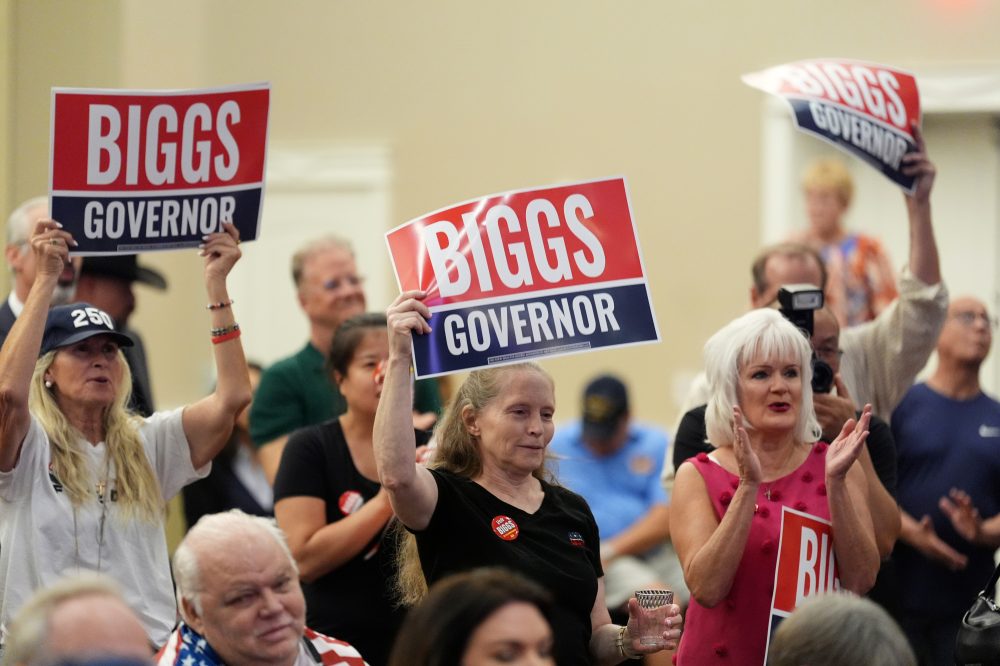

PHOENIX (AP) — For years, Rep. Andy Biggs earned a reputation as one of Washington’s most unyielding conservatives, leading the House Freedom Caucus and pushing President Donald Trump’s agenda while clashing with Republican leadership. Now, his fellow Arizona congressman Rep. David Schweikert is arguing that kind of all-or-nothing approach is exactly what has been costing Republicans elections in Arizona.
The two have spent decades navigating the turbulent waters of Arizona Republican politics, but on Tuesday they face each other directly in a gubernatorial primary. The contest has evolved into a fundamental debate over what direction the GOP must take to reclaim its footing and defeat Democratic Gov. Katie Hobbs, widely regarded as the most vulnerable Democratic governor in the nation.
Biggs carries Trump’s endorsement and the backing of Turning Point Action, and he built his name in Congress as a fierce opponent of compromise. But he has never had to run a competitive general election race against a Democrat. Schweikert, on the other hand, is making the case for a brand of Republicanism that many in the party consider outdated.
“Biggs lives in a district where if he were a turtle running as a Republican, you’re going to win it,” said Kathleen Dunbar, 75, a former Tucson City Council member who intends to vote for Schweikert. “Schweikert lives in a district that’s very much like the state of Arizona, where he has to win the independents. And he’s done it eight times in the last 16 years.”
Trump’s support is Biggs’ most powerful asset — but it comes with complications in Arizona. No Republican has lost a statewide primary with Trump’s endorsement, yet since 2018, only one Trump-backed candidate, former Gov. Doug Ducey, has gone on to win a statewide general election. Despite registered Democrats being outnumbered by both Republicans and independents in the state, Democrats currently hold both U.S. Senate seats and the top three state offices.
In 2022, a Trump-endorsed group of Republican nominees — with former local television anchor Kari Lake leading the ticket as the gubernatorial candidate — refused to soften their message heading into the general election, betting that an energized base would carry them to victory. It did not.
Biggs pushes back on any comparison to Lake and has been working to smooth out his hardline image. After supporting Trump’s effort to block certification of the 2020 election results, Biggs now declines to say whether President Biden’s victory was legitimate. He has also begun highlighting moments when he has reached across party lines.
Kathy Babits, 71, a retired occupational therapist from Scottsdale who plans to vote for Biggs, said she was not moved by Schweikert’s warnings that Biggs would be too polarizing in a general election matchup.
“As long as people get behind him and as long as things don’t change too much, I’m in favor,” Babits said.
Both men are fiscal conservatives representing neighboring suburban Phoenix districts in the East Valley — the two wealthiest and whitest congressional districts in Arizona. Their differences, however, are most apparent in how they operate.
Biggs boasts of his close relationship with Trump and made a name for himself in the House as a roadblock to bipartisan deals. He played a significant role in ousting Republican Speaker Kevin McCarthy and participated in an unsuccessful effort to remove McCarthy’s successor, Mike Johnson. He has staked out some of the most conservative positions in Congress on government spending — voting against COVID-19 economic relief early in the pandemic and, as a state legislator, once proposing to eliminate Arizona’s Medicaid program entirely. His political base is rooted in the fast-growing, family-heavy outer suburbs of metro Phoenix.
“I like his style and his policies and his mannerisms,” said Don Dobie, a Biggs supporter from Scottsdale. “And he looks like a trustworthy guy.”
Schweikert has kept his distance from Trump publicly — no photos together — though he has generally supported Trump’s policy priorities and avoids criticizing him openly. He has instead cultivated an image as a policy-focused lawmaker laser-locked on the federal deficit. He has held his seat even as many of the college-educated, higher-income Republicans in his district drifted away from the party during the Trump era.
To win, Schweikert needs voters like Jeff Clark, a retired telecommunications engineer from Scottsdale who has grown disillusioned with his party’s alignment with Trump.
“Once they say they’re Trump-sponsored and everything, I’m sorry, it’s just not going to work,” Clark said.
Even so, Clark did not cast a ballot in the governor’s race. He believes Biggs has the nomination locked up, and he didn’t feel Schweikert had done enough in Congress to earn his vote.
Michael LoBello, a 79-year-old retiree from Scottsdale who voted for Biggs, said Republicans are losing in Arizona because they haven’t been forceful enough in pushing Trump’s priorities, including the SAVE America election bill.
“Stand up for the people,” LoBello said. “Just stand up for us. They’re forgetting who they represent, and that’s the people.”
Meanwhile, Schweikert’s congressional seat — considered a top battleground in the fight for a House majority — has drawn intense competition in both party primaries.
On the Democratic side, the Democratic Congressional Campaign Committee has made the controversial decision to back Marlene Galán-Woods, a former television news anchor who previously identified as a Republican. Her late husband, Grant Woods, served as Arizona’s Republican attorney general in the 1990s and later became a prominent Trump critic.
Her main challenger is Amish Shah, an emergency medicine physician and former state legislator who ran as the Democratic nominee in 2024 but lost narrowly to Schweikert.
“I like his background in medicine,” said Jeff Cohen, 69, an attorney from Cave Creek who voted for Shah. “And he actually came to my door and I met him. It made a difference. Old-style politics.”
On the Republican side, former Arizona Cardinals kicker Jay Feely holds Trump’s endorsement but has faced criticism for living outside the district — he resides in Biggs’ district and had originally planned to run there before Trump endorsed someone else. Feely is competing against Joseph Chaplik, a former state legislator with strong support among grassroots party activists, and businessman John Trobough.