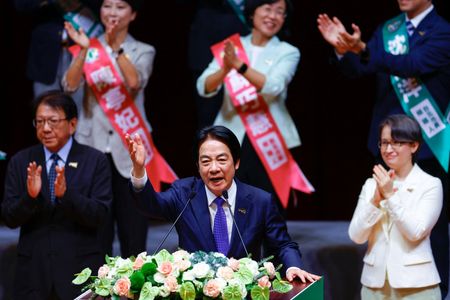

TAIPEI — Taiwan’s president used his party’s annual gathering on Sunday to issue a firm warning: the island’s democratic way of life must be protected, and Taiwan must never fall under China’s control.
President Lai Ching-te, speaking at the Democratic Progressive Party’s yearly convention, called on fellow party members to stand at the forefront of resistance against what he described as China’s “red terror” — a term referring to Beijing’s growing political and legal pressure on the island.
“I also expect comrades within the party to stand on the front lines, unite as one, and jointly oppose the threat posed by China’s ‘red terror’ to Taiwanese society,” Lai said, delivering his remarks in Taiwanese — also known as Hokkien or Hoklo — rather than in Mandarin, the primary language of government.
He went further, declaring: “We must work together to protect our democratic and free way of life, and absolutely never allow ‘democratic Taiwan’ to turn back and become ‘China’s Taiwan.’”
Lai, who also serves as DPP chairman and won election two years ago, has long championed Taiwan’s distinct identity separate from China. That stance regularly draws sharp reactions from Beijing, which considers Taiwan an inseparable part of Chinese territory.
Among the specific concerns Lai raised was China’s new ethnic unity law, which he said amounts to “legal warfare” — giving Beijing a potential legal framework to take action against individuals living outside its borders, including Taiwanese citizens it considers separatists. China has dismissed all criticism of the law. It is worth noting that China’s legal system holds no authority within Taiwan.
Lai also restated his long-held position that Taiwan is already a sovereign nation, formally known as the Republic of China, and is not under the authority of the People’s Republic of China.
“Regardless of ethnic group, regardless of who came earlier or later, anyone who identifies with Taiwan is a master of the country. Taiwan’s future must be decided jointly by the 23 million people of Taiwan,” he said.
The roots of the current political divide trace back to 1949, when the Republic of China government retreated to Taiwan after losing a civil war against Mao Zedong’s communist forces, who then established the People’s Republic of China on the mainland. No peace treaty or armistice has ever been signed, and the two governments have never formally recognized each other.
Reflecting on the past decade under DPP leadership, Lai said Taiwan had not yielded to what he called “authoritarian expansion,” disinformation campaigns, military intimidation, or diplomatic isolation efforts.
“Taiwan has shown the world that democracy is not a weakness; democracy is strength,” he said.
China’s Taiwan Affairs Office had not responded to requests for comment at the time of this report. Beijing has repeatedly rejected Lai’s calls for dialogue, labeling him a “separatist.”