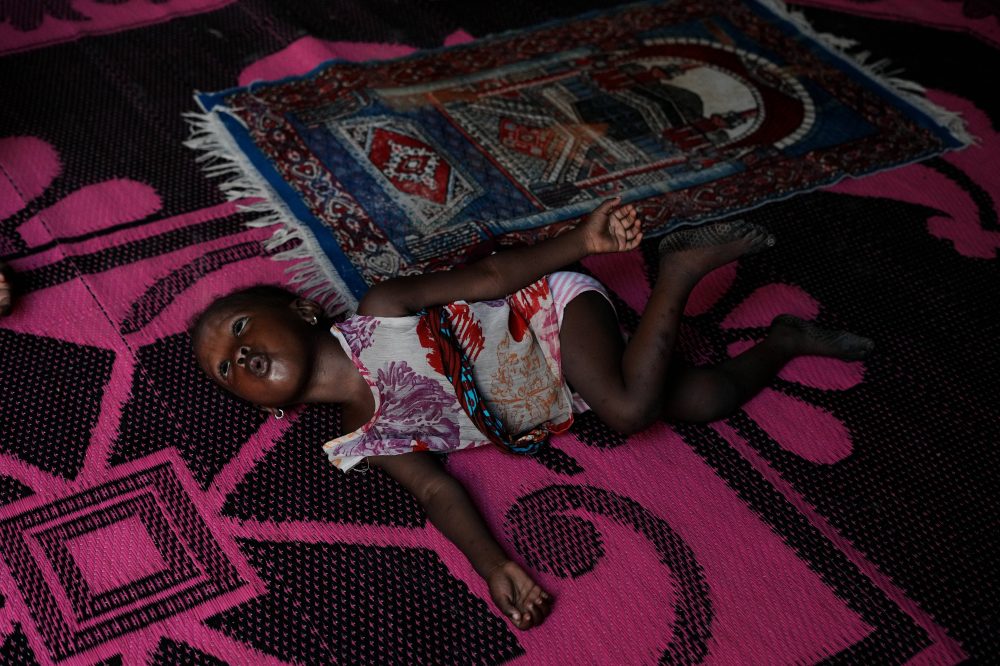

SOKOTO, Nigeria (AP) — When her youngest child was diagnosed with malnutrition for the second time in April, Maryam Aminu was not shocked. The 18-month-old was barely eating regularly, let alone getting the nutritious food she needed to grow.
The family in northwest Nigeria had long faced financial difficulties, but things took a sharp turn for the worse after February. That’s when Maryam’s husband, Shehu Aminu, lost his job as a taxi driver after the retail price of petrol spiked — a direct result of the war in Iran disrupting global oil supplies.
“When she was diagnosed the second time, even though I suspected it, I was sad and angry because I knew why,” Aminu said from inside their modest two-bedroom home in the town of Kware, Sokoto, smoke from a coal stove drifting through the room. “Times are tough, and the food is not consistent.”
Health workers and aid organizations in the region say children falling back into malnutrition after initial treatment has become a troubling and growing pattern across northern Nigeria, with the Iran war cited as a key contributing factor.
Northern Nigeria is already one of the world’s most impoverished areas and has been battling an ongoing insurgency. The Middle East conflict has now made food security even more precarious for millions of people living in poverty, particularly children.
Adding to the strain, Nigerian President Bola Tinubu’s sweeping economic reforms — which included removing fuel subsidies three years ago and devaluing the national currency — have fueled high inflation. A World Bank technical report released this week found that 139 million Nigerians are now considered poor or at risk of falling into poverty.
If the Middle East war drags on, as many as 23.4 million more children could fall into monetary poverty — defined as a lack of income or adequate consumption — before the end of the year, according to a new report from UNICEF, the United Nations children’s agency. The agency warned that at least 80% of those affected would be in Africa and Asia.
“Children are paying the price for the escalating conflict in the Middle East, including children far beyond the region,” said UNICEF Executive Director Catherine Russell. “The longer this continues, the worse the consequences will be.”
The war’s disruption of the Strait of Hormuz — a critical passage through which one-fifth of the world’s oil and gas previously flowed — sent economic shockwaves around the globe. The resulting fuel shock drove up costs across the board, from gasoline and groceries to fertilizer and airline tickets.
In Nigeria specifically, the price of fuel at the pump jumped from 800 naira (about $0.58) per liter in February to 1,400 naira (about $1.02) per liter in April, dragging up the cost of food and other basic necessities along with it.
U.S. President Donald Trump has spent months attempting to pressure Iran into fully reopening the route, employing a range of tactics including airstrikes, naval blockades, negotiations, and threats.
In Sokoto, health workers told The Associated Press that they have seen a growing number of children return to medical facilities this year after slipping back into malnutrition following earlier treatment. Hospital records shared with the AP show that nearly 40 children who had previously been treated for malnutrition since February are currently receiving treatment again — and that figure doesn’t include cases that weren’t officially documented.
“I am worried and sometimes angry about the increasing numbers we are seeing,” said health worker Halimah Muhammad.
UNICEF’s Russell, who was visiting Sokoto this week and spoke with the AP, said the long-term outlook is equally alarming. Children in households crushed by rising prices and economic hardship are more likely to suffer lasting developmental setbacks.
“Their development will be compromised. They are less likely to stay in school because their parents are under so much financial stress. So the long-term implications for children are absolutely terrible,” Russell said.
The conflict has also disrupted fertilizer supplies and driven up prices, threatening the upcoming planting season and compounding the struggles of farming communities across northern Nigeria — communities that are already fighting to access their own land amid violence from armed groups.
“I wake up every morning unhappy, seeing I can no longer provide for my family,” said Shehu, Maryam’s husband. “Then, 2,000 naira could buy you a nutritious meal for the whole family. Now, you need 5,000 naira to buy what 2,000 naira would buy.”
Most days, the family survives on pap — a corn-based pudding — and rice. “There is no way to feed the children,” he said.
Residents of northwest Nigeria are caught in a dangerous squeeze between bandit groups that carry out kidnappings for ransom and Islamist militants pushing into new territory. Analysts say the Iran war only compounds those existing pressures.
“This distant war offers no relief for the north’s vulnerable,” said Ikemesit Effiong, a partner at SBM Intelligence, a Lagos-based geopolitical risk advisory firm.
Larai Malami, a 35-year-old mother of 10, gave birth to her youngest child in December. That infant has already been diagnosed with malnutrition twice. Her husband lost his job as a motorcycle rider and has since crossed into neighboring Niger in search of work, leaving Malami to manage on her own.
She says the high fuel prices — which keep food costs elevated and her husband far from home — weigh on her constantly. “I worry that the child might never be fully well,” she said.
It’s a fear Maryam Aminu understands all too well. “I wish she were excited and full of life,” she said of her youngest daughter.