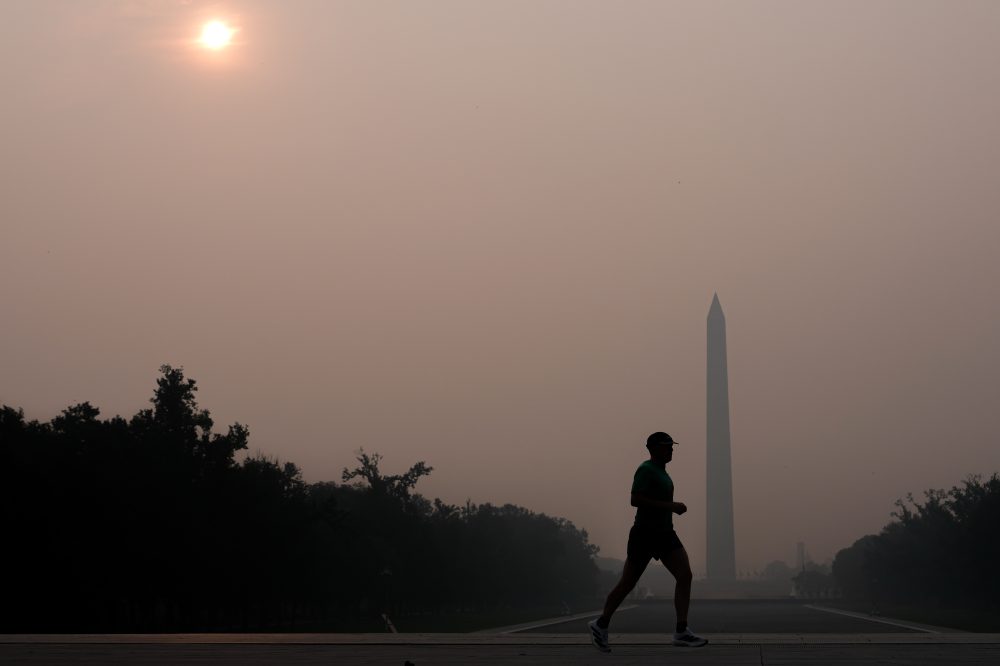

That eerie orange glow in the sky from wildfire smoke may look alarming, but the real danger is something you cannot even see. Tiny particles carried in wildfire haze can trigger both short-term and long-lasting health problems, according to experts.
Wildfire smoke can hang over cities for days at a time — as seen recently when fires burning in Canada sent hazardous air drifting across multiple U.S. states, affecting millions of people. Health officials are urging people to stay inside and take active steps to clean the air within their homes.
If your home has central air conditioning, it can be a powerful tool for filtering out smoke particles. Make sure you are replacing filters on schedule and using the highest filtration level your system can handle. Filters rated MERV 13 or higher are considered ideal. Set your system to recirculate indoor air and, if possible, close any vents that draw air in from outside. The University of Oregon’s Center for Wildfire Smoke Research and Practice recommends keeping the fan running throughout the entire smoke event — not just when the system is actively cooling.
If you are shopping for a portable air filter, look for a HEPA-rated model or one specifically designed to capture fine pollution particles. Be sure to avoid units that produce ozone, which is itself a harmful air pollutant.
If budget is a concern and you can only afford one portable unit, use it to turn a single room into a “clean room” where you spend the majority of your time.
“The basic message is that something is better than nothing,” said Amy Kalkbrenner, an environmental epidemiologist at the University of Wisconsin-Milwaukee.
There is also a low-cost, do-it-yourself option that has real science behind it. Homemade air filters — built by duct-taping furnace filters onto a box fan — have been shown to work effectively. Researchers at the Environmental Protection Agency found that these DIY units perform just as well as small commercial air purifiers when it comes to removing fine particles from the air.
“The good news is they really work,” Kalkbrenner said.
To build one, you will need four 20-by-20-inch furnace filters rated MERV 13 or higher, a box fan, cardboard, and duct tape. The EPA’s website provides instructions, including a modified version that uses only one or two filters. The fan should be positioned to blow outward, with the arrows on the filters pointing inward. Seal everything tightly with tape so no air bypasses the filters.
It is worth noting that many window air conditioners, mini-split heat exchangers, and portable air conditioners lack the filtration needed to remove fine smoke particles. However, heat itself is also a health hazard.
“When smoke and heat occur together, the impacts on your health are even greater than when they occur by themselves,” said Jess Downey, a researcher at the University of Oregon’s Center for Wildfire Smoke Research and Practice.
Downey said the best approach is to run the air conditioning while also using an air purifier or DIY box fan filter. She also recommends making sure your window AC unit is well-sealed in the window frame. Window units should be set to recirculate indoor air, and portable single-hose units should be used as little as possible, according to the University of Oregon wildfire smoke center.
If you do not have air conditioning at all, finding any relief from the heat and smoke is important. Head to a library, shopping mall, or another public space with clean, cool air.
Regardless of what type of cooling system you have, sealing gaps where outside air can sneak in is critical. Use towels, tape, or whatever you have available to block those entry points.
“Being from Chicago, I think you can liken it to trying to keep the cold air out,” said Dr. Khalilah Gates, a lung doctor with Northwestern Medicine. “Any areas in which air can come in, consider sealing up those areas to reduce the amount that’s coming into the home.”
When smoke levels are elevated, experts also advise against burning anything indoors — that means candles, fireplaces, and even gas stoves. Plan your meals ahead of time to avoid needing to cook during peak smoke periods.
Exposure to wildfire smoke can cause shortness of breath, chest tightness, headaches, and a burning feeling in the nose and eyes.
“When you ever start to feel those symptoms and they’re not severe, it’s important to acknowledge, ‘Oh, my body is responding to this. I need to move away from it. I need to move inside,’” Gates said.
If symptoms become severe — including wheezing, difficulty breathing, or significant distress — Gates says you should go to the emergency room right away.