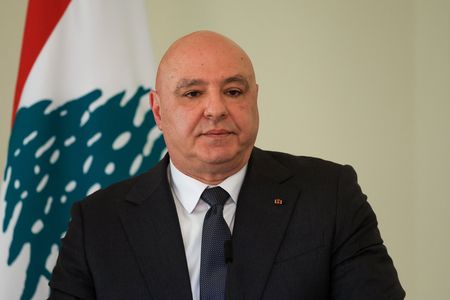

Lebanese President Joseph Aoun is heading to the White House this week for a face-to-face meeting with President Donald Trump — his first visit there and the first by a Lebanese head of state in close to two decades.
Aoun, who previously commanded Lebanon’s U.S.-backed military before winning the presidency last year, plans to bring a written proposal outlining how to dismantle the weapons arsenal held by Hezbollah, the Iran-backed militant group. He also intends to push Trump to pressure Israel into withdrawing its forces from southern Lebanon.
The Tuesday meeting arrives at a critical juncture. Israeli troops currently occupy a portion of southern Lebanon, hundreds of thousands of Lebanese citizens remain displaced in the aftermath of Israeli strikes, and Hezbollah has flatly rejected both the Lebanese government’s direct negotiations with Israel and any effort to strip the group of its weapons.
In remarks released by his office last week, Aoun said he plans to ask Trump to “exert the necessary pressure on Israel” to follow through on a U.S.-brokered agreement reached on June 26 between Lebanon and Israel. That deal calls for Hezbollah’s disarmament, a gradual Israeli troop pullback, and a path toward peaceful relations between the two nations.
A Lebanese official said Aoun believes Trump is the only leader with enough leverage to compel Israel to withdraw and help Lebanon reclaim full sovereignty over its territory.
Aoun, 62, took office just before Trump began his second term. The United States welcomed his election. He is a Maronite Christian, as required under Lebanon’s sectarian power-sharing arrangement, which also mandates that the prime minister be Sunni Muslim and the parliamentary speaker be Shi’ite Muslim. A lifelong military man, Aoun was wounded twice during his career and still carries a shrapnel wound.
His rise to the presidency reflected a dramatic shift in Lebanon’s political landscape following a devastating Israeli military campaign against Hezbollah in 2024 and the removal of Hezbollah’s Syrian ally, President Bashar al-Assad — developments that significantly weakened the group’s grip on Lebanese politics.
At his swearing-in, Aoun pledged to uphold “the state’s right to a monopoly on arms.” Much of his first year in office was dominated by efforts to disarm Hezbollah, which was established by Iran’s Revolutionary Guards in 1982 and has fought multiple wars against Israel. Lebanese soldiers deployed to the country’s south to collect Hezbollah weapons caches under the terms of a ceasefire following the 2024 conflict, with little resistance from a weakened Hezbollah.
However, early in the second year of his term, a new conflict broke out when Hezbollah launched an attack on Israel on March 2 in solidarity with Iran, which was facing strikes from both the U.S. and Israel. The assault triggered a sweeping Israeli air and ground response that has killed more than 4,300 people, according to Lebanon’s health ministry — including nearly 800 children, women, and medical workers. The death toll does not separate civilians from combatants, and Hezbollah has not released figures for its own fighters killed.
Following the outbreak of fighting, Aoun took the historic step of calling for direct talks with Israel — a significant departure for a country that has been invaded by Israel repeatedly since 1978. The move led to the highest-level direct contact between the two countries in decades, but also drew sharp condemnation from Hezbollah and its supporters.
Aoun has not backed down, publicly blaming Hezbollah for starting the war and accusing the group of sacrificing Lebanon for Iran’s interests. Even so, he has declined Trump’s suggestion that he meet directly with Israeli Prime Minister Benjamin Netanyahu.
Born in Sin al-Fil, a suburb of eastern Beirut, Aoun comes from a family with roots in southern Lebanon. He began his military career as a platoon commander in the army rangers in 1985, during Lebanon’s civil war that lasted from 1975 to 1990. Shortly after being promoted to army commander, he led a successful campaign to drive out Islamic State militants from the Syrian-Lebanese border region.
He also guided the military through Lebanon’s severe financial crisis that began in 2019, which devastated the national currency after years of corruption and mismanagement. At the time, he warned that the economic collapse could destroy the Lebanese army, calling it “the backbone of the country.” In an unusually candid statement for a military commander, he called out political leaders over the disaster, noting that soldiers were going hungry alongside ordinary citizens and demanding of politicians, “what do you intend to do?”
Aoun’s election ended a two-year gap in Lebanon’s presidency that followed the conclusion of the term of Hezbollah ally Michel Aoun — who shares a surname but is not related. He has also committed to pursuing long-delayed economic reforms and delivering justice for the victims of the 2020 Beirut port explosion.