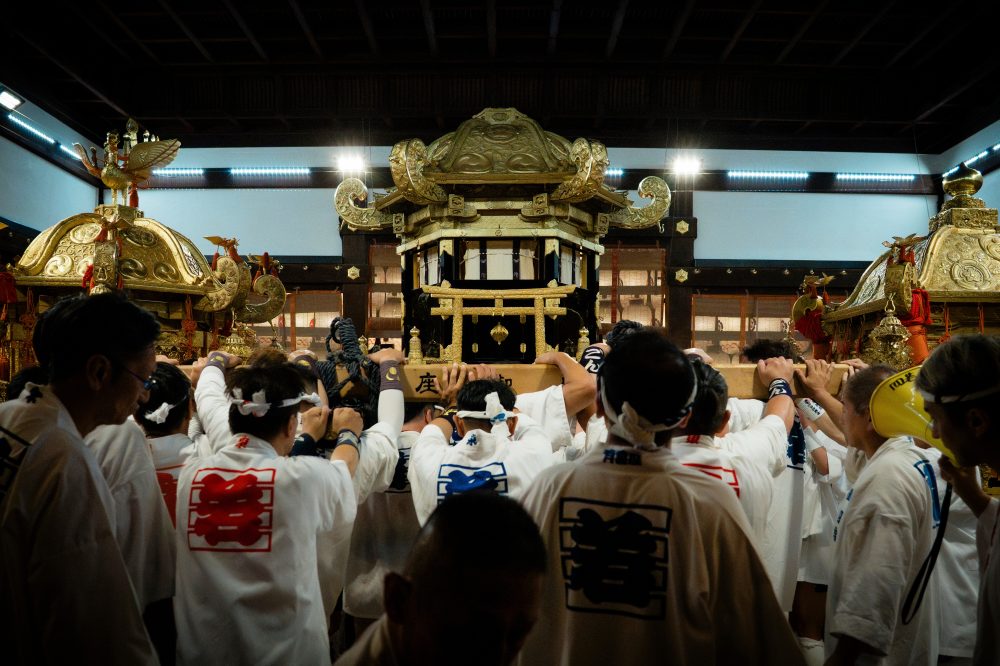

KYOTO, Japan — For Katsushi Horikawa, there is one moment above all others when he feels a deep connection to the divine. That moment arrives when he takes his place atop one of the enormous floats that roll through the streets of Kyoto as part of a procession that has continued for more than a millennium.
The event is known as the Gion Matsuri, a festival that was born over 1,000 years ago as a religious ceremony meant to drive away epidemics. It is held throughout the month of July in Kyoto, the former imperial capital of Japan.
“I am conscious of them when I’m riding on top,” Horikawa said of the gods. “When we’re assembling it as well, but I think the main time is when I’m riding on it.”
Each year, the parades — complete with dance, music, and song — draw massive crowds of locals and visitors alike. The largest floats can tip the scales at up to 12 tons. But beneath the celebratory surface is a tradition deeply tied to the worship of deities and sacred rituals of protection.
“Those performances are not meant primarily for the entertainment of people,” said Fabio Rambelli, a religious studies professor at the University of California, Santa Barbara. “They are offerings to the gods.”
The Gion Matsuri traces its origins to the late 9th century, when it began as a ritual intended to calm spirits thought to be responsible for spreading disease and to seek divine protection from illness. Its name comes from Kyoto’s Gion District and the Japanese word “matsuri,” which means festival.
Central to the festival is Kyoto’s Yasaka Shrine, a Shinto site whose primary deity has historically been regarded as a guardian against disaster and calamity. The shrine’s story, however, also captures centuries of interplay between Shinto and Buddhism within Japan.
“Until about 150 years ago it was a Buddhist temple,” Rambelli said. “That’s part of the religious changes that have taken place in Japan.”
In earlier times, the sanctuary’s chief deity was Gozu Tennō, an ox-headed figure believed to hold power over the spread — or prevention — of epidemics.
“It was a kind of syncretic deity — probably of Indian origin — with connections to Korea and local folklore,” Rambelli said. “A lot of gods in Japan are a mixture of different traditions.”
Rambelli noted that early versions of the Gion Matsuri centered on this deity. To demonstrate to evil forces that their god would stand against them, worshippers carried him through the city in processions similar to those still seen in Kyoto today.
In 1868, during the Meiji era, Japan’s government officially separated Shinto and Buddhism, bringing Shinto shrines under state authority and placing the emperor at the center of the new religious and political order.
“Because the emperor was the direct descendant of the goddess of the sun, they purified the whole system creating what now we see as Shinto,” said Andrea De Antoni, a professor of anthropology and religious studies at the University of Kyoto.
De Antoni noted that a powerful anti-Buddhist movement followed, during which temples, mandalas, and statues were burned and destroyed. Shinto was officially separated from the state following World War II, though its traditions continue to reflect a long history of religious and cultural blending.
“It is an institutionalized religion that revolves around ideas of deities called kami and different spirits,” De Antoni said. “Kami shares its rules with general ideas of animism that can be found throughout the world, but there are a lot of similarities with certain parts of Southeast Asia and with the Pacific,” he added.
Japanese festivals like this one often serve as occasions for deities to be brought into public spaces for sacred or ritual purposes, while simultaneously uniting communities in shared celebration.
“This is the festival of all the people in the neighborhood,” said Jacques Garrigues, a Frenchman who has made Kyoto his home for three decades and who attended the Gion Matsuri procession with his son on Friday. “We also come together through a certain sense of religion, although the religious significance is not the same as in France,” he added.
Among the customs kept alive by the festival is the selection of a young boy to serve as a sacred messenger to the gods. During the parade, this chosen boy rides on one of the floats with his feet never permitted to touch the ground.
Some participants spend months preparing for the event. Different neighborhoods put significant time and care into building their floats, with many people believing the floats carry the power to repel evil spirits.
Atsushi Matono is charged with erecting the shingi — a sacred tree placed at the very top of one of the floats. This is considered the holiest part of the structure, the place where a deity is believed to descend. Like Horikawa, Matono describes sensing a divine presence in his work.
“I always carry out my work with great care and respect,” Matono said. “Feeling the presence of the gods.”