
SOUTH HAVEN, Mich. — When Senate candidate Haley Stevens hits the campaign trail, she focuses on manufacturing, taking on President Donald Trump, and making the case that she’s the Democrat best suited to win Michigan. What she tends not to bring up is the powerful pro-Israel organization that has spent tens of millions of dollars working to get her elected.
The American Israel Public Affairs Committee — better known as AIPAC — along with its affiliated groups, has pumped nearly $30 million into supporting Stevens. That figure represents the single largest investment the organization has ever made in one race. Their goal: defeating progressive candidate Abdul El-Sayed in the August 4 Democratic primary.
Even as AIPAC’s spending has fundamentally changed the dynamics of the race, Stevens has largely steered clear of discussing the group. At a campaign stop in West Michigan in July, she was asked twice about AIPAC and responded with more than 800 words — never once naming the organization. Israel was mentioned just once, when she expressed hope that “the U.S. and Israel working together to rebuild Gaza.”
When the Associated Press asked whether she welcomed AIPAC’s backing, Stevens replied: “Anyone who supported me is supporting me because of my dedication to the people of Michigan, and the things that I have done for Michiganders.”
The exchange captures just how politically sensitive AIPAC has become within the Democratic Party, as Israel’s war in Gaza has deepened divisions over U.S. policy. AIPAC’s mission centers on electing lawmakers who support a strong U.S.-Israel relationship and policies it says benefit both nations’ security. The organization did not respond to a request for comment, and its super PAC, United Democracy Project, also declined to speak on the record.
The stakes are especially high in Michigan, which is home to the largest Arab American population in the country. El-Sayed’s progressive allies are casting the race as a broader referendum on whether grassroots organizing can hold its own against a tidal wave of outside money.
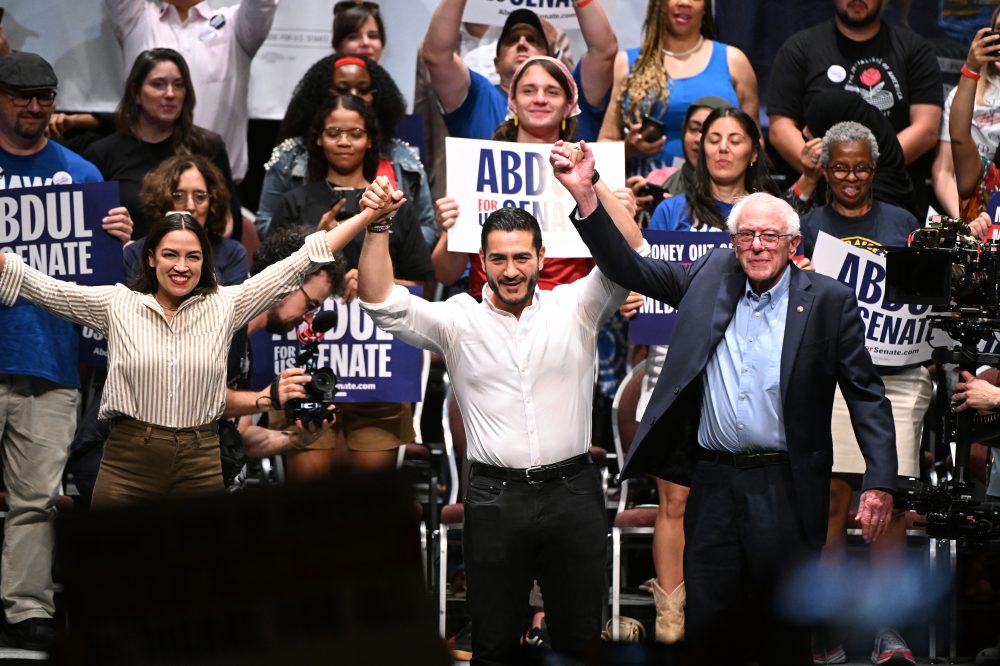
New York Rep. Alexandria Ocasio-Cortez, who has been campaigning for El-Sayed in Michigan, put it plainly: “One of the laws of nature in politics is whoever spends the most money wins. It is an opportunity to show that things other than money can win in America.”
Stevens, a four-term congresswoman, raised only half of what El-Sayed brought in during the most recent fundraising period ending June 30. Her campaign said in a statement that it is “raising the resources we need to win this race.” Through early July, Stevens’ own campaign had spent just $12,000 on advertising before increasing that figure to nearly $1 million, according to AdImpact. Outside groups, however, have collectively spent close to $50 million boosting her candidacy — including roughly $12 million from a group called A Stronger Michigan that has not disclosed its donors.
El-Sayed has made AIPAC’s massive financial footprint a defining issue of his campaign, accusing Stevens of serving the interests of wealthy donors rather than everyday voters. Sen. Bernie Sanders, campaigning alongside El-Sayed at rallies in Detroit, Lansing, and Grand Rapids, was blunt in his assessment: “She is nothing more than an employee of these billionaires.”
Stevens has said she supports “comprehensive campaign finance reform.”
Many Michigan voters may not even realize that the ads flooding their television screens are being funded by AIPAC. The spots never reference Israel, instead spotlighting Stevens’ record on manufacturing and featuring former President Barack Obama. Former Rep. Andy Levin, who lost to Stevens in a 2022 Democratic primary after redistricting — with AIPAC spending millions against him — noted the deliberate strategy. “AIPAC never runs on AIPAC. They never even talk about Israel and Palestine,” said Levin, who is Jewish. “If you’re just a voter and you see a million ads, you don’t know who paid for it.”
The two candidates have staked out starkly different positions on Israel’s military campaign in Gaza. Stevens, though not Jewish, has long been among Congress’ most vocal supporters of Israel, describing herself as a “proud pro-Israel Democrat” and once saying during a Hanukkah celebration that “Israel comes to me in my dreams.” She has, however, criticized Israeli Prime Minister Benjamin Netanyahu, saying during a recent debate that he “has not made us safer, has not brought us closer to peace, and he’s endangered Jews here in America and around the world.”
El-Sayed, the son of Egyptian immigrants, has taken a sharply different stance. He has labeled Israel’s military campaign in Gaza a “genocide,” called the Israeli government “evil,” and argued repeatedly that AIPAC warps Democratic politics. “The reason that we’ve seen this war fought is because of the impact of AIPAC in our politics,” he said at a recent debate.
The war in Gaza was sparked by Hamas’ October 7, 2023 attacks inside Israel, which killed approximately 1,200 people and resulted in 251 being taken hostage. The conflict has now stretched beyond 1,000 days. According to Gaza’s Health Ministry, Israel’s retaliatory military offensive has killed more than 73,000 Palestinians.
If victorious, El-Sayed would become the first Muslim ever elected to the U.S. Senate. He has addressed questions about whether his faith could be a liability in a competitive general election. “When they raise questions about my ‘electability,’ they are usually pointing to the most obvious thing about me that makes me ‘different’ — that’s my name and my Muslim faith,” he wrote in an email to supporters. “Faith, to me, isn’t just about an identity. It’s about the choices that I make every single day about how I live my life.”
El-Sayed’s campaign has spent approximately $3.2 million of its own funds on advertising, with around $1 million in outside support. Rather than competing dollar-for-dollar with Stevens, his team has emphasized grassroots organizing, reporting more than 10,000 volunteers recruited statewide. When asked about Stevens’ volunteer numbers, her campaign said it has “hundreds across Michigan.” “This election will come down to the many versus the money,” El-Sayed wrote.
Support for Israel within the Democratic Party has been eroding since the Gaza war began. Earlier this week, 103 House Democrats voted — unsuccessfully — to block $3.3 billion in U.S. aid to Israel, the most visible sign yet of the party’s internal fracture. Among them was New York Rep. Pat Ryan, who had previously backed aid to Israel and accepted support from AIPAC. “I expect groups like AIPAC will not support me in my future elections and frankly, I don’t want their support,” Ryan posted on social media, later announcing he was returning the money.
Similar tensions played out in Michigan during the 2024 Senate race, when Democratic activists pushed now-Sen. Elissa Slotkin to take a tougher stance on Israel’s actions in Gaza. Slotkin, who is Jewish, had already distanced herself from AIPAC years before the race. She went on to defeat Republican Mike Rogers by fewer than 20,000 votes. Rogers is running for Senate again this year and faces no opposition in the Republican primary.
Even so, some observers question whether the Israel issue will ultimately drive most primary voters to the polls. Michigan political strategist Adrian Hemond offered this perspective: “It’s not that Democratic primary voters love AIPAC. They obviously don’t. But this doesn’t even register as an issue that’s influencing voting behavior for the overwhelming majority of primary voters.”