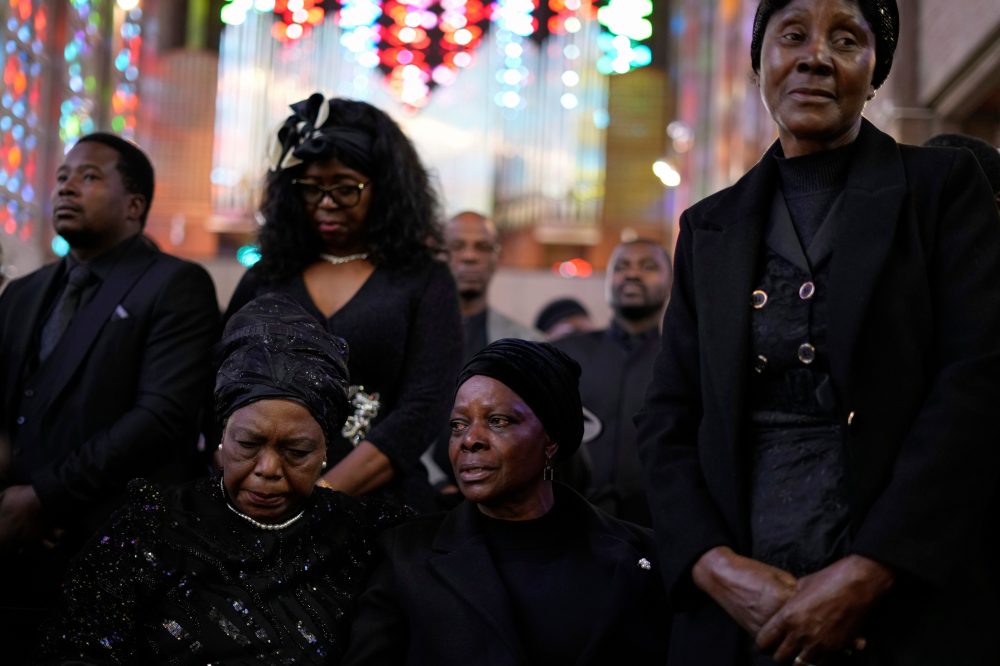
PHNOM PENH, Cambodia — Cambodia’s highest court was expected to deliver a decision Thursday on whether to overturn the treason convictions of two journalists who were jailed for posting photographs connected to border clashes with Thailand last year.
The ruling arrives at a time when serious questions are being raised about whether the court operates independently of the country’s ruling party.
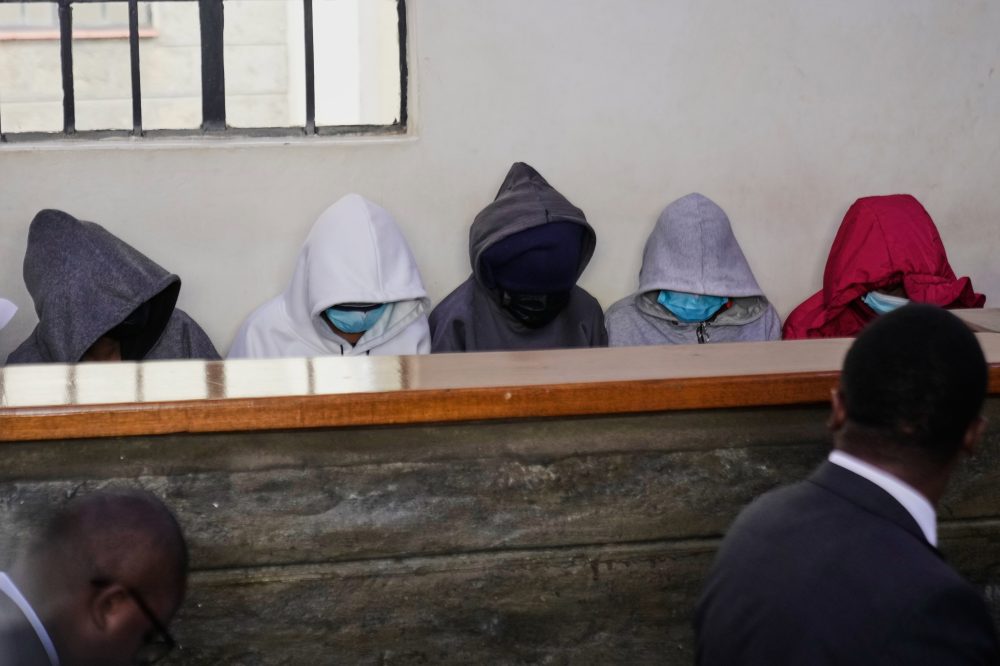
Phorn Sopheap, a journalist with Battambang Post TV Online, and Pheap Pheara, of TSP 68 TV Online, were taken into custody last July after returning from reporting assignments along the border. Authorities alleged the two men had posted images they captured inside a restricted military zone to Facebook.
Both journalists have denied any wrongdoing, maintaining they had authorization to be in the area where the photographs were taken. They are asking the Supreme Court to throw out their convictions and the 14-year prison sentences that came with them.
Among the photos that drew significant attention was an image showing land mines, which was picked up and widely circulated by Thai media. That photograph strengthened Thailand’s argument that Cambodia had placed new mines along the shared border — mines that had injured Thai soldiers on patrol.
Cambodia’s government officially rejected those claims, stating the country complies with international agreements that prohibit the use of land mines. Cambodian officials suggested the mines found may have been remnants from decades of internal conflict that came to an end in the late 1990s.
The border fighting, which flared up in July and again in December, forced hundreds of thousands of people on both sides of the border from their homes and resulted in the deaths of roughly 100 soldiers and civilians. A ceasefire reached in December has held, though the situation between the two countries remains tense.
The two journalists were originally found guilty of treason in December by Siem Reap Provincial Court, which determined they were guilty of “supplying a foreign state with information prejudicial to national defense.” Each received a 14-year sentence.
After a lower appeals court upheld those convictions in March, more than a dozen journalism organizations — both national and international — signed a joint letter urging the Cambodian government to drop the case against the two men.
Thursday’s hearing at the Supreme Court comes less than a week after that same court upheld an incitement conviction against Rong Chhun, a well-known opposition politician. That ruling once again put a spotlight on what critics describe as a pattern of using the legal system to suppress dissent.
Rong Chhun, who is 56 years old, was found guilty last year of inciting social unrest following meetings he held with villagers who had been displaced by government construction projects. Many observers viewed the prosecution as part of a broader effort by the government of Prime Minister Hun Manet to silence political opponents and critics.
Human Rights Watch said the ruling against Rong Chhun exposed the “lack of independence from the ruling party” within Cambodia’s court system. The government pushed back on that characterization, insisting the Supreme Court operates without political interference.
Cambodia spent nearly four decades under the autocratic leadership of former Prime Minister Hun Sen, a period marked by widespread criticism over human rights abuses, including the suppression of free speech and the right to organize. His son, Hun Manet, who received part of his education in the United States, took over in August 2023, but there have been few indications that political conditions have meaningfully improved.
The Committee to Protect Journalists, based in New York, accused Cambodia’s government earlier this year of “using vague national security laws to criminalize legitimate reporting” in the cases involving Pheap Pheara and Phorn Sopheap.
In the 2025 World Press Freedom Index published by Reporters Without Borders, a Paris-based organization, Cambodia ranked 161st out of 180 countries and territories — placing it in the category of nations where the press freedom situation is considered “very serious.”
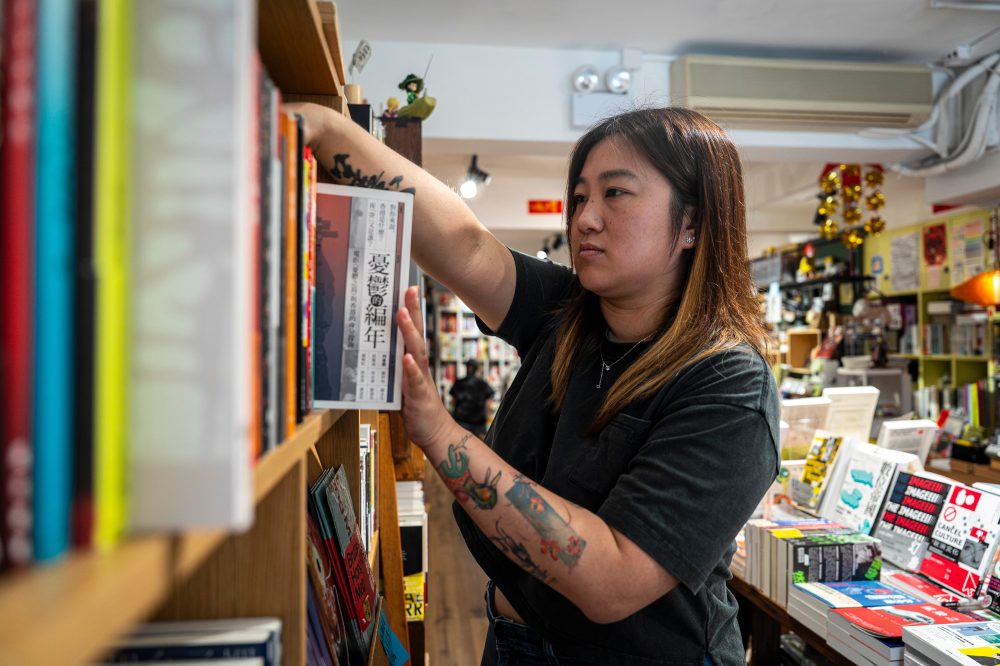
Hong Kong police have taken two bookshop owners into custody on suspicion of displaying and selling publications considered to have “seditious” content, according to an official government statement issued Thursday.
Neither the two individuals nor the bookshop were named in the statement. Both were taken into custody on Wednesday.
The arrests were carried out by the National Security Department of the Hong Kong Police Force during an enforcement operation in the Sham Shui Po district. The two detainees — a 33-year-old woman and a 32-year-old man — are the bookshop’s owners.
According to police investigators, the pair is suspected of selling materials that incite hatred toward the Hong Kong Special Administrative Region Government, its courts, and law enforcement agencies.
Authorities also allege that the two individuals received multiple money transfers funded by foreign political organizations.
During the operation, officers confiscated a collection of items labeled “seditious,” along with books and documents connected to the case, from both the shop and the suspects’ residence.
The timing of the arrests is notable — they occurred just one week before July 1, the anniversary marking Hong Kong’s 1997 handover to Chinese rule. Under Hong Kong’s Basic Law, the city was promised a high degree of autonomy for 50 years, which includes freedom of the press.
In 2020, Beijing enacted a national security law in Hong Kong following a year of often violent anti-government demonstrations. The move drew widespread international condemnation, with critics arguing that the freedoms guaranteed to Hong Kong at the time of the handover are steadily eroding.
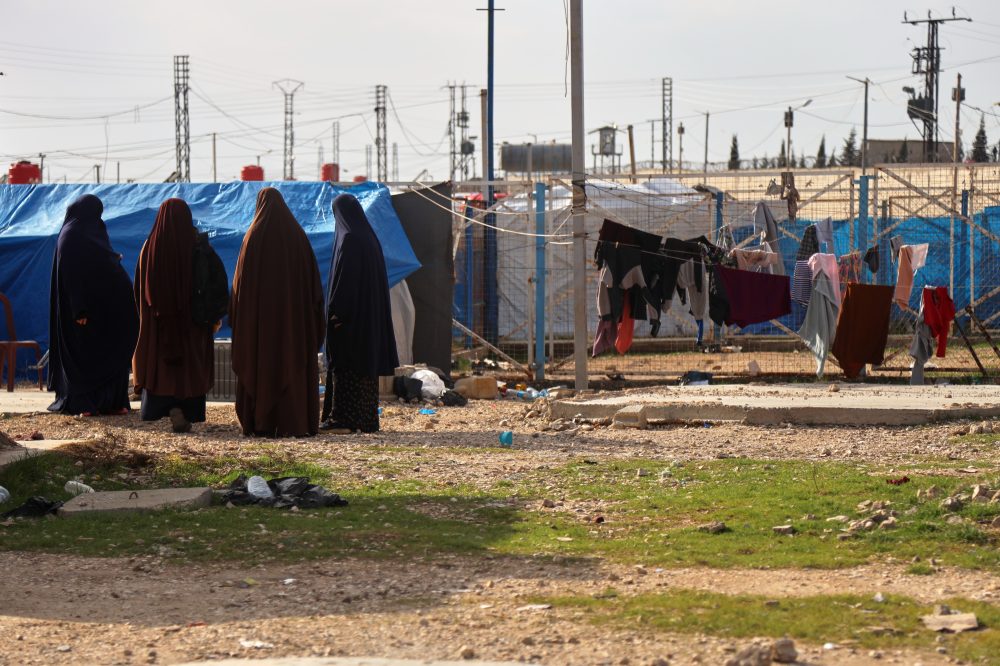
MELBOURNE, Australia — The final Australian woman remaining in a Syrian camp that housed families of Islamic State group fighters has been granted permission to return home, but she will face a rigorous set of conditions once she does, Home Affairs Minister Tony Burke announced Thursday.
The 29-year-old woman, who once lived in Sydney, and her nine-year-old daughter had been set to travel back to Australia in February alongside a group of other Australian women and children from the Roj camp. However, a temporary exclusion order blocked her from departing at that time.
Australia introduced these exclusion orders in 2019 as a tool to keep defeated IS fighters from coming back from the Middle East for periods of up to two years. This woman is the only known person to have been targeted by such an order.
Burke explained Thursday that after the woman’s legal team applied for a permit allowing her return, his government no longer had a legal basis to keep her out of the country.
Upon her return, police and national security agencies will impose a strict set of requirements. She must keep authorities informed of where she lives, works, studies, and intends to travel. She will also be required to give 24 hours advance notice before using any form of communication technology.
“Even if you want to use a public phone, it’s 24 hours notice. Any social media, 24 hours notice on everything has to be given so that there will be a very high level of scrutiny and surveillance and we have gone absolutely to the legal limit that we’re able to,” Burke told the Australian Broadcasting Corp.
Members of the opposition have pushed back against the government, arguing it should have changed the law to stop the woman from coming back at all.
Officials confirmed the exclusion order had been issued on national security grounds, though they declined to elaborate on the specific reasons behind that decision.
The woman’s attorney, Moustafa Kheir, had not responded to a request for comment as of Thursday.
Australian Federal Police have been looking into the conduct of Australians who traveled to the territory where IS declared its caliphate across parts of Iraq and Syria since 2015 — the same year this woman, then 18 years old, left Sydney for Syria.
Whether she will face arrest when she lands in Australia remains uncertain. Of four women who arrived in Australia on May 7 with nine children, three were taken into custody upon arrival and charged with terrorism and slavery-related offenses. Those three have been denied bail and remain behind bars.
The United States government announced late Wednesday that it has reached out to Venezuelan authorities and is working to deliver assistance following a series of powerful earthquakes that struck the South American country.
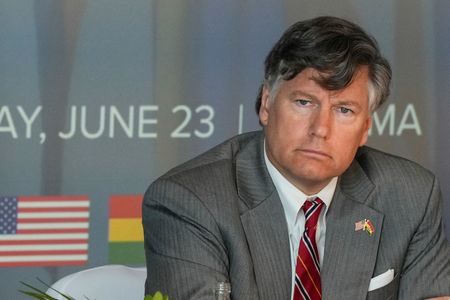
Deputy Secretary of State Christopher Landau took to social media platform X to confirm the outreach, calling the earthquakes “devastating” and stating that the U.S. is “in touch with the authorities and mobilizing assistance.”
The earthquakes hit west of Venezuela’s capital, Caracas, on Wednesday afternoon, causing buildings to collapse, trapping people beneath rubble, and prompting scientists to issue warnings about potentially significant casualties and widespread damage throughout the country.
U.S. State Department official Jeremy Lewin also posted on X, confirming that a disaster assistance team and task force had been activated to deliver and coordinate critical aid to those affected.
“Working with our partners in the interim Venezuelan government, the U.S. will be sending search and rescue teams, medical and humanitarian supplies and other resources in the crucial first days after this tragic natural disaster,” Lewin wrote.
The U.S. embassy in Caracas confirmed that all American staff members had been located and were safe.
Relations between the United States and Venezuela have improved in recent months following the seizure of then-President Nicolas Maduro by American forces during a deadly raid on the capital in January. The Trump administration has since been working with an interim government led by former Maduro ally Delcy Rodriguez, including reaching an agreement for the U.S. to sell Venezuelan oil, and has issued sanctions waivers aimed at encouraging American investment in the country.
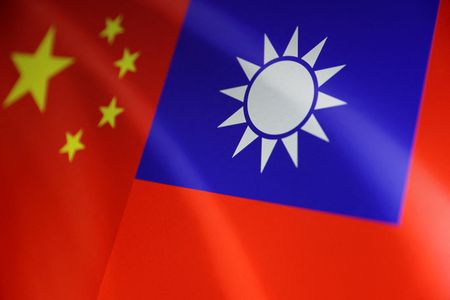
Three U.S. government departments have issued a joint warning, saying China has been reaching out to American state governments and private companies in an effort to push them away from doing business or engaging with Taiwan — and in some cases, misrepresenting what U.S. policy actually says.
The warning came in two similarly worded letters, signed by the U.S. Departments of State, Agriculture, and Commerce. One letter was directed to governors’ offices and the other to CEOs and business leaders. Both were dated June 16 but were made public late Wednesday by the de facto U.S. embassy in Taiwan.
According to the letters, China’s embassy and consulates have been routinely contacting local governments and private businesses across the United States to “discourage engagement with Taiwan.”
“In doing so, they often mischaracterise U.S. policy by, for example, falsely claiming that Washington has previously accepted Beijing’s specific position on Taiwan,” both letters state.
The letters advise that if any government office or company finds itself being pressured by Chinese officials, it should reach out to the State Department for guidance.
China’s foreign ministry had not responded to a request for comment at the time of reporting.
Under Washington’s “One China” policy, the U.S. officially takes no stance on the question of Taiwan’s sovereignty. Even so, the U.S. remains Taiwan’s most important international supporter and its primary arms supplier — a relationship that has long been a source of frustration for Beijing, which views Taiwan as part of its territory despite the island governing itself independently.
The letters emphasize that Taiwan holds an important place in global trade and that American states and businesses have maintained strong ties with the island for many decades.
“Taiwan is a vital U.S. partner and democratic success story,” the letter addressed to governors reads. “We hope you will take advantage of all the opportunities that our shared values and robust relationship with Taiwan offer.”
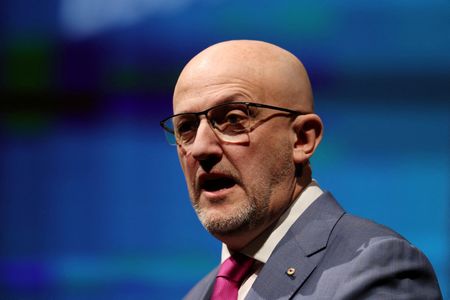
Australia’s top intelligence official is sounding the alarm about a worsening national security landscape, saying the country faces overlapping dangers from authoritarian governments, cybercriminals, and antisemitic extremists that are collectively eroding the nation’s safety.
Australian Security Intelligence Organisation Director-General Mike Burgess delivered the warning during his annual threat assessment speech Wednesday night, saying that while Australia’s terrorism threat level officially remains at “probable,” that label fails to capture the full picture of what the country is facing.
“‘Probable’ does not tell the full story. The next level on the scale is ‘expected,’ which applies when we have intelligence about a specific attack. We do not,” Burgess said. “But we do know the environment is degrading and acts of politically motivated violence are becoming more likely than ‘probable’ suggests.”
The assessment comes after a turbulent year that included online radicalization cases, state-sponsored cyberattacks, arson targeting Jewish-owned businesses, and a mass shooting in Sydney. Burgess noted that ASIO has disrupted 31 major terror plots since 2014 and has closed more than a dozen major terror-related cases since a mass shooting at Bondi Beach in December, during a Jewish Hanukkah celebration, that left 15 people dead. Police have said the two alleged gunmen appeared to have been inspired by the Islamic State militant group.
Burgess defended how ASIO allocated its resources in the lead-up to the Bondi Beach attack, explaining that the agency was simultaneously managing numerous threats and that it was extremely difficult to “simplistically pivot” from one danger to another.
“We cannot stop every terrorist, just as we cannot catch every spy. But we continue to work around the clock to keep Australians safe,” he said.
The spy chief also highlighted the growing role of technology in fueling extremism, saying encrypted messaging platforms are radicalizing individuals — including minors — within just weeks. Social media, he added, is amplifying grievances, eroding public trust in institutions, and deepening societal divisions.
On the espionage front, Burgess said foreign intelligence operatives are actively trying to steal classified information related to Australia’s AUKUS nuclear submarine partnership with the United States and Britain. He cited one case where an official with a security clearance was approached by someone posing as a representative of a consulting firm.
Burgess also pointed the finger at Iran for a series of arson attacks on Jewish businesses in Australia since the outbreak of the Gaza conflict. He said one attack on a Sydney restaurant was likely coordinated by an Australian citizen living in Iran who was working as an agent within Iran’s Islamic Revolutionary Guard Corps. The Iranian embassy did not respond to a request for comment.
“Thankfully, no-one died as a result of the arson attacks…but I do worry that one day an Australian will be killed at the hands of a foreign government here in Australia,” Burgess said.
Australia formally accused Iran of directing two antisemitic arson attacks in Sydney and Melbourne in August 2025 and expelled Tehran’s ambassador — the country’s first such diplomatic expulsion since World War Two.
Despite the sobering assessment, Burgess expressed confidence that Australia is well-positioned to confront these threats going forward.
Venezuela’s interim President Delcy Rodriguez announced a state of emergency on Wednesday after two strong earthquakes struck back-to-back, triggering nearly two dozen aftershocks that toppled buildings in the capital city of Caracas and other parts of the country.
Rodriguez made the announcement on state television, standing alongside her brother Jorge — who serves as head of the national assembly — and Interior Minister Diosdado Cabello. She expressed her sympathies to the families of those who lost their lives in the disaster, though she did not reveal how many people were killed or injured.
Rodriguez also confirmed that Simon Bolivar Airport in Maiquetia, located near Caracas, has been closed due to damage caused by the earthquakes.
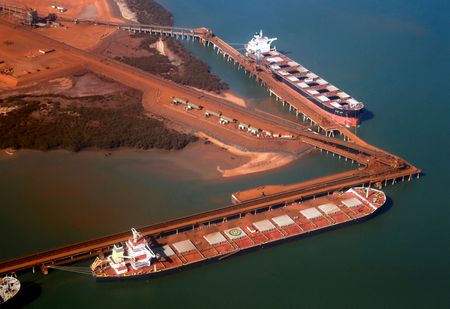
One of the world’s biggest iron ore mining companies is now facing a class action lawsuit over allegations of widespread sexual harassment targeting women at its remote work sites in Australia.
The suit against Fortescue — ranked fourth globally among iron ore producers — was filed Thursday by law firm JGA Saddler. The same firm previously launched comparable class action cases against mining giants Rio Tinto and BHP in late 2024, and those legal battles are still ongoing.
The issue has deep roots in Australia’s mining sector. Back in 2022, the Western Australian state government called for sweeping reforms across the industry after documenting what it described as horrifying treatment of women, concluding that sexual harassment and assault were widespread among fly-in, fly-out, or FIFO, mining workers.
JGA Saddler litigator Paris Hamrey spoke out strongly about the conditions women say they are enduring. “Time and time again, women are telling us that they don’t feel safe at the Fortescue mine sites,” she said in a statement.
Hamrey went on to describe specific allegations from workers: “Women are telling us that they can’t do their daily washing because their underwear is being stolen from the public laundries, they can’t go to the gym because men are touching them inappropriately or following them back to their room.”
She also said that when women do speak up, the consequences are often severe — including demotion, dismissal, being silenced, or being blacklisted from the industry entirely.
The legal filing includes 45 personal accounts from women who have worked at Fortescue. Among the testimonials, one woman wrote: “I came home one night to find a random man in my room.”
Australia leads the world in iron ore production, with many of its remote mining operations relying on FIFO workers who travel long distances to work extended shifts. Women currently make up about 22% of the mining workforce, an increase from roughly 18% at the beginning of the decade.
According to Fortescue’s most recent safety report, the company recorded 22 sexual harassment cases with Western Australia’s mines safety regulator during the 2025 financial year — a 27% drop from the previous year. Notably, Fortescue was the only one of the three companies named in class action suits to report a decline in such incidents.
By comparison, Rio Tinto’s internal care hub — which tracks reports of disrespectful or harmful workplace behavior — logged 702 incidents last year, a 24% jump from the year before, according to its annual report. BHP reported 429 sexual harassment incidents in 2025, a 3% rise, and noted in its annual report that 100 individuals found to be responsible either lost their jobs or resigned.
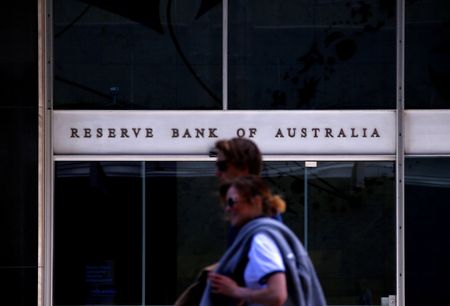
SYDNEY — Australia’s labor market showed signs of renewed strength in May, with employment figures bouncing back and the unemployment rate retreating from its highest level in more than four years, according to data released Thursday.
Numbers from the Australian Bureau of Statistics revealed a net gain of 40,300 jobs in May, reversing the prior month’s decline. April’s job losses were revised to 40,600 — a steeper drop than originally reported. Despite the revision, May’s rebound came in ahead of what analysts had anticipated, with market forecasts calling for a gain of around 30,000 positions.
The unemployment rate slipped to 4.4% in May, down from 4.5% in April, in line with expectations. The participation rate — which measures the share of the population either working or actively looking for work — ticked up slightly to 66.7%. On the downside, total hours worked dropped by a notable 1.1% during the month.
The stronger-than-expected employment data could give policymakers grounds to consider additional interest rate increases if economic conditions call for it.
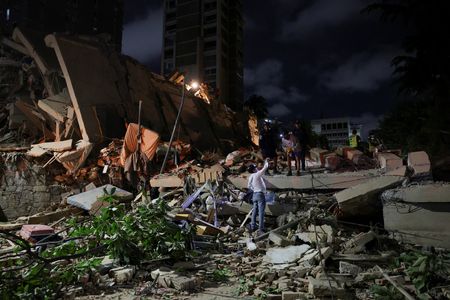
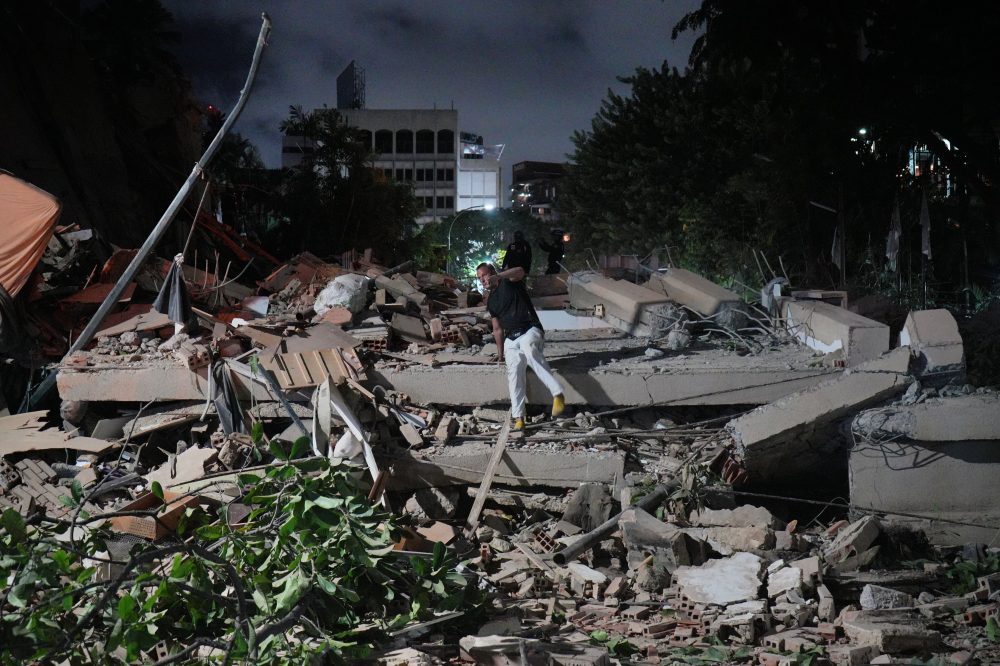
Two powerful earthquakes hit Venezuela in rapid succession on Wednesday, striking just about a minute apart and leaving a trail of collapsed buildings and significant damage across the country, including in the capital city of Caracas.
The twin tremors registered magnitudes of 7.1 and 7.5, making them among the strongest earthquakes to shake Venezuela in more than a century. The rare occurrence of back-to-back quakes of this magnitude caught residents and officials off guard.
Photos captured by AP photo editors document the destruction left behind by the historic seismic event.
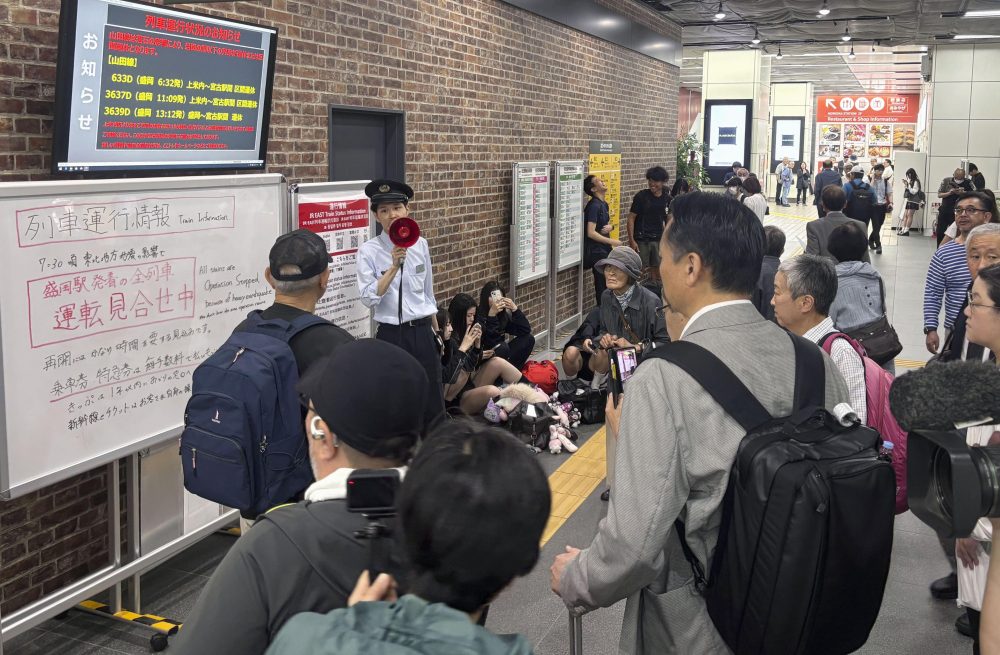
A powerful earthquake hit off Japan’s northern coastline on Thursday, though the country’s meteorological agency quickly confirmed there was no risk of a tsunami following the tremor.
The Japan Meteorological Agency reported the quake carried a preliminary magnitude of 6.9 and originated off the eastern shore of the Iwate region, at a depth of roughly 50 kilometers — about 30 miles below the surface. The U.S. Geological Survey independently confirmed the same 6.9 magnitude reading.
Thursday’s earthquake struck an area that has seen repeated seismic activity in recent months, including a quake last December that set off a week-long major earthquake caution advisory.
The tremor hit during the morning commute in Japan’s northeastern region and was felt as far away as Tokyo, though only mildly there. Top government spokesperson Minoru Kihara said there were no immediate reports of injuries or property damage.
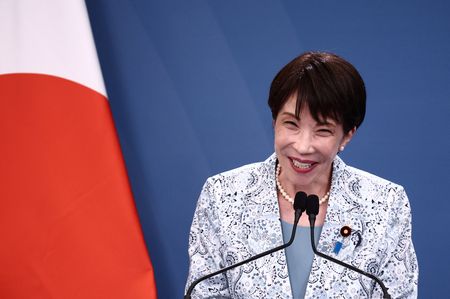
Prime Minister Sanae Takaichi addressed reporters in Tokyo, saying her government’s emergency response team is “putting people’s lives first” as officials gather information and stand ready to launch relief efforts if necessary. She called on residents in impacted areas to remain cautious in the event of aftershocks.
Tomoko Nagane, who serves as principal of a primary school in the town of Hashikami in Aomori prefecture, told NHK she was behind the wheel when earthquake alerts sounded. She described feeling a moderate side-to-side shaking. Students who had already arrived at school were safe, she said, though some were shaken and crying. School was called off for the day, and Nagane confirmed all children made it home safely.
NHK journalists reporting from hard-hit communities, including Sendai and Morioka, described feeling the shaking for roughly two minutes but said they observed no visible damage. Video from those areas showed commuters continuing about their day as normal.
East Japan Railway Co., which runs train service throughout the northeastern part of the country, announced that several bullet trains and regional rail lines were temporarily suspended to allow for safety inspections.
Spokesperson Kihara also confirmed that nuclear facilities in the region — including the Fukushima Daiichi plant, which suffered severe damage in the catastrophic 2011 earthquake and tsunami, as well as a spent nuclear fuel reprocessing facility in Aomori — reported no irregularities as a result of Thursday’s quake.
Japan sits along the Pacific Ring of Fire and ranks among the most seismically active nations on Earth.
Japan’s government is preparing to formally ask its central bank to keep interest rates low in support of private-sector demand, according to a draft of the country’s long-term economic blueprint obtained by Reuters.
The document urges the Bank of Japan, known as the BOJ, to align its monetary policy decisions with Prime Minister Sanae Takaichi’s push to stimulate economic growth. It cites legal provisions that require the central bank to coordinate closely with the government.
“The government won’t hesitate taking nimble and sufficient steps” to prevent Japan from slipping back into deflation, the draft stated, as part of broader pledges to strengthen the country’s long-term economic potential.
The draft further states: “As the government seeks to achieve strong growth under its economic and fiscal policy, appropriate monetary policy that supports private demand through stable price rises is extremely important.”
The blueprint, which shapes Japan’s long-term economic direction, is expected to be finalized in July. It will be the first such document produced under Takaichi, who has historically expressed skepticism toward the BOJ’s attempts to move away from deflation-era stimulus measures.
While Japanese law protects the independence of the central bank, it also requires the BOJ to maintain close coordination with the government on policy matters. Using that requirement as a basis, the draft calls on the BOJ to “work closely with the government to sustainably and stably achieve its 2% inflation target” while watching for signs of a “positive cycle” of rising wages and prices.
The BOJ is scheduled to hold its next policy meeting on July 30-31. Markets widely expect rates to remain unchanged at that gathering, though investors will closely examine updated quarterly forecasts for clues about when the next rate increase might come.
Since assuming office last October, Takaichi has prioritized government spending as a tool for economic recovery — a position that has pushed bond yields higher amid growing concerns about Japan’s fiscal health.
Her new growth strategy targets more than 370 trillion yen, or approximately $2.3 trillion, in investment through the fiscal year 2040, spread across 17 strategic sectors including artificial intelligence and semiconductors.
That level of spending would be easier to sustain under low interest rates. However, rising inflationary pressures have led the BOJ to begin pulling back from its ultra-loose policy stance and raising borrowing costs.
Earlier this month, the BOJ lifted its policy rate to 1%, the highest level in 31 years, and has indicated it is prepared to tighten further as elevated fuel costs tied to the Iran war have kept inflation near its target for nearly four years.
Political pressure, however, may complicate any additional rate hikes. A government representative who attended the BOJ’s June meeting indicated the central bank should take “proactive and appropriate action” if economic conditions deteriorate — a signal, according to a summary of opinions from the meeting, that the administration is not pleased with the direction of rate increases.
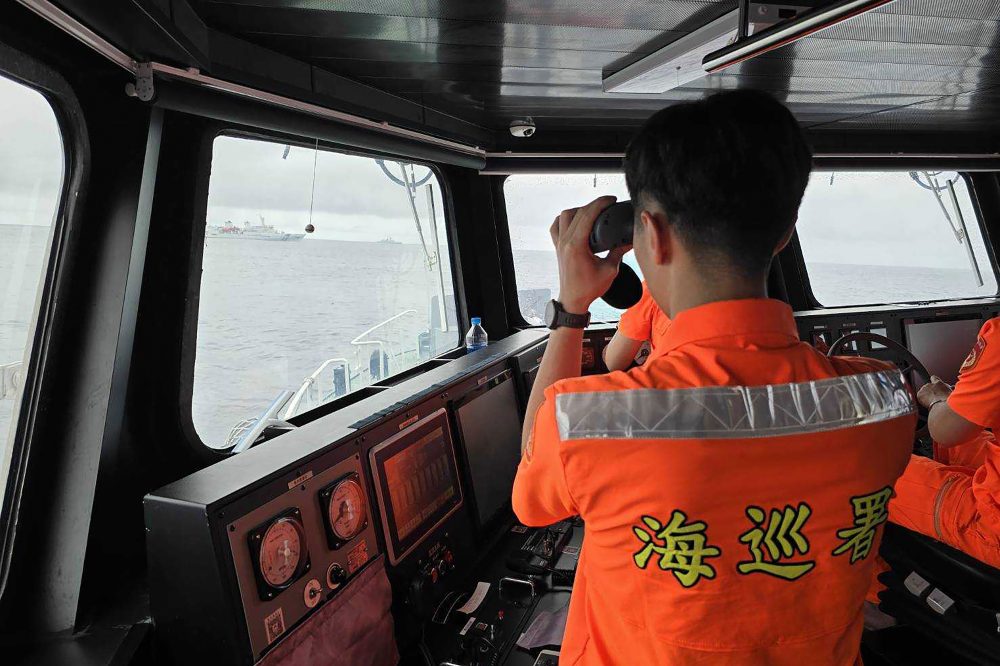
Taiwan’s government voiced appreciation Wednesday after the United States, Britain, France, and Germany sounded the alarm over Chinese Coast Guard activities taking place off the island’s eastern shores, with Taipei emphasizing that open sea lanes are critical to commerce around the world.
Earlier this month, China dispatched Coast Guard vessels into the waters east of Taiwan, describing the deployment as a “special maritime traffic law-enforcement operation.” The move drew sharp criticism from Taiwan’s government. China, which considers democratically governed Taiwan to be part of its own territory, has also been sending maritime survey ships into the same area.
Beijing said its coast guard operation was triggered by an announcement from Japan and the Philippines that they planned to begin formal discussions about their shared maritime boundaries — talks that China viewed as encroaching on waters it claims near Taiwan.
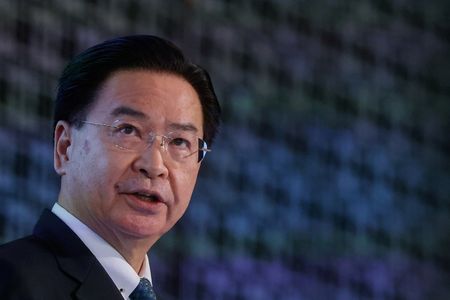
Joseph Wu, who serves as secretary-general of Taiwan’s National Security Council, took to social media platform X late Wednesday to express his appreciation. He said he was “truly thankful” for the statements issued by the four Western nations.
“A rules-based int’l order, the StatusQuo, & regional peace & stability are what we all care about. The PRC should stop its maritime expansionism,” Wu wrote, using the abbreviation for the People’s Republic of China.
China’s foreign ministry had not yet responded to the statements made by the Western governments. Beijing does not recognize any Taiwanese claims to sovereignty and considers both the island and the surrounding waters to be Chinese territory.
Taiwan’s Ocean Affairs Council, the government body that oversees the island’s coast guard operations, released a separate statement declaring that safe and open navigation through the Taiwan Strait and surrounding waters is essential to global trade.
“China’s maritime harassment of Taiwan, and the political pressure that follows, not only violate international law but also harm the shared interests of the international community. They must be promptly contained and collectively rejected,” the council stated.
The council added that Taiwan would continue standing alongside its allies and would “responsibly and jointly defend the international order in surrounding waters through lawful, appropriate, and firm measures.”
Kuan Bi-ling, the minister who heads the Ocean Affairs Council, posted on her Facebook page that China has been “certified” as a disruptor of regional stability. “The more China harasses Taiwan, the more the international community supports Taiwan!” she wrote.
Last week, Kuan hosted the de facto British ambassador to Taiwan, Ruth Bradley-Jones, aboard Taiwan’s Yunlin coast guard vessel while it was docked at port.
Taiwan maintains that China holds no legitimate claim of sovereignty or jurisdiction over the island or the waters around it.
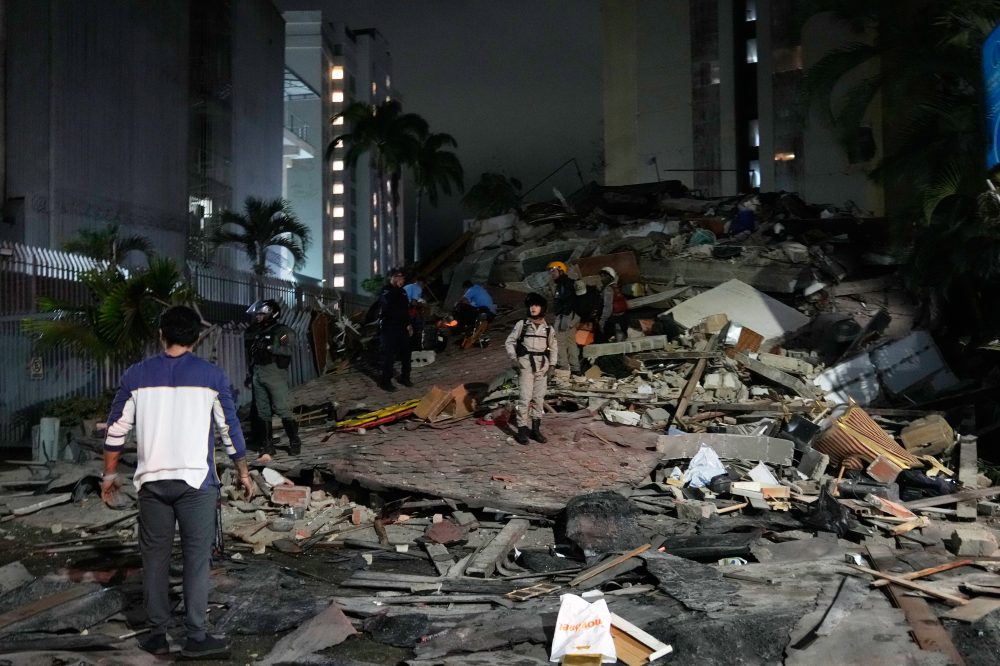
CARACAS, Venezuela — Two powerful earthquakes struck Venezuela in rapid succession Wednesday evening, causing buildings to collapse in the nation’s capital city of Caracas.
According to the U.S. Geological Survey, the first earthquake registered a magnitude of 7.1. Its epicenter was located west of the coastal community of Morón, situated along Venezuela’s Caribbean coastline approximately 168 kilometers (104 miles) west of Caracas. That quake reached a depth of 13 kilometers (about 8 miles).
Just one minute after the first tremor, the USGS recorded a second and even stronger earthquake measuring magnitude 7.5. That quake’s epicenter was 16 kilometers (10 miles) southwest of Morón, at a depth of 10 kilometers.
Both earthquakes are considered among the most powerful to hit Venezuela in more than a century.
In the aftermath, the U.S. Pacific Tsunami Warning Center issued a tsunami alert for the Virgin Islands. Authorities in the Dominican Republic also put out a similar warning for that island. A tsunami alert that had been issued for Puerto Rico was later lifted.
In Caracas, residents fled swaying buildings and gathered outside in the streets. Many were visibly shaken as they witnessed entire walls collapsed, leaving the interiors of buildings — including furniture — exposed to the street. Clouds of dust rose from at least two neighborhoods in the capital, areas where restaurants and businesses are normally bustling with activity.
Interior Minister Diosdado Cabello confirmed the earthquakes were felt across multiple states. He described “alarming situations” in Caracas’s Altamira neighborhood, where homes and buildings had collapsed. He indicated people had been injured and called on drivers to clear the way for ambulances and rescue crews.
Speaking on state television, Cabello urged calm and cooperation. “We understand that some people may be desperate, but we are acting according to protocols to activate aid and rescue efforts to help those who need it most,” he said. “Be very careful with children and the elderly; call each other and check that no one has been harmed.”
Cabello also warned residents to stay outdoors, as aftershocks could cause further damage to already weakened structures.
One Caracas resident, Roberto Damas, described the terrifying experience firsthand. “The building really shook from side to side. Unreal. The force was incredibly strong,” he said. “We were walking and it was tossing us around. Everything in the apartment fell. Well, thank God we were able to get out.”
A significant earthquake with a magnitude of 6.9 rattled the eastern coast of Honshu, Japan on Thursday, according to the European-Mediterranean Seismological Centre.
A powerful earthquake struck north-central Venezuela on Wednesday afternoon, sending residents of the capital Caracas scrambling to get out of their buildings. People in neighboring Colombia also reported feeling the tremors.
The U.S. Geological Survey measured the quake at a magnitude of 7.1. It was centered approximately one hour west of the city of Valencia, at a depth of about 13 kilometers — roughly 8 miles underground.
The timing of the earthquake was notable: many Venezuelans were home from work, observing a national public holiday that marks an 1821 military victory that secured the country’s independence from Spain.
In Caracas, frightened residents rushed out of their homes and offices as buildings swayed from the force of the quake. Video footage from Reuters witnesses showed fire trucks deployed throughout the city’s streets, and several buildings showed visible damage to their outer walls and facades.
Many people across Caracas lost electricity and internet service almost immediately after the shaking stopped.
Maria Romero, an 80-year-old retiree living on the south side of Caracas, was helped out of her building by police officers. She described the experience as devastating. “This earthquake was horrible, even worse than the one in 1967,” she said.
Another witness described returning to their apartment to find cracks running up the walls and shattered glass in the entryway, with power going out shortly afterward.
A resident of Valencia, located to the west of Caracas, described widespread structural damage in their building. “Several walls in my building broke open or cracks formed,” the witness told Reuters. “As soon as it stopped (shaking) my husband and I evacuated.”
Following the earthquake, the U.S. Tsunami Warning System issued a tsunami threat for Puerto Rico and both the U.S. and British Virgin Islands. Officials also warned that the islands of Aruba, Curacao, and Bonaire — located off Venezuela’s coast — could face dangerous wave activity.
WASHINGTON — President Donald Trump said Wednesday that the question of who was responsible for a devastating strike on a girls’ school in Iran may never be answered.
The attack occurred on February 28 — the first day of the Iran war — when U.S. and Israeli forces launched strikes against Iran. The strike hit a school in Minab, in southern Iran, killing more than 175 children and teachers, according to Iranian officials.
Reuters reported in March that an early internal U.S. military investigation pointed to U.S. forces as likely responsible for the fatal strike. The Pentagon has since expanded the investigation but has stopped short of confirming any preliminary conclusions.
Speaking to reporters, Trump cast doubt on whether the truth would ever come out. “I don’t know that they are ever going to solve that problem,” he said. “I don’t know that they are ever going to solve that problem in terms of whose fault was it because there were missiles flying all over the place, and it’s horrible what happened but there were missiles flying all over the place.”
Trump also pushed back on suggestions that the U.S. was to blame. “Somebody said it was our missile, maybe it wasn’t our missile but I have seen nothing to lead me to believe it was,” he said, adding, “I don’t think it was us.”
Sources familiar with the matter told Reuters in March that the strike may have resulted from the use of outdated targeting data by U.S. forces.
Under international humanitarian law, deliberately targeting a school would likely constitute a war crime. U.S. officials have publicly stated that Washington would never intentionally strike a school.
The attack sparked widespread global outrage. The United Nations human rights office described the incident as “absolutely horrific.”
Trump initially blamed Iran for the strike without providing evidence. He has since walked back that claim, saying he lacks sufficient information, that an investigation remains ongoing, that he will accept whatever the inquiry concludes, and that “nobody” deliberately targeted the school.
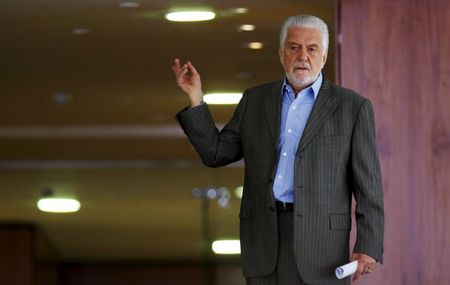
SAO PAULO — A prominent Brazilian senator and close political ally of President Luiz Inacio Lula da Silva has stepped down from his role as the government’s leader in the Senate, adding new turbulence to the administration just months before a national election.
Senator Jaques Wagner announced his resignation on Wednesday through a post on the social media platform X. His exit marks another high-profile departure tied to a growing corruption investigation that has begun to reach into Brazil’s political establishment.
Brazilian authorities revealed last week that Wagner had come under formal investigation as part of a broader probe. The inquiry centers on allegations that Daniel Vorcaro, the owner of the now-defunct Banco Master, used his wealth and political connections to build influence among well-known politicians.
Wagner’s resignation is seen as a significant blow to Lula, raising fresh concerns about the administration’s political standing ahead of October’s election.
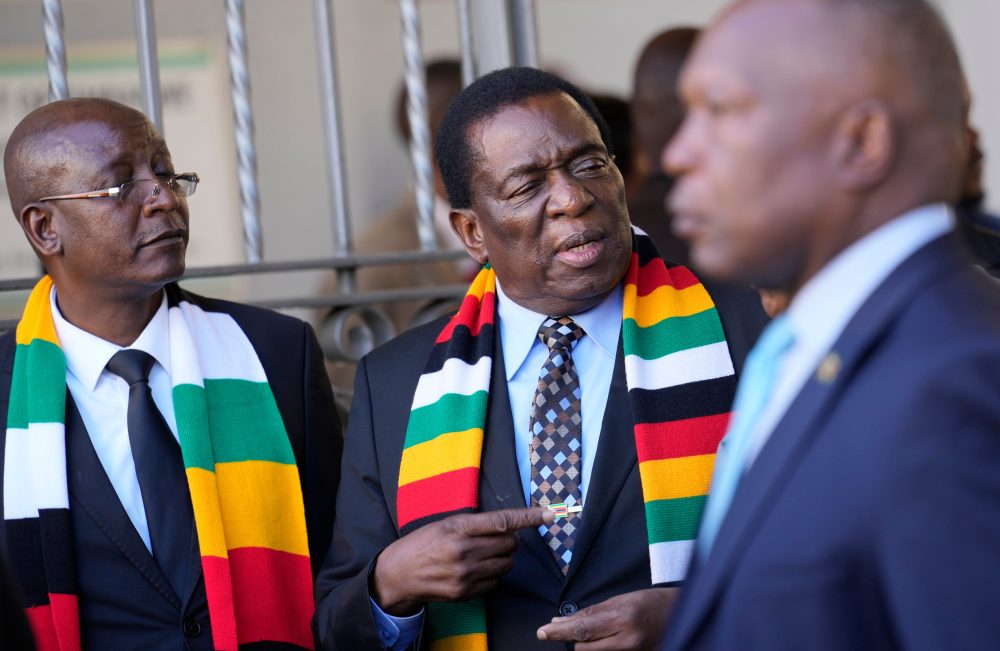
HARARE, Zimbabwe — Zimbabwe’s Senate gave overwhelming approval Wednesday to a set of constitutional amendments that would eliminate direct presidential elections, postpone the next scheduled vote, and extend the term of the nation’s 83-year-old president.
The measure passed with 75 senators voting in favor and only four opposed. Some lawmakers from the divided opposition crossed the aisle to support the bill alongside members of the ruling party. The president’s signature is now the only remaining step before the amendments become law.
Under the proposed changes, the presidential election currently set for 2028 would be pushed back to 2030, giving President Emmerson Mnangagwa an additional two years in office. The bill also fundamentally changes how Zimbabwe’s president is chosen — scrapping the direct popular vote in favor of selection by members of parliament. Additionally, the terms of both the president and parliament members would be extended from five years to seven.
The amendments have drawn sharp criticism from human rights lawyers, activists, and some opposition figures, who argue that lengthening presidential terms requires a public referendum rather than a simple parliamentary vote. Supporters of Mnangagwa counter that parliament has the authority to make these changes, pointing out that the constitutional two-term limit would still be preserved, even if each term becomes longer.
The political climate in Zimbabwe has grown increasingly tense since the amendments were introduced. Critics of the legislation have reportedly faced arrest and detention, while others have described harassment and intimidation. Courts in the southern African nation have not yet ruled on multiple legal challenges filed against the proposed changes.
Mnangagwa has held power since 2017, when the military facilitated the removal of his longtime mentor and former Zimbabwean ruler Robert Mugabe, who passed away in 2019. Though Mnangagwa had previously indicated he would leave office when his second term ended in 2028, his ruling ZANU-PF party has been a driving force behind the amendments. Parliament has even held late-night sessions to advance the legislation. The lower house passed the bill by a wide margin just last week.
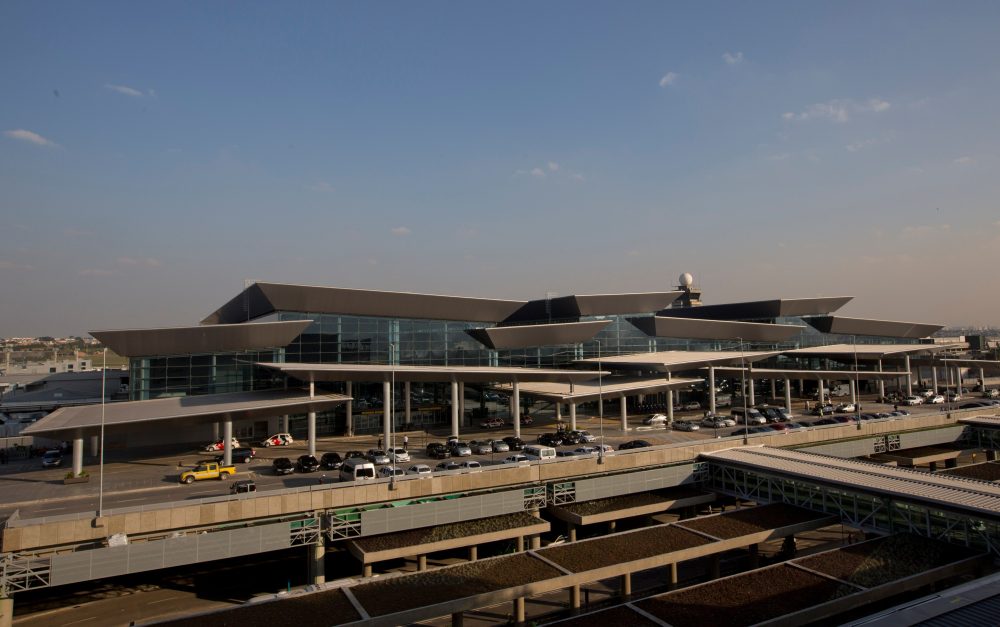
RIO DE JANEIRO — Federal police in Brazil took a Spanish citizen into custody Wednesday at São Paulo’s Guarulhos international airport, marking the most recent in a growing string of high-profile racism-related arrests involving foreign visitors to the country.
Brazil has confronted a long history tied to slavery and has established some of the most stringent anti-racism legislation in Latin America. Those protections were written into the country’s 1988 constitution. Under Brazilian law, insulting someone based on their race can result in a prison sentence of two to five years, along with financial penalties.
According to police, the crew aboard a LATAM airlines flight that had arrived from the northeastern city of São Luís contacted authorities after the Spanish woman allegedly hurled racially offensive comments at the workers responsible for unloading the plane’s baggage. Officers took her into custody as she stepped off the aircraft. LATAM issued a statement saying there was no excuse for the aggression aimed at its staff and that the airline stands firmly against racism and discrimination in all forms.
This incident follows several similar cases in recent months. In January, Argentine national Agostina Páez was arrested in Rio after video spread widely on social media showing her making monkey gestures toward a waiter at a nightclub. Though initially prohibited from leaving Brazil, Páez was ultimately allowed to return to Argentina in April, where photographs captured her meeting with Sen. Patricia Bullrich, a close ally of Argentine President Javier Milei. Both were seen celebrating her homecoming. Legal proceedings in her case are still underway.
In May, another Argentine national, Eduardo Ignacio Murias, was arrested in Minas Gerais. Authorities allege he took unauthorized photos and video of a young child and then shared those images alongside racist messages written in Spanish. News outlet G1 reported on June 17 that a court formally indicted Murias, who continues to be held in pretrial detention.
Also in May, a Chilean citizen was arrested for making racial and homophobic slurs against flight crew members during a trip between Guarulhos and Frankfurt. That individual also reportedly attempted to open the aircraft door mid-flight and, when crew members intervened, directed racial and homophobic insults at them, according to a May 15 police statement.
Brazil’s ties to slavery run deep — the country imported more Africans into forced labor than any other nation and was the final country in the Western Hemisphere to abolish slavery, doing so in 1888. At the same time, Brazil has a long tradition of anti-racism advocacy driven by movements pushing for racial equality.
Irapuã Santana, a lawyer who specializes in anti-racism cases and a professor at the Getulio Vargas Foundation, a think-tank and university, noted the significance of that history. “Social movements played a very important role in ensuring that the Black population was recognized in the 1988 constitution,” which explicitly bans racism, he said.
In January 2023, Brazilian President Luiz Inácio Lula da Silva signed legislation that classified racial insults as equivalent to the crime of racism itself, giving courts stronger tools to address such cases.
Santana added that racism cases in Brazil are drawing increasing public attention as more people learn about the country’s legal protections and recognize that the justice system can and does respond to such offenses.
HONG KONG (AP) — Hong Kong police took two people into custody Wednesday, alleging they sold seditious publications and accepted money from foreign political organizations, invoking powers granted under a recently enacted national security law.
An official government statement released early Thursday declined to name the individuals who were arrested. However, local media outlets — among them the Chinese-language newspaper Ming Pao — cited unnamed sources claiming that one of the two was Leticia Wong, the owner of Hunter Bookstore.
Wong, a former district councilor known for her pro-democracy stance, has continued to speak out publicly at a time when many prominent activists have been imprisoned following a sweeping crackdown that came in the wake of large-scale anti-government demonstrations in 2019. Should her involvement be confirmed, many observers would likely view the arrest as another move to suppress dissenting voices in the city.
The Associated Press was unable to independently confirm the identities of those taken into custody. Police did not answer emailed questions, and Wong was unreachable by phone.
The two arrests happened exactly one week before Hong Kong marks the 29th anniversary of its transition from British colonial rule back to China. Critics argue that Beijing’s pledge to preserve the city’s Western-style civil liberties following the 1997 handover is becoming increasingly hollow.
According to Thursday’s official statement, the pair arrested operate a shop in the Sham Shui Po district — the same area where Wong’s bookstore is located. They face suspicion of sedition under the 2024 national security law, as well as charges related to handling assets believed to be proceeds of an indictable offense under a separate piece of legislation.
A pro-Beijing newspaper reported last year that an independent book fair held at Wong’s bookstore carried overtones of what it called “soft resistance.” That report drew attention to the store’s intention to sell a biography of jailed pro-democracy figure Jimmy Lai.
Authorities said their investigation found the pair allegedly displayed seditious items and offered for sale publications containing seditious content — including materials said to incite hatred toward the city’s government, its courts, and law enforcement. The statement also alleged the two received money transfers funded by foreign political organizations, though it did not name the specific publications or groups involved.
Wong had previously spoken about feeling pressure on her business. In an interview with the AP last year, she said her records documented 92 instances between July 2022 and June 2025 in which government authorities took action against her shop — including inspections, visible patrols outside the premises, and written warnings about alleged violations. She also described how an anonymous letter sent to an organization that had planned an event at her shop led that group to cancel the booking.
This past March, police arrested the owner and employees of a separate bookstore, reportedly also on suspicion of selling seditious materials, including the Lai biography. Those booksellers were subsequently released on bail.
The Hong Kong government maintains that both security laws are essential to maintaining stability in the city, and insists that freedom of expression remains fully protected.
HARARE — Zimbabwe’s senate gave overwhelming approval Wednesday to a bill that would lengthen presidential terms from five years to seven, paving the way for President Emmerson Mnangagwa to hold onto power until 2030.
The vote was not particularly close — 75 senators backed the measure while just four opposed it, surpassing the two-thirds majority required for passage.
Beyond extending the length of presidential terms, the legislation also includes a significant change to how Zimbabwe’s president is chosen. Rather than being elected directly by voters, the president would instead be selected by parliament under the new framework. The bill will officially become law once Mnangagwa puts his signature on it.
Signs that Mnangagwa, who is 83 years old, was looking to remain in office past the end of his second term in 2028 began surfacing roughly two years ago. Supporters at rallies held by the ruling ZANU-PF party began chanting that he needed additional time to finish what he had started.
The ruling party formally committed to amending the constitution to extend presidential terms last year, and the proposal received cabinet approval in February.
Mnangagwa’s path to the presidency came through a 2017 military coup that removed longtime leader Robert Mugabe, who had governed Zimbabwe since the country gained independence in 1980.
Opponents of the bill argue it is simply a mechanism for Mnangagwa to cling to power beyond what voters originally agreed to. Supporters, however, contend the changes will improve government accountability and bring greater political stability to the country.
BOGOTA, Colombia — The emergence of Abelardo de la Espriella, a businessman and attorney set to become Colombia’s next president, is sparking debate over whether a broader political shift taking shape across Latin America could fundamentally alter the fate of the Amazon rainforest.
Colombia’s outcome arrives as Peru appears to be on the verge of electing Keiko Fujimori following a tight vote. At the same time, Brazil is gearing up for a presidential contest that could push the country rightward if Flávio Bolsonaro, son of former President Jair Bolsonaro, manages to unseat President Luiz Inácio Lula da Silva.
Taken together, these elections raise the prospect that the nations controlling the largest portions of the Amazon could shift toward policies that put greater weight on economic expansion, resource extraction, and cracking down on organized crime in remote territories.
“There’s an interesting alignment, particularly across the Andes region and the broader Amazon basin,” said Elizabeth Dickinson, deputy director for Latin America at the International Crisis Group, pointing to a growing view among some governments that economic development and environmental conservation can happen side by side.
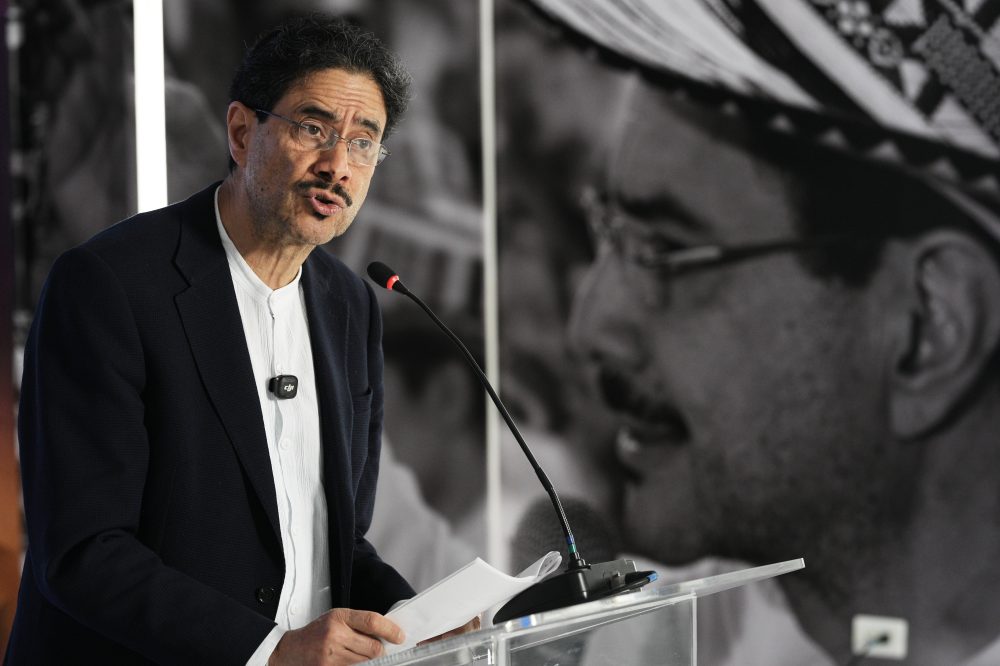
In Colombia, de la Espriella — who received an endorsement from U.S. President Donald Trump — defeated lawmaker Iván Cepeda, who had the backing of outgoing President Gustavo Petro, by a margin of one percentage point, or roughly 251,000 votes. Cepeda acknowledged his defeat on Wednesday.
The Amazon rainforest stretches across much of northern South America and plays a vital role in slowing climate change by soaking up large quantities of carbon dioxide, a greenhouse gas responsible for warming the planet. Scientists have long cautioned that ongoing deforestation could push portions of the Amazon past a point of no return, beyond which vast areas might lose the ability to recover as rainforest.
Approximately 40% of Colombia’s land area falls within the Amazon basin. Under outgoing President Petro, the country became one of the world’s most vocal champions of rainforest preservation and a shift away from fossil fuel dependence.
On the campaign trail, de la Espriella — known by the nickname “The Tiger” — promised to reinvigorate Colombia’s oil industry, expressed support for fracking, which involves extracting oil and gas from underground rock formations, and argued that the nation should draw more heavily on its natural resources to fuel economic growth. Environmental advocates warn that ramping up oil and gas output could undermine emissions reduction goals and place added strain on ecologically sensitive regions.
De la Espriella stands in stark contrast to Petro, who blocked new fossil fuel exploration agreements and worked to establish Colombia as a global leader on climate policy.
Peru, which holds the second-largest share of the Amazon rainforest behind Brazil, appears close to electing Fujimori. Much like de la Espriella, Fujimori has indicated support for growing the mining sector and other industries as engines of economic development, while environmental organizations have voiced concern about what that could mean for forests and Indigenous communities.
Brazil, which contains roughly 60% of the Amazon, faces a presidential race with potentially sweeping consequences for forest protection. The contest comes after the country saw deforestation rates climb sharply under Bolsonaro, only to fall again under President Luiz Inácio Lula da Silva as environmental enforcement was stepped up.
Brazil’s track record demonstrates that government priorities can produce a tangible impact on the Amazon, according to Cristiane Mazzetti, zero deforestation lead at Greenpeace Brazil.
“The elected administration sets budgetary priorities, fills government positions and shapes regulations to either facilitate or hinder predatory exploitation and environmental crimes,” she said. “The result of this is measurable, as evidenced by the rate of deforestation in the Brazilian Amazon.”
Trump’s backing of de la Espriella comes as the U.S. president has rolled back domestic climate policies, pushed for expanded oil and gas production, and pulled the United States out of the 2015 Paris Agreement, the global accord designed to limit rising temperatures.
Sergio Guzmán, director of Colombia Risk Analysis, said environmental priorities may increasingly find themselves competing with demands for investment, energy production, and economic growth.
“Many of the concerns from environmentalists on emissions and fracking are going to take a second place to some of the economic concerns about energy self-sufficiency, investment and foreign direct investment in oil, gas and mining,” Guzmán said.
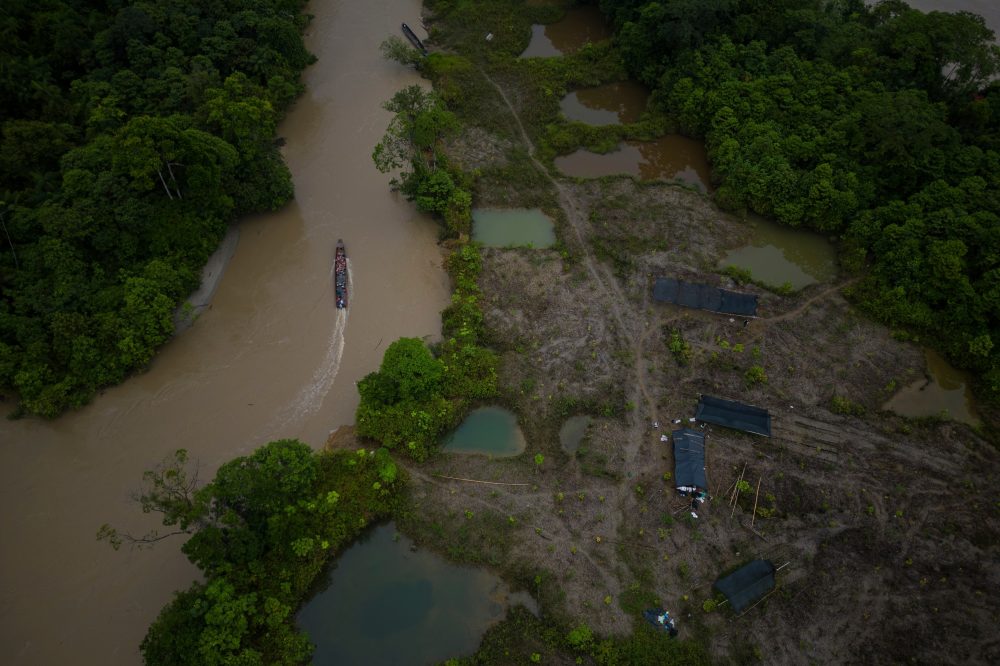
Illegal gold mining has emerged as one of the most destructive forces in parts of the Amazon, polluting rivers with mercury, stripping away forests, and funneling billions of dollars to criminal organizations.
Dickinson noted that many governments have adopted harder stances toward illegal mining, which has become a central issue in environmental policy across the region.
“It’s very hard to disagree with the idea of going after illegal mining, one of the most detrimental industries for the Amazon basin,” she said, adding that governments have typically concentrated on confiscating equipment or clearing miners from specific sites rather than dismantling the criminal and financial networks that drive the operations.
“What we really haven’t reached is an ability to tackle the intellectual authors of these operations,” Dickinson said.
Julio Cusurichi, a well-known Indigenous leader from Peru’s Amazon region, said Indigenous communities would press on with their organizing efforts and push for a stronger voice in decisions that affect their lands.
“Our biodiversity, our territories, our knowledge and our wisdom can contribute greatly to addressing climate change,” he said. “In our territories, we have shown that we can provide governance not only for our peoples, but for the planet.”
Throughout the Amazon, Indigenous territories frequently overlap with areas targeted for mining, oil development, and infrastructure construction. Indigenous organizations have long argued that governments routinely fail to properly consult communities before greenlighting projects.
Dickinson said friction over Indigenous autonomy and extractive projects has become increasingly visible in countries including Peru and Ecuador.
Analysts say some of the clearest early signals of how de la Espriella’s administration will approach environmental issues will come from how it manages Indigenous consultation procedures, environmental permitting, and decisions on new oil, gas, and mining projects in ecologically fragile areas.
Guzmán said de la Espriella’s plans to intensify military pressure on criminal organizations and potentially restart aerial spraying of coca crops — the plant from which cocaine is derived — could also carry consequences for Amazon communities.
Aerial fumigation has been a long-running source of controversy in Colombia. Advocates see it as a necessary tool against drug trafficking, while critics argue it can harm surrounding vegetation, affect water supplies, and push coca growers to clear new stretches of forest as they move further into remote Amazon territory.
Some analysts urge caution against assuming environmental safeguards will automatically erode under the new government.
Colombia’s courts, legislature, Indigenous organizations, and environmental agencies all retain significant influence, while advances in satellite technology are making it harder to conceal deforestation and environmental damage, analysts noted.
In the Colombian Amazon city of Leticia, Indigenous Ticuna resident Arnaldo Rufino said many in the community worry that policies encouraging greater resource extraction could ultimately come at the forest’s expense.
He said political leaders should be focused on safeguarding biodiversity and the Amazon rather than pursuing projects that risk heightening environmental pressures.
“It means cutting down the trees that allow humanity to breathe,” Rufino said.
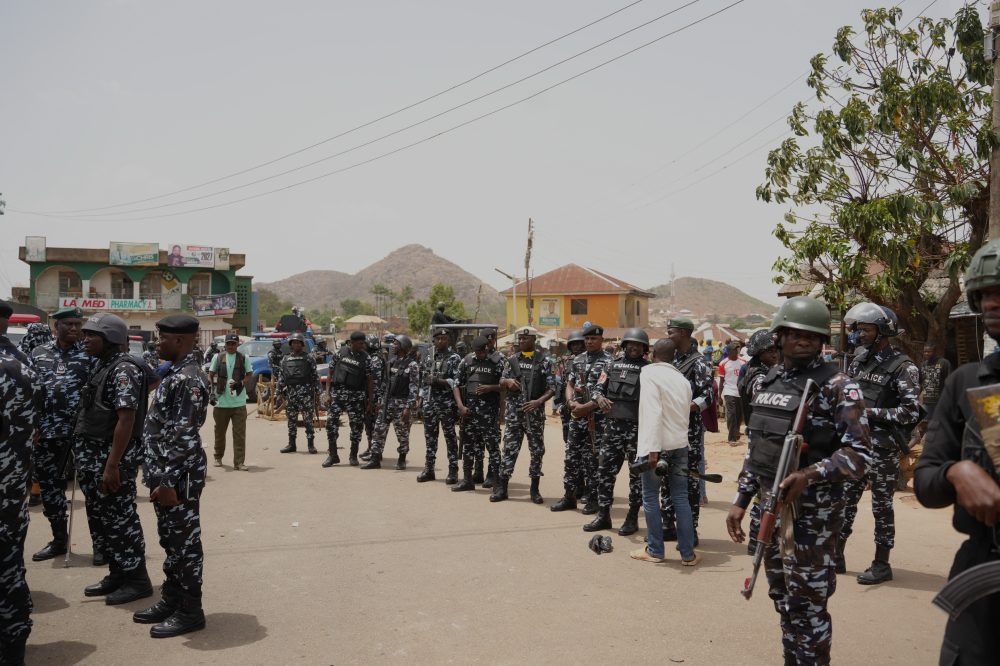
LAGOS, Nigeria — Nigeria’s Senate has approved legislation that would permit individual states to form their own police forces, setting the stage for a sweeping overhaul of how law enforcement operates in the conflict-stricken country.
The proposed change to the nation’s constitution would shift policing authority away from the federal government, which currently holds exclusive control over the country’s police. The federal force has been stretched thin by a growing security crisis, and the new state-level forces would work alongside it rather than replace it.
Security experts say a shortage of police presence in large rural areas has allowed militant and criminal organizations to operate with little resistance. According to the United Nations, these groups — including jihadist factions — have been responsible for the deaths of tens of thousands of people across the country.
If enacted, the law would give each of Nigeria’s 36 states the authority to build a police force that meets a minimum national standard. The federal police would continue to handle counterterrorism operations, border security, organized crime, and other matters of national concern.
The bill has drawn support from both sides of the political aisle and is backed by President Bola Ahmed Tinubu. It has been discussed and debated on multiple occasions in the past and is widely seen as a potential remedy to the country’s worsening security situation.
Under President Tinubu’s administration, insecurity has continued to grow, with militant activity now spreading into the country’s southern regions. At least 80 schoolchildren remain in captivity after being kidnapped by armed groups operating in both the northern and southern parts of Nigeria.
Ikemesit Effiong, a partner at SBM Intelligence — a risk advisory firm based in Lagos — pointed to the recent wave of mass kidnappings as a driving force behind the push for reform. “In the light of recent mass kidnappings, the calls for a decentralized police have increased due to the sluggish nature of the government’s response to the events, which has been, in part, caused by the structural deficiencies of a centralized policing framework in Nigeria,” Effiong said.
While state governors are officially recognized as the top security authorities within their states, they currently have no direct operational control over police forces. That dynamic has fueled both support for and opposition to the proposed reform.
Opponents of the legislation warn that giving governors command over state police forces could open the door to abuse, with officials potentially using law enforcement to pursue personal or political goals and suppress dissent.
Before the bill can become law, it must receive approval from at least two-thirds of Nigeria’s state legislatures, as it involves an amendment to the country’s constitution.
PARIS (AP) — In an effort to dodge the brutal heat wave sweeping across much of Western Europe, Dior pushed its men’s Paris Fashion Week presentation to 9 a.m. Wednesday. Despite the early hour, the scorching temperatures still made their presence felt.
Attendees made their way to the Musée Nissim de Camondo as the city baked in extreme heat. Staff greeted guests at the entrance with cold towels, strawberries, and parasols in an attempt to offer some relief.
Inside the historic mansion, where Northern Irish designer Jonathan Anderson was presenting his newest Dior men’s collection, temperatures climbed rapidly. Some guests appeared to be struggling with the heat, and water was in short supply.
Despite the uncomfortable conditions, the front row was packed with well-known faces. Among those attending were LaKeith Stanfield, Little Simz, James Marsden, Drew Starkey, Mike Faist, 070 Shake, Alexander Ludwig, and Sam Nivola.
Anderson’s collection centered on the idea of formality coming undone — tuxedos worn loosely, denim torn and raw, sequins catching the light, and disco-ball boots striding through a venue steeped in old-world elegance.
Dior described the atmosphere behind the collection as “a soiree turning into a house party.” Anderson himself put it this way: “something quite formal becoming undone.”
The central concept was clear: the Dior man wasn’t just arriving at the party — he had been there all night and stayed until dawn.
Anderson opened with tailored looks, though he made them lighter and less rigid. Pinstripes and houndstooth patterns were printed onto silk chiffon rather than woven into heavier fabric, resulting in pieces that felt formal yet see-through.
The collection pushed Dior’s signature style into edgier territory. Sequined trousers were styled to resemble jeans, ripped denim was finished with delicate silver chains, tuxedos came in relaxed cuts, and pink denim shorts appeared beneath formal coats.
Accessories included crystal sunglasses, disco-ball boots, and patchworked Japanese denim shirts.
The standout pieces succeeded by keeping Dior’s identity recognizable while disrupting it. A scarf motif was drawn from a 1979 Dior haute couture piece, and silver embroidery was borrowed from an 18th-century gentleman’s coat.
Boots were intentionally styled to look worn and disheveled, decorated with tiny ladybird details.
The collection wasn’t a break from Dior’s history — it was a way of putting that history in motion.
The choice of venue added deeper meaning to the show. The Musée Nissim de Camondo, currently closed for restoration, was built around Moïse de Camondo’s collection of 18th-century decorative arts — the same era that captivated Christian Dior himself.
Anderson presented a collection about loosened formality inside a building also caught between its past and its future. Dior’s own show notes framed that “in-between” state as intentional, pointing to beauty found in imperfection.
The mansion also carries a painful history. Camondo’s son perished in World War I, and later generations of the family were deported and killed during the Holocaust. Today the building serves as both a museum and a memorial to that loss.
Set against that somber backdrop, the collection’s playful energy gave the clothing a certain tension. Anderson took elements already embedded in Dior’s identity — the tuxedo, the Bar silhouette, couture embroidery, 18th-century ornamentation — and recast them in a younger, more chaotic register.
The result stood as one of Anderson’s most focused and fully realized outings at Dior to date.
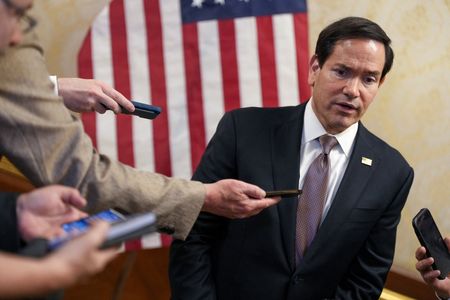
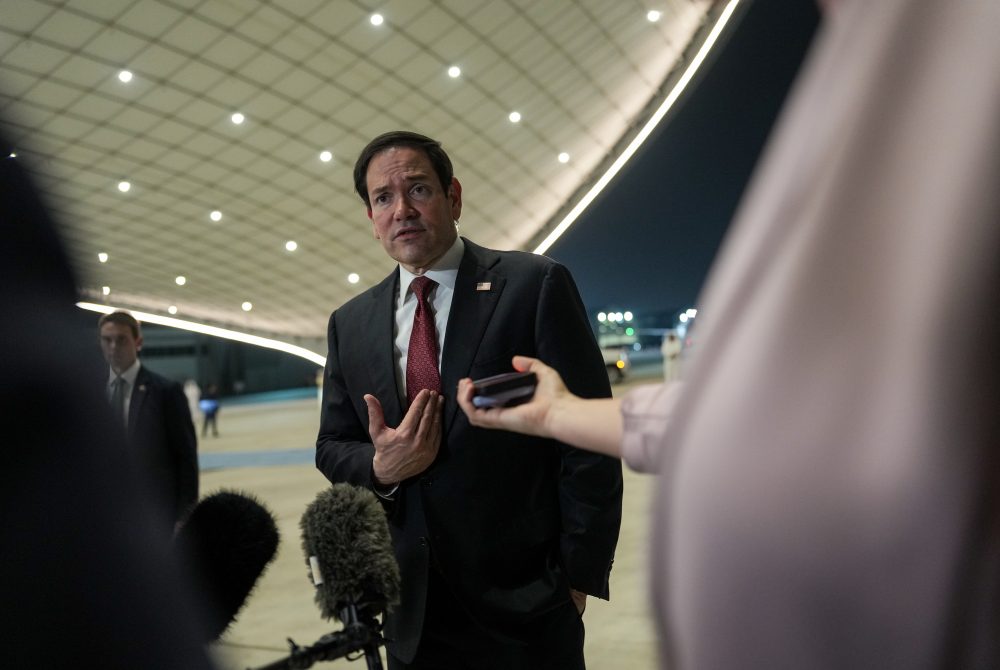
KUWAIT CITY — U.S. Secretary of State Marco Rubio made a firm pledge Wednesday that Washington will take no action to compromise the safety of its Gulf region allies as it navigates its relationship with Iran.
Speaking to reporters in Kuwait City before heading to Bahrain, Rubio emphasized the purpose of his regional visit. “We’re going to be completely aligned with our partners in the Gulf,” he said. “That’s why I’ve taken these trips now, and it’s the reason why I’m here.”
“We’re not going to do anything that undermines the security of our allies, our longstanding allies in the region,” Rubio added.
The nation’s top diplomat is currently visiting three Gulf countries in an effort to ease concerns among allies who believe a proposed Iran peace agreement is not tough enough on a regional power that attacked them during the war. Rubio had earlier met with the United Arab Emirates leader before sitting down with Kuwaiti officials, then departing for Bahrain.
The agreement between the U.S. and Iran, reached last week, marks the first deal signed by leaders of both nations since Iran’s Islamic Revolution in 1979. The accord includes a proposed $300 billion fund and the lifting of certain sanctions.
Since the memorandum of understanding was signed last week, both countries have begun technical-level discussions to work out the specifics of how the deal will be put into practice. The agreement has faced criticism from Democrats as well as military hawks within the Republican Party.
Rubio left the door open for further progress, saying, “If Iran wants to make a good and real deal, the United States is open to that. If they’re not, then of course the President has options.”
He also noted that technical negotiators are expected to pick up talks again before the end of the month and will likely convene once more in Switzerland.
Despite objections from a top member of the U.S. Congress, President Donald Trump’s administration is preparing to finalize a deal selling dozens of jet engines to Turkey worth hundreds of millions of dollars, four sources familiar with the situation confirmed Wednesday.
The engines, manufactured by General Electric, are intended to power Turkey’s first homegrown combat aircraft, known as the Kaan. That aircraft program was launched in 2016 as part of the NATO member nation’s push toward greater independence in its defense capabilities. One source indicated the overall package would exceed $700 million in value.
The planned sale represents a meaningful show of goodwill toward Ankara ahead of a NATO summit scheduled to be held in Turkey on July 7 and 8. The gathering of NATO leaders is taking place amid internal alliance tensions over defense spending, burden-sharing, and U.S. concerns about allies’ involvement in keeping the Strait of Hormuz open during the ongoing U.S.-Iran conflict.
Relations between the U.S. and Turkey have largely been positive under Trump, who has frequently spoken favorably of Turkish President Tayyip Erdogan. Still, friction has persisted over Washington’s earlier decision to exclude Turkey from the F-35 fighter jet program and impose sanctions following Ankara’s purchase of Russian-made S-400 air defense systems — a move the United States has characterized as a security risk.
Representative Gregory Meeks of New York, the leading Democrat on the House Foreign Affairs Committee, raised concerns during the informal review process and has not given his approval for the deal, according to two of the sources, one of whom is a U.S. official.
Even so, the sale is expected to move forward in the coming days, after which the State Department is anticipated to formally notify Congress. The State Department declined to offer any comment on the matter.
The decision to proceed comes roughly a year after Turkey’s Foreign Minister Hakan Fidan publicly expressed frustration over what he described as delays in the approval process.
BOGOTA, Colombia — Progressive candidate Iván Cepeda formally conceded Colombia’s presidential race on Wednesday to conservative political newcomer Abelardo de la Espriella, who carried an endorsement from U.S. President Donald Trump heading into the vote.
According to election results, de la Espriella — a businessman and attorney who had never previously sought public office — beat out Cepeda, a sitting lawmaker, by roughly one percentage point, a margin of nearly 251,000 votes.
In a nationally televised address, Cepeda acknowledged the outcome, saying: “We assume with serenity, responsibility, and absolute resolve — and let there be no doubt about it — the role that circumstances demand of us. We will exercise a democratic, vigilant and constructive opposition.”
Political observers view the outcome as a repudiation of outgoing President Gustavo Petro’s administration, whose agenda Cepeda had pledged to carry forward. That agenda included a largely unsuccessful initiative to negotiate with various armed factions under a program called “total peace.”
Election authorities released nearly all vote totals within hours of polls closing on Sunday. Both Petro and Cepeda initially refused to accept those figures, with Cepeda indicating he would hold off on conceding until a recount was completed.
De la Espriella, who is 47 years old, is set to begin a four-year term on August 7. His campaign had not issued a response to Cepeda’s concession as of Wednesday.
The win places Colombia among a growing number of nations that have turned toward political outsiders to address difficult challenges related to public safety, social conditions, and economic pressures.
Describing himself as the candidate of “the never-before-seen,” de la Espriella appealed to voters worried about a return to widespread internal conflict. He promised a tough-on-crime approach modeled after strategies used by Salvadoran President Nayib Bukele, including the construction of large-scale prisons. Those methods have reduced homicide rates in El Salvador but have also drawn criticism over alleged human rights violations.
Known by the nickname “The Tiger,” de la Espriella holds dual citizenship in both Colombia and the United States, identifies as a Trump supporter, and is a registered member of the Republican Party.
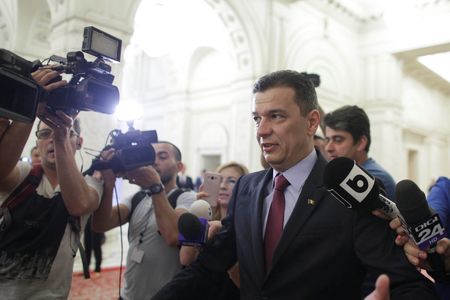
BUCHAREST — Romania’s Social Democrats, the leftist party holding the most seats in parliament, announced Wednesday that they are nominating their own leader, Sorin Grindeanu, to serve as prime minister. The move is part of a broader effort by political parties to piece together a functioning government after a pro-European coalition collapsed last month.
The Social Democrats themselves set off the political turmoil in early May when they walked away from the coalition and joined forces with far-right opposition lawmakers to bring down Liberal Prime Minister Ilie Bolojan.
The three remaining parties from that dissolved coalition have since made clear they have no intention of entering into a new government alongside the Social Democrats. The problem is that without them, no other grouping holds sufficient parliamentary seats to command a majority.
A candidate put forward by the president to lead a new government was unable to secure enough backing. Under Romanian political rules, if a second candidate is nominated and also falls short, the country would be required to hold new parliamentary elections.
The pro-European parties have expressed a desire to form a minority government as a way to head off a snap election, but they have yet to reach a consensus on whether the Social Democrats or the center-right parties should lead that arrangement.
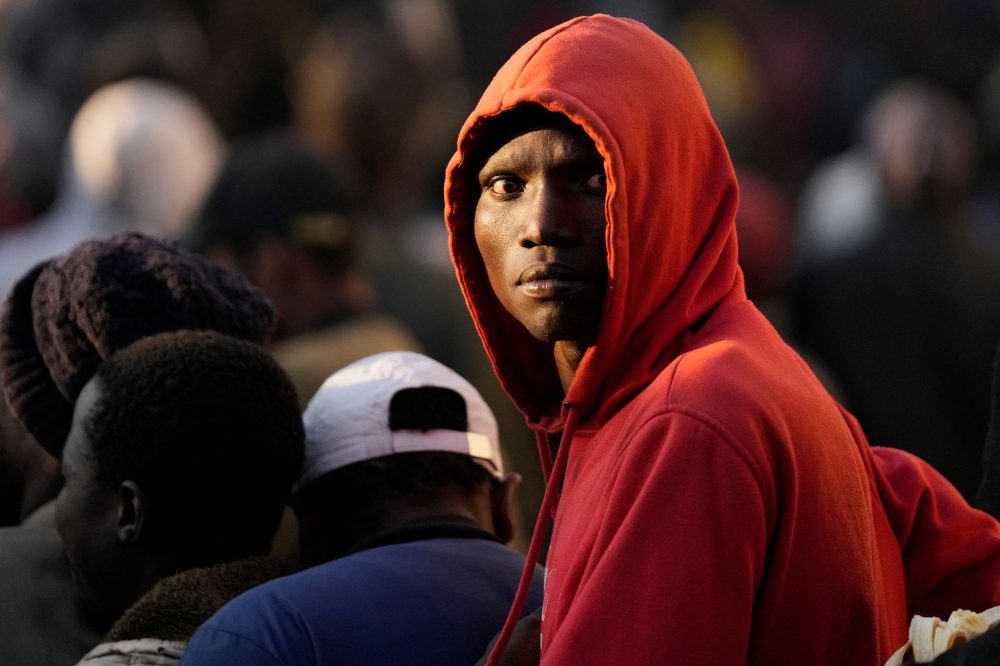
CAPE TOWN, South Africa — A wave of anti-immigrant anger is driving thousands of African migrants out of South Africa, as tensions build ahead of a self-imposed June 30 deadline set by anti-immigration protest groups demanding action from the government.
The protest groups have been staging demonstrations and marches across the country for months, blaming immigrants — without evidence — for South Africa’s high unemployment rate, failing public services, and rising crime. They have threatened to launch a “national shutdown” if the government does not take steps against what they describe as a serious illegal immigration problem by the end of the month.
South Africa’s police minister confirmed that authorities are on high alert, with large-scale protests expected on the deadline day itself.
In the meantime, thousands of migrants have taken refuge in makeshift shelters and near embassies, fearing for their safety. Multiple African countries have begun bringing their citizens home while publicly condemning what they call a climate of xenophobia in South Africa.
The issue has dominated national politics since March, when protests erupted in several major cities. South African President Cyril Ramaphosa addressed the nation on television earlier this month in an effort to calm the situation. He accused some protest organizers of using immigration as a political tool, and stated that “illegal immigration is not the cause of our social and economic difficulties.” However, Ramaphosa also acknowledged that the country’s border control systems have fallen short.
South Africa has long been a destination for migrants from other parts of Africa due to its comparatively stronger economy. According to 2022 census data, roughly 2.4 million foreign nationals were living in South Africa at the time, making up less than 4% of the country’s 62 million residents. Critics argue those numbers don’t capture the full picture, since many undocumented individuals would not be counted.
Over the past two years, South Africa’s home affairs ministry says it has deported more than 100,000 people found to be living in the country without proper documentation, while turning away approximately 500,000 more at border crossings. Anti-immigration groups have pointed to those numbers as proof the problem is significant.
Violence has accompanied the rising tensions. Police are investigating the deaths of two Mozambican nationals killed this month in a small coastal town, where more than 50 homes in an immigrant neighborhood were also set on fire, according to local officials. In a separate incident last week, a man from Malawi was allegedly stoned to death during anti-immigration protests, triggering another police investigation.
South Africa has a long and troubled history with xenophobic violence. Migrants from neighboring countries such as Zimbabwe, Mozambique, and Malawi often settle in low-income communities where unemployment is high and tensions run deep. In 2008, more than 60 people — both South Africans and foreign nationals — were killed when anti-immigrant violence erupted in Johannesburg and spread across the country. Sporadic outbreaks have occurred ever since.
A spokesperson for United Nations Secretary-General Antonio Guterres said the UN chief was “deeply concerned by reports of xenophobic attacks and acts of harassment and intimidation against migrants and foreign nationals in parts of South Africa.”
Nigeria, Ghana, and Mozambique are among the African nations that have spoken out strongly against the treatment of their citizens. Nigeria and Ghana together have repatriated nearly 2,000 people on government-funded flights and say more evacuations are planned. Zimbabwe and Mozambique have also brought back smaller numbers of nationals.
In the eastern city of Durban, approximately 10,000 Malawian migrants gathered at a temporary shelter last week hoping to return home. More than 8,000 of them have since departed on buses arranged by the Malawian government or private sponsors, though more continue to arrive. South African authorities said they assisted with the repatriation process, but also formally deported many of those individuals for lacking valid residency documents.
High-stakes diplomatic talks between the United States and Iran held in Switzerland did not yield a final agreement, but they did mark meaningful progress in turning a fragile memorandum of understanding into a more structured diplomatic process.
The delegations gathered at Bürgenstock, a venue overlooking Lake Lucerne, where American and Iranian officials agreed to press forward with technical negotiations under the framework of the Islamabad MoU. Qatar and Pakistan served as mediators throughout the process.
On the American side, US Vice President JD Vance joined other senior envoys at the table. Iran sent Foreign Minister Abbas Araghchi along with other top officials. Qatar and Pakistan not only helped shape the structure of the talks but also jointly issued the official statement and took on the role of mediators in a wider effort to steer the crisis away from military confrontation.
According to the joint statement released by Qatar and Pakistan on June 22, the discussions resulted in the creation of a high-level committee for political oversight, along with working groups focused on nuclear matters, sanctions, monitoring, and dispute resolution. The two sides also agreed on a roadmap aimed at reaching a final deal within 60 days. Additionally, the US and Iran committed to establishing a direct communication channel to help prevent incidents in the Strait of Hormuz, as well as a de-confliction mechanism involving Lebanon, both parties, and the mediators.
The Switzerland meeting went beyond a simple two-way negotiation between Washington and Tehran. It reflects a broader regional realignment in which the United States appears to be drawing on a wider network of partners — including Gulf nations and Pakistan — rather than relying solely on its traditional coordination with Israel to handle the political and security fallout from the crisis.
Washington faces a two-part challenge going forward: determining whether Iran is genuinely willing to accept meaningful nuclear monitoring and additional technical arrangements, while also keeping related regional issues — Lebanon, maritime security, sanctions relief, and frozen assets — from derailing the overall process. For Tehran, the Swiss talks present an opportunity to maintain leverage while securing economic and political concessions, though it also means entering a more formalized process of verification and implementation.
One of the most sensitive topics under discussion is the return of international nuclear inspectors. Vance stated that Iran had agreed to invite International Atomic Energy Agency inspectors back into the country, describing it as an initial step toward addressing American concerns about Iran’s nuclear activities. However, Iranian officials have been careful not to frame this as a one-sided concession, stressing that any final arrangement would hinge on implementation, sanctions relief, and decisions from Iran’s top political and security leadership.
The question of sanctions is equally complicated. Iranian officials have suggested that restrictions on oil and petrochemical exports have been waived, that a blockade has been lifted, and that some frozen assets have been released. American officials have been more guarded in their language, emphasizing mechanisms, waivers, and limits on how any released funds can be used. The gap between what each side is saying publicly and what can actually be enforced is expected to define the next phase of negotiations.
For Gulf nations, the more pressing concern is not about claiming a diplomatic win — it is about whether this agreement can genuinely reduce risk across the region. The crisis had placed pressure on shipping lanes, energy markets, Lebanon, and Gulf security more broadly. Abdulaziz Alshaabani, a Saudi political analyst, said the agreement is being received with restrained optimism in Saudi Arabia.
The director general of the International Atomic Energy Agency stated Wednesday that inspections of Iran’s nuclear sites will go forward under a recently signed memorandum of understanding, pushing back on claims that Tehran has not consented to granting inspectors access.
IAEA Director General Rafael Mariano Grossi made the remarks during a press conference held at Japan’s Fukushima Daiichi nuclear power plant, where he emphasized that the agreement — signed by the presidents of both Iran and the United States — explicitly calls for IAEA oversight of nuclear activities.
“I can understand political statements, they are part of the reality, but the fundamental thing I would like to remind you and draw your attention to is that there has been a Memorandum of Understanding, signed by both presidents,” Grossi told reporters.
His comments come amid ongoing uncertainty about whether Iran has truly agreed to allow IAEA inspectors back inside its borders.
Earlier this week, Vice President JD Vance described nuclear talks between the U.S. and Iran held in Switzerland as a “very, very good day,” stating that Tehran had agreed to permit IAEA inspectors into the country and calling it a “major milestone.”
Iranian officials quickly pushed back on that description. Tasnim reported Monday that neither Iran’s negotiating team nor top government officials had approved the return of inspectors to the country.
Iranian Foreign Ministry spokesman Esmail Baghaei stated that any cooperation with the UN nuclear watchdog would occur within the boundaries of Iran’s safeguards obligations and in line with decisions made by the country’s parliament and Supreme National Security Council.
Despite the back-and-forth public statements, Grossi stood firm, saying the memorandum itself lays out a clear foundation for inspections to take place.
“The accord,” he said, “says explicitly that the nuclear activities that are going to be carried out with regards to the nuclear material facilities will be supervised by the IAEA — in all letters.”
While Grossi acknowledged the exact timeline for inspections remains unclear, he was adamant that the process will not be stopped.
“Obviously, to do that, we will have to inspect. Whether this happens the day after tomorrow or in one week or in 10 days, it’s important, but not essential. This is going to happen,” he added.
Iran’s current stance is shaped by legislation passed last summer that scaled back cooperation with the IAEA and suspended inspections. However, IRNA reported that the law still allows inspectors to visit certain active nuclear facilities under limited conditions.
JERUSALEM (AP) — A panel of independent experts working under a United Nations mandate has accused Israel of intentionally shooting children in Gaza, while also repeating prior accusations that Israel has carried out genocide in the territory.
Israel strongly and repeatedly denies that it has committed genocide during its two-and-a-half-year military campaign in Gaza.
The Independent International Commission of Inquiry on the Occupied Palestinian Territory, which operates under the U.N. Human Rights Council, released a report Tuesday stating that approximately 30% of Palestinians killed between October 2023 and October 2025 were children — a total exceeding 20,000. Investigators believe additional children may be missing or buried in unmarked graves.
Israel has consistently denied deliberately targeting civilians and has pushed back against genocide accusations from both the commission and various human rights organizations. Israel’s Foreign Ministry dismissed the report as a “libelous sham,” saying the allegations had not been verified. The ministry also attacked the commission itself, describing it as “a fundamentally flawed mechanism whose very purpose is to single out and vilify Israel rather than seek the truth.”
The report concluded that the devastating impact of the conflict on children in Gaza constitutes both war crimes and genocide — an escalation of accusations the commission first raised in September.
“Even after the October 2025 ceasefire, children continue to be killed and seriously injured, with continued disregard by Israel for the ceasefire and for the protection owed to Palestinian children under international law,” said Srinivasan Muralidhar, the commission’s chair.
The report named specific Israeli military divisions operating in areas where children — some as young as infants — were killed, and identified the types of weapons used. Investigators paid particular attention to cases where children were killed by quadcopter drones or sniper fire, frequently from a single gunshot.
Medical professionals interviewed by the commission said autopsies from those incidents “indicate a high degree of precision in the use of force, suggesting that the shot was carefully aimed rather than incidental or the result of indiscriminate fire.”
The report also documented cases of children being killed even after a ceasefire was reached in October 2025, including instances involving children who were reportedly gathering firewood near the yellow line that marks the boundary of Israeli military-controlled territory.
“By maintaining that the children killed were ‘suspects,’ the Israeli security forces have deflected responsibility to Palestinian children, portraying them as ‘terrorists’ rather than casualties,” the report states.
Israel has broadly criticized the United Nations and firmly rejected the commission’s previous findings, including the genocide accusation, asserting that it takes measures to minimize civilian casualties and protect children. The current conflict began with the October 7, 2023, Hamas-led attack on southern Israel, which killed approximately 1,200 people and resulted in 251 individuals being taken hostage. Israel’s subsequent military offensive in Gaza has killed more than 73,000 Palestinians, including those who died after the ceasefire, according to Gaza’s Health Ministry.
The Health Ministry, which operates under the Hamas-led government, is staffed by medical professionals and maintains detailed casualty records that United Nations agencies and independent experts generally regard as reliable. The ministry does not separate civilian deaths from militant deaths, but reports that women and children account for roughly half of all fatalities.
Great Britain, France, and Germany issued an unusual joint statement Wednesday expressing serious concern about Chinese activities in waters east of Taiwan, where China had recently deployed coast guard patrols.
The de-facto embassies representing the three European countries in Taipei, Taiwan’s capital, described the actions as “novel Chinese activity” — without specifying exactly what those activities involved — and warned that they posed a threat to stability across the region.
China considers Taiwan its own territory, claiming the democratically governed island is a breakaway province. Beijing has not ruled out using military force to bring Taiwan under its control. Chinese authorities described the recent operations as a “maritime traffic enforcement and hydrographic survey operation.”
Chinese state media characterized the activities as “sending a pointed warning” to Japan and the Philippines, following an announcement that those two countries intended to discuss their shared maritime boundaries in waters that China also claims.
On Tuesday, China sent its newest and most powerful aircraft carrier through the Taiwan Strait — the stretch of water that separates mainland China from Taiwan — just hours after Taiwan kicked off a five-day military exercise designed to test the island’s readiness in the event of a Chinese attack.
The joint European statement was direct in its criticism: “These actions threaten regional stability and the freedom of navigation and safety of international shipping. We reiterate our opposition to any unilateral change to the status quo, particularly by threat or use of force or coercion.”
The three nations’ offices also called on all parties to respect navigational rights, freedoms, and the safety of those at sea. China’s Foreign Ministry had not responded to requests for comment at the time of publication.
In recent years, China has steadily increased its pressure on Taiwan, sending military ships and aircraft near the island on an almost daily basis and periodically staging live-fire military drills.
Tensions between Beijing and Tokyo have also grown since Japanese Prime Minister Sanae Takaichi suggested last year that Japan’s military could become involved if China takes aggressive action against Taiwan.
Taiwan’s Defense Ministry said the current military exercises are intended to improve combat readiness and test how quickly military units can be deployed — particularly in response to a sudden escalation of what is known as Chinese grey-zone warfare.
Grey-zone tactics include a broad range of aggressive but non-combat actions, such as navy ship patrols and drone flights, that stop short of open warfare.
Earlier this month, Taiwan reported that Chinese coast guard vessels had been stopping commercial ships near Taiwan and demanding that those vessels disclose their planned routes.
Switzerland has launched contract talks with defense manufacturers from France, Israel, and South Korea as the neutral nation looks to add a second air defense system to its arsenal, the Swiss government announced Wednesday.
The move follows major setbacks to Switzerland’s 2022 order of Patriot missile defense systems, built by Raytheon and Lockheed Martin. Originally scheduled for delivery between 2026 and 2028, that timeline has been pushed back four to five years as a result of the ongoing war in Ukraine diverting production and supply.
The Swiss defense ministry confirmed it has resumed previously suspended payments to the United States for the Patriot system and said it wants to minimize any further delays or additional costs tied to that order.
At the same time, officials said negotiations are now underway with manufacturers from France, Israel, and South Korea for a separate, complementary system. The ministry did not identify the specific companies involved in those discussions.
Swiss officials cited a “deteriorating security situation” as the driving force behind the decision, saying the country needs the ability to defend itself from attack as rapidly as possible and requires capacity beyond what the Patriot system alone can provide.
“In addition, a second system reduces dependence on a single provider and a single supply chain, thereby strengthening security of supply,” the ministry stated.
Last month, when Switzerland first signaled it was exploring missile defense options beyond the Patriot system, Germany had also been mentioned as a possible supplier country, though it was not included in the latest round of announced negotiations.
Wealthy buyers from Poland, the United States, and Gulf-based nations are flooding into Spain’s capital city of Madrid and its famous Costa del Sol coastline, searching for a secure luxury retreat amid the ongoing wars in Ukraine and the Middle East, as well as political upheaval in the United States.
Spain’s Mediterranean coast has historically attracted sun-seekers from Britain and Germany, but a more diverse group of investors looking to protect their assets against global instability has entered the market in recent years, according to half a dozen real estate agents, European housing market analysts, and a property attorney who spoke with Reuters.
Official government figures back up that observation.
“Whether it’s Ukrainians or Poles settling on the Costa del Sol, or Americans coming to Spain, the common factor is the geopolitical situation,” said Rebeca Caballero, who leads the international department at realtor Gilmar.
Property registration data from last year shows that foreign buyers were involved in more than 39% of all home sales across major tourist provinces, including Malaga on the Costa del Sol, Alicante on the Costa Blanca, and the Balearic Islands.
That wave of foreign investment has contributed to soaring property prices in a country where housing has become a significant political flashpoint. Spain’s central bank has called for coordinated government action to increase housing supply, citing an estimated shortage of 750,000 homes nationwide.
Polish buyers, hailing from one of Europe’s fastest-growing economies, have been purchasing Spanish coastal properties since 2020. However, their activity has tripled since the COVID-19 pandemic, and last year they made up 4% of all foreign purchases — up from just 1.6% in 2019.
“The strongest wave of investment came after the outbreak of the war in Ukraine … with a frenzy of purchases made over the phone,” said Agnieszka Marciniak-Kostrzewa, who founded a Marbella-based real estate agency.
Marlena Bartkowiak represents that wave of buyers. The 46-year-old, who runs a transport company in Poland, bought an apartment in Benalmadena on Andalusia’s Costa del Sol as a contingency plan when the war began.
“Spain came to mind as it was somehow the least involved in all sorts of political manoeuvring on the European stage,” said Bartkowiak, who continues to live primarily in Poland.
Neinor, one of Spain’s largest property developers, sold 70% of its upscale 102-home Santa Clara development completed in Marbella last year to Polish clients. Polish buyers also dominate purchases in a 64-floor skyscraper currently under construction in the coastal city of Benidorm.
“Spain right now is a diversification play on security grounds,” said Paloma Perez Bravo, CEO of real estate firm Dils-Lucas Fox.
Just as conflict near Poland’s eastern border has fueled Polish investment, real estate professionals are now seeing a fresh wave of demand from Gulf-based investors following the outbreak of the Iran war. Three real estate companies told Reuters they are currently negotiating luxury property deals on the Costa del Sol with buyers from Dubai, as the conflict has damaged the emirate’s reputation as a peaceful sanctuary for the wealthy. At least two transactions have already been finalized.
Marciniak-Kostrzewa recently completed a sale to a Polish client living in Dubai who was looking for a safer home base for their family.
While Dubai has attracted wealthy foreigners with its zero property tax policy, realty lawyer Maria Ruiz Lopez noted that regional wealth tax exemptions and allowances in Madrid and the Costa del Sol make those areas particularly appealing to high-net-worth buyers compared to other parts of Spain.
“We believe there will be an opportunity to attract those seeking an alternative to Dubai … partly because conflicts make Spain appear as a calmer option,” said Mario Lapiedra Vivanco, deputy CEO at Neinor, which has already closed a transaction with a buyer from Dubai.
American buyers have also entered the picture in growing numbers. Gilmar’s Caballero pointed to a surge in U.S. investors — many of them of Hispanic heritage — purchasing Spanish property since President Donald Trump returned to the White House last year.
“It’s not just violent conflict, but also the political and social pressure,” Caballero said. “Many do it as an investment. And others see it as a Plan B, because they don’t know what’s going to happen in the United States.”
Between 2024 and 2025, Gilmar reported that U.S. investments jumped from 0.5% to 6.2% of its total property transactions, with Americans surpassing British buyers as the top foreign purchasers on the Costa del Sol.
Across Spain as a whole, Americans represented 2% of all foreign property purchases and paid the third-highest average price of any nationality, trailing only Swedes and Germans, according to data from the General Council of Notaries.
The growing pool of international buyers has pushed home values upward. Real estate agents handling properties priced between €1 million and €20 million (roughly $1.13 million to $22.68 million) say the rising values make Spanish real estate an increasingly attractive investment, reinforcing the buying trend and distinguishing the market from others in Europe.
Spain’s warm climate and stable economy are additional draws for prospective buyers.
Jack Harris, a London-based partner in Knight Frank’s international residential team, said luxury home prices in Spain have climbed by as much as 9.5% year-over-year — a faster pace than comparable markets in France and Italy.
“Spain has been something of an outlier in terms of performance across Europe over the last 12 months,” Harris said.
Turkish President Tayyip Erdogan indicated Wednesday that a private meeting with U.S. President Donald Trump is expected to take place when Trump arrives in Ankara for the upcoming NATO summit next month.
Turkey is preparing to welcome all 32 NATO member leaders, along with officials from the alliance’s Gulf and Asia-Pacific partner nations, for a summit scheduled July 7-8. The gathering comes at a time of internal tensions within the alliance over how costs and defense responsibilities should be shared, as well as U.S. frustrations over allies’ roles in efforts to reopen the Strait of Hormuz during the U.S.-Iran war.
When reporters in parliament asked Erdogan whether he and Trump planned a separate face-to-face meeting outside of the main summit proceedings, he responded that “it will most likely happen,” though he offered no additional details.
Erdogan has previously emphasized that Trump’s presence at the summit is critical for demonstrating unity among NATO members.
The two leaders have developed a strong working relationship since Trump returned to the White House in 2024, expanding cooperation across several regional issues and settling some long-standing disputes, including a sanctions-evasion case involving Turkish state lender Halkbank.
Burhanettin Duran, who serves as Erdogan’s communications director, addressed Turkish media representatives in Ankara, saying that burden-sharing would be one of the central items on the summit’s agenda.
“The changing security architecture is pushing NATO allies to re-evaluate their defence spending. In that framework, Turkey aims to reach the 3.5% + 1.5% target by the end of 2030,” Duran said, according to a summary of his remarks released Wednesday.
The summit will also be attended at the foreign ministers level by representatives from the Istanbul Cooperation Initiative — a partnership forum involving select Middle Eastern nations — as well as Japan, New Zealand, South Korea, and Australia, collectively referred to as the Indo-Pacific Four.
German federal prosecutors announced Wednesday that law enforcement carried out searches at multiple locations as part of an ongoing investigation into a suspected effort to undermine the country’s gas supply — an effort tied to a murky ownership maneuver involving the former German arm of Russian energy company Gazprom.
According to prosecutors, police conducted searches at the Berlin residence of a suspect and at the home of a second individual who is not under investigation. A third location — an unnamed company in Frankfurt — was also searched. Prosecutors confirmed that nobody was taken into custody.
The individual under investigation is a Russian national whose identity has not been disclosed. That person faces suspicion of serving as an accessory to violations of Germany’s foreign trade investment regulations, as well as being an accessory to attempted sabotage against the constitutional order, according to a prosecutorial statement.
The case traces back to events shortly after Russia launched its full-scale military invasion of Ukraine in 2022. German officials said that around that time, the parent company announced it was pulling out of its German unit, known as Gazprom Germania. The buyer then reportedly ordered the unit to be liquidated — a step that is not permitted before a purchase receives official approval.
German authorities responded by placing a federal government agency in charge of Gazprom Germania, effectively blocking the attempted shutdown. Officials described the unit as being of critical importance to natural gas trading, transportation, and storage across Germany. The company was later brought under full government ownership and is now called Securing Energy for Europe.
Prosecutors believe the sale of the unit to a Moscow-based company with no ties to the energy sector — combined with the attempted liquidation — was designed to disrupt Germany’s gas supply, given the country’s support for Ukraine. The suspect is believed to have actively assisted in carrying out the decision to liquidate the company with that goal in mind.
Following Russia’s invasion of Ukraine, Germany moved quickly to cut its reliance on Russian natural gas. Moscow subsequently halted its remaining gas deliveries to Germany. Shortly afterward, underwater explosions damaged the Nord Stream pipelines, which were constructed to deliver Russian natural gas to Germany beneath the Baltic Sea.
MELBOURNE, Australia — The head of Australia’s domestic intelligence agency revealed Wednesday that Iran’s Revolutionary Guard directed arson attacks against Jewish targets in Sydney and Melbourne through two agents who had previously lived in Australia.
Mike Burgess, director-general of the Australian Security Intelligence Organization (ASIO), stated plainly that “Iran continues to view Australia as a legitimate target for covertly directed acts of violence.”
The attacks in question occurred two months apart in 2024. Fires damaged Lewis’ Continental Kitchen, a kosher restaurant in Sydney, and the Adass Israel Synagogue in Melbourne. Australia formally attributed both incidents to Iran last year, setting off a significant diplomatic crisis that resulted in Iran’s ambassador being expelled from the country. Tehran has rejected the accusations.
During his annual national security briefing, Burgess disclosed that an Australian citizen currently residing in Iran had orchestrated the Sydney firebombing, while the Melbourne attack was directed by a former Australian resident now living in Iraq. He withheld both individuals’ names in order to protect active investigations and ongoing criminal proceedings.
According to Burgess, the Australian citizen held a senior position within the Revolutionary Guard and was responsible for managing its international networks. The former Australian resident, meanwhile, had been recruited through militia groups operating in Iraq. Burgess noted that the Revolutionary Guard had specifically valued this individual’s criminal ties and had actively supported his illegal activities.
That arrangement, however, came to an abrupt end. “That changed dramatically after ASIO publicly named Iran’s involvement in the arsons,” Burgess said. He added that “this person’s Iranian backers lost their enthusiasm and after further pressure from Australian and local law enforcement, they threw him in prison.”
Burgess called the investigation into the two attacks “one of the most difficult and detailed in recent ASIO history.” He had previously indicated that the Revolutionary Guard was suspected of involvement in other antisemitic crimes across Australia dating back to the beginning of Israel’s conflict with Hamas in 2023.
Multiple individuals are currently facing criminal charges in connection with the arson attacks. It has not yet been established whether those charged knew the true identity of the parties they were working for.
A devastating fire at a data centre in New Delhi has left businesses scrambling after the facility, jointly operated by Singapore’s ST Telemedia and India’s Tata Communications, suffered what officials are calling “extensive damage.”
Tata Communications notified Indian stock exchanges on June 5 that it had activated emergency business continuity measures following an early morning blaze at the STT Global Data Centres India location. A letter dated June 15, obtained by Reuters, reveals the full scale of the destruction.
Television footage captured from inside the building on the day of the fire showed server racks and electrical equipment that appeared to be completely destroyed, with ceiling panels caved in and debris scattered across the floor.
Tata Communications subsidiary Novamesh wrote to one of its clients that the fire was “so severe that it caused extensive damage” to portions of the facility and disrupted services. The letter went on to say, “Despite our ongoing best efforts to recover the data, the severity of the damage … presents significant challenges to the recovery of the affected data and systems.”
Neither Tata Communications nor ST Telemedia responded to requests for comment from Reuters.
Delhi fire authorities indicated the blaze originated in lithium battery units, though the exact cause has not been determined.
One affected client, Indian company Matrix Cellular — which sells international SIM cards — says it may have lost more than two decades of records. CEO Gaurav Khanna told Reuters, “Matrix has potentially lost access to over 20 years of accumulated operational and business data stored in the affected Tata data centre.” He added, “It’s been 20 days and they have not restored backup. If there is a backup it should have been restored by now.” Matrix says it also lost customer records, usage history, support logs, and billing and vendor data, and that sales have dropped sharply as a result of the outage.
A second affected business, Indian internet service provider R2 Net, is facing an estimated $2 million in losses along with the departure of commercial clients. Its CEO, Sanjay Singh, told Reuters the fire also damaged “vital tracking data stored in servers and used by law enforcement to monitor illegal internet activity.”
A representative of STT Global Data Centres India told R2 Net in a June 23 email — also reviewed by Reuters — that the company was conducting “detailed assessments and commissioned independent technical root cause analysis” of the incident, with results expected within five to seven weeks.
Google Cloud’s intermittent network problems in India have also been linked to the same fire, according to a source with direct knowledge of the situation who requested anonymity given the sensitivity of the matter. On June 9, Google posted on its incidents page that “a fire at a third-party data center facility required an emergency power shutdown of networking equipment,” without identifying the facility by name. In its most recent update on June 23, Google said no workaround was available yet and cautioned customers to expect potential latency issues until the site is fully restored. Google did not respond to a request for comment from Reuters.
Tata Communications describes itself as serving 300 of the Fortune 500 companies and says it connects businesses to 80% of the world’s largest cloud providers.
The joint venture between ST Telemedia and Tata Communications dates back to 2016, when ST Telemedia purchased a 74% stake in Tata Communications’ data centre operations. Together, they now manage 30 data centres across 10 cities in India.
The fire compounds recent difficulties for the broader Tata group. Tata Electronics recently experienced a cybersecurity incident in which a ransomware website posted what it claimed were documents belonging to clients Apple and Tesla on the dark web.
In its letter to Matrix Cellular, Novamesh described the fire as “clearly an unfortunate force majeure event,” saying that “services under the agreements at the data Centre facility have been hindered” and that “the position continues to be assessed.” The joint venture’s website had previously touted the facility as having a “state-of-the-art fire protection and suppression system.”
KYIV, Ukraine — Ukrainian forces launched overnight strikes against a massive natural gas processing facility and two military satellite communications centers inside Russia, Ukraine’s General Staff announced Wednesday.
The attacks are part of an ongoing aerial campaign targeting Russia’s energy infrastructure and defense industries, which has been ramping up as Ukraine develops more advanced long-range weapons in its fight against Russia’s full-scale invasion, now stretching into its fifth year.
The overnight operation hit the Orenburg Gas Processing Plant, which is part of a larger complex that also contains Russia’s only helium production facility, the General Staff announced via the Telegram messaging platform. The strike ignited a fire at the complex, according to the statement.
Orenburg sits more than 1,200 kilometers — roughly 750 miles — behind the front lines currently running through eastern and southern Ukraine.
According to the General Staff, the plant ranks among the largest gas processing facilities in the world. It produces helium, which is used in liquid-fuel rocket engines and guidance systems, as well as ethane, an essential ingredient in making solid rocket fuel and gunpowder, among other products.
The General Staff’s claims could not be independently confirmed, and Russian officials had not publicly responded as of Wednesday.
Ukraine’s military did not specify whether drones or missiles were used in the assault, though drones have been the weapon of choice in recent strikes on Moscow and St. Petersburg.
The same overnight operation also targeted two satellite communication hubs used by Russia’s military. One was the Dubna Space Communications Center near Moscow — described by the General Staff as the largest ground-based satellite facility in Russia — and the other was located in the Vladimir region, east of the Russian capital.
Ukraine has also been stepping up attacks on Crimea, aiming to sever the strategically important Russian-controlled peninsula. Overnight drone strikes knocked out power in Sevastopol, according to Mikhail Razvozhayev, the city’s Moscow-appointed governor, who made the announcement Wednesday.
Kyiv’s strategy in Crimea involves disrupting Russian military supply lines and hitting the peninsula’s power grid during the peak summer tourist season. Western analysts say Ukraine hopes the campaign will embarrass Russian President Vladimir Putin and fuel public pressure on him to bring the war to an end.
Crimea holds significant strategic value due to its location on the Black Sea, housing naval bases and serving as a key supply corridor for Russian forces operating inside Ukraine.
Ukraine’s Security Service also reported Wednesday that it struck two military airfields and destroyed missile systems in Crimea.
Russia’s Defense Ministry stated that Russian forces shot down 323 Ukrainian drones overnight. Ukraine’s air force, meanwhile, reported that Russia launched 101 long-range attack drones during the same period.
BEIJING — China’s anti-corruption watchdog announced Wednesday that Bian Zhigang, the deputy head of the country’s defense industry agency and national space administration, is being investigated for what officials described as “suspected serious violations of discipline and law.”
The investigation is part of an extensive, years-long crackdown on corruption launched by President Xi Jinping. The campaign has resulted in dozens of senior government officials and high-ranking military generals being investigated, removed from their posts, or expelled. Just last month, two former Chinese defense ministers received death sentences — with a two-year reprieve — after being convicted on graft charges.
Those sentencings came after a series of recent purges targeting executives at state-owned weapons manufacturers, researchers working on military technology, and nuclear scientists.
Bian has spent much of his career at the defense industry agency, which is formally called the State Administration of Science, Technology and Industry for National Defence. The agency plays a central role in overseeing China’s most advanced defense-related sectors.
According to the agency’s own website, it is “responsible for the organisation and coordination of major matters related to weapons and equipment research and production in the fields of nuclear, space, aviation, shipbuilding, armaments and electronics, as well as the development of core defence industry capabilities.”
Attempts to reach Bian for comment on Wednesday were unsuccessful.
ANKARA — Turkish President Tayyip Erdogan announced Wednesday that his government is actively working on a legal framework designed to accelerate the dissolution of the Kurdistan Workers Party, or PKK, a militant organization that has waged an insurgency against Turkey for more than 40 years.
Addressing members of his ruling AK Party during a session in parliament, Erdogan said the proposed legal measures would be placed on the parliamentary agenda without delay. He did not provide specific details about what those measures would entail.
The Turkish president emphasized that Ankara remains firmly committed to bringing the ongoing peace process with the PKK to a successful conclusion and permanently ending the group’s long-running armed campaign against the Turkish state.
The European Commission unveiled a series of new measures on Wednesday designed to strengthen Europol, the European Union’s law enforcement agency, and better equip it to handle the growing threat of cross-border and digitally-driven crime.
The announcement comes after Europol warned last year that organized crime groups have been increasingly turning to artificial intelligence-powered scams to target victims. Stopping smuggling networks that illegally transport migrants across Europe also remains a top priority for governments throughout the region.
Under the new plan, Europol will develop its own sovereign cloud infrastructure and establish a shared data space, making it easier for investigators to work together on joint cases across national lines.
The agency will also open support offices within EU member countries, with those offices to be staffed by personnel who have prior Europol experience, according to the Commission.
Additionally, Europol will work to deepen its relationships with international partners and improve how it coordinates with Eurojust, the EU body responsible for judicial cooperation.
EU tech chief Henna Virkkunen emphasized the urgency of the reforms, saying, “Criminals are highly adept at exploiting the opportunities of the digital realm, operating effectively across borders without limitations.”
Virkkunen added, “We are strengthening both Europol and Eurojust so that Europe can respond faster… share information more effectively, and bring criminals to justice more efficiently.”
CAIRO — An 18-year-old who fled Sudan’s civil war seeking safety in Egypt instead died of pneumonia after spending more than three weeks in a filthy Cairo jail. Friends and relatives say Al-Nazir Al-Sadig endured beatings and was robbed by fellow inmates before his death.
Al-Sadig, a high school student, was swept up in what lawyers and human rights organizations describe as a wide-ranging crackdown on refugees — one that stands in stark contrast to Egypt’s reputation as a place of refuge.
Egypt pushes back against characterizations that it is hostile to refugees. The country took in more than a million people after war erupted in Sudan in 2023, serving as a barrier for those who might otherwise head north toward Europe. However, with an economic crisis mounting and public sentiment turning against migrants, authorities have adopted a far stricter posture, carrying out waves of arrests and deportations.
Beginning late last year, plainclothes security officers began detaining thousands of refugees and other migrants at their homes, workplaces, and on the street — pulling them into unmarked vehicles, according to accounts from 45 refugees, seven lawyers, and eight advocates. Some refugees have chosen to return to conflict-ridden Sudan on their own rather than risk forced family separation. Others have gone into hiding, as activists warn that a newly enacted law could further weaken protections for asylum seekers.
Three Egyptian security officials, speaking anonymously and citing figures not previously made public, said authorities have deported more than 5,500 people since November. That marks a dramatic surge compared to roughly 100 formal deportations annually in both 2023 and 2024. Egypt does not release detailed immigration data, and the figures could not be independently confirmed by Reuters.
Reuters documented three deaths of Sudanese refugees inside Egypt’s overcrowded detention facilities this year: a 30-year-old man who collapsed within 72 hours of being detained, a 67-year-old man with diabetes, and the teenager Al-Sadig. Two of the security officials said a total of nine Sudanese nationals had died while in custody, though they provided no details about the circumstances. The additional deaths could not be independently verified.
Ten people who had been held in police-run facilities described refugees sleeping in shifts due to a lack of floor space, physical abuse, theft of food and clothing, and unsanitary conditions. One Eritrean refugee detained during the crackdown described a violent sexual assault by other female inmates — an account supported by medical records from a Cairo hospital.
Karim Ennarah of the Egyptian Initiative for Personal Rights called the scale of the campaign “unprecedented,” saying it violates Egypt’s obligations under international law, which limits the deportation of refugees.
“Protection as it existed in Egypt for decades has collapsed,” he said.
Egypt’s State Information Service told Reuters that deportation is “generally carried out only though clear legal procedures and judicial guarantees,” and only when someone is found to have broken the law or poses a national security threat. Officials denied that any broad campaign targeting refugees is underway.
The Egyptian government has maintained that isolated incidents do not represent state policy, pointing out that millions of Sudanese and other migrants live, work, and study in Egypt and have access to public services including schools and healthcare.
According to United Nations figures, Egypt ranked second globally in asylum applications in 2025 — something the information service cited as evidence of “the confidence of individuals seeking protection” in the country.
CHOOSING WAR OVER DEPORTATION
At a bus stop in central Cairo, a 40-year-old schoolteacher named Hosna waited with her four children among hundreds of others preparing to travel back to Sudan. She said she feared her two teenage sons could be arrested — despite the family having U.N. refugee status obtained upon their arrival two years ago, they were still waiting for an Egyptian residency appointment. She said children from two families in her apartment building had already been detained and sent back.
“I came here searching for safety but there is no safety. It’s better to die in my country than lose my children,” said Hosna, who gave only her first name.
More than a dozen refugees, including Hosna, expressed deep concern about returning to Sudan, where the capital Khartoum faces frequent drone strikes and barely functioning public services — even as the army reclaimed control from paramilitary forces last year and the government has encouraged residents to return.
Sudan’s information ministry did not respond to a request for comment regarding deportations from Egypt or the dangers deportees may face upon return.
The civil war that began in 2023 has driven millions from their homes amid ethnically motivated violence and campaigns of ethnic cleansing, including a massacre in Darfur. Millions of people are surviving on one meal a day in what has become one of the world’s worst humanitarian disasters.
A new asylum law passed by Egypt in 2024 gives refugees the right to work and access education and healthcare. However, it drew criticism from UNHCR, the U.N. refugee agency, for granting officials broad discretion over who qualifies for refugee status.
Ennarah said implementing regulations published this month fall short of protecting refugees from refoulement — the forced return of people to places where their lives or freedom are in danger.
“The law’s expanded grounds for denial and revocation risk codifying the crackdown,” he said.
In its statement to Reuters, the Egyptian government said the law “affirms respect for human dignity and the principle of non-refoulement” and protects refugees from discrimination and inhumane treatment.
UNHCR said it is troubled by the arrests, detentions, and deportations, including of women and children who are registered with the U.N.
“Returns to Sudan should not take place under the current circumstances, given the ongoing conflict and humanitarian situation, which do not allow for safe and sustainable return,” UNHCR said in response to Reuters questions, while acknowledging the pressure the refugee crisis has placed on public services.
Security sources said Egypt has previously deported Sudanese migrants, including turning thousands away at the border. But the current campaign has more frequently targeted urban areas, including Cairo, and has in some cases affected people who had been living in Egypt for years before the conflict began.
More than 1.1 million people are registered with UNHCR in Egypt, the vast majority of them Sudanese, along with Syrians, Eritreans, and others. The European Union pledged Egypt 7.4 billion euros in 2024, partly in recognition of Egypt’s role in absorbing migrants who might otherwise travel north toward Europe.
INSIDE THE CELLS
On January 18, a white minibus stopped abruptly outside Al-Sadig’s home as he stood with three friends. Plainclothes men got out and arrested all of them, according to his sister Nadia.
Al-Sadig had crossed borders from Sudan’s capital Khartoum with his family in October 2024, settling in Badr, a suburb east of Cairo. Hoping to return to Sudan quickly, he had not taken steps to legalize his presence in Egypt, two family members said.
He was placed in a cell holding more than 140 inmates in a space measuring roughly 6 meters by 6 meters, thick with cigarette smoke. One of the friends detained alongside him, Nabil Suleiman, told Reuters that criminal detainees robbed Al-Sadig.
“It was suffocating. There was no oxygen. Only one broken AC,” Suleiman said.
Al-Sadig told relatives during visits that other prisoners were taking the food they brought him, his sister Nadia said. Inmates survived on jail rations of bread and cheese, Suleiman said. Water came from a hose inside a toilet area. Clothing was stolen by other inmates, including Al-Sadig’s sweater, leaving him shivering during Cairo’s cold winter nights.
During his mother’s last visit, Al-Sadig complained of a chest infection and asked for medicine, saying none was available in the jail, according to Nadia and another family member. The following day, a police officer called to inform the family he had died.
The public prosecutor’s office listed pneumonia as the cause of death, Nadia said, citing a judicial official who oversaw the case. Reuters could not independently confirm the cause of death. The information service did not respond to questions about Al-Sadig’s case.
That same day, Suleiman and the others who had been detained with Al-Sadig were deported to the Sudanese border town of Halfa. Speaking to Reuters from Omdurman — Khartoum’s twin city — where he is currently unemployed, Suleiman described an agonizing 18-hour journey to the border in Egyptian custody, hands and legs chained, with no food, water, or sleep. He said he was given no explanation for the deportation.
Nine other former detainees described similar experiences: extreme overcrowding, scarce food, dirty water, theft, beatings by other inmates, and mistreatment or indifference from guards. Sudanese and darker-skinned refugees were said to be particularly targeted by other inmates.
A 23-year-old Sudanese asylum seeker who said he spent three weeks in a police station described being charged for basic necessities — including a spot on the floor to sleep. Those who refused to pay were forced to remain standing.
“This is when you suffer from hallucinations,” he said.
An Eritrean tea seller in Cairo, who showed Reuters her Egyptian residency card and U.N. refugee documentation, said she was arrested by plainclothes officers while working in August. One officer tore her residency permit, she said. While held in a police lockup, she said three female convicts sexually assaulted her. Medical records from Cairo’s Mostafa Mahmoud clinic confirmed she was treated after her release for uterine bleeding. The hospital confirmed the records were authentic but declined to comment further.
Now 40 years old, she said she is too frightened to leave her home and, without income, is relying on charity from neighbors to survive.
Abazar Youssef, 37, a dual British-Sudanese citizen, was visiting family in Egypt on a tourist visa when he was caught in a January 25 raid in downtown Cairo. During two weeks of detention, he said he witnessed criminals assaulting, blackmailing, and extorting refugees. He said police officers regularly beat detainees during morning lineups. He was deported to Britain on February 14. The British embassy in Cairo confirmed it had provided consular assistance to a detained British national and had been in contact with Egyptian authorities regarding the case.
TOKYO (AP) — Two Japanese citizens are being held in China on suspicion of smuggling materials that are banned from being imported or exported, a Japanese government official announced Wednesday. Reports indicate the case may be connected to rare earths — critical materials that China largely controls.
Japan’s Chief Cabinet Secretary Minoru Kihara told journalists in Tokyo that Chinese customs authorities notified Japanese consular offices in Shenyang and Dalian about the arrests. One individual was detained on May 18, and the other was taken into custody a week later, both as part of what Kihara described as “the same alleged case.”
Kihara confirmed that both detainees are in good health, but declined to provide additional details about the individuals or the specifics of the case, citing privacy concerns and the active nature of the investigation.
In Beijing, a Chinese Foreign Ministry spokesperson, Guo Jiakun, acknowledged that two Japanese citizens had been detained for breaking Chinese law, though no specifics about the case were offered.
“What we would like to emphasize is that the Japanese side should educate and remind Japanese citizens and enterprises in China to abide by Chinese laws and regulations,” Guo stated at a daily press briefing.
According to Kyodo News agency, the two Japanese nationals are employees of a major Japanese machinery manufacturer, with one working at the company’s Chinese subsidiary. Kyodo reported that their alleged attempt to remove materials connected to rare earths may have been considered a violation of Chinese law.
The arrests come roughly five months after Beijing prohibited exports to Japan of dual-use goods — items that can serve both commercial and military purposes. While China has maintained that the export controls do not apply to commercial products, trade figures show that Chinese exports of rare earth magnets to Japan have dropped since the restrictions were put in place.
Relations between the two major Asian economies have been under significant stress for several months. Tensions escalated after Japanese Prime Minister Sanae Takaichi suggested late last year that Chinese military action against Taiwan — a self-governing island that Beijing claims as its own territory — could justify a Japanese military response. That stance marked a departure from the strategic ambiguity that previous Japanese leaders had maintained on the Taiwan issue.
Adding to the friction, a Japanese man who had been held since March 2023 was convicted last year in China on espionage charges and sentenced to three and a half years in prison.
MOSCOW — Russia’s Kremlin said Wednesday that U.S. envoys Steve Witkoff and Jared Kushner are currently tied up with other matters, but that Moscow fully expects talks with them regarding Ukraine to pick back up once their schedules open up.
Kremlin spokesman Dmitry Peskov offered the remarks in response to a question about whether other envoys might step in for Ukraine discussions while Witkoff and Kushner remain occupied. The two are currently part of the American delegation working on peace negotiations with Iran.
“We understand that contacts will continue,” Peskov stated. “Naturally, they are occupied with other matters right now, but at some point they will become available, and we are counting on further work.”
Peskov also expressed Russia’s appreciation for the envoys’ work on Ukraine, calling their approach “highly constructive” and adding, “They are willing to listen to all sides — that is especially valuable right now.”
These relatively upbeat remarks stand in contrast to statements made earlier this week by senior Russian officials, who accused Washington of failing to honor “understandings” that were reportedly reached between Presidents Vladimir Putin and Donald Trump during a summit held in Alaska last August.
Russian officials have repeatedly invoked what they call the “Spirit of Anchorage” — a term analysts say refers to what Moscow interpreted as a potential arrangement under which Ukrainian forces would pull back from the portions of the Donbas region they still hold, in exchange for Russia halting advances along other parts of the front. Ukraine, however, has consistently and firmly stated it will not surrender any of its territory to Russia without a fight.
A Pakistani anti-terrorism court has sentenced well-known civil rights figure Mahrang Baloch and a fellow activist to life in prison, finding them responsible for the death of a paramilitary soldier during a protest that took place in July 2024.
Baloch’s attorney announced that the verdict would be challenged in court.
Baloch has been behind bars since March 2025. Prior to her detention, she was a prominent voice against enforced disappearances and what she described as human rights abuses in Balochistan, a southwestern Pakistani province where ethnic separatist groups have been engaged in an insurgency spanning several decades.
Human rights advocates have raised serious concerns about the conduct of the trial. The defendants were asked to participate via video link from prison but chose to boycott the proceedings instead.
Activists warned that the life sentences handed down to Baloch and Sibghatullah — another leader of the Baloch Yakjehti Committee (BYC) advocacy organization — could deepen mistrust between the Baloch community and the Pakistani government.
Officials from the Balochistan government defended the outcome, stating the verdict followed a fair legal process and demonstrated that protesters who resort to violence and target government personnel can face terrorism charges.
Sarfaraz Bugti, the chief minister of Balochistan province, declared that justice had been delivered for Sepoy Shabbir Baloch, a soldier who was killed by protesters while on duty in the port city of Gwadar.
“Those who take the law into their own hands under the guise of peaceful protest, promote violence, and target state officials are in fact facilitators of terrorism,” Bugti stated.
The Quetta anti-terrorism court found both Baloch and Sibghatullah guilty of murder and terrorism-related charges. According to the court, Baloch had incited protesters to attack paramilitary personnel stationed at the demonstration, and both eyewitness testimony and medical evidence supported the prosecution’s case.
BYC organizer Lala Abdul Baloch condemned the proceedings as a “faceless” trial and cautioned that the ruling could push more young Baloch people toward resistance.
“When you close access to the corridors of justice then more people will rise up against the state,” he said. He added that the group has called for a province-wide strike in protest of the court’s decision.
Baloch’s attorney, Israr Jattak, confirmed on Wednesday that the verdict would be taken before the Balochistan High Court on appeal.
HONG KONG (AP) — China’s Premier Li Qiang took the stage Wednesday to argue that his country’s rapid technological growth represents a positive development for the global community, not something to fear.
Speaking at the opening session of the World Economic Forum’s Annual Meeting of the New Champions — commonly called “Summer Davos” — Li delivered his remarks in the northeastern Chinese coastal city of Dalian. The forum draws global business and political leaders each year.
Li acknowledged that concerns have been mounting worldwide about China’s tech boom, with some critics using the phrase “China Shock 2.0” to describe what they see as a destabilizing force for advanced economies. Li rejected that framing entirely, offering a different label instead.
“From the global development perspective, ‘China Opportunity 2.0’ means there’ll be broader access to advanced technologies and more widely shared benefits,” Li said.
He continued: “China’s emerging technologies and products are bringing to the world not shocks, but opportunities. Not threats, but empowerment.”
China has dramatically expanded its exports of electric vehicles, solar panels, computer chips, batteries, artificial intelligence systems, and robotics in recent years. While those products have offered lower-cost options in global markets, they have also triggered complaints from governments worried about oversupply and unfair competition. Several countries have responded with protectionist trade measures.
Li also pushed back on the widely held view that Beijing’s heavy government subsidies are the engine behind China’s high-tech surge. U.S. and European policymakers have repeatedly raised alarms about Chinese state support giving its industries an unfair edge. A June report from the 38-country Organization for Economic Cooperation and Development, known as the OECD, warned that large state subsidies — including those provided by China — can distort global markets and tilt the competitive playing field.
Li dismissed those concerns directly. “There are some people who say that Chinese products are competitive mainly because the Chinese government’s subsidies,” he said. “That’s not true. The Chinese government is not that wealthy.”
Instead, he pointed to China’s enormous domestic market of 1.4 billion people, which allows new technologies to be deployed rapidly and at massive scale, along with significant private-sector investment, as the real forces behind the country’s technological momentum.
Li highlighted two Chinese companies as examples of that homegrown innovation success: tech giant Huawei and robotics firm Unitree. Both companies have grown quickly in size and market share, though both have also faced restrictions in Western markets. Earlier this month, the Pentagon expanded its list of Chinese companies with alleged military ties to include Unitree, barring it from receiving U.S. defense contracts. Huawei is also on that list.
Authorities governing the eastern portion of divided Libya have officially closed their borders to citizens of four neighboring African nations, in what appears to be an effort to reduce the flow of migrants using the country as a stepping stone to reach Europe.
Libya’s northern coastline has long served as one of the primary departure points for migrants from across Africa hoping to reach European shores. Smugglers routinely load these individuals onto overcrowded and dangerous vessels, and thousands have lost their lives making the treacherous journey across the Mediterranean.
The ban, which was announced late Tuesday, formally states that nationals from Sudan, Eritrea, Ethiopia, and Somalia are “prohibited from entering Libyan territory through all land, sea, and air ports.” The government noted that exceptions would apply to diplomats as well as workers in the health and education fields.
In a separate but related development, hostility toward refugee resettlement has been growing in both eastern and western Libya over recent months. Large-scale crackdowns have resulted in thousands of refugees being arrested, according to Amnesty International.
The United Nations reports that more than 900,000 migrants and refugees are currently living in Libya, with Sudanese nationals making up the largest group. While many of these individuals are attempting to reach Europe, boats are frequently intercepted and returned to Libya, where migrants are often placed in government-run detention facilities. Those facilities have been documented as sites of serious abuses — including forced labor, beatings, sexual violence, and torture — conduct that U.N.-commissioned investigators have characterized as crimes against humanity.
Libya has been in a state of instability since the NATO-supported overthrow of longtime ruler Moammar Gadhafi in 2011. The nation currently operates under two separate governments — one in the west and one in the east — with no unified authority in place.
LONDON (AP) — Andy Burnham moved a step closer to becoming Britain’s next prime minister on Wednesday after Cabinet minister Darren Jones, who had been floated as a potential rival, announced he would not seek the Labour Party leadership.
At the same time, outgoing Prime Minister Keir Starmer is pressing ahead with efforts to leave a lasting mark on his tenure before departing office. Starmer faced the weekly Prime Minister’s Questions session in Parliament on Wednesday before traveling to Berlin to meet with European allies for discussions on Ukraine and the Middle East.
Starmer revealed his intention to step down on Monday and is expected to be out of office within weeks, once the Labour Party selects a new leader.
Jones, a close ally of Starmer, had been urged by some party members to enter the race so that Burnham’s ideas and policies would face scrutiny from Labour lawmakers and members. Others within the party, however, argued that a leadership contest would only shine a spotlight on internal divisions and prolong political uncertainty.
Speaking to Sky News, Jones said running for the leadership is “not something that I’m going to do.”
Even so, Jones offered a warning to Burnham, cautioning him against shifting too far to the left on economic matters — a concern shared by some in the business and financial sectors. Burnham is widely expected to name a new Treasury chief to succeed Starmer’s appointee Rachel Reeves. Jones said the person chosen must be someone “that can reassure the markets, reassure the trade unions and reassure the parliamentary Labour Party, and by extension the public.”
Burnham is expected to deliver a speech next week laying out elements of his economic vision.
Starmer is departing after two years in office that were clouded by missteps and poor judgment calls that weakened his standing with both his party and the British public.
Burnham, a former Cabinet minister who has served as mayor of Greater Manchester since 2017, won a special parliamentary election last week specifically to position himself to challenge Starmer for the Labour leadership and the prime ministership.
As of now, he has no declared opponents. Former Health Secretary Wes Streeting, once seen as Burnham’s main competition, has announced he will support Burnham instead.
Labour leadership nominations are set to open on July 9 and close one week later. Should Burnham be the sole candidate, he could be installed as prime minister as soon as July 17. If a contest does emerge, the new leader is expected to be in place when Parliament returns from its summer recess on September 1.
On Tuesday, Starmer told his Cabinet he intends to oversee an “orderly transition” to whoever succeeds him.
Despite his lame-duck status, Starmer is maintaining a packed schedule in an effort to cement his legacy. However, he is restricted from making major new policy announcements or committing to new spending during the remainder of his time in office.
His trip to Berlin for a gathering of the “E5” — Germany, France, Italy, Poland, and the United Kingdom — for talks on European defense, the Ukraine war, and Middle East conflict highlights the international role he has played. Starmer has generally been seen as more confident on the world stage — particularly in rallying allies to support Ukraine and managing fallout from the Iran conflict — than he has been on domestic issues.
The British government is expected to release a long-awaited defense investment plan before a NATO summit in Turkey on July 7 and 8, which Starmer is likely to attend. That same plan triggered the resignation of Defense Secretary John Healey on June 11.
BUDAPEST — Hungary’s LGBTQ+ community is taking to the streets of the capital Budapest on Saturday for its annual Pride march, with activists and community members pushing to reclaim rights that were steadily eroded during Viktor Orban’s 16-year tenure in power.
Last year’s march became far more than a celebration — when police moved to ban it under Orban’s direction, the event transformed into a massive anti-government protest drawing tens of thousands of participants.
The political landscape has since shifted. Orban was ousted from power after Peter Magyar’s centre-right Tisza party defeated him in April elections. With the change in government, the ban on the march has been removed and Saturday’s event has received official authorization to proceed. Still, organizers are cautioning that the struggle isn’t finished.
“Last year, our love of freedom and our courage forced authoritarian power to retreat… But we have not reached our goal yet,” organizers said in a statement ahead of the march.
During his time in office, Orban positioned himself as a protector of what he described as Christian values against Western liberalism. His government enacted laws that eliminated the ability to change gender on official documents, prohibited same-sex couples from adopting children, and outlawed educational materials deemed to promote homosexuality or gender transition.
For LGBT activist and writer Adam Andras Kanicsar, the damage caused by those years will take considerable time to heal. Speaking with Reuters during a film shoot at a Budapest vintage shop, he reflected on the lasting personal toll.
“I’m still processing the Orban regime, I guess, and then I will process it for years. And I’m not alone with it,” he said.
He added: “In these last 16 years …working as an LGBTQ journalist and writing and speaking about LGBTQ people meant that I always had to go that one extra mile, every time…And I will never get back these miles in my life.”
Magyar, who identifies as a conservative, has urged patience when Hungarian media pressed him on plans to reverse legislation that restricted LGBT rights. However, he has spoken out against Orban’s former party, Fidesz, telling them in parliament “to leave the bedrooms of the Hungarian people as soon as possible” and condemning the party’s efforts to suppress the right to public assembly by banning the Pride march.
Labor unrest is intensifying across Australia’s resources industry, with the country’s iron ore mines and ports now facing a heightened threat of strikes. Major companies including BHP say the combination of rising costs and increased red tape is weakening Australia’s standing as a destination for mining investment.
Mining unions have stepped up industrial action ever since the Labor government passed legislation in 2022 that gave them greater power to negotiate wage agreements covering multiple employers, more flexibility in working arrangements, and the ability to call industry-wide strikes.
Data from the Australian Bureau of Statistics shows that working days lost to labor disputes surged in the final three months of 2025 to their highest point since 2022. Workers have been pushing for pay increases and stronger job protections as Australia contends with 4% inflation and three interest rate hikes over the past year.
Earlier this month, strike activity disrupted shipments of liquefied natural gas from the Ichthys LNG project, which produces about 10% of Australia’s total LNG output. The project’s Japanese operator, Inpex, eventually reached a deal with unions to end the disruption.
Shell’s Prelude floating LNG vessel is now heading into its own wage negotiations. If no new employment agreement is reached, unions have the option of applying to Australia’s labor arbitration body to authorize strike action.
David Peetz, a professor of employment relations at Griffith University, noted that recent union wins in the energy sector are sending a message to workers across the industry. “Seeing union victories in the oil and gas sector in the region will tell a lot of workers that being unionised can make a difference,” he said.
Oil and gas workers had already begun rejoining unions before the 2022 law took effect, and they waged extended wage battles in 2022 and 2023 that resulted in significant pay increases.
Tensions are also rising at BHP’s Port Hedland operations, a critical hub for iron ore exports. Unions may pursue coordinated industrial action if no agreement is reached at their next scheduled meeting on July 7.
Port Hedland, which is also used by Fortescue and Hancock, moves approximately $150 million worth of iron ore every day — highlighting just how much is at stake if operations are disrupted at Australia’s most important export facility.
At a conference in March, BHP’s head of Australian operations, Geraldine Slattery, warned that Australia risks “losing its status as a top mining destination” if issues with costs and productivity are not resolved. Australian mine workers are already counted among the highest-paid in the world.
Jon Mills, an analyst at Morningstar, cautioned that if escalating industrial action continues to push wages higher, “then BHP and Rio will continue to automate as much as possible.”
Europe’s aviation safety agency is urging commercial airlines not to let their guard down over the Middle East, even after a framework deal was reached between Washington and Tehran.
The EU Aviation Safety Agency, known as EASA, announced Wednesday that it is extending its conflict-zone advisory covering the region through July 1. The agency said airlines should continue avoiding the airspace above Iran, Iraq, and Lebanon.
According to EASA, short-term violations of the U.S.-Iran ceasefire remain a real possibility — especially in and around the Strait of Hormuz and the airspace surrounding it.
The agency also pointed to the fragile ceasefire between Israel and Hezbollah as an ongoing concern, warning that military activity could still affect Lebanese airspace.
In addition, EASA called on all airline operators to exercise caution and carefully weigh potential risks when flying through the airspace of Bahrain, Kuwait, Israel, Jordan, Qatar, Oman, the United Arab Emirates, and Saudi Arabia.
Train service across Germany was operating close to normal Wednesday morning after a communication system failure brought rail traffic to a sudden stop late Tuesday, leaving passengers stranded and sparking sharp criticism of the country’s main railway operator.
The disruption was caused by a malfunction in the GSM-R digital communication system, which the rail network relies on for internal operations. All train movement across Germany was halted abruptly, with service not resuming for approximately two hours. During that time, frustrated travelers crowded around information desks seeking answers.
Deutsche Bahn, the federally owned company that operates Germany’s primary rail network, reported that trains were moving “largely seamlessly” by Wednesday morning, though it acknowledged the possibility of some isolated service reductions throughout the day.
Officials have not yet revealed what caused the system to fail.
The incident comes amid a backdrop of growing frustration over the reliability of German rail service, with complaints about delays and interruptions becoming more common in recent years. Deutsche Bahn is currently undertaking major overhauls of key rail routes — a response to years of underinvestment — though the work itself has caused significant disruptions.
Oliver Krischer, who serves as the regional transport minister in North Rhine-Westphalia, Germany’s most populated state, did not mince words in his reaction. Speaking to news agency dpa, he called the shutdown “a new low in already poor operating quality,” adding that “all rail traffic in Germany comes to a halt because of a technical defect.”
Krischer also stressed the need for better safeguards, saying there must be “emergency mechanisms that prevent such a disaster in the future. People rely on reaching their destination at least somewhat punctually by rail.”
Officials from Israel and Lebanon are engaged in ongoing discussions in Washington over a U.S.-supported proposal that would have Israeli forces hand over portions of southern Lebanese territory — currently under Israeli occupation following the war with Hezbollah — to the Lebanese military, according to Israeli and Lebanese officials.
Israeli officials said that Lebanese troops who would take control of the territory would first undergo training and screening by the United States to confirm they have no ties to the Iran-backed militant group Hezbollah. Under the proposal, Israel would continue to maintain a military footprint in a buffer zone running along the border.
The proposal is being described as a “pilot” project and is part of the current round of negotiations between Israeli and Lebanese officials, which began in Washington on Tuesday.
Hezbollah has rejected the diplomatic effort, and the process has been further complicated as Iran has made Lebanon a central issue in its own separate negotiations with the United States.
When asked about the Israeli officials’ statements, a senior Lebanese security official confirmed that talks were continuing in Washington and that Wednesday’s agenda would include direct military-to-military discussions, with the pilot zones among the topics on the table.
The Lebanese official said the conversations would center on a timeline for Israeli withdrawal, and that no final plan is expected to emerge until the last day of talks on Thursday. The official declined to address the Israeli account of U.S. vetting procedures for Lebanese troops.
The most recent conflict between Hezbollah and Israel broke out when the group began firing on Israel in a show of solidarity with Tehran during the early stages of the U.S.-Israeli war on Iran.
A ceasefire has largely held since Sunday, though Israeli forces remain positioned deep within southern Lebanon, where they have established a self-declared security zone. Israel has said the zone is necessary to protect northern Israel from potential Hezbollah attacks.
A preliminary agreement reached between Iran and the United States last week calls on both nations and their allies to immediately and permanently halt military operations on all fronts, including in Lebanon, and to uphold Lebanon’s “territorial integrity and sovereignty.”
SYDNEY — A top official at Australia’s central bank said Wednesday that the institution still has more to do to bring inflation down, describing current price pressures as “far too high” — though he noted that falling global oil prices tied to a possible end to the Middle East conflict could offer some relief.
Reserve Bank of Australia Deputy Governor Andrew Hauser delivered a speech focused on the Phillips curve, an economic framework that describes how inflation and unemployment tend to move in opposite directions. He explained how that framework has shaped the bank’s decisions to raise interest rates this year.
Hauser said the board chose to begin lifting rates back in February out of concern that consumer demand was outpacing the economy’s ability to supply goods and services by a greater margin than anticipated. That imbalance was pushing inflation higher, and officials determined that tightening monetary policy was necessary to bring prices back under control over time.
“But this is where being on the steeper part of the Phillips curve has a potential silver lining,” Hauser said. “It also implies that timely policy steps to reduce inflationary pressures, of the kind we have taken, should also have a proportionally smaller unemployment cost.”
The Reserve Bank of Australia has now raised interest rates three times in 2025, completely reversing the easing measures it had put in place the prior year. Those rate hikes came in response to an energy price shock driven by the ongoing war. While headline inflation slowed to 4.0% in May, a more closely watched measure known as trimmed mean inflation actually moved higher, reaching 3.6% — well above the bank’s target range of 2% to 3%.
There are also signs that Australia’s job market is beginning to soften. The unemployment rate climbed to 4.5% in April, marking a four-and-a-half-year high.
Hauser pointed to several notable economic shifts since May, including the possibility that the conflict in the Middle East could be moving toward a resolution. He said lower oil prices resulting from such a development would be a positive sign for inflation.
“By itself, lower global oil prices would be a welcome development, helping to lower and flatten the Phillips curve somewhat,” he said. “But a full resolution is not yet assured and we still have work to do to reduce inflation here in Australia, which remains far too high.”
BEIJING — China’s government is asserting its right to hold people living outside the country legally responsible under a sweeping new ethnic unity law, with a top official defending the measure as both lawful and in keeping with global standards.
The law, which was passed in March and takes effect July 1, was designed to forge a unified national identity among China’s 55 ethnic minority groups — including Tibetans and Uyghurs, communities that have historically pushed back against Chinese authority and, at times, staged protests that turned violent.
A key clause in the legislation states that individuals and organizations operating outside the People’s Republic of China can be held legally accountable if they are found to be undermining “ethnic unity and progress or inciting ethnic separatism.”
The provision has triggered significant concern, especially in Taiwan — which Beijing considers part of China — over fears it could give the Chinese government yet another legal tool to go after Taiwanese citizens it labels as separatists. Human rights organizations have also raised alarms, pointing to China’s past use of Interpol “red notices” as a means of pressuring foreign governments to detain individuals abroad for what critics describe as political offenses.
At a press conference in Beijing focused on the new law, Vice Justice Minister Hu Weilie dismissed what he called distortions of the overseas clause by certain unnamed Western media outlets.
“This provision is based on China’s national conditions, conforms to legal principles, and is consistent with international practice. It is a legitimate, lawful, necessary, and feasible legal provision,” Hu stated.
He further argued that governments around the world routinely use domestic legislation to guard against separatist activity and maintain social order, saying, “Countries around the world all have the right to prevent separatist and destructive activities, and to maintain social solidarity and normal order, through domestic legislation.”
Hu described the overseas provision as targeting illegal conduct through rule-of-law methods, meant to “guard against various unlawful acts involving ethnic affairs from outside the country.”
He added that enforcing the clause would protect China’s sovereignty, national security, and development interests, while also safeguarding the rights of people across all of China’s ethnic groups.
“It will not affect normal people-to-people exchanges between China and other countries, academic discussions, economic and trade cooperation, or other activities,” Hu said.
CAIRO — Concern is mounting across the international community over a potential large-scale attack on civilians in central Sudan, where a paramilitary force is gathering around a strategically vital city of approximately 500,000 people as the country’s ongoing war enters its fourth year.
A spokesman for United Nations Secretary-General António Guterres issued a stark warning, saying: “We must not allow the horrors of El Fasher to be repeated in El Obeid.”
That warning references a devastating assault last year in which the Rapid Support Forces, or RSF, seized el-Fasher, resulting in more than 6,000 deaths over just three days — an attack that U.N. experts said carried the “hallmarks of genocide.”
The U.N. Security Council has expressed alarm over reports of “substantial” RSF reinforcements building up around el-Obeid in North Kordofan. The United States, Britain, and several other European nations have also issued warnings about “escalating atrocity risks” in the region. The RSF did not respond to requests for comment.
El-Obeid sits along Sudan’s main east-west road connecting to the Nile Valley and the capital, Khartoum, making it a critical asset for Sudan’s military as it continues battling the RSF. The army broke a siege on the city that had lasted more than a year, doing so early last year. The city is also home to a large air base and an infantry division.
Nathaniel Raymond, executive director of the Humanitarian Research Lab at the Yale School of Public Health, explained the broader significance of the situation. “El Obeid is important beyond even the strategic implications because it shows what happens when you have two forces that are highly depleted attempting to gain advantage on the other in high proximity,” he said.
Raymond noted that the RSF is seeking to control the road to Khartoum — which Sudan’s military recaptured last year — along with the neighboring city of Omdurman. Regaining that territory would create “havoc for civilians” and severely complicate the work of humanitarian organizations trying to return to the capital area, he said.
Experts say a potential assault on el-Obeid would differ from the attack on el-Fasher, which followed an 18-month siege and involved widespread ethnically motivated killings. “This is not a genocidal move, it’s a tactical one,” Raymond said, though he cautioned that those perceived as aligned with the military could face reprisal killings if the RSF were to take the city.
Ali Mahmoud Ali, a Sudan researcher with the Armed Conflict Location and Event Data project, known as ACLED, said the RSF has the ability to cut off el-Obeid from multiple directions, but maintaining a prolonged siege would drain the paramilitary group of significant manpower, vehicles, and equipment. If the RSF does manage to capture and hold the city, he warned the situation there “could deteriorate rapidly.”
In recent months, el-Obeid has been subjected to repeated RSF drone strikes that have destroyed civilian infrastructure, including power facilities and residential neighborhoods. The U.N. reports that bridges and key supply routes into the city have also been targeted.
Taghreed al-Rashid, a 35-year-old resident reached by phone, said she takes some comfort in the presence of army forces but is increasingly frightened by drone attacks hitting homes and markets. A recent strike on a power facility triggered a water shortage so severe that she now pays $5 per barrel of water. “We’re committed to staying in the city despite our ongoing hardships because forced displacement is a bigger struggle,” she said.
The toll from these drone attacks has been severe across the broader Kordofan region. According to ACLED, at least 2,670 people — both civilians and combatants — were killed in 2025, representing a 600% increase in drone-related deaths and an 81% rise in drone attacks compared to the previous year.
Another el-Obeid resident, Magdy Abdou, said daily life — including visits to mosques and markets — remains manageable for now, but he is deeply worried about further strikes on critical infrastructure.
Capturing the city would give the RSF a base from which to launch drone attacks at a much closer range. Ravina Shamdasani, a spokesperson for the U.N. human rights office, described the humanitarian conditions as dire. “Many civilians are trapped. Those who are able to flee are doing so. The imminent offensive must be halted, and civilians enabled to safely leave the city,” she said, adding that recent infrastructure attacks have left residents with scarce food, fuel, water, health services, and transportation.
Raymond said the RSF’s “force strength is significantly reduced due to defenses and intertribal fighting” and that it lacks the personnel needed to withstand an expected military counterattack. Nevertheless, Ali noted that the RSF has deployed air defense systems in Abu Zabad, West Kordofan, which could serve as a logistical hub for operations targeting el-Obeid and the nearby city of Dilling, potentially intensifying the conflict.
Since the army broke the siege on el-Obeid last year, the RSF has launched multiple offensives trying to reestablish control from various directions. Sudan’s army, which also operates drones, said recent strikes destroyed an RSF battalion and more than 50 armored vehicles in West Kordofan, blocking advances toward North Kordofan and el-Obeid. An army official, speaking on condition of anonymity because he was not authorized to speak to the media, said the military has a plan in place to protect the city’s airspace from RSF drone attacks.
Federico Donelli, an associate professor of international relations at the University of Trieste, said the army has made defending el-Obeid and the east-west corridor to the Nile Valley a priority since last year. “Overall, the SAF appears capable of mounting an organized initial defense, but the key open question is whether it can sustain it against a faster, better-equipped RSF push,” Donelli said.
The leader of the United Nations’ nuclear watchdog agency made his strongest statement yet Wednesday, confirming that his inspectors would be visiting Iranian nuclear enrichment sites — a central piece of the interim agreement struck between the United States and Iran.
International Atomic Energy Agency Director General Rafael Mariano Grossi made the remarks at a news conference held at the tsunami-damaged Fukushima Daiichi nuclear power plant, signaling that the IAEA’s role in the deal is non-negotiable.
Ever since Israel launched a 12-day war against Iran in 2025, Tehran has blocked IAEA inspectors from accessing enrichment sites where the Islamic Republic is believed to have stockpiled enough highly enriched uranium to potentially construct as many as 10 nuclear weapons, if it chose to pursue them. Iran has consistently maintained that its nuclear program is for peaceful purposes, though it remains the only nation on Earth to have enriched uranium to 60% purity without having a weapons program.
On Tuesday, the U.S. and Iran offered conflicting accounts of whether those enrichment sites would be subject to inspections under the new deal.
Grossi addressed that tension directly, telling reporters: “I can understand political statements, they are part of the reality, but the fundamental thing I would like to remind you and draw your attention to is that there has been a Memorandum of Understanding, signed by both presidents.”
He said the agreement “says explicitly that the nuclear activities that are going to be carried out with the regards to the nuclear material facilities will be supervised by the IAEA — in all letters.”
Grossi left no room for ambiguity about what comes next: “Obviously, to do that, we will have to inspect. Whether this happens the day after tomorrow or in one week or in 10 days, it’s important, but not essential. This is going to happen.”
Those inspections are a critical element of the deal, which requires Iran’s uranium stockpile to be “downblended” — reduced from its current highly enriched state.
Iran did not immediately respond to Grossi’s comments. A day earlier, Iran’s Foreign Ministry spokesperson Esmail Baghaei told reporters in Tehran that U.N. inspectors were not on schedule to examine nuclear facilities that were bombed by the United States last year. Those remarks came in direct contrast to statements made by U.S. Vice President JD Vance.
While the IAEA has been permitted to visit some Iranian nuclear facilities since the 12-day war — including the Bushehr nuclear power plant — it has been shut out of the enrichment sites. Without that access, the agency says it cannot confirm the current status of Iran’s uranium stockpile or assess the centrifuge systems used for enrichment. Both Iran and the IAEA say Tehran has not been actively enriching uranium, but experts in nuclear nonproliferation have raised concerns that Iran may be relocating its stockpile to undisclosed locations.
The U.S. and Iran reached their agreement last week, under which Tehran would dilute its enriched uranium stockpile. In return, U.S.-backed sanctions on Iran would be waived, and both sides would have 60 days to work toward a broader, more comprehensive agreement.
The fragile ceasefire has already faced strain, however, with Iran announcing it closed a key strait again following renewed fighting between Israel and the Iranian-backed militia Hezbollah in Lebanon. Violence flared again in Lebanon on Tuesday, though it did not escalate further.
JDEIDAT MARJAYOUN, Lebanon — Standing on a friend’s balcony, Milia el-Cheikh strained to make out what remained of her home village among the rubble below — its entrances now sealed off with coils of barbed wire.
Her village, Dibbine, is among several communities in southern Lebanon with Shiite majorities that have been destroyed by Israeli forces engaged in combat against the Iran-backed militant group Hezbollah. Israel has taken control of large swaths of territory, and fighting has continued even through declared ceasefires. The most recent truce — established as part of an interim peace agreement between the United States and Iran — appears to be holding for now.
El-Cheikh, one of the few Christians who called Dibbine home, found temporary shelter in a nearby village. She regularly makes her way to Jdeidat Marjayoun — a predominantly Christian village adjacent to her hometown — to share coffee with a church friend. What was once a comforting routine now unfolds against a landscape of destruction and dread.
“I don’t know anything about my house,” she said. “Nothing is more agonizing than not being able to get to your home.”
Jdeidat Marjayoun is one of several towns and villages that the Associated Press visited along the uncertain boundary of Israel’s occupied zone in southern Lebanon. Israeli forces have pushed out the largely Shiite population from many areas, believing those communities shelter Hezbollah fighters, and numerous towns have been leveled.
Residents of neighboring Christian, Sunni, and Druze communities have been permitted to remain, but the conflict has upended their lives. Their homes have been struck, road closures have cut them off from the rest of Lebanon, and Israeli military raids in the night have left residents shaken.
Israeli warnings against sheltering Hezbollah fighters have effectively prevented these communities from taking in displaced Shiite neighbors, creating a rift between people who have lived side by side for generations and inflaming political and sectarian tensions.
The current round of fighting began when Hezbollah launched rockets into Israel in the days following an Israeli and U.S. military campaign against Iran that started on February 28. Israel subsequently invaded Lebanon and has extended its zone of control as deep as 12 kilometers — roughly 7 miles — in some areas.
As Israeli forces moved forward, they warned civilians to evacuate large portions of southern Lebanon. In April, Israel released a list of 53 towns and villages — the majority of them Shiite — where residents are prohibited from returning. On Thursday, eight additional predominantly Shiite villages were added to that list.
Israel maintains that its troops are stationed in southern Lebanon for defensive purposes, asserting that Hezbollah was deeply embedded in the region. The military has released videos it says show tunnels and military infrastructure hidden within civilian neighborhoods.
Iran has stated that any broader ceasefire agreement must include Lebanon and that Israel must pull back its forces. Hezbollah has declared it will resist the occupation, and Lebanon’s government has also demanded an Israeli withdrawal.
Mixed communities perched on hills and nestled in valleys among orchards and olive groves sit within view of the devastation that has befallen their neighbors. Residents there have pledged to stay put.
The Shiite town of Khiam — now a flattened white expanse of destroyed buildings under Israeli control — is visible from the Christian village of Qlayaa.
Qlayaa’s residents are essentially cut off from their olive groves in the valley below. “Now another season is lost,” said Hanna Daher, the mayor of Qlayaa.
A priest in Qlayaa was killed by shelling while he was inspecting the site of an earlier strike. A father and his two children were killed in a drone attack while driving toward the village. Israel says it targets only militants.
In Jdeidat Marjayoun, a house was bombed on the suspicion that militants were using it. Rockets — believed to have been fired by Hezbollah — damaged the dome of a church. In other locations, solar panels, electrical transmitters, and water facilities have been struck.
El-Cheikh fled Dibbine with her neighbors in early March after Israel issued warnings to evacuate. In late May, after weeks of sustained fighting, Israeli forces raided Dibbine before pulling out in early June.
While the fighting raged, el-Cheikh’s friend Lolitta Costantine sheltered with her husband in their home in Jdeidat Marjayoun, at one point moving in with neighbors. The walls of her home now bear cracks from nearby explosions. Windows were blown out and doors knocked off their frames. She has kept a piece of shrapnel as a reminder of what she endured.
“We didn’t know where the danger was coming from,” Costantine said.
Shiites seeking refuge from the fighting have been turned away by residents who fear Israeli airstrikes or forced evacuation, worsening tensions that had largely been dormant since Lebanon’s civil war, which lasted from 1975 to 1990.
When one Qlayaa resident allowed a friend from a Shiite village to stay on his orchard property, his house was bombed, according to Mayor Daher. Other residents have asked Shiites seeking safety to move on.
“We told them, we don’t want problems for you or for us,” Daher said.
Israel has warned the municipality of Jdeidat Marjayoun not to allow displaced people from neighboring villages to enter, saying doing so could endanger the town or lead to a forced evacuation, according to a post from the municipality on social media.
“We were forced to ask some to leave the town,” said the parish priest, Father Philip Habib Okla. “It caused many disagreements and tension. We are counting on faith to remain united.”
The Israeli military said it has cautioned people in parts of southern Lebanon not to allow Hezbollah to operate within their villages, saying the militant group uses civilian areas as cover, putting residents in danger.
During Israel’s occupation of southern Lebanon from 1982 to 2000, the area was a stronghold for the South Lebanon Army, a mostly Christian militia that cooperated with Israeli forces. When Israel withdrew, some militia members fled to Israel while others faced prosecution in Lebanon, where they were broadly regarded as collaborators.
Some current residents worry they will be unfairly labeled as collaborators simply for remaining in their homes. Few are willing to speak openly about the tensions, afraid of retaliation from either Israel or Hezbollah.
At a church visited by the AP, a man cried out in frustration that suspicion had spread throughout the community — even among Christians themselves. He placed blame on Hezbollah for drawing Lebanon into the conflict, saying the group had made a grave error.
Late one night in March, Israeli forces surrounded a building in the predominantly Sunni village of Halta. They broke in and arrested a man named Chadi Abdel-Al, who cried out “my heart” as he was beaten and dragged into a vehicle, according to his mother, Ayesha al-Qaderi, who lives in the same building.
In the chaos, a 15-year-old relative named Mohammad Abdel-Al ran through the darkness in his pajamas toward the house, according to his grandfather, Hatem. Israeli soldiers shot and killed him. A neighbor who had stepped out onto his balcony was wounded in the incident.
The Israeli military said it had detained the leader of a local militant organization.
In a separate incident, Israeli soldiers detained three farmers from Halta during a raid on a nearby village.
They are among at least eight people detained by Israeli troops since March, according to Lebanese media reports. The Israeli military has said those detained were suspected of involvement in militant activities and in plots targeting its forces.
“We still don’t know why they kidnapped them. Maybe to instill fear in the village and to send a message that they see everyone,” said Issa Abdel-Al, the community’s leader. “It has become like the West Bank here,” he added, drawing a comparison to the occupied Palestinian territory.
Al-Qaderi, who has received no information about her son since he was taken away, said simply: “I just want to know his fate.”
NATO Secretary-General Mark Rutte is heading to the White House this Wednesday for a face-to-face meeting with President Donald Trump, looking to cool rising tensions between the U.S. and its allies before a high-stakes NATO summit next month in Ankara.
Trump, who has long been critical of NATO — at one point calling it a “paper tiger” — has grown increasingly frustrated with the alliance’s refusal to back American military action in the Middle East. He has also been angered by NATO’s failure to help reopen the Strait of Hormuz, a crucial oil shipping route that was disrupted following a U.S.-Israeli strike on Iran on February 28.
Last week, Defense Secretary Pete Hegseth sharply criticized what he called “free-riding” allies during a NATO gathering and announced a six-month review of U.S. troop deployments across Europe — a process that could lead to reductions in American forces stationed there. That came on the heels of a U.S. decision to scale back the military resources it makes available to the alliance during crises, leaving NATO members scrambling to cover the shortfall.
Managing Trump’s rocky relationship with NATO has been a central part of Rutte’s job since Trump’s election in November 2024. He has repeatedly worked to prevent flashpoints — including Trump’s push to take control of Greenland, a territory belonging to fellow NATO member Denmark — from turning into full-blown crises, earning him a reputation as a so-called “Trump whisperer.”
Wednesday’s meeting is expected to follow that same careful diplomatic approach.
Stephen Wertheim, a senior fellow at the Carnegie Endowment for International Peace, a Washington-based think tank, offered his take on what Rutte is trying to accomplish. “I expect he is trying to get on the same page with Trump to make sure that the NATO summit is a success or not a wipeout,” Wertheim said.
Wertheim also cautioned that the summit itself carries real dangers. “The NATO summit carries a potential for significant risk because Trump is upset and erratic, and even if Rutte comes and thinks he has an understanding with Trump, who knows what two weeks later will bring,” he said.
The relationship between Trump and NATO allies has deteriorated in recent months. After the alliance declined to support Trump’s Iran military campaign — which he launched without first consulting allies — Trump publicly questioned whether the U.S. should remain bound by NATO’s mutual defense commitment and suggested he might pull out of the alliance altogether.
In a Tuesday interview on Fox News, Rutte pushed back on the idea that NATO members broadly blocked U.S. military operations, calling such incidents “isolated.” He noted that hundreds of American aircraft flew out of U.S. bases across Europe in support of Washington’s military campaign — a point he said he plans to bring up with Trump on Wednesday.
“We will also zoom out from this to this bigger picture of what he is doing for NATO,” Rutte said, adding that member nations have been boosting their defense budgets and that he would be unveiling what he described as “huge” spending figures during Wednesday’s meeting.
NATO spokesperson Allison Hart confirmed that Rutte’s White House visit is part of the final preparations for the July 7-8 Ankara summit. Hart said the gathering “will focus on how Allies are delivering on the commitments made last year at the NATO Summit in The Hague, including on increasing defense investment, expanding defense industrial production, and continuing support for Ukraine.”
The NATO alliance is under extraordinary pressure, with several European nations worried that Washington could withdraw entirely — a move that would fundamentally reshape the future of the alliance. Trump has previously threatened to do exactly that.
During Rutte’s visit, he is also expected to meet with members of Congress. The trip comes as U.S. officials have expressed concern about what they see as an “unhealthy co-dependence” by European nations on American military forces.
Despite the tensions, Rutte has maintained solid working relationships with Pentagon leadership. Hegseth spoke positively about Rutte’s leadership during last week’s NATO meeting in Brussels.
At last year’s summit in The Hague, NATO leaders agreed to Trump’s demand for a major boost in defense spending, pledging to dedicate 5% of their GDP to defense and defense-related measures within a decade. However, while some European countries have significantly ramped up their military budgets, others have been slow to follow through.
When most people imagine a prison, they think of metal bars, locked doors and stripped-away freedom. But visitors to a correctional facility in Johannesburg — South Africa’s largest city — are met with something far different: an art gallery.
The display of work created by incarcerated individuals is part of a broader national push to lower reoffending rates through rehabilitation efforts inside the country’s prisons. Since 2023, the Department of Correctional Services has launched nine arts-and-crafts galleries at facilities across the country, with the goal of helping inmates build skills, generate income and prepare themselves for life once they’re released.
At Leeuwkop Correctional Facility, artwork made by 34 inmates is on view for the public, offering a window into stories of culture, personal memory and transformation — all within a country that struggles with one of the highest crime rates in the world. Inmates also have the opportunity to view one another’s creations.
“I get a peaceful and healed mindset when I do my art,” inmate Freddy Mongkoai told the Associated Press. “It encourages me to be strong and present. I can focus, so it gives me peace of mind.”
Mongkoai, 51, has been serving nearly two years of a 12-year murder sentence connected to an act described as vigilante justice. He joined the prison’s art program in October and has since explored both painting and papier-mâché sculpture. His most recent creation is a replica of the FIFA World Cup trophy.
Estimates of how often released offenders return to crime in South Africa vary widely depending on how recidivism is measured, with some figures reaching as high as 95%.
South African prisons are well known for serious violence problems tied to overcrowding, gang activity, underfunding and administrative shortcomings. Correctional officials say repeat offenders are a major driver of that overcrowding.
With that reality in mind, the correctional department argues that initiatives like the arts program can play a meaningful role in breaking the cycle of reoffending.
“As they leave here to serve parole and finish their sentences, this is the most effective way of making it a point that they don’t do crime again,” said Makgothi Thobakgale, national commissioner of the Department of Correctional Services.
The gallery at Leeuwkop reflects a wide range of artistic experience and personal backgrounds. Works on display include Mongkoai’s detailed grayscale portrait of a woman balancing firewood on her head while carrying a baby on her back, as well as a simple pencil sketch bearing the words “STOP GBV” — a reference to South Africa’s deeply troubling levels of gender-based violence.
Mongkoai said the portrait is among his favorites because it draws from a childhood story he grew up hearing in Limpopo province — a piece of folklore about a woman said to live on the moon.
“The elders would tell us that there is a woman carrying firewood on her head and a baby on her back, while being followed by a dog, on the moon,” he said. “That is my favorite because it reminds me of my childhood.”
According to Unathi Mahlati, a senior program officer at Just Detention International-South Africa — which has partnered with the correctional department on the program since 2024 — inmates frequently gravitate toward themes of home and family in their work.
Mahlati explained that the program is designed to be therapeutic in nature, though it differs from formal art therapy, which is clinical and led by a licensed physician. Participation is entirely voluntary, and the emphasis is on helping inmates process their thoughts, feelings and personal needs — not on developing artistic talent.
“A lot of them have experienced a lot of trauma before coming into the facilities, but there’s not a lot of services for them to process and metabolize that trauma,” Mahlati said. “We emphasize that it’s not about skill. It’s a creative expression to process trauma.”
She also noted that correctional environments tend to be “very rigid and very dogmatic,” adding, “So we give people a chance to just be.”
Artwork created through the program is made available for public purchase, with prices ranging from roughly 50 rand (about $3) to more than 2,000 rand (over $120), depending on the size and complexity of each piece.
Officials say the money raised goes back into restocking art supplies and providing small stipends to participating inmates, who traditionally earn money through work in places like orchards and dairy farms, or through training programs that produce furniture, uniforms and baked goods.
Inmate artwork is also regularly featured at major South African events, including the Comrades Marathon Expo and the National Arts Festival in Makhanda, broadening the reach of the inmates’ creative work.
“For them to also see that this can be a way of living, it helps because now they are able to manage their own finances, albeit at a small scale,” Commissioner Thobakgale said.
For Mongkoai, the vision extends well beyond his time behind bars.
TAIPEI — Taiwan’s top defense official says the island’s military must be prepared to respond instantly to an outbreak of war, as the amount of advance warning before a potential Chinese attack continues to shrink.
This week, Taiwan is carrying out five days of “immediate combat readiness” drills. The military has begun structuring some exercises around a scenario in which China abruptly converts one of its routine operations near the island into an actual assault.
Defense Minister Wellington Koo addressed reporters in parliament on Wednesday, explaining that the drills place a heavier focus on speed and the ability to quickly shift into a wartime footing.
“It is intended to build the speed we believe is necessary for converting from peacetime to wartime status,” Koo said.
He continued: “In other words, given the current threat situation from the enemy, and as we believe the warning time is shortening, we need to verify that we can respond immediately.”
Koo also noted that the exercises are testing whether Taiwan’s armed forces can operate effectively under a decentralized regional command structure.
China considers Taiwan, which is democratically governed, to be part of its own territory. Chinese military forces conduct operations near the island on a near-daily basis. On Tuesday, China’s newest aircraft carrier passed through the Taiwan Strait.
Taiwan has held several military drills this month, including tests of its U.S.-manufactured HIMARS rocket system — the same system widely used in Ukraine — firing into the Taiwan Strait. The island’s major annual military exercises, known as Han Kuang, are scheduled for August.
From Beijing, Zhang Han, a spokesperson for China’s Taiwan Affairs Office, condemned the drills on Wednesday, saying they revealed the ruling Democratic Progressive Party’s “malicious intent to seek independence by force.”
“In the face of the powerful people’s army, the DPP authorities’ posturing is completely futile; it will only harm and destroy Taiwan and bring about their own destruction,” Zhang said.
Zhang also reiterated Beijing’s stated preference for “peaceful reunification” while drawing a firm line: “However, we will never pledge to renounce the use of force, and we will never leave any room for separatist activities seeking Taiwan independence in any form.”
China last conducted large-scale war games around Taiwan in late December.
Sevastopol, the largest city in Russian-annexed Crimea, lost power Wednesday after Ukraine carried out strikes targeting energy facilities in the area, according to Mikhail Razvozhayev, the governor installed by Russia to lead the city.
Razvozhayev announced on Telegram that defense systems had intercepted and shot down nine drones over Sevastopol earlier in the day.
In a separate development, Russian forces shelled the eastern Ukrainian city of Balakliia on Wednesday, and local officials reported via Telegram that the attack claimed one life.
Reuters was unable to independently confirm the details surrounding these latest military strikes.
North Korea has officially added a 5,000-ton warship to its naval fleet, with leader Kim Jong Un using the occasion to boast about the country’s expanding nuclear and maritime military power, according to state media reports released Wednesday.
The country’s official Korean Central News Agency reported that Kim attended a commissioning ceremony on Tuesday at the western port of Nampo, where the destroyer — named the Choe Hyon — was formally inducted into service. Kim told those gathered that vessels like the Choe Hyon are evidence that his plan to arm the navy with nuclear weapons is moving forward on schedule.
According to KCNA, the Choe Hyon will be responsible for protecting North Korea’s western coastline. State media has previously reported that the ship carries a variety of weapons systems, including anti-aircraft and anti-ship armaments, along with ballistic and cruise missiles capable of delivering nuclear warheads.
Kim first revealed the ship in April 2025, presenting it as a significant advancement in his military’s ability to strike targets at range and take preemptive action. North Korea has conducted several tests with the vessel in the months leading up to its commissioning, including test launches of what it described as nuclear-capable cruise missiles fired from the ship.
Speaking at Tuesday’s ceremony, Kim declared that his navy’s role has fundamentally changed. “It has clearly become a thing of the past when our navy existed as a force for defending the sea off our land,” he said. “It is rising into a full-fledged service equipped with strategic means as the program of equipping the Navy with nuclear weapons is following its planned course unerringly.”
Officials and analysts in South Korea believe the Choe Hyon was likely constructed with help from Russia, reflecting the growing military relationship between Pyongyang and Moscow. However, some experts have questioned whether the destroyer is genuinely ready for active combat operations.
Kim’s attention has increasingly turned to naval power in recent years, following years of prioritizing ballistic missile development. He also highlighted naval goals — including the development of intercontinental ballistic missiles capable of being launched from underwater — at a Workers’ Party congress held in February. North Korea is also in the process of building a nuclear-powered submarine.
Following a missile test conducted aboard the Choe Hyon back in March, Kim claimed that arming his navy with nuclear weapons would “constitute a radical change in defending our maritime sovereignty, something that we have not achieved for half a century.” State media offered no further explanation of the remark, though some analysts believe North Korea may be laying the groundwork to formally declare a maritime boundary that could overlap with waters currently under South Korean control.
Kim has repeatedly stated that he does not recognize the Northern Limit Line — the sea boundary established by the U.S.-led U.N. Command following the 1950-53 Korean War — as inter-Korean tensions continue to escalate. That contested boundary has been the scene of multiple deadly confrontations over the years.
A second destroyer of the same class as the Choe Hyon, named the Kang Kon, was unveiled in May 2025 but suffered damage during a failed launch at the northern port of Chongjin, drawing a sharp and angry reaction from Kim. North Korea later announced the ship had been relaunched in June following repairs, though outside experts remain skeptical about its operational status. During Tuesday’s ceremony, Kim indicated the Kang Kon would also be entering service in the near future. Separately, North Korea has announced plans to construct an even larger 10,000-ton destroyer.
Since the breakdown of nuclear negotiations with U.S. President Donald Trump in 2019, Kim has moved aggressively to grow his nuclear stockpile and strengthen ties with both Moscow and Beijing. While taking a hardline approach toward South Korea, he has indicated a willingness to return to talks with Washington — provided the United States abandons its insistence on denuclearization as a starting condition for any new negotiations.
Israel’s ambassador to the United States delivered a sharp warning Tuesday as Israeli and Lebanese officials sat down in Washington for a fifth round of negotiations, saying the talks have veered away from the principles that brought both sides to the table in the first place.
Ambassador Yechiel Leiter voiced serious concern that discussions once centered on eliminating Hezbollah as a military force and driving out Iranian influence from Lebanon have grown increasingly murky in recent weeks.
Speaking directly to reporters at the start of Tuesday’s session, Leiter pulled no punches in describing where things stand.
“We are in a train wreck,” he said.
The ambassador recalled that the first four rounds of talks had been grounded in a shared vision among Israel, Lebanon, and the United States, with Washington taking the lead in pushing toward concrete security arrangements and a broader peace framework between the two neighboring nations.
“Before four rounds, we all boarded the same train, with the United States serving as the locomotive,” Leiter said. “The train was heading toward a very clear destination: full peace and security between the countries; the removal of Iran and its malicious influence from Lebanon; the dismantling of Hezbollah.”
Leiter said recent shifts in the tone and focus of the negotiations have cast doubt on whether those goals are still firmly on the table.
“The basic assumption was that Iran was out, and that the central discussion concerned Lebanon and Hezbollah — not the question of how much Iran can restrain Hezbollah,” he said.
In Leiter’s view, the talks should be about building up Lebanese sovereignty, not handing Tehran any role in determining what happens inside Lebanon.
“It is not Iran’s role. Its role is to leave Lebanon. The role of the Lebanese government is to exercise its sovereignty,” he said. “Sovereignty means that Iran will no longer be involved in activity or malicious influence in Lebanon.”
The ambassador also pushed back on the growing use of the term “deconfliction” — a concept being discussed between the United States and Iran as it relates to Lebanon — suggesting it signals a troubling shift in priorities.
Leiter said Israel urgently needs a clearer picture of where the negotiations are actually headed and whether dismantling Hezbollah is still at the heart of the discussions.
“Is the dismantling of Hezbollah still the basis of these discussions? Because from our perspective it must remain so,” he said.
The latest edition of Facing the Middle East, hosted by Felice Friedson, takes a three-part look at Israel — examining efforts in higher education, faith-based diplomacy, and transportation innovation.
The episode opens with a conversation with Fleur Hassan-Nahoum, Israel’s special envoy for trade and innovation and a former deputy mayor of Jerusalem. She discusses Campus Israel, a newly launched initiative designed to make Israeli universities more accessible to Jewish students living outside the country. Hassan-Nahoum explains that the program grew directly from growing concern about antisemitism and hostility toward Israel on college campuses following October 7.
She makes the case that Israeli universities offer more than English-language academic programs — they also give students a firsthand look at the country’s culture of entrepreneurship and creative problem-solving. In her view, even a relatively small number of Jewish students choosing to study in Israel could produce lasting results, helping to shape a future generation of diaspora leaders with deeper ties to the country.
The discussion also covers the ongoing Iran conflict, the possibility of a US-Iran agreement, and the broader landscape of regional diplomacy. Hassan-Nahoum describes the Islamic Revolutionary Guard Corps as a significant barrier to any real or lasting change, and she stresses that the Iranian people deserve the chance to reclaim their freedom. She also speaks to the durability of Israel’s trade relationships with the United Arab Emirates and Bahrain, noting that commerce with the UAE actually grew during the war. She adds that Saudi Arabia’s path toward normalizing relations with Israel remains closely tied to how the situation with Iran and regional alliances develops.
Friedson then speaks with Albert Veksler, the global director of the Jerusalem Prayer Breakfast, as the organization celebrates its 10th anniversary with a three-day event in Jerusalem. Veksler addresses the rise of antisemitism, the role of Christian communities in supporting Israel, the place of prayer in public life, and why he believes allies must remain visible and vocal even in times of conflict and instability.
The episode also includes a report by Gabriel Colodro from the Samson International Smart Mobility Summit 2026, held in Tel Aviv. Elon Musk joined the event via video call, offering praise for Israel’s track record of innovation and speaking about Tesla’s self-driving technology. Israeli Transportation Minister Miri Regev joined industry leaders in presenting the latest developments in autonomous vehicles, drone technology, elevated transit systems, child safety tools, and smart infrastructure. The central question driving the summit was whether these emerging mobility technologies can move beyond test programs and become regulated, trusted parts of everyday life.
Taken together, the episode presents a portrait of Israel confronting war, campus hostility, and an uncertain regional environment — while simultaneously investing in education, international partnerships, faith-based support networks, and technologies aimed at shaping what comes next.
Nearly 1,500 journalists representing at least 65 nations have required emergency assistance after being driven from their home countries since 2021, according to figures released June 19 by the press freedom organization Reporters Without Borders — known internationally by its French acronym RSF — ahead of World Refugee Day.
RSF reported that it provided support to 1,468 journalists between 2021 and 2025 who escaped threats, imprisonment, or dangers to their lives. During that same timeframe, the number of countries from which journalists fled more than doubled, rising from 19 to 40. In 20 of those nations, at least 10 journalists were compelled to leave.
Afghanistan stood out as the single largest source of displaced journalists, with 677 individuals supported by RSF following the Taliban’s return to power in August 2021. Russia ranked second, with 160 journalists aided by the organization, while 101 journalists from Myanmar received RSF support after the military took control of that country in 2021.
RSF noted that the trend has spread significantly across Sub-Saharan Africa — particularly in the Sahel region and eastern Democratic Republic of the Congo — as well as in parts of Latin America, where political violence and organized criminal networks have made independent journalism increasingly life-threatening.
The organization cautioned that when journalists are forced out of their home countries, it weakens the public’s access to credible information and creates fertile ground for disinformation — a concern RSF specifically linked to Russia’s ongoing war against Ukraine.
Vianney Loriquet, a data journalist and head of the World Press Freedom Index at RSF, said the numbers reflect a troubling and expanding global pattern. “The exile journeys of journalists supported by RSF paint a global picture of repression year after year,” he said. Referring to the total number of reporters driven out over the past five years, Loriquet added, “This is a staggering figure, yet it represents only a fraction of a much larger phenomenon.”
Loriquet also emphasized that the dangers journalists face do not end when they cross a border, pointing to ongoing risks such as extortion, deportation, and administrative abuse. He called on governments to strengthen protections for journalists in exile through emergency visa programs, residency permits, resettlement pathways, and safeguards against refoulement — the practice of forcibly returning individuals to countries where they may face persecution.
Victoria Lavenue, who heads RSF’s Assistance Office, echoed those concerns. “When a journalist is forced to flee his or her country, exile does not put an end to the threats,” she said. “Precarious living conditions, isolation and transnational repression often compound administrative and linguistic difficulties in host countries.”
Lavenue argued that protecting journalists in exile is essential to preserving access to reliable information and sustaining democratic discourse. She urged governments to put stronger reception and integration measures in place, including improved legal protections, financial assistance, and support for exiled journalists to continue their professional work.
Celia Mercier, head of RSF’s South Asia Desk, told The Media Line that Afghan journalists have been fleeing their country since the Taliban takeover due to severe restrictions on press freedom, censorship, arrests, detention, torture, and persecution. She said exile has not ensured safety for many of them, with ongoing insecurity, legal uncertainty, harassment, financial hardship, and transnational repression remaining serious concerns. Approximately 200 Afghan journalists currently in Pakistan face risks of arrest, extortion, and forced deportation, she said.
Mercier described the mass exile of journalists as a global threat to democracy and the right to information, arguing that it strips societies of independent coverage of corruption, conflict, and human rights violations. RSF supports displaced journalists through emergency relocation grants, administrative help, advocacy against forced returns, and limited financial and capacity-building assistance for media organizations operating from abroad, she said.
Iqbal Khattak, RSF’s representative in Pakistan, told The Media Line that the situation facing exiled journalists is nearing a breaking point. “If this trend continues, it will have disastrous consequences for journalists and citizens who will be deprived of independent and reliable information,” he warned.
Khattak said that in some countries, criticizing those in power is increasingly being treated as a criminal act, while restrictions on public information deny citizens fundamental rights. He called for Pakistan to significantly improve working conditions for journalists and urged coordinated international action and stronger support systems for media workers at risk.
“RSF is doing its part by highlighting unsafe countries and supporting those in exile. We advocate for safe relocation with governments and provide training to help them continue their journalism from abroad,” Khattak said, stressing that meaningful political will is essential to keeping independent journalism alive.
For Afghan journalists, the dangers are especially severe. Azita Nazimi, a veteran Afghan journalist and former television presenter for TOLOnews and other major outlets, was among the female journalists who confronted Taliban chief spokesman Zabihullah Mujahid following the group’s seizure of power in 2021.
“That interview exposed the group’s true mentality,” Nazimi told The Media Line. “I saw first-hand that they were systematically oppressive toward women’s inclusion in society.”
“As the regime cracked down, female journalists became primary targets. My home was raided multiple times, but I managed to escape,” she recalled. “Because I was a recognizable face on television, concealing my identity was impossible. Fear and absolute uncertainty forced me to flee to Pakistan.”
Nazimi said Afghan journalists in exile in Pakistan and Iran continue to face grave security threats, including persistent deportation risks. “They remain deeply vulnerable, knowing the Taliban commands significant local support in both host countries,” she said. She also noted that the practical hardships of exile are made worse by the psychological weight of being separated from home and family.
Abdul Haq Hamidi, a former Afghan journalist now living in Nice, France, previously served as editor-in-chief of the Gardish-e-Etilaat news agency and worked with multiple media organizations in Kabul. He told The Media Line that conditions in Afghanistan following the Taliban takeover made his journalism increasingly dangerous.
In January 2024, he said, he was detained for three days, beaten, tortured, and humiliated. The ordeal left him feeling frightened and powerless, while ongoing surveillance and pressure continued to threaten both his professional freedom and personal safety.
“The threats ultimately forced me to leave Afghanistan to protect my life and family. I sought refuge in Pakistan, where I lived for nearly two years in uncertain and exhausting conditions under fear of deportation,” he explained, noting that with RSF’s support and financial assistance, he was able to relocate to France in February 2026.
Hamidi said arriving safely in France has not erased the trauma of exile. “It is not easy,” he said, “to escape the shadow of fear, memories of torture, psychological pressure, and the sorrow of losing one’s homeland.” He said exiled journalists carry a daily burden of professional displacement, instability, and the loss of a life built over many years — and that even in safer countries, many do not feel fully secure.
Selsela, an exiled Afghan female journalist identified only by her first name for security reasons, said she was targeted by Taliban officials because of her critical reporting. After narrowly avoiding multiple arrest attempts, she fled Afghanistan, only to face deportation threats in her host country.
“In exile, we face multiple hardships, including uncertain legal status, the threat of deportation, economic difficulties, limited employment opportunities, and the psychological burden of separation from family and an uncertain future,” Selsela said.
She noted that anxiety among exiled Afghan journalists has intensified following the recent deportation of a senior Afghan journalist from Turkey. “For journalists in limbo, safety requires more than surviving the initial escape. True security exists when a person has legal residency, the ability to continue their professional work, and confidence that they will not be sent back to a place where their life may be at risk,” she said.
PARIS — Pharrell Williams brought a surf fantasy to life at Paris Fashion Week on Tuesday, closing out the first day of menswear presentations with a Louis Vuitton show that placed the clothes front and center — even as a massive wave loomed overhead.
The outdoor setting featured a moonlit sky with visible stars and a towering barrel wave rising from a sandy landscape, spraying mist into the warm evening air. A glass-walled camper, styled as a sleek habitat nestled among dunes, anchored the scene and nodded to one of Vuitton’s oldest themes: travel.
The celebrity turnout was considerable. Jeremy Allen White, Charles Melton, Future, Missy Elliott, Lola Young, Coco Jones, Quavo, Victor Wembanyama, Jackson Wang, BamBam, and Finn Bennett were all spotted in the front row.
Williams’ vision for the Louis Vuitton spring-summer 2027 men’s collection drew heavily from surf culture — but filtered through a lens of luxury and refinement. Wetsuit-inspired textures, patched outerwear, sun-faded hoodies with gilded LV drawstrings, weathered denim, beaded bomber jackets, and logoed surfboards all made appearances on the runway.
Since taking the creative helm at Vuitton, Williams has consistently returned to the idea of the well-dressed gentleman — polished yet relaxed. This season, that figure found himself at the beach, arriving with cashmere and luggage in hand.
The collection shone brightest when the surf influences were kept subtle. Technical diving pieces carried the house’s Monogram branding. Jackets had a worn-in quality. Coats took on a robe-like ease, evoking the feeling of wrapping up after a swim. Denim and outerwear featured shibori-style indigo patterns, while bomber jackets were adorned with thick layers of beadwork.
Williams’ signature trompe l’oeil technique also reappeared, with materials designed to look like something else entirely, and casual-looking pieces that revealed intricate handwork on closer inspection.
A new flat-soled skate shoe rounded out the collection, connecting the surf theme back to Williams’ roots in skateboarding and streetwear culture — and providing a clear commercial anchor for the line.
The production surrounding the show was elaborate. A cinematic opening sequence featured surfers Mikey February and Julian Wilson, and the soundtrack included contributions from Quavo, Williams, and Angélique Kidjo. Live performances came from L’Orchestre du Pont Neuf and the Voices of Fire choir.
Still, the spectacle did not overshadow the garments themselves — a balance Williams has not always struck in previous seasons, where massive sets sometimes commanded more attention than the clothes.
Vuitton also announced a conservation commitment tied to the collection’s ocean theme, pledging to support Coral Gardeners with plans to plant 1,000 corals and restore 250 square meters of reef habitat in French Polynesia in 2026.
Williams took his final bow with the enormous wave still rising behind him — a fitting image for a collection that managed to hold its own against the tide.
BERLIN (AP) — A failure in a critical communications system brought Germany’s entire rail network to a standstill late Tuesday evening, leaving passengers stuck at stations throughout the country.
The nation’s primary rail operator, Deutsche Bahn, announced that all trains were being held in place due to a nationwide outage affecting the GSM-R digital communications system — a network used for internal coordination across the railway.
About an hour and a half after first reporting the issue, Deutsche Bahn released a statement at midnight saying the root cause had been pinpointed, though the company did not reveal what had gone wrong. The statement noted that technicians “are working intensively on a solution.”
The company did not indicate how long repairs might take, nor did it provide figures on how many trains or travelers were impacted.
According to the Bild newspaper, Deutsche Bahn CEO Evelyn Palla stated that “we are now trying to get the trains into stations so that travelers can disembark.”
Deutsche Bahn said it would provide affected passengers with taxi and hotel vouchers and, when possible, allow travelers to wait inside trains parked at stations. The company issued an apology for the disruption.
GSM-R — which stands for Global System for Mobile Communications–Railway — provides the voice and data services essential to running a rail network, including direct communication between train operators and control centers.
The European Union Agency for Railways notes that the system has been rolled out across Europe since 2000 as a unified standard for rail operations.
While Germany’s rail network has occasionally suspended all or most service in the past, those instances were typically caused by severe storms rather than technical failures.
GÖDÖLLŐ, Hungary — The heads of government of four Central European nations came together Tuesday in Hungary, signaling a fresh start for their regional alliance after years of tension stemming from the pro-Russian stance of Hungary’s former prime minister.
The leaders of the Czech Republic, Hungary, Poland, and Slovakia convened for the first Visegrád Four — or V4 — summit in more than two years. The informal regional bloc had been strained by Hungary’s previous leadership and its approach to the war in Ukraine, which put it at odds with the group’s other members, especially Poland.
The gathering took place at Grassalkovich Castle in Gödöllő, a suburb of Budapest. Hungarian Prime Minister Péter Magyar served as host. Since taking over from his predecessor in May, Magyar has repeatedly stressed the need to reinvigorate the alliance.
Speaking to reporters after a one-hour meeting with his fellow prime ministers, Magyar said he put forward a proposal to develop a high-speed rail corridor connecting the four countries’ capital cities. The leaders also discussed shared priorities including energy security, agricultural policy, and illegal immigration.
LIMA, Peru — Presidential hopeful Roberto Sánchez announced Tuesday that he refuses to acknowledge the outcome of Peru’s June 7 presidential runoff election — but only if election authorities move forward with counting ballots submitted by Peruvians living outside the country, which he claims were handled improperly.
With 99.72% of ballots tallied, Sánchez finds himself trailing conservative rival Keiko Fujimori by approximately 40,000 votes. Election analysts expect him to fall short once officials finish processing the remaining tally sheets. More than 18 million Peruvians cast ballots in the runoff.
However, according to data released by Peru’s election authorities, Sánchez would actually come out ahead if the votes submitted by Peruvians living abroad were thrown out entirely. That detail is central to why his campaign is pushing to have those ballots invalidated.
Sánchez’s team has formally filed a petition to discard the overseas votes, claiming that Peruvian consulates failed to use a government-mandated app to scan tally sheets — a step required under Peruvian election law.
Peru’s Foreign Affairs Ministry pushed back in an official statement, explaining that in late May it had received approval from electoral officials to skip the scanning step at consulates and instead send tally sheets directly to the capital, Lima, for processing after voting concluded.
The ministry said the adjustment was necessary because the scanning application had experienced technical difficulties during the first round of voting. Sánchez’s campaign, however, argues that this procedural workaround created an opening for potential fraud — an allegation that both Peru’s national elections agency, ONPE, and the Foreign Affairs Ministry have flatly denied.
“Under these conditions of transgression of the rules, we will not recognize the government of Miss (Keiko) Fujimori,” Sánchez declared on Tuesday.
According to ONPE, more than 307,000 Peruvians residing abroad participated in the June 7 runoff, with 65% of those voters casting their ballots in favor of Fujimori.
Fujimori, who ran on a platform focused heavily on combating crime, captured an overwhelming share of votes from Peruvians living in the United States, Argentina, and Japan — the country where her paternal grandparents were born. She has not publicly responded to Sánchez’s demand to throw out the overseas ballots.
Sánchez, who is aligned with imprisoned former President Pedro Castillo, has pledged sweeping changes to Peru’s mining industry that would give local community groups a financial stake in copper and gold operations. His campaign dominated in the mountainous southern regions of Peru, areas that have long faced economic hardship, but struggled in Lima, where roughly one-third of the country’s electorate is concentrated.
Peru has cycled through eight presidents over the past decade. Only two of them reached office through a general election — the rest stepped in after predecessors either resigned or were ousted by Peru’s Congress amid corruption scandals.
Despite this persistent political turbulence, Peru has managed to maintain steady economic policies, allowing it to rank among the fastest-growing economies on the South American continent.
ABU DHABI, United Arab Emirates — U.S. Secretary of State Marco Rubio has touched down in the United Arab Emirates, kicking off the first stop of a three-nation Gulf tour designed to calm the nerves of regional allies who are uneasy about a tentative agreement reached with Iran.
Rubio landed in Abu Dhabi late Tuesday, following two days of intense diplomatic exchanges between the United States and Iran in Switzerland. Those talks, spearheaded by Vice President JD Vance, produced what Vance describes as a major agreement — one that would bring all hostilities in the region to an end, reopen the Strait of Hormuz to shipping, and offer Iran sanctions relief, with nuclear negotiations set to wrap up within 60 days.
The tour will take Rubio to the UAE, Kuwait, and Bahrain — three countries that were struck by Iranian missiles and drones in response to U.S.-Israeli airstrikes. Leaders in those nations have, in some instances, taken a harder stance toward Iran than the Trump administration has recently.
Speaking briefly to reporters after landing, Rubio said he planned to lay out the benefits of the agreement to these skeptical Gulf partners — but only if the deal is actually put into practice. He noted that a proposed $300 billion investment fund for Iran would never materialize unless, as he put it, “its leadership makes a decision that they want to be a country instead of a revolutionary movement that exports terror.”
Gulf allies have also raised concerns that the agreement fails to address Iran’s missile capabilities, its backing of regional proxy forces, and that it delays the nuclear question to a later date.
Rubio pushed back on those concerns, pointing out that the memorandum of understanding signed last week calls for the “complete end of hostilities and conflicts in the region.” He argued that language effectively requires Iran to stop financing proxy groups such as Hamas in Gaza, Hezbollah in Lebanon, and the Houthis in Yemen.
“You can’t have the end of hostilities and conflicts in a region as long as Iranian proxies are launching missiles and drones from Iraq, and are participating in terrorism, like Hamas did, and like Hezbollah did,” Rubio said. “So, I do think it’s covered by the MOU, and it is an issue that will be gotten to at the appropriate time in these negotiations.”
The UAE has been especially vocal in pushing for firm action to guarantee the Strait of Hormuz stays open. There have been conflicting signals about what last week’s memorandum of understanding actually means for the strait — a critical waterway that global shipping depends on being able to transit freely.
While the U.S. has held a firm position on free passage, Iran has been moving forward with a plan that could impose service fees on ships passing through the strait — something many view as essentially a toll system. Rubio made clear the U.S. will not accept that under any circumstances.
“It’s an international waterway,” he said. “No country is allowed to charge tolls or fees on an international waterway. That’s existing international law. That’s the way it is.”
Rubio added that he doesn’t expect to have much convincing to do on that particular point among Gulf leaders. “I think all the countries in this region would agree with us,” he said.
Prosecutors in Kenya have prepared murder charges against a group of students accused of igniting a deadly dormitory fire last May that killed 16 girls at a secondary school, officials announced Tuesday.
The fire broke out on May 28 and swept through a dormitory at Utumishi Girls School in central Kenya, where 202 students were sleeping. When the blaze started, students were forced to escape through a single doorway after the school matron was unable to open an emergency exit.
Investigators later arrested nine suspects, alleging that they deliberately set a mattress on fire close to one of the exits. Those suspects are currently being held in custody during a 21-day investigation period, after which they will be formally brought before a court, according to Kenya’s Office of the Director of Public Prosecutions.
That same office raised alarm about what it described as a rising number of fire incidents at schools throughout the country, warning that anyone found responsible would face consequences.
By early June, the Kenya Red Cross reported that it had already responded to 37 separate school fire incidents since January.
Last month, Kenya’s Education Ministry suspended the principal of Utumishi Girls School, citing the administrator’s failure to follow fire safety rules. The ministry also revealed it had shut down more than 300 schools in the wake of a 2024 fire disaster that claimed the lives of 21 boys in central Kenya.
School fires remain a serious and ongoing concern in Kenya, where classrooms and dormitories are frequently overcrowded and firefighting equipment is rarely available on campus. Authorities often point to faulty electrical wiring as a contributing factor in many of these incidents.
The worst school fire in Kenya’s recent history happened in 2001, when 67 students lost their lives in a dormitory fire in Machakos County.
BOGOTA, Colombia — European Union election observers are defending the integrity of Colombia’s presidential vote-counting process, pushing back against repeated claims by President Gustavo Petro that the results were flawed after his preferred candidate fell short.
The independent EU monitoring mission sent approximately 150 observers to watch Sunday’s runoff election, which showed conservative outsider Abelardo de la Espriella holding a lead of about one percentage point — nearly 251,000 votes — with nearly all ballots counted. The same mission had also monitored the first-round vote held in May.
Mission chief Esteban González Pons addressed the situation directly, stating: “We have not observed any irregularities. And as far as we have observed, Colombian legislation has been followed.”
Despite those assurances, President Petro and his political ally, progressive candidate Iván Cepeda, are formally contesting the outcome. Petro had similarly alleged fraud after Cepeda failed to win the first round of voting last month.
Cepeda announced Sunday that his campaign would challenge results from more than 30,000 voting stations and would refuse to accept the final outcome until a recount is completed. Electoral authorities are expected to wrap up that recount by the end of this week.
Voter turnout for the runoff broke records, with more than 26 million Colombians casting ballots. Among those voters, over 426,000 chose a “no-name” protest option on the ballot — a way for voters to reject both candidates — while roughly 29,000 submitted blank ballots.
The deeply divisive election played out against a backdrop of public anxiety over the possibility of renewed internal conflict. Both candidates offered starkly different approaches to shielding Colombia from the brutal violence — including car bombings, kidnappings, forced disappearances, and mass displacements — that plagued the country in past decades.
Whoever is declared the winner will be sworn in to a four-year term on August 7.
In the weeks leading up to the runoff, the campaign grew increasingly bitter, with both sides trading sharp accusations of fraud, vote-buying, and voter intimidation. Petro also raised concerns about the software used to tabulate votes.
González Pons expressed puzzlement at the president’s behavior after presenting the mission’s preliminary findings. “It surprises us, and continues to surprise us, that the President of the Republic is denouncing irregularities that the candidates haven’t denounced,” he told reporters. “It seems pointless to point this out, but he’s not a candidate.”
The EU mission will continue monitoring the ongoing recount process and plans to release its full final report in September.
Italy’s Foreign Minister Antonio Tajani announced Tuesday that two Italian pro-Palestinian campaigners who had been held in Libya were released after spending approximately one month in detention.
The activists were part of the Global Sumud Flotilla movement, which has been working to deliver humanitarian aid supplies to the Gaza Strip. Last month, Israeli forces arrested hundreds of people aboard dozens of ships in international waters in an effort to stop Flotilla volunteers from reaching Gaza.
The two Italians held in Libya, however, were part of a different group of Flotilla participants who had attempted to reach the Palestinian territory by land rather than by sea.
In a post on the social media platform X, Tajani confirmed that the two Italians had been transferred to Italy’s consul in Benghazi. A Uruguayan citizen who also holds Italian citizenship was released alongside them.
The Global Sumud Flotilla had previously reported that the detained activists launched a hunger strike to protest both their imprisonment and what they described as mistreatment while in custody.
Tajani said all three individuals were scheduled to travel back to Italy on Wednesday.
WASHINGTON — The United States government announced new sanctions Tuesday targeting nine individuals and 26 entities connected to the Prince Group, a Cambodian conglomerate accused of running cybertheft and large-scale scam operations aimed at American victims.
The move expands on action the Treasury Department took in 2025 against the Prince Group, a sprawling Cambodian business empire with holdings in real estate, banking, and airlines.
“Scam centers in Southeast Asia steal billions of dollars from American victims each year,” Treasury Secretary Scott Bessent said in a statement announcing the sanctions.
According to Treasury, transnational criminal organizations based in Southeast Asia are using massive cyber fraud and scam operations to target Americans. A government estimate found that Americans lost at least $10 billion in 2024 to scam operations originating in Southeast Asia — a 66 percent jump compared to the previous year.
Treasury’s Financial Crimes Enforcement Network also proposed updating its 2025 Huione Group Final Rule to bring in HPay Service PLC and any organization that succeeds it. Officials said one of the most widespread and profitable schemes involves fraud centered on digital asset investments.
The Huione Group, also based in Cambodia, has played a central role in laundering money stolen through cyber heists and virtual currency investment scams, and was used by the Prince Group to move proceeds from its own fraud operations, Treasury said.
In a related action, the U.S. Justice Department announced it had seized a cloud computing account used by subsidiaries of the Huione Group. Those subsidiaries helped funnel money from cryptocurrency investment frauds and cyber scams into the conventional banking system, the department said.
“The Huione Group used this cloud computing account as part of a technological backbone that allowed billions in fraud proceeds to be transferred, moved, and concealed — much of it stolen through Southeast Asian scam centers,” the Justice Department stated.
The seized account was connected to the operation of Huione Guarantee, also known as Haowang Guarantee, which is accused of using channels on the social media platform Telegram to facilitate illegal activity. That activity allegedly ranged from selling stolen credit card numbers and personal identity data to human trafficking, as well as laundering money from romance and investment scams.
Among those named in Tuesday’s Treasury sanctions is Hu Xiaowei, described by authorities as the Prince Group’s second-in-command and referred to as “big brother” to the group’s leader, Chen Zhi, who was sanctioned in 2025. Treasury said Hu Xiaowei controls three companies registered in the British Virgin Islands: Eagle Fortitude Limited, Leisure Focus Limited, and Future King Inc. Through Future King Inc., he is said to oversee a broad network of companies used to manage funds and properties.
Chen Zhi was arrested and extradited to China in January following a joint investigation by the United States and China into transnational crime. Beijing had been investigating the Prince Group since 2020 and maintains a close relationship with Cambodia.
Neither the Prince Group nor the Huione Group could be reached for comment.
SAN JUAN, Puerto Rico — Washington has leveled new sanctions against a group of Cuban state-run companies, a move that economic analysts say will likely drive off foreign investors and push Cuba’s struggling economy even deeper into crisis.
Secretary of State Marco Rubio announced that the penalties target five Cuban entities, three of which are tied to a powerful business conglomerate known as GAESA — short for Grupo de Administración Empresarial S.A. The conglomerate is run by Cuba’s Revolutionary Armed Forces and is believed to control nearly 40% of the island’s entire economy. As of early 2024, it held approximately $14.5 billion in liquid reserves.
“The situation in Cuba is devolving as the island’s corrupt, brutal and anti-American Communist regime continues to prioritize its own total control over the freedom, opportunity and basic well-being of the Cuban people,” Rubio wrote on social media platform X.
Rubio, who is himself the son of Cuban immigrants, charged that the “regime elites” were exploiting GAESA to “steal the island’s few resources, diverting them for repression, anti-American subversion and spying instead of schools, power plants, and basic necessities for the Cuban people.”
Cuba’s foreign affairs minister, Bruno Rodríguez, pushed back sharply, calling Rubio “dishonest and mendacious.” He wrote on X: “Cuba has proven stronger, more capable, and more effective than he anticipated in the face of the ruthless aggression and collective punishment inflicted upon its people and their living conditions. What this individual is promoting from the world’s greatest power is a crime.”
Under the sanctions, any person or business that provides services to the designated Cuban entities risks being penalized and cut off from the U.S. financial system.
Michael Bustamante, a professor and chair in Cuban and Cuban-American Studies at the University of Miami, explained the intended effect: “By designating specific entities, they’re making it clear to foreign investors: ‘If your business in Cuba touches any of these folks, you risk being banned.’” He added, “For most of these companies, it’s a bridge too far.”
One of the five sanctioned entities is Almacenes Universales S.A., also called AUSA, which serves as Cuba’s primary logistics and warehousing operation. It underpins the country’s entire import and export system and is the main storage provider used by Cuba’s government, its private sector, and international business partners, according to Bustamante. If companies begin avoiding this storage network, he warned, it could disrupt the flow of goods into the country and lead to humanitarian consequences.
Also on the sanctions list is Rafin S.A., which Bustamante described as a “very opaque” company he believes functions as the government’s corporate financial arm inside GAESA. While it is not a bank, he said it holds capital for both the government and GAESA and may be involved in financial transactions.
“That would also seemingly throw more cold water on the foreign investors that are already there,” Bustamante said.
A third GAESA-connected entity to be sanctioned is Banco Financiero Internacional S.A., a commercial bank that Bustamante described as a critical institution for foreign investors operating in Cuba. “If you don’t have a bank where you can go as a foreign investor, it makes your operations logistically quite difficult, to put it mildly,” he said.
Rounding out the list are Geominera S.A., a government-owned mining company, and Empresa Siderúrgica Jose Martí, which the U.S. identified as Cuba’s largest producer of raw steel. Additionally, sanctions were imposed on Annalie Lilliam Rueda Cardero, the daughter-in-law of former President Raúl Castro.
These latest actions follow a recent series of sanctions that have already targeted GAESA itself and Cuban President Miguel Díaz-Canel.
Bustamante raised broader questions about the administration’s long-term strategy: “It’s very, very hard to suss out what’s going on here. Is this setting the table for the great sale of Cuba state assets to the highest bidder or the lowest bidder?…Is this part of the recipe of a hostile takeover?”
The administration of U.S. President Donald Trump has continued to press for a transformation of Cuba’s political and economic structure, arguing that the island poses a threat to the United States due to its ties with American adversaries. Cuba’s government has repeatedly denied being a threat.
Separately, Cuba announced a set of economic reforms last week that Bustamante called “potentially the most significant liberalization of the Cuban economy in 60 years,” though he noted that significant questions and doubts remain about their implementation. Despite those moves, the U.S. is “giving no signal of encouragement that this is even vaguely, partially in the right direction,” Bustamante said.
Cuba is already grappling with widespread power outages, shortages of food and water, and a deteriorating healthcare system — conditions that stem in part from a U.S. energy blockade. In late January, President Trump threatened tariffs against any country that sells or supplies oil to Cuba, which had been heavily dependent on oil shipments from Venezuela — shipments that were halted after the U.S. took action against that South American nation.
TORONTO (AP) — A suspect accused of fatally shooting a Montreal police officer outside a hotel had left behind a written manifesto tied to the so-called “incel” movement, according to an official with knowledge of the situation who confirmed the information Tuesday.
The armed suspect opened fire on officers Monday using a long gun before police shot back, killing him. A civilian also lost their life during the incident, though it remained unclear Tuesday who fired the shot that killed them.
The official, who spoke only under the condition of anonymity because they were not authorized to discuss the case publicly, said the document connects the suspect to the “involuntary celibate” — or incel — ideology. The incel movement is largely an online community made up mostly of men who believe society unfairly withholds sexual or romantic relationships from them.
Authorities have not released the suspect’s name to the public.
The officer who was killed was identified by police as Constable Mohamed Lamine Benredouan, 34 years old, who had served on the force since 2021.
The existence of the manifesto led to an alert being sent to police departments throughout Canada warning of the potential for similar attacks targeting officers.
A police spokesperson in British Columbia confirmed that law enforcement agencies throughout that province received a warning following the shooting.
Staff Sgt. Lindsey Houghton of the Surrey Police Service said the alert was distributed Monday afternoon through an intelligence-sharing unit based at Royal Canadian Mounted Police headquarters in British Columbia.
Quebec Domestic Security Minister Ian Lafrenière said he would hold back from discussing details about the suspect’s background or possible motives, noting that an independent police watchdog — which handles investigations into deaths and injuries involving police — is conducting its own inquiry.
Montreal Mayor Soraya Martinez Ferrada said she was unable to speak to the specifics of the case, but stressed the importance of staying alert given the volume of hateful content circulating on social media platforms.
“A lot of people are being recruited, young people. They are not on the street, they are in a different space, which is much harder to control. That’s something that we’re going to have to be working on with the Montreal police in the future,” the mayor said.
The Montreal attack draws comparisons to a 2018 incident in Toronto, where a man used a van to mow down pedestrians, killing 10. That case, which brought widespread attention to the online culture of sexual frustration, rage, and misogyny associated with the incel community, ended in a 2021 guilty verdict. Alek Minassian was convicted on 10 counts of first-degree murder and 16 counts of attempted murder.
NAIROBI, Kenya — Kenya’s health minister issued an order Tuesday to suspend construction of an Ebola quarantine facility designed to house Americans who contract the virus while abroad, one day after being held in contempt of court for allowing the project to continue.
Officials from the Trump administration had announced plans to send Americans exposed to Ebola in foreign countries to the new Kenyan facility rather than bringing them back to the United States.
Back in May, a high court had directed that construction be stopped while judges considered a legal challenge brought by the Law Society of Kenya and the Katiba Institute, a constitutional watchdog group. Those organizations argued that Kenya’s already strained health infrastructure could not safely manage a potential Ebola outbreak.
Despite that court order, construction pressed on. Residents in the area staged multiple protests over the project, and three people died during those demonstrations.
Health Minister Aden Duale was found in contempt on Monday and was required to appear at a sentencing hearing the following day. During that hearing, Duale offered an apology to the court, stating that it was never his intention to “disregard, undermine or act in defiance of the orders of the court.”
The court accepted the apology and chose not to impose any additional punishment on the minister.
Duale also pushed back against fears surrounding the facility, insisting that worries about it endangering nearby communities were not backed by science.
“The fear that the Laikipia facility could serve as a vehicle for Ebola importation into surrounding communities is scientifically unfounded,” Duale said.
The United States has pledged $13.5 million to support Kenya’s efforts to prepare for a potential Ebola outbreak.
TAIPEI, Taiwan — China’s newest and most capable aircraft carrier passed through the Taiwan Strait on Tuesday, Taiwan’s defense ministry announced, coming just one day after Taiwan launched a five-day military drill focused on responding to a potential Chinese military invasion.
The Fujian carrier had previously made a test run through the narrow waterway that separates China and Taiwan back in September of last year. It then made its first transit through the strait as a fully operational commissioned warship in December.
Beijing considers Taiwan part of its territory, even though the island governs itself independently. China has not taken the option of military force off the table when it comes to bringing Taiwan under its control. In recent years, Chinese military activity near Taiwan has grown increasingly frequent, with naval vessels and warplanes now approaching the island on an almost daily basis.
Taiwan launched its own five-day military exercise on Monday, designed to test and strengthen its ability to respond in the event of a Chinese invasion attempt.
The United States Navy routinely sends warships through the Taiwan Strait, as do some allied nations, as a signal to Beijing that any forceful move to claim the island would not go unchallenged.
The Fujian was officially commissioned in November 2025. According to the U.S. Naval Institute, it holds the distinction of being the world’s largest non-nuclear-powered warship and is regarded as more technologically advanced than China’s two other carriers, the Shandong and the Liaoning.
ROME — Italy’s Economy Minister Giancarlo Giorgetti declared Tuesday that holding a national election in April is off the table, saying the government needs more time to push through legislation transferring greater authority to regional governments.
Giorgetti was responding to reports from Italian media outlets and Bloomberg suggesting that Prime Minister Giorgia Meloni might call early elections in April — several months ahead of the autumn 2027 deadline for her term to end.
Speaking at a conference hosted by the newspaper La Verita’, Giorgetti was direct: “Let me give you a piece of news … in order to complete the parliamentary passage (of the regional devolution legislation) we cannot vote in April.”
Those who favor holding elections earlier have argued that waiting until September 2027 — the natural end of Meloni’s term — could leave Italy without a fully functioning government during October’s budget season, a critical window when new public finance goals are established.
In additional comments, Giorgetti addressed Italy’s standing with the European Union over its budget deficit, saying the country still has a shot at exiting an EU infringement procedure before the year is out.
Italy’s national statistics agency ISTAT reported in March that the 2025 deficit came in at 3.1% of gross domestic product, just above the EU’s 3% ceiling. That figure has kept Italy locked in a procedure that restricts its fiscal flexibility.
“The match isn’t over yet,” Giorgetti said, pointing out that the 2025 deficit figure could be revised downward at a scheduled review in September. He acknowledged he was doubtful that would happen, but said he hadn’t given up hope entirely.
Giorgetti also confirmed the government will not extend a reduction in excise taxes on fuel past the current July 3 cutoff date, citing recent declines in diesel and gasoline prices.
“It is no longer necessary in the current situation,” he said.
The fuel tax relief measure has been extended and gradually reduced multiple times since it was first put in place in March, following an energy price spike triggered by U.S.-Israeli strikes on Iran on February 28.
A delegation of Taliban officials met with European Union representatives in Brussels on Tuesday, marking the first time such a meeting has taken place on EU soil — a development that drew immediate backlash from human rights organizations and European politicians.
The EU and its member nations have not formally recognized the Taliban government since the militant group seized control of Afghanistan five years ago, following two decades of conflict against a government supported by a U.S.-led NATO coalition.
Despite that lack of recognition, Brussels has defended its decision to engage in limited talks with what it calls Afghanistan’s “de facto authorities,” saying such dialogue is necessary to facilitate the removal of failed asylum seekers who have committed crimes or are considered a threat.
According to an EU European Commission spokesperson, officials from the Commission and 15 EU member states were present at the Brussels meeting, which served as a follow-up to an earlier gathering held in Kabul back in January.
“The Commission services and Sweden co-chaired a technical-level meeting today in Brussels with technical-level representatives of the de facto authorities of Afghanistan responsible for return and readmission,” the Commission spokesperson stated.
Afghanistan’s Foreign Ministry offered a broader description of what was discussed. A spokesperson for the ministry, Abdul Qahar Balkhi, said topics included the possibility of a consular presence within the EU, the resumption of consular services for Afghans living in Europe, and what he called “the need for trust-building measures.”
Balkhi added that the meeting raised “hope to build positive momentum to safeguard consular rights of Afghans residing abroad.”
However, a letter from the Commission addressed to Balkhi — reviewed by Reuters — indicated the talks were specifically focused “on the return and readmission of Afghan nationals without a right to stay in the EU.”
The visit sparked strong opposition from rights organizations and several European elected officials, who warned that engaging with the Taliban could endanger Afghans and contradict the EU’s foundational values.
“Every invitation, every visa and every official meeting sends a political signal. The Taliban are not seeking technical discussions, they are seeking legitimacy,” said Hannah Neumann, a European lawmaker from the Green Party, in a statement co-signed by German parliamentarians and former Afghan lawmakers.
Belgium’s Foreign Ministry took steps to limit the Taliban delegation’s access, issuing visas that permitted the Afghan representatives to enter the country for just one day and confined their movement to Belgian territory, preventing them from traveling freely through the EU’s broader Schengen zone.
Since reclaiming power, the Taliban have progressively rolled back civil rights in Afghanistan — restricting women’s ability to move freely, barring girls from attending school beyond the primary level, and enforcing strict morality laws that limit free expression and access to work.
The United Nations Security Council voted unanimously Tuesday to adopt a new resolution designed to ensure those who attack UN peacekeepers face justice, as concerns mount over escalating violence and the failure to prosecute offenders.
The action comes in the wake of a string of deadly attacks on UN personnel, including an incident in early March when seven peacekeepers serving with the United Nations Interim Force in Lebanon were killed following renewed fighting between Israel and Hezbollah.
Denmark and Pakistan drafted the resolution, which received co-sponsorship from 152 countries before passing without a single dissenting vote.
The resolution calls on nations that host UN peacekeeping forces to take “all necessary measures” to investigate and bring charges against anyone responsible for targeting UN personnel.
The document acknowledges that prosecution rates have remained consistently low and stresses that holding perpetrators accountable is critical to deterring future attacks.
While the resolution reaffirms that host nations carry the primary responsibility for protecting UN personnel within their borders, it also urges all parties involved to cooperate fully with any investigations that take place.
The resolution requests that the UN secretary-general appoint “a senior focal point” within the organization to oversee and coordinate efforts aimed at improving accountability for crimes committed against peacekeepers.
Additionally, the resolution encourages countries that contribute troops and police to UN missions to send investigators — when requested by host nations — to help with inquiries. It also calls for an annual report from the UN detailing progress on investigations and prosecutions.
The Security Council noted that attacks on UN peacekeepers may rise to the level of war crimes and signaled its intention to explore further measures to strengthen accountability going forward.
A South African appeals court delivered a ruling Tuesday giving the family of former Zambian President Edgar Lungu the authority to decide where he will be laid to rest, reversing an earlier court order that had sided with the Zambian government’s push for a state funeral.
Lungu served as Zambia’s president from 2015 until 2021 and passed away in South Africa roughly a year ago while undergoing medical treatment. His remains have stayed in South Africa ever since, as a dispute between his family and the Zambian government has dragged on over the proper burial location.
The Zambian government had sought to bring Lungu’s body back to the capital, Lusaka, for burial at a site designated for the country’s former presidents. His family, however, has preferred a private burial in South Africa.
At the heart of the family’s resistance is their belief that Lungu would not have wanted his current successor, President Hakainde Hichilema, present at the funeral. The two men were longstanding political adversaries.
South Africa’s Supreme Court of Appeal concluded Tuesday that Zambia’s government had not demonstrated any legal standing under South African law to override the family’s preferences regarding the burial arrangements. The court also dismissed Zambia’s claim that a binding agreement had been reached with the family, finding instead that negotiations between the two sides were still ongoing at the time.
Zambia’s Attorney General Mulilo Kabesha told Reuters that while the government did not fully agree with the ruling, it would honor the court’s decision. “We will not exercise our right to appeal to the Constitutional Court. We will not take the matter any further,” Kabesha said.
South Africa’s government had previously stated it felt obligated to respect the family’s wishes, though it also expressed the view that a state burial in Zambia would be the most appropriate send-off for a former head of state.
During his time in office, Lungu oversaw a significant buildup of national debt. Zambia defaulted on its international debt obligations in 2020, a development widely seen as contributing to his defeat at the polls. President Hichilema is now preparing to seek a second five-year term at an election scheduled for August.
TBILISI — The leader of South Ossetia, a small breakaway region of Georgia supported by Russia, announced Tuesday that he is leaving his post to serve as an adviser to Russian President Vladimir Putin.
In a statement posted to a South Ossetian government website, Alan Gagloyev said his resignation takes effect immediately, and that he will be moving into a role within Russia’s presidential administration. He said his prime minister will take over as president in his place.
Gagloyev explained that his new role will focus on helping carry out a treaty signed between South Ossetia and Russia the previous year. He described the agreement as a step toward what he called a “cherished dream” — the full incorporation of the small territory into Russia.
South Ossetia is home to roughly 50,000 people. The region first separated from Georgia during the collapse of the Soviet Union in the early 1990s, achieving de facto independence with significant support from Moscow.
A brief but intense war between Russia and Georgia erupted in 2008 over the territory, ending with Georgian forces being pushed out of areas they had previously held within South Ossetia.
In the aftermath of that conflict, Russia and a small number of other nations formally recognized South Ossetia — along with Abkhazia, another Georgian breakaway region — as independent states.
Over the years, various South Ossetian leaders have expressed a desire for the territory to one day become part of Russia. However, neither local officials nor the Kremlin have moved forward with an official vote on annexation.
CAPE TOWN, South Africa — A lengthy legal fight over the final resting place of former Zambian President Edgar Lungu may finally be coming to an end. South Africa’s Supreme Court of Appeal issued a ruling Tuesday in favor of Lungu’s family, rejecting the Zambian government’s attempt to take custody of his body and bring it home for burial.
The decision reverses an earlier South African court order that had required the family to turn over Lungu’s remains to Zambian authorities for repatriation.
Lungu passed away in South Africa on June 5, 2025, at the age of 68. The Zambian government had sought to have him buried at a national cemetery reserved for the country’s leaders, while his family chose to lay him to rest in South Africa instead.
The dispute carried with it the weight of a bitter political rivalry between Lungu and current Zambian President Hakainde Hichilema — a conflict that, remarkably, continued even after Lungu’s death. His body remained in a mortuary throughout the duration of the court proceedings.
Lungu’s family stated they were carrying out his final wishes, which included that Hichilema have no involvement with his body and not preside over any state funeral held in Zambia.
The conflict erupted last June when a funeral service organized by the family in South Africa was halted after the Zambian government filed an emergency court case. Authorities argued that national customs and protocols required Lungu to be interred at the national cemetery in his home country.
In a majority decision handed down Tuesday, the panel of judges on the Supreme Court of Appeal concluded that “the common law and constitutional rights of family prevail” over the Zambian government’s position.
The Supreme Court of Appeal ranks as South Africa’s second highest court. The Zambian government still has the option to escalate the matter to the Constitutional Court.
Lungu led Zambia as president from 2015 to 2021, defeating Hichilema in two separate elections during that period. While Lungu held power, Hichilema — then the opposition leader — was jailed for four months on treason charges that were eventually dropped.
Lungu ultimately lost the 2021 election to Hichilema and later claimed that he had been effectively placed under house arrest by officials acting under Hichilema’s direction.
THE HAGUE, Netherlands — Niger has officially departed from the International Criminal Court, with the country’s leadership accusing the tribunal of practicing selective justice.
The west African nation formally submitted a letter to the United Nations triggering its exit from the Rome Statute, which serves as the court’s foundational legal document.
The letter stated, “While the court had raised great hopes among peoples who cherish peace and justice, it has been misused and exploited.”
Niger joins Mali and Burkina Faso, all three of which announced their intentions to withdraw from the court last year. With this departure, Niger becomes only the third nation ever to exit the ICC, following the Philippines and Burundi.
A military coup removed Niger’s democratically elected government in 2023. Since that takeover, the ruling military junta has cut ties with longtime allies and forged new partnerships — including with Russia, whose President Vladimir Putin is himself the subject of an ICC arrest warrant related to the war in Ukraine.
Mali and Burkina Faso have undergone comparable political shifts following their own military takeovers.
The ICC responded to Niger’s departure with disappointment. “We regret any decision to depart from the collective effort to end impunity for the most serious international crimes,” the court said in an official statement.
Niger’s withdrawal will not take effect until 12 months after the United Nations received the letter. Importantly, any crimes that take place before the withdrawal is finalized will still fall under the court’s authority.
The departure comes amid ongoing violence in the region. Earlier this month, gunmen attacked the main airport in Niger’s capital city of Niamey, killing more than 30 people. It marked the second assault on the airport this year. The facility serves as a critical military hub, housing the ruling junta’s air force base along with the majority of its drones and aircraft. It also serves as headquarters for the regional military alliance uniting forces from Niger, Mali, and Burkina Faso.
The attack reflects a broader and troubling trend of armed groups increasingly setting their sights on cities and populated areas across Africa’s Sahel region.
In a related development, Hungary had also moved to leave the ICC last year, but reversed that decision after Viktor Orbán was removed from the presidency following elections held in April.
VILNIUS, Lithuania — Lithuanian Prime Minister Inga Ruginienė and her entire cabinet officially stepped down Tuesday, triggered by a realignment of the country’s ruling coalition. The shake-up sets the stage for the Baltic nation’s third prime minister in just two years and a new government that has signaled it wants to pursue a more practical relationship with China after a prolonged period of diplomatic tension.
The government’s fall came after the center-left Social Democrats broke off their coalition agreement earlier this month with the scandal-plagued populist Nemuno Aušra party. The split followed mounting controversy surrounding one of that party’s former leaders, who is facing accusations of antisemitic rhetoric.
That former leader, ex-lawmaker Remigijus Žemaitaitis, was ordered to pay a 5,000 euro fine — roughly $5,800 — by a Lithuanian court last year. The court determined he had incited hatred toward Jewish people, grossly minimized Nazi Germany’s atrocities, and made deeply offensive statements downplaying the Holocaust through social media posts and public remarks made in May and June of 2023. Prosecutors are now seeking a harsher penalty before an appeals court. Žemaitaitis maintains he is not guilty.
Ruginienė’s formal resignation will be delivered to President Gitanas Nausėda, who is widely expected to ask the departing administration to remain in a caretaker role while a new government is assembled.
Before stepping down, Ruginienė — a Social Democrat and former labor union leader — addressed her ministers with words of appreciation. “Despite all the difficulties, we have much to be proud of, and each of you has made a significant contribution to the welfare of our state and the improving lives of its people,” she told them Tuesday.
Under the Lithuanian constitution, the president has 15 days to put forward a prime ministerial candidate to parliament. Based on a coalition agreement signed last week by the new ruling majority, Social Democratic Party leader Mindaugas Sinkevičius is the anticipated nominee for the top government post.
The newly formed coalition, made up of the Social Democrats and two other center-left parties, took shape without the Nemuno Aušra party. Together, the new alliance holds 75 seats in the 141-member Lithuanian parliament, known as the Seimas. The coalition agreement calls for at least four ministerial positions to change hands, though the country’s broader policy directions are expected to stay largely intact.
On foreign policy, the coalition’s governing document indicates a desire to rebuild more stable ties with Beijing. The new partners say they back restoring diplomatic dialogue and growing economic cooperation where it benefits Lithuania, while continuing to honor the country’s obligations to the European Union, NATO, and its strategic partnership with Taiwan.
If the Seimas approves the prime minister-designate, that individual will have up to two weeks to present a new cabinet and governing program — developed in coordination with the president — for parliamentary review and approval.
Authorities in the Philippines announced Tuesday that they are temporarily blocking an online gaming app after discovering that one of two teenage suspects in a deadly school shooting was a frequent user of it. The move is intended to help officials determine whether the app had any influence on the attack.
The shooting took place Monday at San Jose National High School in the central city of Tacloban, where two students — ages 14 and 15, each armed with a handgun — opened fire on their classmates. Three students were killed and 20 others were injured in the attack.
The Cybercrime Investigation and Coordinating Center announced the decision to block the app known as Gorebox, citing an active police investigation that revealed one of the suspects was a heavy user of the platform. Officials said the temporary block would allow them to evaluate “whether the platform played any role in the actions of the suspects.”
The block took effect Tuesday, according to a statement from Undersecretary Aboy Paraiso of the cybercrime center.
“We cannot ignore possible online influences that may have contributed to this tragic incident,” Paraiso said, though he did not indicate how long the restriction would remain in place.
Gorebox, which launched in 2023, has been described in marketing materials as “a physics-driven sandbox game where creativity meets unrestrained destruction,” according to the cybercrime center.
Paraiso did not address what steps might follow if a government review concludes that the app encourages violent behavior among players.
“Beyond this temporary ban, we are reinforcing our monitoring efforts to identify online spaces that may pose risks to young users and to ensure that appropriate interventions are made immediately,” Paraiso said. “Our priority is the safety and well-being of Filipino children exposed to the internet.”
While gun-related crimes are common in the Philippines — in part because of the widespread presence of unlicensed firearms — school shootings remain relatively uncommon in the country.
Regional police chief Brig. Gen. Jason Capoy said the suspects told investigators they carried out the attack in retaliation for being bullied at school. However, Capoy and other police officials noted that a full investigation ordered by President Ferdinand Marcos Jr. will examine all possibilities, including the potential influence of online groups that encourage rebellion and violent behavior among young people.
One of the suspects obtained a 9 mm pistol from an aunt who works as a police officer and is now under investigation. The other suspect had a .38 caliber revolver that came from a security agency employee. Police said the two were able to bring the weapons onto school grounds because security measures at the campus were insufficient for its 1,600 students.
Video footage of the shooting that was shared online captured students hiding beneath desks inside a locked classroom, crying and screaming as gunshots rang out nearby. Some of the students could be heard calling out for their mothers.
All of the victims — both those killed and those wounded — were students, police confirmed. Investigators recovered at least 40 shell casings from the scene.
Due to their ages, both suspects were expected to be transferred to government welfare officials following the investigation. Under a Philippine law enacted in 2006, the 14-year-old cannot face criminal prosecution. The law sets the minimum age of criminal liability at 15, and only when authorities determine the suspect fully understood the nature of the crime and its consequences.
BANGKOK (AP) — A Thai woman stood before a Myanmar court Tuesday as her trial moved forward on an immigration-related charge connected to accusations that she murdered her former husband, a U.S. diplomat, according to an attorney with knowledge of the case.
Pavinee Supasirivisan faces both an immigration code violation charge and a murder charge stemming from the diplomat’s death in May. However, she is currently being tried first on the immigration violation, which applies to any foreign national who commits a crime in Myanmar. The identity of the diplomat has not been made public.
During the hearing at Kamayut Township Court — the second session in her trial — three prosecution witnesses took the stand, including immigration officers. The attorney who provided this information spoke under the condition of anonymity, citing concerns about potential consequences from Myanmar’s military-controlled government.
The attorney noted that Pavinee had two legal representatives present in court, though further details were unavailable. It also remained unclear whether she had entered a formal plea. A conviction on the immigration charge could result in a sentence of anywhere between six months and five years behind bars.
An official from Kamayut township’s immigration and population department confirmed to The Associated Press that witnesses did testify at the proceeding but declined to elaborate. That official also spoke anonymously, as they were not authorized to speak with members of the press.
It remains unknown how long the current trial will take to conclude, or when proceedings on the murder charge will begin. A murder conviction in Myanmar carries a potential sentence ranging from 10 years in prison up to the death penalty.
Myanmar’s military took control of the country in 2021, overthrowing the democratically elected government led by Aung San Suu Kyi. That power grab triggered widespread protests that have since escalated into a full-scale civil war in the country, also known as Burma.
Authorities in Myanmar have largely refused to engage with the media on this case. Police, the prison where the suspect is believed to be held, and the court where she appeared have all declined to comment. Members of the press are barred from attending court proceedings.
Thailand’s Foreign Ministry has acknowledged providing consular assistance to the suspect but has not offered any additional details.
According to the attorney, the diplomat was discovered dead on May 11 at the Sakura Residence & Hotel, a property known to be frequented by diplomats, business travelers, and other international visitors. The hotel is situated approximately 1.5 kilometers — roughly one mile — from the U.S. Embassy. The victim had suffered stab wounds to the head and neck.
The U.S. State Department acknowledged the diplomat’s death but has declined to release further information, including the individual’s name.
AMSTERDAM — The Netherlands has officially signed on to the Pax Silica initiative, a U.S.-backed alliance of allied nations aimed at coordinating AI-related supply chains, according to the Dutch foreign ministry, which made the announcement Tuesday.
The Netherlands joining Pax Silica represents a significant achievement for U.S. technology diplomacy, even as tensions remain between Washington and Amsterdam over export restrictions tied to Dutch chip equipment manufacturer ASML.
The announcement comes as Dutch Trade Minister Sjoerd Sjoerdsma traveled to Washington to push back against the proposed U.S. Match Act, a measure that would require allied nations to fall in line with American export controls targeting China.
Both the U.S. and the Netherlands have reached agreement on blocking ASML from shipping its most advanced chip-making tools to China — the kind used to produce circuitry for AI chips. However, the two governments remain divided on whether ASML should be permitted to sell and provide maintenance for certain older, less-advanced equipment to Chinese buyers.
Sjoerdsma and Jacob Helberg, the U.S. undersecretary of state for economic affairs who oversees the Pax Silica initiative, are expected to present the agreement as a step forward for both trade and economic security. The European Union is anticipated to formally join the alliance at some point in the future.
South Korea and Japan have already become members of Pax Silica. Taiwan, which is home to chipmaker TSMC, has expressed support for the group but has not signed on as a full member.
The European Commission is preparing to step up its investigation into Meta Platforms, with new allegations that the company intentionally designed its social media apps to hook children, according to a Bloomberg News report published Tuesday citing sources with knowledge of the situation.
Meta, which owns both Instagram and Facebook, has faced growing scrutiny over the effects its platforms have on the mental health and safety of younger users.
According to the Bloomberg report, European regulators are drafting preliminary findings that accuse Meta of using design tactics specifically intended to keep young people engaged and coming back to its platforms. No timeline has been set for when those findings will be officially released.
Neither Meta nor the European Commission responded to requests for comment from Reuters, which noted it was unable to independently confirm the Bloomberg report.
Regulators are also weighing restrictions on Meta similar to measures already put in place by the United Kingdom and other nations. Those potential curbs are expected to be considered after an expert panel delivers its recommendations next month.
The European Commission first launched its investigation into Meta in May 2024 under the Digital Services Act, citing concerns that the company had not done enough to protect children on its platforms. Then in April of this year, EU officials formally charged Meta with violating its technology regulations, demanding the company take stronger steps to prevent children under 13 from accessing its social networks.
In the United States, Meta has separately been lobbying Congress to grant the company legal immunity from lawsuits tied to harm caused to children. The company is currently facing thousands of legal claims from young users and their families, according to a Reuters report from last week.
Adding to Meta’s legal troubles, a jury in Los Angeles reached a significant verdict in March, finding both Meta and Alphabet’s Google negligent for building social media platforms that were harmful to young people.
FRANKFURT — The European Central Bank took a significant step forward Tuesday, winning key support from a major parliamentary committee for the creation of a digital euro — an electronic payment system designed to make the euro zone less dependent on U.S.-based credit card companies at a time when transatlantic relations are under strain.
The digital euro would function as an electronic wallet backed by the central bank but distributed through traditional banks or financial technology companies. It would give all euro zone residents the ability to make purchases both online and in person.
The project has been in development for six years, but it has taken on new urgency since Donald Trump returned to the White House, imposing tariffs on longtime trade partners including the European Union. The move has fueled concerns that the U.S. could eventually use its control over major payment networks like Visa and Mastercard as a political tool.
Tuesday’s approval of draft rules by the economic committee of the European Parliament follows three years of back-and-forth between the ECB and the banking industry. Banks had raised concerns about losing deposits and revenue, and pushed to scale back the project’s reach.
The proposed regulation states that the digital euro would “reduce overreliance on non-European providers by becoming a pan-European means of payment and would bring the single currency into the digital era by giving Union citizens the freedom to opt to pay with central bank money in their daily transactions.”
Not everyone was on board. Siegbert Frank Droese, representing the far-right Europe of Sovereign Nations group in the European Parliament, said his group voted against the measure — raising the possibility that an additional vote may be required when the full Parliament meets in plenary session.
If no objection arises there, lawmakers are expected to begin negotiations with EU governments and the European Commission next month, with the goal of reaching final approval before year’s end.
The ECB is planning a 12-month pilot program beginning in the second half of next year, ahead of a full launch scheduled for 2029.
KYIV — Ukrainian Prime Minister Yulia Svyrydenko is set to lead her country’s delegation to a significant reconstruction conference taking place in Poland this week, even as tensions between the two neighboring nations have been growing over a dispute concerning the name of a Ukrainian military unit.
Svyrydenko outlined who would be traveling with her, stating: “The Ukrainian delegation at the conference will include representatives of Ukrainian business, heads of state-owned companies, representatives of our communities from across the country, and, of course, government officials and members of parliament.”
Authorities in both eastern and western Libya have significantly escalated their campaign against migrants and refugees over the past month, carrying out mass arrests, detentions, and forced removals, according to Amnesty International. The human rights group, in a statement released Tuesday, placed blame squarely on the European Union for enabling the abuse.
Libya has long served as a key transit point for people attempting to escape conflict and poverty in search of a better life in Europe. Since a NATO-backed revolt in 2011 that ousted Muammar Gaddafi, migrants have risked their lives crossing the Mediterranean Sea. The country remains divided between competing factions controlling the west and east of the nation.
The EU and its member countries have provided funding and training to the Libyan coastguard for years. That coastguard intercepts migrants trying to cross the sea. Although the EU officially recognizes only the government based in Tripoli, it has also increased its dealings with the rival eastern authorities since last year.
Amnesty detailed the crackdown as including sweeping arrests across several cities, forced evictions, and the expulsion of hundreds of migrants — among them citizens of war-ravaged Sudan — who were given no opportunity to seek asylum or contest their removal.
Diana Elahawy, Amnesty International’s deputy regional director for the Middle East and North Africa, had sharp words for the EU’s role. “The EU has long bankrolled migration control in Libya with its support to the Libyan Coast Guard, which has already made it complicit in horrific violations and abuses,” she said.
Elahawy went further, saying: “Extending this cooperation to eastern-based armed groups with records of committing war crimes and other abuses with impunity shows a shocking disregard, not only for international law, but also for human life and dignity.”
Neither the EU’s executive body, the European Commission, nor the Libyan government in Tripoli, nor the eastern administration responded to requests for comment. EU officials have previously argued that their cooperation with Libya is aimed at saving lives on the water and stopping illegal smuggling operations.
In a letter sent to EU leaders last week, Commission President Ursula von der Leyen wrote that “continued EU engagement with Libya remains indispensable,” pointing to a surge in irregular crossings toward Greece through the Eastern Mediterranean route.
“We are providing targeted financial and operational support to strengthen border management, search-and-rescue and anti-smuggling capacities, and reduce illegal departures and the loss of lives at sea,” von der Leyen wrote.
Last summer, EU Migration Commissioner Magnus Brunner traveled to eastern Libya for meetings with officials there, but was expelled shortly after he arrived.
ABUJA, Nigeria — At least 20 people lost their lives when an armed group stormed a community in north-central Nigeria, according to police who announced the attack on Monday.
The assault took place Sunday in the Kawel community, situated in the Bokkos area of Plateau State, according to police spokesman Alfred Alabo, who released the information in an official statement.
Officers responded quickly and engaged in a gunfight with the attackers, eventually forcing them to flee the area, Alabo said. Despite the confrontation, no one was taken into custody.
No organization has stepped forward to claim responsibility for the deadly assault, which occurred in an area that has seen repeated episodes of violence over the years.
“The remains of the victims have since been released to their families for burial, as the families declined autopsy,” Alabo said.
Plateau State Gov. Caleb Mutfwang directed the government’s emergency management and humanitarian agencies to deliver immediate assistance and support to those affected, according to a statement from spokesperson Joyce Ramnap.
The United Nations has documented how an ongoing insurgency in northeastern Nigeria has claimed thousands of lives and forced millions of people from their homes over the years. Armed criminal groups continue to operate across the northwest and north-central regions of the country as well.
This latest bloodshed follows a nighttime attack in March that also claimed 20 lives, striking the Gari Ya Waye community in Plateau State.
BERLIN (AP) — German Chancellor Friedrich Merz stood firm Tuesday, vowing to push forward a sweeping overhaul of the country’s strained pension system — one that would gradually raise the retirement age in step with increasing life expectancy. “Failure is not an option,” he declared.
Merz’s coalition, made up of center-right and center-left parties, has been in power for just over a year. The government came in promising to shake up and reinvigorate Germany’s sluggish economy — the largest in Europe — but has since fallen deeply out of favor with the public, largely due to a perception that the coalition has bickered without producing meaningful results.
After contracting for two consecutive years, Germany’s economy returned to modest growth last year. However, the government projects only 0.5% growth for this year, a figure dragged down by the economic fallout from the war in Iran.
The nation of 83.5 million people was already grappling with stiff competition from Chinese manufacturers, soaring energy costs following Russia’s full-scale invasion of Ukraine, and pressure from U.S. President Donald Trump’s tariffs and trade threats. Layered on top of those challenges are longer-standing structural issues: high production costs, sluggish private investment, and increasingly expensive healthcare and pension systems driven by an aging population.
On Tuesday, a panel of experts and politicians appointed by the government presented 33 recommendations designed to put the pension system on more stable footing. The goal is to prevent pension payouts from declining while also avoiding a major long-term hike in the contributions workers pay into the system. Right now, employees contribute 18.6% of their gross wages.
Germany has long wrestled with the reality that “fewer and fewer contributors have to finance pensions for more and more retirees,” Merz said. “Doing nothing is not an option.”
Among the panel’s key proposals is introducing market-based investments into individual pension insurance — modeled after a system used in Sweden — as a way to ease financial pressure on the overall program.
Two decades ago, Germany began phasing in an increase to the standard retirement age, moving it from 65 to 67. The commission is now recommending going further, tying the retirement age to life expectancy beginning in 2031. According to the national statistics office, life expectancy in Germany currently stands at 78.5 years for men and 83.2 years for women.
Commission co-chairperson Constanze Janda described the proposed retirement age adjustment as “moderate,” estimating it would rise by roughly six months over a decade if life expectancy continues on its current trajectory.
Since the mid-2010s, Germany has allowed workers with 45 years of pension contributions to retire at age 63 without a financial penalty. The panel is recommending that provision be eliminated and that the minimum retirement age be raised to 64.
The commission also proposed raising the age at which workers can begin scaling back their hours in preparation for retirement — from 55 to 58.
Merz said his coalition plans to “implement in full” the commission’s proposals, and to do so swiftly. Labor Minister Bärbel Bas, who also co-leads the center-left Social Democrats, echoed that commitment.
Still, the road ahead won’t be easy. The governing coalition holds a relatively slim majority in parliament, and the reform package has already drawn sharp criticism from labor unions. Despite the obstacles, Merz repeated his firm stance: “Failure is not an option.”
LONDON — Peter Murrell, the 61-year-old estranged husband of former Scottish First Minister Nicola Sturgeon, was sentenced Tuesday to five years and three months behind bars after admitting he stole more than 400,000 pounds — roughly $540,000 — from the Scottish National Party while serving as its chief executive.
Murrell confessed to using party money to purchase an expensive motorhome, two vehicles including a Jaguar, luxury Bremont watches, and various household items — even two toilet seats. He received credit for time already served.
Judge James Young did not mince words during sentencing. “All told, this was a calculated crime of dishonesty,” the judge stated. “And let me make it clear to you, one factor in the sentence which I imposed today will be to act as a deterrent to any senior officials in other large organizations who might be tempted to abuse their position in the way that you did.”
Sturgeon has publicly separated herself from her estranged husband’s wrongdoing, maintaining that she had no knowledge of his criminal actions.
The sentencing brings to a close a turbulent stretch for the Scottish National Party — which advocates for Scotland’s independence from the United Kingdom — and for the prominent political couple that once led it together.