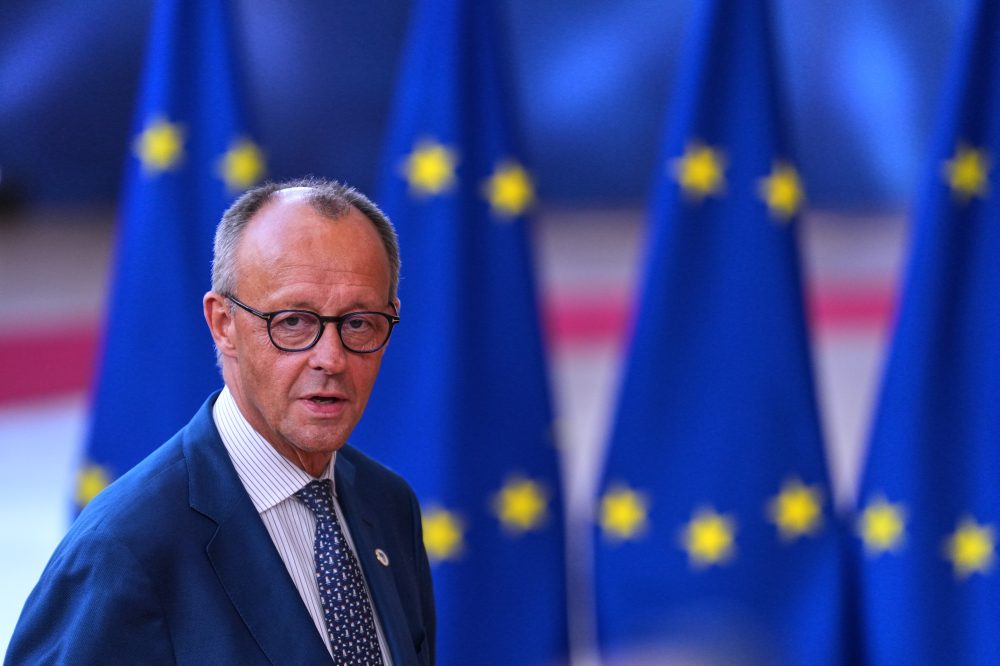

BERLIN (AP) — German Chancellor Friedrich Merz stood firm Tuesday, vowing to push forward a sweeping overhaul of the country’s strained pension system — one that would gradually raise the retirement age in step with increasing life expectancy. “Failure is not an option,” he declared.
Merz’s coalition, made up of center-right and center-left parties, has been in power for just over a year. The government came in promising to shake up and reinvigorate Germany’s sluggish economy — the largest in Europe — but has since fallen deeply out of favor with the public, largely due to a perception that the coalition has bickered without producing meaningful results.
After contracting for two consecutive years, Germany’s economy returned to modest growth last year. However, the government projects only 0.5% growth for this year, a figure dragged down by the economic fallout from the war in Iran.
The nation of 83.5 million people was already grappling with stiff competition from Chinese manufacturers, soaring energy costs following Russia’s full-scale invasion of Ukraine, and pressure from U.S. President Donald Trump’s tariffs and trade threats. Layered on top of those challenges are longer-standing structural issues: high production costs, sluggish private investment, and increasingly expensive healthcare and pension systems driven by an aging population.
On Tuesday, a panel of experts and politicians appointed by the government presented 33 recommendations designed to put the pension system on more stable footing. The goal is to prevent pension payouts from declining while also avoiding a major long-term hike in the contributions workers pay into the system. Right now, employees contribute 18.6% of their gross wages.
Germany has long wrestled with the reality that “fewer and fewer contributors have to finance pensions for more and more retirees,” Merz said. “Doing nothing is not an option.”
Among the panel’s key proposals is introducing market-based investments into individual pension insurance — modeled after a system used in Sweden — as a way to ease financial pressure on the overall program.
Two decades ago, Germany began phasing in an increase to the standard retirement age, moving it from 65 to 67. The commission is now recommending going further, tying the retirement age to life expectancy beginning in 2031. According to the national statistics office, life expectancy in Germany currently stands at 78.5 years for men and 83.2 years for women.
Commission co-chairperson Constanze Janda described the proposed retirement age adjustment as “moderate,” estimating it would rise by roughly six months over a decade if life expectancy continues on its current trajectory.
Since the mid-2010s, Germany has allowed workers with 45 years of pension contributions to retire at age 63 without a financial penalty. The panel is recommending that provision be eliminated and that the minimum retirement age be raised to 64.
The commission also proposed raising the age at which workers can begin scaling back their hours in preparation for retirement — from 55 to 58.
Merz said his coalition plans to “implement in full” the commission’s proposals, and to do so swiftly. Labor Minister Bärbel Bas, who also co-leads the center-left Social Democrats, echoed that commitment.
Still, the road ahead won’t be easy. The governing coalition holds a relatively slim majority in parliament, and the reform package has already drawn sharp criticism from labor unions. Despite the obstacles, Merz repeated his firm stance: “Failure is not an option.”