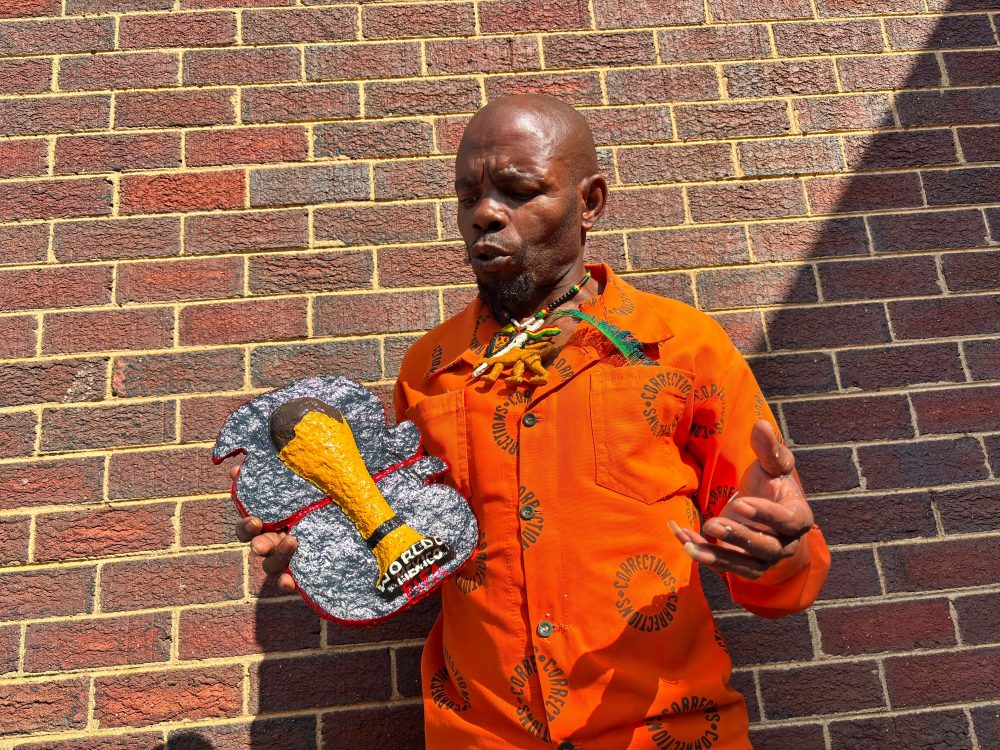

When most people imagine a prison, they think of metal bars, locked doors and stripped-away freedom. But visitors to a correctional facility in Johannesburg — South Africa’s largest city — are met with something far different: an art gallery.
The display of work created by incarcerated individuals is part of a broader national push to lower reoffending rates through rehabilitation efforts inside the country’s prisons. Since 2023, the Department of Correctional Services has launched nine arts-and-crafts galleries at facilities across the country, with the goal of helping inmates build skills, generate income and prepare themselves for life once they’re released.
At Leeuwkop Correctional Facility, artwork made by 34 inmates is on view for the public, offering a window into stories of culture, personal memory and transformation — all within a country that struggles with one of the highest crime rates in the world. Inmates also have the opportunity to view one another’s creations.
“I get a peaceful and healed mindset when I do my art,” inmate Freddy Mongkoai told the Associated Press. “It encourages me to be strong and present. I can focus, so it gives me peace of mind.”
Mongkoai, 51, has been serving nearly two years of a 12-year murder sentence connected to an act described as vigilante justice. He joined the prison’s art program in October and has since explored both painting and papier-mâché sculpture. His most recent creation is a replica of the FIFA World Cup trophy.
Estimates of how often released offenders return to crime in South Africa vary widely depending on how recidivism is measured, with some figures reaching as high as 95%.
South African prisons are well known for serious violence problems tied to overcrowding, gang activity, underfunding and administrative shortcomings. Correctional officials say repeat offenders are a major driver of that overcrowding.
With that reality in mind, the correctional department argues that initiatives like the arts program can play a meaningful role in breaking the cycle of reoffending.
“As they leave here to serve parole and finish their sentences, this is the most effective way of making it a point that they don’t do crime again,” said Makgothi Thobakgale, national commissioner of the Department of Correctional Services.
The gallery at Leeuwkop reflects a wide range of artistic experience and personal backgrounds. Works on display include Mongkoai’s detailed grayscale portrait of a woman balancing firewood on her head while carrying a baby on her back, as well as a simple pencil sketch bearing the words “STOP GBV” — a reference to South Africa’s deeply troubling levels of gender-based violence.
Mongkoai said the portrait is among his favorites because it draws from a childhood story he grew up hearing in Limpopo province — a piece of folklore about a woman said to live on the moon.
“The elders would tell us that there is a woman carrying firewood on her head and a baby on her back, while being followed by a dog, on the moon,” he said. “That is my favorite because it reminds me of my childhood.”
According to Unathi Mahlati, a senior program officer at Just Detention International-South Africa — which has partnered with the correctional department on the program since 2024 — inmates frequently gravitate toward themes of home and family in their work.
Mahlati explained that the program is designed to be therapeutic in nature, though it differs from formal art therapy, which is clinical and led by a licensed physician. Participation is entirely voluntary, and the emphasis is on helping inmates process their thoughts, feelings and personal needs — not on developing artistic talent.
“A lot of them have experienced a lot of trauma before coming into the facilities, but there’s not a lot of services for them to process and metabolize that trauma,” Mahlati said. “We emphasize that it’s not about skill. It’s a creative expression to process trauma.”
She also noted that correctional environments tend to be “very rigid and very dogmatic,” adding, “So we give people a chance to just be.”
Artwork created through the program is made available for public purchase, with prices ranging from roughly 50 rand (about $3) to more than 2,000 rand (over $120), depending on the size and complexity of each piece.
Officials say the money raised goes back into restocking art supplies and providing small stipends to participating inmates, who traditionally earn money through work in places like orchards and dairy farms, or through training programs that produce furniture, uniforms and baked goods.
Inmate artwork is also regularly featured at major South African events, including the Comrades Marathon Expo and the National Arts Festival in Makhanda, broadening the reach of the inmates’ creative work.
“For them to also see that this can be a way of living, it helps because now they are able to manage their own finances, albeit at a small scale,” Commissioner Thobakgale said.
For Mongkoai, the vision extends well beyond his time behind bars.
“My dream is to have my own gallery,” he said.